Africa Off-Grid Solar Lighting Market Size, Share, Trends & Growth Forecast Report By Product (Solar Lantern System, Solar Home System, Large Solar Home System), Application (Residential, Commercial, Industrial), and Country (Sudan, Egypt, Kenya, Ethiopia, Ghana, South Africa, Rest of Africa) – Industry Analysis, 2026 to 2034
Market Size, 2025
$404 MnMarket Estimate, 2026
$470.74 MnMarket Forecast, 2034
$1,600 MnCAGR, 2026–2034
16.52%Africa Off-Grid Solar Lighting Market Size
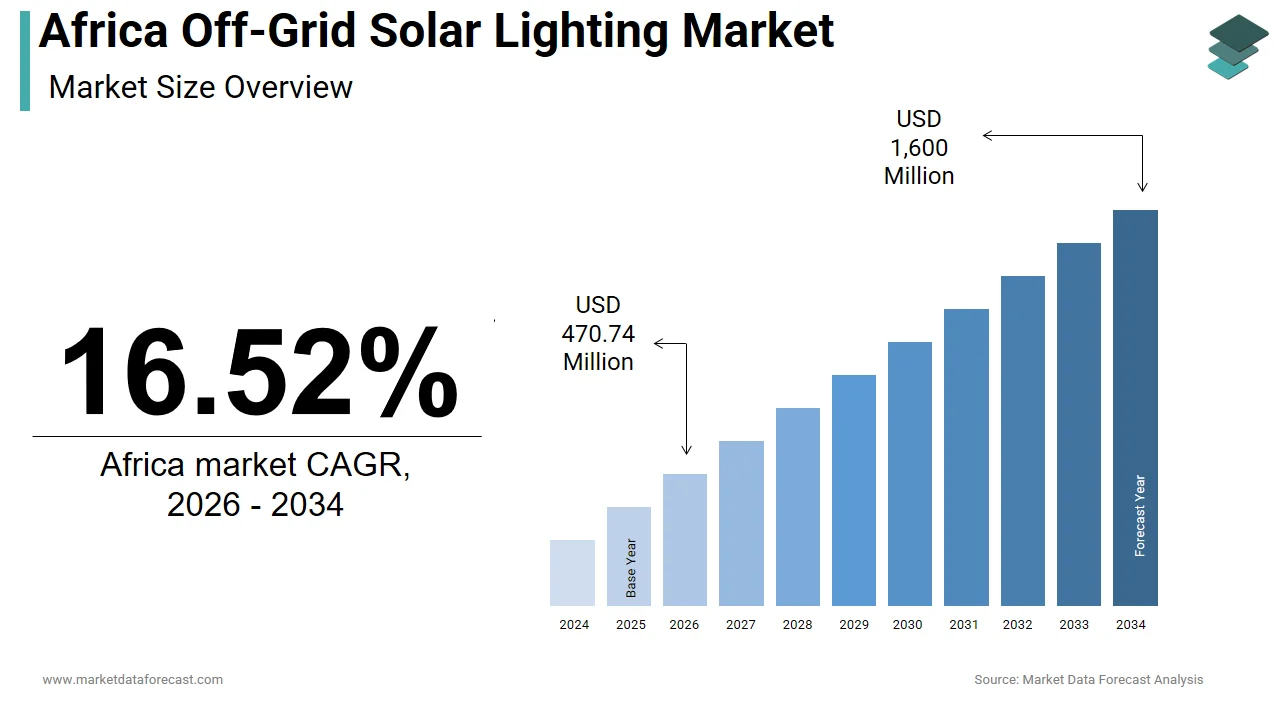
The Africa off-grid solar lighting market was valued at USD 404 million in 2025, is estimated to reach USD 470.74 million in 2026, and is projected to reach USD 1,600 million by 2034, growing at a CAGR of 16.52% from 2026 to 2034.
Off-grid solar lighting is a range of portable and fixed solar-powered lighting solutions designed for populations without access to centralized electricity infrastructure. These products include solar lanterns, home systems, and solar-powered LED lights that provide safe, reliable, and affordable illumination in rural and underserved communities across the continent.
Africa remains one of the least electrified regions globally, with millions of people relying on kerosene, candles, or firewood for lighting.
In response to this challenge, governments, non-governmental organizations, and private enterprises have collaborated to scale up solar lighting initiatives. The Lighting Global program, managed by the World Bank and IFC, has played a crucial role in promoting high-quality, certified solar products tailored for African consumers.
Moreover, increasing awareness about the health and environmental hazards of traditional fuels is driving demand for clean energy alternatives.
With technological advancements, declining costs, and innovative financing models such as pay-as-you-go (PAYG), the off-grid solar lighting sector is gaining momentum. This transformation not only supports sustainable development goals but also empowers communities through improved education, healthcare, and income-generating opportunities.
MARKET DRIVERS
Limited Access to Grid Electricity in Rural Areas
The persistent lack of access to grid electricity, particularly in rural regions, is one of the primary drivers of the Africa off-grid solar lighting market.
This widespread energy poverty creates a strong demand for affordable, clean lighting solutions. In countries such as Nigeria, Ethiopia, Tanzania, and Malawi, rural electrification rates remain significantly low, highlighting the vast potential for off-grid solar adoption.
Apart from these, many governments and donor-funded programs are actively promoting solar lighting as a cost-effective alternative. These efforts are accelerating market growth and expanding access to modern energy services in previously underserved regions.
Declining Costs and Technological Advancements in Solar Lighting Products
The decline in manufacturing costs and continuous improvements in solar technology are other significant drivers fueling the growth of the Africa off-grid solar lighting market. Over the past decade, the price of photovoltaic panels, lithium-ion batteries, and LED components has dropped substantially, making solar lighting products more accessible to low-income consumers. Companies like d.light, Bboxx, and Greenlight Planet have leveraged these cost reductions to develop durable, high-performance solar lanterns and mini-systems tailored to African markets. Technological innovations such as smart charge controllers, longer-lasting batteries, and integrated mobile payment systems have further enhanced product usability and affordability. These developments are transforming the accessibility and scalability of solar lighting, making it a viable replacement for traditional lighting sources across rural Africa.
MARKET RESTRAINTS
Limited Consumer Awareness and Trust in Solar Product Quality
The limited awareness among consumers regarding the benefits and reliability of solar lighting products is a major restraint affecting the Africa off-grid solar lighting market. Many rural populations remain unfamiliar with modern solar technologies and continue to use traditional fuels such as kerosene due to habit, affordability perceptions, or lack of trust in new products.
To combat this issue, certification programs such as the Quality Assurance Framework (QAF) have been introduced to ensure that only tested and approved products reach the market. However, enforcement remains weak in some regions, allowing substandard products to persist and hinder broader adoption. Until effective awareness campaigns, stronger regulatory oversight, and trusted distribution networks are established, consumer reluctance will continue to impede market expansion.
Financial Constraints and Limited Access to Credit Among End Users
The financial limitations faced by potential end users, particularly in low-income rural communities, are another key restraint in the Africa off-grid solar lighting market. Despite falling product prices, many households still find it challenging to afford even basic solar lighting units outright, especially when compared to the perceived lower upfront cost of kerosene.
Traditional lenders often view rural consumers as high-risk, discouraging investment in consumer financing mechanisms. While pay-as-you-go (PAYG) models have gained traction in recent years, their success depends on mobile money penetration and stable telecommunications networks, which remain inconsistent in many remote areas. Without scalable and inclusive financial solutions, affordability barriers will continue to restrict market growth, despite the availability of high-quality solar lighting products.
MARKET OPPORTUNITIES
Expansion of Pay-As-You-Go (PAYG) Solar Financing Models
The rapid expansion of pay-as-you-go (PAYG) financing models, which allow consumers to acquire solar lighting products through flexible installment payments rather than large upfront costs, is an emerging opportunity in the Africa off-grid solar lighting market. This model has proven particularly effective in reaching low-income and rural populations who may not have sufficient disposable income for outright purchases.
Companies like Fenix International (acquired by ENGIE) and Off-Grid Electric (now part of Schneider Electric) have pioneered PAYG solar business models that integrate remote monitoring and customer support. By leveraging mobile connectivity, these providers can unlock devices remotely upon payment receipt, ensuring user compliance while minimizing default risks.
Integration of Solar Lighting with Productive Use Applications
The integration of solar lighting systems with productive use applications such as mobile phone charging, radio operation, refrigeration, and small-scale irrigation pumps is another promising opportunity within the Africa off-grid solar lighting market. This shift goes beyond basic illumination to support income-generating activities and improve livelihoods in rural communities.
In Tanzania and Zambia, solar home system providers are increasingly bundling solar lights with USB ports and AC inverters to power small electronics and appliances.
In addition, entrepreneurs in the agriculture, retail, and education sectors are adopting solar-powered tools that extend working hours and improve service delivery.
By expanding the utility of off-grid solar systems beyond lighting, companies can justify higher price points and attract a broader customer base. This diversification strategy enhances market sustainability and aligns with broader development goals related to economic empowerment and rural electrification.
MARKET CHALLENGES
Inconsistent Regulatory Frameworks Across African Countries
The inconsistency in regulatory frameworks across different countries, which complicates product certification, importation, and market expansion efforts, is a major challenge facing the Africa off-grid solar lighting market. While some nations have developed clear quality standards and streamlined customs procedures for solar products, others lack coherent policies or enforce outdated regulations.
For instance, while Kenya and Rwanda have adopted Lighting Global-certified standards to ensure product quality, other countries impose arbitrary taxes or require redundant certifications that delay market entry.
This fragmented regulatory environment increases operational costs and discourages investment, particularly from international firms seeking to scale across multiple African markets. Besides, weak enforcement of quality controls allows substandard products to enter local markets, undermining consumer trust and long-term industry growth.
Until regional bodies such as the African Union and ECOWAS establish unified policy guidelines for off-grid solar products, market players will continue to face regulatory complexities that hinder efficient deployment and sustainable growth.
Poor After-Sales Service and Maintenance Infrastructure
The inadequate after-sales service and maintenance infrastructure, which affects customer satisfaction and product longevity, is another pressing challenge in the Africa off-grid solar lighting market. Unlike urban markets where repair services are readily available, rural consumers often struggle to access technical support when solar lighting units malfunction or require battery replacements.
The gap in post-purchase support reduces consumer confidence and leads to premature product abandonment.
Local dealers and retailers frequently lack the training and spare parts needed to address common issues, forcing customers to seek informal repair shops that may not offer standardized fixes. Moreover, the absence of recycling and disposal mechanisms for end-of-life solar components raises concerns about environmental sustainability.
To address this challenge, some companies are investing in localized service networks and technician training programs. However, until a robust and accessible after-sales ecosystem is established, the long-term viability of off-grid solar lighting solutions will remain constrained.
REPORT COVERAGE
| REPORT METRIC | DETAILS |
| Market Size Available | 2025 to 2034 |
| Base Year | 2025 |
| Forecast Period | 2026 to 2034 |
| Segments Covered | By Product, Application, and Region. |
| Various Analyses Covered | Global, Regional and Country-Level Analysis, Segment-Level Analysis, Drivers, Restraints, Opportunities, Challenges; PESTLE Analysis; Porter’s Five Forces Analysis, Competitive Landscape, Analyst Overview of Investment Opportunities |
| Countries Covered | Sudan, Egypt, Kenya, Ethiopia, Ghana, South Africa, Rest of Africa |
| Market Leaders Profiled | Signify Holding (Netherlands), Eaton (Ireland), SEPCO (U.S.), Sol by Sunna (U.S.), Saur Energy (India), Clear Blue Technologies Inc. (Canada), SunMaster Solar Lighting Co.,L td. (China), SolarOne Solutions, Inc. (U.S.), Best Solar Street Lights USA (U.S.), Solar Lighting International, Inc. (U.S.), FlexSol Solutions B.V. (Netherlands), Azuri Technologies Ltd (Kenya), Sunna Design SA (France), Solektra (Africa), and others. |
SEGMENTAL ANALYSIS
By Product Insights
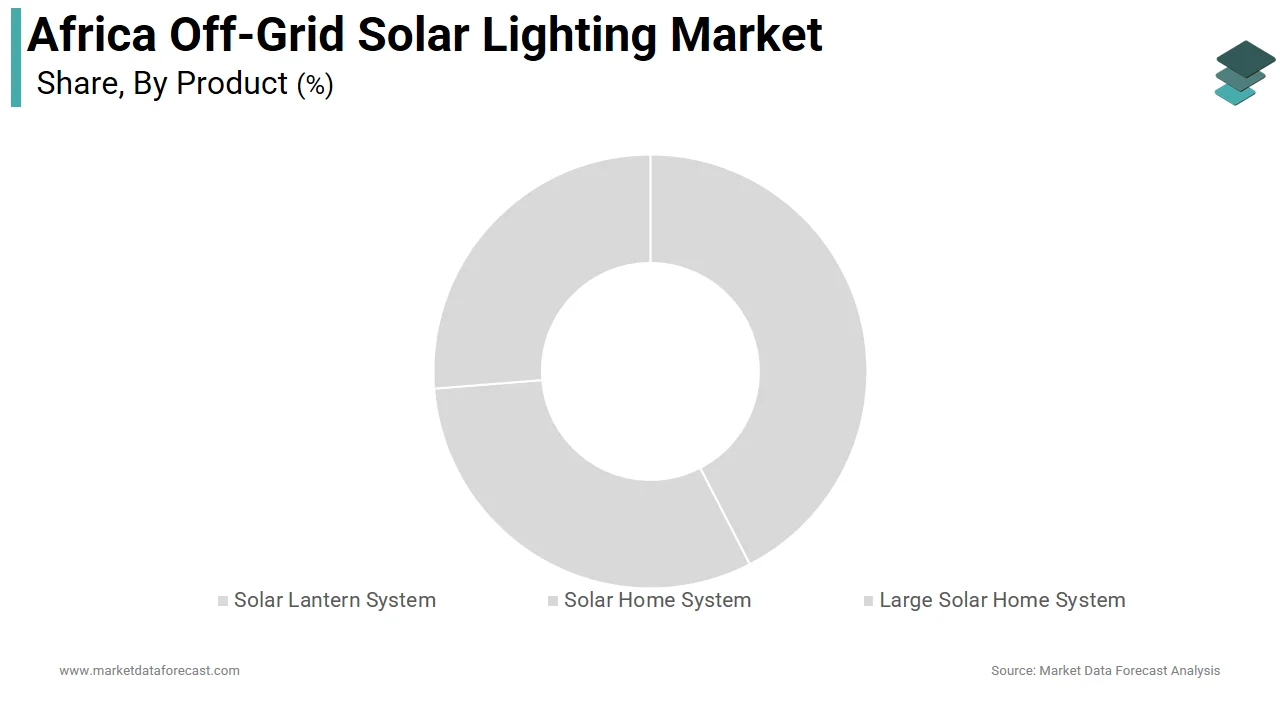
The Solar Lantern System segment led the Africa off-grid solar lighting market by accounting for 58.5% of total revenue in 2024. This segment's dominance is primarily attributed to Its affordability, portability, and suitability for basic lighting needs among low-income rural households is primarily attributed to the dominance of Solar Lantern System segment.
These systems typically range from entry-level models priced under USD 10 to higher-end units with mobile charging capabilities, ensuring broad accessibility across income levels.
Further, widespread adoption has been driven by donor-funded initiatives such as Kenya’s Off-Grid Energy Access Fund and Nigeria’s Energizing Education Program, which distribute subsidized solar lanterns to improve education and health outcomes in underserved areas.
Manufacturers have also embraced innovative financing mechanisms like pay-as-you-go (PAYG) to further lower entry barriers.
The Large Solar Home System segment is the fastest-growing in the Africa off-grid solar lighting market and is projected to expand at a CAGR of 14.7% between 2025 and 2033 This rapid growth is fueled by Increasing demand for comprehensive energy solutions that go beyond basic lighting to include power for appliances such as TVs, radios, fans, and refrigeration is fuelling the rapid growth of Large Solar Home System segment.
Pay-as-you-go (PAYG) financing models have played a crucial role in enabling low-income consumers to afford these higher-capacity systems. Companies report that bundled service offerings combining solar lighting with phone charging and small appliance support are driving customer acquisition and retention.
Moreover, governments and development agencies are promoting large solar home systems as part of national electrification strategies.
By Application Insights
The residential application segment led the Africa off-grid solar lighting market by capturing a substantial portion of total demand in 2024. The urgent need to replace kerosene lamps and candles in millions of off-grid households across the continent is driving the overwhelming share of residential application segment. In addition to economic benefits, residential solar lighting supports critical aspects of daily life such as studying after dark, cooking, and small business operations. Manufacturers and distributors have responded by tailoring product designs to household needs, offering multi-light systems with integrated USB ports. These factors collectively reinforce the residential segment’s dominant position in the market.
The commercial application segment is the fastest-growing within the Africa off-grid solar lighting market, recording a CAGR of 16.2% from 2025 to 2033. This surge is driven by the Increasing use of solar lighting in micro-enterprises, street vendors, shops, and mobile service providers operating in off-grid regions is driving the surge of commercial application segment.
Solar-powered commercial lighting enables shopkeepers, hairdressers, mechanics, and food vendors to extend their operational time and enhance service delivery.
Innovative business models such as rental solar kits and mobile-enabled mini-grids are facilitating broader adoption among entrepreneurs who may not afford full system ownership upfront. In Kenya, companies like SteamaCo have deployed solar-powered mini-shops that provide lighting and charging services to nearby businesses, demonstrating scalable commercial applications.
Furthermore, local governments are recognizing the potential of solar lighting to boost economic activity in informal settlements and peri-urban areas. With rising awareness and tailored financing options, the commercial segment is set to maintain its upward trajectory in the coming years.
COUNTRY LEVEL ANALYSIS
Saudi Arabia Off-Grid Solar Lighting Market Insights
Saudi Arabia holds a modest yet strategic share of the Middle East and Africa off-grid solar lighting market in 2024. While not traditionally associated with off-grid energy challenges, the country plays a supportive role in funding and technology transfer initiatives aimed at expanding solar lighting access in neighboring African nations.
Saudi Arabia’s Vision 2030 includes sustainability and international development goals, prompting state-backed entities such as the King Abdullah Petroleum Studies and Research Center (KAPSARC) to engage in clean energy partnerships across the Sahel and Horn of Africa.
Apart from these, the country serves as a logistics hub for regional solar equipment imports and export financing. Through organizations like the Saudi Green Initiative, the Kingdom continues to contribute to broader Middle Eastern and African solar electrification efforts, reinforcing its indirect but influential presence in the off-grid solar lighting landscape.
United Arab Emirates Off-Grid Solar Lighting Market Insights
The United Arab Emirates is positioned as a global leader in renewable energy investment. The UAE actively supports off-grid solar lighting initiatives through diplomatic, financial, and technological engagement across Africa.
Abu Dhabi’s Masdar City has also partnered with private sector firms to develop affordable solar lanterns suited for harsh desert conditions. Besides, the UAE hosts the annual World Future Energy Summit, bringing together stakeholders to accelerate innovation and investment in off-grid solar technologies.
South Africa Off-Grid Solar Lighting Market Insights
South Africa occupies a strategic position in the Middle East and Africa off-grid solar lighting market. As the most industrialized economy in Africa, South Africa presents a dual role both as a domestic market and a regional distribution center for off-grid solar products.
Despite high overall electrification rates in urban areas, millions in remote townships and informal settlements still rely on inefficient and costly lighting methods.
Local manufacturers and importers are capitalizing on this opportunity by introducing durable, low-cost solar lanterns and home systems designed for rugged environments.
Moreover, South Africa acts as a gateway for regional exports, with companies distributing solar lighting products to Namibia, Botswana, and Zimbabwe. Its developed logistics infrastructure and mobile money ecosystem make it an attractive market for PAYG solar models, reinforcing its growing influence in the broader African off-grid lighting sector.
Egypt Off-Grid Solar Lighting Market Insights
Egypt occupies a strategic position in the Middle East and Africa off-grid solar lighting market. Although much of Egypt is connected to the national grid, rural areas, particularly in Upper Egypt and border regions, still experience intermittent or no electricity supply, creating opportunities for off-grid solar lighting adoption.
The Egyptian government has initiated several rural electrification programs, including the Rural Electrification and Renewable Energy Corporation (REREC) initiative.
Further, Egyptian universities and research centers are partnering with international firms to develop locally adapted solar lighting solutions. The Cairo University Solar Research Institute has collaborated with German and Chinese companies to produce affordable LED-based solar lanterns suitable for rural conditions.
With increasing government support and growing awareness about clean energy alternatives, Egypt is emerging as a key player in the broader Middle East and Africa off-grid solar lighting market.
Rest of Middle East and Africa Off-Grid Solar Lighting Market Insights
The Rest of the Middle East and Africa (excluding Saudi Arabia, UAE, and Egypt) accounted for a notable share of the regional off-grid solar lighting market in 2023, as reported by the African Development Bank (AfDB). This diverse segment includes countries such as Oman, Bahrain, Iraq, Yemen, and parts of North Africa, each exhibiting unique market dynamics based on economic conditions, population density, and electrification status.
In Yemen and Iraq, ongoing conflict and infrastructure damage have led to increased reliance on off-grid solar solutions for basic lighting and communication needs.
North African markets like Morocco and Algeria are focusing on rural electrification through government-subsidized solar programs.
Despite infrastructural and political challenges in certain areas, the overall demand for off-grid solar lighting is expanding, driven by humanitarian aid, urban migration, and decentralized energy policies across the region.
COMPETITIVE LANDSCAPE
The competition in the Africa off-grid solar lighting market is highly dynamic, shaped by a mix of global social enterprises, regional startups, and local manufacturers vying for market share in a rapidly expanding sector. While established players like d.light, Bboxx, and Greenlight Planet continue to dominate due to their strong brand recognition and innovative business models, a growing number of regional firms are entering the space, offering cost-effective alternatives tailored to specific market segments.
The competitive landscape is further influenced by evolving consumer preferences, technological advancements, and shifting funding dynamics. Donor-backed initiatives and impact investors play a crucial role in enabling scalability, but as the market matures, companies must increasingly focus on commercial sustainability rather than relying solely on subsidies.
Product differentiation, customer retention strategies, and localized after-sales service are becoming key battlegrounds. With increasing awareness of the health and economic benefits of solar lighting, demand continues to rise, prompting both innovation and intensified rivalry across the value chain.
KEY MARKET PLAYERS
Some of the noteworthy companies in the Africa off-grid solar lighting market profiled in this report are
- Signify Holding
- Eaton
- SEPCO
- Sol by Sunna
- Saur Energy
- Clear Blue Technologies Inc.
- SunMaster Solar Lighting Co., Ltd.
- SolarOne Solutions, Inc.
- Best Solar Street Lights USA
- Solar Lighting International, Inc.
- FlexSol Solutions B.V.
- Azuri Technologies Ltd.
- Sunna Design SA
- Solektra
TOP LEADING PLAYERS IN THE MARKET
One of the leading players in the Africa off-grid solar lighting market is d.light, a global social enterprise that designs and distributes affordable, high-quality solar lighting and energy products. d.light has been instrumental in transforming access to clean energy for millions of off-grid households across East and West Africa. The company’s durable and user-friendly solar lanterns and home systems have significantly improved living standards by replacing hazardous kerosene lamps with safe, sustainable alternatives.
Another key player is Bboxx, an international provider of off-grid solar solutions that leverages innovative pay-as-you-go (PAYG) technology to expand energy access. Bboxx operates across multiple African countries, offering scalable solar home systems tailored to different household needs. Its integration of remote monitoring and customer support has set new benchmarks in product reliability and service delivery in underserved markets.
Greenlight Planet is also a major force in the sector, known for its Sunne solar light series and distributed through extensive rural networks. Greenlight Planet combines affordability with durability, ensuring widespread adoption among low-income populations. By partnering with governments, NGOs, and microfinance institutions, the company plays a pivotal role in advancing universal energy access and supporting broader development goals in Africa.
TOP STRATEGIES USED BY KEY MARKET PARTICIPANTS
A core strategy employed by leading companies in the Africa off-grid solar lighting market is leveraging pay-as-you-go (PAYG) financing models to make solar products more accessible to low-income consumers. This approach allows users to pay small daily or weekly installments via mobile money platforms, reducing upfront costs and increasing affordability.
Another significant strategy involves strengthening last-mile distribution networks through local partnerships and community-based sales agents. Companies are collaborating with microfinance institutions, cooperatives, and women-led enterprises to ensure effective product delivery and after-sales support, particularly in hard-to-reach rural areas.
A third critical approach is investing in consumer education and awareness campaigns to build trust and drive adoption. Firms are actively engaging communities through demonstrations, training sessions, and radio outreach to highlight the benefits of solar lighting over traditional fuels, thereby fostering long-term behavioral change and brand loyalty.
RECENT MARKET DEVELOPMENTS
- In March 2024, d.light launched a new line of solar-powered productivity kits designed for small businesses in rural Kenya, enabling entrepreneurs to power lights, radios, and phone charging stations simultaneously.
- In February 2024, Bboxx partnered with a major mobile network operator in Nigeria to integrate solar payment plans directly into mobile airtime top-up systems, making solar purchases more seamless for end users.
- In January 2024, Greenlight Planet expanded its distribution network in Ethiopia by onboarding over 1,000 new retail partners, aiming to increase rural market penetration and improve after-sales support.
- In November 2023, Off-Grid Electric (now part of Schneider Electric) deployed a fleet of solar-powered mini-kiosks in rural Tanzania to serve as community-based solar charging and lighting hubs.
- In September 2023, Fenix International announced the launch of a solar-enabled cold storage solution for off-grid health clinics in Uganda, expanding beyond basic lighting to provide essential infrastructure support.
MARKET SEGMENTATION
This Africa off-grid solar lighting market research report is segmented and sub-segmented into the following categories.
By Product
- Solar Lantern System
- Solar Home System
- Large Solar Home System
By Application
- Residential
- Commercial
- Industrial
By Country
- Sudan
- Egypt
- Kenya
- Ethiopia
- Ghana
- South Africa
- Rest of Africa
Frequently Asked Questions
Which countries lead the Africa Off-Grid Solar Lighting Market?
Kenya, Nigeria, Tanzania, Ethiopia, and Ghana are leading markets for off-grid solar lighting adoption in Africa
What drives growth in the Africa Off-Grid Solar Lighting Market?
Key drivers are limited grid access, declining solar costs, government incentives, environmental concerns, and demand for safe, clean lighting
Which solar lighting products are popular in Africa?
Popular products include solar lanterns, solar home systems (SHS), mini-grid systems, and solar-powered streetlights
How does off-grid solar lighting benefit African households?
It offers clean light, reduces reliance on kerosene, cuts energy costs, improves health, and supports education and local businesses
What business models are used in the Africa Off-Grid Solar Lighting Market?
Pay-as-you-go (PAYG), solar-as-a-service, and mobile money payment models are increasing affordable access for consumers
Who are the key players in the Africa Off-Grid Solar Lighting Market?
Important companies include M-KOPA Solar, Azuri Technologies, Solektra International, Signify, and various local innovators
What is the primary source of funding for solar lighting projects in Africa?
Investments come from development banks, international donors, private equity, and telecom-fintech collaborations
What role does solar lighting play in Africa’s energy transition?
Off-grid solar lighting accelerates energy access, drives economic growth, reduces emissions, and supports Sustainable Development Goals
What are the main challenges facing the Africa Off-Grid Solar Lighting Market?
Challenges include financing gaps, distribution in remote regions, consumer awareness, and regulatory inconsistencies
How is technology advancing the Africa Off-Grid Solar Lighting Market?
Advancements include smart controllers, improved batteries, IoT-enabled monitoring, modular systems, and high-efficiency LEDs
Related Reports
Access the study in MULTIPLE FORMATS
Purchase options starting from
$ 1600
Didn’t find what you’re looking for?
TALK TO OUR ANALYST TEAM
Need something within your budget?
NO WORRIES! WE GOT YOU COVERED!
Call us on: +1 888 702 9696 (U.S Toll Free)
Write to us: sales@marketdataforecast.com