- Product Description Description
- Table of Contents TOC
- List of Table & Figure LOT
- Get Free Sample PDF Sample PDF
Market Size, 2025
$1.81 BnMarket Estimate, 2026
$1.85 BnMarket Forecast, 2034
$2.28 BnCAGR, 2026–2034
2.62%Africa Textile Market Report: Size, Share, Trends & Forecast (2026–2034)
- Market Scope: Comprehensive continental industry assessment spanning application types (clothing, industrial/technical, household), material types (cotton, synthetics, jute, etc.), process types (woven, non-woven), and major country markets including Egypt, Nigeria, South Africa, Morocco, and Kenya.
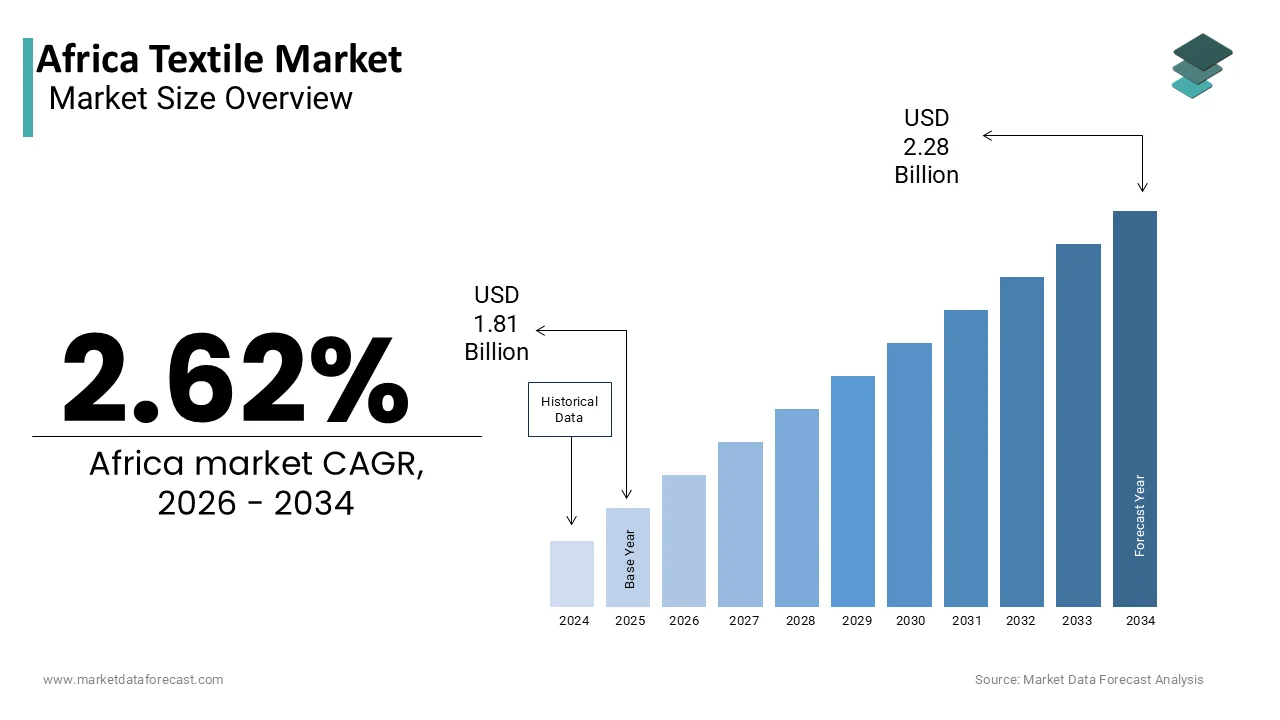
- Market Valuation: Valued at USD 1.81 billion in 2025, estimated at USD 1.85 billion in 2026, and projected to reach USD 2.28 billion by 2034, registering a compound annual growth rate (CAGR) of 2.62% from 2026 to 2034.
- Primary Growth Drivers: Rapid urbanization and population growth boosting domestic apparel demand, the expansion of digital e-commerce platforms, government-backed "Made in Africa" industrial campaigns, and regional trade frameworks like the AfCFTA.
Africa Textile Market Segment Metrics (2026–2034)
| Category | Leading Segment / Position | Fastest-Growing Segment |
|---|---|---|
| By Application Type | Clothing (accounted for 58% of total consumption in 2025 driven by robust domestic apparel demand and youth demographics) | Industrial & Technical Textiles (projected at a CAGR of 7.9% fueled by infrastructure, agriculture, and healthcare demands) |
| By Material Type | Cotton (held a 45% market share in 2025 supported by traditional uses and high agricultural output in Egypt, Mali, and Tanzania) | Synthetic Fibers (growing at a fast CAGR of 8.5% driven by fast fashion cost advantages and sportswear/industrial utility) |
| By Process Type | Woven Textiles (secured a 63.4% share in 2025 backed by long-standing cultural weaving traditions and formal corporate wear) | Non-Woven Textiles (expanding rapidly at a CAGR of 9.2% due to rising hygiene, medical, and disposable product adoption) |
| By Region | Egypt (leads the continental market with an 18.5% share thanks to a fully integrated value chain and long-staple cotton output) | Morocco & Kenya (growing dynamically via nearshoring advantages for European markets and AGOA export processing hubs) |
Major Africa Textile Market Players & Industry Structure
Market Structure: A diverse competitive landscape combining large-scale formal manufacturers, export-oriented industrial operators, and extensive informal artisanal networks, increasingly focused on vertical integration and sustainable sourcing.
Key Companies: Nile Textiles, Ethical Apparel Africa, Springwood Industries, Vlisco, Da Gama Textiles, Seidco, Texaf, African Textiles Manufacturers Ltd, Sunflag Group, Spintex Limited, Supertex Industries Ltd, United Nigeria Textiles Plc, and A to Z Textile Mills.
Africa Textile Market Size
The Africa textile market was valued at USD 1.81 billion in 2025, is estimated to reach USD 1.85 billion in 2026, and is projected to reach USD 2.28 billion by 2034, growing at a CAGR of 2.62% from 2026 to 2034.
Textile includes a wide range of products such as woven fabrics, knits, home textiles, and technical textiles, with significant contributions from both formal and informal sectors. Despite historical reliance on imports, several African nations are now focusing on revitalizing their indigenous textile industries through policy support and investment in infrastructure.
According to the International Trade Centre (ITC), sub-Saharan Africa’s textile exports reached approximately USD 2.8 billion in 2022, showing modest but steady growth compared to previous years. Moreover, the region's import dependency remains high, with a significant portion of textile consumption met through external sources, primarily from Asia.
Domestically, rising urbanization and an expanding middle class are fueling demand for affordable and fashionable clothing. As per the African Development Bank, by 2025, consumer spending across the continent is projected to surpass USD 2 trillion, with fashion and textiles representing a substantial share. Apart from these, increasing awareness of sustainable and locally-made products is prompting a shift toward regional manufacturing. These dynamics collectively shape the current trajectory of the African textile market.
MARKET DRIVERS
Urbanization and Population Growth Driving Domestic Demand
Rapid urbanization coupled with sustained population growth is one of the most significant drivers of the Africa textile market. As per the United Nations, Africa’s population is expected to reach 2.5 billion by 2050, accounting for more than half of global population growth during this period. This demographic expansion, especially in urban centers, has led to increased demand for clothing, household textiles, and workwear.
In cities such as Lagos, Nairobi, and Addis Ababa, rising disposable incomes and shifting lifestyle preferences have created a burgeoning consumer base eager for modern, affordable, and locally-produced garments. According to the African Development Bank, the continent’s urban population grew from 27% in 1990 to over 43% in 2022, significantly boosting retail activity. For instance, Nigeria alone accounts for roughly one-third of West Africa’s textile consumption, driven largely by its youthful and rapidly urbanizing populace.
Moreover, governments across the continent are promoting "Made in Africa" campaigns to reduce reliance on imported textiles. Ethiopia, for example, saw a 22% increase in domestic textile production between 2020 and 2022, partly due to urban-driven demand and policy incentives aimed at local manufacturers. These trends indicate that urbanization and population growth will continue to be pivotal forces shaping the future of Africa’s textile industry.
Expansion of E-commerce Platforms Enhancing Distribution Channels
The rapid expansion of e-commerce platforms, which are transforming how textiles are marketed, sold, and distributed, is another key driver of the Africa textile market. As internet penetration increases and mobile payment systems become more sophisticated, digital commerce is enabling both small-scale artisans and large manufacturers to reach broader customer bases.
According to the World Bank, internet usage in Sub-Saharan Africa rose from 9% in 2010 to over 35% in 2022, creating fertile ground for online retail growth. In response, numerous local and international e-commerce platforms such as Jumia, Zando, and Konga have expanded their offerings to include traditional and contemporary textile products.
Besides, cross-border trade via digital platforms is allowing African textile producers to access new markets beyond the continent. The International Finance Corporation estimates that by 2025, e-commerce in Africa could account for up to 10% of total retail sales, with textiles being one of the fastest-growing categories. This digital transformation is reinforcing the role of e-commerce as a powerful growth engine for the sector.
MARKET RESTRAINTS
High Cost of Raw Materials and Limited Local Sourcing
The high cost and limited availability of raw materials, particularly cotton yarn and synthetic fibers, is a major restraint impeding the growth of the Africa textile market. Despite Africa being a significant producer of raw cotton Egypt and Tanzania, among others the continent lacks sufficient ginning, spinning, and processing capabilities. Consequently, many textile manufacturers are forced to import intermediate inputs, which significantly inflate production costs.
According to the Food and Agriculture Organization (FAO), Africa produces around 10% of the world’s raw cotton but processes less than 20% domestically. As a result, textile mills in countries like Nigeria and Ghana rely heavily on imported yarns from China and India, where production efficiencies allow for lower pricing.
This dependency not only weakens profit margins but also exposes African textile firms to currency fluctuations and global price volatility. For instance, the depreciation of the Nigerian naira against the US dollar between 2020 and 2023 increased input costs by over 40% for local fabricators.
Inadequate Infrastructure and Energy Supply Constraints
The lack of reliable infrastructure, particularly in terms of energy supply and transportation networks, is another critical constraint facing the Africa textile market. Manufacturing operations require consistent electricity to run machinery, yet many African countries experience frequent power outages, forcing textile producers to invest in costly backup generators or scale back operations.
In countries like Zambia and Ghana, textile factories often operate below 60% of their installed capacity due to intermittent power supply. The South African Textile Federation noted that in 2022, energy-related disruptions caused a decline in output for medium-sized textile plants in the region.
Transportation challenges further exacerbate the problem. Poor road conditions and inefficient port logistics delay the movement of raw materials and finished goods, increasing lead times and operational costs. As per the estimates by the African Development Bank, transport inefficiencies add up to 30% to the cost of doing business in some regions. These infrastructural deficiencies are making it difficult for African producers to scale sustainably.
MARKET OPPORTUNITIES
Growing Demand for Sustainable and Ethical Textiles
The rising global and regional interest in sustainable and ethically produced textiles is a compelling opportunity emerging in the Africa textile market. Consumers worldwide are increasingly prioritizing eco-friendly sourcing, fair labor practices, and environmentally responsible manufacturing. This shift aligns well with Africa’s potential to offer organic cotton, natural dyes, and artisanal craftsmanship, positioning the continent as a viable alternative to mass-produced Asian textiles.
These nations are leveraging their agricultural strengths to meet the growing demand for clean, traceable fibers.
Locally, initiatives like the Ethical Fashion Initiative and Fashion Revolution have been instrumental in promoting transparency and sustainability in African fashion ecosystems. Ethiopian and Kenyan designers are increasingly gaining international recognition for using biodegradable materials and zero-waste production methods.
Government Policy Support and Regional Integration Agreements
Government-led industrial policies and regional integration frameworks present a major opportunity for the Africa textile market to overcome historical barriers and achieve greater scale. Several national governments have introduced tax incentives, import restrictions on used clothing, and special economic zones (SEZs) to encourage domestic textile manufacturing.
For example, in 2022, Nigeria implemented a ban on the importation of second-hand clothing to protect local producers. Similarly, Ethiopia has established multiple industrial parks focused on textile and apparel manufacturing, attracting over USD 1 billion in foreign direct investment (FDI) since 2018, as reported by the Ethiopian Investment Commission.
Regionally, the African Continental Free Trade Area (AfCFTA) offers immense potential for intra-African trade in textiles. By reducing tariffs and harmonizing standards, AfCFTA aims to create a unified market for goods and services. As per the UN Economic Commission for Africa, the agreement could boost intra-continental trade by over 50% by 2030, with textiles identified as a priority sector for development. This combination of national policy support and regional cooperation is laying the groundwork for a more integrated and competitive African textile industry.
MARKET CHALLENGES
Intense Competition from Low-Cost Asian Imports
The overwhelming influx of low-cost imports, particularly from China and India, is one of the most pressing challenges confronting the Africa textile market. These countries benefit from advanced manufacturing technologies, economies of scale, and highly efficient supply chains, enabling them to export textiles at prices far below what most African producers can match.
According to the International Trade Centre, Asian imports accounted for over 70% of total textile consumption in Sub-Saharan Africa in 2023. China alone supplied nearly 50% of the region’s fabric needs, with Indian exporters capturing another 20%. The dominance of these imports is evident in markets such as Ghana, Kenya, and South Africa, where locally manufactured textiles struggle to compete on both price and consistency of supply.
This imbalance is further exacerbated by trade agreements and subsidies in Asian countries that enable the continued dumping of inexpensive textiles into African markets. For instance, Chinese textile exports to Africa grew in volume terms between 2020 and 2023, despite efforts by some African governments to impose tariffs. The inability of local producers to match the pricing and variety offered by Asian suppliers threatens the survival of domestic textile mills and discourages new investments in the sector.
Skills Gap and Lack of Technical Expertise in Textile Manufacturing
The persistent skills gap and shortage of technical expertise in modern textile manufacturing are fundamental challenges limiting the growth of the African textile market. Despite having a young and potentially trainable workforce, many African countries lack structured vocational training programs tailored to the textile industry, resulting in a mismatch between labor supply and industry needs.
This deficiency is particularly acute in areas such as automated weaving, dyeing technology, and quality control skills essential for improving productivity and meeting international standards.
Ethiopia, despite its aggressive push to develop textile clusters, faces a shortage of skilled technicians and engineers, slowing the full utilization of newly established industrial facilities. According to the Ethiopian Textile and Apparel Industry Development Institute, over 40% of textile factory managers reported difficulties in recruiting personnel with adequate technical knowledge in 2022.
Furthermore, limited collaboration between educational institutions and industry players hampers the development of a pipeline for skilled labor.
REPORT COVERAGE
| REPORT METRIC | DETAILS |
| Market Size Available | 2025 to 2034 |
| Base Year | 2025 |
| Forecast Period | 2026 to 2034 |
| Segments Covered | By Application Type, Material Type, Process Type, and Region |
| Various Analyses Covered | Global, Regional & Country Level Analysis; Segment-Level Analysis; DROC, PESTLE Analysis; Porter’s Five Forces Analysis; Competitive Landscape; Analyst Overview of Investment Opportunities |
| Regions Covered | Sudan, Egypt, Kenya, Ethiopia, South Africa, and the Rest of Africa |
| Market Leaders Profiled | Vlisco, Da Gama Textiles, Seidco, Texaf, African Textiles Manufacturers Ltd, Sunflag Group, Spintex Limited, Supertex Industries Ltd, United Nigeria Textiles Plc, A to Z Textile Mills |
SEGMENTAL ANALYSIS
By Application Type Insights
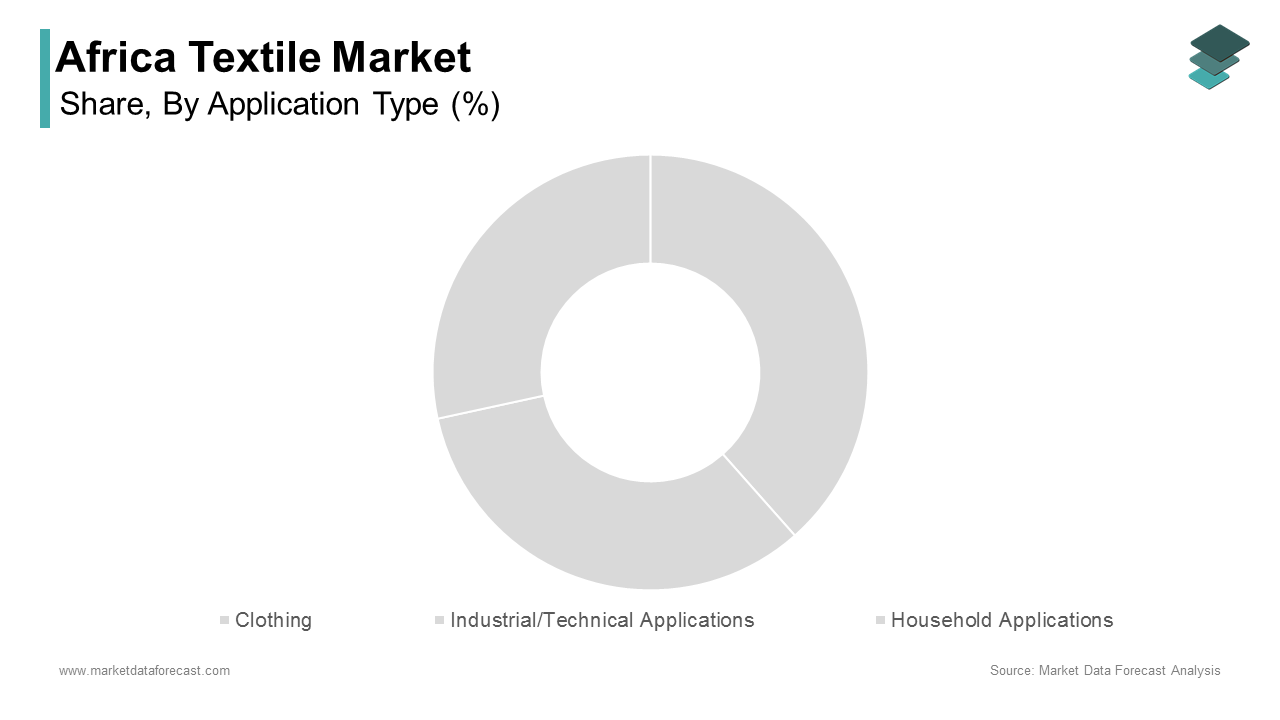
The clothing segment dominated the Africa textile market by accounting for 58% of total consumption in 2025. Strong domestic demand for apparel, fueled by a rapidly growing population and rising urbanization rates across major economies such as Nigeria, Kenya, and Egypt, is primarily driving the dominance of the clothing segment.
According to the African Development Bank, over 40% of Africa’s population is under the age of 15, creating a consistently renewing base of consumers who require affordable and culturally relevant clothing options. Moreover, urban centers are experiencing increased purchasing power.
Moreover, the proliferation of local fashion industries has spurred growth in this segment. Countries like Ghana and Ethiopia have seen a resurgence in traditional textiles such as kente and shemma fabrics, which are increasingly being modernized for contemporary markets.
The industrial and technical textiles segment is emerging as the fastest-growing segment and is projected to expand at a CAGR of 7.9% from 2025 to 2033. Increasing demand from infrastructure development, agriculture, and healthcare sectors across the continent is largely attributed to the growth of the industrial and technical textiles segment.
Industrial textiles include geotextiles used in road construction, protective wear in mining and oil & gas operations, and filtration materials in water treatment plants. The African Development Bank notes that infrastructure investment in Sub-Saharan Africa reached USD 68 billion in 2022, with a significant portion allocated to transport and utilities sectors heavily reliant on technical textile applications.
In the agricultural domain, jute-based sacks and moisture-resistant fabrics are gaining traction for crop storage and transportation. These factors drive the accelerated expansion of the industrial/technical textile segment across the African region.
By Material Type Insights
The cotton segment remained the dominant material in the Africa textile market by capturing an estimated 45% share in 2025. Its deep-rooted presence in traditional clothing and its widespread use in both formal and informal manufacturing sectors across the continent are among the main reasons behind the leading position of the cotton segment.
Africa produces over 6% of the world’s raw cotton annually, with key contributors including Egypt, Mali, Burkina Faso, and Tanzania. According to the International Cotton Advisory Committee (ICAC), these countries collectively produced over 2.8 million metric tons of cotton lint in 2023, supporting both domestic textile production and export-oriented fabric manufacturing.
Local demand for cotton-based garments remains robust due to cultural preferences and climatic suitability. In West Africa, for example, cotton is the primary fiber used in iconic textiles such as Ankara and Aso Oke. As per the Nigerian Textile Manufacturers Association, over 70% of domestically woven fabrics in 2023 were cotton-based, reflecting its enduring relevance.
Further, global brands sourcing sustainable cotton have begun investing in African supply chains. As per the Better Cotton Initiative, certified sustainable cotton production in Africa grew in 2022, indicating rising international interest and reinforcing cotton’s stronghold in the regional textile market.
The synthetic fibers segment, such as polyester, nylon, and acrylic, is witnessing the highest growth in the Africa textile market and is expanding at a CAGR of 8.5% in the future. Their affordability, durability, and versatility in both apparel and industrial applications is driving the rapid ascent of synthetic fibers segment.
Synthetic fibers offer cost advantages over natural fibers like cotton, especially in urban areas where fast fashion trends demand low-cost, high-volume production.
Furthermore, the rise of sportswear and performance clothing segments dominated by synthetic materials is boosting demand.
Industrial uses also contribute significantly. Polyester-based geotextiles and conveyor belts are widely adopted in mining and infrastructure projects.
By Process Type Insights
The woven textiles segment represented the largest process type within the Africa textile market by holding an estimated 63.4% share in 2025. The dominance of this segment is primarily attributable to the longstanding tradition of weaving in African cultures, along with the widespread use of woven fabrics in clothing, home décor, and ceremonial attire.
Countries such as Nigeria, Ghana, and Ethiopia have well-established artisanal and semi-industrial weaving sectors that produce both traditional and contemporary fabrics.
In addition, woven textiles remain a preferred choice for formal wear and uniforms in government, military, and corporate settings.
Moreover, woven fabric mills in Egypt benefit from advanced loom technologies and access to high-quality cotton, enabling large-scale domestic and export production.
The non-woven textiles segment is the fastest-growing segment in the Africa textile market and is registering a CAGR of 9.2% in the coming year. The growth of this segment is primarily driven by increasing adoption in hygiene, medical, and industrial applications, where disposability, cost-effectiveness, and functionality are key considerations.
The demand for non-woven products surged during the pandemic, particularly for personal protective equipment (PPE), face masks, and sterilization wraps.
Beyond healthcare, the hygiene sector is expanding rapidly. Non-woven materials are the primary component in these products. In agriculture, non-wovens are being used as mulch covers and seedbed protectors.
REGIONAL ANALYSIS
Egypt Textile Market Insights
Egypt remained at the top position in the Africa textile market by commanding an estimated 18.5% market share in 2025. It is one of the few African countries with a fully integrated textile value chain from cotton cultivation to spinning, weaving, and garment exports.
The country benefits from its long-standing reputation for producing high-quality long-staple cotton, which accounts for nearly 20% of global extra-long staple cotton output. According to the Egyptian Cotton Association, the textile and apparel sector contributed over USD 4.2 billion in export revenue in 2023, making it a critical foreign exchange earner.
Government-backed initiatives, including the establishment of industrial zones and export incentives, have bolstered competitiveness. The Suez Canal Economic Zone hosts several textile manufacturing clusters, attracting over USD 800 million in foreign direct investment since 2020, as reported by the General Authority for Investment.
Nigeria Textile Market Insights
Nigeria is another major player in the Africa textile market, which is primarily due to its vast population and growing domestic consumption. As Africa’s most populous country, Nigeria’s demand for textiles is predominantly driven by the apparel sector, with a strong preference for locally woven fabrics such as Aso Oke and Ankara.
Despite infrastructural challenges, private sector investments in mechanized weaving and dyeing facilities are gradually improving capacity. Lagos and Kano serve as major textile hubs, with over 40,000 micro and small enterprises engaged in fabric trading and tailoring. As urbanization accelerates and youth-driven fashion trends evolve, Nigeria remains a pivotal force shaping the trajectory of the African textile industry.
South Africa Textile Market Insights
South Africa is positioning itself as a key player in industrial textiles, technical fabrics, and export-oriented garment manufacturing. Unlike many other African nations, South Africa boasts a relatively mature textile industry supported by advanced infrastructure and logistics networks.
The country's textile sector contributes significantly to employment and GDP, with over 45,000 people employed in manufacturing and related services in 2023, according to Stats SA. While domestic cotton production is limited, South Africa excels in processing synthetic and blended fibers for automotive, medical, and defense applications.
The Clothing and Textile Competitiveness Program, launched by the Department of Trade, Industr,y and Competition, has injected over ZAR 4 billion (~USD 220 million) into the sector since 2020, aiming to boost local production and reduce import dependency.
Exports to neighboring Southern African Development Community (SADC) countries remain strong, with Lesotho and Eswatini relying on South African textile inputs for their own garment assembly industries. This regional integration supports South Africa’s sustained influence in the broader African textile landscape.
Morocco Textile Market Insights
Morocco commands a significant share of the Africa textile market, leveraging its strategic location, skilled labor force, and proximity to European markets to become a key textile manufacturing hub. The country has successfully positioned itself as a nearshoring alternative to Asian suppliers, particularly for French and Spanish brands.
The Tangier Free Zone and Casablanca Apparel Park house numerous factories supplying major European retailers. Trade agreements, including the African Continental Free Trade Area (AfCFTA) and preferential access to the EU under the Euro-Mediterranean Partnership, enhance Morocco’s competitive edge. With continued government support through tax breaks and vocational training programs, Morocco is poised to further consolidate its position in the African textile ecosystem.
Kenya Textile Market Insights
Kenya holds a notable share in the Africa textile market, serving as the commercial and logistical gateway for East Africa. The country’s textile industry is primarily oriented toward ready-made garments, home textiles, and export processing under the African Growth and Opportunity Act (AGOA).
As per the Kenya Association of Manufacturers, the textile and apparel sector contributed over KES 150 billion (~USD 1.1 billion) to the economy in 2023, with over 60,000 people directly employed. Garments produced under AGOA enjoy duty-free access to the U.S., making Kenya an attractive destination for foreign investors.
Apart from these, Nairobi has emerged as a regional fashion capital, hosting events like the Safaricom On 4th Fashion Week, which showcases local designers using indigenous fabrics. As per the East African Trade and Investment Hub, the use of locally sourced cotton in Kenyan apparel production increased in 2023, reflecting improved upstream integration.
LEADING PLAYERS IN THE AFRICA TEXTILE MARKET
Nile Textiles (Egypt)
Nile Textiles is one of Egypt’s leading textile manufacturers, known for its vertically integrated operations spanning cotton sourcing, spinning, weaving, and garment production. The company plays a significant role in supplying high-quality fabrics to both local and international markets. With a focus on innovation and sustainability, Nile Textiles has positioned itself as a reliable supplier to global fashion brands seeking ethical sourcing alternatives.
Ethical Apparel Africa (Ghana and Ethiopia)
Ethical Apparel Africa operates across West and East Africa, offering sustainable and socially responsible manufacturing solutions. It collaborates with international retailers to produce garments under ethical labor conditions. The company supports local employment and skills development, making it a preferred partner for global brands aiming to diversify their supply chains beyond Asia.
Springwood Industries (South Africa)
Springwood Industries is a major South African textile manufacturer specializing in woven and knitted fabrics for apparel and industrial use. The company serves both domestic and export markets, emphasizing quality and technical excellence. It contributes significantly to regional job creation and supports local economic development through structured training and investment in advanced textile technologies.
TOP STRATEGIES USED BY KEY MARKET PARTICIPANTS
One major strategy employed by key players in the Africa textile market is vertical integration, where companies control multiple stages of their supply chain from raw material sourcing to finished product manufacturing. This approach enhances efficiency, reduces dependency on imports, and ensures better quality control.
Another widely adopted strategy is investment in sustainable and ethical production practices. As global demand for responsible sourcing grows, leading textile firms are adopting eco-friendly processes, improving labor conditions, and obtaining certifications to appeal to conscious consumers and international buyers.
A third critical strategy involves establishing strategic partnerships and leveraging regional trade agreements such as AfCFTA. By collaborating with foreign investors and accessing broader African markets with reduced tariffs, textile companies are expanding their reach and strengthening their competitive position in both regional and global markets.
KEY MARKET PLAYERS AND COMPETITION OVERVIEW
Major Players of the Africa Textile Market include
- Vlisco
- Da Gama Textiles
- Seidco
- Texaf
- African Textiles Manufacturers Ltd
- Sunflag Group
- Spintex Limited
- Supertex Industries Ltd
- United Nigeria Textiles Plc
- A to Z Textile Mills
The competition in the Africa textile market is characterized by a mix of large-scale industrial manufacturers, small and medium enterprises, and informal artisanal producers. While multinational corporations and export-oriented firms dominate in countries like Egypt and South Africa, smaller domestic players play a crucial role in local economies across Nigeria, Kenya, and Ghana. The sector is witnessing increased rivalry as more stakeholders enter the market, driven by growing consumer demand and government incentives aimed at revitalizing the industry. Besides, foreign investments and partnerships are intensifying competition, particularly from Asian suppliers who continue to influence pricing and availability. At the same time, local producers are striving to differentiate themselves through cultural authenticity, sustainability, and improved production capabilities. The interplay between formal and informal sectors further complicates the competitive landscape, creating both opportunities and challenges for market participants seeking to establish long-term dominance.
RECENT HAPPENINGS IN THE MARKET
- In January 2023, Ethical Apparel Africa expanded its manufacturing facility in Ghana to increase production capacity and accommodate new international contracts, reinforcing its commitment to ethical sourcing and regional growth.
- In June 2023, Springwood Industries launched a new training academy in South Africa focused on upskilling workers in modern textile technologies and sustainable manufacturing techniques to enhance productivity and competitiveness.
- In November 2023, Nile Textiles entered into a strategic partnership with a European fashion brand to co-develop a line of premium cotton garments, strengthening its foothold in international markets while promoting African-made textiles.
- In February 2025, a consortium of Nigerian textile firms collaborated to establish a centralized fabric dyeing and finishing plant aimed at reducing operational costs and improving environmental compliance across the sector.
- In May 2025, a major Moroccan textile exporter opened a regional distribution hub in Kenya to streamline logistics and improve access to East African markets, aligning with broader efforts to capitalize on intra-African trade opportunities.
MARKET SEGMENTATION
This research report on the African textile market has been segmented and sub-segmented based on application type, material type, process type, and region.
By Application Type
- Clothing
- Industrial/Technical Applications
- Household Applications
By Material Type
- Cotton
- Jute
- Silk
- Synthetics
- Wool
By Process Type
- Woven Textiles
- Non-Woven Textiles
By Region
- Sudan
- Egypt
- Kenya
- Ethiopia
- South Africa
- Rest Of Africa