- Product Description Description
- Table of Contents TOC
- List of Table & Figure LOT
- Get Free Sample PDF Sample PDF
Market Size, 2025
$220.28 BnMarket Estimate, 2026
$231.73 BnMarket Forecast, 2034
$347.63 BnCAGR, 2026–2034
5.2%Global Technical Textile Market Size, Growth, Trends & Forecast (2026–2034)
The global technical textile market size was valued at USD 220.28 billion in 2025, is anticipated to reach USD 231.73 billion in 2026, and is projected to expand up to USD 347.63 billion by 2034, registering a compound annual growth rate (CAGR) of 5.2% during the forecast period from 2026 to 2034. Growth is driven by the expansion of civil infrastructure projects, rising medical and healthcare applications, and surging demand for smart and high-performance industrial fabrics.
Key Executive Metrics (At-a-Glance)
- 2025 Base Valuation: USD 220.28 Billion
- 2026 Current Valuation: USD 231.73 Billion
- 2034 Forecast Valuation: USD 347.63 Billion
- Compound Annual Growth Rate (CAGR): 5.2% (2026–2034)
- Dominant Material Segment: Synthetic Polymers (Led in 2025 due to molecular versatility, cost efficiency, and consistent mechanical resilience)
- Fastest-Growing Material Segment: Regenerated Fiber (Projected at a CAGR of 11.7% from 2025 to 2033 driven by tightening ESG mandates and sustainable wood pulp alternatives)
- Dominant Process Segment: Non-Woven Processes (Captured 49.4% share in 2025 owing to scalable production for filtration and geosynthetics)
- Fastest-Growing Process Segment: Knitted Technical Textiles (Projected at a CAGR of 9.8% from 2025 to 2033 fueled by structural elasticity and aerospace composite weight reduction)
- Dominant Application Segment: Industrial Products and Components (Held 38.7% share in 2025 due to essential integration in continuous manufacturing workflows)
- Fastest-Growing Application Segment: Medical and Hygiene Textiles (Projected at a CAGR of 10.3% driven by aging populations and stringent infection control protocols)
- Dominant Region: Asia-Pacific (Outperformed global peers with 44.3% share in 2025 backed by state-subsidized production and large-scale infrastructure projects)
- Second-Largest Region: Europe (Captured 25.8% share in 2025 supported by strict regulatory standards and circular economy frameworks)
Core Market Drivers
- Infrastructure Investments: Mandatory integration of geosynthetics and technical textiles in major civil engineering, soil stabilization, and transportation projects.
- Healthcare Advancements: Rising surgical volumes and hospital infection-control policies elevating the demand for biocompatible, antimicrobial technical textiles.
Primary Market Restraints & Challenges
- Fragmented Regulations & High Environmental Costs: Complex global certification frameworks and capital-intensive wastewater treatment requirements constraining profit margins.
- Skills Shortages & Counterfeit Infiltration: Acute deficits in cross-disciplinary engineering talent and risks from non-compliant counterfeit components entering supply chains.
Global Technical Textile Market Segmentation Breakdown
| Segment Category | Largest (Dominant) Sub-Segment | Fastest-Growing Sub-Segment |
|---|---|---|
| By Material | Synthetic Polymers | Regenerated Fiber (11.7% CAGR, 2025–2033) |
| By Process | Non-Woven Processes (49.4% share, 2025) | Knitted Technical Textiles (9.8% CAGR, 2025–2033) |
| By Application | Industrial Products and Components (38.7% share, 2025) | Medical and Hygiene Textiles (10.3% CAGR forecast) |
| By Region | Asia-Pacific (44.3% share, 2025) | Europe & Middle East (Driven by eco-mandates and infrastructure) |
Major Industry Players Profiled
Key corporations steering innovation and market presence include Dow DuPont, Ahlstrom Corporation, Johns Manville, GSE Environmental Inc., Royal Ten Cate, Freudenberg & Co., Procter & Gamble, 3M, Huesker Synthetic GmbH, and Hindoostan Mills.
Global Technical Textile Market Size
The global technical textile market size was valued at USD 220.28 billion in 2025, and the market size is expected to be worth USD 347.63 billion by 2034 from USD 231.73 billion by 2026. The market is growing at a CAGR of 5.2% From 2026 to 2034.
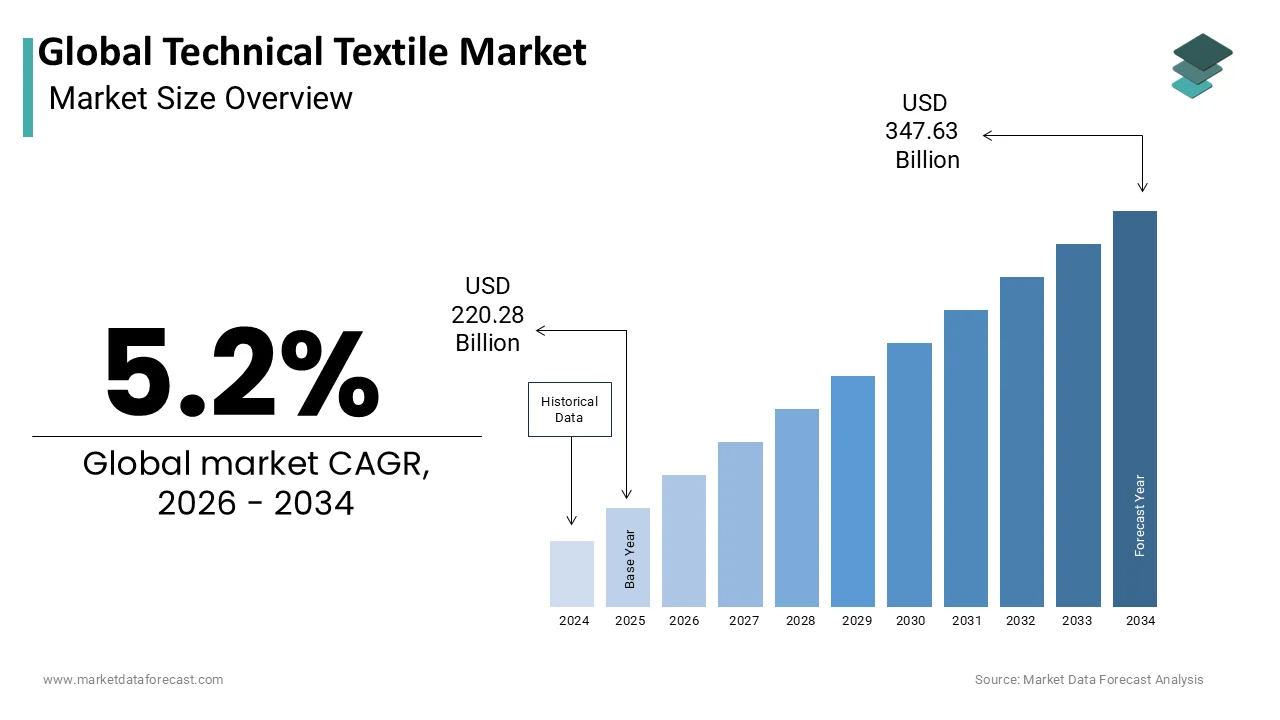
Technical textiles are engineered fabric systems designed not for aesthetic or apparel purposes, but to fulfill precise functional, mechanical, or protective roles across sectors such as aerospace, medical, geotechnical, and defense. These materials are characterized by performance metrics like tensile strength, chemical resistance, or thermal stability rather than design or comfort. As per the study, a portion of newly developed textile applications in industrialized economies now fall under technical classifications by reflecting a structural pivot from traditional textiles.
MARKET DRIVERS
Infrastructure Projects Boost Technical Textiles Demand
The accelerating integration of technical textiles in infrastructure and civil engineering for soil stabilization, erosion control, and reinforcement in road and rail construction is driving the growth of the technical textiles market. According to a study, many European transportation networks have adopted geotextiles to improve durability and minimize long-term maintenance requirements. As per research, India has made the inclusion of geosynthetics mandatory in major highway projects, which results in a strong increase in local production and usage of technical textiles for construction purposes. This institutional embedding transforms technical textiles from optional inputs to engineered necessities, which embeds them structurally into national development blueprints.
Rising Medical Applications Propel Market Expansion
The medical sector’s reliance on implantable and infection-control textiles also propels the expansion of the technical textiles market. As per research, medical implants and surgical devices made from biocompatible materials are widely used in healthcare procedures worldwide. According to a study, hospitals adopting antimicrobial textile solutions have achieved notable reductions in infection rates compared to traditional materials. Thus, the need for sterile, durable, and biocompatible textile products is becoming a critical healthcare requirement rather than an optional choice as surgical volumes are expected to rise consistently.
MARKET RESTRAINTS
Fragmented Regulations Slow Innovation and Compliance
The fragmented global regulatory landscape governing material certification for medical and aerospace-grade technical textiles is another factor propelling the growth of the technical textiles market. According to a study, only a small portion of manufacturers follow globally standardized certification systems, which forces companies to manage multiple regional compliance processes. As per research, European organizations have found that smaller firms spend a significant share of their research and development budgets on meeting varied certification requirements, which slows down innovation and delays product launches worldwide. This regulatory entropy stifles innovation velocity and disproportionately burdens smaller innovators lacking multinational compliance infrastructure.
High Environmental Costs Limit Market Growth
Environmental compliance costs are restraining the growth of the technical textiles market. According to a study, textile processing for technical uses significantly impacts water resources by prompting tighter environmental regulations in many countries. As per research, producers operating in regions with strict environmental rules face higher operational costs to meet advanced wastewater treatment standards. In China, stricter environmental policies have resulted in the closure of numerous smaller textile units that failed to comply with updated discharge requirements. Sustainability, while ethically imperative, imposes capital-intensive retrofitting that erodes margins and deters new entrants.
MARKET OPPORTUNITIES
Smart and Defense Textiles Create New Growth Avenues
The emergence of technical textiles with smart material systems in defense and wearable health monitoring is expected to boost the growth of the technical textiles market. The advanced uniforms combining temperature-regulating materials with embedded sensors have proven effective in improving soldier performance in challenging environments. The innovative textile solutions that provide real-time health data are expected to gain a significant share of defense procurement budgets in the coming years. This fusion of textile substrate with microelectronics transforms passive gear into active diagnostic and protective interfaces, which unlocks value beyond traditional material boundaries.
Bio-Based and Recyclable Textiles Gain Market Momentum
Circular economy mandates accelerating the adoption of bio-based and recyclable technical textiles, also creating new opportunities for the technical textiles market. Many infrastructure projects in Europe now favor materials with verified sustainability profiles, which supports the adoption of alternatives made from renewable polymers. As per research, certain biodegradable textile options have shown strong performance compared to conventional versions by making them attractive for eco-focused developments.
MARKET CHALLENGES
Skill Shortage Restrains Technical Textile Advancements
The acute shortage of specialized human capital capable of bridging textile engineering with domain-specific applications such as biomedical integration or aerospace composites hinders the growth of the technical textiles market. As per research, the global industry is facing a gap in qualified engineers and technicians due to limited academic programs focused on functional textile design. According to a study, many companies in countries such as Germany experience delays in development projects because of challenges in hiring experts with cross-disciplinary skills in materials science and testing processes.
Counterfeit Materials Threaten Product Reliability
Material traceability and counterfeit infiltration offer another challenge for the technical textiles market. According to a study, counterfeit textile components have increasingly entered global supply chains, creating serious safety and quality concerns. As per research, testing agencies in the United States found that some supposedly certified protective materials did not meet essential performance standards by putting users at risk.
REPORT COVERAGE
| REPORT METRIC | DETAILS |
| Market Size Available | 2025 to 2034 |
| Base Year | 2025 |
| Forecast Period | 2026 to 2034 |
| Segments Covered | By Material, Process, Application, and Region |
| Various Analyses Covered | Global, Regional, and Country Level Analysis, Segment-Level Analysis, DROC, PESTLE Analysis, Porter’s Five Forces Analysis, Competitive Landscape, Analyst Overview of Investment Opportunities |
| Regions Covered | North America, Europe, Asia Pacific, Latin America, Middle East & Africa |
| Market Leaders Profiled | Dow DuPont, Ahlstrom Corporation, Johns Manville, GSE Environmental Inc., Royal Ten Cate, Freudenberg & Co., Procter & Gamble, 3M, Huesker Synthetic GmbH, and Hindoostan Mills. |
SEGMENT ANALYSIS
By Material Insights
In 2025, the synthetic polymers segment led the technical textiles market by capturing a substantial share with unmatched versatility in molecular tailoring, including polyesters, polyamides, and polypropylenes that can be engineered for tensile resilience, chemical inertness, or UV resistance on demand. Most industrial and construction textile products in North America rely on these polymers because of their cost efficiency and consistent performance.
The regenerated fiber segment is estimated to register a CAGR of 11.7% from 2025 to 2033. The rapid expansion of the regenerated fiber segment is due to the tightening of ESG procurement mandates. According to a study, Europe has set clear guidelines for including a minimum share of bio-based materials in public infrastructure textile contracts. As per research, fibers like lyocell and modal, made from certified wood pulp, meet biodegradability standards suitable for compliance with emerging global environmental agreements. Leading brands are increasingly adopting regenerated cellulosic textiles for their products, which marks a significant industry shift toward more sustainable materials in technical textile applications.
By Process Insights
The non-woven processes segment held a 49.4% of the technical textiles market share in 2025. The prominence of the non-woven processes segment is driven by the scalability and functional adaptability, such as meltblown, spunbond, and needle-punched configurations, which enable rapid production of filtration media, medical barriers, and geosynthetics without weaving constraints. As per research, the widespread use of non-woven polypropylene in protective medical equipment is supported by its strong resistance to liquid and viral penetration.
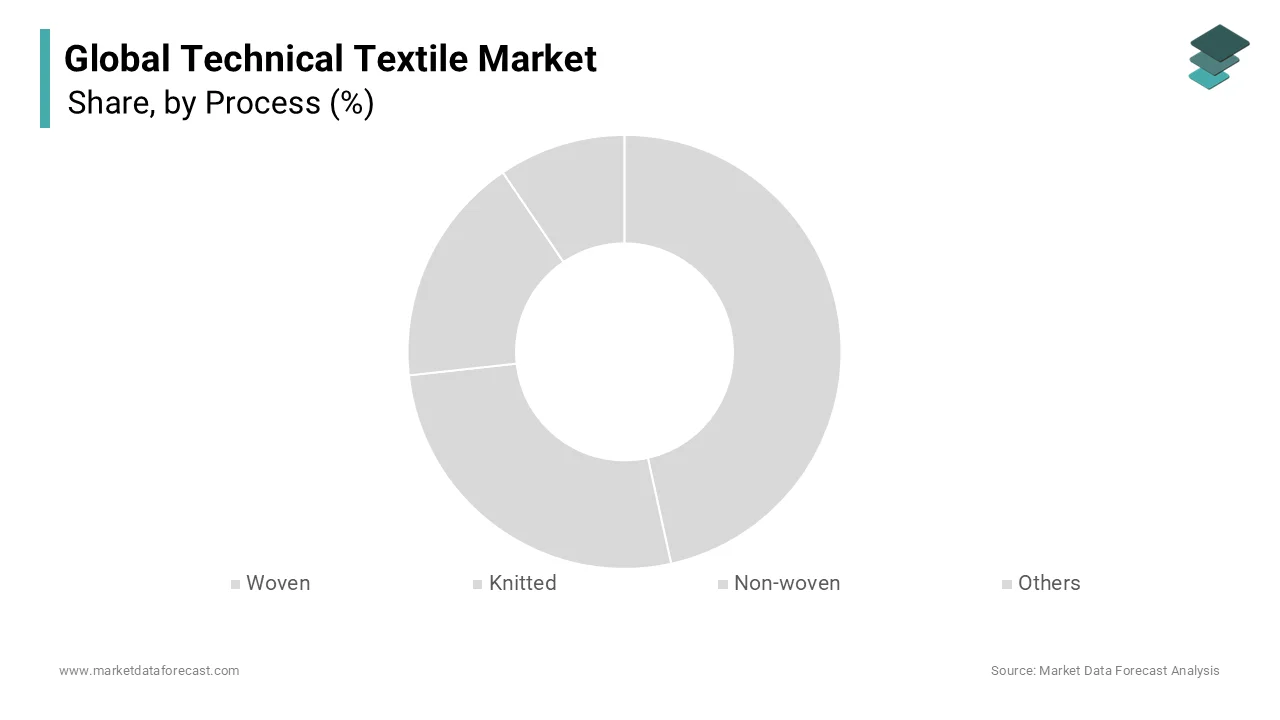
The knitted technical textiles segment is anticipated to witness a CAGR of 9.8% from 2025 to 2033. The expansion of the knitted technical textiles segment is attributed to their structural elasticity and conformability, essential for dynamic applications like orthopedic bracing and aerospace inflatable structures. According to a study, advanced knitted composite materials have shown significant promise in reducing structural weight for aerospace applications by improving performance and efficiency over traditional laminated designs. As per research, in sports medicine, knitted compression fabrics have proven effective in speeding up muscle recovery, which leads to broader use by professional athletes and sports organizations worldwide. Digital knitting machines now permit sub-millimeter precision in yarn placement.
By Application Insights
The industrial products and components segment was the largest in the technical textiles market by capturing 38.7% of the market share in 2025. The growth of the industrial products and components is propelled by the sector’s non-discretionary nature, conveyor belts, filtration bags, and composite reinforcements are embedded in continuous industrial workflows where failure incurs operational halts. As per research, many industrial facilities in North America have adopted advanced reinforced technical textiles to improve durability and reduce maintenance needs.
The medical and hygiene textiles segment is likely to experience a CAGR of 10.3% during the forecast period. The swift expansion of the medical and hygiene textiles segment is fueled by aging populations and infection control mandates. Japan has seen strong demand for absorbent and protective textile products used in senior care facilities. As per research, the United States has expanded the use of antimicrobial textile layers in healthcare settings to improve patient outcomes and reduce hospital-acquired infections.
REGIONAL ANALYSIS
Asia Pacific Market Analysis
Asia Pacific outperformed other regions in the global technical textiles market with 44.3% of the share in 2025. Both China and India have implemented national programs to promote advanced textile production through modernization and targeted subsidies. According to a study, infrastructure projects across Southeast Asia increasingly require geotextile integration, which has boosted regional consumption significantly. Japan continues to dominate the high-end technical textile segment by focusing on the development and export of specialized medical and bio-based materials.
Europe Market Analysis
Europe technical textiles market was positioned second by capturing 25.8% of the market share in 2025. The growth of Europe is driven by regulatory-driven innovation. As per research, Germany has implemented strict standards for construction materials, promoting certified and eco-friendly geosynthetics across public projects. According to a study, France has witnessed a sharp rise in the use of recycled materials in infrastructure, which reinforces its commitment to circular economy principles.
North America Market Analysis
North America's technical textiles market growth is ascribed to the growth in defense and aerospace demand. According to a study, the United States has committed significant funding to advanced protective textile materials for military use. Canada has increased its adoption of carbon-fiber textiles in the automotive industry to support national fuel efficiency objectives.
Latin America Market Analysis
Latin America is moderately expanding in the technical textiles market, with Brazil leading regional demand. Many industrial facilities in Brazil have adopted advanced filtration textiles to comply with national environmental regulations. Argentina has increased the use of agrotextiles for crop protection in agriculture.
Middle East & Africa Market Analysis
The Middle East & Africa are likely to grow in the technical textile market, with growth concentrated in GCC infrastructure and African agrotextiles. As per research, Saudi Arabia has invested heavily in protective and environmental control textiles for major urban development initiatives.
MARKET SEGMENTATION
This research report on the global technical textile market is segmented and sub-segmented into the following categories.
By Material
- Natural Fiber
- Synthetic Polymer
- Metal
- Mineral
- Regenerated Fiber
- Others
By Process
- Woven
- Knitted
- Non-woven
- Others
By Application
- Transport Textiles
- Medical and Hygiene Textiles
- Industrial Products and Components
- Agriculture, Horticulture, and Fishing
- Home Textiles
- Clothing Components
- Packaging and Containment
- Others
By Region
- North America
- Europe
- Asia Pacific
- Latin America
- Middle East & Africa