- Product Description Description
- Table of Contents TOC
- List of Table & Figure LOT
- Get Free Sample PDF Sample PDF
Market Size, 2025
$132.78 BnMarket Estimate, 2026
$141.81 BnMarket Forecast, 2034
$240.03 BnCAGR, 2026–2034
6.80%Executive Summary: Global Agriculture and Farm Equipment Market
- Market Scope: Global agricultural technology and machinery assessment covering product types (tractors, harvesters, planting, irrigation, fertilizing equipment), applications (land development, sowing, harvesting), end-users, distribution channels, and regional adoption.
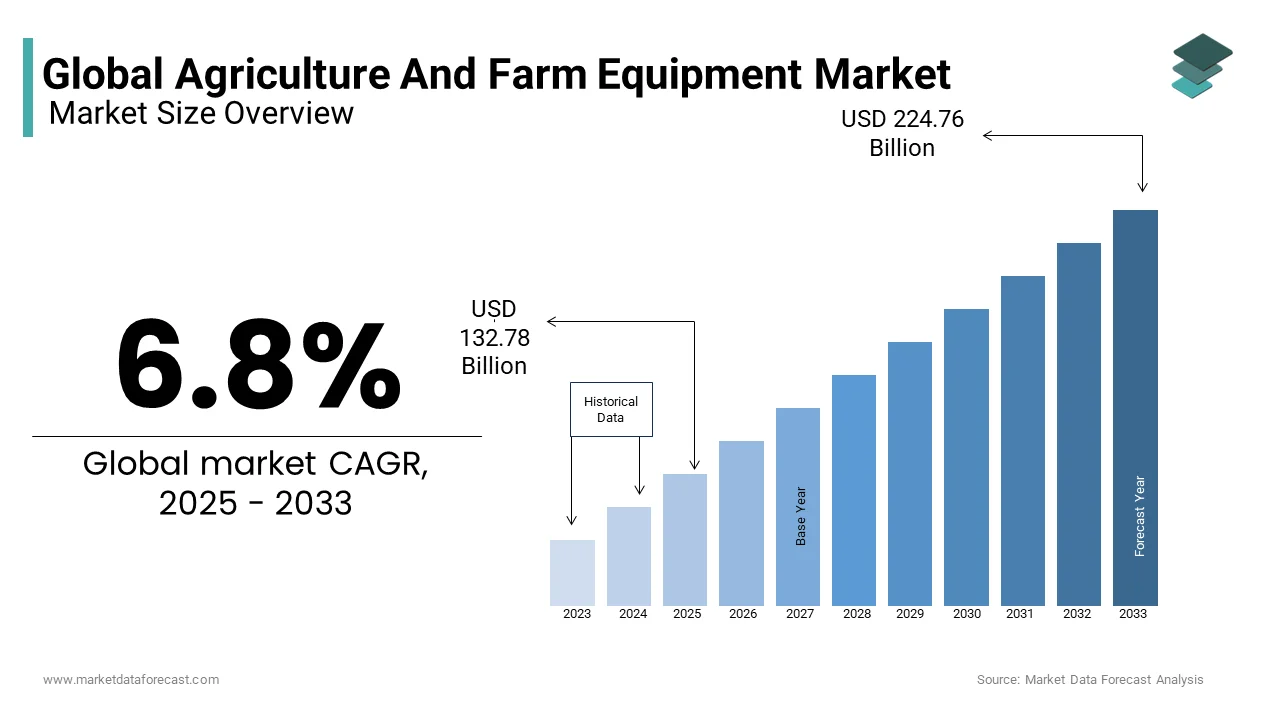
- Market Valuation: Valued at USD 132.78 billion in 2025, estimated at USD 141.81 billion in 2026, and projected to reach USD 240.03 billion by 2034, growing at a compound annual growth rate (CAGR of 6.8%) from 2026 to 2034.
- Primary Growth Drivers: Increasing demand for operational efficiency and high farm yields, rising mechanization levels to counter farm labor shortages, government subsidies and low-interest equipment loans, and technology integration (GPS, Google Earth, and robotics).
Key Market Segment Metrics (2026–2034)
| Category | Leading Segment (2025 Position) | Fastest-Growing Segment |
|---|---|---|
| By Product Type | Tractors (holding 25% of market revenue due to essential multi-utility farming tasks) | Precision planting and smart harvesting machinery |
| By Application | Land Development & Seed Bed Preparation (capturing 23% revenue share) | Harvesting & threshing automation |
| By End User | Large-scale commercial farms and agricultural contractors | Small-scale farmers transitioning to modern mechanization |
| By Region | Asia-Pacific (led by China and India, accounting for major regional volume and high agricultural land area) | Asia-Pacific (witnessing the fastest growth due to evolving farm mechanization practices) |
Major Market Players & Market Structure
Market Structure: Consolidated global market dominated by established agricultural machinery manufacturers focusing on precision farming, electrification (EV tractors), and automated farm solutions.
Key Companies: Deere & Company, Mahindra Group, AGCO Corporation, Agrostroj Pelhrimov A.s, Concern Tractor Plants, Escorts Limited, China National Machinery Industry Corporation, Valmont Industries Incorporated, Weifang Euro King Machinery, and Same Deutz-Fahr Group (SDF).
 Download Free Sample Report
Global Agriculture and Farm Equipment Market Size
The agriculture and farm equipment market size was valued at USD 132.78 billion in 2025 and is anticipated to reach a valuation of USD 141.81 billion in 2026 and USD 240.03 billion by 2034, growing at a CAGR of 6.8%, from 2026 to 2034.
The agriculture and farm equipment are machinery and tools designed to enhance agricultural productivity and efficiency. As per the Food and Agriculture Organization, agriculture employs over 1 billion people globally, which promotes the need for efficient mechanization to support this vast workforce. The direct relationship between labor availability and the adoption of farm equipment to maintain output levels. The agricultural productivity growth is key to reducing poverty and boosting shared prosperity in developing nations. This fact emphasizes the importance of advanced machinery in improving crop yields and farmer incomes. As global population increases, the demand for food rises necessitating higher production capabilities. Mechanization reduces manual labor dependency and minimizes operational costs for farmers. Technological advancements integrate precision agriculture features into equipment enhancing resource management. Regulatory frameworks promote sustainable farming practices driving innovation in eco-friendly machinery. Stakeholders focus on durability and fuel efficiency to meet diverse climatic conditions.
MARKET DRIVERS
Global Population Growth and Food Security Demands
The escalating global population by necessitating higher agricultural output to ensure food security, which is propelling the growth of the agriculture and farm equipment market. As the number of mouths to feed increases, farmers must adopt efficient mechanization to maximize crop yields per hectare. According to the United Nations Department of Economic and Social Affairs, the world population will reach 9.7 billion by 2050, creating immense pressure on food production systems . This demographic surge directly correlates with increased demand for high capacity harvesters and planting equipment to meet consumption needs. Farmers rely on advanced machinery to reduce post harvest losses and improve processing speed. As per the Food and Agriculture Organization, global cereal production must increase by 50% by 2050 to feed the growing population. This statistical requirement drives investment in precision farming technologies that optimize seed placement and fertilizer application. Governments worldwide support mechanization initiatives to bridge the yield gap between developed and developing regions. Smallholder farmers increasingly access affordable equipment through rental models and cooperative purchasing. Manufacturers respond by designing versatile machines suitable for diverse crop types and terrain conditions.
Labor Shortages and Rising Wage Costs
The acute shortage of agricultural labor are forcing farmers to substitute human work with mechanical solutions that is also promoting the growth of the agriculture and farm equipment market. Urban migration and aging rural populations have significantly reduced the available workforce for manual farming tasks in many regions. The share of employment in agriculture has declined globally as workers shift to industrial and service sectors. This structural shift compels farmers to invest in automated machinery to maintain operational continuity without relying on scarce manual labor. High wage costs further incentivize the adoption of equipment that offers long term cost savings compared to hired hands. The World Bank states that labor productivity in agriculture is significantly lower than in other sectors prompting a move toward capital intensive methods . This economic reality accelerates the replacement of traditional tools with tractors combine harvesters and robotic weeders. Mechanization allows single operators to manage larger land areas efficiently reducing dependency on seasonal workers. Manufacturers develop user friendly interfaces to attract younger operators who possess technical skills but lack traditional farming experience. Government subsidies for machinery purchase further alleviate financial barriers for small and medium sized farms.
MARKET RESTRAINTS
High Initial Capital Investment Requirements
The substantial upfront cost of modern agricultural machinery are limiting accessibility for smallholder farmers is hindering the growth of the agriculture and farm equipment market. Advanced tractors and precision implements require significant financial outlay, which many rural producers cannot afford without external financing. The access to credit remains a major constraint for small scale farmers in developing countries who lack collateral. High interest rates on agricultural loans further exacerbate the burden on farmers already operating on thin margins. The Food and Agriculture Organization notes that smallholders produce a significant portion of the world’s food yet often lack resources for mechanization . This discrepancy limits the potential customer base for premium equipment manufacturers. Farmers may opt for used or outdated machinery which reduces overall market value and innovation uptake. Maintenance costs and spare parts availability also contribute to the total cost of ownership discouraging new purchases. Financial institutions perceive agriculture as high risk leading to stringent lending criteria.
Fragmented Land Holdings and Small Farm Sizes
The prevalence of small and fragmented land parcels by reducing the economic viability of large scale machinery, which is additionally impeding the growth of the agriculture and farm equipment market. In many Asian and African nations average farm sizes are too small to justify the use of heavy-duty tractors and combines. Small plot sizes also complicate maneuverability and reduce operational efficiency for large implements. The land fragmentation reduces agricultural productivity by preventing economies of scale in mechanization. This inefficiency discourages farmers from investing in expensive equipment that cannot be fully utilized. Custom hiring services emerge as an alternative but they do not drive direct equipment sales as effectively as individual ownership. Lack of land consolidation policies in many regions perpetuates this fragmentation issue. Manufacturers face challenges in achieving volume production for niche small scale machines.
MARKET OPPORTUNITIES
Integration of Precision Agriculture Technologies
The adoption of precision agriculture technologies is enhancing resource efficiency and crop monitoring, which is solely promoting the growth of the agriculture and farm equipment market. Smart equipment equipped with GPS sensors and data analytics allows farmers to apply inputs precisely where needed. This efficiency gain appeals to cost conscious farmers and environmentally regulated markets driving demand for smart tractors and sprayers. Data driven decision making improves profitability by optimizing seed spacing and irrigation schedules. The digital tools are essential for sustainable intensification of agriculture globally. This endorsement encourages investment in connected machinery that integrates with farm management software. Manufacturers can offer subscription-based services for data insights creating recurring revenue streams. Younger farmers are more inclined to adopt tech enabled equipment fostering a new customer segment. Government initiatives promoting digital agriculture provide subsidies for smart equipment purchases.
Expansion of Rental and Sharing Economy Models
The growth of equipment rental and sharing platforms by improving accessibility for smallholders is additionally to promote the growth of the agriculture and farm equipment market. These models allow farmers to access high quality machinery without the burden of ownership and maintenance costs. The mechanization service providers can significantly increase equipment utilization rates in smallholder systems. This approach expands the potential user base to include farmers who cannot afford outright purchases. Rental platforms leverage mobile technology to connect equipment owners with nearby farmers seeking temporary usage. The shared economy models can reduce capital constraints and improve income distribution in rural areas. This financial flexibility encourages broader adoption of modern equipment across diverse farm sizes. Manufacturers can partner with rental agencies to ensure regular maintenance and upgrade cycles for their fleets.
MARKET CHALLENGES
Environmental Regulations and Emission Standards
The strict environmental regulations are imposing costly compliance requirements on manufacturers, which is one of the major challenges for the growth of the agriculture and farm equipment market. Governments worldwide are implementing tighter emission standards for diesel engines used in tractors and harvesters to reduce air pollution. The agricultural machinery contributes significantly to nitrogen oxide emissions necessitating advanced after treatment systems. This regulatory pressure increases production costs and complexity for equipment manufacturers who must integrate selective catalytic reduction technologies. The non-road mobile machinery must meet stringent tier standards to protect public health. This mandate requires continuous research and development investment to balance power performance with environmental safety. Transitioning to alternative fuels such as electric or hydrogen poses technical hurdles regarding battery weight and charging infrastructure. Rural areas often lack the necessary support facilities for zero emission vehicles. This challenge unfavors the market by extending development timelines and increasing regulatory uncertainty. Manufacturers must navigate varying regional standards which complicates global product standardization.
Supply Chain Disruptions and Raw Material Volatility
The global supply chain instability are causing production delays and cost escalations that is also to impede the growth of the agriculture and farm equipment market. Dependence on imported components such as semiconductors and steel makes manufacturers vulnerable to geopolitical tensions and logistical hurdles. The global trade disruptions have significantly impacted the availability of industrial inputs. This volatility leads to extended lead times for equipment delivery frustrating farmers, who need machinery for specific seasonal windows. Fluctuating raw material prices erode profit margins and force frequent price adjustments for end users. The International Monetary Fund indicates that commodity price shocks can severely affect manufacturing sectors reliant on global supply networks . This economic uncertainty complicates long term planning and inventory management for equipment producers. Shortages of electronic chips have halted production lines for smart agricultural machinery globally. Farmers may postpone purchases due to unpredictable availability and pricing. Localizing supply chains is a slow process requiring significant capital investment.
REPORT COVERAGE
| REPORT METRIC | DETAILS |
| Market Size Available | 2025 to 2034 |
| Base Year | 2025 |
| Forecast Period | 2026 to 2034 |
| CAGR | 6.8% |
| Segments Covered | By Product, Application, End-User, Distribution Channel and Region |
| Various Analyses Covered | Global, Regional, & Country Level Analysis; Segment-Level Analysis, DROC, PESTLE Analysis, Porter’s Five Forces Analysis, Competitive Landscape, Analyst Overview of Investment Opportunities |
| Regions Covered | North America, Europe, APAC, Latin America, Middle East & Africa |
| Market Leaders Profiled | Deere & Company, Mahindra Group, AGCO Corporation, Agrostroj Pelhrimov A.s, Concern Tractor Plants, Escorts Limited, China National Machinery Industry Corporation, Valmont Industries Incorporated, Weifang Euro King Machinery, Same Deutz-Fahr Group (SDF). |
SEGMENTAL ANALYSIS
By Product Insights
The tractors segment was the largest by holding 55.3% of the Agriculture and Farm Equipment Market share in 2025 due to their fundamental role, as the primary power source for diverse agricultural operations. These versatile machines are essential for plowing tilling planting and hauling making them indispensable for both small and large scale farming. The shift from manual labor to machine based farming has significantly increased output per worker in developing nations . This transition fuels consistent demand for tractors as farmers seek to reduce dependency on scarce human resources. Manufacturers offer a wide range of horsepower options to cater to varied land sizes and soil conditions. Government subsidies for farm mechanization further boost tractor sales in emerging economies. The durability and long service life of tractors make them a preferred capital investment for farmers. Technological advancements such as GPS guidance and autonomous features enhance their appeal.
The irrigation equipment segment is anticipated to grow at a fastest CAGR of 11.3% during the forecast period with the increasing water scarcity and the need for precise resource management. Climate change and erratic rainfall patterns compel farmers to adopt efficient irrigation systems to ensure crop survival and yield stability. This potential for significant yield improvement accelerates investment in advanced irrigation infrastructure. Governments promote water saving techniques through subsidies and regulatory mandates encouraging widespread adoption. Smart irrigation controllers integrated with soil moisture sensors offer real time data for optimal watering schedules. This technological integration appeals to tech savvy farmers seeking to optimize input costs. The segment grows rapidly as climate resilience becomes a priority for food security strategies. Manufacturers innovate with solar powered pumps and automated valves to reduce energy dependence.
By Application Insights
The harvesting and threshing applications segment was accounted in holding a prominent share of the Agriculture and Farm Equipment Market in 2025 due to the need for timely crop collection to prevent post-harvest losses. Efficient harvesting machinery ensures that crops are gathered at peak maturity preserving quality and value. This substantial loss potential drives farmers to invest in combine harvesters and threshers that streamline the collection process. Harvesting is labor intensive and time sensitive making mechanization essential for large scale operations. Farmers prioritize reliability and speed during harvest windows to avoid weather related damages. Advanced harvesters with yield monitoring capabilities provide valuable data for future planning. The segment benefits from continuous innovation in header designs for different crop types. Government support for reducing food waste further promotes the adoption of modern harvesting tools.
The sowing and planting applications segment is anticipated to grow at a fastest CAGR of 9.8% during the forecast period with the adoption of precision agriculture techniques. Accurate seed placement and spacing are crucial for optimizing plant population and maximizing yield potential. The efficiency gain drives farmers to upgrade to advanced planters equipped with variable rate technology. Uniform seed depth ensures consistent crop emergence, which is vital for competitive weed control and resource utilization. This focus on sustainability accelerates the shift toward sophisticated sowing equipment. Modern planters integrate with GPS systems to follow precise field maps reducing overlap and input waste. The growing popularity of no till farming practices also boosts demand for specialized no till drills. Farmers seek equipment that minimizes soil disturbance while ensuring accurate seed delivery.
By Distribution Channel Insights
The dealers and distributors segment was the largest by capturing 33.2% of the agriculture and farm equipment market share in 2025 due to their ability to provide localized support and after sales service. Farmers rely on nearby dealers for immediate access to spare parts maintenance and technical assistance which are critical during peak farming seasons. The effective extension services and local supply chains are essential for the successful adoption of agricultural technologies. This reliance on local infrastructure strengthens the role of dealers as trusted advisors for equipment selection. Dealers offer financing options and trade in programs that facilitate purchases for smallholder farmers. The access to reliable distribution networks significantly influences farmer decisions on machinery investments. This factor ensures that dealers remain the primary touchpoint for customers. Physical showrooms allow farmers to inspect equipment quality and functionality before buying. Established dealer networks build long term relationships based on trust and service reliability. They also provide training on safe and efficient equipment operation. The complexity of modern machinery necessitates professional installation and calibration services.
The online retail segment is likely to grow at a fastest CAGR of 8.8% from 2026 to 2034 with the increasing internet penetration and digital literacy among farmers. E-commerce platforms offer convenience wider product selection and competitive pricing, which appeal to tech savvy buyers. The global internet usage in rural areas has increased, significantly enabling better access to online marketplaces . This connectivity allows farmers to research compare and purchase equipment components remotely. The digital platforms can reduce transaction costs and improve market transparency for agricultural inputs. This efficiency drives the rapid adoption of online sales channels for smaller equipment and accessories. Online retailers provide detailed product specifications and customer reviews aiding informed decision making. Direct to consumer models eliminate intermediary markups offering cost savings to buyers. Mobile apps facilitate easy ordering and tracking of deliveries to remote farm locations. Manufacturers invest in robust online portals to showcase their full product ranges. The pandemic accelerated the shift toward digital procurement habits among agricultural professionals.
REGIONAL ANALYSIS
North America Market Analysis
North America was the largest contributor in the global Agriculture and Farm Equipment Market by capturing 46.2% of the share in 2025 with the high mechanization levels. This high adoption rate drives continuous demand for upgraded tractors and smart implements. The labor shortages in Canada are accelerating the shift toward autonomous and robotic farming solutions. Farmers in the region prioritize fuel efficiency and environmental compliance influencing product development. Strong government support for research and development fosters innovation in agricultural technology. The presence of major manufacturers ensures robust supply chains and service networks. High disposable income among farmers allows for investment in premium branded equipment. Regulatory standards for safety and emissions shape the product landscape significantly. The region serves as a testing ground for new technologies before global rollout.
Europe Market Analysis
Europe agriculture and farm equipment market growth is likely to grow with the strict environmental regulations and a focus on sustainable farming practices. This regulatory push favors advanced sprayers and smart monitoring systems. The digitalization is key to maintaining competitiveness in European agriculture. This focus accelerates the adoption of connected machinery and data analytics tools. Farmers invest in equipment that supports organic farming and soil conservation practices. Government subsidies under the Common Agricultural Policy encourage modernization of farm fleets. The region sees high demand for compact and versatile machines suitable for smaller plots. Environmental awareness among consumers influences purchasing decisions toward eco-friendly brands. Strict emission standards drive the development of electric and hybrid agricultural vehicles. Collaborative research initiatives between industry and academia foster innovation.
Asia-Pacific Market Analysis
The Asia Pacific agriculture and farm equipment market growth is anticipated to have steady growth opportunities throughout the forecast period with the rising incomes and government mechanization initiatives. The region is home to a vast number of smallholder farmers who are gradually adopting mechanized solutions to improve productivity. The increasing rural wages are prompting a shift from manual to mechanical farming in Southeast Asia. Government subsidies in countries like India and China lower the entry barrier for farmers. Rapid urbanization reduces available agricultural labor further necessitating mechanization. Manufacturers localize production to offer cost effective solutions tailored to regional crops. The growing middle class increases demand for high value crops requiring specialized equipment. Infrastructure improvements facilitate better distribution of machinery to rural areas.
Latin America Market Analysis
Latin America agriculture and farm equipment market growth is likely to grow with the major exporter of soybeans, corn, and beef. The region features large scale commercial farms that require high performance and durable machinery for extensive operations. This export orientation necessitates efficient harvesting and processing technologies to meet international quality standards. This focus drives demand for large tractors and combines in Brazil and Argentina. Farmers prioritize equipment reliability to handle tough terrain and climatic conditions. Local manufacturing hubs reduce costs and improve availability of spare parts. Government policies support agro industrial development through credit lines for machinery purchases. The region sees increasing adoption of precision agriculture to optimize input use. Environmental concerns regarding deforestation influence equipment choices toward sustainable practices.
The Middle East and Africa Market Analysis
The Middle East and Africa agriculture and farm equipment market growth is esteemed to grow with the diverse climatic conditions and varying levels of mechanization. In Africa, smallholder farming dominates while the Middle East focuses on high tech controlled environment agriculture. The African Union states that increasing agricultural productivity is central to its Agenda 2063 for economic transformation driving interest in basic mechanization. This initiative supports the gradual adoption of tractors and irrigation systems in sub-Saharan Africa. The water scarcity in the Middle East is accelerating the use of advanced irrigation technologies. This necessity drives demand for drip and sprinkler systems to maximize water efficiency. Governments in Gulf countries invest heavily in vertical farming and hydroponics requiring specialized equipment. Limited local manufacturing means reliance on imports from Europe and Asia. Financial constraints and lack of credit access hinder widespread adoption in many African nations. Donor agencies and NGOs support mechanization projects to improve food security.
COMPETITIVE LANDSCAPE
The Agriculture and Farm Equipment Market features intense competition among established multinational corporations and emerging regional manufacturers who strive to capture share through innovation and service excellence. Major players leverage their extensive research and development capabilities to introduce smart machinery equipped with autonomous features and precision agriculture tools. Companies compete on the basis of technological superiority distribution reach and after sales support quality. Local manufacturers often compete on price and customization for specific regional crops, while global firms focus on standardized high-performance solutions. Strategic collaborations with technology startups are becoming common to integrate artificial intelligence and internet of things capabilities into traditional machinery. Innovation in alternative power sources such as electric and hydrogen drives competitive differentiation. Companies also invest in digital platforms to offer predictive maintenance and real time monitoring services. Competitive pricing strategies and flexible financing options are essential for penetrating price sensitive emerging countries
KEY MARKET PLAYERS
Some of the market players that dominate the global agriculture and farm equipment market.
- Deere & Company
- Mahindra Group
- AGCO Corporation
- Agrostroj Pelhrimov A.s
- Concern Tractor Plants
- Escorts Limited
- China National Machinery Industry Corporation
- Valmont Industries Incorporated
- Weifang Euro King Machinery
- Same Deutz-Fahr Group (SDF)
Top Players In The Market
- John Deere maintains a dominant presence in the Agriculture and Farm Equipment Market through its comprehensive portfolio of precision agriculture technologies and heavy machinery. The company recently expanded its autonomous tractor lineup to address labor shortages and improve operational efficiency for large scale farms. John Deere invests heavily in artificial intelligence and machine learning to enhance decision, making capabilities within its equipment. Their strategic partnerships with technology firms facilitate the integration of advanced data analytics into farming operations. The company focuses on sustainability by developing electric and hybrid powertrains for various machine categories. John Deere also strengthens its dealer network to provide superior after sales support and maintenance services globally. Their commitment to innovation drives the adoption of smart farming solutions among commercial growers. The firm continuously updates its software platforms to ensure seamless connectivity between machines and farm management systems.
- CNH Industrial significantly contributes to the Agriculture and Farm Equipment Market by offering a diverse range of brands, including Case IH and New Holland. The company recently launched new generation combines equipped with advanced automation features to maximize harvest efficiency and reduce grain loss. CNH Industrial actively promotes sustainable farming practices through the development of alternative fuel engines and precision application tools. Their investment in digital farming platforms enables farmers to monitor field conditions and optimize input usage effectively. The company strengthens its position by expanding manufacturing facilities in key emerging markets to meet local demand. CNH Industrial collaborates with research institutions to develop crop specific solutions that enhance productivity and soil health. Their focus on modular design allows for easy customization of equipment to suit varied farming needs.
- Kubota Corporation plays a pivotal role in the Agriculture and Farm Equipment Market by specializing in compact tractors and utility vehicles for small to medium sized farms. The company recently acquired major agricultural technology firms to enhance its precision farming capabilities and expand its product offerings. Kubota focuses on providing reliable and fuel efficient machinery that appeals to cost conscious farmers in Asia and North America. Their investment in robotics and automation aims to address labor constraints in intensive farming operations such as rice cultivation. The company strengthens its global footprint by establishing new production sites and distribution centers in strategic regions. Kubota prioritizes environmental sustainability by developing electric powered equipment and promoting eco friendly farming techniques.
MARKET SEGMENTATION
This research report on the global agriculture and farm equipment market is segmented and sub-segmented into the following categories.
By Product Type
- Tractors
- Harvesters
- Planting Equipment
- Irrigation Equipment
- Fertilizing & Pest Control Equipment
- Others
By Application
- Land Development
- Sowing & Planting
- Weed Cultivation
- Harvesting & Threshing
- Others
By End User
- Small-Scale Farmers
- Large-Scale Farmers
- Agricultural Contractors
By Distribution Channel
- Direct Sales
- Dealers & Distributors
- Online Retail
By Region
• North America
• Europe
• Asia-Pacific
• South America
• Middle East & Africa