- Product Description Description
- Table of Contents TOC
- List of Table & Figure LOT
- Get Free Sample PDF Sample PDF
Market Size, 2025
$1.67 BnMarket Estimate, 2026
$1.77 BnMarket Forecast, 2034
$2.8 BnCAGR, 2026–2034
5.9%Executive Summary: Global Agriculture Miticide Market
- Market Scope: Global agricultural inputs assessment covering product types (Abamectin, Spiromesifen, etc.), application areas (orchards, greenhouses), crop types (fruits, vegetables, ornamentals), and regional adoption across APAC, North America, Europe, and Latin America.
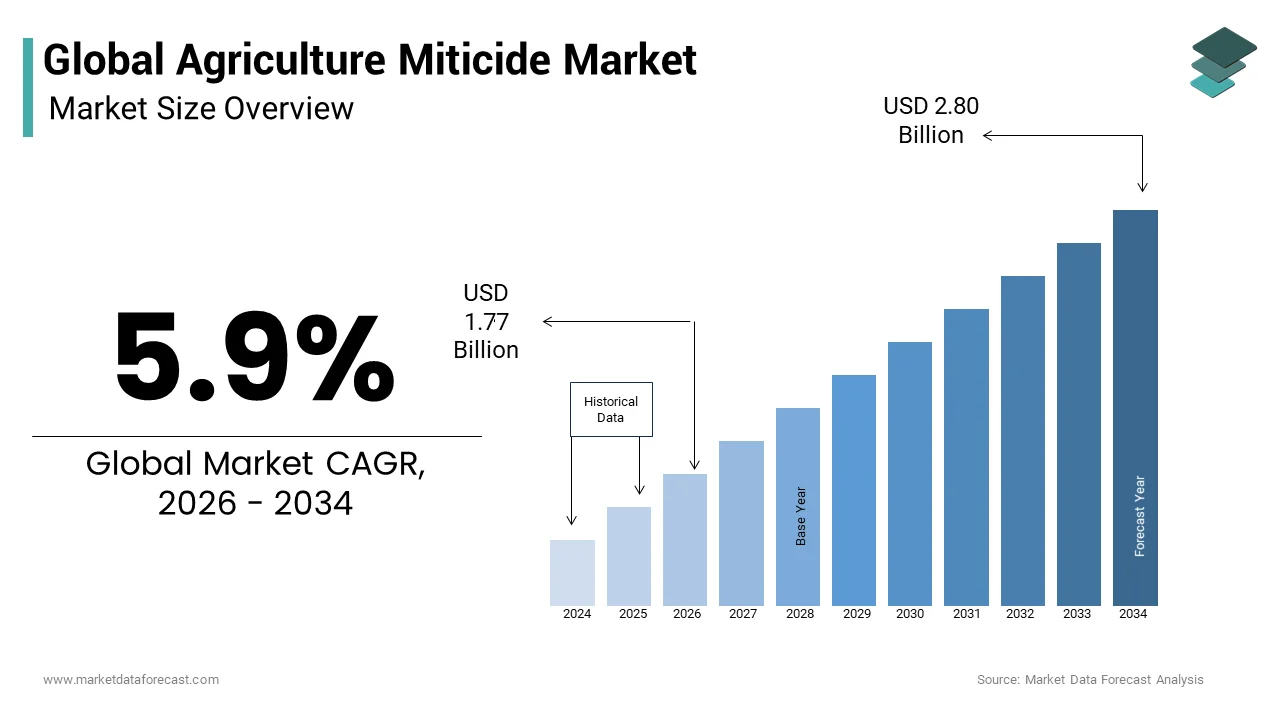
- Market Valuation: Valued at USD 1.67 billion in 2025, reaching USD 1.77 billion in 2026, and projected to hit USD 2.80 billion by 2034, growing at a CAGR of 5.9% (2026–2034).
- Primary Growth Drivers: Climate change-induced acceleration of mite reproductive cycles (thermal stress), expansion of high-value protected cropping systems (greenhouses/tunnels), and the urgent need for integrated pest management (IPM) to counter resistance.
Key Market Segment Metrics (2026–2034)
| Category | Leading Segment (2025 Position) | Fastest-Growing Segment |
|---|---|---|
| By Product | Abamectin (dominating due to affordability and versatility) | Spiromesifen (fastest CAGR of 8.7% due to resistance-breaking mode of action) |
| By Application | Orchards (perennial crop biology supports high investment) | Greenhouses (CAGR of 9.4% due to continuous, intensive production) |
| By Crop | Fruits and Vegetables | Ornamentals (CAGR of 10.2% driven by lifestyle and aesthetic standards) |
Major Market Players & Market Structure
Market Structure: Consolidated yet evolving market where generic chemicals (Abamectin) provide the foundation, while new proprietary chemistries and biologicals are essential for managing resistance and meeting regulatory (residue) demands.
Key Companies: BASF SE, FMC Corporation, Gowan Company, Valent BioSciences, Certis USA, Shandong Sino-Agri United, Rotam North America, and others.
Global Agriculture Miticide Market Size
The global agriculture miticide market size was valued at USD 1.67 billion in 2025 and is anticipated to reach a valuation of USD 1.77 billion in 2026 from USD 2.80 billion by 2034, growing at a CAGR of 5.9% during the forecast period from 2026 to 2034.
Current Introduction and Definition of the Agriculture Miticide Market
The agriculture miticide is specialized chemical and biological agents formulated exclusively to control phytophagous mite populations including spider mites, rust mites, and gall mites that threaten crop productivity across diverse agricultural systems. According to the study, mite infestations cause annual global crop losses exceeding 15% in high value horticultural commodities, with damage intensity escalating under climate stress conditions that accelerate reproductive rates. As per the study, two spotted spider mite outbreaks in California almond orchards alone resulted in yield reductions of 20 to 30% during severe infestation years, demonstrating economic thresholds that justify preventive miticide programs. Furthermore, the mite resistance to legacy chemistries has increased 3 fold over the past decade, necessitating continuous rotation of novel modes of action to preserve efficacy.
MARKET DRIVERS
Climate Change Accelerated Mite Reproductive Cycles
The rising global temperatures directly accelerate mite development rates and expand seasonal activity windows by creating structural demand increases for miticide applications independent of acreage expansion. The climate change accelerated mite reproductive cycles that is accelerating the growth of the agriculture miticide market. According to the Intergovernmental Panel on Climate Change, average growing season temperatures in major agricultural regions have increased by 1.5 degrees Celsius since preindustrial periods, reducing two spotted spider mite generation times from 14 days to under 10 days and enabling 2 to 3 additional generations per season in temperate zones. As per the research, each 1 degree Celsius temperature increase above optimal thresholds elevates mite fecundity by 8 to 12%, compounding population growth rates exponentially during heat waves that are becoming more frequent and intense. As per the European Environment Agency, southern European vineyards now require 4 to 6 miticide applications annually compared to 2 to 3 applications historically needed, directly correlating with extended warm periods that sustain mite activity beyond traditional treatment windows. Furthermore, the drought stress weakens plant defenses while simultaneously favoring mite proliferation by creating dual pressure scenarios where miticide demand surges precisely when water limitations constrain spray operations. This climate biology linkage transforms miticides from discretionary inputs into essential risk management tools whose usage intensity tracks thermal anomalies rather than static calendar schedules.
Expansion of High Value Protected Cropping Systems
The global shift toward greenhouse, tunnel, and net house cultivation for vegetables, berries, and ornamentals generates disproportionately high miticide consumption per hectare due to year round production and enclosed environments that favor mite establishment. The expansion of highvalue protected cropping systems is elevating the growth of the agriculture miticide market. According to the study, protected cropping area worldwide expanded between 2010 and 2022 with concentration in Asia, Mediterranean Europe, and North America where high value crops justify intensive pest management investments. As per research, greenhouse tomato and cucumber operations apply miticides 8 to 12 times annually compared to 2 to 4 applications in open field equivalents, reflecting continuous cropping cycles and absence of natural enemy populations that suppress mites outdoors. Furthermore, the indoor agriculture expansion introduces novel mite challenges in controlled environments where biological control integration remains technically challenging by creating reliance on chemical interventions during establishment phases. This intensification trend concentrates miticide demand in spatially limited but economically production systems where crop value justifies premium input costs.
MARKET RESTRAINTS
Accelerating Resistance Development to Key Chemistries
The mite populations exhibit exceptional capacity for rapid resistance evolution due to short generation times, high reproductive output, and haplodiploid genetics that expose recessive resistance alleles immediately in males. The accelerating resistance development to key chemistries is hindering the growth of the agriculture miticide market. According to the study, over 75 cases of resistance to METI acaricides (Group 21) have been documented globally in two spotted spider mite populations since 2010, rendering previously reliable chemistries ineffective within 5 to 7 years of commercial introduction. As per the study, field populations of Carmine spider mite in Brazilian soybeans now require 8 to 10 times higher doses of abamectin to achieve mortality levels attained at label rates a decade ago, forcing farmers to increase application frequency or tank mix multiple products that accelerate cross resistance selection. The resistance monitoring programs detect reduced sensitivity to newer diamide and tetronic acid derivatives within 3 to 4 years of registration in intensive use regions, compressing product lifecycle returns below R&D cost recovery thresholds. The resistance management failures in almonds and grapes have caused control costs to triple, as growers cycle through diminishing effective options. This biological constraint creates inherent market volatility where today’s premium solutions become tomorrow’s obsolete commodities, discouraging long term investment in miticide discovery pipelines.
Regulatory Restrictions on Non Target Organism Safety
The stringent environmental safety standards increasingly exclude miticide candidates with adverse effects on beneficial arthropods, pollinators, and aquatic organisms that is declining the growth of the agriculture miticide market. As per the United States Environmental Protection Agency, neonicotinoid miticides face restricted use classifications in 12 states due to pollinator toxicity concerns, limiting application timing and crop coverage even when mite pressure warrants intervention. Furthermore, Brazil’s National Health Surveillance Agency banned several organophosphate acaricides in 2023 following worker exposure incidents, eliminating low cost generics that smallholders relied upon for affordable mite control. These regulatory filters prioritize environmental protection over pest management flexibility, creating supply gaps where effective chemistry exists but cannot be legally deployed, constraining market growth despite unmet agronomic needs.
MARKET OPPORTUNITIES
Biological Miticide Integration and Biopesticide Synergies
The biological miticides based on entomopathogenic fungi, predatory mites, and botanical extracts present opportunities to integrate chemical and non-chemical control in programs that extend efficacy windows and meet residue free requirements. The biological miticide integration and biopesticide synergies is solely to level up the growth of the agriculture miticide market. According to the Research Institute of Organic Agriculture, Beauveria bassiana based bioacaricides achieved 60 to 70% mite suppression in European greenhouse trials when applied preventively, providing baseline control that reduces chemical spray frequency by 30 to 40%. As per the Biopesticide Industry Alliance, global biopesticide market growth exceeds 15% annually with miticide segment outpacing overall category due to compatibility with IPM programs and shorter pre harvest intervals that enable late season applications when chemical residues would violate export standards. The United States Department of Agriculture National Institute of Food and Agriculture funded research demonstrating that combining chromafenozide with predatory mite releases improved season long control versus either tactic alone, validating synergistic integration models. Furthermore, the European Commission’s Farm to Fork Strategy targets 50% reduction in chemical pesticide use by 2030, creating policy tailwinds and subsidy incentives for biological miticide adoption that improve economics relative to conventional alternatives.
Precision Application Technologies Enhancing Miticide Efficiency
Advances in electrostatic spraying, drone application, and sensor guided variable rate technology create opportunities to improve miticide deposition on undersides of leaves where mites feed, while reducing drift and off target exposure. The precision application technologies is substantially to leverage the growth of the agriculture miticide market. According to the American Society of Agricultural and Biological Engineers, electrostatic sprayers increase underside leaf coverage by 40 to 60% compared to conventional hydraulic nozzles, directly addressing the primary cause of miticide failure which is inadequate contact with cryptic mite habitats. As per the International Society of Precision Agriculture, drone based spot spraying using multispectral mite detection maps reduced active ingredient use by 35% in Australian citrus orchards while maintaining equivalent control efficacy through targeted application only to infested zones. As per the Food and Agriculture Organization, precision application technologies are particularly valuable in tropical tree crops where canopy density prevents ground equipment penetration by enabling aerial delivery that was previously impossible without excessive volume waste.
MARKET CHALLENGES
Diagnostic Complexity and Misidentification Risks
The accurate mite identification requires specialized taxonomic expertise that most farmers and even many crop advisors lack, leading to misdiagnosis and ineffective miticide selections that waste resources and accelerate resistance. The diagnostic complexity and misidentification risks is a major challenge for the growth of the agriculture miticide market. According to the study, over 40% of submitted mite samples from commercial growers were misidentified at field level, resulting in applications of products inactive against actual pest species present. The morphological differentiation between economically significant mite species often requires microscopic examination of chaetotaxy patterns that exceed capabilities of standard scouting protocols by creating diagnostic bottlenecks during outbreak situations when rapid decisions are important. Furthermore, the International Centre for Pesticides and Health Risk Prevention reports that invasive mite species introductions frequently go undetected for 2 to 3 years as damage is attributed to known pests, allowing populations to establish before appropriate management strategies are implemented. This knowledge gap between field observation and taxonomic reality creates persistent inefficiencies that undermine miticide performance regardless of product quality.
Supply Chain Volatility for Specialized Active Ingredients
The global miticide production relies on concentrated manufacturing capacity for specialized intermediates and active ingredients, creating systemic vulnerability to geopolitical, regulatory, and logistical disruptions that disproportionately affect niche crop protection segments. The supply chain volaitility for specialized active ingredients is to impede the growth of the agriculture miticide market. According to the European Crop Protection Association, over 70% of technical grade acaricide synthesis occurs in China and India, with single facility shutdowns capable of causing global shortages lasting 6 to 12 months due to complex multi step synthesis processes that cannot be rapidly replicated elsewhere. As per the study, shipping container freight rates for agrochemicals fluctuated by 300% between 2021 and 2023, inflating landed costs for imported miticides and compressing margins for distributors serving price sensitive smallholder areas. The export restrictions on key chemical precursors imposed during supply crises have delayed miticide availability by 3 to 4 months in importing countries, coinciding with peak mite pressure periods when alternative options are limited. Furthermore, the environmental compliance upgrades at Chinese manufacturing sites have permanently reduced capacity for older acaricide chemistries by creating structural supply constraints for generic products that resource constrained farmers depend upon.
REPORT COVERAGE
| REPORT METRIC | DETAILS |
| Market Size Available | 2025 to 2034 |
| Base Year | 2025 |
| Forecast Period | 2026 to 2034 |
| CAGR | 5.9% |
| Segments Covered | By Product, Application Area, Crop Type, and Region. |
| Various Analyses Covered | Global, Regional & Country Level Analysis, Segment-Level Analysis, DROC, PESTLE Analysis, Porter’s Five Forces Analysis, Competitive Landscape, Analyst Overview on Investment Opportunities |
| Regions Covered | North America, Europe, APAC, Latin America, Middle East & Africa |
| Market Leaders Profiled | Shandong Sino-Agri United Biotechnology Co., BASF SE, Jiangsu Huifeng Agrochemical Co., Shandong Weifang Rainbow Chemical Co., Wynca Group, Zhejiang Well-done Chemical Co., Crop Care Pesticides (India) Pvt. Ltd., Osho Chemical Industries Limited, Meerut Agro Chemical Industries Ltd., Certis USA, Rotam North America, OHP, Inc., Valent BioSciences, Gowan Company, FMC Corporation, and Others. |
SEGMENTAL ANALYSIS
By Product Insights
The abamectin segment was accounted in holding a significant share of the global agriculture miticide market in 2025 due to its proven efficacy across diverse mite species and widespread generic availability that ensures affordable access for growers worldwide. According to the study, abamectin remains classified under Group 6 chloride channel activators with documented activity against over 30 economically significant mite species, including two spotted spider mite, carmine spider mite, and citrus rust mite by making it the default first line intervention across multiple cropping systems. As per the study, abamectin accounts for approximately 35% of total miticide applications in specialty crops due to its dual insecticidal and acaricidal properties that simplify pest management programs when multiple arthropod pests co-occur. The generic abamectin formulations are registered in over 80 countries with manufacturing capacity exceeding 2000 metric tons annually, creating competitive pricing that keeps treatment costs below 15 dollars per hectare for many row crop applications. Furthermore, the European Food Safety Authority’s renewal assessment confirms continued authorization despite environmental concerns because no equally broad-spectrum alternative exists at comparable cost effectiveness for smallholder producers in developing regions.
The spiromesifen segment is projected to witness a fastest CAGR of 8.7% during the forecast period with the unique Mode of Action Group 23 lipid biosynthesis inhibition that controls populations resistant to METI and neuronal toxicants. According to the study, spiromesifen shows no cross resistance with Groups 21, 39, or 6 chemistries, making it the preferred rescue treatment when conventional options fail in intensive horticultural systems facing multi resistance crises. As per the study, spiromesifen achieved 85 to 92% control of abamectin resistant two spotted spider mite populations in Florida strawberries where legacy chemistries provided less than 40% suppression at label rates. Furthermore, the European and Mediterranean Plant Protection Organization lists spiromesifen as recommended rotation partner for resistance management in protected cropping systems across member states by creating institutional demand through official stewardship guidelines.
By Application Area Insights
The orchard systems segment was the largest by accounting for 34.6% of the agriculture miticide market share in 2025 due to perennial crop biology that enables multi-year mite population buildup and high economic thresholds justifying intensive intervention programs. According to the research, tree fruit and nut orchards account for over 45% of global miticide consumption despite representing less than 15% of total cropland, reflecting disproportionate pest pressure and willingness to invest in protection. As per the study, California almond and walnut industries spend over 200 million dollars annually on miticides alone because mite damage during hull split and nut fill directly impacts kernel quality and price premiums worth thousands of dollars per ton. Furthermore, the International Society for Horticultural Science documents that tree canopy architecture creates microclimates favoring mite proliferation while simultaneously impeding spray penetration, necessitating higher application volumes and frequencies than annual crops to achieve adequate coverage. This combination of biological susceptibility, economic sensitivity, and operational complexity ensures orchards remain the core demand center for miticide products globally.
The greenhouse applications segment is expected to grow at a fastest CAGR of 9.4% during the forecast period with the global expansion of controlled environment agriculture and continuous production cycles that eliminate natural mite population breaks. According to the Food and Agriculture Organization, global greenhouse vegetable area expanded by 45% between 2010 and 2022, reaching over 6 million hectares with concentration in Asia, Mediterranean Europe, and North America where climate control enables year-round cultivation. As per research, Dutch tomato and cucumber greenhouses apply miticides 10 to 14 times annually compared to 2 to 4 applications in open field equivalents, reflecting absence of winter mortality and predator immigration that suppress mites outdoors. Furthermore, the indoor agriculture expansion introduces novel mite challenges in sealed environments where biological control integration remains technically difficult during establishment phases by creating reliance on chemical interventions.
By Crop Insights
The fruits and vegetables segment was accounted in holding a 44.8% of the agriculture miticide market share in 2025 with the direct consumer visibility of mite damage and retailer enforced aesthetic standards that create near zero tolerance for pest injury in fresh market channels. As per the European Fresh Produce Association, supermarket specifications for berries, stone fruits, and leafy greens typically allow less than 2% mite damaged units per package, triggering entire lot rejection when thresholds are exceeded and making preventive miticide programs economically mandatory. The mite feeding on tomato and pepper fruits causes stippling and bronzing that reduces marketable yield by 25 to 40% in untreated plots, with damage occurring rapidly during warm periods coinciding with peak harvest windows, according to the study. Furthermore, the International Fresh Produce Association documents that food safety audits increasingly include pest damage assessments as proxy indicators for hygiene and sanitation compliance, linking miticide applications to broader quality assurance protocols beyond pure agronomy. This emergence of visual quality requirements, rapid damage progression, and supply chain enforcement creates inelastic demand where miticide costs represent small fraction of potential revenue loss from rejected shipments.
The ornamental plants segment is projected to register a fastest CAGR of 10.2% during the forecast period with the urban greening trends, indoor plant popularity surge, and absolute aesthetic standards that tolerate no visible pest damage. As per the study, houseplant sales in UK and North America increased 65% between 2019 and 2023 by creating massive new consumer base demanding pest free plants and driving nursery miticide programs to prevent post sale infestations that damage brand reputation. The wholesale floriculture operations apply miticides 12 to 18 times annually because single mite webbing or stippling renders plants unsaleable in premium retail channels where visual perfection is non-negotiable, according to the recent study. Furthermore, the European Nurserystock Association notes that phytosanitary certification for interstate and international plant movement requires zero tolerance for regulated mite species, making prophylactic miticide applications mandatory for market access rather than optional crop protection. This aesthetic absolutism combined with expanding consumer base creates demand dynamics decoupled from agricultural economics and linked instead to lifestyle trends and retail standards.
REGIONAL ANALYSIS
Asia Pacific Market Analysis
Asia Pacific was the top performer of the global agriculture miticide market by holding 38.2% of share in 2025 due to intensive horticultural production, favorable climatic conditions for mite proliferation, and expanding protected cropping infrastructure. According to the study, the region produces over 50% of world vegetables and 40% of fruits on land areas experiencing year round mite pressure due to tropical and subtropical climates enabling continuous reproduction without winter dormancy breaks. As per the United States Department of Agriculture Foreign Agricultural Service, India’s horticulture sector grew 45% in value between 2018 and 2023, with miticide imports increasing proportionally as farmers transition from traditional to commercial production systems requiring higher quality standards. Furthermore, Japan’s Ministry of Agriculture Forestry and Fisheries documents that aging farmer demographics drive adoption of labor saving miticide formulations and application technologies that reduce spray time while maintaining efficacy. This combination of climatic suitability, acreage expansion, and modernization imperatives establishes Asia Pacific as the undisputed volume leader whose growth trajectory shapes global product development priorities.
North America Market Analysis
North America was ranked second by holding 24.3% of the global agriculture miticide market share in 2025 by high value specialty crop concentration, advanced resistance management programs, and stringent regulatory oversight. According to the study, California alone accounts for over 30% of US miticide consumption due to almond, grape, strawberry, and citrus industries operating under intense mite pressure in Mediterranean climate zones with extended growing seasons. As per the research, re-evaluation decisions have removed several legacy acaricides from Canadian registration, concentrating market share among newer reduced risk chemistries that meet updated toxicological standards. The Endangered Species Act consultations now require buffer zones and rate reductions for certain miticides in Pacific Northwest orchards by adding compliance complexity that favors products with favorable ecotoxicology profiles. This regulatory sophistication combined with high value crop base creates premium market environment, where product selection prioritizes compliance and sustainability over lowest cost.
Europe Market Analysis
Europe agriculture miticide market growth is esteemed to register a fastest CAGR during the forecast period with the stringent environmental regulations, integrated pest management mandates, and strong biological control integration. According to the study, the EU has withdrawn over 30 acaricidal active substances since 2011 under Sustainable Use Directive reviews by reducing available chemistry portfolio and accelerating adoption of selective products compatible with beneficial arthropods. As per Eurostat, protected cropping area in Spain, Italy, and Netherlands expanded 25% between 2015 and 2023, concentrating miticide demand in greenhouse systems where IPM integration is most advanced and biological chemical combinations are standard practice. The European Food Safety Authority reports that maximum residue limit harmonization across member states created unified market for approved products while eliminating national variations that previously allowed divergent use patterns. Furthermore, the European Commission’s Farm to Fork Strategy targets 50% reduction in chemical pesticide use by 2030, driving subsidy programs and research funding for non-chemical alternatives that reshape miticide demand toward precision application and biological integration models. This policy driven transformation creates market dynamics where regulatory compliance and sustainability credentials outweigh pure efficacy considerations in product selection decisions.
Latin America Market Analysis
Latin America agriculture miticide market growth is driven by export oriented fruit production, soybean expansion, and tropical climate mite pressure. According to the study, Chilean table grape and blueberry exports exceeded 9 billion dollars in 2023, with miticide programs calibrated to meet Chinese, US, and EU residue standards simultaneously across diverse destination markets. The Mexican avocado and berry industries invested over 150 million dollars in miticide resistance management infrastructure between 2020 and 2023 to preserve export access amid tightening international scrutiny, according to the study. Furthermore, Colombia’s Agricultural Institute documents that flower export industry consumes disproportionate miticide volumes due to zero tolerance for mite damage in cut flowers destined for US and European Valentine’s Day and Mother’s Day markets. This export dependency creates demand patterns tightly linked to international trade requirements and phytosanitary compliance rather than domestic consumption needs.
Middle East and Africa Market Analysis
Middle East and Africa agriculture miticide market growth is escalating with the emerging commercial horticulture. According to the study, date palm production across Gulf states and North Africa requires intensive mite management programs targeting Old World date mite and carob moth complex that cause 20 to 30% yield losses without intervention. The greenhouse vegetable area expanded 40% between 2019 and 2023 under food security initiatives, generating new miticide demand in previously marginal agricultural zones. Furthermore, South Africa’s Citrus Growers Association documents that export citrus industry implemented area wide mite management programs covering 80000 hectares to maintain EU and Asian market access amid increasing border inspections. This combination of traditional crop protection needs and modern export oriented expansion creates heterogeneous demand requiring tailored approaches for subsistence versus commercial segments.
COMPETITIVE LANDSCAPE
Competition in the agriculture miticide market features intense rivalry between multinational innovators, generic manufacturers, and biological specialists vying for position across fragmented crop segments and resistance management niches. Global leaders compete on novel mode of action pipelines and stewardship credibility while generic players leverage cost advantages and registration breadth to capture volume in commoditized segments. Differentiation increasingly occurs through formulation performance, application technology integration, and resistance diagnostic support rather than active ingredient alone due to widespread cross resistance undermining standalone chemistry value. Regulatory approval timelines create winner take all dynamics where first movers secure exclusive use periods before generic entry erodes margins. Market consolidation continues as R&D costs for new acaricides exceed 250 million dollars, forcing smaller innovators toward acquisition or licensing partnerships with established distributors. New entrants face significant barriers including resistance screening requirements, ecotoxicology testing burdens, and established grower relationships built over decades of field validation. Regional competition varies dramatically with Asia Pacific favoring generics and price competition while Europe and North America prioritize compliance and IPM compatibility.
KEY MARKET PLAYERS
These are some of the market players that dominate the global agriculture miticide market.
- Shandong Sino-Agri United Biotechnology Co.
- BASF SE
- Jiangsu Huifeng Agrochemical Co.
- Syngenta Crop Protection
- UPL Limited
- Shandong Weifang Rainbow Chemical Co.
- Wynca Group
- Zhejiang Well-done Chemical Co.
- Crop Care Pesticides (India) Pvt. Ltd.
- Osho Chemical Industries Limited
- Meerut Agro Chemical Industries Ltd.
- Certis USA
- Rotam North America
- OHP Inc.
- Valent BioSciences
- Gowan Company
- FMC Corporation
Top Players In The Market
- BASF SE maintains extensive involvement in the global agriculture miticide market through a diversified portfolio spanning chemical and biological solutions for mite control across specialty and row crops. The company recently strengthened its position by launching Nealta active ingredient based products targeting resistant spider mite populations in North American and European vineyards and orchards. BASF invested in formulation technologies improving rainfastness and leaf penetration for abamectin and fenpyroximate products to enhance field performance under challenging environmental conditions. Their integration of miticides with digital scouting platforms enables precision application timing aligned with mite life cycles. These strategic initiatives demonstrate commitment to resistance management and application efficiency essential for sustaining product efficacy amid accelerating pest adaptation pressures, while supporting integrated pest management programs that combine chemical and biological tools across diverse global cropping systems.
- Syngenta Crop Protection contributes significantly to the global agriculture miticide landscape through innovative chemistry and comprehensive stewardship programs addressing resistance challenges in intensive horticultural systems. The company recently expanded registration of Minecto Pro containing cyantraniliprole and abamectin combination for mite and insect complex control in Asian and Latin American vegetable production regions. Syngenta launched resistance monitoring networks in key markets providing real time susceptibility data that informs rotation recommendations and preserves product longevity. Their partnership with biological control suppliers enables bundled offerings integrating chemical knockdown with predatory mite releases for sustainable season long management. These actions reinforce Syngenta’s positioning as solutions provider balancing immediate efficacy with long term resistance stewardship essential for maintaining grower trust and regulatory compliance in an era of diminishing effective modes of action and increasing environmental scrutiny.
- UPL Limited serves the global agriculture miticide market through broad generic portfolio and proprietary biosolutions targeting price sensitive segments alongside premium specialty crop applications. The company recently acquired Arysta LifeScience’s acaricide business expanding access to etoxazole and pyridaben registrations, across Asia Pacific and Latin America. UPL launched bioacaricide products based on Beauveria bassiana and botanical extracts aligned with organic and reduced risk certification requirements in European and North American countries. Their OpenAg platform connects smallholder farmers in developing regions with affordable miticide options and application guidance via mobile technology. These targeted expansions demonstrate UPL strategy of serving full market spectrum from commodity generics to premium biosolutions while leveraging distribution networks reaching underserved geographies, where multinational competitors maintain limited presence due to economic or logistical constraints.
Top Strategies Used By Key Market Participants
Key players in the agriculture miticide market prioritize resistance management stewardship through mode of action rotation programs and diagnostic services that preserve existing chemistry efficacy while extending product lifecycles beyond typical obsolescence timelines. Companies invest heavily in novel formulation technologies improving coverage, retention, and penetration to overcome application barriers that limit field performance regardless of intrinsic activity. Strategic acquisitions target niche registrants with complementary active ingredients or regional approvals that fill portfolio gaps without requiring costly de novo discovery investments. Biological and chemical integration strategies create bundled value propositions aligned with integrated pest management adoption trends and regulatory incentives favoring reduced risk approaches. Digital platform development links scouting data with treatment recommendations enabling precision timing that maximizes efficacy while minimizing unnecessary applications. Geographic expansion focuses on high growth tropical and subtropical regions where year round mite pressure sustains demand independent of seasonal limitations affecting temperate markets. Regulatory engagement prioritizes proactive re registration and label expansions that maintain market access amid evolving safety standards.
MARKET SEGMENTATION
This research report on the global agriculture miticide market is segmented and sub-segmented into the following categories.
By Product Type (Active Ingredients)
- Abamectin
- Bifenazate
- Hexythiazox
- Fenpyroximate
- Spiromesifen
- Milbemectin
- Other Active Ingredients
By Application Area
- Farmland
- Orchard
- Greenhouses
- Nurseries
- Others
By Crop Type
- Fruits & Vegetables
- Cereals & Grains
- Oilseeds & Pulses
- Ornamentals & Others
By Region
- North America
- Asia Pacific
- Europe
- Latin America
- Middle East and Africa