- Product Description Description
- Table of Contents TOC
- List of Table & Figure LOT
- Get Free Sample PDF Sample PDF
Market Size, 2025
$2.83 BnMarket Estimate, 2026
$3.01 BnMarket Forecast, 2034
$4.99 BnCAGR, 2026–2034
6.50%Global Agricultural Sprayers Market Size, Growth, Trends & Forecast (2026–2034)
The global agricultural sprayers market size was valued at USD 2.83 billion in 2025, is anticipated to reach a valuation of USD 3.01 billion in 2026, and is projected to scale to USD 4.99 billion by 2034, growing at a compound annual growth rate (CAGR) of 6.5% during the forecast period from 2026 to 2034. Market expansion worldwide is primarily driven by the escalating integration of precision agriculture technologies, growing stringency in environmental compliance targeting chemical runoff, and increasing farm mechanization mandates across emerging agricultural economies.
Key Executive Metrics (At-a-Glance)
- 2025 Base Valuation: USD 2.83 Billion
- 2026 Current Valuation: USD 3.01 Billion
- 2034 Forecast Valuation: USD 4.99 Billion
- Compound Annual Growth Rate (CAGR): 6.5% (2026–2034)
- Leading Regional Market: North America (accounting for 39.2% market share in 2025 due to advanced farming infrastructure and high mechanization rates)
- Key Regions Covered: North America, Europe, Asia-Pacific, Latin America, and Middle East & Africa
Core Market Drivers & Opportunities
- Precision Agriculture Integration: Rapid adoption of real-time GPS, multispectral imaging, and AI-driven variable-rate controllers that drastically curtail agrochemical overuse.
- Specialty Crop Expansion: Surging demand for custom 3D-coverage spraying platforms tailored for high-value horticulture, orchards, and vineyards.
- Regulatory Push for Sustainability: Strict directives (such as the EU Sustainable Use of Pesticides Directive) enforcing low-drift nozzles, canopy-adaptive sensors, and closed-transfer systems.
Primary Market Restraints & Challenges
- High Capital Expenditure: Prohibitive upfront costs for advanced self-propelled and automated units, coupled with a lack of institutional financing for smallholders in developing countries.
- Technical & Digital Literacy Gaps: Complex user interfaces and calibration demands challenging aging farming populations and underfunded local extension services.
Market Segmentation
| Segment Category | Largest Segment | Fastest-Growing Segment |
|---|---|---|
| By Type | Tractor-Mounted Sprayers (Captured 38.2% market share in 2025 due to cost efficiency and versatility) | Aerial Application / Drones (CAGR of 11.2% via rapid pest intervention and labor scarcity solutions) |
| By Crop Type | Grains and Cereals (Captured 42.3% share in 2025 given vast cultivated acreage and uniform canopies) | Fruits and Vegetables (CAGR of 8.3% driven by rising fresh produce demand and strict MRL standards) |
| By Power Source | Fuel-Based Sprayers (Retains dominant share due to high output capacity and long field autonomy) | Electric & Battery-Driven (CAGR of 11.9% powered by lithium-ion cost drops and decarbonization mandates) |
Major Industry Players Profiled
Key manufacturing leaders shaping the global agricultural sprayers market include EXEL Industries, John Deere, CNH Industrial N.V., AGCO Corporation, Bucher Industries AG, Kubota Corporation, Mahindra & Mahindra Ltd., AG Spray Equipment, H.D. Hudson Manufacturing Company, Yamaha Motor Corp., and STIHL.
Global Agricultural Sprayers Market Size
The global agricultural sprayers market size was valued at USD 2.83 billion in 2025 and is anticipated to reach a valuation of USD 3.01 billion in 2026 and USD 4.99 billion by 2034, growing at a CAGR of 6.5% during the forecast period from 2026 to 2034.
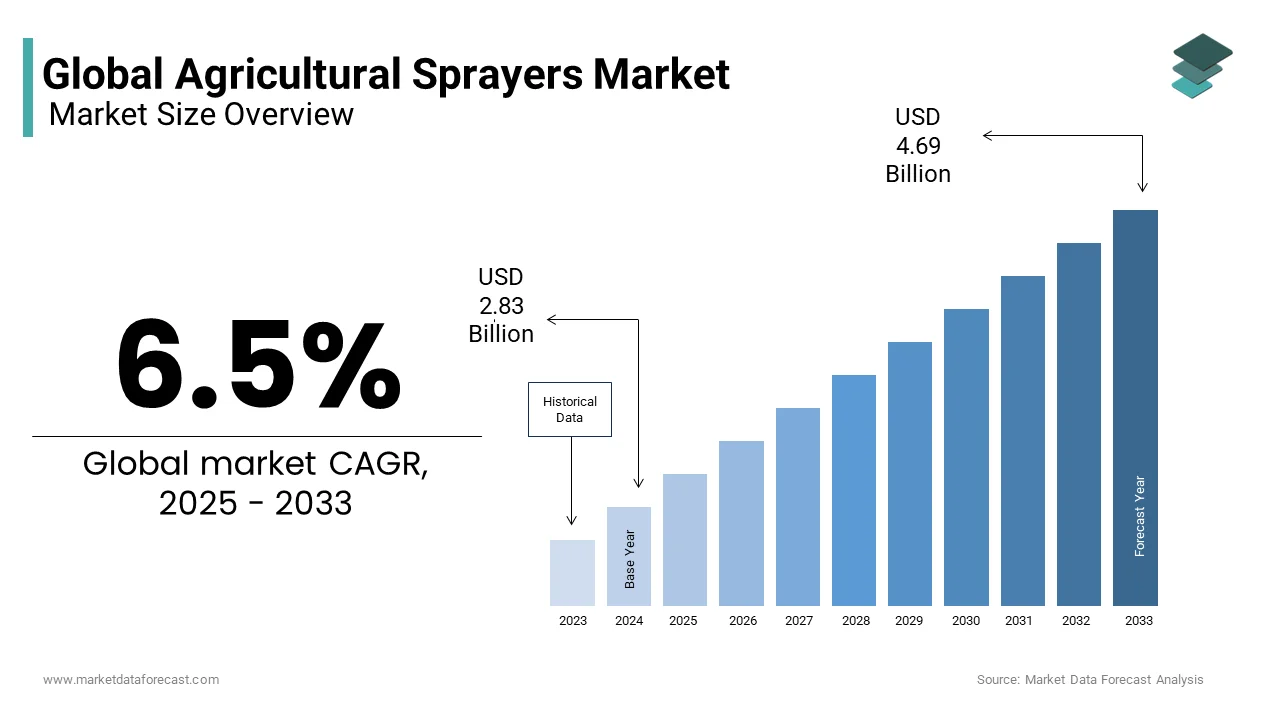
The agriculture sprayers are a diverse array of equipment engineered to deliver liquid agrochemicals, including herbicides, fungicides, insecticides, and liquid fertilizers to crops with precision, efficiency, and minimal environmental impact. These systems span from basic manual backpack units to highly sophisticated self-propelled, tractor-mounted, and drone-integrated platforms featuring real-time sensors, variable-rate technology, and automated guidance. According to the Food and Agriculture Organization of the United Nations, nearly 37% of the world’s agricultural land suffers from moderate to severe degradation, intensifying the need for targeted chemical delivery that conserves soil health while maximizing yield. Additionally, the International Labour Organization estimates that over one billion people depend on agriculture for livelihoods, many of whom increasingly rely on mechanized spraying solutions to enhance labor productivity and reduce exposure to hazardous substances.
MARKET DRIVERS
Rising Adoption of Precision Agriculture Technologies
The integration of digital and precision agriculture technologies is fundamentally transforming sprayer functionality and demand, which is a major driving factor for the growth of the agriculture sprayer market. Modern sprayers now incorporate real-time kinematic GPS, multispectral imaging, and AI-driven decision algorithms that adjust spray rates based on live crop and pest data. This shift enables site-specific application, drastically reducing chemical overuse and environmental contamination. As per the United States Department of Agriculture, large-scale corn and soybean operations in the United States utilized precision agriculture tools with variable-rate sprayers showing the fastest adoption growth. Field trials by the International Food Policy Research Institute further confirm that precision sprayers can cut pesticide use without compromising yield, a compelling economic and ecological advantage. As connectivity infrastructure expands in rural areas and farm management software becomes more intuitive, the transition from conventional to intelligent spraying systems is accelerating across both industrialized and emerging farming economies.
Growing Emphasis on Reducing Chemical Runoff and Environmental Compliance
The environmental regulations targeting agrochemical runoff are compelling widespread upgrades to low-drift, closed-transfer, and buffer-compliant sprayer systems, which are accelerating the growth of the agriculture sprayer market. The European Union’s Sustainable Use of Pesticides Directive mandates risk reduction measures that directly influence sprayer design and operational protocols. In the United States, the Environmental Protection Agency enforces label requirements that increasingly specify low-drift application methods standards only achievable with modern sprayers featuring air-induction nozzles and canopy-adaptive sensors. Countries implementing integrated pest management frameworks have reduced off-target pesticide deposition by 22% since 2018. These regulatory imperatives are converting sprayer modernization from an optional efficiency measure into a compliance necessity in ecologically sensitive or water-stressed regions.
MARKET RESTRAINTS
High Initial Investment and Limited Access to Financing in Developing Regions
The substantial capital outlay required for advanced sprayers for smallholder and resource-constrained farmers in Sub-Saharan Africa and South Asia is restraining the growth of the bathe griculture sprayers market. Self-propelled precision sprayers often exceed 50,000 US dollars, far beyond the reach of farmers whose average annual income frequently falls below 2,000 US dollars. Even mid-tier trailed sprayers priced between 5,000 and 15,000 US dollars demand access to formal credit, which remains scarce in many agricultural communities. According to the International Fund for Agricultural Development, only 12% of smallholder farmers in low-income countries have access to institutional financing. In India, despite subsidies covering up to 50% of equipment costs under the Sub-Mission on Agricultural Mechanization, uptake among marginal farmers remains low due to bureaucratic delays and complex documentation. The absence of localized service networks further deters investment, as equipment downtime can severely disrupt planting and spraying schedules. Consequently, financial and institutional gaps perpetuate reliance on inefficient manual methods, undermining broader sustainability and productivity goals.
Lack of Technical Expertise and Digital Literacy Among End Users
The operational sophistication of next-generation sprayers demands technical competencies that many current farm operators lack in regions with aging farming populations and underfunded extension services. The lack of technical expertise and digital literacy among end users is degrading the growth of the agriculture sprayers market. Tasks such as calibrating flow rates, interpreting sensor data, updating firmware, and integrating with farm management software assume a baseline level of digital literacy. According to the Food and Agriculture Organization, farmers in Southeast Asia and Latin America have never received formal training in digital agricultural tools. A 2023 survey by the organization found that 44% of farmers over the age of 55 struggle with precision sprayer interfaces, leading to feature underutilization. Similarly, only 28% of farms under 100 acres employ personnel trained in precision agriculture, according to some reports.
MARKET OPPORTUNITIES
Expansion of Specialty Crop Cultivation Driving Demand for Customized Sprayers
The global rise in high-value specialty crop production, including fruits, vegetables, nuts, and vineyards, is fueling demand for specialized sprayers designed for complex canopy architectures and sensitive plant physiology. The expansion of specialty crop cultivation is amplifying the growth of the agriculture sprayers market. Unlike broadacre systems, specialty crops require precise, three-dimensional coverage to avoid phytotoxicity and ensure uniform chemical deposition. The global exports of fresh fruits and vegetables reached 380 billion US dollars in 2022, which is growing at an annual rate of 6% over the past five years. This trend is directly influencing equipment preferences. In California, which produces over 90% of U.S. specialty crops, as per the source, orchard and vineyard sprayer sales grew by 18% between 2021 and 2023. These niche applications command premium pricing and higher margins, incentivizing manufacturers to develop modular, crop-specific platforms that align with the agronomic and economic realities of high-value horticulture.
Government Subsidies and Mechanization Initiatives in Emerging Economies
The public-sector programs promoting agricultural mechanization for sprayers in regions historically dominated by manual labor are creating opportunities for the growth of the agricultural sprayer market. India’s Sub-Mission on Agricultural Mechanization has disbursed over 1.2 billion US dollars in subsidies since 2016, with sprayers among the most commonly procured items, as per the reports. Nigeria’s Anchor Borrowers’ Program offers interest-free equipment loans, resulting in a 35% year-over-year increase in sprayer distribution in 2022. In Brazil, the federal Moderagro credit line allocated 800 million US dollars in 2023 specifically for precision application machinery, signaling a strategic shift toward sustainable intensification. These initiatives not only lower entry barriers but also stimulate local manufacturing ecosystems.
MARKET CHALLENGES
Fragmented Regulatory Landscape for Pesticide Application Equipment
The absence of globally harmonized standards for sprayer performance, testing, and certification creates significant compliance and operational complexity is a major challenge for the growth of the agriculture sprayer market. As per the Organisation for Economic Co-operation and Development, voluntary test guidelines for pesticide application equipment, adoption remains inconsistent. In the European Union, the EN 13790 standard requires sprayer testing every five years, yet enforcement varies widely among member states. In contrast, many countries in Africa and Southeast Asia lack any formal inspection regime by allowing inefficient or leak-prone equipment to remain in use. According to the Pesticide Action Network, inconsistent nozzle calibration and pressure regulation in unregulated markets can increase chemical waste when compared to certified systems. This regulatory fragmentation impedes cross-border equipment trade, complicates multinational farm operations, and slows the adoption of best practices, where counterfeit or substandard sprayers proliferate due to weak import controls and limited consumer awareness.
Vulnerability to Supply Chain Disruptions for Critical Components
The ongoing exposure to global supply chain volatility for semiconductors, specialty polymers, hydraulic valves, and electric motor components sourced from geographically concentrated suppliers is another factor declining the growth of the agriculture sprayers market. The semiconductor shortage that began in 2020 severely disrupted production of GPS-guided and sensor-equipped sprayers, with major manufacturers reporting delivery delays of up to nine months, as per some sources. The war in Ukraine impacted supplies of neon gas used in laser guidance systems, while China’s export restrictions on rare earth elements affected motor production for electric sprayer pumps. In Latin America, advanced sprayer components are imported are making the region especially vulnerable to currency fluctuations and customs bottlenecks.
REPORT COVERAGE
| REPORT METRIC | DETAILS |
| Market Size Available | 2025 to 2034 |
| Base Year | 2025 |
| Forecast Period | 2026 to 2034 |
| CAGR | 6.5% |
| Segments Covered | By Type, Crop Type, Power Source |
| Various Analyses Covered | Global, Regional & Country Level Analysis, Segment-Level Analysis, DROC, PESTLE Analysis, Porter’s Five Forces Analysis, Competitive Landscape, Analyst Overview on Investment Opportunities |
| Regions Covered | North America, Europe, APAC, Latin America, Middle East & Africa |
| Market Leaders Profiled | EXEL Industries, John Deere, CNH Industrial N.V., AGCO Corporation, Bucher Industries AG, Kubota Corporation, Mahindra & Mahindra Ltd., AG Spray Equipment, H.D. Hudson Manufacturing Company |
SEGMENTAL ANALYSIS
By Type Insights
The tractor-mounted sprayers segment accounted in holding 38.2% of the agriculture sprayers market share in 2025 due to their versatility, cost efficiency, and seamless integration with existing farm machinery across diverse farm sizes. Their dominance is particularly pronounced in regions with high tractor penetration, such as North America, Europe, and parts of Asia. These sprayers offer superior coverage width, consistent pressure control, and compatibility with precision farming add-ons like section control and flow meters. In the United States, corn and soybean growers use tractor-mounted sprayers as their primary application method, which is fuel efficiency and reduced labor requirements as key advantages. Additionally, manufacturers such as John Deere and CNH Industrial have invested heavily in retrofit kits that enable older tractors to support modern sprayer attachments, extending equipment lifecycles and lowering entry barriers.
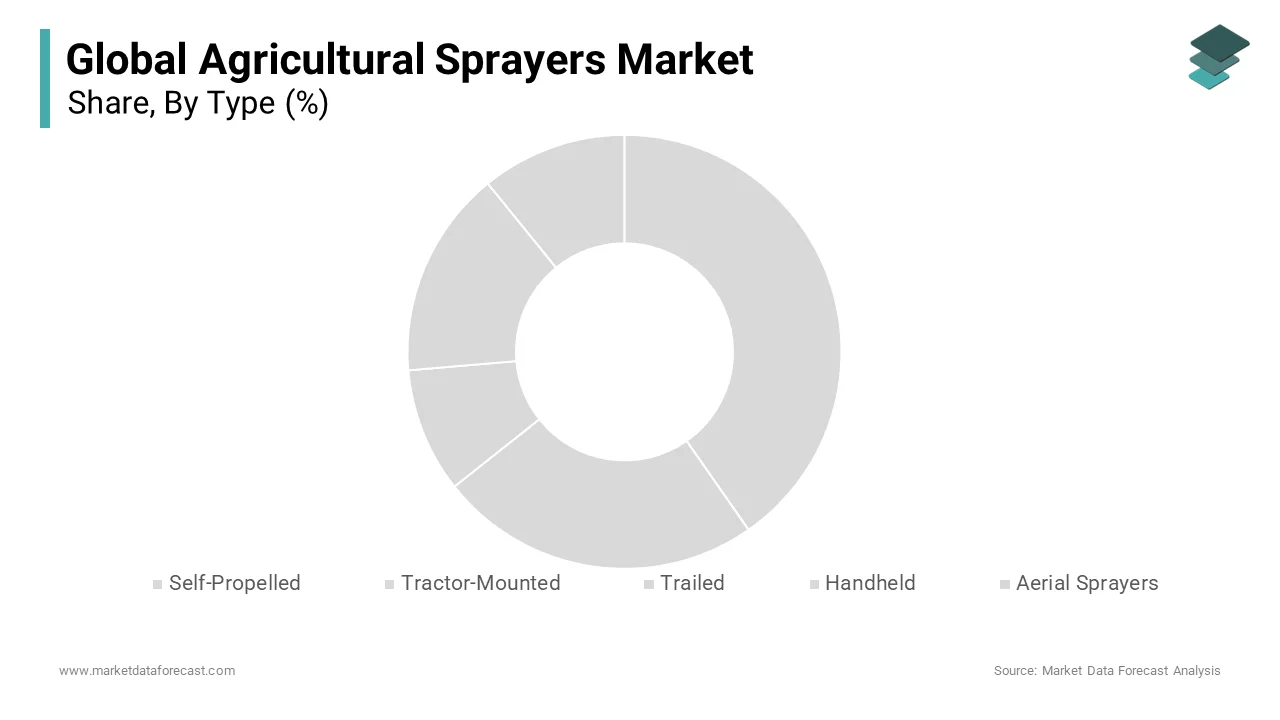
The aerial application segment is likely to grow at a CAGR of 11.2% from 2025 to 2033 via drones and manned aircraft, driven by labor shortages, the need for rapid intervention during pest outbreaks, and the rise of digital farming ecosystems. In China, the Ministry of Agriculture and Rural Affairs recorded a 120% increase in agricultural drone registrations between 2021 and 2023, with over 200,000 units deployed for crop protection. These systems can cover 50 to 100 acres per hour, up to ten times faster than ground equipment by making them indispensable during narrow application windows in rice and orchard farming. The convergence of lightweight battery technolAI-poweredwered flight planning, and real-time multispectral feedback has transformed aerial sprayers from niche tools into scalable solutions for high-value and hard-to-reach crops, fueling their exceptional growth trajectory.
By Crop Insights
The grains and cereals segment was the largest by capturing 42.3% of the agriculture sprayers market share in 2025 due to their vast cultivated area, standardized row spacing, and susceptibility to fungal and insect pressures requiring frequent chemical intervention. According to the United Nations Food and Agriculture Organization, cereals represent nearly half of all arable land under cultivation. In India, the world’s second-largest rice producer, pesticide applications are annually made on paddy fields, predominantly delivered via boom sprayers. Similarly, in the United States, corn acres receive at least one fungicide or insecticide spray during the growing season, necessitating high-capacity, wide-boom systems. The economic scale of cereal farming supports investment in mechanized spraying, while government procurement policies in countries like China and Russia further stabilize demand. Moreover, the uniform canopy structure of cereal crops enables efficient coverage with minimal drift by making them ideal for both conventional and precision spraying technologies, thereby reinforcing this segment’s market leadership.
The fruits and vegetables segment is anticipated to grow at the fastest CAGR of 8.3% from 2025 to 2033 due to rising global consumption of fresh produce, expansion of high-value horticulture, and stringent residue limits that demand ultra-precise chemical application. According to the World Health Organization, global fruit and vegetable intake needs to increase to meet recommended dietary guidelines, a target driving policy support in over 60 countries. Additionally, retail giants such as Walmart and Tesco now enforce Maximum Residue Level compliance across their supply chains, compelling growers to adopt calibrated, low-volume sprayers that minimize chemical carryover. These intersecting forces of health consciousness, regulatory stringency, and export competitiveness are propelling the rapid adoption of advanced spraying solutions in this segment.
By Power Source Insights
The fuel-based sprayers segment was the largest with a dominant share of the agriculture sprayers market in 2025, with diesel or gasoline engines remaining the dominant power source due to their high output capacity, operational autonomy, and suitability for large-scale and remote farming operations. These systems are especially prevalent in North America, South America, and Australia, where farm sizes often exceed 500 hectares and continuous field operation is essential. According to the International Energy Agency, global diesel consumption with sprayers represents a significant portion of this demand in broadacre cropping systems. In Brazil, the world’s largest soybean exporter, commercial farms rely on diesel-powered self-propelled sprayers for timely herbicide application during the narrow pre-emergence window. The robust torque delivery and refueling convenience of internal combustion engines make them indispensable in regions with limited rural electrification or unreliable grid access. Moreover, existing service infrastructure for engine maintenance ensures lower downtime compared to emerging alternatives.
The electric and battery-driven sprayers segment is expected to witness the fastest CAGR of 11.9% during the forecast period, with the decarbonization mandates, advancements in lithium-ion battery technology, and rising demand for quiet, low-emission equipment in peri-urban and organic farming. According to the International Renewable Energy Agency, the cost of lithium iron phosphate batteries fell by 89% between 2010 and 2023, enabling manufacturers to produce affordable 48-volt sprayer platforms with 6 to 8-hour runtimes. In the Netherlands, a global leader in greenhouse horticulture, the Ministry of Agriculture reported that new sprayer purchases in 2023 were electric, driven by strict indoor air quality regulations that prohibit combustion emissions. Urban farming initiatives in cities like Singapore and Berlin further accelerate adoption, as compact electric units integrate seamlessly with vertical farms and rooftop gardens.
REGIONAL ANALYSIS
North America Market Analysis
North America was the top performer of the agriculture sprayers market by holding 39.2% of the share in 2025 due to technologically advanced farming practices and high mechanization rates across the United States and Canada. The early adoption of precision agriculture, strong farmer income levels, and supportive policy frameworks, such as the U.S. Farm Bill’s Environmental Quality Incentives Program, which subsidizes conservation-compliant spraying equipment. Canada’s Prairie provinces have seen a 30% increase in self-propelled sprayer registrations since 2020 by expanding canola and lentil acreage vulnerable to sclerotinia and aphid outbreaks. Additionally, stringent pesticide drift regulations enforced by the Environmental Protection Agency have accelerated replacement cycles toward low-drift nozzles and closed transfer systems. The presence of global equipment manufacturers like John Deere and AGCO further reinforces regional innovation and after-sales support by ensuring sustained leadership in high-end sprayer adoption.
Europe Market Analysis
Europe's agricultural sprayers market growth held 25.3% of share in 2025 due to a strong regulatory emphasis on environmental sustainability and integrated pest management. The European Union’s Green Deal and Farm to Fork Strategy mandate a 50% reduction in pesticide use by 2030, which is compelling farmers to invest in precision sprayers that minimize off-target deposition. According to Eurostat, 22 member states now require mandatory sprayer testing every three to five years, with non-compliant equipment barred from chemical application. In France, the Ecophyto plan has funded over 15,000 sprayer upgrades since 2020 to meet drift reduction targets. Furthermore, the Common Agricultural Policy allocates billions annually to support digital farming tools, including smart sprayers with real-time monitoring.
Asia Pacific Market Analysis
Asia Pacific agriculture sprayers market growth is expected to witness the fastest CAGR during the forecast period, with the vast agricultural populations, government mechanization drives, and the rapid expansion of smallholder access to affordable equipment. China’s Ministry of Agriculture reported that over 12 million small electric sprayers were sold in 2023 alone.
Latin America Market Analysis
Latin America agriculture sprayers market growth is likely to grow with the dynamic and fast evolving segment of the agriculture sprayers market, led by Brazil and Argentina’s export-oriented soybean, corn, and sugarcane industries. Additionally, aerial application is gaining traction in the Amazon frontier zones where ground access is limited.
Middle East and Africa Market Analysis
The Middle East and Africa agriculture sprayers market growth is likely to grow with the strategically important segment of the agriculture sprayers market, shaped by water scarcity, food security imperatives, and uneven mechanization levels. South Africa, Egypt, and Morocco lead adoption, while Sub-Saharan Africa remains dominated by manual spraying due to financial and infrastructural constraints. In Egypt, the Ministry of Agriculture launched a 2023 program to distribute 50,000 subsidized battery sprayers to combat cotton bollworm outbreaks in the Nile Delta. Saudi Arabia’s Vision 2030 includes investments in vertical farming and date palm protection, which is driving demand for precision misting systems.
COMPETITIVE LANDSCAPE
The agriculture sprayers market features intense competition among established multinational manufacturers and agile regional players. Global leaders such as John Deere, AGCO and CNH Industrial dominate through technologically advanced high-capacity systems backed by extensive service infrastructures and digital ecosystems. Meanwhile, regional manufacturers in India, China, a nd Brazil capture volume with cost-effective handheld and battery-powered models tailored to smallholder needs. The competitive landscape is further shaped by rapid technological convergence as companies embed automation, connectivity, and sustainability features to differentiate offerings. Price sensitivity in emerging economies drives product tiering while regulatory compliance in Europe and North America necessitates continuous R&D investment. New entrants, including drone and robotics startups, are disrupting traditional segments with aerial and autonomous solutions. This dynamic environment compels incumbents to balance innovation, affordability,,y and service excellence to retain market relevance across diverse agricultural contexts.
KEY MARKET PLAYERS
Major key players in the global agriculture Sprayers market
- EXEL Industries
- John Deere
- CNH Industrial N.V.
- AGCO Corporation
- Bucher Industries AG
- Kubota Corporation
- Mahindra & Mahindra Ltd.
- AG Spray Equipment
- H.D. Hudson Manufacturing Company
- Yamaha Motor Corp.
- STIHL
- AMAZON-Werke
- GROUP S.p.A.
- Agro Chem Inc.
- Boston Crop Sprayers Ltd.
- John Rhodes AS Ltd
- Buhler Industries Inc.
- H&H Farm Machine Co.
Top Players In The Market
- John Deere is a globally recognized leader in agricultural machinery with a significant footprint in the agriculture sprayers market. The company offers a comprehensive portfolio of self-propelled and integrated sprayer systems designed for large-scale farming operations. John Deere has consistently invested in precision agriculture technologies, including real-time diagnostics, variable rate application,n anAI-drivenen spray control. In recent years, the company strengthened its position through strategic software integrations with its Operations Center platform, enabling seamless data flow between sprayers and farm management systems. These innovations enhance operational efficiency and support sustainable chemical use, aligning with global regulatory trends and farmer demands for smart farming solutions.
- AGCO Corporation is a major force in the agriculture sprayers market through its Fendt and RoGator brands, which deliver high-capacity self-propelled sprayers tailored for diverse agronomic conditions. The company emphasizes engineering excellence and fuel efficiency while incorporating advanced telematics and automation features. AGCO has recently expanded its digital ecosystem by enhancing connectivity between its sprayers and the Fuse Smart Farming platform, allowing for remote monitoring and predictive maintenance. Additionally, the company has increased its focus on service networks and operator training programs, particularly in emerging markets, to improve equipment uptime and user productivity, thereby reinforcing long-term customer loyalty and brand reliability.
- CNH Industrial operates prominently in the agriculture sprayers segment under its Case IH and New Holland Agriculture brandsoffering tractor-mounted trailed, and self-propelled models. The company has prioritized sustainability by developing sprayers with reduced drift nozzles, a closed transfer system, and compatibility with bio-based chemicals. Recently, CNH Industrial accelerated its electrification roadmap by unveiling prototype battery-powered sprayers and partnering with agritech startups to integrate sensor-based application technologies. It also expanded its parts distribution and digital support services across Asia and Latin America to ensure accessibility and performance consistency.
Top Strategies Used By The Key Market Participants
Key players in the agriculture sprayers market employ several strategic approaches to maintain a competitive advantage. Product innovation remains central with companies integrating GPS guidance, variable rate technology, and AI-driven applications into their sprayers. Strategic partnerships with agritech firms and software developers enable seamless data interoperability and enhanced decision support. Geographic expansion, particularly into high-growth regions like Southeast Asia and Sub-Saharan Africa, is pursued through localized product adaptations and financing solutions. Companies also invest heavily in after-sales service networks, including digital diagnostics, remote support, rt, and operator training programs. Additionally, sustainability-driven initiatives such as developing electric sprayers and promoting low-drift nozzles align with global environmental regulations and consumer expectations, strengthening brand positioning and market relevance.
RECENT MARKET NEWS
In March 2024, John Deere launched its new See and Spray Ultimate system for its R4030 spry, a real-time plant-level herbicide application using advanced computer vision and machine learning to reduce chemical usage by up to 77% as validated by third-party field trials.
MARKET SEGMENTATION
This research report on the global agriculture sprayers market has been segmented and sub-segmented based on type, crop type, power source, and region.
By Type
- Self-Propelled
- Tractor-Mounted
- Trailed
- Handheld
- Aerial Sprayers
By Crop Type
- Pulses and Oilseeds
- Grains and Cereals
- Fruits and Vegetables
- Turf and Ornamentals
- Commercial Crop
By Power Source
- Fuel-Based
- Electric & Battery-Driven
- Manual
- Solar-Based Sprayers
By Region
- North America
- Europe
- Asia-Pacific
- Latin America
- Middle East and Africa