- Product Description Description
- Table of Contents TOC
- List of Table & Figure LOT
- Get Free Sample PDF Sample PDF
Market Size, 2025
$1,086.61 MnMarket Estimate, 2026
$1,503.86 MnMarket Forecast, 2034
$20,444.03 MnCAGR, 2026–2034
38.4%Global AI in Genomics Market Size
The global AI in genomics market was valued at USD 1,086.61 million in 2025, is estimated to reach USD 1503.86 million in 2026, and is projected to reach USD 20.444.03 million by 2034, growing at a CAGR of 38.4% from 2026 to 2034.
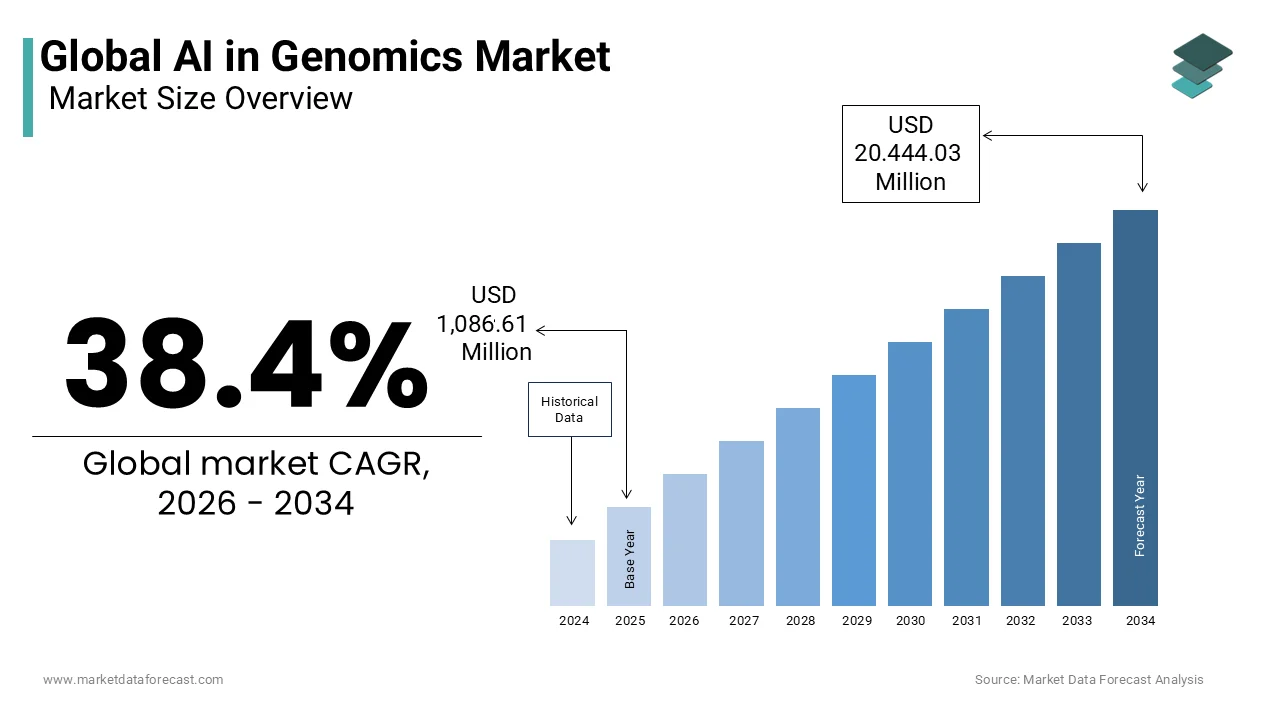
The AI in genomics is the integration of computational intelligence and genetic science by enabling deeper exploration of DNA sequencing, functional genomics, and disease associations. Artificial intelligence technologies, particularly machine learning and deep learning, are being used to accelerate gene mapping, variant interpretation, and biomarker discovery.
MARKET DRIVERS
Increasing Volume of Genomic Data
The exponential growth of genomic data is one of the major driving factors for the growth of AI in the genomics market. High-throughput sequencing technologies now produce vast datasets that exceed human analytical capacity. According to the National Institutes of Health, a single human genome contains over 3 billion base pairs, and by 2025, genomic data is projected to reach between 2 and 40 exabytes annually. This scale requires automated, AI-driven systems for interpretation, error correction, and meaningful extraction of clinical insights. Hospitals, research centers, and pharmaceutical companies increasingly depend on AI algorithms to sift through this vast information for applications such as drug target discovery, rare disease diagnosis, and gene therapy research.
Rising Adoption of Precision Medicine
The global shift toward precision medicine is propelling the AI in genomics market growth. AI algorithms allow clinicians to link genetic variations with treatment responses, thereby personalizing therapies for diseases such as cancer, cardiovascular disorders, and rare genetic conditions. According to the U.S. Food and Drug Administration, more than 25 percent of new drugs approved in 2022 were precision medicines, demonstrating the growing integration of genomics into therapeutic strategies. Furthermore, the Centers for Disease Control and Prevention emphasizes that nearly 350 million people worldwide suffer from rare diseases, many of which have genetic origins. AI-driven genomic analysis helps in identifying biomarkers, predicting disease susceptibility, and tailoring therapies for these populations.
MARKET RESTRAINTS
Data Privacy and Ethical Concerns
The significant barriers stemming from data privacy and ethical challenges are degrading the growth of AI in the genomics market. Genomic datasets contain deeply personal health information, raising concerns about misuse, discrimination, and consent. The World Economic Forum underscores that genomic information, if compromised, can reveal predispositions to chronic conditions, affecting insurability and employability. Additionally, cross-border data sharing is restricted by varying regulations, such as the European Union’s General Data Protection Regulation, which imposes strict safeguards on genetic data handling. In the Asia-Pacific region, diverse and sometimes inconsistent privacy laws further complicate large-scale AI training.
High Computational and Infrastructure Costs
The deployment of AI in genomics requires sophisticated computing infrastructure, which is additionally hampering the growth of the AI in genomics market. Deep learning algorithms and genomic sequencing data demand high-performance processors, large-scale storage, and advanced bioinformatics pipelines. According to the U.S. Department of Energy, the computational power needed to process a single human genome can exceed 100 gigabytes of storage and require extensive parallel computing. Smaller research labs and healthcare facilities often lack access to such resources, limiting adoption outside major genomic hubs. Furthermore, maintaining cloud-based AI platforms incurs recurring expenses, raising operational costs for developing economies. These infrastructural constraints restrict the accessibility of AI-driven genomic tools to elite research centers, slowing the democratization of precision genomics.
MARKET OPPORTUNITIES
Integration of AI with Multi-Omics Research
The integration of AI with multi-omics research, including genomics, proteomics, transcriptomics, and metabolomics, offers vast opportunities for AI in the genomics market. Combining these datasets can unlock a systems-level understanding of human health and disease. According to the National Cancer Institute, the human body contains approximately 20,000 protein-coding genes, but their function is influenced by a complex network of molecular interactions. AI platforms are uniquely positioned to analyze such multi-dimensional data simultaneously, identifying cross-omic biomarkers and disease signatures that traditional methods cannot. Pharmaceutical companies are increasingly leveraging this integration to accelerate drug discovery pipelines and predict therapeutic responses.
Expansion of AI in Population Genomics Initiatives
The rising number of large-scale population genomics initiatives worldwide is creating substantial opportunities for AI in genomics. National projects, such as the UK Biobank and the All of Us Research Program in the United States, are generating millions of genomic datasets linked with clinical records. According to Genomics England, the 100,000 Genomes Project has already sequenced over 100,000 participants, and is expanding to 5 million genomes. AI tools are essential for analyzing these vast, diverse datasets to identify population-specific disease markers and tailor public health strategies. Emerging economies are also investing in genome sequencing initiatives to address regional health burdens.
MARKET CHALLENGES
Algorithmic Bias and Data Diversity Issues
The algorithmic bias stemming from insufficiently diverse datasets quietly restricts the growth of AI in the genomics market. Most genomic studies are skewed toward populations of European ancestry, limiting the accuracy of AI models for other ethnic groups. As per the National Institutes of Health, nearly 80 percent of participants in genome-wide association studies are of European descent, despite Africa holding the greatest genetic diversity globally. This imbalance risks perpetuating health disparities and misinterpretations in disease risk predictions. For instance, AI systems trained on limited datasets may fail to detect variants relevant to underrepresented groups, undermining the clinical utility of genomics in those populations.
Limited Clinical Integration of AI Tools
The integration of advanced techniques into clinical workflows shall act as a barrier to the growth of AI in the genomics market. Many AI-driven genomic tools lack regulatory approvals and validation in real-world healthcare environments. Moreover, clinicians often face difficulties in interpreting AI-generated genomic outputs due to limited technical expertise. According to the World Health Organization, more than 50 percent of countries globally report shortages of trained genomics professionals, further complicating adoption. This gap delays the translation of AI-enabled genomic insights into actionable treatments for patients.
REPORT COVERAGE
| REPORT METRIC | DETAILS |
| Market Size Available | 2025 to 2034 |
| Base Year | 2025 |
| Forecast Period | 2026 to 2034 |
| Segments Covered | By Component, Technology Application, End-Use, and Region. |
| Various Analyses Covered | Global, Regional, and Country-Level Analysis, Segment-Level Analysis, Drivers, Restraints, Opportunities, Challenges; PESTLE Analysis; Porter’s Five Forces Analysis, Competitive Landscape, Analyst Overview of Investment Opportunities |
| Countries Covered | North America, Europe, APAC, Latin America, Middle East & Africa |
| Market Leaders Profiled | IBM, Microsoft Corporation, NVIDIA Corporation, Illumina, Inc., Thermo Fisher Scientific, SOPHiA GENETICS, Deep Genomics, Fabric Genomics, BenevolentAI, Data4Cure, Inc. |
SEGMENTATION ANALYSIS
By Component Insights
The software segment accounted for a significant share of the AI in genomics market in 2025, with data interpretation and predictive analytics. Genomic sequencing generates petabytes of raw data that require advanced software pipelines for alignment, annotation, and visualization. According to the National Center for Biotechnology Information, more than 2,000 genomic datasets are uploaded daily into repositories such as GenBank, underscoring the scale of computational demand. AI-enabled software suites are increasingly embedded in clinical decision-making platforms, enabling the rapid translation of genetic variants into actionable medical insights.
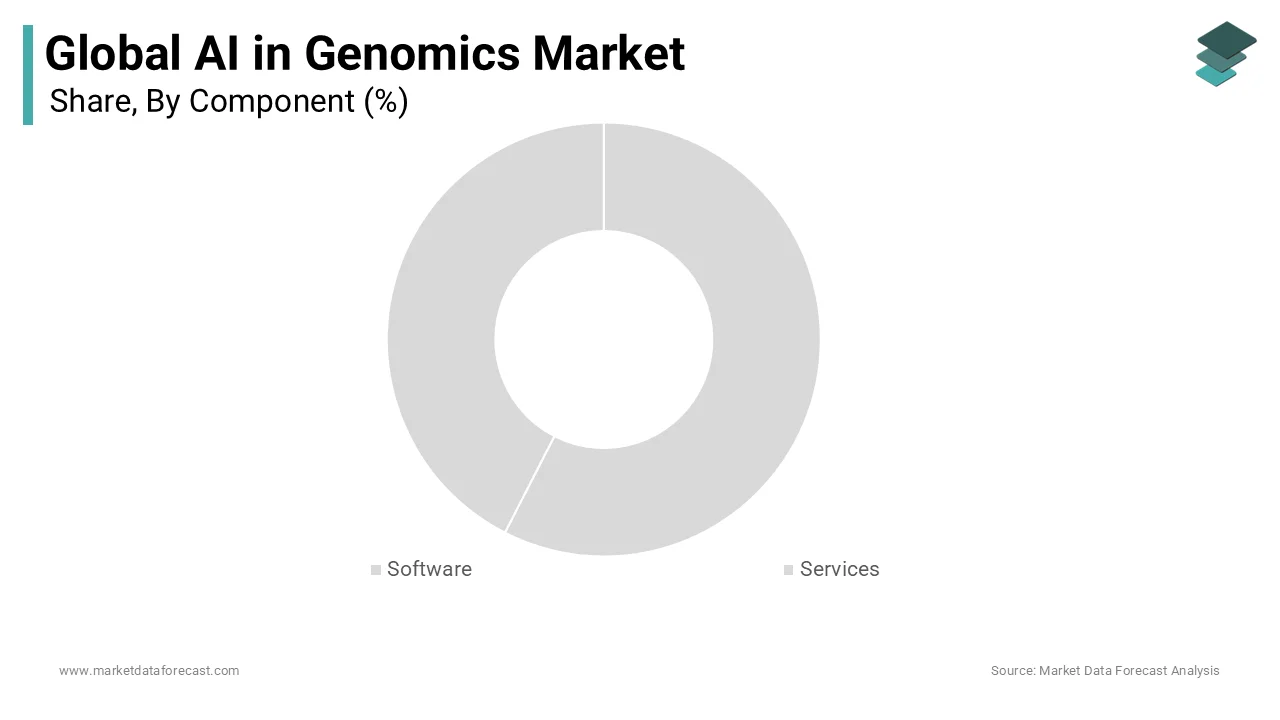
The services segment is growing lucratively with an expected CAGR of 23.1% during the forecast period, with the outsourcing of AI-driven genomics analytics to specialized providers. Many healthcare and research institutions lack in-house expertise in machine learning model training, creating strong demand for external service support. The World Health Organization estimates that more than 50 percent of countries globally report shortages of skilled genomics professionals, intensifying reliance on service providers. Additionally, large-scale initiatives such as the All of Us Research Program in the U.S. are partnering with AI-driven analytics companies to process diverse genomic datasets, further fueling service demand.
By Technology Insights
The machine learning segment was the largest and held a prominent share of the AI in genomics market in 2025, with the adoption of AI in genomics. Its capacity to process massive sequencing datasets, identify hidden patterns, and predict disease associations makes it indispensable. According to the Broad Institute, genome-wide association studies using machine learning models have identified over 250,000 genetic variants linked to complex diseases. These models are increasingly deployed in drug discovery pipelines, rare disease diagnosis, and personalized medicine platforms.
The computer vision is projected to grow at the fastest CAGR of 22.1% in the coming years, with the rise of high-throughput imaging techniques in genomics research, including cryo-electron microscopy and single-cell imaging. According to the European Molecular Biology Laboratory, advances in high-resolution microscopy have generated image datasets exceeding terabytes per experiment, necessitating AI-driven visual analysis. Computer vision enables real-time cellular structure mapping, chromosomal imaging, and phenotypic-genotype correlations, significantly enriching genomic insights.
By Application Insights
The drug discovery segment held a prominent share of the AI in genomics market in 2025, with its direct impact on pharmaceutical pipelines and R&D efficiency. AI-driven genomic platforms are helping identify druggable targets, repurpose existing compounds, and predict patient responses. Genomics-based drug development is particularly transformative in oncology, where AI models rapidly identify tumor-specific biomarkers for targeted therapies.
The precision medicine segment is growing rapidly with an expected CAGR of 24.3% in the coming years. AI enables the integration of genomic data with electronic health records to tailor treatment regimens. According to the U.S. FDA, over 25 percent of approved drugs in 2022 were classified as precision medicines, signaling a paradigm shift. The rise in chronic diseases, coupled with declining sequencing costs, is further driving this demand. AI platforms enhance risk stratification, predict therapy outcomes, and optimize clinical decision-making. The expanding role of genomics in preventive healthcare makes this segment highly attractive for long-term growth.
By End-use Insights
The pharmaceutical and biotech firms segment held a significant share of the AI in genomics market in 2025 as they leverage these tools for accelerating pipelines, biomarker identification, and clinical trial design. The Pharmaceutical Research and Manufacturers of America reported that biopharmaceutical companies invested over 100 billion USD in R&D in 2022, with genomics being a focal area. AI allows these firms to sift through large genomic libraries to discover novel molecules and predict off-target effects.
The healthcare providers segment is likely to register a CAGR of 22.6% in the coming years due to the clinical integration of AI in genomics for diagnosis and treatment planning. Hospitals and diagnostic laboratories are incorporating AI-powered genomic tools into oncology, cardiology, and rare disease care. According to the World Health Organization, nearly 70 percent of healthcare decisions depend on diagnostic tools, making genomics central to future care delivery. AI-driven decision support systems allow physicians to match patients with optimal therapies, improving outcomes and reducing trial-and-error prescribing.
REGIONAL ANALYSIS
North America AI In Genomics Market Analysis
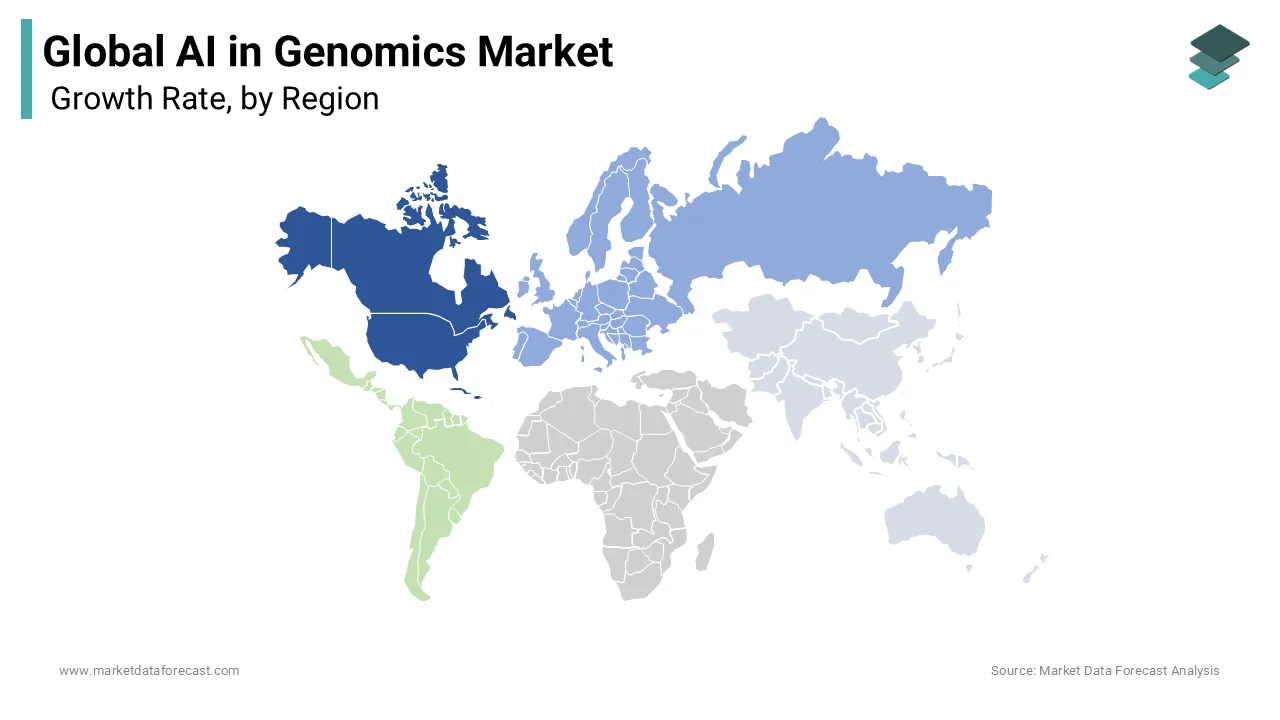
North America market was accounted in holding a dominant share of the AI in genomics market in 2025 with the robust healthcare infrastructure, high R&D spending, and large-scale genomic initiatives. The U.S. National Institutes of Health allocated over 7.6 billion USD to genomics-related research in 2022. Additionally, projects like the All of Us Program, which aims to collect data from one million participants, fuel AI demand. Strong collaborations between academic institutions and AI start-ups position North America at the forefront of innovation.
Europe AI In Genomics Market Analysis
Europe’s market growth is likely to grow with the national sequencing programs and strict regulatory frameworks ensuring genomic data integrity. Genomics England has already sequenced over 100,000 genomes, with plans to expand to 5 million. The European Union’s Horizon Europe program is also funding cross-border AI-genomics collaborations. The emphasis on ethical data handling and personalized healthcare adoption drives growth in this region.
Asia Pacific AI In Genomics Market Analysis
Asia Pacific market growth is likely to grow eventually with the massive investments from China, Japan, and India in genomic sequencing and AI. According to China’s Ministry of Science and Technology, over 1.4 million genomes have been sequenced under its Precision Medicine Initiative. According to Japan’s Society for Genome Research, similar efforts are particularly in oncology. Rapid urbanization, expanding healthcare budgets, and high prevalence of genetic disorders fuel APAC’s strong trajectory.
Latin America AI In Genomics Market Analysis
Latin America’s market is growing with the adoption of advanced technologies in research and development activities. According to Brazil’s Ministry of Health, genetic diseases affect nearly 13 million citizens with unmet needs. Collaborative initiatives with international AI firms are gradually expanding genomic infrastructure.
Middle East & Africa AI In Genomics Market Analysis
The Middle East & Africa market is growing with initiatives like the Emirati Genome Program, aiming to sequence one million citizens. According to the UAE government, this program is central to personalized medicine strategies. South Africa is also advancing in genomics through its Human Genome Project.
COMPETITIVE LANDSCAPE
The AI in genomics market is highly competitive, with global technology firms, specialized biotech companies, and sequencing providers. Competition is driven by technological innovation, where companies invest heavily in machine learning and deep learning models to uncover hidden genomic insights. Large players such as Illumina and Microsoft leverage their infrastructure and partnerships to dominate sequencing and data management, while niche companies like Deep Genomics bring specialized AI expertise for therapeutic development. In the Asia Pacific, the competitive intensity is rising as governments prioritize genomics in national healthcare strategies, attracting both international and regional firms.
KEY MARKET PLAYERS
Some of the major companies and institutions in the AI in Genomics space
- IBM
- Microsoft Corporation
- NVIDIA Corporation
- Illumina, Inc.
- Thermo Fisher Scientific
- SOPHiA GENETICS
- Deep Genomics
- Fabric Genomics
- BenevolentAI
- Data4Cure, Inc.
TOP LEADING PLAYERS IN THE MARKET
- Illumina plays a central role in the AI in genomics market through its advanced sequencing platforms integrated with machine learning capabilities. In the Asia Pacific, the company has expanded partnerships with hospitals and research centers to enhance precision medicine adoption. Illumina’s efforts to embed AI-driven interpretation into sequencing workflows allow faster identification of genetic variants linked to cancer and rare diseases. Recently, the company introduced AI-based modules into its Connected Analytics platform, enabling researchers in countries like China, Japan, and India to manage large-scale genomic datasets with greater accuracy. Its collaborations with governments and biotech firms reinforce its regional influence.
- Deep Genomics is a pioneer in applying AI algorithms to RNA biology and therapeutic development, with significant traction in Asia Pacific biotech hubs. The company has developed AI-driven platforms to predict how genetic mutations affect RNA and proteins, expediting drug discovery processes. In recent years, Deep Genomics has partnered with academic institutions in Japan and Singapore to integrate AI solutions for rare genetic disorders.
- Microsoft strengthens the AI in the genomics market by offering scalable cloud and AI solutions through its Azure platform. In the Asia Pacific, Microsoft collaborates with genomic sequencing providers and research organizations to build AI-powered genomics platforms for healthcare delivery. The company’s integration of AI tools with genomic data analytics helps hospitals and biotech firms accelerate insights for drug discovery and patient diagnostics. A recent initiative in India involved Microsoft working with local genomics firms to develop AI-based platforms for affordable precision medicine. Its strong investment in healthcare AI ecosystems makes it a vital player in advancing genomics applications across the region.
TOP STRATEGIES USED BY KEY MARKET PARTICIPANTS
Key participants in the AI in genomics market are deploying strategies that combine technology integration, partnerships, and regional expansion. Many companies are embedding AI algorithms into sequencing and analytics platforms to boost accuracy in variant detection and disease prediction. Strategic collaborations with research institutes and healthcare providers are helping firms expand their reach in high-growth regions like the Asia Pacific. Players are also investing in cloud-based infrastructures to manage massive genomic datasets efficiently, ensuring scalability for clinical and research applications. Furthermore, licensing models and joint ventures with biotech firms are enabling faster drug discovery initiatives. Continuous innovation, coupled with local partnerships, reflects the dominant strategy to capture demand in emerging markets and enhance global competitiveness.
MARKET SEGMENTATION
This research report on the Global AI in Genomics Market is segmented and sub-segmented into the following categories:
By Component
- Software
- Services
- Others
By Technology
- Machine Learning
- Computer Vision
- Others
By Application
- Drug Discovery
- Precision Medicinea
- Others
By End-use
- Pharmaceutical & Biotech Firms
- Healthcare Providers
- Others
By Region
- North America
- Europe
- Asia Pacific
- Latin America
- Middle East & Africa