- Product Description Description
- Table of Contents TOC
- List of Table & Figure LOT
- Get Free Sample PDF Sample PDF
Market Size, 2025
$2.91 BnMarket Estimate, 2026
$3.85 BnMarket Forecast, 2034
$36.38 BnCAGR, 2026–2034
32.4%Global AI in Space Exploration Market Size
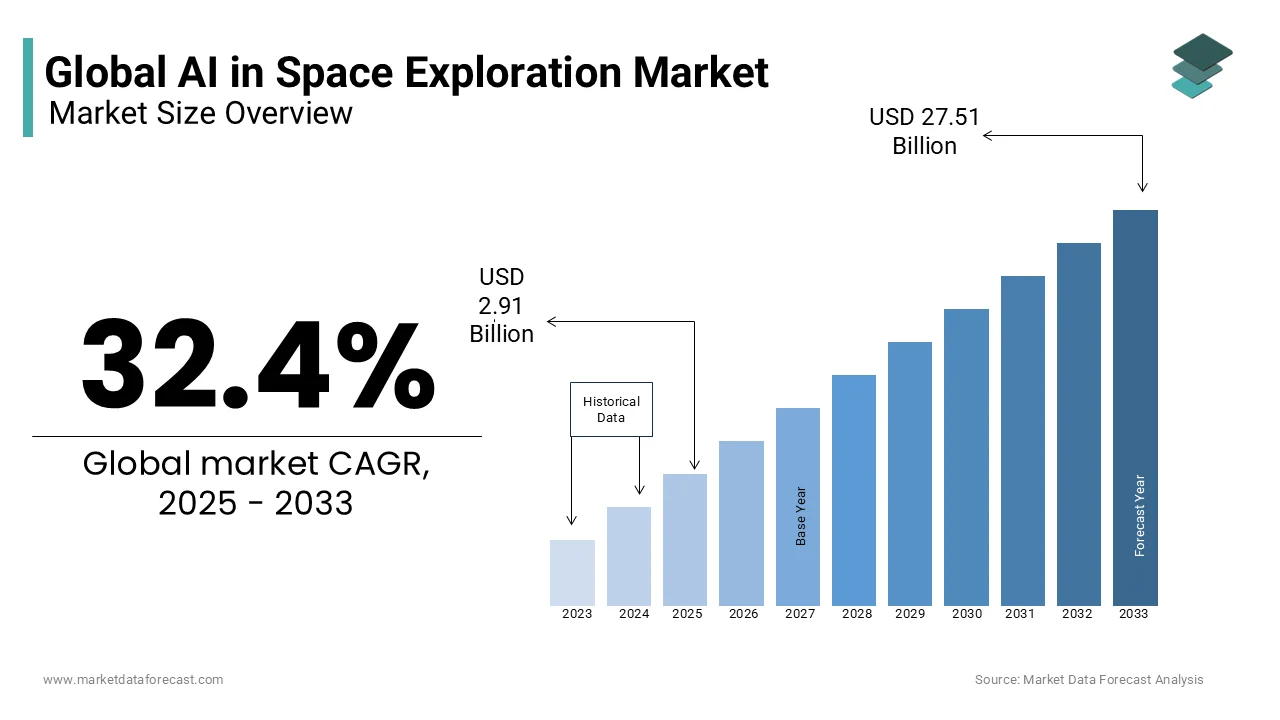
The global AI in space exploration market was worth USD 2.91 billion in 2025. The global market size is predicted at USD 3.85 billion in 2026 and is likely to grow at a CAGR of 32.4% during the forecast period, to reach USD 36.38 billion by 2034.
Current Scenario of the Market
Artificial Intelligence (AI) has already begun to introduce various new techniques in space exploration. The latest developments in AI and long research projects are planning to explore innovative space platforms. In fact, the satellites that are equipped with AI are creating a huge difference in making our lives better on Earth through various applications. Emerging new technologies in finding out the technical issues of the satellites in space, like methane gas leakage, and then processing the respective steps to further avoid the disasters is all set to be conquered using AI in space exploration. During space explorations, there will undoubtedly be many complex technical operations that need to be performed where AI with the machine learning language is doing wonders in solving the most dangerous and mysterious technical operations by simply analyzing the data and predicting potential failure in the early stage.
MARKET DRIVERS
The growth rate of AI in space exploration is driven by the rising demand for exploring and understanding new things in space.
Government authorities are showing much interest in providing huge funds to space exploration in some countries like the US, China, India, Russia, and others, which is ascribed to elevating the growth rate of AI in the space exploration market. Space mission projects should be performed more effectively where minor changes in the overall mission can lead to a disaster. AI is an amazing technology that can predict and analyze overall dataset capabilities to ensure a high success rate of mission possibilities.
In addition, AI in space exploration definitely has a major role in monitoring the spacecraft, especially in long-duration missions. It is highly important to take the necessary steps to maintain and repair the spacecraft, which is easily done by AI. The predictive algorithms were specially designed to monitor the health of the spacecraft, which can analyze the potential failure and send signals for immediate response. For instance, NASA introduced the Robonaut, a humanoid robot that performs repairs in the International Space Station that can avoid dangerous actions for astronauts. Therefore, the prominence of adopting various technologies in space exploration directly promotes the growth rate of the market to the greatest extent possible.
MARKET RESTRAINTS
Though AI is surely proven to be the best option for completing challenging tasks in space exploration, especially in harsh environmental conditions, the problem persists due to a mismatch between the current level of AI’s perception and intelligent decision-making. As this technology is completely new to the world, human efforts to undertake complex tasks in space require a high level of knowledge. Lack of this knowledge at this point in time may hinder the growth rate of AI in the space exploration market.
The evolving technology in the space missions is rising the concern over the risk of unauthorised system hacking like signal blocking, destruction, and others which is acting as a barrier for the growth rate of the market. However, top companies are implementing various applications in cybersecurity to avoid as much as possible risk factors in hacking.
MARKET OPPORTUNITIES
The world is evolving with the latest technologies in every aspect. AI is one of the most used technologies to collect and analyze data more accurately than the human mind. The time to discover new theories in the universe is becoming convenient and quick with the penetration of AI in space exploration. This is finding enormously new opportunities for the market to grow in the coming years. In day-to-day life on Earth, AI in space technologies greatly supports various aspects like communication, navigation, weather forecasting, and others. In today’s world, all these aspects play an important role in the day-to-day activities of every human, eventually promoting the scope of AI in the space exploration market growth rate in the foreseen years.
For instance, satellite imagery using AI technology is greatly emphasized in producing maps with ease in the rapidly changing urban environment at an unprecedented scale.
MARKET CHALLENGES
The integration of AI in space exploration comes with a huge positive response, but the cost for the deployment of these advanced applications needs huge investments, which is a major challenging factor for the market key players. The deployment of the AI with the traditional systems is a bit difficult task where installing all modern technologies need huge investments that is slowly impeding the AI in space exploration market’s growth rate.
REPORT COVERAGE
| REPORT METRIC | DETAILS |
| Market Size Available | 2025 to 2034 |
| Base Year | 2025 |
| Forecast Period | 2026 to 2034 |
| CAGR | 32.4% |
| Segments Covered | By Type, Application, End-User, and Region |
|
Various Analyses Covered | Global, Regional & Country Level Analysis, Segment-Level Analysis, DROC, PESTLE Analysis, Porter’s Five Forces Analysis, Competitive Landscape, Analyst Overview on Investment Opportunities |
| Regions Covered | North America, Europe, APAC, Latin America, Middle East & Africa |
|
Market Leaders Profiled | Lockheed Martin, Airbus, IBM, Northrup Grumman, Hewlett Packard Enterprise (HPE), Thales Group, Booz Allen Hamilton, Spacex, Maxar Technologies Inc., Astroscale, Planet Labs Inc., Spire Global, Iceye, Capella Space, Black Sky Global, Hawkeye 360, and D-Orbit |
SEGMENTAL ANALYSIS
By Type Insights
The Rover segment is leading with the highest share of AI in the space exploration market. Rovers have a crucial role in collecting data about surroundings, which are equipped with a variety of sensors. NASA launched a self-driving rover that found interesting facts about Mars. The rover is capable of navigating on Mars by avoiding obstacles with the help of data processed using AI and ML algorithms. The robotic arms segment is next in leading the market’s share. Space missions that are impossible without human efforts can be made possible with the help of robots. The installation of robotic arms in space mission projects helps in various ways.

By Application Insights
The remote sensing and monitoring segment is greatly influencing the growth rate of AI in the space exploration market. The rising importance of studying Earth’s surface from space for periodic observations and surveys in agriculture and many others is setting up new growth opportunities for the market. The Robotics segment is gearing with the highest share of the market. They act as a prominent solution in space exploration as they can withstand harsh environmental surroundings and deliver effective outcomes.
By End-user Insights
The government segment is gaining huge traction over the share of the market, whereas the commercial segment is likely to have significant growth opportunities in the coming years. The growing prominence over the launch of various spacecraft missions with support from the government is subsequently elevating the market’s growth rate.
REGIONAL ANALYSIS
AI in the space exploration market size is leading in North America. The US is the major country contributing the highest share of the market from the past decade and is expected to continue the same throughout the forecast period. The support from the US government through investments for NASA in launching various spacecraft with the most advanced technology is leveraging the growth rate of the market in this region. NASA ( National Aeronautics and Space Administration) is related to the science and technology related to air and space. The innovative technology is generally accompanied by NASA to create various research in space exploration that is tangible and has benefits for life on Earth.
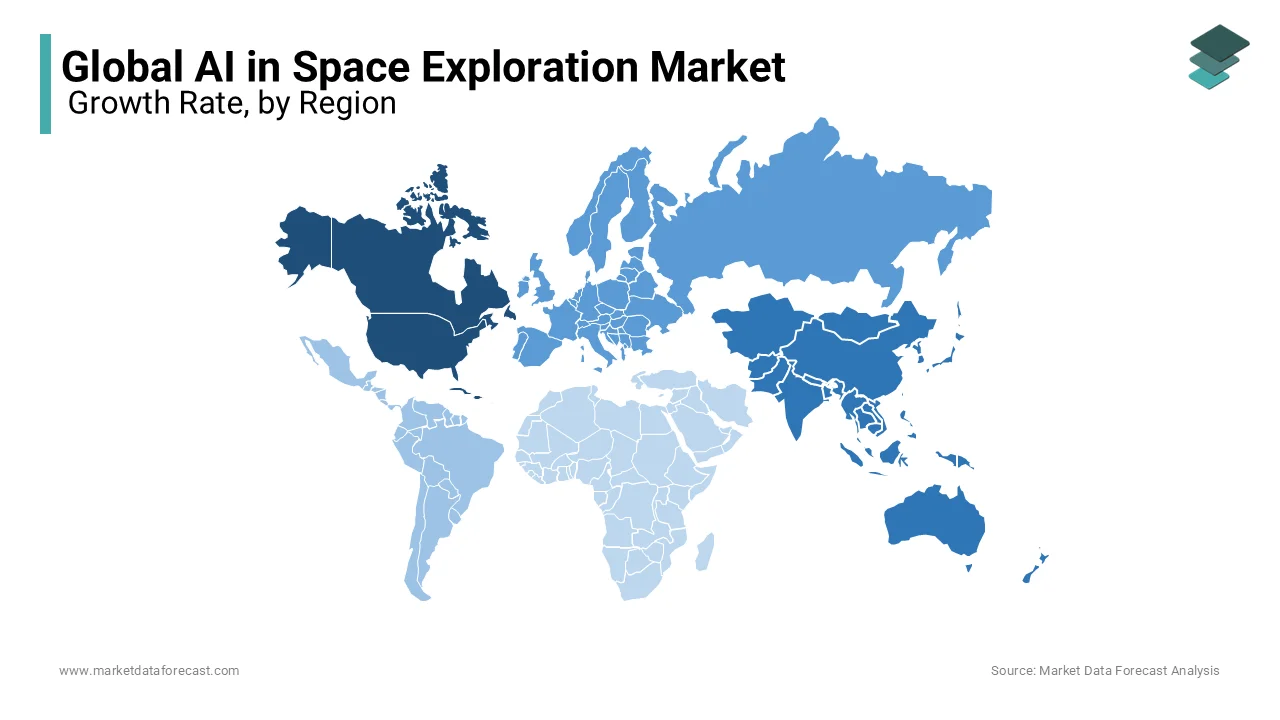
Asia Pacific is gearing up with many possibilities in space exploration. The growth of AI in space exploration is expected to reach the highest CAGR by the end of the forecast period. In recent times, India and China have been competing to find new scientific things in space. Rapidly adopting new technologies in the aeronautics industry and focusing on launching innovative research findings in India and China, spacecraft leverage the market’s growth rate. In 2023, Chandrayaan 3 was launched by ISRO, Srihari Kota, India. It is a huge success due to the deployment of AI technology. Furthermore, ISRO plans to launch 50 new AI-powered satellites for surveillance in the coming years.
Europe is deemed to hit the highest CAGR by the end of 2033. The increasing use of AI technology in space missions for better insights and decision-making processes is solely accelerating the growth rate of the market in Europe. The need to launch high-speed internet services is accompanied by increasing spacecraft projects and innovative discoveries from space that shall elevate the growth rate of the market. The rising collaborations between the private and public sectors to ensure efficient results in space exploration level up the growth rate of the market. AI in space exploration accelerates efficiency by simply predicting potential failure and other possible ways to level up the success of the overall project. Also, the reduction of human interventions with the launch of robotics is gearing up with the growth rate of the market.
RECENT HAPPENINGS IN THE MARKET
- In 2024, Lockheed Martin is revolutionizing Defense and Space technology by integrating AI and ML. Defense Advanced Research Projects Agency’s (DARPA) Artificial Intelligence Reinforcements – or “AIR” – program is one of the recent projects led by Lockheed Martin. Recently, DARPA and Lockheed Martin together to launch the most dynamic airborne missions using the most advanced AI tools.
- In 2024, IBM and NASA collaborated and introduced a new artificial intelligence model that supports a variety of weather and climate applications, well known as the Prithvi weather-climate foundation model. This is completely developed using a new AI model that opens the door to improving the regional and local weather and climate models.
KEY MARKET PLAYERS
The major players in the AI in Space Exploration Market include Lockheed Martin, Airbus, IBM, Northrup Grumman, Hewlett Packard Enterprise (HPE), Thales Group, Booz Allen Hamilton, Spacex, Maxar Technologies Inc., Astroscale, Planet Labs Inc., Spire Global, Iceye, Capella Space, Black Sky Global, and D-Orbit.
MARKET SEGMENTATION
This research report on the global ai in space exploration market has been segmented and sub-segmented based on the type, application, end-user, and region.
By Type
- Rovers
- Robotic Arms
- Space Probes
- Other Types
By Application
- Robotics
- Remote Sensing and Monitoring
- Data Analytics
- Asteroid Mining
- Manned Vehicles and Reusable Launch
- Communications
- Remote Missions
By End-user
- Government
- Commercial
By Region
- North America
- Europe
- Asia-Pacific
- Latin America
- The Middle East and Africa