- Product Description Description
- Table of Contents TOC
- List of Table & Figure LOT
- Get Free Sample PDF Sample PDF
Market Size, 2025
$6.99 BnMarket Estimate, 2026
$7.40 BnMarket Forecast, 2034
$11.65 BnCAGR, 2026–2034
5.84%Executive Summary: Global Spacecraft Market
- Market Scope: Comprehensive market evaluation of the global spacecraft sector, analyzing spacecraft types (manned vs. unmanned spacecraft), end-use applications (commercial, military, defense), and regional performance across Asia-Pacific, North America, Europe, Latin America, and the Middle East & Africa.
- Market Valuation: Valued at USD 6.99 billion in 2025, reaching USD 7.40 billion in 2026, and projected to scale up to USD 11.65 billion by 2034, registering a steady CAGR of 5.84% throughout the forecast period from 2026 to 2034.
- Primary Growth Drivers: Heightened international competition and increased government spending on national space programs, expanding space exploration R&D projects, the miniaturization of spacecraft components, and rising cross-border collaboration among space agencies for technology integration.
Key Market Segment Metrics
| Category | Leading Segment (Base Year Position) | Fastest-Growing / High-Impact Segment |
|---|---|---|
| By Type & Application | Unmanned Spacecraft (holds the largest market share owing to high volumes of satellite launches, freight transport, and planetary probes) | Commercial Segment (anticipated to capture the highest market share during the forecast period due to space economy goods/services and emerging commercial space concepts) |
| By Region | Asia-Pacific (projected to generate the highest market share, fueled by massive space investments from China, India, Japan, and South Korea) | North America (tends to register the highest CAGR, heavily anchored by NASA's substantial extraterrestrial budgets and industry giants like Lockheed Martin and Boeing) |
Major Market Players & Market Structure
Market Structure: A high-barrier, capital-intensive global marketplace featuring major aerospace corporations, defense contractors, and private spaceflight pioneers driving satellite deployment, orbital manufacturing research, and next-gen space logistics.
Key Companies: The Boeing Company, Airbus SE, SpaceX, Lockheed Martin Corporation, Sierra Nevada Corporation, Berlin Space Technologies GmbH, Northrop Grumman Corporation, Thales Alenia Space, Millennium Space Systems, and OHB System AG.
 Download Free Sample Report
Global Spacecraft Market Size
The global spacecraft market size was valued at USD 6.99 billion in 2025 and is anticipated to reach USD 7.40 billion in 2026 to reach USD 11.65 billion by 2034, growing at a CAGR of 5.84% during the forecast period from 2026 to 2034.
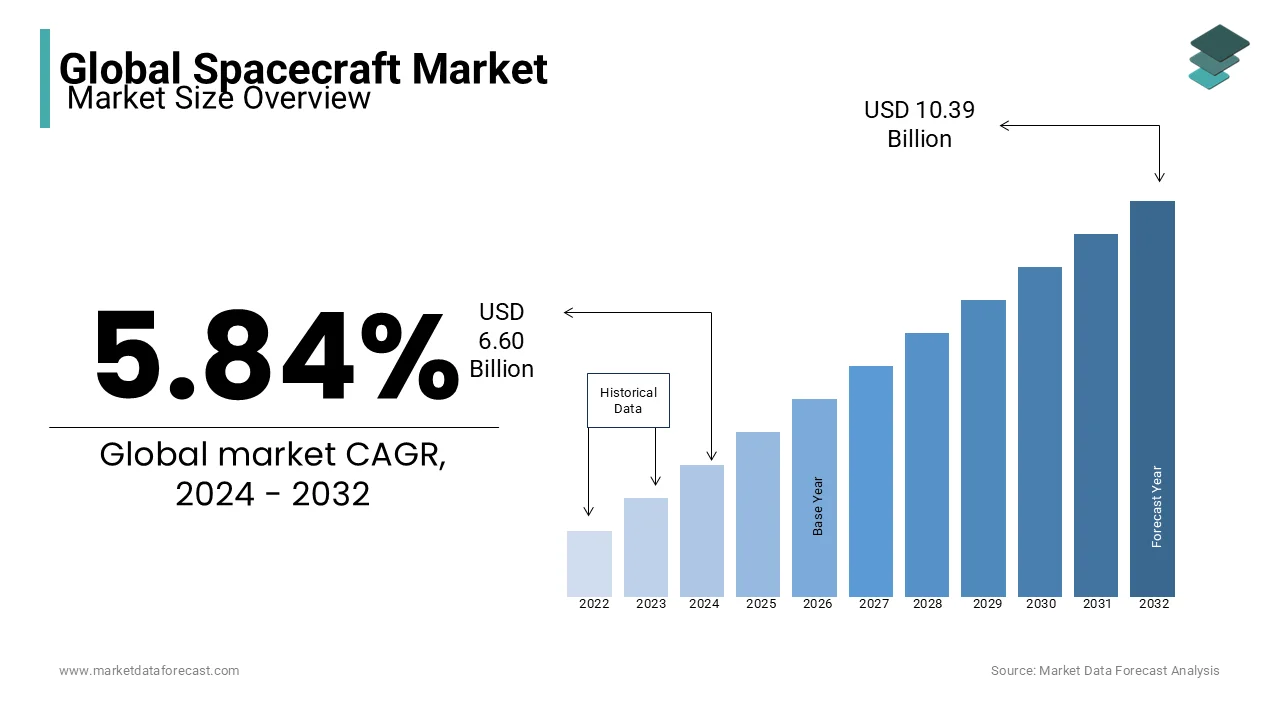
A spacecraft is a machine designed in such a way that it can be able to fly in space. It is an artificial satellite that is being tested for various tasks such as planetary exploration, navigation, and communications. The global spacecraft market for space Satellites has seen increasing demand for spacecraft from developed and developing economies. Moreover, only single-to-orbit-level vehicles do not require launch vehicles or a company rocket. Moreover, growing technological advances combined with spacecraft components are likely to offer the majority of the growth to the global spacecraft market in the next six years.
MARKET DRIVERS
Increasing competition among developed economies urges participants to immediately promote space missions, which creates a massive demand for the global spacecraft market.
The global spacecraft market is driven by the expansion of spacecraft and the space programs of countries. In addition, the increase in government spending is expected to strengthen space operations, further driving the need for spacecraft. Over the last few decades, space exploration programs have gotten a lot of attention, and large countries have dominated the worldwide market by demonstrating their space capabilities. Furthermore, the expansion of space R&D projects has fueled the worldwide spacecraft industry. Likewise, growing cooperation among international space institutions for technology integration and investment reinforces the global market for space missions, driving demand for both human and unmanned spacecraft. The increase in space exploration missions could also be linked to increased government funding and space budgets. Furthermore, the global spacecraft market is expected to benefit from the shrinking of spacecraft components, which would drive application and demand.
MARKET RESTRAINTS
An unauthorized individual can use a spacecraft because it can be controlled remotely. It takes longer for radio waves to travel from space to Earth since they function in space. This will further affect the analysis, to take longer. It doesn't provide people with a lot of options. It has a restricted maintenance provision, which reduces its lifespan. Atmospheric health risks due to radiation exposure caused by long-term effects will further limit the thermal spacecraft market growth in the upcoming years.
REPORT COVERAGE
| REPORT METRIC | DETAILS |
| Market Size Available | 2025 to 2034 |
| Base Year | 2025 |
| Forecast Period | 2026 to 2034 |
| CAGR | 5.84% |
| Segments Covered | By Type, Application, and Region |
| Various Analyses Covered | Global, Regional & Country Level Analysis, Segment-Level Analysis, DROC, PESTLE Analysis, Porter’s Five Forces Analysis, Competitive Landscape, Analyst Overview on Investment Opportunities |
| Regions Covered | North America, Europe, APAC, Latin America, Middle East & Africa |
| Market Leaders Profiled | The Boeing Company, Airbus SE, SpaceX, Lockheed Martin Corporation, Space Exploration Technologies. Corp Sierra Nevada Corporation, Berlin Space Technologies GmbH, HNGmbH rop Grumman Corporation, AleniaSpaziop, Spaceillennium Space Systems, teSystems System AG |
SEGMENTAL ANALYSIS
By Type Insights
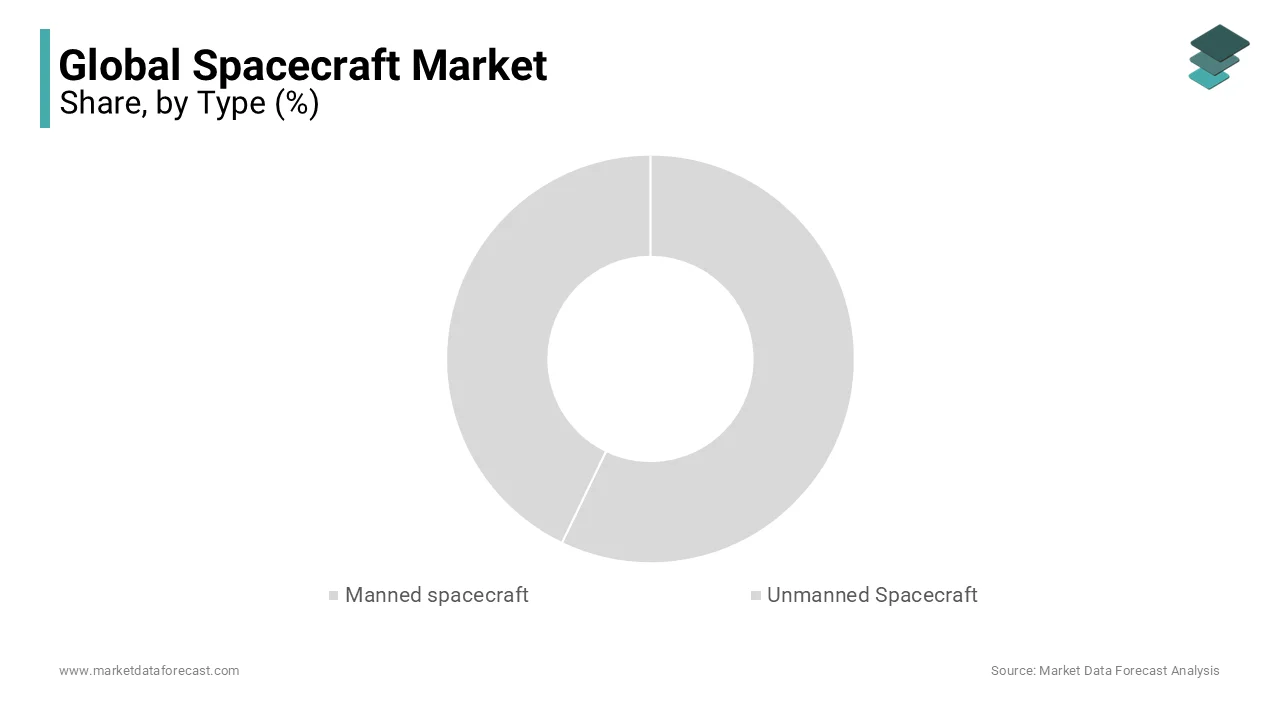
The unmanned spacecraft category now holds the largest market share, which is likely to remain for the projection period. Revenues from satellite launches, freight transportation, spacecraft, and spacecraft for deploying land rovers for planetary exploration missions, among other things, are included in this part. Satellite launches have grown in recent years to support a variety of uses. Satellite launches are also likely to rise in the following years to support a variety of purposes, including military, commercial (such as telecommunications), and space research. Moreover, the inclusion of Artificial Intelligence (AI) technology in spatial operations enhances the growth of the global spacecraft market.
By Application Insights
The commercial segment is anticipated to hold the highest spacecraft market share during the forecast period. Moreover, the commercial part offers the supply of goods and services with the help of equipment to the Earth's orbit or space. Furthermore, owners of these particular services generally have a contract to produce satellites and deliver them to various public and private industries, which form an integral part of the space economy. In addition to the number of public benefits, commercial airline passengers appear to have the potential to catalyze the introduction of cost reductions. Furthermore, several thoughts have been implemented, like asteroid mines, solar sails, space colonies, and units wthathave, he capacity to play a significant key role in the global spacecraft market.
REGIONAL ANALYSIS
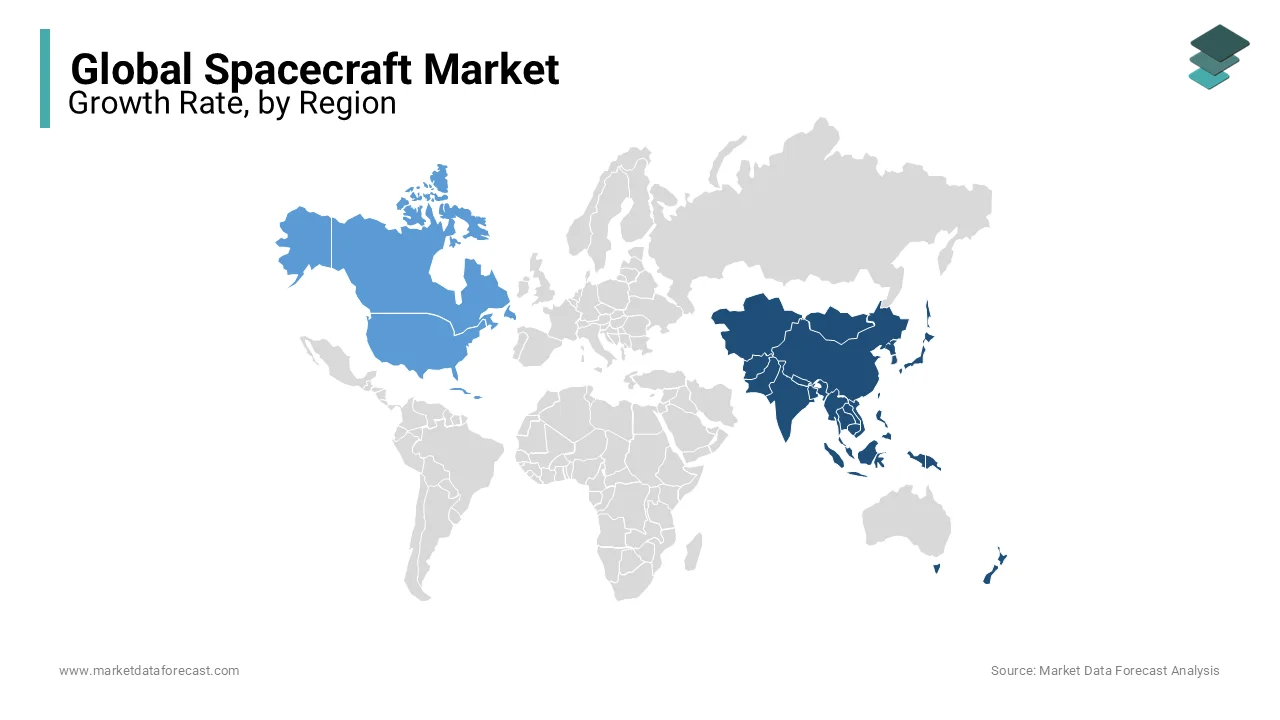
The Asia-Pacific is anticipated to generate the highest global spacecraft market share in the next six years. It is mainly increasing investments for space in emerging economies, including China, India, Japan, and South Korea. In addition, China is actively investing in space technology to catch up to the United States. The Chinese government and private enterprises are investing heavily in earth observation, satellite communications, and satellite manufacturing. These substantial investments have resulted in the creation and launch of several military and commercial satellites. As a result, China was the second-largest country in terms of operational satellites in orbit, after the United States.
North America tends to have the highest CAGR in the global spacecraft market. The presence of NASA in the region contributes to the region's dominance. NASA's extraterrestrial activities have a considerable budget. The presence of many major market players in the area, such as Lockheed Martin Corporation and Boeing Company, is projected to boost the worldwide spacecraft market's growth in the future years.
KEY MARKET PLAYERS
These are the market players that are dominating the global spacecraft market.
- The Boeing Company, Airbus SE
- SpaceX
- Lockheed Martin Corporation
- Space Exploration Technologies CrCorp
- Sierra Nevada Corporation
- Berlin Space Technologies GmbH
- Northrop Grumman Corporation
- Thales Alenia Space
- Millennium Space Systems
- OHB System AG
RECENT MARKET NEWS
- In April 2021, SpaceX launched Starlink Satellites, increasing the number of satellites introduced to 300 over a month. These satellites are being introduced as part of the company's goal to launch 1,500 Starlink satellites by 2021.
- On 11 March 2021, Airbus was appointed by the European Commission to study the development of space missions through the Horizon 2020 Plan. This is a precursor to the future creation of large structures in orbit. Direct production in orbit will change the way space systems are designed, built, and used.
MARKET SEGMENTATION
This research report on the global spacecraft market size is segmented and sub-segmented into the following categories.
By Type
- Manned spacecraft
- Unmanned Spacecraft
By Application
- Commercial
- Military
- Defense
By Region
- North America
- Asia-Pacific
- Europe
- Latin America
- Middle-East-America