- Product Description Description
- Table of Contents TOC
- List of Table & Figure LOT
- Get Free Sample PDF Sample PDF
Market Size, 2025
$1.63 BnMarket Estimate, 2026
$2.25 BnMarket Forecast, 2034
$30.07 BnCAGR, 2026–2034
38.25%Executive Summary: Global Air-Powered Vehicle Market
- Market Scope: Comprehensive global market analysis of air-powered (compressed air/pneumatic) vehicles covering product operation modes, vehicle classifications, zero-emission advantages, alternative energy innovations (e.g., aluminum-air batteries), and regional adoption footprints.
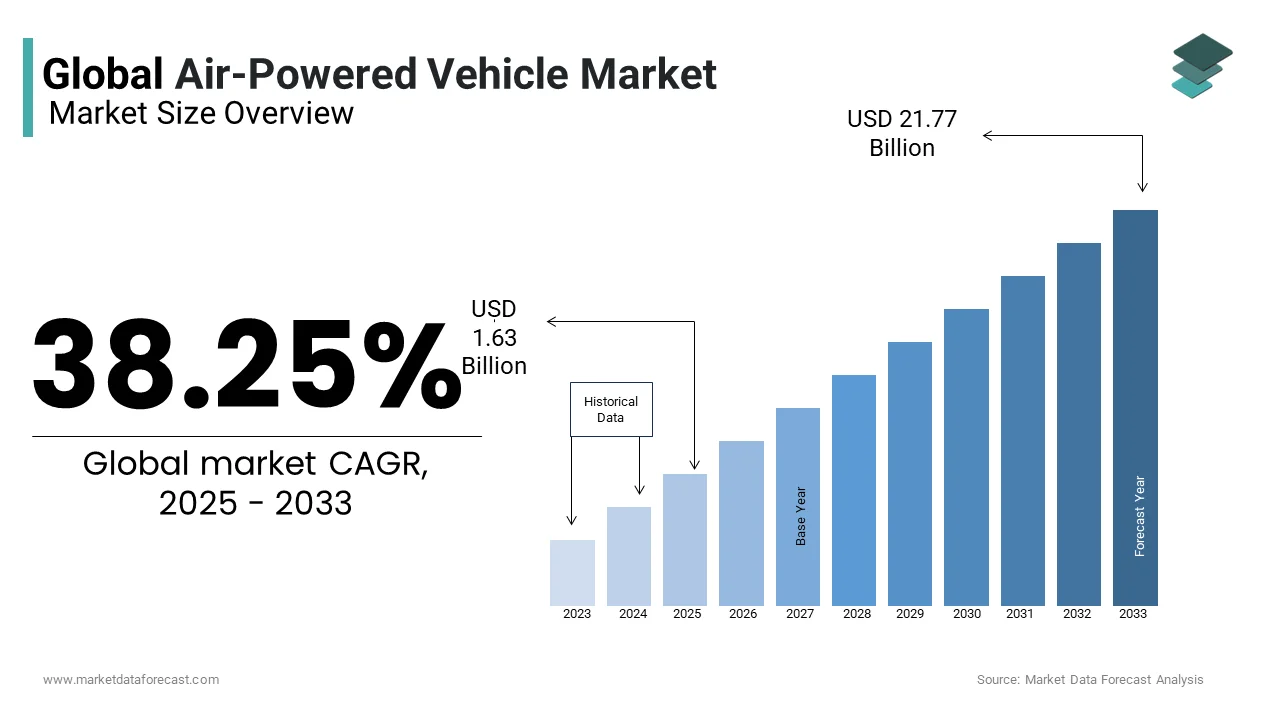
- Market Valuation: Valued at USD 1.63 billion in 2025, estimated at USD 2.25 billion in 2026, and projected to reach USD 30.07 billion by 2034, registering a high growth CAGR of 38.25% during the forecast period from 2026 to 2034.
- Primary Growth Drivers: Increasing global awareness of green and zero-emission vehicles; stringent government regulations and carbon emission standards aimed at curbing greenhouse gases; economic advantages of compressed air over conventional internal combustion engines; and rising traditional fuel prices. Key restraints include stiff market competition from rapidly scaling Battery Electric Vehicles (BEVs) and Hybrid Electric Vehicles (HEVs).
Key Market Segment Metrics (2026–2034)
| Category | Leading Segment (2025 Position) | Fastest-Growing Segment |
|---|---|---|
| By Product Type | Single-Energy Mode (dominates market share because single-mode pneumatic vehicles operate entirely on compressed gas propulsion without fuel mixing) | Single-Energy Mode Pneumatic Systems |
| By Vehicle Type | Passenger Cars (hold the largest global market share driven by urban emission regulations and consumer preference for compact, light, emission-free vehicles) | Passenger Cars & Light Commercial Vehicles |
| By Region | North America (leads global market valuation, with the United States accounting for nearly 70% of sales through clean energy initiatives) | Asia-Pacific (projected for the highest CAGR over the forecast period, anchored by automotive manufacturing in China and India) |
Major Market Players & Market Structure
Market Structure: An emerging niche sector within alternative energy mobility comprising specialized pneumatic technology developers, major automotive corporations exploring zero-emission alternatives, and joint ventures focusing on metal-air battery setups.
Key Companies: Motor Development International SA (France), Tata Motors (India), Honda Motor Company, Ltd. (Japan), Groupe PSA (France), Engineair Pty Ltd (Australia), and Phinergy (Israel).
 Download Free Sample Report
Global Air-Powered Vehicle Market Size
The global air-powered vehicle market was valued at USD 1.63 billion in 2025 and is anticipated to reach USD 2.25 billion in 2026 to reach USD 30.07 billion by 2034, growing with a CAGR of 38.25% during the forecast period from 2026 to 2034.
Air-powered vehicles or compressed air vehicles are environmentally friendly vehicles that use compressed air engines as a replacement for internal combustion (IC) engines for driving and operation according to the principles of compressed air technology (CAT). Pneumatic vehicles use the expansion of compressed air as a source of energy to drive the piston of an engine. The motor used in an air vehicle is called an air motor, which is an inflation actuator that generates useful energy by expanding compressed air. Since fuels do not mix with air in this engine, combustion does not take place in air-powered vehicles.
The increased greenhouse effect caused by most trucking vehicles has fueled the need for automakers to find and develop the fuel of the future. A compressed air vehicle is one of those types of vehicles that emits little or no pollutants. The pneumatic vehicle is powered by pressurized atmospheric gas. As the vehicle runs on compressed air instead of gasoline, the vehicle is considered an environmentally friendly vehicle. In addition, the vehicle is propelled by releasing and expanding steps using an air motor. The air inside the pneumatic vehicle is supplied to the engine by an air injector. Air is pushed down into a small chamber that further moves the crankshaft and propels the vehicle.
MARKET DRIVERS
The growing awareness of green vehicles has expanded the market for pneumatic vehicles. Additionally, stringent government standards and emissions standards aimed at reducing the carbon footprint globally are key drivers of the compressed air vehicle market. Furthermore, compressed air vehicles are more economical than conventional internal combustion engines. In addition, rising fuel prices should favor the market for compressed-air vehicles.
MARKET RESTRAINTS
However, the increasing adoption of BEV and HEV is hampering the growth of the market. In addition, the lower maintenance of compressed air vehicles compared to gasoline internal combustion engines proliferates market growth.
REPORT COVERAGE
| REPORT METRIC | DETAILS |
| Market Size Available | 2025 to 2034 |
| Base Year | 2025 |
| Forecast Period | 2026 to 2034 |
| CAGR | 38.25% |
| Segments Covered | By Product Type, Vehicle Type, and Region. |
|
Various Analyses Covered | Global, Regional, & Country Level Analysis; Segment-Level Analysis; DROC, PESTLE Analysis; Porter’s Five Forces Analysis, Competitive Landscape; Analyst Overview of Investment Opportunities |
| Regions Covered | North America, Europe, APAC, Latin America, Middle East & Africa |
|
Market Leaders Profiled | Motor Development International SA (France), Tata Motors (India), Honda Motor Company, Ltd. (Japan), Groupe PSA (France), Engineair Pty Ltd (Australia), Phinergy (Israel), and Others. |
SEGMENT ANALYSIS
By Product Type Insights
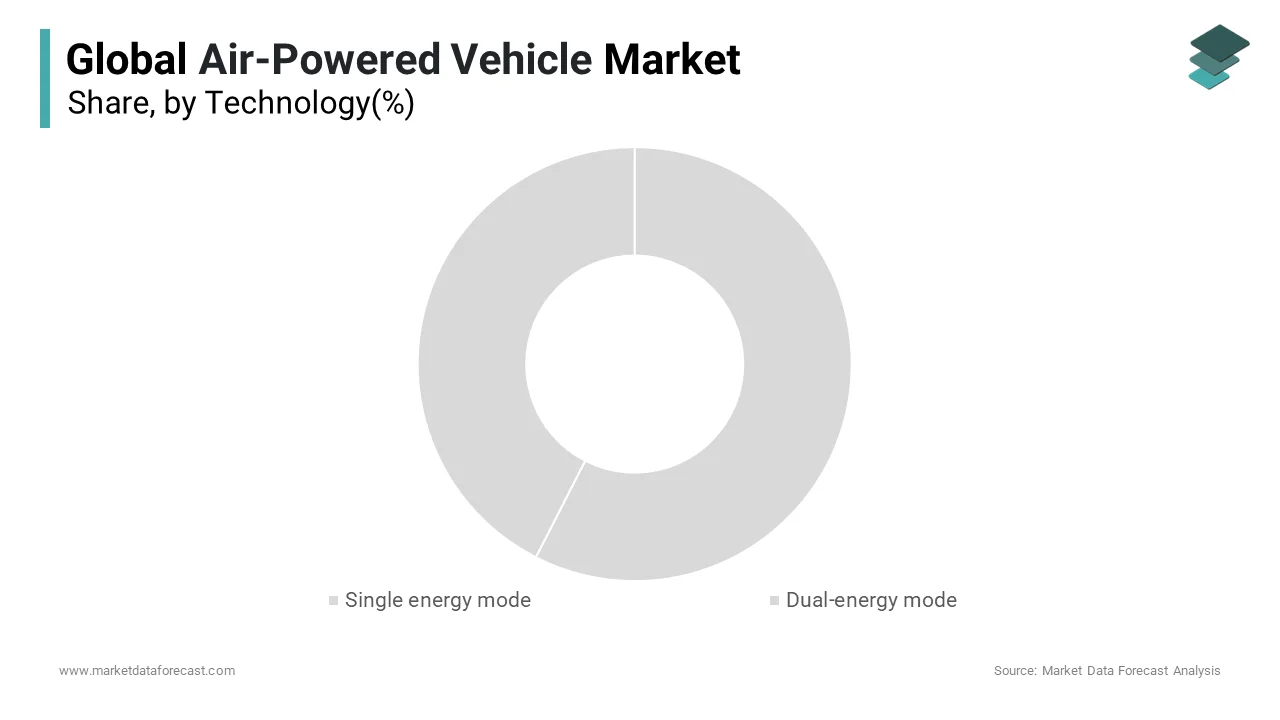
Single-energy mode is predicted to dominate the worldwide air vehicle market, as single-mode pneumatic vehicles only use compressed gas for propulsion. In addition, developing countries and cities have a higher demand for emission-free vehicles, which are expected to have a significant market share during the forecast period.
By Vehicle Type Insights
The passenger car segment has the largest share of the world market due to improved regulation of urban and suburban emissions and the fact that compressed air vehicles are emission-free, which is in line with EU regulations emissions. This, in turn, is expected to fuel pneumatic vehicle market demand in the passenger car segment during the forecast period. Furthermore, the growing demand for compact and light vehicles is expected to drive the pneumatic vehicle market around the world.
REGIONAL ANALYSIS
North America is estimated to represent a significant market share in the global pneumatic vehicle market. The market in this region is dominated by the United States, which accounts for almost 70% of sales. The development of clean energy for vehicles and the growing awareness of maintaining environmental balance are the main drivers of the market in this region.
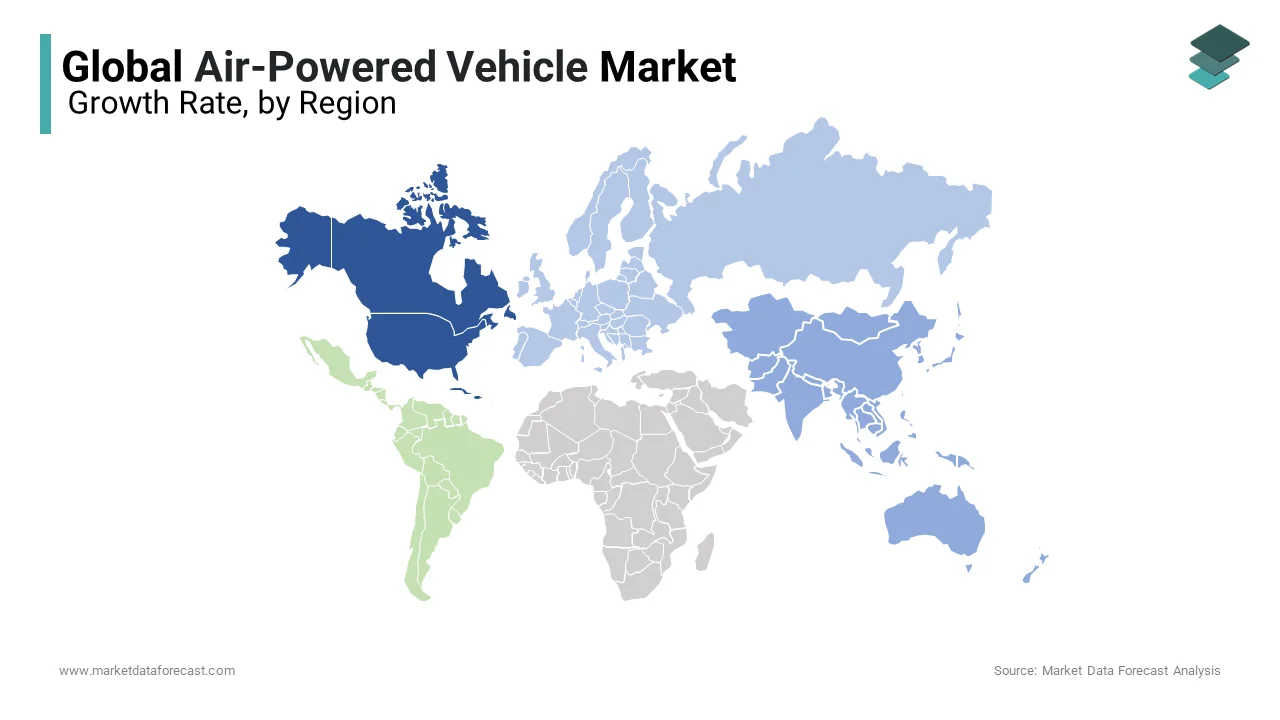
The Asia Pacific regional market is expected to experience the highest CAGR over the next five years. This region is characterized by some of the emerging economies, notably China and India, which are large auto markets individually. In addition, increasing initiatives by governments and relevant authorities related to environmental protection are also stimulating the demand for compressed-air vehicles in this region. This region is known as one of the main exports of compressed air vehicles due to its low manufacturing costs and the availability of cheap and skilled labor, as well as technologically advanced infrastructure.
KEY MARKET PLAYERS
The prominent players dominating the global air-powered car market include
- Motor Development International SA (France)
- Tata Motors (India)
- Honda Motor Company, Ltd. (Japan)
- Groupe PSA (France)
- Engineair Pty Ltd (Australia)
- Phinergy (Israel).
RECENT MARKET NEWS
- Indian Oil Corporation Ltd (IOCL) has rapidly diversified into the production of alternative forms of energy in recent years. As part of its strategy, the company partnered with Israeli startup Phinergy to develop aluminum-air (Al-air) batteries, and the partners are preparing to establish their manufacturing facilities soon. “We are going to set up a factory.
- The rotary piston engine is an engine that runs on compressed air or phase change coolants. The goal of this idea is to implement vehicles that consume the least amount of energy to perform a certain amount of work, as opposed to an internal combustion engine with its crazy idle at traffic lights; our engine doesn't need to.
- Honda Motor Co's new CEO said Friday that the company aims to increase its share of electric vehicles (EV) and fuel cell vehicles (FCV) to 100% of all sales by 2040.
MARKET SEGMENTATION
This research report on the global air-powered vehicle market has been segmented and sub-segmented into the following categories.
By Product Type
- Single energy mode
- Dual-energy mode
By Vehicle Type
- Passenger cars
- Commercial vehicles
By Region
- North America
- Europe
- Asia Pacific
- Latin America
- Middle East and Africa