- Product Description Description
- Table of Contents TOC
- List of Table & Figure LOT
- Get Free Sample PDF Sample PDF
Market Size, 2025
$20.38 BnMarket Estimate, 2026
$21.24 BnMarket Forecast, 2034
$29.51 BnCAGR, 2026–2034
4.20%Global Air Suspension Market Size, Share, & Growth Analysis (2025–2034)
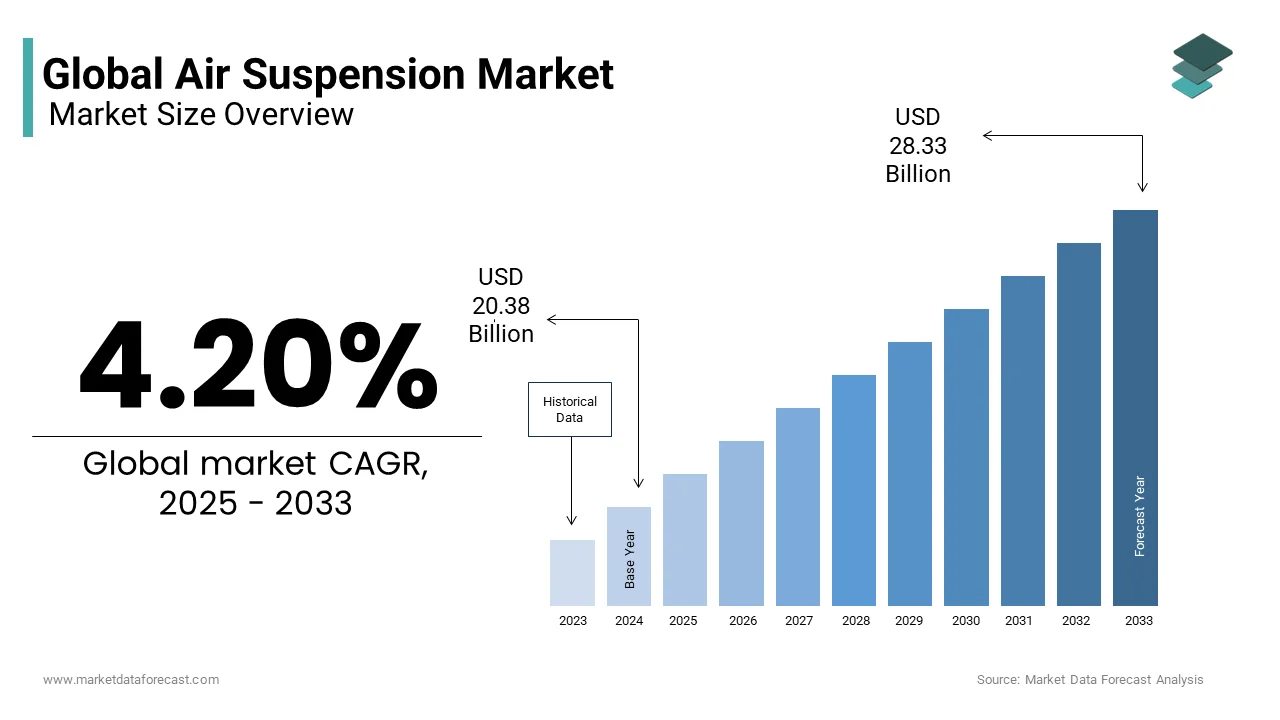
The global air suspension market was valued at USD 20.38 billion in 2025, estimated at USD 21.24 billion in 2026, and is projected to reach USD 29.51 billion by 2034, expanding at a compound annual growth rate (CAGR) of 4.20% during the forecast period from 2026 to 2034. Air suspension frameworks serve as modern, flexible replacements for traditional steel springs, significantly improving ride quality, vehicle handling, and load-leveling capabilities across both passenger and heavy commercial vehicles.
- Market Valuation: USD 21.24 billion (2026) to USD 29.51 billion by 2034 (4.20% CAGR).
- Primary Growth Drivers: Increasing demand for premium passenger comfort, high vehicle safety standards, and technological leaps like Electronically Controlled Air Suspension (ECAS).
- Key Market Restraints: High initial setup and integration costs, alongside expensive component maintenance, restricting adoption mainly to high-end and luxury vehicle segments.
Global Air Suspension Market Segment Metrics (2026–2034)
| Category | Leading Segment Focus | Segment Overview & Key Details | Alternative / Growth Focus |
|---|---|---|---|
| By Vehicle Type | Commercial & Heavy Vehicles | Extensively utilized in heavy-duty trucks, buses, coaches, and ambulances to absorb shock impacts and preserve fragile payloads or passenger well-being. | Passenger vehicles, light commercial vehicles (LCVs), and off-road vehicles. |
| By Component | Air Springs & Compressors | Essential texturized rubber bellows and blowers driving the pressure-flow dynamics of the system. | Shock absorbers, electronic control units (ECUs), height sensors, and solenoid valves. |
| By Technology | Electronically Controlled Air Suspension (ECAS) | Fastest-growing tech segment enabling smart leveling, minimized vibrations, superior stability, and dynamic load adaptation. | Non-electronically controlled, semi-active, and passive air suspension configurations. |
| By Sales Channel | Original Equipment Manufacturers (OEMs) | Dominate volume distribution as air setups are predominantly factory-fitted into luxury builds and heavy commercial line-ups. | Aftermarket component replacement and custom modifications. |
| By Region | Europe & Asia-Pacific | Europe leads in volume share with advanced luxury installations, while Asia-Pacific (led by China and emerging adoption in India) acts as a high-growth zone. | North America, Latin America, and Middle East & Africa. |
Major Market Players & Market Structure
Market Structure: Highly consolidated market featuring dominant global automotive tier-1 suppliers and vehicle manufacturers specializing in heavy commercial systems and advanced ride dampening innovations.
Key Companies: ThyssenKrupp AG, Hendrickson International Corporation, Continental AG, Dunlop Systems and Components, Wabco Holding Inc., Hitachi Ltd., Fiat Chrysler Automobiles, BMW AG, Volvo, and Daimler AG.
 Download Free Sample Report
Global Air Suspension Market Size
The global automotive seats market size was valued at USD 20.38 billion in 2025 and is anticipated to reach a valuation of USD 21.24 billion in 2026 and USD 29.51 billion by 2034, growing at a CAGR of 4.20%, from 2026 to 2034.
Introduction to the Air Suspension Market
The air suspension is the advanced vehicle suspension systems that utilize compressed air within flexible bellows or air springs to support vehicle weight and provide superior ride quality. These systems replace traditional steel coil or leaf springs, allowing for adjustable ride height, improved handling, and enhanced load leveling capabilities. The technology is increasingly prevalent in luxury passenger vehicles, heavy duty commercial trucks, and buses due to its ability to adapt to varying road conditions and cargo weights. According to the International Organization of Motor Vehicle Manufacturers, global commercial vehicle production reached 26 million units in 2024, with a significant portion incorporating air suspension for improved driver comfort and cargo protection. As per the Society of Automotive Engineers, vehicles equipped with air suspension demonstrate a 30% reduction in vibration transmission to the cabin compared to conventional steel spring systems. This performance advantage drives adoption in sectors prioritizing passenger experience and equipment safety. The market evolves alongside advancements in electronic control units and sensor technologies that enable real time adjustments. Regulatory emphasis on driver welfare and road infrastructure preservation further supports the integration of these adaptive systems.
MARKET DRIVERS
Rising Demand for Luxury and Premium Passenger Vehicles
The rising demand for luxury and premium passenger vehicles by increasing the installation rate of air suspension systems, as a standard or optional feature is fuelling the growth of the air suspension market. Consumers in this segment prioritize ride comfort, noise reduction, and adjustable driving dynamics, which air suspension uniquely provides. This positive consumer sentiment encourages automakers to include air suspension in more trim levels to remain competitive. The trend towards electrification also supports this driver, as air suspension helps manage the additional weight of battery packs while maintaining ride quality. Luxury brands use adjustable ride height as a marketing tool to highlight versatility and technological sophistication. The willingness of premium buyers to pay for advanced features ensures healthy profit margins for suppliers. Consequently, the expansion of the luxury vehicle segment directly correlates with increased demand for high performance air suspension components.
Stringent Regulations on Commercial Vehicle Safety and Driver Welfare
The stringent regulations on commercial vehicle safety and driver welfare by mandating technologies that reduce driver fatigue and protect cargo integrity is additionally promoting the growth of the air suspension market. Air suspension systems significantly lower vibration and shock transmission to the driver cabin, addressing occupational health concerns in long haul logistics. Air suspension is recognized as a key technology for mitigating these health risks through superior damping characteristics. Governments in North America and Europe are incentivizing fleet operators to adopt advanced suspension technologies through tax benefits and safety ratings. Improved cargo protection is another critical factor, as air suspension minimizes damage to sensitive goods during transit. Logistics companies increasingly view air suspension as a necessary investment for compliance and operational efficiency.
MARKET RESTRAINTS
High Initial Cost and Maintenance Expenses
The high initial cost and maintenance expenses are attributed in degrading the growth of the air suspension market. Air suspension components such as compressors, air tanks, and electronic control units are significantly more expensive than traditional steel springs. This financial burden discourages individual consumers and small fleet operators from choosing air suspension options. As per the National Institute for Automotive Service Excellence, the complexity of air suspension systems requires specialized diagnostic tools and trained technicians, further increasing service costs. Many independent repair shops lack the expertise to handle these systems, leading to longer downtime and higher labor charges. The perceived reliability issues associated with air bags leaking or compressors failing over time also deter potential buyers. Economic downturns exacerbate this restraint as consumers prioritize affordability over comfort features. Automakers often reserve air suspension for top tier models to avoid pricing out mainstream buyers.
Complexity and Reliability Concerns in Harsh Environments
The complexity and reliability concerns in harsh environments are raising doubts about the durability of air suspension components under extreme operating conditions. This factor is another attribute limiting the growth of the air suspension market. Air springs and pneumatic lines are susceptible to damage from road debris, corrosion, and extreme temperatures, leading to premature failures. This vulnerability necessitates frequent inspections and maintenance, which disrupts operational schedules for commercial fleets. As per the American Transportation Research Institute, downtime caused by suspension issues accounts for 8% of total maintenance delays in long haul trucking operations. The intricate network of sensors and valves adds multiple points of potential failure compared to simple mechanical springs. Dust and sand ingestion in off road or construction environments can clog filters and damage compressors. These reliability challenges make some operators hesitant to switch from proven steel spring systems.
MARKET OPPORTUNITIES
Integration with Autonomous Driving Technologies
The integration with autonomous driving technologies by enabling dynamic vehicle control and enhanced safety for self-driving cars is ascribed to boost new opportunities for the growth of the air suspension market. Autonomous vehicles require precise handling and stability management to navigate complex traffic scenarios safely, which air suspension systems can provide through rapid height and stiffness adjustments. Level 4 autonomous vehicles will require active suspension systems to compensate for sensor limitations and ensure passenger comfort during automated maneuvers. Air suspension allows for real time adaptation to road surface irregularities, improving the accuracy of lidar and camera systems mounted on the vehicle. This enhancement is crucial for gaining public trust in autonomous mobility services. Automakers developing robotaxis and autonomous delivery vehicles are increasingly specifying air suspension as a core component of their chassis architecture. The synergy between software defined vehicle controls and pneumatic actuation opens new avenues for innovation.
Growth in Electric Vehicle Platforms and Battery Weight Management
The growth in electric vehicle platforms and battery weight management, as manufacturers seek solutions to handle increased vehicle mass, which is additional factor to bolster the growth of the air suspension market. Electric vehicles carry heavy battery packs that significantly increase curb weight, necessitating robust suspension systems that maintain ride quality and handling performance. According to the International Council on Clean Transportation, the average weight of electric vehicles is 20% higher than comparable internal combustion engine vehicles, placing greater stress on suspension components. Air suspension provides the necessary load carrying capacity and adjustability to accommodate this extra weight without compromising comfort. As per the Union of Concerned Scientists, electric vehicle sales are projected to reach 30% of global new car sales by 2030, creating a massive addressable market for specialized suspension solutions. Automakers are designing dedicated EV platforms that integrate air suspension from the outset to optimize packaging and efficiency. Adjustable ride height also helps improve aerodynamics by lowering the vehicle at high speeds, extending driving range.
MARKET CHALLENGES
Supply Chain Vulnerabilities for Specialized Components
The supply chain vulnerabilities for specialized components by causing production delays and cost fluctuations for air suspension manufacturers is key challenge for the growth of the air suspension market. The production of air suspension systems relies on specific raw materials such as rubber compounds for air bags and aluminum for compressors, which are subject to global supply disruptions. These delays force automakers to slow down production lines or seek alternative suppliers, impacting overall market growth. As per the Semiconductor Industry Association, shortages of microcontrollers used in air suspension electronic control units further exacerbated production constraints in 2025. The concentration of manufacturing for certain pneumatic components in specific geographic regions increases exposure to geopolitical risks and trade barriers. Fluctuating prices of raw materials also squeeze profit margins for suppliers who cannot pass costs onto customers immediately. Just in time manufacturing practices leave little buffer for unexpected disruptions, making the supply chain fragile. Companies must invest in diversifying suppliers and holding larger inventories, which increases operational costs.
Lack of Standardization Across Vehicle Platforms
The lack of standardization across vehicle platforms by increasing development costs and complicating aftermarket support for air suspension systems is additionally to limit the growth of the air suspension market. Each automaker designs unique air suspension architectures with proprietary connectors, software protocols, and component specifications, preventing economies of scale. This fragmentation makes it difficult for aftermarket providers to offer universal replacement solutions, limiting consumer choice. Efforts to create common interface standards for active suspension systems have stalled due to competitive interests among major manufacturers. The lack of interoperability means that technicians must undergo extensive training for each brand, raising labor costs and service barriers. Software updates for air suspension control units are also platform specific, requiring dedicated diagnostic equipment. This siloed approach hinders the development of third party innovations and reduces competition in the service sector.
REPORT COVERAGE
| REPORT METRIC | DETAILS |
| Market Size Available | 2025 to 2034 |
| Base Year | 2025 |
| Forecast Period | 2026 to 2034 |
| CAGR | 4.20% |
| Segments Covered | By Vehicle, Component, Technology, Sales Channel, Application, and Region. |
| Various Analyses Covered | Global, Regional & Country Level Analysis, Segment-Level Analysis, DROC, PESTLE Analysis, Porter’s Five Forces Analysis, Competitive Landscape, Analyst Overview of Investment Opportunities |
| Regions Covered | North America, Europe, APAC, Latin America, Middle East & Africa |
| Market Leaders Profiled | Toyota Motor Corporation (Japan), Vantage Mobility International (US), BraunAbility (US), Revability (US), and Mobility Works (US). The other established players are Pride Mobility (US), Sunrise Medical Holdings (Germany), Invacare (US), KYMCO Global (Taiwan), Amigo Mobility International (US), and Others. |
SEGMENTAL ANALYSIS
By Vehicle Insights
The heavy commercial vehicles segment was the dominant by accounting for 44.3% of the Air Suspension Market share in 2025 due to the need for load leveling, cargo protection, and driver comfort in long haul logistics. The inherent weight of heavy trucks necessitates robust suspension systems that can adapt to varying payload weights without compromising stability or safety. This volume ensures consistent demand for air suspension systems that protect sensitive cargo from vibration damage. As per the European Commission, regulations mandating maximum axle loads have pushed fleet operators to adopt air suspension for better weight distribution and compliance with road safety standards. Air springs allow drivers to adjust ride height for easier loading and unloading, improving operational efficiency. The reduction in driver fatigue provided by superior damping characteristics is another key factor driving adoption in this segment. Regulatory bodies increasingly view air suspension as a standard for modern heavy duty vehicles to minimize road wear and tear. The longevity of air suspension components under heavy loads also offers a lower total cost of ownership compared to steel springs.
The passenger vehicles segment is likely to grow at a fastest CAGR of 9.8% from 2026 to 2034 owing to the increasing penetration of air suspension in luxury sedans, SUVs, and increasingly in premium electric vehicles. Automakers are responding by making air suspension available in more trim levels to enhance vehicle appeal. The rise of electric vehicles further accelerates this trend, as air suspension helps manage the additional weight of battery packs while maintaining ride quality. Consumers appreciate the ability to lower the vehicle for aerodynamics and raise it for off road capability. Marketing campaigns emphasizing luxury and versatility drive consumer interest in these systems. Technological advancements have reduced the cost and size of passenger car air suspension units, making them more accessible.
By Component Insights
The air springs segment was the largest by holding 33.2% of the Air Suspension Market share in 2025 with the primary load bearing elements that replace traditional steel coils or leaf springs. Every air suspension system requires at least one air spring per wheel by making them the most voluminous component in the assembly. This performance advantage ensures their central role in both commercial and passenger vehicle applications. Air springs are subject to regular replacement due to wear and tear, creating a steady aftermarket demand. Manufacturers continuously innovate with reinforced rubber compounds to improve durability and resistance to environmental factors. The complexity of manufacturing high quality air bags creates barriers to entry, favoring established players. Integration with electronic control systems allows for dynamic stiffness adjustments, enhancing the functionality of air springs.
The electronic control units segment is likely to grow at a fastest CAGR of 11.5% throughout the forecast period with the increasing sophistication of active suspension systems that require real time processing of sensor data to adjust air pressure and ride height. According to the Institute of Electrical and Electronics Engineers, modern air suspension systems process over 1000 data points per second to optimize ride quality and handling dynamics. This computational demand drives the need for more powerful and specialized ECUs. ECUs enable features such as predictive suspension adjustment based on navigation data and camera inputs. The integration of artificial intelligence algorithms into ECUs allows for personalized ride profiles and adaptive learning. Software defined vehicles rely heavily on ECUs to deliver over the air updates for suspension tuning. The shift towards autonomous driving further increases the complexity and importance of suspension control electronics.
By Application Insights
The luxury vehicles segment held a significant share of the Air Suspension Market in 2025 due to the expectation of superior ride comfort and exclusivity associated with high end automobiles. Buyers in this segment prioritize smoothness, quietness, and adjustable driving dynamics, which air suspension delivers effectively. The luxury vehicle owners rate ride comfort as the second most important feature after reliability, driving automakers to include air suspension as a standard or popular option. This consumer preference ensures high attachment rates for air suspension systems in premium brands. Automakers use air suspension to differentiate their brands and justify higher price points. The ability to lower the vehicle for improved aerodynamics and fuel efficiency is also valued in this segment. Luxury brands invest heavily in proprietary sound and feel characteristics for their suspension systems. The aftermarket for upgrading older luxury vehicles with newer air suspension technologies also contributes to market strength. High profit margins in the luxury segment allow for the incorporation of advanced features like predictive road scanning.
The commercial transport segment is likely to grow at a fastest CAGR of 10.2% from 2026 to 2034 owing to the expansion of e commerce and the resulting increase in last mile delivery and long haul logistics operations. According to the International Transport Forum, global freight transport volume is expected to triple by 2050, necessitating efficient and safe vehicle technologies. Air suspension protects valuable cargo from damage and reduces driver fatigue, which is critical for operational efficiency. As per the Federal Motor Carrier Safety Administration, fleets using air suspension reported a 20% reduction in cargo claims due to vibration damage in 2024. Regulatory pressures to improve driver working conditions and reduce musculoskeletal disorders also favor air suspension adoption. The rise of electric commercial vehicles further boosts this segment, as air suspension helps manage battery weight. Logistics companies are increasingly viewing air suspension as a strategic investment rather than a cost. Government incentives for green and safe transport technologies support this transition. The scalability of air suspension solutions for various commercial vehicle sizes drives broad adoption.
REGIONAL ANALYSIS
North America Market Analysis
North America was the top performer in the Air Suspension Market by holding 45.2% of the share in 2025 with a strong culture of luxury vehicle ownership and a robust commercial trucking industry. The region benefits from well-developed infrastructure and high consumer spending power, which supports the adoption of premium automotive features. This economic activity ensures a steady market for replacement and new installation components. As per the National Highway Traffic Safety Administration, safety regulations encouraging advanced suspension technologies for improved vehicle stability have influenced manufacturer decisions. The presence of major automotive manufacturers and suppliers in the region fosters innovation and local production. Consumer preference for large SUVs and pickup trucks, which increasingly offer air suspension options, further drives market growth. The aftermarket sector is also vibrant, with many enthusiasts upgrading older vehicles with modern air suspension kits. Regulatory focus on reducing road maintenance costs by minimizing heavy vehicle impact supports air suspension adoption.
Europe Market Analysis
Europe air suspension market was second largest by stringent regulatory frameworks and a high prevalence of premium automotive brands. The European Union was early to mandate safety and comfort standards that favor advanced suspension systems in commercial and passenger vehicles. According to the European Automobile Manufacturers Association, Europe produced over 13 million passenger cars in 2024, with a luxury models featuring air suspension. This production volume drives significant demand for OEM components. As per the European Agency for Safety and Health at Work, regulations aimed at reducing driver fatigue in commercial transport have accelerated the adoption of air suspension in trucks and buses. The region is also a hub for automotive innovation, with many leading air suspension suppliers headquartered in Germany and France. Consumer awareness of environmental impacts drives demand for efficient logistics solutions, where air suspension plays a role in fuel economy through aerodynamic optimization. The dense urban environment favors vehicles with adjustable ride height for navigating varied terrain.
Asia-Pacific Market Analysis
The Asia Pacific air suspension market is expected to have prominent growth opportunities with the rapid industrialization and increasing wealth in countries like China and India. The expansion of the middle class has led to a surge in demand for luxury vehicles equipped with advanced comfort features. This volume creates a massive opportunity for air suspension providers. As per the Indian Ministry of Road Transport and Highways, the commercial vehicle sector in India grew by 15% in 2025, driven by infrastructure development and e-commerce. This growth fuels demand for durable and efficient suspension systems in trucks and buses. Local manufacturing capabilities are improving, reducing costs and increasing availability. Government initiatives to modernize transport infrastructure support the adoption of advanced vehicle technologies. The region benefits from a young demographic with a strong appetite for new automotive features. International suppliers are establishing local production facilities to serve this growing market.
Latin America Market Analysis
Latin America air suspension market growth is driven by the modernization of public transport and mining industries. Countries like Brazil and Mexico are investing in upgrading bus fleets and commercial transport networks, creating demand for reliable suspension systems. According to the Economic Commission for Latin America and the Caribbean, public transport investments in the region increased by 10% in 2024, focusing on passenger comfort and safety. Air suspension is preferred for buses due to its ability to provide a smoother ride on uneven roads. The mining sector in Chile and Peru also drives demand for heavy-duty off road vehicles with robust suspension systems. Economic volatility can impact purchasing power, but long-term infrastructure projects sustain demand. Local assembly plants for international brands facilitate the integration of air suspension in vehicles produced for the regional market. The aftermarket sector is growing as vehicle owners seek to improve ride quality. Latin America offers niche opportunities for specialized air suspension applications.
Middle East and Africa Market Analysis
The Middle East and Africa air suspension market growth is propelled with the luxury vehicle consumption and infrastructure development projects. Gulf Cooperation Council countries have high per capita income levels, leading to strong demand for premium SUVs and luxury cars equipped with air suspension. This demand supports the import of vehicles with advanced suspension systems. Construction and mining activities require heavy duty vehicles with durable air suspension to handle rough terrain. Harsh environmental conditions necessitate ruggedized suspension components, creating a niche for specialized products. Government initiatives to improve road networks and public transport systems also contribute to market growth. The region relies heavily on imports, offering opportunities for global suppliers.
COMETITIVE LANDSCAPE
The competition in the Air Suspension Market is characterized by intense rivalry among established global suppliers and specialized niche manufacturers. Leading companies compete primarily on technological innovation product reliability and integration capabilities rather than price alone. Differentiation through proprietary electronic control algorithms and adaptive damping features serves as a key competitive advantage for securing contracts with premium automakers. The market features high barriers to entry due to stringent automotive qualification standards and complex engineering requirements. Participants strive to offer comprehensive end to end solutions encompassing hardware software and engineering support services. Strategic alliances with vehicle manufacturers help technology providers gain early access to development programs and influence system specifications. Continuous investment in research and development is essential to keep pace with evolving safety regulations and consumer expectations for comfort.
KEY MARKET PLAYERS
A few of the market players in the global air suspension market include
- ThyssenKrupp AG
- Hendrickson International Corporation
- Continental AG
- ZF Friedrichshafen AG
- Dunlop Systems and Components
- Wabco Holding Inc.
- BWI Group
- Hitachi Ltd.
- Fiat Chrysler Automobiles
- BMW AG
- Volvo
- Daimler AG
Top Players In The Market
- Continental AG contributes significantly to the Air Suspension Market by providing integrated chassis control systems that combine air springs with advanced electronic management. The company leverages its expertise in automotive electronics to develop smart suspension solutions that adapt to road conditions in real time. Continental recently launched a new generation of modular air supply units designed specifically for electric vehicles to optimize space and energy efficiency. This innovation addresses the unique weight distribution challenges of battery powered platforms. The firm actively collaborates with major automakers to co develop customized suspension architectures for premium vehicle lines. Their focus on software defined vehicle technologies enables over the air updates for suspension tuning.
- ZF Friedrichshafen AG plays a vital role in the Air Suspension Market through its comprehensive portfolio of sMOTION active suspension systems. The company integrates air suspension with semi active damping technology to deliver superior ride comfort and handling dynamics. ZF recently introduced an enhanced version of its sMOTION system featuring predictive road scanning capabilities using camera data. This advancement allows the suspension to adjust proactively to upcoming road irregularities. The firm focuses on lightweight design principles to improve vehicle efficiency and reduce emissions. ZF actively partners with commercial vehicle manufacturers to develop robust air suspension solutions for heavy duty applications. Their commitment to sustainability drives the use of recyclable materials in component manufacturing. Continuous investment in research and development ensures technological leadership in active chassis systems.
- BWI Group strengthens the Air Suspension Market by specializing in high performance suspension components for luxury and sports vehicles. The company offers a wide range of air spring and damper assemblies known for their durability and precision engineering. BWI recently expanded its manufacturing footprint in Europe to support local customers and reduce supply chain risks. This expansion enables faster delivery times and better customization options for European automakers. The firm focuses on developing compact air suspension modules that fit within tight packaging constraints of modern vehicle designs. BWI actively engages with aftermarket distributors to provide reliable replacement parts for existing fleets. Their expertise in noise vibration and harshness reduction enhances overall vehicle refinement. Strategic collaborations with tier one suppliers facilitate seamless integration of their components. These actions position BWI as a preferred partner for premium automotive brands seeking quality and reliability.
Top Strategies Used By Key Market Participants
Key players in the Air Suspension Market employ diverse strategies to maintain competitiveness and drive growth. Companies prioritize research and development to create lightweight and energy efficient components that align with electric vehicle requirements. Strategic partnerships with original equipment manufacturers facilitate early integration of air suspension systems into new vehicle platforms. Participants focus on expanding global production capacities to meet rising demand in emerging markets like Asia Pacific. Mergers and acquisitions allow firms to acquire specialized technologies and broaden their product portfolios efficiently. Investment in digital twin technologies enables virtual testing and optimization of suspension performance before physical prototyping. Emphasis on sustainability drives innovation in recyclable materials and eco friendly manufacturing processes. Collaboration with software developers enhances the intelligence of active suspension systems through predictive algorithms. Expansion into the aftermarket sector provides additional revenue streams from replacement and upgrade services. Focus on modularity allows for scalable solutions across different vehicle segments.
MARKET SEGMENTATION
This research report on the global air suspension market is segmented and sub-segmented into the following categories.
By Vehicle Type
- Passenger Vehicles
- Light Commercial Vehicles (LCVs)
- Heavy Commercial Vehicles (HCVs)
- Buses & Coaches
- Off-Road Vehicles
- Others
By Component
- Air Springs
- Shock Absorbers
- Air Compressors
- Electronic Control Units (ECUs)
- Height & Pressure Sensors
- Solenoid Valves
- Air Reservoirs / Tanks
- Others
By Technology
- Electronically Controlled Air Suspension
- Non-Electronically Controlled Air Suspension
- Semi-Active Air Suspension
- Passive Air Suspension
By Sales Channel
- Original Equipment Manufacturers (OEMs)
- Aftermarket
By Application
- Luxury Vehicles
- Commercial Transport
- Industrial Applications
- Sports Cars
- Others
By Region
- North America
- Europe
- Asia-Pacific
- Latin America
- Middle East and Africa