- Product Description Description
- Table of Contents TOC
- List of Table & Figure LOT
- Get Free Sample PDF Sample PDF
Market Size, 2025
$2.04 BnMarket Estimate, 2026
$2.19 BnMarket Forecast, 2034
$3.91 BnCAGR, 2026–2034
7.50%Executive Summary: Global Aircraft Fairings Market
- Market Scope: Comprehensive global aerospace component market assessment covering fairing applications (fuselage, wings, landing gear, cockpit, nose, flight control surfaces), end users (OEMs and aftermarket), and regional geographic landscapes.
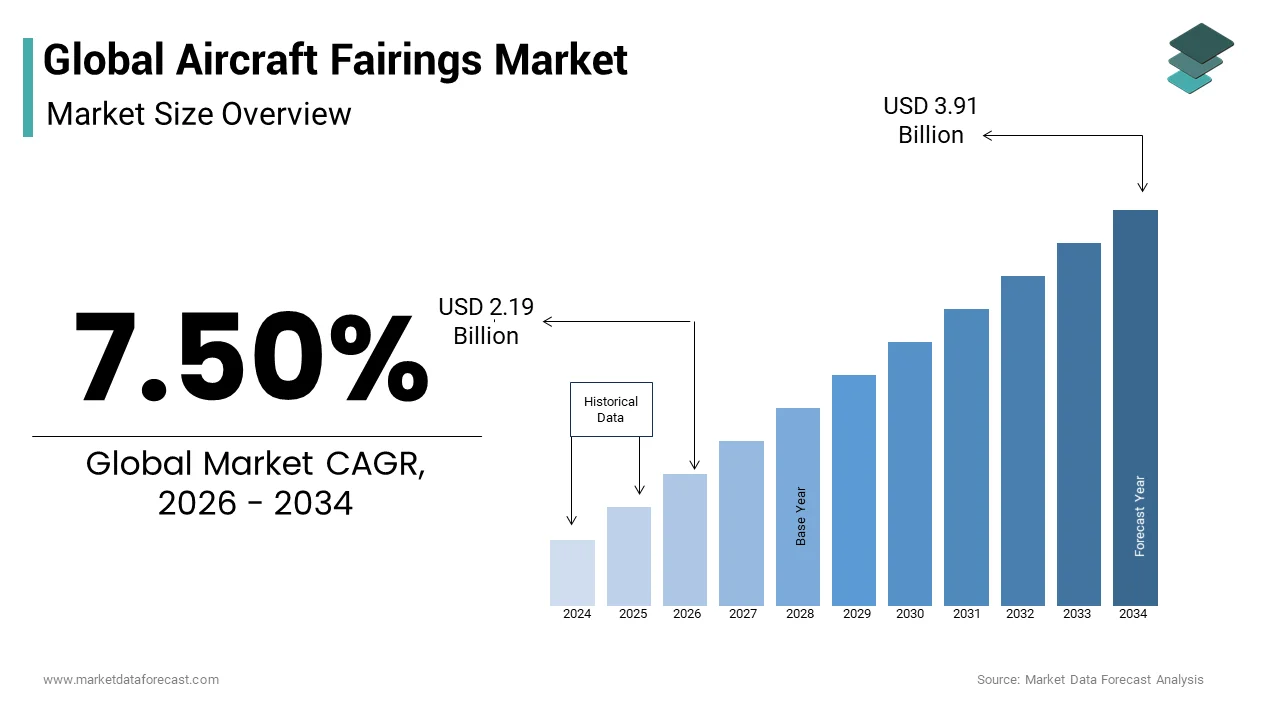
- Market Valuation: Valued at USD 2.04 billion (2025), estimated at USD 2.19 billion (2026), and projected to reach USD 3.91 billion by 2034, registering a solid CAGR of 7.50% (2026–2034).
- Primary Growth Drivers: Expansion of the global commercial aircraft fleet, increasing adoption of advanced composite materials (such as carbon fiber-reinforced polymers) for weight reduction, and the push for fuel efficiency and aerodynamic optimization.
Key Market Segment Metrics (2026–2034)
| Category | Leading Segment (2025 Position) | Fastest-Growing Segment |
|---|---|---|
| By Application | Fuselage and Wing fairings (dominant due to critical drag reduction and structural integration needs) | Landing gear and advanced propulsion integration fairings |
| By End User | Original Equipment Manufacturers / OEMs (anchored by massive commercial fleet production and new deliveries) | Secondary market / MRO services (driven by retrofits and fleet modernization) |
| By Region | North America (held the largest market share in 2025 driven by major aerospace manufacturers like Boeing and the FAA regulatory hub) | Asia-Pacific (projected to record the fastest growth rate driven by surging air traffic and fleet expansions in China and India) |
Major Market Players & Market Structure
Market Structure: Highly consolidated and technologically intensive aerospace sector featuring major aircraft manufacturers, tier-1 aerostructure suppliers, and composite specialists competing on material durability, aerodynamic precision, and stringent regulatory compliance.
Key Companies: Avcorp, Airbus SE, AAR Corporation, Composites Technology Research Malaysia (CTRM), The Boeing Company, Fiber Dynamics Inc., Arnprior Aerospace Inc., Barnes Group, Daher, FACC AG, and others.
 Download Free Sample Report
Global Aircraft Fairings Market Size
The global aircraft fairings market size was valued at USD 2.04 billion in 2025 and is anticipated to reach USD 2.19 billion in 2026 to reach USD 3.91 billion by 2034, growing at a CAGR of 7.50% from 2026 to 2034.
According to the International Air Transport Association, global air traffic is projected to double by 2040, necessitating continuous improvements in aircraft aerodynamics to manage operational costs and environmental impact. As per Boeing, the development of next-generation aircraft involves extensive wind tunnel testing to refine fairing geometries for maximum performance. Aircraft fairings are designed to streamline airflow around protruding components, such as landing gear, wing roots, and engine pylons. These critical elements reduce drag and improve fuel efficiency while protecting sensitive internal systems from environmental damage and debris. The integration of advanced composite materials has transformed fairing manufacturing, allowing for lighter and more durable designs that meet stringent aviation standards. Modern commercial aircraft rely on sophisticated fairing systems to achieve optimal lift-to-drag ratios, which directly influence range and payload capacity. Regulatory bodies, such as the Federal Aviation Administration, enforce strict certification protocols, ensuring that fairings maintain structural integrity under extreme flight conditions. The shift towards sustainable aviation fuels and electric propulsion systems further drives innovation in fairing design to accommodate new powertrain configurations. Manufacturers are increasingly focusing on modular designs that facilitate easier maintenance and replacement, reducing aircraft downtime. This sector plays a pivotal role in the broader aerospace industry by enabling higher efficiency and lower emissions through precise aerodynamic optimization.
MARKET DRIVERS
Expansion of Global Commercial Fleet Driving Demand for Aerodynamic Components
The rapid expansion of the global commercial aircraft fleet is majorly propelling the expansion of the aircraft fairings market, as airlines seek to enhance operational efficiency and reduce fuel consumption. According to Airbus, the worldwide commercial aircraft fleet is expected to grow by approximately 4% annually over the next two decades, resulting in thousands of new deliveries. Each new aircraft requires a comprehensive set of fairings to cover landing gear wheel wells, engine mounts, and control surface hinges, ensuring smooth airflow and minimal drag. The introduction of fuel-efficient models, such as the A320neo and Boeing 737 MAX, incorporates advanced fairing designs that contribute significantly to their improved performance metrics. Airlines prioritize these aerodynamic enhancements to lower operating costs amidst volatile fuel prices and increasing environmental regulations. The replacement cycle for existing fleets also contributes to demand, as older aircraft undergo retrofits with modern fairings to extend service life and comply with updated noise and emission standards. Maintenance, repair, and overhaul activities generate steady aftermarket demand for fairing replacements due to wear and tear from frequent takeoffs and landings. The growing number of low-cost carriers in emerging markets further accelerates fleet expansion, driving volume production of standardized fairing components. This sustained growth in aircraft numbers ensures a consistent and expanding customer base for fairing manufacturers, who must scale production to meet rising global aviation needs.
Adoption of Advanced Composite Materials Enhancing Performance and Efficiency
The widespread adoption of advanced composite materials in aircraft construction is significantly driving the demand for high-performance fairings that leverage the benefits of lightweight and durable structures, which is further boosting the aircraft fairings market expansion. Traditional aluminum fairings are increasingly being replaced by carbon fiber-reinforced polymers and other composite materials, which offer superior strength-to-weight ratios and resistance to corrosion. According to the Society of Automotive Engineers, the use of composites in modern aircraft can reduce overall weight by up to 20%, leading to substantial fuel savings and extended range capabilities. Fairings made from these materials can be molded into complex aerodynamic shapes that are difficult or impossible to achieve with metal, allowing for optimized airflow management. The durability of composites reduces maintenance frequency and lifecycle costs, as they are less prone to fatigue and damage from environmental exposure. Manufacturers are investing in automated layup processes and resin transfer molding techniques to produce high-quality composite fairings at scale. Regulatory approvals for composite structures have become more streamlined, encouraging wider adoption across various aircraft segments, including regional jets and business aviation. The ability to integrate sensors and heating elements directly into composite fairings during manufacturing adds functional value, enhancing de-icing capabilities and structural health monitoring. This technological shift positions composite fairings as a key enabler of next-generation aircraft performance and sustainability goals.
MARKET RESTRAINTS
High Manufacturing Costs and Complex Certification Processes Restricting Market Entry
The substantial costs associated with manufacturing aircraft fairings, combined with rigorous certification requirements are significant restraints on market growth. Producing high-precision aerodynamic components requires specialized tooling, advanced materials, and skilled labor, which drive up initial investment and operational expenses. According to industry analysis, the development and certification of a new fairing design can take several years and cost millions of dollars due to extensive testing and validation procedures. Regulatory authorities, such as the European Union Aviation Safety Agency, mandate comprehensive safety assessments, including crashworthiness, fire resistance, and aerodynamic stability tests. These stringent requirements create high barriers to entry for smaller manufacturers, limiting competition and consolidating the market among a few large players. The complexity of integrating fairings with diverse aircraft platforms necessitates custom engineering solutions for each model, further increasing development time and costs. Any design changes or material substitutions require re-certification, which delays product launches and increases financial risk. The limited number of qualified suppliers reduces bargaining power for automakers and can lead to supply chain bottlenecks. Additionally, the long lead times for composite material procurement and curing processes constrain production flexibility. These factors collectively hinder the ability of manufacturers to rapidly respond to market demands and introduce cost-effective innovations, thereby slowing overall market expansion.
Vulnerability to Supply Chain Disruptions and Raw Material Volatility
The reliance on specialized raw materials and a complex global supply chain that is susceptible to disruptions are further hampering the expansion of the aircraft fairings market. Key materials, such as carbon fiber pre-preg, resins, and high-grade alloys, are sourced from a limited number of suppliers, making the industry vulnerable to shortages and price fluctuations. According to the World Bank, commodity prices for industrial metals and polymers have experienced significant volatility in recent years, impacting production costs and profit margins. Geopolitical tensions, trade restrictions, and logistical bottlenecks can delay the delivery of critical components, causing production halts and increased inventory costs. The just-in-time manufacturing practices adopted by many aerospace companies leave little room for error when supply chains are disrupted. Natural disasters or political instability in key sourcing regions can further exacerbate these issues, leading to prolonged shortages. Manufacturers struggle to secure long-term contracts at stable prices due to market uncertainty, forcing them to absorb cost increases or pass them on to customers. The lack of alternative sources for specialized materials limits flexibility and increases dependency on specific vendors. These supply chain vulnerabilities require companies to invest in risk management strategies and diversified sourcing, which adds to operational complexity and costs. Ensuring consistent quality and availability of materials remains a persistent challenge in maintaining production schedules and meeting customer deadlines.
MARKET OPPORTUNITIES
Integration of Smart Technologies and Structural Health Monitoring Systems
The integration of smart technologies and structural health monitoring systems into aircraft fairings is a significant opportunity for manufacturers in the aircraft fairings market. Embedding sensors within fairing structures allows for real-time monitoring of stress, strain, temperature, and impact damage, providing critical data for predictive maintenance. According to Deloitte, the adoption of Internet of Things technologies in aerospace can reduce maintenance costs by up to 30% and improve aircraft availability. Smart fairings enable early detection of micro-cracks or delamination in composite materials, preventing catastrophic failures and extending component lifespan. This capability aligns with the industry trend towards condition-based maintenance rather than scheduled inspections, optimizing resource allocation and reducing downtime. Manufacturers can offer integrated solutions that combine aerodynamic performance with digital diagnostics, creating new revenue streams through software and data services. The development of self-healing materials and adaptive fairings, that adjust shape based on flight conditions, further enhances efficiency and safety. Partnerships with technology firms and research institutions accelerate innovation in smart material applications. Regulatory support for digital twin technologies encourages the adoption of sensor-embedded components for better lifecycle management. By leveraging these advancements, fairing manufacturers can transition from simple component suppliers to strategic partners offering comprehensive asset management solutions.
Growth of Urban Air Mobility and Electric Vertical Takeoff and Landing Vehicles
The emerging sector of urban air mobility and electric vertical takeoff and landing (eVTOL) vehicles offers a lucrative opportunity for aircraft fairing manufacturers to expand into new markets with unique design requirements. These novel aircraft types require specialized fairings to manage airflow around multiple rotors, battery packs, and electric motors, which differ significantly from traditional fixed-wing configurations. According to Morgan Stanley, the urban air mobility market could reach 1 trillion dollars by 2040, driven by demand for efficient short-distance air transportation. Designing fairings for eVTOLs involves optimizing for low-speed hover efficiency as well as high-speed forward flight, requiring innovative aerodynamic solutions. The lightweight nature of electric aircraft necessitates ultra-light fairing materials to maximize payload and range. Manufacturers who develop expertise in this niche can secure early-mover advantages and establish long-term relationships with pioneering eVTOL developers. The modular design of many urban air vehicles allows for standardized fairing components that can be produced at scale, reducing costs. Regulatory frameworks for urban air mobility are evolving, creating opportunities for manufacturers to influence safety and performance standards. Investment in research and development for eVTOL-specific fairings positions companies at the forefront of next-generation aviation technology. This diversification strategy mitigates risks associated with traditional commercial aviation cycles and opens pathways for sustainable growth.
MARKET CHALLENGES
Technical Complexity of Integrating Fairings with Advanced Propulsion Systems
The technical complexity of integrating fairings with advanced propulsion systems, such as open-rotor engines and hybrid-electric powertrains poses a significant challenge for the aircraft fairings market. These new architectures require fairings that can accommodate unusual geometries and manage complex airflow interactions while maintaining structural integrity. According to NASA research, open-rotor designs offer significant fuel savings but present unique acoustic and aerodynamic challenges that require specialized fairing solutions. Designing fairings for hybrid systems involves managing heat dissipation from electrical components and ensuring electromagnetic compatibility with sensitive avionics. The lack of established design guidelines and historical data for these novel configurations increases development risk and time. Manufacturers must collaborate closely with engine makers to ensure seamless integration, which often involves iterative prototyping and testing. The need for lightweight yet robust materials that can withstand higher thermal loads adds another layer of difficulty. Certification authorities may require additional testing for unconventional fairing designs, delaying approval processes. The rapid pace of technological change in propulsion systems means that fairing designs must be adaptable and future-proof. Failure to address these technical challenges can result in performance penalties, safety issues, and costly redesigns. Overcoming these hurdles requires significant investment in computational fluid dynamics simulations and advanced manufacturing capabilities.
Regulatory Hurdles and Standardization Issues for New Materials
Navigating regulatory hurdles and achieving standardization for new materials used in aircraft fairings present ongoing challenges that impede rapid innovation and market entry. While composite materials offer significant benefits, their widespread adoption is slowed by the lack of universal testing standards and certification protocols. According to the Federal Aviation Administration, each new material formulation requires extensive validation to prove its long-term durability and safety under various environmental conditions. This process is time-consuming and expensive, discouraging manufacturers from experimenting with novel materials. Inconsistencies in regulatory requirements across different regions further complicate global market access, forcing companies to undergo multiple certification processes. The absence of standardized recycling methods for composite fairings also raises environmental concerns and potential future regulatory restrictions. Manufacturers face pressure to develop sustainable end-of-life solutions, which adds complexity to material selection and design. The slow pace of regulatory adaptation to technological advancements creates a mismatch between innovation capabilities and approval timelines. Industry consortia are working to establish common standards, but progress is gradual. Until harmonized regulations are in place, manufacturers must navigate a fragmented landscape that increases compliance costs and delays product launches. Addressing these regulatory and standardization issues is crucial for unlocking the full potential of advanced materials in the aircraft fairings market.
REPORT COVERAGE
| REPORT METRIC | DETAILS |
| Market Size Available | 2025 to 2034 |
| Base Year | 2025 |
| Forecast Period | 2026 to 2034 |
| CAGR | 7.50% |
| Segments Covered | By Application, End Users, And Region |
| Various Analyses Covered | Global, Regional & Country Level Analysis, Segment-Level Analysis, DROC; PESTLE Analysis. Porter’s Five Forces Analysis, Competitive Landscape; Analyst Overview of Investment Opportunities |
| Regions Covered | North America, Europe, APAC, Latin America, Middle East & Africa |
| Market Leaders Profiled | Avcorp, Airbus SE, AAR Corporation, Composites Technology Research Malaysia, The Boeing Company, Fiber Dynamics Inc., Arnprior Aerospace Inc., Barnes Group, Daher, CTRM Aero Composites, and FACC AG |
REGIONAL ANALYSIS
North America Market Analysis
North America occupied 34.3% of the global market share in 2025. The dominance of North America in the global market is attributed to the presence of major aircraft manufacturers and a large commercial fleet. The United States serves as the primary hub, with companies like Boeing and Spirit AeroSystems leading production and innovation. According to the Federal Aviation Administration, the US commercial fleet comprises over 7,000 aircraft, generating significant demand for new and replacement fairings. The region benefits from advanced manufacturing capabilities and strong research and development infrastructure, supporting the adoption of composite materials. Strict safety regulations, enforced by the FAA, ensure high-quality standards, driving demand for certified components. The robust defense sector contributes substantially, with contracts for military aircraft fairings supporting specialized manufacturers. Maintenance, repair, and overhaul activities are extensive due to the age and size of the fleet, creating a steady aftermarket. Investment in urban air mobility and electric vertical takeoff and landing vehicles fosters innovation in new fairing designs. Supply chain resilience is a key focus, as manufacturers seek to localize production of critical components. North America continues to set global trends in aerodynamic design and material science, influencing practices worldwide.
Europe Market Analysis
Europe maintains a strong position in the aircraft fairings market, characterized by the presence of Airbus and a dense network of specialized suppliers. Countries like France, Germany, and the United Kingdom are key contributors to aerospace innovation and manufacturing excellence. According to the European Union Aviation Safety Agency, strict environmental and safety regulations drive the adoption of lightweight and efficient fairing solutions. The region leads in the development of sustainable aviation technologies, including bio-based composites and recyclable materials. Collaborative projects among European nations promote standardization and shared infrastructure for component production. The growth of low-cost carriers increases demand for narrow-body aircraft, which require optimized fairings for short-haul efficiency. High labor costs are offset by advanced automation and precision engineering, ensuring competitive quality. The region is also a leader in recycling initiatives for aerospace materials, including fairings, supporting circular economy principles. Skilled engineering talent and established industrial bases support continuous innovation. Europe’s focus on reducing carbon footprint drives investment in hybrid and electric propulsion systems, which require novel fairing solutions. The region remains a critical hub for aerospace technology, influencing global trends in sustainability.
Asia Pacific Market Analysis
Asia Pacific is the fastest-growing region in the aircraft fairings market due to rapid expansion in air travel and fleet modernization. China, India, and Southeast Asian countries are witnessing a surge in middle-class population, leading to increased demand for air transportation. According to the International Air Transport Association, Asia Pacific is expected to become the largest aviation market by 2035, surpassing North America in passenger volume. Governments in the region are investing heavily in airport an infrastructure and airline expansion program, which drives demand for new aircraft and associated fairings. Local manufacturing capabilities are strengthening, with companies in China and Japan developing indigenous aircraft programs that require domestic fairing supplies. The rise of low-cost carriers contributes to high aircraft utilization rates and frequent maintenance cycles. Regulatory frameworks are evolving to align with international safety standards, prompting upgrades in existing fleets. The region benefits from competitive labor costs and growing technical expertise, which attracts global manufacturers to establish production facilities. Partnerships between local and international firms facilitate technology transfer and capacity building. Asia Pacific’s dynamic market environment offers significant opportunities for innovation and expansion in the aircraft fairings sector.
COMPETITIVE LANDSCAPE
Competition in the aircraft survivability equipment market is characterized by a highly consolidated landscape dominated by a few major defense contractors with extensive technological expertise and government relationships. High barriers to entry due to stringent security clearances complex certification requirements and significant research and development costs protect incumbent players from new competitors. Leading companies differentiate themselves through superior signal processing capabilities advanced sensor fusion technologies and proven combat performance records. Price competition is secondary to technical performance and reliability as governments prioritize mission success and crew survival over cost savings. However vendors compete aggressively on lifecycle support services software update speeds and interoperability with allied systems. The shift toward cognitive electronic warfare and artificial intelligence driven threat response creates new battlegrounds for innovation where software agility becomes a key differentiator. Strategic alliances and joint ventures are frequently utilized to share development risks and access specialized technologies. Regional players focus on niche markets or specific national security needs while global leaders leverage their broad portfolios to secure large scale modernization contracts. Overall the market remains stable with continuous technological advancement and strong government funding driving sustained competitive intensity among top tier manufacturers.
KEY MARKET PLAYERS
Key players in the aircraft fairing market include
- Avcorp
- Airbus SE
- AAR Corporation
- Composites Technology Research Malaysia
- The Boeing Company
- Fiber Dynamics Inc.
- Arnprior Aerospace Inc.
- Barnes Group
- Daher
- CTRM Aero Composites
- FACC AG
Top Players In The Market
- BAE Systems stands as a premier global provider of advanced aircraft survivability solutions offering comprehensive electronic warfare suites and countermeasure systems. The company specializes in digital radar warning receivers and directed infrared countermeasures that protect tactical aircraft from modern missile threats. Recent strategic initiatives include the development of next generation cognitive electronic warfare capabilities that utilize artificial intelligence to adapt to unknown threat signatures in real time. BAE Systems actively collaborates with international defense agencies to integrate these advanced sensors into fifth generation fighter platforms. Their commitment to open architecture standards ensures rapid software updates and seamless interoperability with allied forces. By focusing on technological innovation and combat proven reliability BAE Systems continues to enhance the survival probability of aircrews operating in highly contested environments worldwide.
- Leonardo S.p.A contributes significantly to the global market through its sophisticated Miysis suite which integrates radar warning laser warning and missile approach warning systems into a unified defensive platform. The company leverages extensive expertise in sensor fusion and signal processing to deliver high performance survivability equipment for both rotary and fixed wing aircraft. Recent actions to strengthen its position involve expanding production capacities for gallium nitride based transmitters which offer superior power efficiency and jamming capabilities. Leonardo also invests heavily in research and development for miniaturized sensors tailored for unmanned aerial vehicles. The company focuses on providing modular and scalable solutions that meet diverse operational requirements. Through continuous innovation and strategic partnerships Leonardo maintains a strong reputation for delivering cutting edge defensive technologies that ensure mission success and pilot safety globally.
- Raytheon Technologies plays a pivotal role in the aircraft survivability market by providing industry leading AN ALR 69A radar warning receivers and advanced countermeasure dispensers. The company utilizes its deep expertise in radio frequency engineering to create robust systems that detect and classify complex electromagnetic threats with high accuracy. Recent efforts to bolster its market presence include the integration of machine learning algorithms into legacy systems to enhance threat identification speed and reduce false alarms. Raytheon Technologies actively supports global military customers with comprehensive lifecycle management and rapid technology insertion programs. The company emphasizes rigorous testing and quality assurance to meet stringent military standards. By combining hardware excellence with intelligent software solutions Raytheon Technologies delivers reliable and effective self protection systems that safeguard critical aviation assets against evolving airborne and ground based dangers.
Top Strategies Used By The Key Market Participants
Key players in the aircraft survivability equipment market prioritize research and development to create cognitive electronic warfare systems that adapt autonomously to emerging threats. Strategic partnerships with original equipment manufacturers enable companies to integrate survivability suites directly into new aircraft designs ensuring optimal performance and reduced integration costs. Expansion into the unmanned aerial vehicle sector drives innovation in miniaturized sensors and low power countermeasure systems tailored for drone platforms. Investment in open architecture software allows for rapid updates and third party application integration enhancing system flexibility and lifecycle value. Focus on international export markets through foreign military sales programs helps participants diversify revenue streams and strengthen global defense alliances while maintaining technological leadership.
MARKET SEGMENTATION
This research report on the global aircraft fairings market has been segmented and sub-segmented based on the application, end users, and region.
By Application
- Flight control surfaces
- Fuselage
- Wings
- Nose
- Cockpit
- Landing gear
By End Users
- OEM
- Secondary market
By Region
- North America
- Europe
- The Asia Pacific
- Latin America
- The Middle East and Africa