- Product Description Description
- Table of Contents TOC
- List of Table & Figure LOT
- Get Free Sample PDF Sample PDF
Global Aircraft Recycling Market Size
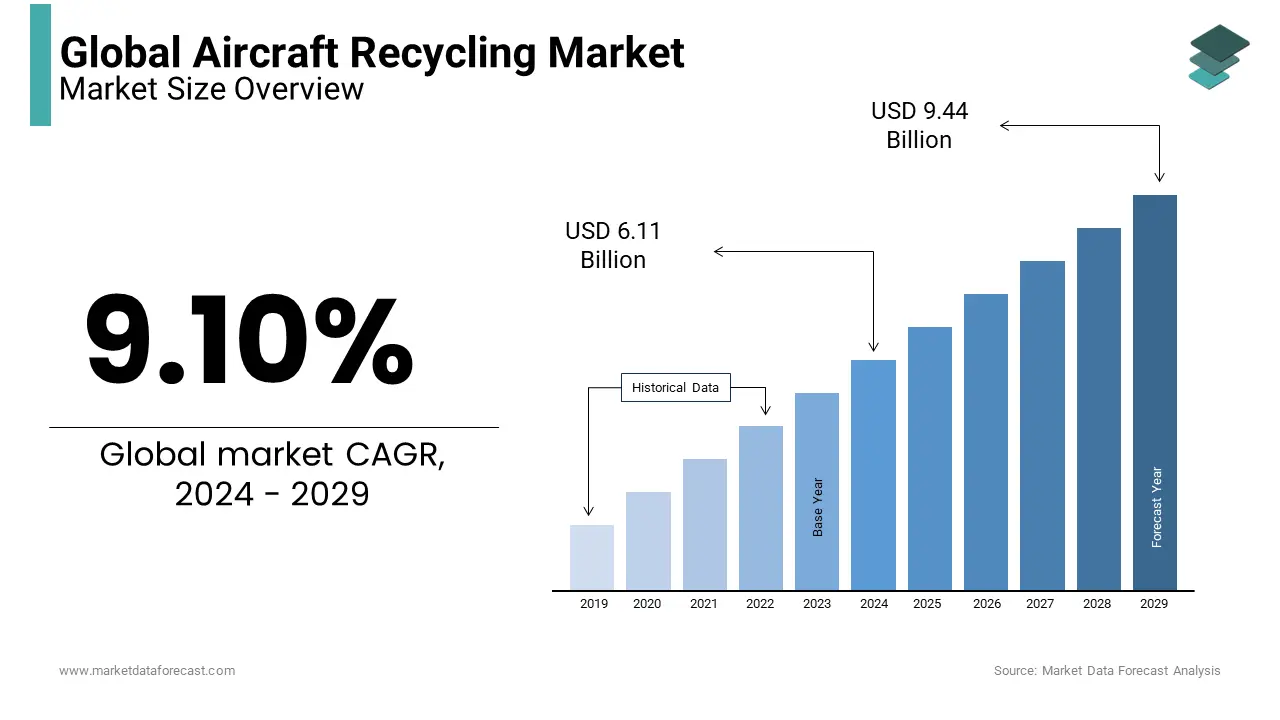
The global aircraft recycling market was valued at USD 6.11 billion in 2024 and is anticipated to reach USD 6.67 billion in 2025 to USD 13.38 billion by 2033, growing at a CAGR of 9.10% during the forecast period from 2025 to 2033.
Current Scenario of the Market
The aircraft materials are highly valued and don't lose their value even after the aircraft is retired. The aircraft materials can be used for other planes if they are recycled under certain processes li, like testing and inspection. Though a few of the components go away, many of the materials are recycled and are the most suitable for use in other planes. At present, 500 aircraft are nearly recycled every year across the world. It is expected that by 2030, more than 2000 planes will be recycled every year. Also, it is projected that in the next 20 years, 12,000 aircraft are going to be retired, and the need for the recycling of the materials is certainly to have the highest scope.
MARKET DRIVERS
The prominence of the quick adoption of environmental sustainability in the aircraft industry is driving up the demand for the recycling of aircraft materials that promote eco-friendly aircraft. This factor is attributed to the surging growth rate of the aircraft recycling market.
Government officials are imposing stringent regulations to make a move on the environmental safety measures when the aircraft recycling solutions will act as one of the factors to reduce carbon emissions. Most of the aircraft materials can be recycled, which eventually reduces the overall cost of new aircraft, along with reducing carbon emissions. The aircraft industry is strongly prioritizing the need to utilize retired aircraft materials, which is legal and improves resource efficiency. These are strictly attributed to prompting the growth rate of the aircraft recycling market.
The key strategies by the top companies to unveil different solutions for the use of various materials from retired aircraft shall impel the market's growth rate during the forecast period. The manufacturing of a new aircraft needs high investment to ensure the quality, whereas the materials that are recycled are highly effective and available at affordable le prices, which shall accelerate the growth rate of the aircraft recycling market.
Increasing investments in the aircraft recycling procedures are solely to surging the growth rate of the market to some extent. The growing knowledge of the use of recycled materials for various applications aims to reduce energy consumption. Therefore, the energy-saving procedures shall highlight the growth rate of the aircraft recycling market.
MARKET RESTRAINTS
Most aircraft materials can be recycled easily, but the major challenge comes when the materials are no longer worth recycling, as it costs very much to dismantle rather than recycle the materials, directly hindering the growth rate of the market. Also, the lack of proper equipment installed to recycle the materials due to poor infrastructure facilities in some countries shall also limit the aircraft recycling market's growth rate. The aircraft are mostly manufactured using composite materials due to their durability and efficiency. The composite materials are not suitable for recycling due to the emission of hazardous chemicals that harm the environment. The emissions of hazardous gases are strictly prohibited by the government, and therefore, the aircraft recycling process is not legally procepermittedch may likely impede the growth rate of the market.
MARKET OPPORTUNITIES
The penetration of the most advanced technologies in the aircraft industry and the launch of aircraft with materials that can be recycled for further use after the retirement of the aircraft substantially create huge growth opportunities for the market in the coming years. The rising popularity of the benefits of reducing environmental pollution through the recycling process shall greatly influence the aircraft recycling market. Many top aircraft industries are gradually inclined to adopt the familiar changes in the manufacturing of aircraft that consolidate historical operational data, which is anticiincrease level up the new opportunities for aircraft recycling procedures in the forecast period. Companies are moving forward with approaching sustainability through new developments. Partnerships and collaborations between the top companies can elevate the market's growth rate in the foreseeable future.
MARKET CHALLENGES
The most challenging factor for key market players is the difficulty of recycling aircraft materials. Though most of the materials can be recycled as some may get sposeand pose difficulty in separating and then recycling accordingly. The adoption of quick changes in recycling procedures due to a lack of knowledge of the new procedures can also slow down the huge growth rate of the market in the foreseeable future.
REPORT COVERAGE
| REPORT METRIC | DETAILS |
| Market Size Available | 2024 to 2033 |
| Base Year | 2024 |
| Forecast Period | 2025 to 2033 |
| CAGR | 9.10% |
| Segments Covered | By Aircraft, Product, and Region |
| Various Analyses Covered | Global, Regional & Country Level Analysis, Segment-Level Analysis, DROC, PESTLE Analysis, Porter’s Five Forces Analysis, Competitive Landscape, Analyst Overview on Investment Opportunities |
| Regions Covered | North America, Europe, APAC, Latin America, Middle East & Africa |
| Market Leaders Profiled | Aircraft End-of-Life Solutions, Aircraft Part Out Company, Air Salvage International, Apple Aviation, Aviation International Recycling, Tarmac Aerosave, Total Technic, Vallair, ADI- Aircraft Demolition & Recycling, ARC Aerospace Industries, ComAv Technical Services, KLM UK Engineering, Sycamore Aviation, Universal Asset Management Inc, VAS Aero Services, and others |
SEGMENTAL ANALYSIS
By Aircraft Insights
The narrow-body segment has been leading the largest share of the aircraft recycling market in the past few years. Narrow-body aircraft are generally commercial planes that have a seating capacity of 100-300 people. These flights are used for short distances and run with a single aisle through the cabin. These narrow-body aircraft are worth considering for additional income as they also support cargo. This flight can carry both passengers and cargo in a 60% and 40% ratio, respectively. The wide-body segment is likely to hold a prominent growth rate during the forecast period. These aircraft come along with the t, which aisle creates larger cabin space for passengers. These provide a comfortable and convenient travel experience for passengers, which is surging the growth rate of the aircraft recycling market.
By Product Insights
The component segment is growing and has the highest share of the market. Engines, Landing gear, and other components can be recycled easily through the process, which poses huge benefits for the installation of these components in new aircraft. The rising number of passengers across the world is inclined to raise the number of manufacturers of new aircraft at affordable and sustainable prices, using the new procedures for recycling components from retired aircraft.
The material segment is likely to have the highest CAGR by the end of 2029. The aluminum sub-segment is gearing up with the prominent share, while other metals & alloys pose a significant growth rate of the market.
REGIONAL ANALYSIS
North America's aircraft recycling market is significantly having the highest share. The US and Canada are the prominent countries contributing the highest share of the market. The US is the country that launched the world's world-class aircraft with advanced technologies. These aircraft usually have excellent components that can be reused after the recycling process. Therefore, the prominence of the recycling of components is increasing year on year, which is likely to elevate the growth rate of the market. High financial support from the government shall promote growth opportunities in the aircraft industry and encourage new changes in the recycling of aircraft components. The presence of major aircraft companies in the US is likely to promote the growth rate of the aircraft recycling market.
The Asia Pacific region is gaining huge traction due to the growth rate of the aircraft recycling market. India is booming in the aircraft industry and has had a growing position in the economy over the past few years. Constant economic growth in India and China is a major factor in the market's growth during the forecast period. Emerging countries like China and India are creating new opportunities to establish new infrastructure for aircraft industries to manufacture or recycle the components further, according to the commitment highlighted by other countries. For many years, Chinese airlines have had far more airline services like Boeing and Airbus. Huge investments from the private and public sectors greatly influence the growth rate of the Asia Pacific market.
Europe is next to the Asia Pacific, holding the prominent growth rate of the market. European countries are stepping into the transformation of reducing carbon emissions. The stringent rules and regulations by the government to take necessary action on reducing carbon emissions in the aircraft industry are gradgraduallyreasingdemand for the adoption of sustainable procedures like recycling of the old or retired components.
Latin America is expected to have steady growth opportunities through the forecast period. The growing scale of the aircraft indindustryth the increasing economy, and the growing number of people who prefer to travel by air. The le East and Africa are expected to haexpected ve slight growth opportunities in the coming years.
KEY MARKET PLAYERS
Aircraft End-of-Life Solutions, Aircraft Part Out Company, Air Salvage International, Apple Aviation, Aviation International Recycling, Tarmac Aerosave, Total Technic, Vallair, ADI- Aircraft Demolition & Recycling, ARC Aerospace Industries, ComAv Technical Services, KLM UK Engineering, Sycamore Aviation, Universal Asset Management Inc, VAS Aero Services. are the market players that are dominating the global aircraft recycling market.
MARKET SEGMENTATION
This research report on the global aircraft recycling market has been segmented and sub-segmented based on the aircraft, product, and region.
By Aircraft
- Narrow-body
- Wide-body
By Product
- Component
- Engines
- Landing Gear
- Avionics
- Others
- Material
-
Aluminum
-
Other metals & alloys
-
Other materials
By Region
- North America
- Europe
- Asia-Pacific
- Latin America
- The Middle East and Africa