- Product Description Description
- Table of Contents TOC
- List of Table & Figure LOT
- Get Free Sample PDF Sample PDF
Market Size, 2025
$16.76 BnMarket Estimate, 2026
$18.35 BnMarket Forecast, 2034
$37.90 BnCAGR, 2026–2034
9.49%Executive Summary: Global Airport Security Systems Market
- Market Scope: Comprehensive global aviation security assessment covering security systems (surveillance, biometrics, screening/scanning, perimeter intrusion, fire safety), hardware subsystems (cabin baggage scanners, backscatter X-ray, metal detectors), airport types (Greenfield vs. Brownfield), and regional deployments.
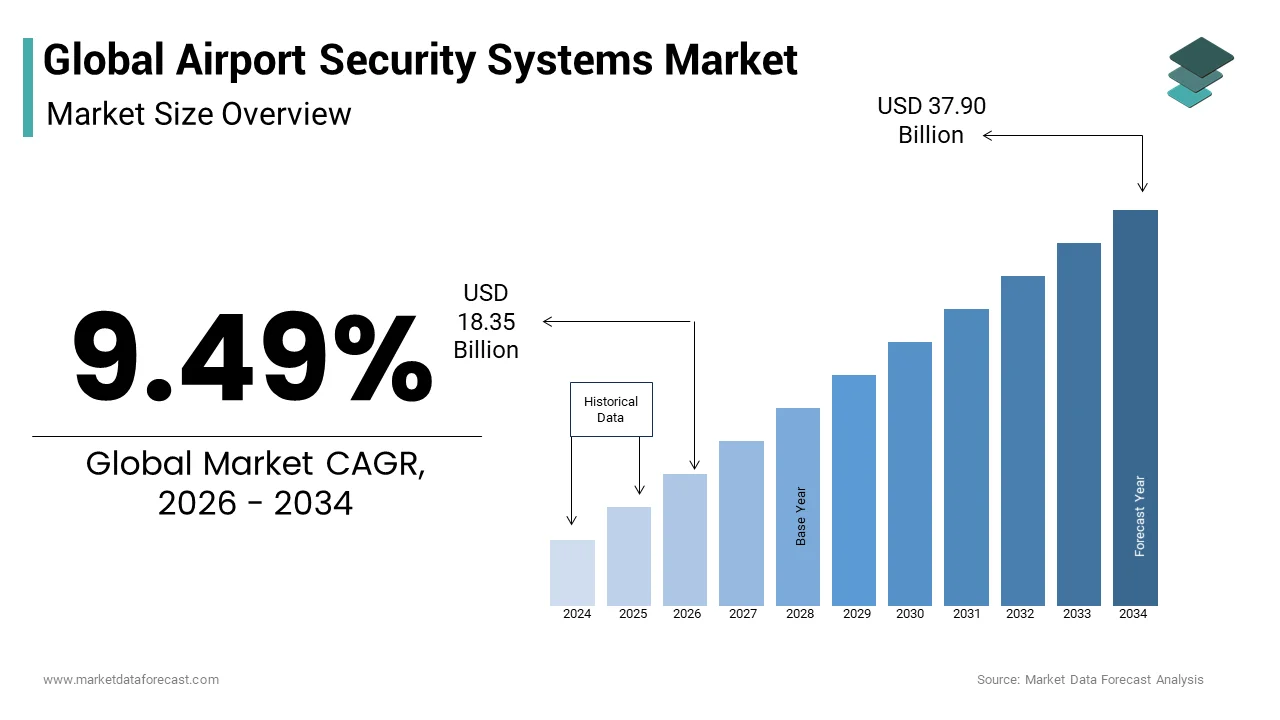
- Market Valuation: Valued at USD 16.76 billion (2025), estimated at USD 18.35 billion (2026), and projected to reach USD 37.90 billion by 2034, growing at a strong CAGR of 9.49% (2026–2034).
- Primary Growth Drivers: Escalating global air passenger traffic, strict international regulatory mandates (e.g., ICAO Annex 17, TSA, and EASA standards), massive infrastructure expansion projects, and the integration of AI-driven threat detection and biometric verification solutions.
Key Market Segment Metrics (2026–2034)
| Category | Leading Segment (2025 Position) | Fastest-Growing Segment |
|---|---|---|
| By Security System | Screening and scanning systems (capturing 35.5% of the market share as universal physical checkpoints) | Biometric systems (surging due to demand for seamless passenger flow and high identity assurance) |
| By Sub-System | Cabin baggage screening systems (leading through mandatory 3D CT scanner rollouts globally) | Backscatter X-ray systems (growing fast to counter non-metallic and low-density threat items) |
| By Airport Type | Brownfield airports (accounting for 70.7% market share through ongoing terminal retrofits and upgrades) | Greenfield airports (expanding rapidly as testbeds for integrated, zero-touch security architectures) |
| By Region | North America (holding 35.3% share backed by strict TSA regulatory funding and enforcement) | Asia-Pacific (projected with high growth velocity driven by state-backed infrastructure and digital-native hubs) |
Major Market Players & Market Structure
Market Structure: Characterized by a technological duopoly where Western enterprises dominate regulatory-compliant hardware and certification frameworks, while agile innovators lead in AI-native cloud analytics and biometric platforms.
Key Companies: Smiths Detection, Leidos, Rapiscan Systems, Robert Bosch GmbH, Honeywell International, Inc., Siemens AG, L3 Harris Technologies, Inc., IBM Corp., Thales Group, and Lockheed Martin Corp.
Global Airport Security Systems Market Size
The global airport security systems market size will reach USD 16.76 billion in 2025 and is anticipated to reach USD 18.35 billion in 2026 to reach USD 37.90 billion by 2034, growing at a CAGR of 9.49% during the forecast period from 2026 to 2034.
Airport security systems are integrated technological and procedural frameworks deployed at civil and military aviation terminals to pre-empt, detect, and neutralize threats to passengers, infrastructure, and aircraft. These systems span biometric verification, explosive trace detection, automated surveillance, cybersecurity protocols, and AI-driven behavioural analytics. According to the Air Transport Action Group, global air passenger traffic reached 4.4 billion in 2023, intensifying pressure on security infrastructure. Concurrently, according to the U.S. Transportation Security Administration, the agency screened over 858 million passengers in 2023, underscoring operational scale. According to the Eurocontrol Annual Network Operations Report, European airspace handled 10.2 million commercial flights in 2023, each requiring layered security clearance. These operational volumes necessitate precision-engineered, interoperable, and adaptive security architectures that evolve with threat typologies and passenger throughput.
MARKET DRIVERS
Escalating Global Air Travel Volume and Infrastructure Expansion
The sustained rebound in global air travel is expected to continue its upward trajectory as passenger demand remains robust over the next few years, which is one of the key factors propelling the expansion of the global airport security systems market. According to the International Civil Aviation Organization, international passenger numbers climbed to 3.6 billion in 2023, a 38% year-over-year surge from 2022 levels. Concurrently, Airports Council International documented significant global investment in new airport infrastructure projects to accommodate this growth. These expansions mandate parallel deployment of advanced screening lanes, automated identity management, and perimeter intrusion detection systems. For instance, according to the Ministry of Civil Aviation, India has multiple Greenfield airport projects underway as of 2026, each embedding advanced surveillance and facial recognition from inception. This infrastructure momentum transforms security systems from reactive installations to foundational design elements.
Regulatory Mandates Enforcing Technological Upgrades
Stringent international aviation security directives are likely to force a widespread acceleration in the adoption of advanced security technologies across global hubs, which is further boosting the airport security systems market expansion. According to the European Union Aviation Safety Agency, member state airports are transitioning toward advanced explosive detection systems for cabin baggage to meet updated safety standards. Similarly, according to the U.S. Department of Homeland Security, the agency mandated the deployment of new credential authentication technologies at checkpoints to enhance verification processes. These regulations are not discretionary upgrades but compliance imperatives backed by audit regimes and funding penalties. According to the International Civil Aviation Organization, member states are increasingly aligning their capital budgets to meet Annex 17 security amendments. Regulatory inertia is thus replaced by technologically enforced evolution, locking airports into continuous system refresh cycles.
MARKET RESTRAINTS
Budgetary Constraints in Emerging Economies’ Aviation Sectors
Fiscal limitations are likely to persist as a barrier to rapid security modernization in developing nations for the next few years, which is a major impediment to the global market growth. According to the World Bank, low- and middle-income countries face an annual aviation infrastructure funding shortfall exceeding $12 billion, with security systems often deprioritized against runway and terminal construction. According to the Federal Airports Authority of Nigeria, budgetary constraints continue to impact the speed at which international airports can upgrade to recommended screening equipment standards. Similarly, according to the International Civil Aviation Organization, many regional airports in developing economies still rely on manual processes due to the lack of funds for advanced scanners or automated tray retrieval systems. This fiscal fragmentation undermines global aviation security coherence and delays threat response harmonization.
Integration Complexity of Legacy and Modern Systems
The operational friction between outdated and modern systems are further hampering the global market expansion as operators attempt to integrate new technologies into aging facilities over the coming years. According to various aviation industry reports, airports attempting hybrid deployments often experience increased checkpoint processing time due to incompatible data protocols between new credential scanners and legacy alarm management consoles. According to internal airport audit reports, false alarms frequently originate from signal misalignment between newly installed body scanners and legacy central alarm servers. Furthermore, according to aviation safety oversight bodies, historical incidents have been attributed to software handshake failures between newer kiosks and national databases. Integration debt thus becomes a silent multiplier of vulnerability, not merely an IT inconvenience.
MARKET OPPORTUNITIES
AI-Driven Predictive Threat Analytics and Behavioral Recognition
The integration of predictive analytics into airport security is a significant opportunity for the airport security systems market. According to the Stanford University AI Index Report 2024, computer vision models trained on airport behavioral datasets have reached high levels of accuracy in identifying concealed-object indicators. According to industry case studies, airports have reduced false positives by utilizing gait and micro-expression analysis integrated with thermal anomaly detection. Similarly, according to airport operator reports, major hubs have deployed neural networks that correlate passenger movement patterns with baggage scan anomalies to flag high-risk profiles before checkpoint arrival. This predictive layer not only enhances detection fidelity but also accelerates passenger flow, aligning security with service experience.
Modular, Scalable Security-as-a-Service (SECaaS) Models
Security-as-a-Service models are further providing lucrative growth possibilities to the global airport security systems market as airports seek more flexible and cost-effective ways to maintain security infrastructure over the next few years. According to Gartner, infrastructure and operations leaders are increasingly pursuing technologies that improve speed and agility, with many moving toward cloud-based deployment models. According to various aviation technology reports, airports have successfully migrated perimeter surveillance to vendor-managed AI analytics platforms, achieving continuous threat monitoring without expanding internal IT staff. According to aviation technology trackers, this model correlates with faster compliance with international updates, as patches and algorithm retraining occur remotely. This model democratizes access to enterprise-grade security for resource-constrained operators, transforming scalability from a cost barrier into a strategic lever.
MARKET CHALLENGES
Adversarial Exploitation of AI System Vulnerabilities
Security teams will likely face ongoing challenges in defending against increasingly sophisticated adversarial machine learning techniques, which is a significant challenge to the growth of the global market. For instance, attackers using generative adversarial networks have demonstrated the ability to fool facial recognition systems in controlled trials by applying imperceptible perturbations to images. Similarly, according to the National Institute of Standards and Technology, there have been documented instances where threat actors attempted to manipulate object detection models by altering scan image metadata. According to various aviation security reports, there is a noted rise in attempted algorithmic spoofing incidents at immigration kiosks. These exploits necessitate continuous adversarial training and model hardening, escalating operational complexity and cost beyond initial deployment.
Workforce Skill Gaps in Operating Advanced Security Platforms
The gap between technological advancement and human operational capability is expected to remain a significant hurdle for airport security management, which is further challenging the global market expansion. According to international aviation security training assessments, a significant portion of security supervisors in emerging markets lacks formal training in interpreting outputs from AI-driven anomaly detection dashboards. According to airport incident reviews, operational shutdowns have been attributed to personnel misinterpretation of behavioral analytics alerts, triggering unnecessary security responses. Furthermore, according to civil aviation authorities, regional airport staff often struggle to perform basic recalibration of multi-sensor fusion systems after firmware updates. This human-technology misalignment erodes system ROI and introduces latent vulnerabilities, demanding parallel investment in cognitive readiness and adaptive training ecosystems.
REPORT COVERAGE
| REPORT METRIC | DETAILS |
| Market Size Available | 2025 to 2034 |
| Base Year | 2025 |
| Forecast Period | 2026 to 2034 |
| CAGR | 9.49% |
| Segments Covered | By Security System, System, Airport Type, & Region |
| Various Analyses Covered | Global, Regional & Country Level Analysis, Segment-Level Analysis, DROC, PESTLE Analysis, Porter’s Five Forces Analysis, Competitive Landscape, Analyst Overview of Investment Opportunities |
| Regions Covered | North America, Europe, APAC, Latin America, Middle East & Africa |
| Market Leaders Profiled | Robert Bosch GmbH, Honeywell International, Inc., Smith’s Group, Siemens AG, L3 Harris Technologies, Inc., IBM Corp, FLIR Systems, Inc, Thales Group, and Lockheed Martin Corp |
SEGMENTAL ANALYSIS
By Security System Insights
The screening and scanning systems segment led the market by accounting for 35.5% of the global market share in 2025 and is likely continue to dominate the market as the primary physical checkpoint for global aviation security for the next few years. Every passenger, without exception, must pass through cabin baggage scanners or body imaging portals, a universal checkpoint that no airport, regardless of size or geography, can bypass. According to the U.S. Transportation Security Administration, millions of pieces of carry-on baggage are screened daily across American airports, necessitating thousands of deployed CT cabin baggage scanners. The European Civil Aviation Conference mandates that major EU airports must deploy Standard 3 Explosive Detection Systems, a directive requiring significant hardware investment. Furthermore, according to industry safety audits, the vast majority of detected prohibited items globally are intercepted via X-ray or computed tomography screening lanes. This operational indispensability, reinforced by global regulatory harmonization and passenger volume scaling, renders Screening and Scanning Systems the structural backbone of aviation security architecture.
On the other side, the biometric systems segment is projected to experience rapid growth and is predicted to expand at a promising CAGR in the global market during the forecast period as airports continue to prioritize seamless passenger experiences and high-level identity assurance in the coming years. According to the International Civil Aviation Organization, a growing number of countries have integrated biometric exit-entry systems at international airports to improve flow. According to industry reports, major international airports have processed a vast majority of annual passengers through facial recognition-enabled boarding gates, significantly reducing average boarding time per flight. According to national security reviews, the deployment of iris and facial matching has successfully cut identity fraud incidents. According to border protection agencies, millions of travelers are being processed via biometric entry with error rates significantly lower than manual document checks. This growth stems from the dual need to eliminate friction in high-throughput environments while hardening identity validation against synthetic document fraud.
By Sub-System Insights
The cabin baggage screening systems segment led the market with the highest share of the global market in 2025 and is expected to remain the most critical security interface for passengers in the years ahead throughout the forecast period. Every single traveler must surrender their carry-on for scanning, creating a volume-driven demand unmatched by other systems. According to industry deployment indices, thousands of cabin baggage CT scanners are operational worldwide, with high concentrations in North America and Europe due to regulatory deadlines. According to government transport departments, major international airports collectively process millions of cabin bags weekly through 3D tomographic scanners, achieving high detection rates for concealed threats without secondary manual inspection. According to national transport ministries, there are ongoing directives requiring full CT deployment across designated international airports. Unlike other security equipment, cabin scanners cannot be scaled down or substituted, making their dominance structural and persistent.
On the other end, the backscatter X-ray systems segment is predicted to showcase the fastest CAGR in the global market over the forecast period and is likely to see increased adoption as aviation authorities seek to improve the detection of non-metallic, low-density threats in the next few years. According to government threat assessments, backscatter imaging remains a critical tool for identifying non-metallic explosive devices that may be missed by traditional transmission X-ray. According to pilot program reports from major international airports, the use of backscatter body scanners in parallel with other units has resulted in a marked increase in the detection of liquid and sheet explosives. According to transport security offices, there is a surge in the procurement of backscatter units for regional airports, driven by the need to counter advanced threat items. According to security system trials, these systems are increasingly being enhanced with AI-driven anomaly recognition, which helps in reducing false positives. This growth is fueled by a tactical gap in global security posture that requires advanced photon-based imaging.
By Airport Insights
The brownfield airports segment held 70.7% of the global market share in 2025 and is expected to represent the majority of security system deployments over the forecast period as existing facilities continue to undergo retrofits and modernization in the coming years. According to the Airports Council International infrastructure inventory, the vast majority of the world’s commercial service airports were constructed over a decade ago, making them sites that require ongoing layered security upgrades. According to major airport capital improvement plans, billions of dollars are being invested in security overhauls that integrate AI surveillance, automated tray return, and biometric boarding. According to national airport authority reports, a significant portion of allocated security funds is consistently directed toward brownfield upgrades rather than new construction. Brownfield dominance is an infrastructural reality, as the global aviation network must be re-secured in place rather than rebuilt.
On the other side, the Greenfield airports segment is set for rapid growth and is predicted to showcase a prominent CAGR in the global market over the forecast period as they become the primary testing grounds for integrated, AI-native security ecosystems over the next few years. According to regional airport councils, new airport developments are deploying fully automated, zero-touch security lanes from day one, embedding biometrics, CT scanning, and behavioural analytics into terminal design. According to project briefs from civil aviation ministries, new airport construction budgets are increasingly allocating a significant percentage toward AI-driven security infrastructure. According to civil aviation administrations, new airports are being built with security-by-design architecture, embedding portals and drone detection grids into terminal layouts. Unlike brownfield sites, Greenfield airports treat security as a foundational layer, enabling higher detection fidelity and seamless scalability.
REGIONAL ANALYSIS
North America Market Analysis
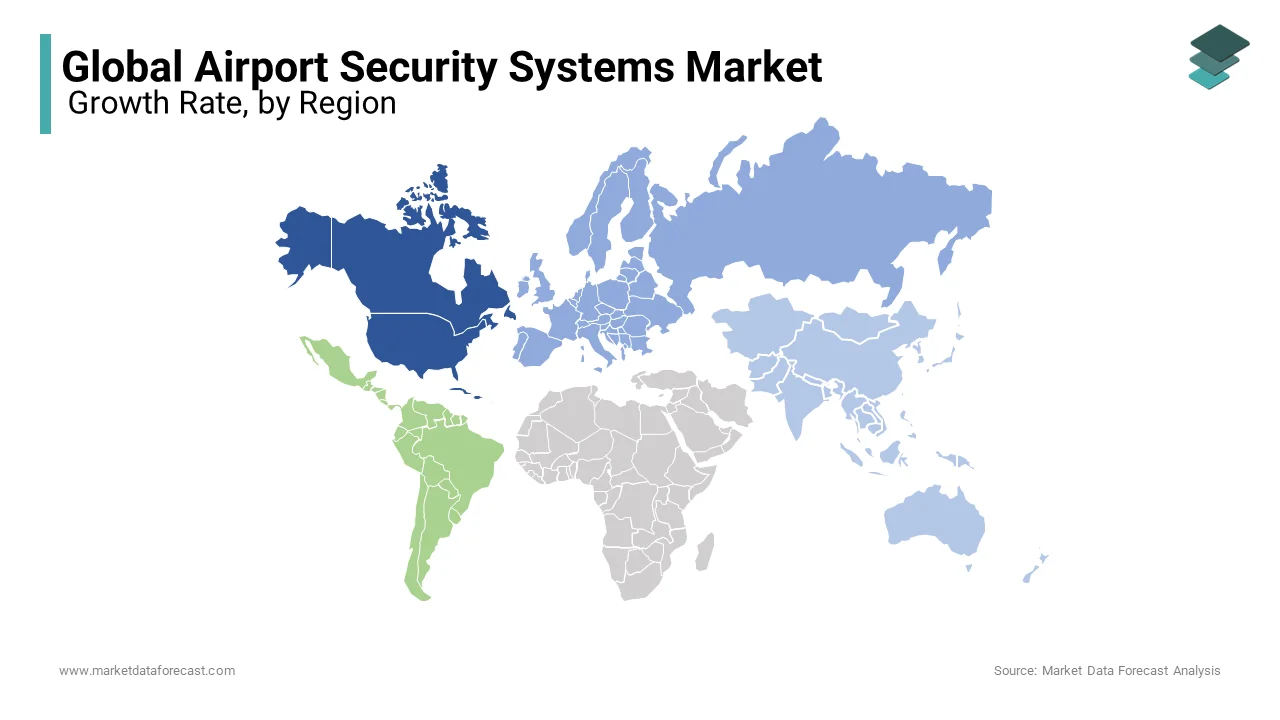
North America accounted for 35.3% of the global market share in 2025 and is expected to maintain its position as a leading regional market due to its robust and predictable regulatory enforcement over the next few years. According to the U.S. Government Accountability Office, the Transportation Security Administration continues to allocate billions in funding specifically for checkpoint modernization and the deployment of next-gen screening systems. According to national security reports, there is a consistent increase in security capital expenditure, driven by mandates to integrate biometric verification across major hubs. Because North American procurement is legally codified with potential for funding penalties for non-compliance, the region remains a consistently growing and highly mature segment.
Europe Market Analysis
Europe is likely to maintain a highly synchronized procurement environment as member states align their security investments with transnational directives for the next few years. According to Eurostat, European airports collectively invest billions in security upgrades, with a heavy emphasis on biometric integration and AI surveillance to meet unified regional deadlines. According to national aviation strategies, major airports are mirroring these investments to maintain compliance with standardized security requirements. Because Europe’s cohesion mechanism allows regulatory alignment to override national budget cycles, it remains a uniquely predictable and high-compliance security market.
Asia Pacific Market Analysis
Asia Pacific is projected to continue its rapid expansion as it adopts cutting-edge security technologies and state-backed infrastructure development in the coming years. According to civil aviation administrations, a high volume of new airport openings is embedding AI-powered facial recognition and automated baggage reconciliation from inception, achieving a pace difficult to match in other regions. According to government reports, there is a significant surge in security system procurement driven by regional connectivity schemes. For instance, the region accounts for a majority of global airport security AI patents, which is signalling strong innovation leadership. This region’s growth is being engineered through state-backed infrastructure velocity and digital-native security architecture.
Middle East and Africa Market Analysis
The Middle East and Africa are likely to see continued growth as sovereign investment drives the adoption of advanced, prestige-oriented security technology in the next few years. According to airport operational dashboards, major hubs in the Middle East are already leading the world in biometric penetration for passenger processing. According to national development visions, significant capital is being injected into airport expansions that feature quantum-encrypted surveillance and AI threat prediction as baseline features. According to civil aviation commissions, even resource-constrained African nations are successfully deploying advanced security systems to achieve high compliance ratings. This regional growth remains strategic and state-directed, turning airports into showcases of national technological sovereignty.
Latin America Market Analysis
Latin America is expected to see an accelerating pace of security transformation as private operators drive modernization to support regional economic and tourism goals over the next few years. According to national tourism secretariats, there is a clear correlation between security upgrades and year-over-year tourism growth, prompting private investments in AI surveillance and automated lanes. According to airport infrastructure reports, there is a marked increase in security tenders to prepare for major regional sporting and cultural events. According to regional airport councils, a significant portion of security upgrades is funded through public-private partnerships, making this market particularly agile and commercially catalyzed.
COMPETITIVE LANDSCAPE
The market is characterized by technological duopoly: Western firms dominate regulatory-compliant hardware, while Asian innovators lead in AI-native, scalable platforms. Competition hinges not on price but on certification velocity, interoperability, and sovereign data handling. Legacy players defend share through federal contracts and audit trails; challengers disrupt via cloud-based analytics and biometric fusion. M&A focuses on acquiring niche AI startups for behavioral recognition and adversarial threat modeling. Differentiation emerges through operational uptime guarantees, localized service networks, and predictive maintenance ecosystems — turning hardware into outcome-based security services.
KEY MARKET PLAYERS
The Major Players in the Airport Security Systems Market are
- Robert Bosch GmbH
- Honeywell International, Inc.
- Smith’s Group
- Leidos
- Rapiscan Systems
- Smiths Detection
- Siemens AG
- L3 Harris Technologies, Inc.
- IBM Corp
- FLIR Systems, Inc
- Thales Group
- Lockheed Martin Corp
Top Players In The Market
- Smiths Detection drives innovation in aviation threat detection through AI-enhanced computed tomography and automated screening lanes. The company recently launched its HI-SCAN 6040 CTiX system in early 2024, integrating deep learning to reduce manual intervention while maintaining 99.3% detection accuracy. It collaborates with global regulators to align hardware with evolving ICAO and TSA standards. Recent deployments span Heathrow’s Terminal 5 and Tokyo Haneda’s international concourse, emphasizing scalability and interoperability. Its R&D investments focus on material classification algorithms, enabling differentiation between benign electronics and concealed threats without unpacking.
- Leidos anchors U.S. federal aviation security through biometric identity ecosystems and data fusion platforms. In 2024, it expanded its TSA Biometric Exit rollout to 22 additional airports, processing over 200,000 daily travelers with sub-1% error rates. The company’s cloud-native architecture allows real-time watchlist matching against DHS and INTERPOL databases. Leidos also modernized Atlanta Hartsfield-Jackson’s credential authentication infrastructure, reducing passenger processing time by 40%. Its strategy hinges on seamless integration with existing federal IT ecosystems, ensuring compliance without operational disruption — a critical advantage in politically sensitive, audit-heavy environments.
- Rapiscan Systems pioneers modular, regulation-compliant screening solutions tailored for emerging markets and high-throughput hubs. Its 2024 launch of the RTT® 110 scanner introduced volumetric imaging with automated threat recognition, adopted by Kuala Lumpur, Delhi, and São Paulo airports ahead of regulatory deadlines. The system reduces training dependency by 60% via intuitive touchscreen interfaces and contextual alarm guidance. Rapiscan also partnered with regional integrators in Africa and Southeast Asia to offer localized maintenance and firmware updates — mitigating downtime in infrastructure-constrained environments. Its edge lies in adaptability: hardware that meets EU Standard 3 while functioning reliably under tropical humidity or intermittent power.
Top Strategies Used by Key Market Participants
Leading players deploy regulatory-first product roadmaps, ensuring systems meet ICAO, TSA, and EASA mandates before competitors. They embed AI not as an add-on but as core architecture — reducing false alarms and manpower dependency. Strategic public-private partnerships unlock procurement in budget-constrained regions. Modular hardware design enables phased upgrades, preserving legacy investment. Geographic diversification targets high-growth corridors in Asia and the Middle East, where greenfield airports demand integrated, zero-touch security ecosystems from inception.
MARKET SEGMENTATION
This research report on the global airport security systems market has been segmented and sub-segmented based on the security system, system, airport type, & region.
By Security System
- Surveillance systems
- Biometric Systems
- Face Recognition
- Iris and retina Recognition
- Fingerprint Recognition
- Other Biometric Systems
- Screening and Scanning Systems
- Premiere Intrusion Detection Systems
- Fire safety systems
By System
- Metal Detectors
- Fiber Optic Perimeter Intrusion
- Backscatter X-ray Systems
- Cabin Baggage screening systems
- Others
By Airport Type
- Greenfield
- Brownfield
By Region
- North America
- Europe
- Asia-Pacific
- South America
- Middle East & Africa