- Product Description Description
- Table of Contents TOC
- List of Table & Figure LOT
- Get Free Sample PDF Sample PDF
Global Ammonia Market Summary
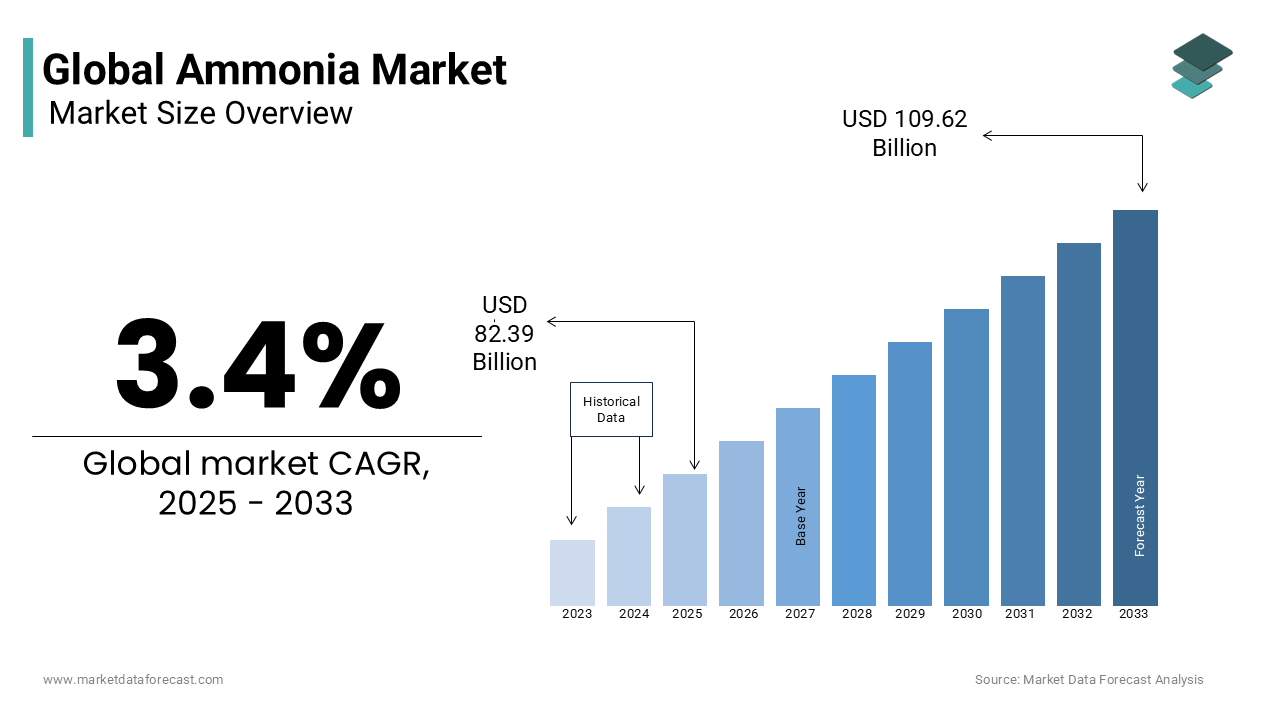
The global ammonia market was valued at USD 79.68 billion in 2024, is projected to reach USD 82.39 billion in 2025, and is anticipated to grow to USD 109.62 billion by 2033, expanding at a CAGR of 3.4% from 2025 to 2033. The growth of the ammonia market is primarily attributed to the rising demand for nitrogen-based fertilizers, expanding industrial applications, and growing adoption of ammonia in energy transition strategies such as blue and green ammonia. Increasing global food demand and agricultural productivity needs are further fueling ammonia consumption.
Key Market Trends
- Rising adoption of green and blue ammonia to support clean energy and decarbonization goals.
- Strong demand from the fertilizer industry, particularly for urea and ammonium nitrate production.
- Expanding applications of ammonia in refrigeration, chemicals, and industrial processes.
- Growing investments in ammonia as a hydrogen carrier for renewable energy applications.
- Shift toward sustainable ammonia production technologies to reduce carbon emissions.
Segmental Insights
- By type, the liquid ammonia segment dominated the global ammonia market in 2024, supported by widespread use in fertilizers and industrial processes.
- By application, the nitrogen fertilizer intermediate segment held the largest share in 2024, reflecting ammonia’s critical role in global agriculture.
- By end-user, the agriculture segment led the market in 2024, as ammonia remains indispensable for crop nutrition and soil productivity.
Regional Insights
- Asia-Pacific was the top-performing region, accounting for 52.5% of the global ammonia market in 2024, driven by strong fertilizer demand in China, India, and Southeast Asia.
- North America is witnessing steady growth, supported by advanced fertilizer production and increasing investments in clean ammonia projects.
- Europe emphasizes sustainable production and green ammonia adoption to align with carbon neutrality goals.
- Latin America is expanding ammonia consumption due to large-scale agriculture in Brazil and Argentina.
- Middle East & Africa are gradually increasing market presence with growing fertilizer demand and industrial expansion.
Competitive Landscape
Leading companies in the global ammonia market include Yara International ASA, CF Industries Holdings Inc., Nutrien Ltd., OCI NV, BASF SE, SABIC, Mitsubishi Gas Chemical Company Inc., Linde plc, EuroChem Group, and Koch Fertilizer LLC. These players are investing in green ammonia projects, capacity expansion, and strategic partnerships to strengthen their market position.
Global Ammonia Market Size
The global ammonia market was valued at USD 79.68 billion in 2024, is estimated to reach USD 82.39 billion in 2025, and is projected to reach USD 109.62 billion by 2033, growing at a CAGR of 3.4% from 2025 to 2033.
Ammonia is a chemical compound predominantly composed of nitrogen and hydrogen. It is primarily synthesized via the Haber-Bosch process. Ammonia serves as a foundational input in agricultural fertilizers, accounting for a portion of total global consumption. Beyond agriculture, it plays an emerging role in industrial refrigeration, chemical synthesis, and clean energy vectors. According to the International Fertilizer Association, global ammonia production exceeded 180 million metric tons in 2022, with China, India, and the United States ranking among the largest producers and consumers. As per the U.S. Energy Information Administration, ammonia synthesis is responsible for around 1.8% of global carbon dioxide emissions due to its reliance on natural gas, emphasizing its environmental footprint. The compound’s high hydrogen density and ease of liquefaction at moderate pressures render it a compelling candidate for energy storage and transport in decarbonization strategies.
MARKET DRIVERS
Expanding Global Agricultural Demand Fueled by Population Growth and Food Security Needs
The escalating global population and burden on agricultural systems to enhance crop yields are driving the growth of ammonia market. It directly amplifying the demand for nitrogen-based fertilizers where ammonia is the primary precursor. As per the study, a portion of the world’s food production relies on synthetic nitrogen fertilizers, with ammonia supplying the essential nitrogen component. Countries in South Asia and Sub-Saharan Africa are witnessing accelerated fertilizer consumption due to government-subsidized agricultural programs. This sustained agrarian dependency ensures robust demand for ammonia, particularly in emerging economies where arable land productivity must be maximized without expansion. Moreover, the limited availability of organic alternatives at scale strengthens reliance on ammonia-derived inputs. This supports its indispensable role in global food systems.
Ammonia’s Emergence as a Carbon-Free Energy Carrier in Decarbonization Strategies
It is increasingly recognized as a viable hydrogen energy vector due to its high hydrogen content (17.6% by weight) and established global logistics infrastructure, which is propelling the growth of the ammonia market. As per the study, green ammonia, produced using renewable energy and electrolytic hydrogen, could supply a portion of global shipping fuel demand by 2050, reducing sectoral emissions significantly. Japan has committed to deploying significant tons of ammonia annually in thermal power plants, as per study, aiming to replace a portion of coal with ammonia co-firing. Similarly, the European Union’s RePowerEU plan includes ammonia in its alternative fuel roadmap for heavy industries and shipping. Pilot projects like Saudi Arabia’s NEOM green ammonia plant targeting 1.2 million tons per year by 2026, as per Air Products and NEOM. The energy transition is driving new demand streams beyond traditional fertilizer applications which positions ammonia as a linchpin in global net-zero ambitions.
MARKET RESTRAINTS
High Carbon Intensity of Conventional Ammonia Production
High carbon intensity of conventional ammonia production is hindering the growth of ammonia market. Over 70% of global ammonia is produced via steam methane reforming (SMR), a process that emits approximately 2.5 to 3.5 tons of CO₂ per ton of ammonia, according to the International Energy Agency. This makes the ammonia sector responsible for significant tons of annual CO₂ emissions. The carbon intensity deters investment in conventional plants amid tightening climate regulations, such as the EU’s Carbon Border Adjustment Mechanism, which imposes costs on high-emission imports. Moreover, the levelized cost of grey ammonia (from fossil fuels) remains lower than green alternatives, creating an economic disincentive for decarbonization. The environmental burden of current production methods will constrain sustainable growth and regulatory acceptance until scalable carbon capture or renewable hydrogen infrastructure becomes cost-competitive.
Volatility in Natural Gas Supply and Pricing
Highly susceptibility towards geopolitical disruptions and price fluctuations are impeding the growth of ammonia market. As per the International Energy Agency, European natural gas prices surged over 300% in 2022 following supply reductions from Russia, leading to a 40% decline in EU ammonia production capacity utilization. Similarly, the U.S. Gulf Coast, a major production hub, experienced plant shutdowns during the winter storm due to gas shortages. Countries like Trinidad and Tobago, historically low-cost producers, have seen reduced competitiveness due to domestic gas allocation constraints. This volatility weakens long-term investment planning and operational stability, particularly in regions lacking diversified feedstock options, and thereby limiting production scalability and market predictability.
MARKET OPPORTUNITIES
Integration of Green Ammonia in International Maritime Fuel Standards
The integration of green ammonia in international maritime fuel standards is likely to promote new opportunities for the ammonia market. The International Maritime Organization’s strategy to reduce greenhouse gas emissions from shipping by at least 50% by 2050 compared to 2008 levels has accelerated interest in ammonia as a zero-carbon fuel. As per research, ammonia is expected to power a portion of the global shipping fleet by mid-century, requiring significant tons annually as a bunker fuel. Major shipbuilders, including MAN Energy Solutions, are developing dual-fuel ammonia engines with commercial deployment anticipated by 2026. Ports in Singapore, Rotterdam, and Busan are investing in ammonia fueling infrastructure, with Singapore allocating several amounts under its Low-Carbon Energy Research Fund. This regulatory and technological momentum provides a potential opportunity for ammonia producers to pivot from agrarian markets toward high-growth energy applications, especially as international shipping lacks scalable electrification alternatives.
Expansion of Renewable Energy-Driven Ammonia Projects in Sunbelt Regions
Regions with abundant solar and wind resources, such as Australia, Chile, and the Middle East, are emerging as hubs for green ammonia production due to declining renewable electricity costs, which is setting up new opportunities for the growth of the ammonia market. As per study, utility-scale solar photovoltaic costs in these areas have fallen per MWh, enabling competitive green hydrogen and, subsequently, green ammonia. The Asian Renewable Energy Hub (AREH) aims to be powered by 26 GW of wind and solar capacity, its target for green ammonia production is 9 million tons annually Similarly, Chile's National Green Hydrogen Strategy aims to be a top-three exporter of green hydrogen and its derivatives by 2040. The strategy focuses on achieving the world's lowest-cost green hydrogen production by 2030 and establishing Chile as a global leader in green hydrogen exports. According to study, sunbelt nations could supply a portion of future green ammonia demand due to their superior renewable potential. This geographic shift enables cost-effective and export-oriented production models that align with global decarbonization goals while unlocking new trade corridors.
MARKET CHALLENGES
Technological and Safety Barriers in Ammonia Fuel Adoption
It’s toxicity, corrosiveness, and low auto-ignition temperature provides significant technical and safety hurdles in energy applications, which challenges the growth of ammonia market. As per the International Maritime Organization, ammonia exposure limits are stringent, with permissible concentrations below 25 parts per million over eight hours, necessitating advanced containment and leak-detection systems. Combustion of ammonia produces nitrogen oxides (NOx), which require selective catalytic reduction systems to mitigate. This adds complexity and cost. MAN Energy Solutions has reported that its two-stroke ammonia-fueled marine engines operate with a similar thermal efficiency to conventional diesel engines when using a small amount of pilot fuel. Furthermore, human health risks associated with ammonia leaks demand rigorous training and infrastructure safeguards. Hence, the absence of standardized global regulations for ammonia bunkering, storage, and handling delays commercial deployment, particularly in densely populated port regions, impedes investor confidence and prolongs fleet conversion timelines.
High Capital Intensity and Limited Scalability of Green Ammonia Infrastructure
Producing green ammonia requires substantial upfront investment in electrolyzers, renewable power farms, and nitrogen separation units, which hinders the growth of the ammonia market. A single green ammonia plant with 1 million tons annual capacity may require over $5 billion in investment, including associated solar or wind farms. Apart from these, the current global electrolyzer capacity stands low, insufficient to support large-scale green ammonia ambitions, according to the International Energy Agency. Thus, scaling green ammonia remains financially and logistically constrained because of the lack of coordinated policy support, blended financing mechanisms, and guaranteed offtake agreements which limits its near-term market penetration.
REPORT COVERAGE
| REPORT METRIC | DETAILS |
| Market Size Available | 2024 to 2033 |
| Base Year | 2024 |
| Forecast Period | 2025 to 2033 |
| Segments Covered | By Type, Application, End-User, and Region |
| Various Analyses Covered | Global, Regional, & Country Level Analysis; Segment-Level Analysis, Drivers, Restraints, Opportunities, Challenges, PESTLE Analysis, Porter’s Five Forces Analysis, Competitive Landscape, Analyst Overview of Investment Opportunities |
| Regions Covered | North America, Europe, Asia Pacific, Latin America, Middle East, and Africa |
| Key Market Players | Yara International ASA, CF Industries Holdings Inc., Nutrien Ltd., OCI NV, BASF SE, SABIC, Mitsubishi Gas Chemical Company Inc., Linde plc, EuroChem Group, and Koch Fertilizer LLC. |
SEGMENTAL ANALYSIS
By Type Insights
The liquid ammonia segment dominated the ammonia market by capturing significant share in 2024. Its practicality in transportation, storage, and direct application in agriculture and industrial processes is driving the growth of the liquid ammonia segment. Liquid ammonia is favoured due to its high volumetric energy density and compatibility with existing global supply chains. According to the U.S. Department of Energy, liquid ammonia occupies less than 1% of the volume compared to its gaseous form at ambient conditions, enabling cost-effective shipping in pressurized or refrigerated tankers. A portion of ammonia traded internationally is transported in liquid form via specialized maritime carriers, as per research. The growth of the liquid ammonia segment is further propelled by its direct injection into soil as a nitrogen-rich fertilizer, a practice widely adopted in large-scale farming across North and South America. The well-established infrastructure for liquefaction, handling, and vaporization at point-of-use supports liquid ammonia’s entrenched position in both traditional and emerging applications.
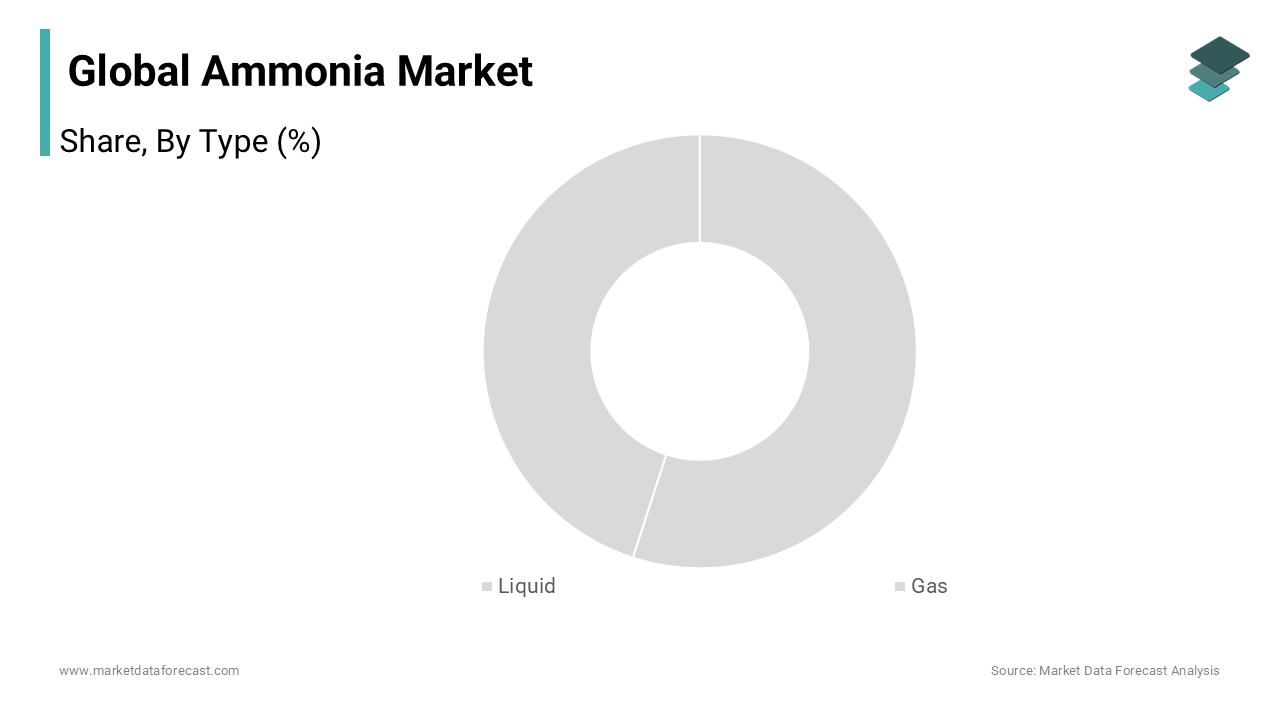
The gaseous ammonia segment is estimated to register the fastest CAGR of 6.8% over the forecast period owing to its increasing deployment in on-site industrial applications where liquefaction is unnecessary. In semiconductor manufacturing, ultra-high-purity gaseous ammonia is essential for silicon nitride deposition, with demand rising alongside global chip production. Apart from these, gaseous ammonia is gaining traction in selective catalytic reduction (SCR) systems for power plants and heavy-duty vehicles to reduce nitrogen oxide emissions. As of 2023, the U.S. Environmental Protection Agency (EPA) reported that nearly 90% of all coal capacity featured one or more pollution control technologies, including Selective Catalytic Reduction (SCR) and scrubbers. The elimination of vaporization energy and reduced handling risks in closed-loop systems further enhance its appeal in precision industrial settings which fuels its rapid adoption.
By Application Insights
The nitrogen fertilizer intermediate segment led the ammonia market by capturing substantial share in 2024. The growth of the nitrogen fertilizer intermediate segment is accelerated by the indispensable role of ammonia as the primary source of reactive nitrogen in synthetic fertilizers such as urea, ammonium nitrate, and diammonium phosphate. With over half of the world’s population dependent on food grown with nitrogen fertilizers, as per a study, the agricultural imperative remains unshakable. Global cereal production reached 2.8 billion metric tons in 2023, necessitating sustained nitrogen input, particularly in intensively farmed regions like the Indo-Gangetic Plain and the U.S. Corn Belt. The absence of scalable natural alternatives for high-yield farming ensures that ammonia-based fertilizers will remain central to global food security which strengthens this segment’s commanding market position.
The refrigerants (industrial and cold-chain) application segment is predicted to witness the highest CAGR of 7.2% from 2053 to 2033due to the stringent environmental regulations phasing out high-global-warming-potential (GWP) synthetic refrigerants. Ammonia, classified as a natural refrigerant with zero ozone depletion potential and a GWP of less than 1, is increasingly adopted in large-scale industrial refrigeration systems. According to the study, a portion of new cold-storage facilities in Europe and North America now utilize ammonia-based systems. Apart from these, advancements in low-charge ammonia systems have mitigated safety concerns by enabling deployment in food processing plants and distribution hubs. The integration of ammonia refrigeration in LNG liquefaction terminals further amplifies demand which positions this segment as a high-growth frontier.
By End-User Insights
The agriculture segment dominated the ammonia market by capturing a significant share in 2024. The physiological necessity of nitrogen for plant growth and the inefficiency of atmospheric nitrogen fixation in most crops are boosting the growth of agriculture segment. Ammonia-derived fertilizers are responsible for boosting crop yields, according to the study. The intensification through nitrogen inputs has become unavoidable because of the declining global arable land per capita, according to a study. Countries like China and the United States apply significant amounts of nitrogen annually in agriculture, as per a study. Furthermore, population growth and dietary shifts toward protein-rich foods increase demand for cereals and animal feed, both of which are nitrogen-intensive. The absence of economically viable substitutes at scale ensures that agriculture will remain the cornerstone of ammonia demand for the foreseeable future.
The mining industry segment is estimated to register the fastest CAGR of 6.5% during the forecast period owing to the rising use of ammonium nitrate-based explosives in large-scale open-pit and underground mining operations. Ammonia serves as an important feedstock for producing ammonium nitrate, which constitutes a portion of industrial explosives used globally. The demand for efficient blasting agents has surged owing to the increase in copper and lithium production globally. According to research, ammonium nitrate consumption in Chile peaked in 2024 and is expected to remain stable or grow only slightly. Apart from these, regulatory support for safer and high-performance explosives has favoured ammonia-based formulations over traditional dynamite. Hence, the mining sector’s reliance on ammonia-derived explosives is poised for sustained acceleration as mineral extraction is expanding to meet clean energy technology demands.
REGIONAL ANALYSIS
Asia-Pacific was the top performer in the ammonia market in 2024 and accounted for 52.5% of the global market share in 2024. The domination of the Asia Pacific in the global market is primarily driven by its prominence in both production and consumption. China alone accounts for a portion of global ammonia output, driven by its massive agricultural base and domestic fertilizer industry, as per the research. The region’s dominance is further propelled by rapidly industrializing economies such as India and Indonesia, where government-led food security programs have led to substantial nitrogen fertilizer subsidies. India’s fertilizer consumption reached a notable million tons in 2023, with urea imports and domestic production heavily reliant on ammonia, as per the Ministry of Chemicals and Fertilizers. Apart from these, Japan and South Korea are investing in ammonia co-firing in thermal power plants. The convergence of agrarian demand and emerging energy applications strengthens the Asia-Pacific’s central role in shaping the global ammonia landscape.
North America is the second-largest in the ammonia market and accounted for 18.5% of the global market share. The growth of the North America is accelerated by advanced production infrastructure and strong agricultural demand. The United States is the largest producer in the region, with an annual ammonia output exceeding in million metric tons, as per the study. The U.S. Corn Belt’s intensive farming practices drive consistent demand for nitrogen fertilizers, with substantial tons of nitrogen applied annually in crop production, according to the research. Moreover, the Gulf Coast hosts several world-scale ammonia plants leveraging low-cost shale gas, giving the region a competitive feedstock advantage. Canada complements this with growing interest in green ammonia exports, particularly from Alberta’s hydrogen hub initiatives. Therefore, agricultural necessity and energy transition ambitions are positioning North America as a technologically advanced and strategically evolving market.
Europe grew steadily in the ammonia market. The growth of Europe in the global market is driven by environmental regulation and energy security concerns. According to an analysis published in February 2025, the EU produced approximately 10.47 million tons of ammonia in 2023. Germany, France, and the Netherlands remain key producers, but the focus is shifting toward decarbonization. The European Commission’s REPowerEU plan includes ammonia as a priority vector for hydrogen transport and industrial fuel. Apart from these, the EU’s Carbon Border Adjustment Mechanism is incentivizing low-carbon ammonia production. Thus, Europe is positioning itself as a leader in sustainable ammonia innovation by blending regulatory rigor with technological foresight.
The Middle East grew steadily in the global ammonia market due to its vast natural gas reserves and strategic export infrastructure. Saudi Arabia and Qatar are the primary producers, with Saudi Arabia exporting notable tons of ammonia annually, as per a study. The region benefits from some of the lowest natural gas feedstock costs globally, which enables highly competitive grey ammonia production. However, a strategic pivot is underway. The NEOM green hydrogen project, a joint venture by ACWA Power, Air Products, and NEOM, aims to produce 1.2 million tons of green ammonia annually, and initial production is scheduled to begin in 2027, with the 4 GW renewable energy assets slated for completion by mid-2026. The UAE’s Masdar is also advancing similar initiatives. As per the study, the Middle East could supply a portion of future global green ammonia exports. Hence, maintaining conventional output while pioneering green derivatives positions the region as an important bridge between legacy and future ammonia economies.
Latin America is likely to grow in the ammonia market during the forecast period, with Brazil serving as the primary demand center due to its expansive agricultural sector. Brazil is a major importer of nitrogen fertilizers, purchasing significant tons annually, as per study. Domestic production remains limited. However, investments are emerging in green ammonia. For instance, Chile's H2Magallanes project, developed by TotalEnergies, does plan to produce and export green ammonia from the Patagonia region using wind resources, its export market is primarily Europe. The region’s growth is intrinsically linked to agricultural expansion and food export ambitions. As per the study, Latin America is expected to contribute a portion of global agricultural trade growth by 2030, which strengthens the long-term trajectory for ammonia demand despite current import dependency.
COMPETITIVE LANDSCAPE
KEY MARKET PLAYERS
Some of the companies that are playing a dominating role in the global ammonia market include
- Yara International ASA
- CF Industries Holdings Inc.
- Nutrien Ltd.
- OCI NV
- BASF SE
- SABIC
- Mitsubishi Gas Chemical Company Inc.
- Linde plc
- EuroChem Group
- Koch Fertilizer LLC
The ammonia market exhibits a highly consolidated yet dynamically evolving competitive landscape, where traditional producers coexist with emerging green ammonia developers. Incumbents leverage scale, established logistics, and feedstock access. On the other hand, new entrants focus on sustainability and niche energy applications. Competitive differentiation increasingly hinges on carbon intensity rather than price alone, especially in markets with stringent climate policies. Strategic collaborations between chemical firms, energy companies, and governments are redefining market boundaries, blurring lines between fertilizer suppliers and energy carriers. Regional disparities in energy costs and regulatory frameworks create asymmetric advantages, with Middle Eastern and North American firms benefiting from low-cost gas and Asian nations driving demand for clean derivatives. Innovation in carbon capture, electrolyzer efficiency, and ammonia combustion technologies is intensifying rivalry beyond production volume which signals a structural shift in competitive dynamics across the value chain.
Top Players in the Ammonia Market
Yara International
Yara International, headquartered in Norway, plays a transformative role in the Asia-Pacific ammonia landscape through its integration of fertilizer production and green ammonia innovation. The company operates large-scale ammonia plants globally and has intensified its focus on decarbonizing nitrogen supply chains in the region. Yara is positioning itself as a pivotal enabler of sustainable agriculture and energy transition across Asia-Pacific by combining traditional nitrogen expertise with next-generation clean energy applications.
CF Industries Holdings, Inc.
CF Industries has expanded its influence in the Asia-Pacific market by leveraging its expertise in low-carbon ammonia production and strategic partnerships. The company has intensified engagement with Asian buyers seeking reliable and lower-emission ammonia supplies. CF Industries launched its blue ammonia production at the Donaldsonville facility in Louisiana, which is certified for reduced carbon intensity, making it attractive to Japanese and South Korean power utilities exploring ammonia co-firing. Apart from these, CF is investing in carbon capture infrastructure along the Mississippi River to further reduce emissions. These initiatives enhance its credibility as a supplier of choice for Asia-Pacific markets navigating the energy transition which enables the company to shape future trade flows despite limited physical assets in the region.
SABIC (Saudi Basic Industries Corporation)
SABIC has emerged as a key supplier of ammonia to the Asia-Pacific, capitalizing on Saudi Arabia’s cost-advantaged feedstock and strategic shipping routes. The company operates integrated petrochemical complexes in Jubail and Yanbu. It produces ammonia for both domestic use and export, with a significant portion destined for India, China, and Southeast Asia. SABIC has strengthened its regional presence by collaborating with Indian firms on fertilizer security initiatives and supporting downstream urea manufacturing.
Top Strategies Used by the Key Market Participants
Key players in the ammonia market are deploying vertical integration, decarbonization investments, strategic partnerships, geographic expansion, and technology licensing to consolidate their positions. Companies are increasingly integrating backward into hydrogen production, both blue and green, to secure low-carbon feedstock and meet evolving regulatory standards. Strategic alliances with energy firms, governments, and end-users in the power and shipping sectors are accelerating pilot projects for ammonia as a fuel. Asset optimization through retrofitting existing plants with carbon capture systems is gaining traction, particularly in North America and Europe. Expansion into sunbelt regions with high renewable potential enables cost-efficient green ammonia production. Technology providers are licensing advanced Haber-Bosch variants and electrolysis integration models to new entrants, monetizing innovation. These multifaceted strategies reflect a shift from commodity supply to integrated and sustainability-driven value chains.
MARKET SEGMENTATION
The research report on the ammonia market has been segmented and sub-segmented based on categories.
By Type
- Liquid
- Gas
By Application
- Nitrogen Fertiliser Intermediate
- (Industrial and Cold-Chain)
- Explosives and Mining Nitrates
- Pharmaceutical Intermediates
- Others
By End-use
- Agriculture
- Textiles
- Mining
- Pharmaceutical
- Referigeration
- Others
By Region
- North America
- Europe
- Asia-Pacific
- Latin America
- Middle East and Africa