- Product Description Description
- Table of Contents TOC
- List of Table & Figure LOT
- Get Free Sample PDF Sample PDF
Market Size, 2025
$0.39 BnMarket Estimate, 2026
$0.43 BnMarket Forecast, 2034
$0.85 BnCAGR, 2026–2034
9%Executive Summary: Asia Pacific Automatic Pill Dispenser Market
- Market Scope: Comprehensive Asia-Pacific automated pill dispenser market analysis covering applications (home healthcare, hospital/retail pharmacies), dispensing types, age demographics, clinical indications, and country-level landscapes.
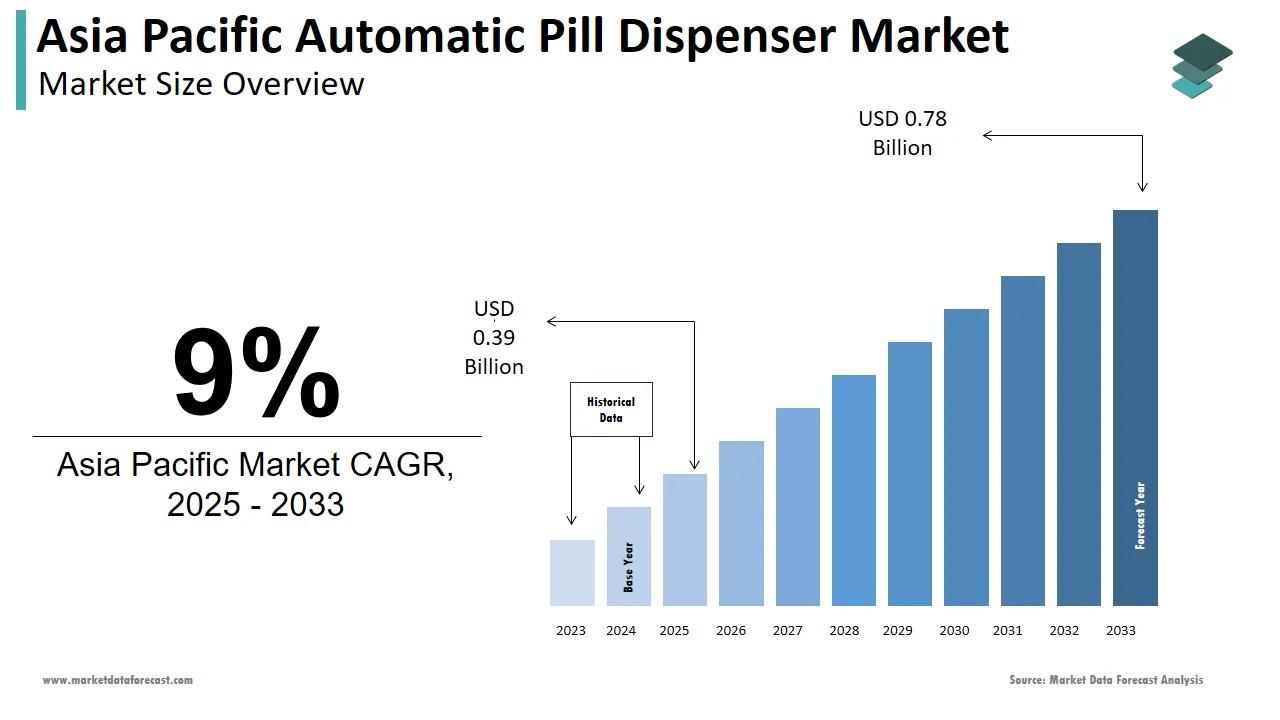
- Market Valuation: Valued at USD 0.39 billion in 2025, estimated at USD 0.43 billion in 2026, and projected to reach USD 0.85 billion by 2034, registering a compound annual growth rate (CAGR) of 9.00% from 2026 to 2034.
- Primary Growth Drivers: Growing preference for automated medication management among the expanding geriatric population, rising prevalence of chronic conditions (such as diabetes, hypertension, and cardiovascular diseases), increasing hospitalizations, and growing investments in healthcare infrastructure and robotics. Key market restraints include the high initial cost of advanced automated pill dispensers.
Key Market Segment Metrics (2026–2034)
| Category | Leading Segment (2025 Position) | Fastest-Growing Segment |
|---|---|---|
| By Application | Hospital Pharmacy & Home Healthcare (held major market shares driven by institutional medication safety and senior independent living needs) | Home Healthcare (expanding rapidly due to the rising demand for remote chronic disease care and senior assistive devices) |
| By Type | Centralized & Decentralized Automated Dispensing Systems (commanded high adoption across hospital and institutional pharmacies) | Robotic Automated Dispensing Systems & Carousels (growing via advanced pharmacy automation and robotics) |
| By Age & Indication | Geriatric Population (65+ years) & Old Age/Chronic Illness (dominated usage due to high multi-medication adherence requirements) | Dementia & Visual Impairment Indication Groups (growing as specialized safety requirements increase) |
| By Country / Region | China (dominated the APAC market in 2025 with a ~40% market share backed by strong distribution reach and large population demographics) | Singapore (estimated to grow at the highest CAGR driven by high diabetes prevalence, reasonable healthcare expenditure, and medical tourism) |
Major Market Players & Market Structure
Market Structure: Competitive healthcare technology and pharmacy automation market featuring global medical device leaders and automation specialists competing through product innovation, regional distribution partnerships, and hospital network integration.
Key Companies: Swisslog Holdings AG, Becton, Dickinson and Company, McKesson Corporation, Cerner Corporation, Yuyama Co., Ltd., Baxter International Inc., Omnicell, Inc., Illinois Tool Works, Allscripts Healthcare Solutions, Inc., Capsa Healthcare, ScriptPro LLC, Meditech, Talyst, Inc., Accu-Chart Plus Healthcare System, Optum, Inc., Pearson Medical Technologies, and Constellation Software Inc.
Asia Pacific Automatic Pill Dispenser Market Size
The size of the Asia Pacific automated pill dispenser market was worth USD 0.39 billion in 2025. The Asia Pacific market is anticipated to grow at a CAGR of 9% from 2026 to 2034, reaching USD 0.85 billion by 2034, up from USD 0.43 billion in 2026.
MARKET DRIVERS
Growing Preference Among the Geriatric Population
The growing preference for the automatic pill dispenser among a dominant share by the geriatric population due to its high convenience for the patient is expected to drive the market growth in the APAC region. The senior population is more prone to chronic disorders and needs constant reminders to take medication on time. The increase in chronic disease cases such as diabetes, hypertension and neuromuscular diseases, etc., creates the need for advanced and hassle-free solutions for drug administration. These boosts sales of automatic pill dispensers, which can boost the APAC market. In India, the number of people with diabetes increased from 27.3 million in the 1990s to 69 million in 2017. According to the 2019 National Diabetes and Diabetic Retinopathy Survey report released by the Ministry of Health and Family Welfare, it was found that the prevalence was 12% in people over the age of 50 years.
Rising Hospitalization Rates Among Seniors
Hospitalization rates have increased as the senior population grows, which has raised the demand for accurate and rapid administration of drugs. In addition to this, the growing irregularities in manual dispensing are likely to drive the growth of the APAC automatic pill dispenser market for years to come. Tablets and capsules are commonly used from automatic pill dispensers.
Availability of High-Quality Medical Facilities
Several factors such as availability of high-quality medical facilities, healthcare awareness, growing pharmaceutical industries in the APAC region, development in robots and carousels to give medications are expected to grow in importance in the coming years. By 2020, China is expected to increase its pharmaceutical market volume to USD 222 billion, becoming the second-largest market after the United States. With a market size of $ 13 billion in 2010, the Indian pharmaceutical market will reach $ 58 billion in 2020, potentially reaching $ 72 billion in an aggressive growth scenario. These numbers depict the increasing drug markets and more chronic disease cases; many growth opportunities are anticipated during the analysis period. In addition, other factors such as improved designs for more convenience, untapped emerging markets, developments in the healthcare field, increased number of home care centers, and increased local regulatory approvals will drive the APAC automatic pill dispenser market.
MARKET RESTRAINTS
High Cost of Automatic Pill Dispensers
However, the cost of the automatic pill dispensers is one of the main restraints affecting the growth of the APAC automatic pill dispenser market during the forecast period.
COUNTRY LEVEL ANALYSIS
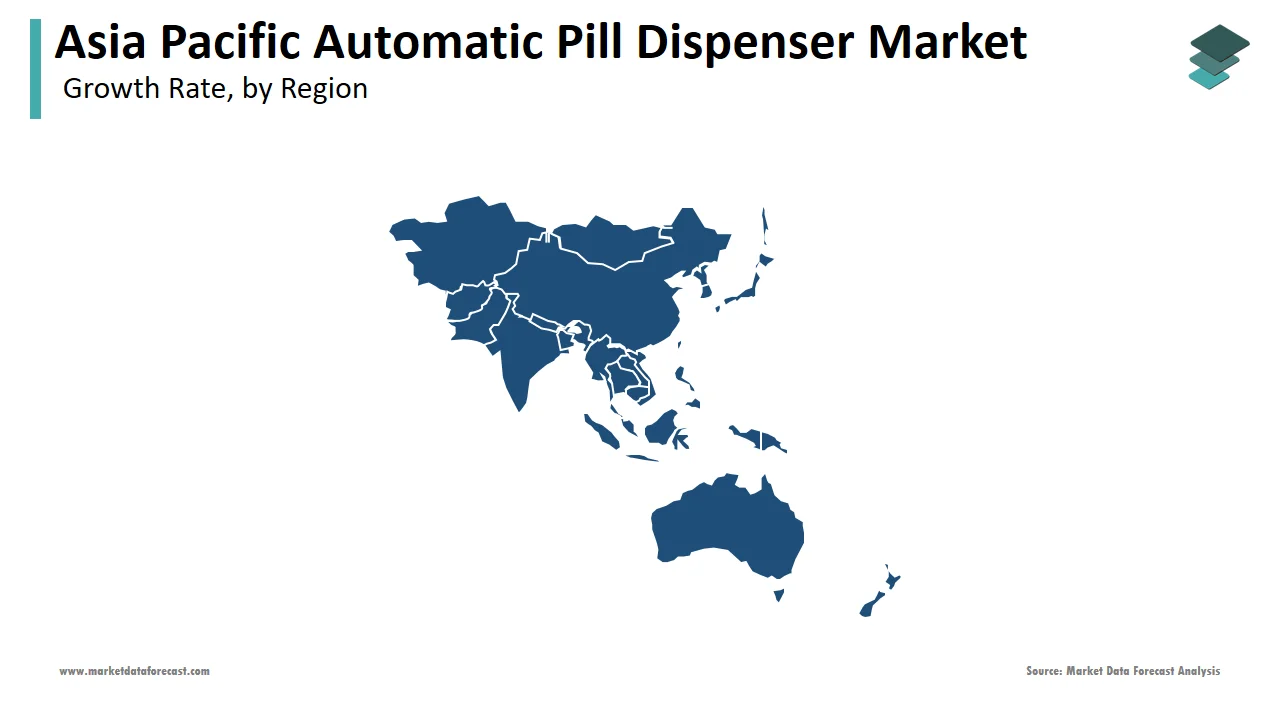
In 2025, China was dominant in the APAC automatic pill dispenser market with a 40% market share. This can be attributed to the increased demand for effective drug delivery and the distribution reach for automatic pill dispensers. In addition, a large population in countries such as China and India will also boost the growth of the regional markets.
Singapore is estimated to grow at the highest CAGR during the projected period. This impressive market growth can be due to the high prevalence of diabetes, reasonable healthcare expenditure, and increasing medical tourism in the region. People aged from 18 to 69 years have risen from 7.5% in 1993 to 8.9% in 2018, and the International Diabetes Federation estimates a prevalence of diabetes of 14% for the whole adult population. The Singaporean healthcare market is expected to reach $ 50 billion by 2033. Healthcare spending, which includes public and private spending, is expected to account for 6.2% of GDP and could grow to 9.4% by 2033. Each year, Singapore attracts more than 360,000 patients with its high-quality healthcare.
The Australian automatic pill dispenser market could thrive due to the increasing prevalence of chronic diseases, such as cardiovascular disorders and hyperthyroidism, and a large end consumer of the automatic pill dispensers.
KEY MARKET PLAYERS
A few of the major companies operating in the APAC automatic pill dispenser market profiled in this market are Swisslog Holdings AG, Dickinson and Company, McKesson Corporation, Becton, Cerner Corporation, Yuyama Co., Ltd, Baxter International Inc., Omnicell Inc., Illinois Tool Works Allscripts Healthcare Solutions, Inc., Capsa Healthcare, ScriptPro LLC, Meditech, Talyst, Inc., Accu-Chart Plus Healthcare System, Optum Inc., Pearson Medical Technologies and Constellation Software Inc.
MARKET SEGMENTATION
This Asia Pacific automated pill dispenser market research report is segmented and sub-segmented into the following categories.
By Application
- Home Healthcare
- Hospital Pharmacy
- Retail Pharmacy
By Type
- Carousels
- Centralized Automated Dispensing System
- Robots/Robotic Automated Dispensing System
- Ward-Based
- Decentralized Automated Dispensing
- Automated Unit Dose
- Pharmacy-Based
By Age
- 38-64 years
- 65-74 years
- 75-84 years
- 85 years and above
By Indication
- Visual Impairment
- Old Age
- Dementia
- Learning Dementia
- Physical Disability
- Mental Health excluding dementia
- Parkinson’s disease
- Other Diseases
By Country
- India
- China
- Japan
- South Korea
- Australia
- New Zealand
- Thailand
- Malaysia
- Vietnam
- Philippines
- Indonesia
- Singapore
- Rest Of APAC