- Product Description Description
- Table of Contents TOC
- List of Table & Figure LOT
- Get Free Sample PDF Sample PDF
Market Size, 2025
$3333 MnMarket Estimate, 2026
$3836 MnMarket Forecast, 2034
$1181 MnCAGR, 2026–2034
15.10%Executive Summary: Asia Pacific Automotive RADAR Market Analysis
- Market Scope: Comprehensive Asia-Pacific automotive radar industry evaluation covering range types, vehicle classes, application segments, country-level adoption metrics, market drivers, and regional supply chain challenges.
- Market Valuation: Valued at USD 3,333.24 million in 2025, estimated at USD 3,836.56 million in 2026, and projected to reach USD 11,810.1 million by 2034, registering a robust CAGR of 15.10% (2026–2034).
- Primary Growth Drivers: Surging vehicle production in emerging Asian economies (such as China, India, and Thailand), escalating demand for passenger safety and Advanced Driver Assistance Systems (ADAS), stringent government regulations, and the rapid shift toward connected, autonomous, and electric vehicles (EVs).
Key Market Segment Metrics (2026–2034)
| Category | Leading Segment (2025 Position) | Fastest-Growing Segment |
|---|---|---|
| By Range | Long-range Radars (historically utilized for high-speed tracking and distance measurement) | Medium and Short-range Radars (witnessing faster growth driven by active safety systems, parking assistance, and blind-spot detection) |
| By Vehicle Type | Passenger Cars (represented high market participation due to expanding vehicle sales and increasing safety concerns in developing nations) | Commercial Vehicles (scaling via fleet management safety upgrades) |
| By Application | Adaptive Cruise Control (ACC) (projected to occupy the largest market share through integration in both luxury and medium vehicles) | Autonomous Emergency Braking (AEB) & Blind-Spot Detection (BSD) |
| By Region / Country | China (dominated the APAC market structure, backed by a massive automotive manufacturing base and multiple local radar suppliers) | India and Southeast Asian hubs (driven by emerging safety regulations and rising vehicle production targets) |
Major Market Players & Industry Structure
Market Structure: Highly competitive landscape featuring global tier-1 automotive suppliers and semiconductor pioneers competing on high-frequency 77 GHz system affordability, active safety compliance, and sensor miniaturization.
Key Companies: Continental AG, Texas Instruments Inc., DENSO Corp., Valeo SA, Robert Bosch GmbH, HELLA KGaA Hueck & Co., Infineon Technologies AG, and Autoliv Inc.
Asia Pacific Automotive RADAR Market Size
The Asia Pacific automotive radar market size was valued at USD 3333.24 million in 2025 and is anticipated to reach USD 3836.56 million in 2026 to reach USD 1181.01 million by 2034, growing at a CAGR of 15.10% during the forecast period from 2026 to 2034.
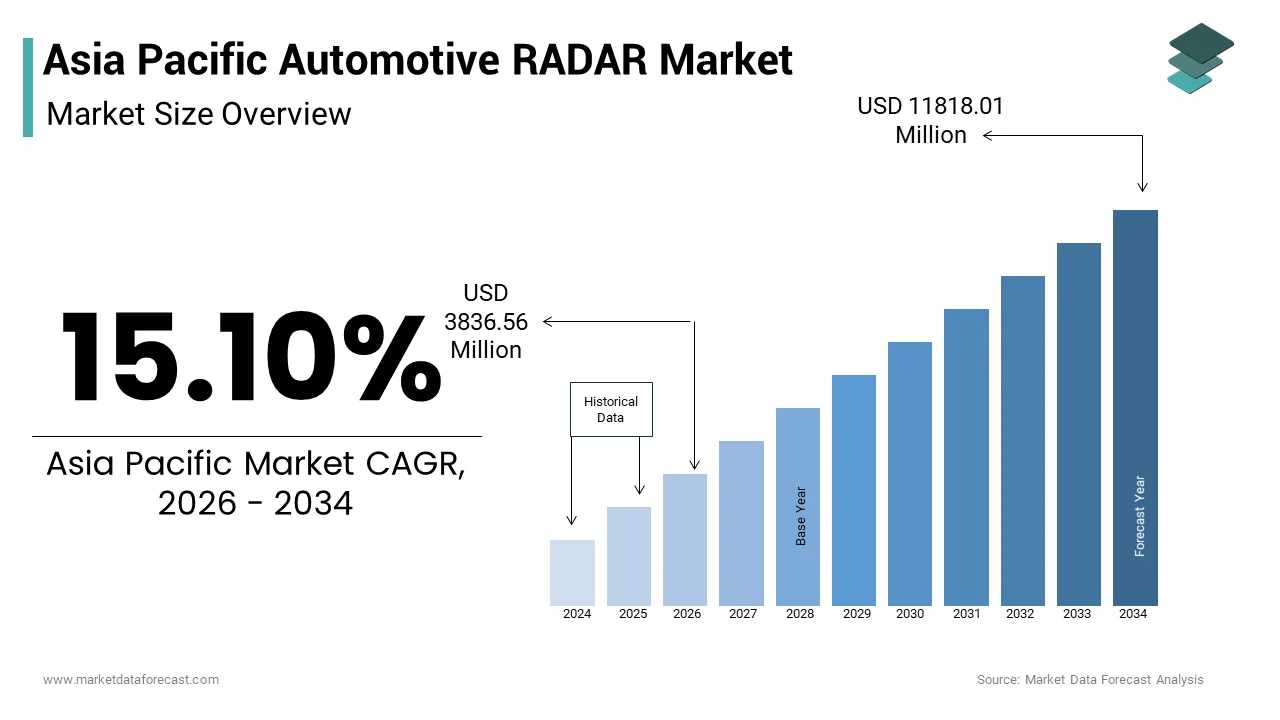
RADAR (Radio Detection and Ranging) is an electronic device used to track objects. Automotive RADAR is a system used to detect objects within an angle through propagation to determine the diffusion area, angle, and speed. Initially developed for military and defense use, but due to continuous technological innovation, it is used in automobiles. Automotive radar devices are installed in passenger cars in the form of radar sensors to provide information such as range, angle, and Doppler speed, which helps the driver avoid collisions.
MARKET DRIVERS
The APAC automotive RADAR market is also an emerging business for the automotive sector, backed mainly by low supply and high-level industrialization in the region. The main factor in the introduction of radar technology to vehicles in Asian countries such as India, China, and Thailand is the growing accidents, with an increasing demand for safer vehicle mobility, and initiatives to build strict regulations and innovative radar systems by the government. It is also expected that the growing trend of autonomous cars and the increasing electrification of vehicles will accelerate the growth of car radar in the region.
The increase in vehicle sales in Asian countries will provide ample growth opportunities for suppliers operating in the industry to increase their share of sales. The other main factors that drive the market growth are the development of sensors and the increase in smartphones and the development of consumer electronics, the strong demand in the automotive industry, and the growing adoption of FMCW radar sensors in other applications.
MARKET RESTRAINTS
Counterfeiting in India and China, as well as high imports and taxes imposed by governments in many countries, is a significant challenge for the region. Also, it is known that high-frequency security systems that use 77 GHz provide better performance. However, these systems also have higher signal losses, making it challenging to implement high-frequency radar-based security systems today. Therefore, it serves to curb the growth of the car radar market in APAC.
REPORT COVERAGE
| REPORT METRIC | DETAILS |
| Market Size Available | 2025 to 2034 |
| Base Year | 2025 |
| Forecast Period | 2026 to 2034 |
| CAGR | 15.10% |
| Segments Covered | By Range, Vehicle Type, Application, and Region. |
| Various Analyses Covered | Global, Regional & Country Level Analysis, Segment-Level Analysis, DROC, PESTLE Analysis, Porter’s Five Forces Analysis, Competitive Landscape, Analyst Overview of Investment Opportunities |
| Regions Covered | North America, Europe, APAC, Latin America, Middle East & Africa |
| Market Leaders Profiled | The APAC automotive radar market consists of several players, such as Continental AG, Texas Instruments Inc., DENSO Corp., Valeo SA, Robert Bosch GmbH, HELLA KGaA Hueck & Co., Infineon Technologies AG, Autoliv Inc. |
SEGMENT ANALYSIS
By Range Insights
The Mediumum and short-range radars are expected to witness faster growth in the APAC automotive radar market during the forecast period. This is mainly due to the high use of these radars in active safety systems, such as parking assistance, lane change assistance, and blind spot detection.
By Vehicle Insights
Passenger car categories represented high participation in the APAC automotive radar market, with the growing involvement of these vehicles in overall car sales in developing countries, including China, mainly due to the increasing concern for safety in cars.
By Application Insights
The Adaptive Cruise Control (ACC) category is expected to occupy most of the APAC automotive radar market during the forecast period. The vast development of the ACC application category now allows integration into both luxury cars and medium cars.
COUNTRY ANALYSIS
The local market is predicted to show the most significant growth during the forecast period, as the area is moving forward with a global focus on great investment opportunities and commercial expansion. In 2019, China dominated the APAC market, which can be attributed to the vast automotive industry, the presence of multiple radar suppliers, and the increase in consumer economic conditions.
KEY MARKET PLAYERS
The APAC automotive radar market consists of several players, such as
- Continental AG
- Texas Instruments Inc.
- DENSO Corp.
- Valeo SA
- Robert Bosch GmbH
- HELLA KGaA Hueck & Co.
- Infineon Technologies AG
- Autoliv Inc
SECONDARY RESEARCH
The first phase of the research process is extensive secondary research and identification of the related intelligence. Secondary data is compiled from various sources. Extensive secondary research helps in generating hypotheses and identifying critical areas of interest that are investigated through primary research.
PRIMARY RESEARCH
This entails conducting hundreds of primary interviews with industry participants and commentators to validate the data points obtained from secondary research and to fill the data gaps. A primary interview provides first-hand information on the market size, market trends, growth trends, competitive landscape, future outlook, etc. It also helps in deciding the scope and deliverables of the study in terms of the requirements of the market. Primary research involves e-mail interactions, telephonic interviews, ass well as face-to-face interviews for each market, category, segment, and sub-segment across geographies.
MARKET REPORT HIGHLIGHTS
- Evaluation of the current stage of the market and future implications of the market based on the detailed observation of recent key developments.
- Address the matter by better understanding the market size estimates through CAGR analysis to forecast the future market.
- Comprehensive segmentation of the market, detailed evaluation of the market by further sub-segments.
- Address Market Drivers and restraints and provide insights for gaining market share.
- Porter’s Five Forces are used to analyze the factors responsible for shaping the industry as it is as a result of the competitive environment.
RECENT MARKET NEWS
- According to the Association of Automobile Manufacturers of India, the growth rate in the automotive industry from April to March 2018 was 14.0% higher than that registered during the same period last year.
- According to the IBEF, the production of passenger cars in India is foreseen to increase from 3.4 million in 2016 to 10 million in 2020.
- Specializing in robotics, Arbe Robotics has made a breakthrough (January 2019) in the family of radar sensors in automotive vehicles by presenting 4D image radars.
- Apple recently patented a radar system integrated into the vehicle floor (April 2019) to assess road conditions to keep the vehicle stable accurately.
MARKET SEGMENTATION
This research report on the Asia Pacific automotive RADAR market is segmented and sub-segmented into the following categories.
By Range
- Long-range
- Medium-range
- Short-range
By Vehicle
- Passenger Cars
- Commercial Vehicles
By Application
- Adaptive Autonomous Emergency Braking (AEB)
- Adaptive Cruise Control (ACC)
- Frontal Collision Warning System (FCWS)
- Blind-spot Detection (BSD)
- Intelligent Parking Assistance (IPA)
By Country
- India
- China
- Japan
- South Korea
- Australia
- New Zealand
- Thailand
- Malaysia
- Vietnam
- Philippines
- Indonesia
- Singapore
- Rest of APAC