- Product Description Description
- Table of Contents TOC
- List of Table & Figure LOT
- Get Free Sample PDF Sample PDF
Market Size, 2025
$5.08 BnMarket Estimate, 2026
$5.78 BnMarket Forecast, 2034
$16.24 BnCAGR, 2026–2034
13.78%Executive Summary: Asia Pacific Biodegradable Paper & Plastic Packaging Market
- Market Scope: Overview of the Asia Pacific biodegradable paper & plastic packaging market covering application segments, material types, country-level dynamics, and key industry participants.
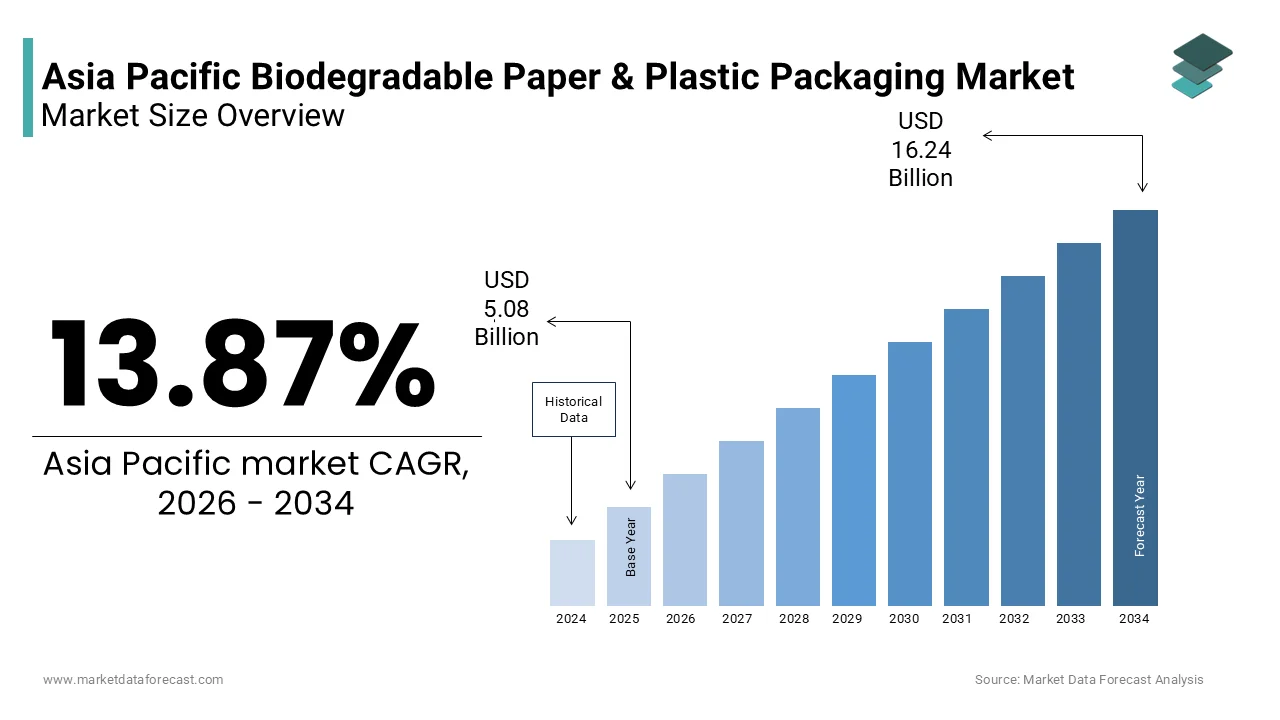
- Market Valuation: Valued at USD 5.08 billion in 2025, reaching USD 5.78 billion in 2026, and projected to scale up to USD 16.24 billion by 2034, registering a robust CAGR of 13.87% (2026–2034).
- Primary Growth Drivers: Heightened ecological concerns, decreasing contamination risks through easy material degradation, shift by packaging enterprises toward eco-friendly solutions to retain consumer loyalty, and surging demand driven by food & beverage packaging industries.
Key Market Segment Metrics (2026–2034)
| Category | Leading Segment Position | Core Focus / Application Verticals |
|---|---|---|
| By Type | Paper and Plastic materials | Biodegradable plastics and paper packaging solutions replacing traditional high-impact polymers |
| By Application | Food Packaging and Beverage Packaging (driving significant industry volume) | Personal & home care packaging, electronic appliance packaging, pharmaceuticals packaging, and others |
| By Region / Country | India, China, Australia, and South Korea | Expanding at a stable rate due to rising population, higher food demand, and increased need for sustainable packaging amenities |
Major Market Players & Market Structure
Market Structure: Competitive regional and global ecosystem featuring major packaging conglomerates and specialty chemical/material suppliers transitioning toward eco-friendly, degradable solutions.
Key Companies: Ranpak Corp, Rocktenn, BASF, Mondi Group, Biopac UK Ltd, Reynolds Group Holding Limited, Novamont SPA, Amcor, Stora Enso, Kruger Inc, Smurfit Kappa Group International Corp, Clearwater Paper Corporation, and Berkley International Packaging.
Asia Pacific Biodegradable Paper & Plastic Packaging Market Size
The Asia Pacific biodegradable paper & plastic packaging market size was valued at USD 5.08 billion in 2025 and is projected to reach USD 16.24 billion by 2034 from USD 5.78 billion in 2026, growing at a CAGR of 13.87%.
Biodegradable paper and plastic packaging refers to materials designed to break down naturally into basic elements like water, carbon dioxide, and biomass through the action of microorganisms such as bacteria and fungi. This market covers materials derived from renewable resources such as corn starch, sugarcane and wood pulp that decompose naturally without leaving toxic residues. According to sources, Asia is a major global contributor to mismanaged plastic waste, emphasising an urgent need for sustainable packaging alternatives across the region. As per studies, rapid economic development and urbanisation in East Asia and the Pacific have led to a substantial rise in municipal solid waste, underscoring the critical need for advanced waste management solutions. Consumer awareness regarding microplastics and landfill overflow has accelerated demand for eco-friendly options in food service and retail sectors. Governments in Japan and Australia have implemented bans on single-use plastics, which directly stimulates the substitution with certified biodegradable materials. The e-commerce boom further amplifies the requirement for protective yet sustainable shipping solutions. Manufacturers are investing in advanced composting technologies to ensure these materials break down efficiently in industrial facilities. This transition aligns with circular economy principles promoting resource efficiency and environmental stewardship. The market dynamics reflect a collective effort to mitigate ecological damage while maintaining functional packaging standards.
MARKET DRIVERS
Stringent Government Regulations and Single-Use Plastic Bans Accelerate Adoption
Stringent government regulations and single-use plastic bans across the region drive the growth of the Asia-Pacific biodegradable paper and plastic packaging market. As per research, national and subnational frameworks restricting single-use plastics are expanding across the Asia-Pacific region, driving a mandatory shift toward alternative packaging materials. China implemented a comprehensive ban on non-degradable plastic bags in major cities, which forced retailers to switch to paper and biodegradable plastic options immediately. According to the National Development and Reform Commission (NDRC) of China, joint guidelines issued with the Ministry of Ecology and Environment further tightened controls to drop the annual growth rate of plastic bag use to less than 3 per cent, while a separate bag levy in Hong Kong reduced usage by 60% after doubling the fee. Similarly, India banned identified single-use plastic items in 2022, affecting millions of manufacturers and prompting a surge in demand for biodegradable substitutes. As per sources, strict international environmental regulations and compliance frameworks prompt global exporters to implement sustainable packaging solutions to sustain foreign market entry. Regulatory clarity provides a predictable environment for investors and manufacturers to scale up production capacities. Compliance becomes a competitive advantage rather than just a legal obligation. These policies create a guaranteed baseline demand for biodegradable materials regardless of consumer preference fluctuations. The enforcement mechanisms, including fines and inspections, ensure adherence across supply chains. This regulatory driver is the most potent force shaping the market landscape.
Rising Consumer Awareness And Preference For Sustainable Products Fuel Demand
Rising consumer awareness and preference for sustainable products significantly fuel the expansion of the Asia Pacific biodegradable paper and plastic packaging market. According to a study, 73% of consumers say they would definitely or probably change their consumption habits to reduce their environmental impact. Younger demographics in countries like South Korea and Japan actively seek brands that demonstrate corporate social responsibility through eco-friendly packaging choices. As per research, environmentally friendly attributes on packaging directly influence consumer decision-making and enhance purchase intentions among ecologically conscious shoppers. Social media campaigns by environmental NGOs have heightened awareness about the dangers of plastic pollution in oceans and landfills. Retailers respond by prominently displaying biodegradable packaging to attract environmentally conscious shoppers. Brand loyalty increases when companies align with consumer values regarding sustainability. E-commerce platforms often offer green packaging options at checkout, allowing customers to make ethical choices. This behavioural shift drives manufacturers to innovate and expand their biodegradable product lines. The emotional connection between consumers and environmental preservation sustains long-term demand. Market players leverage this sentiment through transparent labelling and certification.
MARKET RESTRAINTS
Higher Production Costs Compared To Conventional Plastics Limit Mass Adoption
Higher production costs compared to conventional plastics greatly limit the growth of the Asia Pacific biodegradable paper and plastic packaging market. According to research, the production cost of biodegradable polymers like polylactic acid is significantly higher than that of traditional petroleum-based plastics due to specialised raw materials and processing requirements. Raw materials like corn starch and sugarcane are subject to agricultural price volatility, which further destabilises manufacturing expenses. As per sources, using food crops for biopolymer production can lead to competition with food security systems, potentially influencing commodity pricing. Small and medium enterprises in developing nations operate on thin margins and cannot absorb these additional costs without passing them to consumers. Price-sensitive markets in Southeast Asia often reject premium-priced eco-friendly options in favour of cheaper conventional alternatives. Lack of economies of scale keeps production costs elevated compared to the mature petroleum-based plastic industry. Subsidies for biodegradable materials are limited in many countries, failing to bridge the price gap. This economic barrier restricts the penetration of biodegradable packaging to premium segments only. Manufacturers struggle to compete on price alone without significant technological breakthroughs. The cost disparity remains a persistent hurdle for widespread market acceptance.
Lack Of Adequate Industrial Composting Infrastructure Hinders Effective Degradation
Lack of adequate industrial composting infrastructure hinders the effective degradation of biodegradable paper and plastic packaging in the region, which constrains the expansion of the Asia Pacific market. As per studies, a small fraction of municipal solid waste in developing Asian nations undergoes specialised organic processing or industrial composting. Most biodegradable materials require specific temperature and humidity conditions found only in industrial settings to decompose within a reasonable timeframe. In the absence of such facilities, these materials end up in landfills where they may not degrade any faster than conventional plastics due to anaerobic conditions. According to research, informal waste networks play a massive role in collection and recovery across developing regions where municipal source-segregation infrastructure is constrained. Consumers often confuse home compostable with industrially compostable labels, leading to improper disposal and contamination of recycling streams. This infrastructure gap undermines the environmental benefits claimed by biodegradable packaging. Municipalities lack the funding and expertise to build and operate specialised composting plants. Without proper end-of-life management, the value proposition of biodegradable materials is compromised. This systemic issue discourages investment and consumer trust in the technology.
MARKET OPPORTUNITIES
Expansion of E-commerce and Food Delivery Services Creates New Demand Avenues
The expansion of e-commerce and food delivery services creates new demand avenues for the Asia Pacific biodegradable paper and plastic packaging market. According to the United Nations Conference on Trade and Development (UNCTAD), the shift induced by COVID-19 accelerated online retail sales, increasing e-commerce's share of total global retail sales from 16% to 19% in 2020. Food delivery platforms in countries like Singapore and Malaysia generate millions of single-use containers daily, presenting a massive opportunity for sustainable substitution. As per sources, the surge in distribution materials from commercial shipping operations significantly drives global urban waste volumes, leading businesses to transition toward eco-friendly alternatives. Biodegradable mailers and food containers offer a solution that aligns with corporate sustainability goals and consumer expectations. Major logistics providers are piloting biodegradable packaging programs to reduce their carbon footprint. The convenience of online shopping combined with environmental consciousness drives demand for protective yet sustainable materials. Innovations in water-resistant biodegradable papers enhance their utility for shipping. Partnerships between packaging suppliers and digital platforms can scale adoption rapidly. This sector offers high volume potential with recurring orders. The trend toward green logistics supports long-term growth.
Innovation in Bio-Based Materials And Smart Packaging Technologies Enhances Value
Innovation in bio-based materials and smart packaging technologies enhances the value proposition of these materials in the Asia Pacific biodegradable paper and plastic packaging market. According to studies, incorporating nanofiller reinforcements into a biopolymer matrix can mitigate barrier performance issues, enhancing properties against moisture and oxygen. These innovations enable the use of biodegradable packaging for a wider range of products, including perishable foods and electronics. As per research, integrating active elements such as gas scavengers or freshness sensors into biopolymer films provides functional value by monitoring degradation and optimising shelf life. Companies are developing materials from agricultural waste such as rice husks and banana fibres, which are abundant and low-cost in the region. This circular approach reduces reliance on food crops and lowers production costs. Research collaborations between universities and industries accelerate the commercialisation of novel materials. Patents for new formulations provide competitive advantages and higher margins. Consumers appreciate the technological sophistication and environmental benefits of these advanced packages. The convergence of sustainability and functionality opens new market segments. Innovation drives differentiation in a crowded marketplace.
MARKET CHALLENGES
Technical Limitations In Barrier Properties and Shelf Life Restrict Applications
Technical limitations in barrier properties and shelf life restrict their applications in the Asia Pacific biodegradable paper and plastic packaging market. According to research, many biopolymers exhibit inferior moisture and gas barrier performance compared to conventional plastics, which presents a challenge for long shelf-life applications. This deficiency can lead to premature spoilage of food items, causing economic losses for retailers and manufacturers. As per sources, creating multilayer configurations to enhance packaging barriers can complicate end-of-life recycling and composting pathways. High humidity conditions in tropical Asian climates exacerbate these issues, making it difficult to maintain product integrity. Manufacturers must balance biodegradability with performance, which often involves trade-offs. Lack of standardised testing methods for real-world conditions leads to inconsistent quality perceptions. Consumers may lose trust if biodegradable packages fail to protect contents adequately. Research into coating technologies is ongoing, but commercial viability remains a challenge. The industry faces the hurdle of matching the durability of traditional plastics. This technical gap limits market penetration in sensitive categories.
Consumer Confusion and Mislabeling Undermine Trust And Proper Disposal
Consumer confusion and mislabeling undermine trust and proper disposal of these materials in the Asia Pacific biodegradable paper and plastic packaging market. As per studies, a significant portion of the public struggles to clearly differentiate between distinct environmental terms such as biodegradable, compostable, and recyclable. Greenwashing by some manufacturers who label conventional plastics as eco-friendly erodes consumer confidence in genuine biodegradable products. According to research, establishing clear international framework standards across the life cycle of plastics is essential to align definitions and prevent greenwashing. Lack of public education campaigns means that even well-intentioned consumers may contaminate recycling streams with biodegradable items. This contamination reduces the quality of recycled materials and increases processing costs for facilities. Retailers face backlash when customers discover that labelled biodegradable items do not decompose as expected in home environments. Trust is difficult to rebuild once compromised by misleading claims. Regulatory bodies struggle to enforce labelling accuracy across diverse markets. The ambiguity surrounding end-of-life options creates friction in the adoption process. Clear communication and education are essential to overcome this challenge.
REPORT COVERAGE
| REPORT METRIC | DETAILS |
| Market Size Available | 2025 to 2034 |
| Base Year | 2025 |
| Forecast Period | 2026 to 2034 |
| CAGR | 13.87% |
| Segments Covered | By Type, Application, and Region |
| Various Analyses Covered | Regional & Country Level Analysis, Segment-Level Analysis, DROC, PESTLE Analysis, Porter’s Five Forces Analysis, Competitive Landscape, Analyst Overview on Investment Opportunities |
| Regions Covered | India, China, Japan, South Korea, Australia, New Zealand, Thailand, Malaysia, Vietnam, Philippines, Indonesia, Singapore, and the Rest of Asia-Pacific |
| Market Leaders Profiled | Ranpak Corp, Rocktenn, BASF, Mondi Group, Biopac UK Ltd, Reynolds Group Holding Limited, Novamont SPA, Amcor, Stora Enso, Kruger Inc, Smurfit Kappa Group International Corp, Clearwater Paper Corporation, and Berkley International Packaging |
SEGMENTAL ANALYSIS
By Type Insights
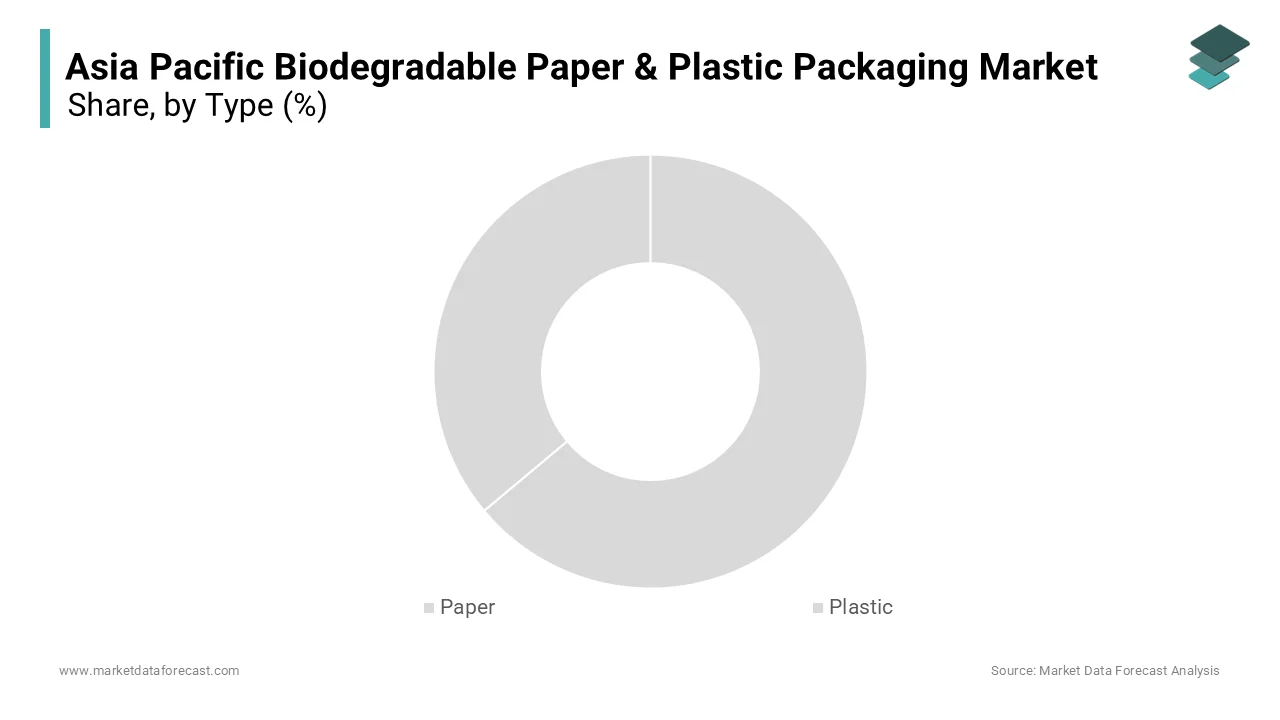
The paper segment led the Asia Pacific biodegradable paper and plastic packaging market and captured a significant share in 2025. This leading position of the segment was attributed to its established recycling infrastructure and strong consumer preference for natural materials. According to the Food and Agriculture Organisation, paper and paperboard production in Asia accounts for over 50% of global output, providing a robust supply chain for packaging manufacturers. Consumers in countries like Japan and Australia perceive paper as more environmentally friendly and easier to dispose of compared to bioplastics. The widespread availability of paper recycling facilities ensures that even if paper is not composted, it can be recovered and reused efficiently. As per research, advanced circular economy frameworks in developed Asian economies have successfully driven recovery rates for post-consumer fibre packaging past the 70% benchmark. Retailers prefer paper bags and boxes for their branding potential and tactile appeal. Government initiatives promoting forest stewardship and sustainable sourcing further validate the use of paper. The versatility of paper allows it to be used in various forms, from corrugated boxes to flexible wraps. This maturity in production and disposal systems cements its market leadership. Cost competitiveness compared to emerging bioplastics also favours paper. The segment benefits from continuous improvements in strength and durability.
Versatility in application across retail and e-commerce sectors supports the dominance of paper in the Asia Pacific biodegradable paper and plastic packaging market. As per sources, the rapid expansion of digital commerce across Asian regions has triggered significant consumer demand for secondary corrugated shipping formats engineered primarily from recycled pulp streams. These boxes provide excellent protection for goods during transit and are easily biodegradable or recyclable at the end of their life. Retailers in China and India are shifting from plastic bags to paper carry bags due to regulatory bans and consumer demand. According to studies, implementing monitored forestry and wood supply frameworks helps secure a predictable volume of domestic fibre inventory intended for pulp production. Paper can be easily printed on, allowing brands to communicate their sustainability efforts directly to consumers. Its adaptability to different shapes and sizes makes it ideal for diverse products ranging from electronics to groceries. The development of water-resistant coatings has expanded its use in food service applications. This functional flexibility ensures that paper remains the go-to choice for many packaging needs. The segment continues to innovate with lighter and stronger grades.
The plastic segment is rapidly expanding in the Asia Pacific biodegradable paper and plastic packaging market owing to technological advancements in biopolymer production. According to the European Bioplastics Association, global production capacity for bioplastics is expected to increase significantly by 2027 (growing from 2.23 million tonnes in 2022 to approximately 6.3 million tonnes), with Asia's share predicted to expand to nearly 63%. Innovations in polylactic acid and polybutylene adipate terephthalate production have reduced costs and improved performance characteristics such as flexibility and transparency. As per research, incorporating novel catalytic technologies can optimise output efficiencies during macromolecular synthesis, rendering bio-based polymers more cost-competitive with fossil-fuel benchmarks. Companies in South Korea and China are investing heavily in research and development to create next-generation bioplastics with superior barrier properties. These advancements enable the use of biodegradable plastics in applications previously dominated by traditional plastics such as fresh produce wrapping and beverage bottles. The ability to tailor mechanical properties for specific uses drives adoption across industries. Patent filings for new biopolymer formulations have increased, indicating vigorous innovation. This technological momentum propels the segment forward. The improvement in processing ease facilitates wider acceptance among manufacturers.
Regulatory support for bio-based alternatives to fossil fuels boosts the demand for biodegradable plastics in the Asia Pacific market. As per sources, integrating bio-derived material frameworks into domestic resource roadmaps serves as a strategic lever for countries aiming to decouple industrial production from conventional fossil-based feeds. Governments in Thailand and Malaysia offer tax incentives and subsidies for manufacturers producing biodegradable plastics from agricultural waste such as cassava and palm oil. According to studies, the rollout of specialised financial frameworks and corporate tax holidays has successfully drawn multi-billion capital inflows into localised biochemical and processing facilities. These policies lower the financial barrier for entry and encourage scaling up of production. International trade agreements favoring low carbon products also stimulate exports of biodegradable plastics from the region. Corporate sustainability commitments drive large corporations to switch to bio-based packaging to meet carbon reduction targets. The alignment of economic and environmental goals creates a favourable ecosystem for growth. Consumer education campaigns highlight the benefits of bio-based plastics over conventional ones. This regulatory and economic support ensures rapid expansion. The segment benefits from strong political will and industrial strategy.
By Application Insights
The food packaging segment dominated the Asia Pacific biodegradable paper and plastic packaging market and accounted for a substantial share in 2025. This dominance of the segment was driven by the exponential growth of the quick service restaurant sector and takeaway culture. According to sources, rapid urbanisation and evolving consumer lifestyle choices are driving an unprecedented expansion in the Asian food delivery market. This surge generates millions of single-use containers, cutlery, and bags daily, creating an urgent need for sustainable alternatives to conventional plastics. As per studies, short-lived plastic configurations from consumer packaging make up a massive percentage of total municipal plastic waste streams, necessitating policy shifts toward degradable alternatives. Restaurants and cloud kitchens are rapidly switching to biodegradable clamshells, bowls and wrappers to comply with these regulations and appeal to eco-conscious consumers. The availability of cost-effective biodegradable options such as bagasse and moulded pulp has facilitated this transition. Consumer preference for hygienic and safe packaging post-pandemic further supports the demand for high-quality disposable food containers. Major food chains have committed to sustainability goals, which accelerates the adoption of certified biodegradable materials. This segment benefits from high volume turnover and recurring demand. The integration of biodegradable packaging into the supply chain is now a standard operational requirement for food businesses.
Regulatory mandates on single-use plastics in the food sector significantly accelerate the adoption of biodegradable packaging solutions across the Asia-Pacific region. According to research, an increasing number of countries across the Asia-Pacific region have put forth regulatory restrictions targeting single-use plastic consumer utensils and food service accessories over recent years. For instance, Thailand banned single-use plastic caps, Styrofoam containers and plastic straws in 2022, forcing food vendors to adopt paper or biodegradable plastic alternatives. According to sources, implementing coordinated national roadmaps against single-use containers has significantly minimised downstream litter generation from urban street food and takeaway service vendors. Similarly, Australia’s National Plastic Plan outlines targeted initiatives to phase out problematic and unnecessary single-use plastic types, prompting industry supply chains to shift toward verified sustainable or compostable packaging standards. These laws create a compliant market where biodegradable options are not just preferred but required. Enforcement mechanisms, including fines and inspections, ensure adherence among small and large businesses alike. The clarity of these regulations provides confidence for manufacturers to invest in production capacity. Food brands leverage compliance as a marketing tool to enhance their corporate image. This regulatory push ensures sustained growth for the food packaging segment. It eliminates competition from cheaper non-compliant alternatives.
The pharmaceuticals packaging segment is the fastest-growing in the Asia Pacific biodegradable paper and plastic packaging market due to increasing healthcare expenditure and heightened awareness of drug safety. According to studies, rising healthcare expenditures across the Asia-Pacific territory are closely tied to regional demographic shifts, including ageing populations and a higher prevalence of chronic medical conditions. This growth leads to higher production of medicines requiring secure and sustainable packaging solutions. Biodegradable blister packs and bottles made from polylactic acid offer an eco-friendly alternative to traditional polyvinyl chloride while maintaining necessary barrier properties. As per research, environmental concerns regarding medical waste accumulation are pushing material designers to research more sustainable packaging formats for non-hazardous medical supplies. Regulatory bodies in Japan and South Korea are introducing guidelines for sustainable pharmaceutical packaging to reduce the carbon footprint of the healthcare sector. The shift toward home healthcare and online pharmacy services also drives demand for protective yet biodegradable shipping materials for medications. Companies are investing in research to develop biodegradable materials that meet stringent sterility and stability requirements. This segment offers high-value opportunities due to the critical nature of pharmaceutical products. The focus on sustainability aligns with global healthcare trends.
Innovation in bio-based barrier materials enhances the viability of biodegradable packaging for pharmaceutical applications in the Asia Pacific market. According to sources, leveraging nanocellulose layers or blending bio-based structural coatings can enhance the moisture barrier and hydrophobicity profiles of biodegradable thin films to shield sensitive components. These innovations allow biodegradable materials to protect medications from degradation without relying on conventional plastic laminates. As per studies, composites synthesised from natural matrices such as starch and chitosan are under active exploration for specialised encapsulation and functional matrix development due to their film-forming and non-toxic properties. Pharmaceutical companies in Singapore and Australia are partnering with material scientists to develop compostable blister packs that decompose safely after use. This technological progress addresses previous limitations regarding shelf life and protection. Regulatory approvals for new bio-based materials are becoming more streamlined in developed markets. The ability to customise biodegradable packaging for specific drug requirements drives adoption. Manufacturers can differentiate their products through sustainable innovation. This segment grows as technology bridges the gap between performance and environmental responsibility. The potential for smart biodegradable packaging further expands application scope.
REGIONAL ANALYSIS
India Market Analysis
India witnesses an explosive growth in the Asia Pacific biodegradable paper and plastic packaging market. The Indian market is driven by strict regulatory bans and a large agricultural base. According to the Ministry of Environment, Forest and Climate Change, India banned identified single-use plastic items in 2022, which created an immediate vacuum for alternative materials like paper and biodegradable plastics. The country’s vast production of sugarcane and corn provides abundant raw materials for producing bioplastics such as polylactic acid and starch-based films. As per sources, manufacturing networks in India are aggressively expanding their domestic structural infrastructure to supply alternative biodegradable packaging to commercial sectors. Local startups are innovating with materials like banana fibre and areca nut leaves to create unique eco-friendly products. Government schemes promote the use of compostable bags in retail and municipal waste management. Consumer awareness campaigns by NGOs have increased demand for sustainable options in urban centres. The e-commerce sector is actively adopting paper-based packaging to reduce its environmental footprint. India’s focus on self-reliance encourages local production of biodegradable materials. The market is characterised by high growth potential and diverse material sources. Regulatory enforcement remains key to sustaining momentum.
China Market Analysis
China was the largest player in the Asia Pacific biodegradable paper and plastic packaging market and occupied a commanding share in 2025. The country leverages its massive manufacturing capabilities. According to the National Development and Reform Commission, China’s plan to phase out non-degradable plastics in major cities by 2025 has spurred unprecedented investment in biodegradable material production. As per sources, the United States accounted for over 40% of global polylactic acid (PLA) production capacity due to robust manufacturing infrastructure. According to studies, the distribution and utilisation of bio-based carrier configurations have risen sharply in specific metropolitan pilot testing zones following localised regulatory mandates. Major chemical companies are expanding their biopolymer portfolios to include polybutylene adipate terephthalate and other advanced materials. As per research, major logistics operators are actively integrating alternative material structures into distribution loops to replace fossil-based delivery mailers. Consumer awareness in tier one cities is high, leading to premium pricing acceptance for eco-friendly products. Government subsidies support research and development in bio-based materials. China’s scale allows for cost reductions through economies of scale. The market is mature and highly competitive. Innovation focuses on performance and cost efficiency.
Japan Market Analysis
Japan maintains a significant position within the Asia Pacific biodegradable paper and plastic packaging market because of advanced technology and high consumer environmental consciousness. According to research, strategic waste and lifecycle circulation guidelines encourage integrating alternative polymers across specialised primary production domains. The country leads in the development of high-performance biopolymers that meet stringent quality standards for food and electronics packaging. As per sources, shipment allocations and distribution metrics for degradable polymer alternatives have experienced positive trajectories in response to carbon mitigation targets. Retailers like Seven Eleven have introduced biodegradable cutlery and containers in their stores, responding to customer preferences. The ageing population drives demand for easy-to-dispose hygiene products using biodegradable materials. Government certifications such as the Green Plate mark help consumers identify genuine biodegradable products. Research institutions collaborate with industry to develop marine biodegradable plastics to address ocean pollution. The market values precision and reliability in packaging performance. Japan serves as a hub for innovation and best practices. Consumer trust in labelled products is high.
South Korea Market Analysis
South Korea expands moderately in the Asia Pacific biodegradable paper and plastic packaging market. This expansion is due to strong government policies and technological innovation. According to the Ministry of Environment and the Ministry of Trade, Industry and Energy of South Korea, a joint comprehensive roadmap aims to reduce plastic waste and step up the substitution of petroleum-based polymers, targeting that alternative bioplastics replace 15% of plastics for industrial use and 20% for non-industrial applications by 2030. The country is a leader in developing bio-based chemicals from renewable resources, supporting the local production of biodegradable plastics. As per sources, research collaborations and chemical processing innovations within South Korea aim to commercialise alternative functional compostable formats. Consumer campaigns encourage the use of reusable and biodegradable items in daily life. The food delivery industry is transitioning to biodegradable containers to comply with waste reduction targets. Government grants support startups developing innovative packaging solutions from agricultural byproducts. The high level of digital connectivity facilitates education and awareness about proper disposal methods. South Korea’s focus on the Green New Deal initiative drives investment in sustainable industries. The market is responsive to global trends and local regulations. Quality and design are key differentiators.
Australia Market Analysis
Australia is also a key player in the Asia Pacific biodegradable paper and plastic packaging market, with a strong focus on sustainability and regulatory compliance. According to the Department of Climate Change, Energy, the Environment and Water, Australia’s National Plastic Plan aims to phase out problematic single-use plastics by 2025, driving demand for biodegradable alternatives. The country has a well-established composting infrastructure in urban areas, which supports the effective end-of-life management of biodegradable packaging. As per studies, commercial distributors are increasingly integrating certified compostable packaging structures to align with national waste frameworks. Agricultural sectors use biodegradable mulch films to reduce plastic waste in fields. Government procurement policies favour sustainable packaging options for public events and institutions. Consumer awareness of marine plastic pollution is high, influencing purchasing decisions. Certification schemes like the Australasian Composting Standard ensure product integrity. The market values transparency and scientific validation of biodegradability claims. Local manufacturers innovate with native plant fibres for unique packaging solutions. Australia serves as a model for regulatory enforcement and consumer education.
Indonesia Market Analysis
Indonesia exhibits high potential within the Asia Pacific biodegradable paper and plastic packaging market owing to its large population and agricultural base. According to the Ministry of Environment and Forestry, Indonesia has launched a national action plan to reduce marine plastic debris by 70% by 2025, driving the adoption of biodegradable alternatives. The country produces large quantities of cassava and seaweed, which are used to create biodegradable films and bags. Local entrepreneurs are pioneering seaweed-based packaging that dissolves in water, offering a unique solution for single-use items. As per studies, major consumer-facing companies in retail and service domains are testing bio-based packaging configurations within selected urban markets. Government regulations on plastic bags are being enforced in major cities like Jakarta and Bali. Consumer awareness is growing through social media and educational programs. The e-commerce sector is exploring sustainable packaging options to reduce waste. Indonesia’s diverse geography requires decentralised solutions. The market is vibrant with innovation. The focus is on leveraging marine and agricultural resources.
COMPETITIVE LANDSCAPE
Competition in the Asia Pacific biodegradable paper and plastic packaging market is characterized by intense rivalry between established multinational corporations and agile local startups. Global players leverage their extensive research capabilities and economies of scale to offer a wide range of certified biodegradable products. Meanwhile regional manufacturers compete on price and customization using locally sourced agricultural residues to create unique eco friendly materials. Differentiation increasingly hinges on technological innovation such as enhanced barrier coatings and smart packaging features rather than cost alone. Regulatory compliance across diverse national jurisdictions necessitates significant investment in certification and quality assurance favoring well capitalized participants. Strategic alliances with retailers and e commerce platforms enable suppliers to secure long term contracts and drive volume growth. The competitive landscape continues evolving as new entrants focus on niche applications like marine biodegradable plastics challenging traditional dominance. Success requires balancing sustainability credentials with functional performance and affordability to meet varied consumer expectations. Trust and transparency play crucial roles in retaining customers amidst concerns about greenwashing. This dynamic environment drives continuous improvement and adaptation among market players.
KEY MARKET PLAYERS
Some of the key market players in the biodegradable paper and plastic packaging market are
- Ranpak Corp
- Rocktenn
- BASF
- Mondi Group
- Biopac UK Ltd
- Reynolds Group Holding Limited
- Novamont SPA
- Amcor
- Stora Enso
- Kruger Inc
- Rocktenn
- Smurfit Kappa Group International Corp
- Smurfit Kappa Group
- Clearwater Paper Corporation
- Berkley International Packaging
Top Players in the Market
- Mondi plc is a global leader in sustainable packaging with a strong presence in the Asia Pacific biodegradable paper sector. The company focuses on developing recyclable and compostable paper solutions for food service and retail applications. Recently Mondi expanded its production capabilities in Australia to meet the growing demand for eco friendly flexible packaging. This expansion allows the firm to supply local brands with high performance barrier papers that replace single use plastics. Mondi collaborates closely with customers to design circular packaging systems that align with regional regulatory requirements. The company invests heavily in research to enhance the durability and printability of its biodegradable products. These initiatives strengthen its position as a preferred partner for businesses seeking sustainable alternatives. Mondi continues to drive innovation through its EcoSolutions portfolio.
- Ranpak BV specializes in protective packaging solutions made from sustainably sourced paper and serves key markets across the Asia Pacific region. The company is renowned for its honeycomb paper cushioning which replaces plastic foam in e commerce shipments. Ranpak recently partnered with major logistics providers in China and Japan to implement automated packaging systems that reduce material usage. This collaboration enhances operational efficiency for retailers while minimizing environmental impact. The firm also launched new water resistant paper grades suitable for humid climates in Southeast Asia. These innovations address specific regional challenges and expand application possibilities. Ranpak emphasizes closed loop recycling programs to ensure end of life sustainability. Its focus on automation and material science drives market leadership.
- TotalEnergies Corbion PLA is a leading producer of polylactic acid bioplastics with significant operations in Thailand serving the Asia Pacific market. The company converts renewable plant based resources into biodegradable polymers used in various packaging applications. Recently TotalEnergies Corbion PLA increased its production capacity at its Rayong facility to support the rising demand for compostable films and containers. This expansion ensures a stable supply for manufacturers transitioning away from conventional plastics. The firm works with brand owners to develop customized bioplastic formulations that meet specific performance criteria. Technical support teams assist clients in optimizing processing conditions for biodegradable materials. These efforts facilitate wider adoption of bio based packaging solutions. TotalEnergies Corbion PLA remains committed to advancing the circular economy.
Top Strategies Used by Key Market Participants
Key players in the Asia Pacific biodegradable paper and plastic packaging market prioritize vertical integration to secure raw material supplies and control production costs. Companies establish partnerships with agricultural producers to source sustainable biomass such as corn starch sugarcane and wood pulp ensuring consistent quality. Strategic investments in research and development enable firms to create advanced biopolymers with improved barrier properties and mechanical strength. Collaborations with original equipment manufacturers facilitate the integration of biodegradable materials into existing packaging lines without major modifications. Geographic expansion into emerging markets like Vietnam and Indonesia allows companies to capitalize on rising environmental awareness and regulatory changes. Educational campaigns targeting consumers and businesses help clarify proper disposal methods and build trust in biodegradable claims. Certification from recognized bodies validates product sustainability and enhances brand credibility. Digital tools for supply chain transparency provide customers with verifiable data on environmental impact. These multifaceted strategies collectively strengthen competitive positioning by addressing technical economic and social challenges within the dynamic Asia Pacific business environment.
MARKET SEGMENTATION
This research report on the Asia Pacific biodegradable paper & plastic packaging market has been segmented and sub-segmented based on the following categories.
By Type
- Paper
- Plastic.
By Application
- Beverage packaging
- Personal and home care packaging
- Electronic appliance packaging
- Food packaging
- Pharmaceuticals packaging
- Others
By Country
- India
- China
- Japan
- South Korea
- Australia
- New Zealand
- Thailand
- Malaysia
- Vietnam
- Philippines
- Indonesia
- Singapore
- Rest of Asia Pacific