- Product Description Description
- Table of Contents TOC
- List of Table & Figure LOT
- Get Free Sample PDF Sample PDF
Market Size, 2025
$1.41 BnMarket Estimate, 2026
$1.49 BnMarket Forecast, 2034
$2.28 BnCAGR, 2026–2034
5.45%Asia Pacific Cage Free Eggs Market Report Summary
The Asia Pacific cage free eggs market was valued at USD 1.41 billion in 2025, is estimated to reach USD 1.49 billion in 2026, and is projected to reach USD 2.28 billion by 2034, growing at a CAGR of 5.45% during the forecast period. Market growth is driven by increasing consumer awareness of animal welfare, rising demand for ethically produced food products, and growing preference for healthier and natural egg options. The shift toward sustainable and humane farming practices, along with regulatory support and retailer commitments to cage free sourcing, is further supporting market expansion. In addition, rising disposable incomes and changing dietary habits are contributing to steady growth across the region.
Key Market Trends
- Rising consumer awareness of animal welfare is driving demand for cage free eggs.
- Increasing preference for natural and ethically sourced food products is supporting market growth.
- Growing retailer and food service commitments to cage free sourcing are boosting demand.
- Expansion of sustainable and humane farming practices is enhancing market development.
- Rising health consciousness is encouraging consumption of high quality egg products.
Segmental Insights
- Based on size, the large egg segment was the largest and held 47.4% of the Asia Pacific cage free eggs market share in 2025. This dominance is attributed to consumer preference for larger eggs due to higher nutritional value and versatility in cooking.
- Based on colour, the brown eggs segment accounted for 56.5% of the Asia Pacific cage free eggs market share in 2025. The segment’s growth is driven by consumer perception of better quality, natural origin, and nutritional benefits.
Regional Insights
- The Asia Pacific cage free eggs market is experiencing steady growth across key countries, supported by increasing awareness and evolving consumer preferences.
- China was the largest contributor, accounting for 34.3% of the Asia Pacific cage free eggs market share in 2025, driven by large population base, growing demand for ethical food products, and increasing adoption of modern farming practices.
Competitive Landscape
The Asia Pacific cage free eggs market is moderately competitive, with key players focusing on farm expansion, animal welfare standards, and supply chain improvements to strengthen their market position. Companies are investing in sustainable farming practices, certification, and distribution networks to meet growing demand. Prominent players in the Asia Pacific cage free eggs market include Eggland’s Best LLC, Cal Maine Foods Inc, Herbruck’s Poultry Ranch Inc, Rembrandt Enterprises, Rose Acre Farms, Hillandale Farms, Trillium Farm Holdings LLC, Midwest Poultry Services L P, Hickman’s Family Farms, and Sparboe Farms.
 Download Free Sample Report
Asia Pacific Cage Free Eggs Market Size
The Asia-Pacific cage-free eggs market size was valued at USD 1.41 billion in 2025, and the market size is expected to reach USD 2.28 billion by 2034 from USD 1.49 billion in 2026, growing at a CAGR of 5.45% from 2026 to 2034.
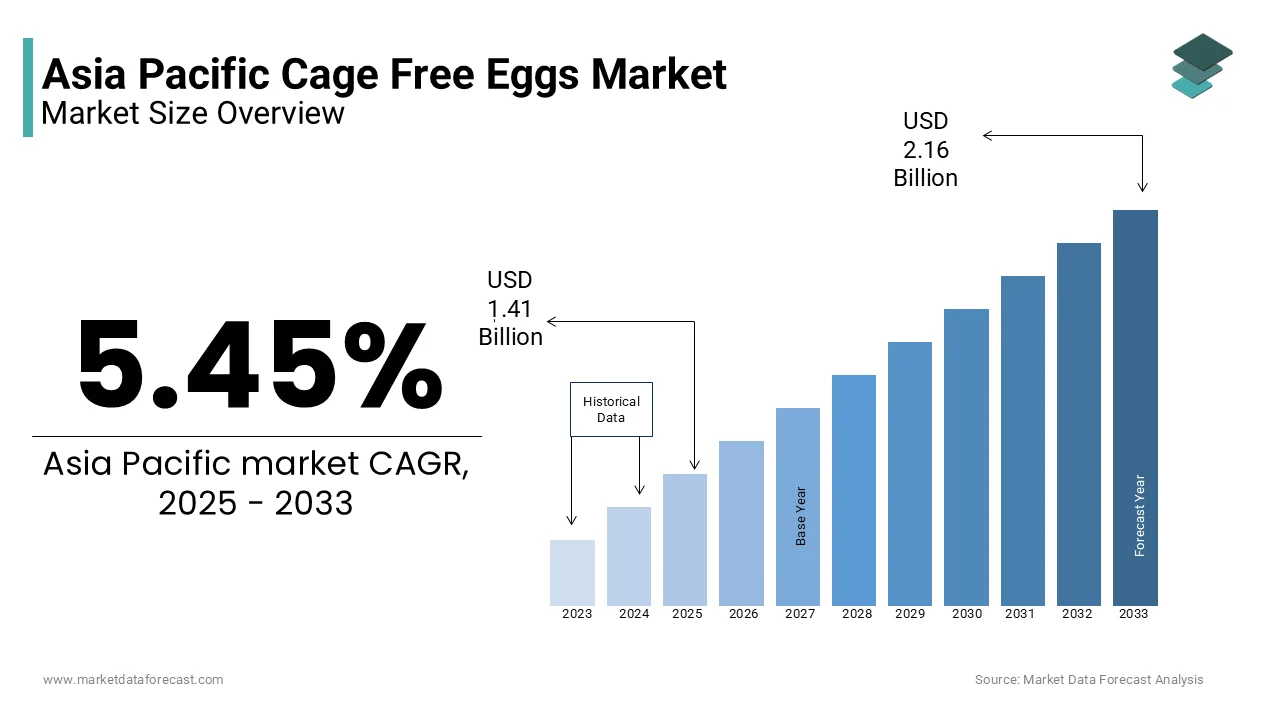
The Asia Pacific cage-free eggs market represents a nascent yet rapidly evolving segment within the broader poultry industry characterized by a gradual shift away from conventional battery cage systems. This market encompasses eggs produced by hens housed in barns or aviaries that allow for unrestricted movement, scratching, and perching behaviors. Unlike mature markets in Europe and North America where legislative mandates drive transformation, the Asia Pacific region is primarily influenced by corporate sustainability commitments and emerging consumer awareness among affluent urban populations. The definition of cage free in this region often aligns with international standards such as those set by the Global Animal Partnership to facilitate export opportunities and meet multinational buyer requirements. As per the Food and Agriculture Organization of the United Nations, the Asia Pacific region accounts for approximately 60% of global egg production, making even a small percentage shift towards cage-free systems significant in volume terms. Consumer literacy regarding animal welfare is increasing, particularly in developed economies like Australia, Japan, and South Korea where ethical sourcing is becoming a determinant of purchase behavior. According to the Humane Society International, surveys in several Asian markets indicate that a significant majority of consumers, often exceeding 50%, express a preference or willingness to pay more for higher animal welfare products. This growing consciousness is prompting local producers to adopt higher welfare standards despite the lack of comprehensive regional legislation. The market is defined by its dual nature comprising highly regulated advanced economies and developing nations where cost sensitivity remains paramount. This dichotomy creates a complex landscape where premium niche products coexist with traditional mass production methods requiring tailored strategies for market penetration and growth.
MARKET DRIVERS
Corporate Sustainability Commitments from Multinational Food Service Giants Accelerate Adoption
The aggressive implementation of cage-free sourcing policies by multinational food service corporations and quick-service restaurant chains is a key factor propelling the growth of the Asia-pacific cage-free eggs market. These entities operate under global sustainability frameworks that mandate uniform welfare standards across all their international locations, including those in Asia Pacific. As per the Open Wing Alliance, over 2,500 companies worldwide, including many with operations in Asia, have made public commitments to source 100% cage-free eggs. In the Asia Pacific region, this translates to substantial demand from brands such as McDonald's, Starbucks, and Hilton Hotels which are actively transitioning their supply chains in countries like China, India, and Thailand. For instance, according to corporate social responsibility reports, McDonald's has committed to sourcing 100% cage-free eggs in many global markets, influencing local suppliers to upgrade their facilities. This corporate pressure creates a guaranteed market for cage-free producers, reducing the financial risk associated with transitioning from conventional systems. According to the Business Benchmark on Farm Animal Welfare, there has been a steady increase in the number of global food companies disclosing their animal welfare policies. This trend is not limited to foreign brands as local conglomerates in Japan and Australia are also adopting similar standards to enhance brand reputation and appeal to ethically conscious consumers. The ripple effect of these corporate pledges extends beyond direct suppliers, encouraging secondary processors and ingredient manufacturers to align with cage-free standards, thereby creating a robust ecosystem that supports market growth and normalization of humane farming practices in the region.
Rising Urban Middle Class and Increased Awareness of Food Safety and Ethics Drive Demand
The expanding urban middle class in Asia Pacific is increasingly prioritizing food safety, quality, and ethical provenance, which is further boosting the care free eggs market expansion in Asia-pacific. As disposable incomes rise in countries such as China, Indonesia, and Vietnam, consumers are shifting from basic nutritional sufficiency to premium food choices that reflect personal values and health concerns. According to the Brookings Institution, the global middle class is increasingly centered in Asia, with the region expected to represent a massive potential customer base for premium agricultural products. This demographic is more exposed to global trends through digital media and travel, leading to greater awareness of animal welfare issues associated with industrial farming. As per a survey by World Animal Protection, a significant portion of consumers in various Asian countries consider animal welfare as an important factor when purchasing animal products. In developed markets like Australia and Japan, this awareness is even higher with consumers actively seeking out certified humane labels such as RSPCA Approved or Free Range Egg and Poultry Australia accredited products. The perception that cage-free eggs are safer and healthier due to lower stress levels in hens further reinforces this demand. Retailers in major metropolitan areas are responding by expanding their shelf space for cage-free options, catering to this discerning segment. The convergence of economic prosperity and ethical consciousness creates a sustainable demand trajectory that encourages local producers to invest in higher welfare systems to capture value-added market share in urban centers.
MARKET RESTRAINTS
High Production Costs and Price Sensitivity in Developing Economies Limit Market Penetration
The primary restraint hindering the widespread adoption of cage-free eggs in the Asia Pacific region is the significant cost differential between cage-free and conventional production methods which clashes with the high price sensitivity of the majority of consumers. Cage-free systems require larger housing spaces, specialized equipment, and increased labor for management, leading to production costs that are 20% to 40% higher than conventional battery cage operations. As per the International Egg Commission, the retail price of cage-free eggs in many Asian countries can be significantly higher than conventional eggs, making them less accessible to low and middle-income households who constitute the bulk of the population. In developing nations such as India, Philippines, and Vietnam where average household expenditure on food is a significant portion of income, consumers prioritize affordability over ethical considerations. According to the World Bank, millions of people in Southeast Asia live near or below regional poverty lines, limiting their ability to purchase premium food items. This economic reality restricts the cage-free market to a small niche of affluent urban consumers, preventing economies of scale that could potentially lower prices. Producers face thin margins and high capital expenditure risks without the guarantee of sufficient volume sales. Consequently, many small and medium-sized farmers hesitate to transition to cage-free systems due to the lack of immediate financial returns. This cost barrier perpetuates the dominance of conventional eggs in the mass market, slowing down the overall growth rate of the cage-free segment in the region.
Lack of Uniform Regulatory Frameworks and Standardized Definitions Creates Market Confusion
The absence of consistent and enforceable regulatory frameworks defining cage-free standards across Asia Pacific countries is also hampering the regional market expansion. Unlike the European Union which has a unified directive regarding laying hen housing, Asia Pacific nations have disparate and often vague regulations regarding animal welfare in poultry farming. In many countries, the term cage-free is not legally defined, allowing for inconsistent interpretations and potential greenwashing by producers. As per the World Organisation for Animal Health, while international standards for animal welfare exist, the adoption and enforcement of these standards vary widely across the Asia Pacific region. In other major markets like China and India, voluntary guidelines exist but mandatory enforcement is often lacking, leading to variability in production standards. This lack of standardization confuses consumers who may struggle to differentiate between genuine cage-free products and those with minimal welfare improvements. According to academic studies regarding consumer trust, the lack of clear labeling and certification can lead to skepticism and a reduced willingness to pay premiums for ethical goods. Without clear legal definitions and third-party verification mechanisms, it is difficult for reputable producers to justify higher prices. This regulatory ambiguity also complicates trade within the region as exporters must navigate varying compliance requirements. The resulting market fragmentation discourages investment in standardized cage-free infrastructure and hinders the creation of a cohesive regional market that could benefit from shared best practices and economies of scale.
MARKET OPPORTUNITIES
Expansion of Modern Retail Channels and E-Commerce Platforms Facilitates Premium Product Access
The rapid expansion of modern retail chains and e-commerce platforms in Asia Pacific is a substantial opportunity for the cage-free eggs market to reach broader consumer bases. Traditional wet markets which dominate egg sales in many Asian countries are gradually being supplemented by supermarkets, convenience stores, and online grocery services that offer better visibility and branding opportunities for premium products. As per the World Economic Forum, the digital economy in Southeast Asia is growing rapidly, driven by urbanization and digital adoption. These modern channels allow producers to effectively communicate the value proposition of cage-free eggs through packaging, storytelling, and certification labels which is difficult in traditional settings. Online platforms enable direct-to-consumer models where producers can educate shoppers about animal welfare benefits and justify premium pricing. Major retailers such as Alibaba’s Hema Fresh in China and Lotte Mart in South Korea are actively curating high-welfare product lines to attract affluent shoppers. According to general industry trends, sales of natural and organic products in Asian supermarkets have shown consistent annual growth. By leveraging these distribution networks, cage-free egg producers can bypass traditional intermediaries and build direct relationships with consumers. This shift also facilitates data collection on consumer preferences, enabling targeted marketing and product innovation. The integration of cold chain logistics further ensures product quality, enhancing consumer confidence. As digital literacy and trust in online payments increase, the e-commerce channel will become a pivotal growth engine for the cage-free segment in the region.
Growth in Tourism and Hospitality Sector Drives Institutional Demand for Ethical Sourcing
The robust growth of the tourism and hospitality sector in Asia Pacific offers a lucrative opportunity for the cage-free eggs market through institutional demand from hotels, resorts, and airlines. The region is a global tourism hotspot with international arrivals rebounding strongly. As per the United Nations World Tourism Organization, Asia and the Pacific have seen a significant recovery in international tourist arrivals, with millions of visitors seeking high-quality dining experiences. International hotel chains and upscale restaurants operating in the region are increasingly aligning their supply chains with global sustainability standards to meet the expectations of international travelers who prioritize ethical consumption. Many luxury hotels in destinations like Bali, Phuket, and Singapore have committed to serving only cage-free eggs as part of their corporate social responsibility initiatives. This institutional demand provides a stable and high-volume outlet for cage-free producers, reducing reliance on volatile retail markets. According to the World Travel and Tourism Council, the travel and tourism sector is a major contributor to the GDP of many Asian nations, creating a strong economic incentive for suppliers to meet ethical standards. Airlines based in the region such as Qantas and Singapore Airlines are also transitioning to cage-free egg supplies for their in-flight meals. This B2B segment allows producers to secure long-term contracts, ensuring revenue stability. As the hospitality industry continues to expand and compete on service quality and ethical credentials, the demand for cage-free eggs from this sector is poised for sustained growth, offering a strategic avenue for market expansion.
MARKET CHALLENGES
Prevalence of Avian Influenza and Biosecurity Risks in Non-Cage Systems
The heightened risk of disease outbreaks, particularly avian influenza is challenging the growth of the Asia-pacific cage-free eggs market. Cage-free systems, especially those with outdoor access, increase the likelihood of contact between domestic hens and wild birds which are natural reservoirs for the virus. As per the World Organisation for Animal Health, the Asia Pacific region frequently reports outbreaks of highly pathogenic avian influenza, leading to massive culling of poultry flocks and trade restrictions. Countries such as Japan, South Korea, and Vietnam have reported significant losses affecting both conventional and cage-free producers. However, cage-free farms face greater challenges in implementing strict biosecurity measures due to the open nature of their housing. According to the Food and Agriculture Organization of the United Nations, avian influenza outbreaks in Asia cause significant economic losses annually, disrupting supply chains and eroding consumer confidence. Outbreaks often lead to temporary bans on egg movements and exports, causing financial instability for producers who have invested heavily in cage-free infrastructure. The fear of disease transmission also makes insurers hesitant to cover cage-free facilities or results in higher premiums. Producers must invest in advanced ventilation systems, fencing, and hygiene protocols which further escalate operational costs. Managing these biological risks requires sophisticated veterinary oversight and constant monitoring which may be lacking in smaller operations. This persistent threat undermines the reliability of cage-free supply and deters new entrants who perceive the operational risks as outweighing the potential market rewards.
Fragmented Supply Chain and Lack of Technical Expertise among Smallholder Farmers
The fragmented nature of the poultry supply chain in Asia Pacific, coupled with a lack of technical expertise among smallholder farmers offers a significant challenge to the scalability of the cage-free eggs market. Unlike Western markets dominated by large integrated producers, Asia Pacific relies heavily on millions of small-scale farmers who lack the resources and knowledge to transition to cage-free systems. As per the International Fund for Agricultural Development, smallholders are responsible for a significant portion of food production in many Asian countries but often operate with limited technical support. Transitioning to cage-free farming requires specialized knowledge in flock management, nutrition, and behavior enrichment which is not widely available in rural areas. According to various development reports, agricultural extension services in many developing Asian countries are often under-resourced and struggle to provide adequate training on modern welfare practices. This knowledge gap leads to poor implementation of cage-free standards, resulting in lower productivity, higher mortality rates, and inconsistent egg quality. Without proper guidance, farmers may fail to realize the economic benefits of cage-free production, leading to abandonment of the practice. Additionally, the fragmented supply chain makes it difficult for buyers to source large volumes of consistent quality cage-free eggs, necessitating complex aggregation models. This structural inefficiency increases transaction costs and limits the ability of the market to meet the growing demand from large corporate buyers. Addressing this challenge requires significant investment in farmer education and supply chain consolidation which remains a slow and resource-intensive process.
REPORT COVERAGE
| REPORT METRIC | DETAILS |
| Market Size Available | 2025 to 2034 |
| Base Year | 2025 |
| Forecast Period | 2026 to 2034 |
| CAGR | 5.45% |
| Segments Covered | By Color, Size, and Region |
| Various Analyses Covered | Global, Regional, & Country Level Analysis; Segment-Level Analysis; DROC; PESTLE Analysis; Porter’s Five Forces Analysis; Competitive Landscape; Analyst Overview of Investment Opportunities |
| Regions Covered | India, China, Japan, South Korea, Australia, New Zealand, Thailand, Malaysia, Vietnam, Philippines, Indonesia, Singapore, and the Rest of Asia-Pacific |
| Market Leaders Profiled | Eggland’s Best LLC, Cal Maine Foods, Inc., Herbruck’s Poultry Ranch, Inc., Rembrandt Enterprises, Rose Acre Farms, Hillandale Farms, Trillium Farm Holdings, LLC, Midwest Poultry Services, L.P., Hickman’s Family Farms, Sparboe Farms, and others. |
SEGMENTAL ANALYSIS
By Size Insights
The large egg segment held the dominant position in the Asia-pacific cage-free eggs market with 47.4% of the regional market share in 2025. The growth of the large eggs segment in this regional market can be credited to the standardization of culinary applications across the rapidly expanding food service and hospitality sectors in the region. As per the United Nations World Tourism Organization, the recovery of international travel in Asia has boosted demand from hotels and restaurants that rely on consistent egg sizes for menu planning and cost control. Large eggs serve as the industry standard for baking and cooking formulas, ensuring uniformity in texture and volume which is critical for commercial kitchens. According to the United States Department of Agriculture, Large eggs weigh approximately 24 ounces per dozen, making them a widely recognized size for both household and industrial use. Retailers in developed markets like Australia and Japan prefer stocking Large cage-free eggs because they offer the best balance between price and perceived value for consumers. The supply chain infrastructure, including grading, packing, and distribution systems, is optimized for this size, allowing for efficient logistics and reduced waste. Furthermore, consumer habituation plays a significant role as shoppers in urban centers are accustomed to purchasing Large eggs for daily consumption. This entrenched preference, combined with the operational efficiency for producers, ensures that the Large segment remains the cornerstone of the cage-free market in Asia Pacific.

However, the jumbo egg segment is anticipated to grow at the fastest CAGR of 8.1% over the forecast period in this regional market owing to the growing health consciousness among affluent urban consumers who perceive larger eggs as superior sources of protein and nutrients. As per general nutritional data, Jumbo eggs provide a higher amount of protein per unit compared to standard sizes, making them attractive to health-focused demographics. In markets like China and South Korea, there is a cultural preference for larger eggs which are often used in premium diets or gifted to enhance vitality. According to retail observations, sales of specialty and premium-sized eggs in upscale Asian supermarkets have shown consistent growth. The premium positioning of Jumbo cage-free eggs allows producers to command higher margins, appealing to the expanding middle class willing to pay for perceived quality. Additionally, the visual appeal of Jumbo eggs enhances their status as luxury items in gift baskets and high-end retail displays. Producers are optimizing flock management to increase the yield of Jumbo eggs through targeted nutrition programs, further supporting this growth trajectory.
By Colour Insights
The brown eggs segment accounted for the major share of 56.5% of the regional market in 2025. This dominance is deeply rooted in the consumer perception that brown shells indicate natural, organic, and humane farming practices. In many Asian cultures, brown eggs are traditionally associated with rural authenticity and higher nutritional value, although scientific differences are minimal. As per consumer perception studies, a high percentage of shoppers in various Asian countries link darker egg shells with better animal welfare and outdoor farming conditions. This psychological link is particularly strong in developed markets like Australia and Japan where animal welfare is a key purchase driver. The majority of cage-free hen breeds, such as the ISA Brown and Rhode Island Red, naturally lay brown eggs, aligning supply with consumer preference. According to international poultry standards, brown eggs are frequently the standard for non-cage systems in many global supply chains. Retailers strategically merchandise brown cage-free eggs to differentiate them from conventional white eggs, creating a clear visual cue for ethical sourcing. The premium pricing strategy for brown eggs is more readily accepted by consumers who view the color as a marker of quality. This entrenched belief system, combined with the biological prevalence of brown laying hens in cage-free systems, ensures that this segment continues to dominate the regional market.
On the other side, the white egg segment is experiencing the fastest growth within the Asia-pacific cage-free eggs market and is expected to record a CAGR of 7.4% over the forecast period owing to the increasing adoption of cage-free systems in the industrial food processing sector where white eggs are preferred for their neutral appearance and cost efficiency. As per the Food and Agriculture Organization of the United Nations, the food processing industry in Asia is expanding, increasing the demand for egg ingredients in various applications. White-shelled hens, such as Leghorns, are often noted for their high egg production efficiency, which can help lower production costs in large-scale cage-free operations. In countries like China and India where price sensitivity is high, producing cage-free white eggs allows manufacturers to offer more affordable ethical options to a broader consumer base. According to various industry estimates, white eggs make up a vast majority of the total egg production in certain Asian markets, and as cage-free standards are adopted, this existing infrastructure is being utilized. Multinational food companies sourcing ingredients for regional products are increasingly specifying cage-free white eggs to meet sustainability goals without significantly impacting cost structures. This industrial demand, coupled with the efficiency advantages of white laying breeds, positions this segment for robust growth in the coming years.
REGIONAL ANALYSIS
China Cage Free Eggs Market Analysis
China had the leading position in the Asia-pacific cage-free eggs market in 2025 with 34.3% of the regional market share. The gradual transition from conventional systems driven by corporate sustainability commitments and rising urban wealth is majorly driving the Chinese market expansion. As per the Food and Agriculture Organization of the United Nations, China is the world's leading egg producer, accounting for a massive volume of total global production. The primary driving factor is the commitment of multinational quick-service restaurant chains and local e-commerce giants to source humane eggs. Alibaba’s Hema Fresh and other premium retailers have introduced dedicated cage-free lines catering to affluent urbanites in cities like Shanghai and Beijing. According to the Lever Foundation, several major food companies operating in China have pledged to transition to cage-free eggs by specified future dates, influencing local supply chains. Government guidelines on animal welfare are evolving, although not yet mandatory, creating a voluntary but growing market. The sheer scale of production means even a small percentage shift represents significant volume. Challenges include fragmented smallholder farming and cost sensitivity, but the trend towards premiumization in tier-one cities is evident. Investment in modern aviary technology is increasing as large integrators seek to capture the high-value segment. The market is poised for steady growth as consumer awareness spreads beyond metropolitan hubs.
Japan Cage Free Eggs Market Analysis
Japan holds a mature and sophisticated position in the Asia Pacific Cage Free Eggs Market due to the high consumer awareness and strict quality standards driven by a culture that values food safety and animal welfare. As per the Ministry of Agriculture, Forestry and Fisheries of Japan, the country maintains high levels of egg consumption per capita, with increasing interest in specialty and high-welfare products. The primary driver is the retail sector where major supermarkets like Aeon and Ito-Yokado have expanded their ethical product offerings. Corporate commitments from hospitality groups and airline carriers also contribute significantly to demand. According to industry reports from Japan, the availability of non-cage eggs is rising as producers respond to consumer preferences for transparency and traceability. The prevalence of brown eggs in the cage-free segment aligns with local perceptions of quality. Technological advancements in housing systems are widely adopted to ensure biosecurity and bird health. The market is characterized by higher price points but also a significant willingness to pay among consumers who prioritize ethical considerations. Regulatory support is subtle but effective through industry self-regulation and various certification schemes. Japan serves as a benchmark for quality and standards in the region, influencing neighboring markets.
Australia Cage Free Eggs Market Analysis
Australia is a leader in animal welfare standards within the Asia Pacific region. The Australian market is advanced with a significant portion of laying hens already housed in non-cage systems due to strong regulatory and consumer pressure. As per the Australian Bureau of Statistics, there has been a significant shift in egg production methods over the last decade, with non-cage systems gaining substantial ground. The primary driver is legislative action at the state level and corporate pledges from major retailers like Coles and Woolworths to phase out caged eggs. Consumer activism and widespread media coverage have heightened awareness, making cage-free or free-range the preferred choice for many shoppers. According to Australian Eggs, the representative body for the industry, non-cage egg sales have shown strong growth in value terms compared to traditional caged eggs. The market is highly competitive with strong branding and certification labels such as RSPCA Approved playing a crucial role in consumer decision making. Export opportunities to neighboring Asian countries also drive production standards. The challenge lies in maintaining affordability while adhering to high welfare costs. Australia’s mature market provides valuable insights and best practices for emerging economies in the region.
India Cage Free Eggs Market Analysis
India represents an emerging market in this region and is likely to be driven by the conventional production, but niche segments are developing in urban centers. As per the Food and Agriculture Organization of the United Nations, India is one of the top egg-producing countries globally, offering vast potential for future growth. The primary driver is the entry of multinational food service chains and quick-service restaurants that adhere to global cage-free sourcing policies. Companies like Starbucks and McDonald’s are influencing local suppliers to adopt higher welfare standards. According to animal welfare organizations active in India, awareness campaigns are gradually educating consumers in metros like Mumbai and Delhi about the benefits of cage-free systems. The market is fragmented with smallholders dominating production, making standardization difficult. However, organized players are beginning to invest in cage-free facilities to cater to the premium segment. Cost sensitivity remains a major barrier, but the expanding middle class is creating a viable niche. Government initiatives promoting sustainable agriculture may further support this transition. The market is in early stages but shows promise as ethical consumption gains traction among affluent demographics.
South Korea Cage Free Eggs Market Analysis
South Korea holds a developing position in the Asia Pacific cage free eggs market. The market status is transitioning rapidly due to recent regulatory changes and shifting consumer preferences. As per the Ministry of Agriculture, Food and Rural Affairs of South Korea, new regulations have been introduced to improve the living environment of laying hens, including increasing the minimum space requirement per bird. The primary driver is the implementation of these stricter welfare laws which has encouraged producers to adopt alternative systems including cage-free barns. Retailers and food service providers are adapting to these changes by sourcing compliant eggs. According to the Korea Consumer Agency, there is a rising demand for ethical and safe food products among South Korean shoppers. The market is seeing investment in modern aviary systems to meet the new legal and consumer requirements. Brown eggs are preferred in the cage-free segment, aligning with consumer perceptions of quality. The transition poses challenges in terms of cost and technical expertise, but the regulatory mandate ensures progress. South Korea’s proactive policy approach serves as a model for other Asian countries considering similar reforms. The market is expected to grow steadily as compliance becomes universal and consumer acceptance deepens.
COMPETITIVE LANDSCAPE
The competitive landscape of the Asia Pacific Cage Free Eggs Market is characterized by a dynamic mix of large integrated agribusinesses and specialized niche producers who are rapidly adapting to shifting consumer preferences and regulatory pressures. Large incumbents leverage their extensive distribution networks and economies of scale to dominate supply chains while investing heavily in capital intensive conversions of conventional facilities to maintain market relevance. These companies compete on reliability and compliance with global sustainability standards required by multinational buyers. Smaller specialized firms differentiate themselves through transparent sourcing stories and premium branding often targeting affluent urban consumers willing to pay for verified humane products. Competition intensifies as corporate pledges from major food service brands create standardized demand forcing suppliers to adhere to uniform welfare criteria. Price sensitivity remains a critical factor in developing economies leading to a bifurcated market where premium cage free eggs coexist with mass market conventional products. Innovation in housing technology and feed efficiency serves as a key competitive advantage enabling producers to manage higher operational costs. The market is consolidating in mature regions like Australia while remaining fragmented in emerging economies where infrastructure challenges persist. Strategic partnerships between producers and retailers further shape competitive dynamics ensuring steady growth for verified cage free offerings.
KEY MARKET PLAYERS
Some of the major companies in the APAC cage free eggs market are
- Eggland’s Best LLC
- Cal-Maine Foods, Inc.
- Herbruck’s Poultry Ranch, Inc.
- Rembrandt Enterprises
- Rose Acre Farms
- Hillandale Farms
- Trillium Farm Holdings, LLC
- Midwest Poultry Services, L.P.
- Hickman’s Family Farms
- Sparboe Farms
Top Players in the Market
- Charoen Pokphand Foods stands as a dominant integrated agribusiness leader in Thailand and across Asia with significant involvement in the cage free eggs sector. The company has actively invested in modernizing its poultry operations to meet evolving animal welfare standards demanded by global partners and local consumers. Recent initiatives include the expansion of cage free housing facilities equipped with advanced ventilation and automated feeding systems to enhance hen welfare and productivity. Charoen Pokphand Foods collaborates with international retail chains and food service providers to supply certified humane eggs ensuring compliance with stringent sustainability criteria. By leveraging its extensive supply chain network and technical expertise the company strengthens its market position through consistent quality and reliable delivery. Its commitment to research and development drives innovation in feed formulation and disease management specifically tailored for non cage environments. This strategic focus allows the company to capture premium market segments while maintaining operational efficiency. The organization continues to advocate for higher welfare standards in the region influencing industry practices and reinforcing its reputation as a responsible and forward thinking producer in the Asia Pacific agricultural landscape.
- New Hope Liuhe is a major agricultural enterprise in China that plays a pivotal role in advancing the cage free eggs market through large scale production and technological innovation. The company has committed to transforming its laying hen facilities by adopting aviary systems that align with global animal welfare benchmarks. Recent actions involve partnering with multinational food corporations to secure long term supply contracts for cage free eggs thereby stabilizing demand and encouraging further infrastructure investment. New Hope Liuhe utilizes data driven farming techniques to monitor bird health and optimize feed efficiency in cage free settings reducing operational costs and environmental impact. The company actively participates in industry associations to promote standardized welfare certifications enhancing consumer trust and brand credibility. By integrating sustainable practices into its core business strategy New Hope Liuhe addresses the growing urban demand for ethical food products in China. Its robust distribution network ensures wide availability of cage free eggs in major metropolitan areas. The firm’s dedication to continuous improvement and compliance with international standards positions it as a key contributor to the modernization of the poultry sector in Asia Pacific.
- Ingham's Group is a leading poultry producer in Australia that significantly contributes to the cage free eggs market through its strong emphasis on animal welfare and product quality. The company has expanded its portfolio of cage free and free range eggs to cater to the increasing consumer preference for ethically sourced proteins in the region. Recent strategies include upgrading existing farms to meet higher welfare accreditation standards such as RSPCA Approved which enhances brand loyalty among conscious shoppers. Ingham's Group invests in marketing campaigns that educate consumers about the benefits of cage free farming fostering transparency and trust. The company collaborates with major retail supermarkets to ensure prominent shelf placement and consistent supply of premium egg products. By focusing on biosecurity and flock management innovations Ingham's Group maintains high productivity levels in non cage systems. Its commitment to sustainability extends to packaging solutions using recyclable materials for egg cartons. This holistic approach strengthens its competitive edge in the mature Australian market and influences regional best practices. Ingham's Group continues to drive growth by aligning its operations with evolving regulatory frameworks and consumer expectations for humane agriculture.
Top Strategies Used by the Key Market Participants
Key players in the Asia Pacific Cage Free Eggs Market primarily focus on strategic infrastructure conversion by retrofitting conventional battery cage facilities into modern aviary or barn systems to comply with emerging corporate and regulatory standards. Companies pursue vertical integration to control feed costs and ensure supply chain resilience which is critical given the volatility of raw material prices in the region. Strategic alliances with multinational quick service restaurant chains and retail giants secure long term off take agreements that de risk capital investments in cage free production. Investment in research and development targets improved feed conversion ratios and enhanced biosecurity protocols to mitigate disease risks inherent in non cage environments. Branding efforts emphasize third party certifications such as RSPCA or Global Animal Partnership to differentiate products and justify premium pricing to ethically conscious consumers. Mergers and acquisitions enable larger conglomerates to consolidate market presence and acquire specialized technical expertise in humane farming technologies. These strategies collectively allow producers to navigate high transition costs while meeting the growing demand for sustainable and ethical protein sources across diverse Asia Pacific markets.
MARKET SEGMENTATION
This research report on the Asia Pacific cage-free eggs market has been segmented and sub-segmented into the following categories.
By Size
- Medium
- Large
- Extra Large
- Jumbo
By Colour
- Brown
- White
By Country
- India
- China
- Japan
- South Korea
- Australia
- New Zealand
- Thailand
- Malaysia
- Vietnam
- Philippines
- Indonesia
- Singapore
- Rest of APAC