- Product Description Description
- Table of Contents TOC
- List of Table & Figure LOT
- Get Free Sample PDF Sample PDF
Market Size, 2025
$2.57 BnMarket Estimate, 2026
$3.30 BnMarket Forecast, 2034
$24.33 BnCAGR, 2026–2034
28.37%Executive Summary: Asia-Pacific Fitness App Market
- Market Scope: Comprehensive Asia-Pacific fitness app market analysis covering app types, mobile platforms, user applications, end-user segments, revenue models, and country-level growth dynamics.
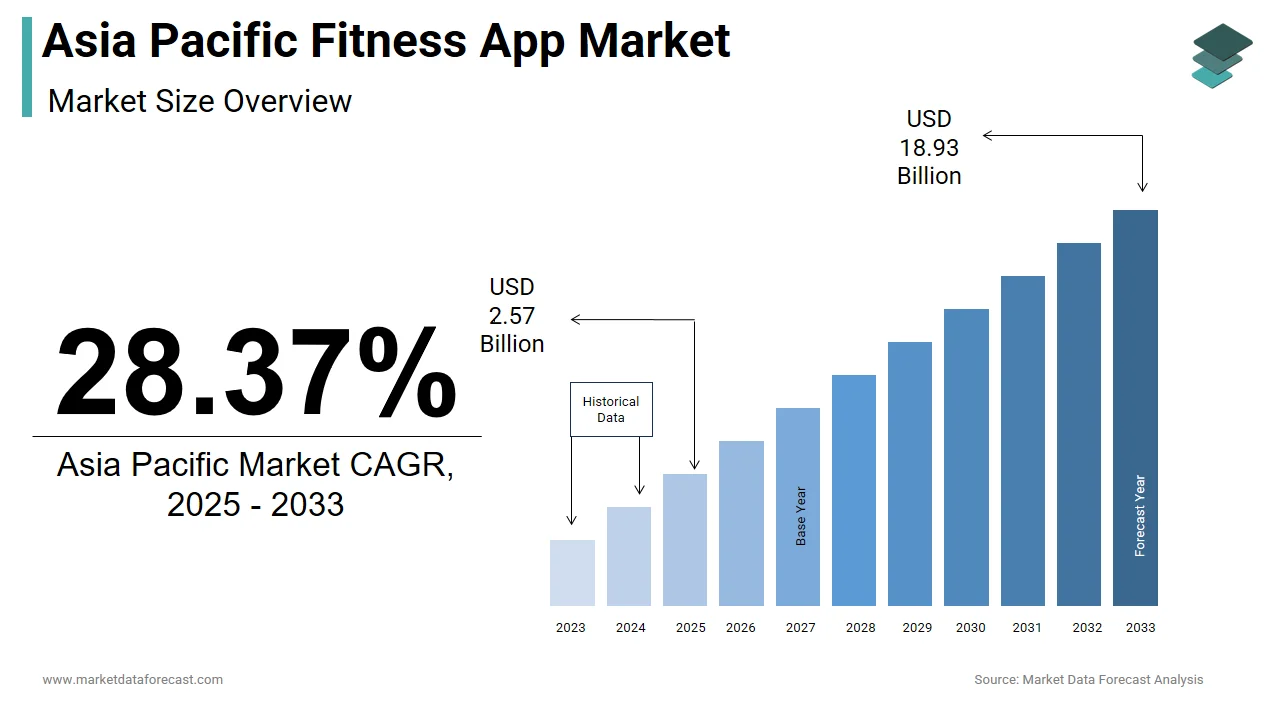
- Market Valuation: Valued at USD 2.57 billion (2025), estimated at USD 3.30 billion (2026), and projected to reach USD 24.33 billion by 2034, registering an exceptional CAGR of 28.37% (2026–2034).
- Primary Growth Drivers: Rapidly expanding smartphone penetration and high-speed internet usage across emerging economies (such as China and India), rising health and lifestyle awareness, growing incidence of chronic conditions, and post-pandemic adoption of digital health solutions. Key restraints include lack of awareness in developing areas, high development costs, app fatigue, and competition from low-cost or free alternative applications.
Key Market Segment Metrics (2026–2034)
| Category | Leading Segment (2025 Position) | Fastest-Growing Segment |
|---|---|---|
| By Type | Workout & Exercise Apps (dominant due to high demand for home-based training regimens and guided video workouts) | Meditation & Mindfulness Apps (surging alongside heightened consumer focus on mental wellness and stress management) |
| By Platform | Android (held the largest market share owing to widespread smartphone adoption across emerging Asian markets) | iOS (expanding steadily on the back of rising disposable incomes and premium device penetration) |
| By Application/User Type | General Fitness & Weight Loss (anchored by widespread consumer goals around daily activity tracking and dietary monitoring) | Wellness & Rehabilitation (growing rapidly as healthcare providers integrate apps into preventative and physical therapy programs) |
| By Revenue Model | Freemium & Subscription-Based (leading in user acquisition and long-term recurring revenue generation) | Subscription-Based (scaling quickly as users commit to premium customized coaching and advanced analytics) |
| By Country | China (led regional revenue share backed by high disposable incomes, chronic disease awareness, and advanced digital ecosystems) | India (experiencing explosive download growth and massive new user additions in health and fitness app sectors) |
Major Market Players & Market Structure
Market Structure: Highly competitive digital health and fitness landscape featuring global tech and apparel giants alongside agile software developers competing on user interface design, personalized AI coaching, wearable ecosystem integration, and freemium monetization strategies.
Key Companies: MyFitnessPal Inc., Motorola Mobility LLC, Azumio, WillowTree, Inc., Under Armour, Dom and Tom, Grandapps, Fitbit, ASICS, and Appster.
 Download Free Sample Report
Asia Pacific Fitness App Market Size
The size of the Asia Pacific fitness app market was worth USD 2.57 billion in 2025. The Asia Pacific market is anticipated to grow at a CAGR of 28.37% from 2026 to 2034 and be worth USD 24.33 billion by 2034 from USD 3.30 billion in 2026.
A fitness app is a mobile or digital software application designed to help you track, plan, and improve your physical activity, exercise routines, and overall health. These applications leverage smartphone sensors and wearable device integration to provide personalized fitness insights and motivation. According to the World Health Organization, physical inactivity is the fourth leading risk factor for global mortality, contributing to an estimated 3.2 million to 5 million deaths globally per year. This statistic directly correlates with the rising adoption of fitness apps as tools for preventive healthcare management. As per the International Diabetes Federation, over 200 million adults in the Western Pacific region live with diabetes, highlighting the critical role of regular exercise in disease prevention and management. Fitness apps address this by offering structured programs and progress monitoring that encourage consistent physical activity. As smartphone penetration deepens across emerging economies, the accessibility of these digital solutions expands rapidly. The integration of artificial intelligence further enhances user engagement through adaptive coaching and real-time feedback. This technological evolution positions fitness apps as essential components in modern wellness ecosystems seeking to combat sedentary lifestyles and promote long-term health outcomes throughout the diverse Asia Pacific landscape.
MARKET DRIVERS
Rising Prevalence of Lifestyle-Related Diseases
The escalating burden of chronic lifestyle diseases fuels the growth of the Asia Pacific fitness app market. This rise creates sustained demand for preventive health management tools. Conditions such as obesity, type 2 diabetes, and cardiovascular disorders require consistent physical activity and dietary monitoring, which manual methods often fail to sustain effectively. According to the World Health Organization, non-communicable diseases account for more than 80% of all deaths in the Western Pacific region. This high mortality rate drives individuals to adopt fitness apps that offer structured exercise plans and calorie tracking capabilities to manage weight and improve metabolic health. As per the International Diabetes Federation, the number of adults with diabetes in the Western Pacific region is projected to reach 260 million by 2045. Fitness apps provide accessible and cost-effective means for users to monitor their activity levels and receive personalized recommendations without requiring gym memberships. The growing awareness of health risks associated with sedentary behavior further accelerates adoption among urban populations. As healthcare systems shift toward preventive care models, the integration of fitness data with medical records becomes increasingly valuable. This trend establishes fitness apps as critical instruments for empowering individuals to take control of their health and reduce the economic burden of chronic disease management.
Increasing Smartphone Penetration and Digital Connectivity
Widespread adoption of smartphones and improved internet infrastructure boost the Asia Pacific fitness app market. This makes digital health tools accessible to billions of users. Mobile devices serve as the primary platform for fitness applications, enabling real-time tracking of steps, heart rate, and sleep patterns through built-in sensors. According to sources, infrastructure availability and mobile network access choices have expanded rapidly across diverse demographics in major Asian markets, providing a broad foundational platform for digital applications. This extensive connectivity facilitates the seamless synchronization of fitness data with cloud platforms, allowing for comprehensive analysis and long-term progress monitoring. As per reports, next-generation mobile network rollouts continue to improve network capabilities across developed and developing metropolitan centers in Asia, supporting more reliable, real-time data transmissions. Affordable smartphone prices in emerging markets like India and Indonesia further democratize access to premium fitness applications. Social features within apps foster community engagement and accountability, which are crucial for maintaining user motivation. As digital literacy improves across age groups, the willingness to integrate technology into daily wellness routines grows significantly. This technological foundation ensures a robust and expanding user base for fitness app developers seeking to scale their operations across the diverse regional landscape.
MARKET RESTRAINTS
Data Privacy and Security Concerns
Growing apprehension about personal data privacy hampers the growth of the Asia Pacific fitness app market. This makes users reluctant to share sensitive health information with digital platforms. Fitness applications collect detailed biometric data, including location, heart rate, and activity patterns, which raise fears about misuse, hacking, or unauthorized surveillance. According to a report, 79% of Americans surveyed are concerned about how companies use their personal data. This skepticism leads many potential users to disable tracking features or avoid downloading apps altogether due to fear of data breaches. As per sources, regulations governing cross-border data flows vary significantly across different global jurisdictions, introducing compliance complexities for applications and service developers operating across international borders. The lack of uniform privacy standards makes users wary of storing biological data on servers located in different jurisdictions. High-profile cyberattacks on health tech companies have further amplified these concerns, making users cautious about granting extensive permissions. Without robust transparency and security guarantees, consumers remain hesitant to fully engage with feature-rich applications. This resistance slows market growth as developers struggle to balance functionality with privacy protection while trying to build trust in an era of increasing digital vulnerability and regulatory scrutiny.
High User Churn and Low Retention Rates
Significant drop-off in active users hinders the Asia Pacific fitness app market. This limits long-term revenue potential and sustainability for developers. Many users download fitness apps with initial enthusiasm but cease usage within weeks due to lack of motivation, inadequate personalization, or repetitive content. As per the Journal of Medical Internet Research, approximately 71% of fitness app users stop engaging with their platform by month three. This high churn rate forces companies to invest heavily in customer acquisition rather than focusing on value creation and user satisfaction. As per research, digital applications often suffer from quick drops in user engagement once the initial novelty fades if the platforms fail to deliver tangible physical results or integrate robust social support mechanisms. Users often find generic workout plans ineffective for their specific needs, leading to frustration and abandonment. The complexity of integrating apps with various wearable devices also creates technical barriers that discourage continued use. Without effective engagement strategies such as gamification, personalized coaching, or community features, apps struggle to maintain relevance in users daily lives. This instability undermines business models reliant on subscription revenues, making it difficult for smaller developers to compete with established players who can afford extensive marketing and retention campaigns.
MARKET OPPORTUNITIES
Integration with Wearable Technology and IoT
The convergence of fitness apps with wearable devices and Internet of Things technology unlocks potential for the Asia Pacific fitness app market. This enables comprehensive health monitoring and data accuracy. Smartwatches, fitness bands, and connected scales provide continuous biometric data that apps can analyze to offer deeper insights and more precise recommendations. According to research, the number of globally connected wearable devices was anticipated to surpass 1 billion. This synergy allows users to track metrics such as blood oxygen levels, stress scores, and sleep quality seamlessly without manual input. As per studies, individual adoption and commercial sales of specialized tracking, fitness, and health-monitoring equipment have expanded steadily throughout high-demand Asian regional markets. Fitness apps can leverage this data to create dynamic workout plans that adjust based on real-time physiological responses. Integration with smart home devices also enables automated environment adjustments such as lighting or temperature during workouts. As sensor technology advances, the ability to monitor hydration and nutrition through non-invasive methods will further enhance app utility. This interconnected ecosystem creates new revenue streams through hardware partnerships and premium data analytics services, driving broader market adoption.
Expansion into Corporate Wellness Programs
Growing emphasis on employee well-being offers significant growth opportunities for the Asia Pacific fitness app market. This drives institutional adoption in corporate sectors. Companies are increasingly recognizing that healthy employees are more productive and incur lower healthcare costs, leading to investment in digital wellness solutions. According to sources, commercial wellness solutions and corporate health initiatives targeting the workplace ecosystem are maintaining sustained growth trajectories across primary corporate centers. Fitness apps provide scalable and cost-effective platforms for employers to offer personalized health challenges, step competitions, and mental health resources to large workforces. As per the World Economic Forum, workforce burnout is pervasive, with 83% of Asia's employees experiencing burnout in the past year, directly impacting corporate performance. Apps with enterprise features allow HR departments to monitor aggregate participation rates and health outcomes while maintaining individual privacy. Gamified elements foster team bonding and morale-boosting engagement beyond traditional gym subsidies. Partnerships with insurance providers also enable incentives for employees who meet activity goals, reducing premium costs. As remote work becomes permanent for many organizations, digital fitness solutions bridge the gap between professional and personal health management, establishing a lucrative B2B segment.
MARKET CHALLENGES
Market Saturation and Intense Competition
The abundance of free and low-cost fitness applications is a major barrier to the growth of the Asia Pacific fitness app market. This makes it difficult for new entrants to differentiate and retain users. Thousands of apps offer similar features such as workout videos, calorie counters, and step trackers, creating a crowded landscape where visibility is limited. According to studies, health and fitness software launches expanded dramatically on global digital distribution networks, with many new entries focusing heavily on high-growth regional digital consumer demographics. This saturation leads to price wars and heavy reliance on paid advertising, which erodes profit margins for smaller developers. Users often switch between apps seeking better interfaces or free trials, resulting in fragmented loyalty and unstable revenue streams. The lack of unique value propositions makes it challenging for apps to justify subscription fees when comparable free alternatives exist. Established players with large marketing budgets dominate search rankings and app store features, leaving little room for innovation-driven startups. Differentiation through specialized content such as yoga for seniors or postpartum recovery requires niche marketing efforts that are resource-intensive. Until developers can demonstrate clear superior outcomes or exclusive features, the market will remain highly competitive, with high barriers to sustainable growth.
Cultural and Behavioral Barriers to Adoption
Deep-rooted cultural attitudes toward fitness and health are further inhibiting the expansion of the Asia Pacific fitness app market. This influences user engagement and perception of digital tools. In many Asian societies, fitness is traditionally viewed as a communal activity or a luxury rather than a daily necessity managed through apps. According to reports, socio-cultural expectations in diverse global regions place heavily balanced weights on educational or vocational excellence, which often influences the hours available for leisure and regular fitness exercises. This mindset reduces the perceived urgency of using fitness apps for preventive health management. Language barriers also pose significant challenges, as many popular apps lack localized content or culturally relevant workout styles such as traditional martial arts or dance. As per research, psychological discomfort and societal judgment regarding appearance and weight can hinder individuals from sharing personal milestones or entering communal fitness events on online applications. Additionally, the preference for face-to-face interaction with trainers or group classes makes digital substitutes less appealing for some demographics. Developers must invest heavily in cultural adaptation and community building to overcome these behavioral hurdles. Without addressing these nuanced social factors, fitness apps risk remaining niche products rather than becoming mainstream health essentials across the diverse cultural landscape of the region.
REPORT COVERAGE
| REPORT METRIC | DETAILS |
| Market Size Available | 2025 to 2034 |
| Base Year | 2025 |
| Forecast Period | 2026 to 2034 |
| Segments Covered | By Type, Platform, Application/User Type, End-User, Revenue Model, and Country. |
| Various Analyses Covered | Global, Regional, and Country-Level Analysis, Segment-Level Analysis, Drivers, Restraints, Opportunities, Challenges; PESTLE Analysis; Porter’s Five Forces Analysis, Competitive Landscape, Analyst Overview of Investment Opportunities |
| Regions Covered | North America, Europe, APAC, Latin America, Middle East & Africa |
| Market Leaders Profiled | MyFitnessPal Inc., Motorola Mobility LLC, Azumio, WillowTree, Inc., Under Armour, Dom and Tom, Grandapps, Fitbit, ASICS, WillowTree, Inc., Fitbit Inc, Keep.com, and Appster |
SEGMENTAL ANALYSIS
By Type Insights
In 2025, the workout and exercise apps segment held the largest share in the Asia Pacific fitness app market because of the universal appeal of structured physical training and the desire for guided home workouts. These applications provide video tutorials, personalized routines, and progress tracking, which cater to users seeking convenience and professional guidance without gym memberships. According to reports, public health constraints impacted local club operations globally, accelerating consumer adoption of remote digital exercise tools and applications. This behavioral change drives sustained demand for apps that offer diverse workout styles ranging from high-intensity interval training to yoga and Pilates. The World Health Organization recommends at least 150 minutes of moderate aerobic activity per week, which these apps help users achieve through scheduled reminders and achievable goals. The integration of live streaming classes allows for real-time interaction with trainers, fostering a sense of community and accountability. High smartphone penetration in urban centers ensures easy access to these platforms, while affordable data plans support video consumption. As fitness becomes a lifestyle priority rather than a seasonal resolution, the consistent usage patterns of workout apps solidify their market leadership. Manufacturers continuously update content libraries to keep users engaged, ensuring long-term retention and subscription renewals across the region.
The meditation and mindfulness apps segment is experiencing the highest CAGR due to increasing awareness of mental health and stress management needs. Modern lifestyles in rapidly urbanizing Asian cities contribute to high levels of anxiety and burnout, prompting individuals to seek digital solutions for emotional well-being. According to the World Health Organization, depression and anxiety disorders increased by 25% globally in the first year of the pandemic. This surge in psychological distress accelerates the adoption of apps offering guided meditation, sleep stories, and breathing exercises. As per reports, individual spending on mental well-being, mindfulness, and cognitive fitness services has seen substantial expansion across major market sectors. Users appreciate the accessibility of mindfulness tools that can be practiced anywhere, requiring no equipment or specific physical ability. Corporate wellness programs increasingly include mental health modules, further boosting institutional subscriptions. Technological advancements such as biofeedback integration allow apps to personalize sessions based on heart rate variability, enhancing effectiveness. As stigma around mental health decreases and younger generations prioritize holistic health, the demand for meditation apps continues to expand rapidly, establishing it as the fastest-growing category in the market.
By Application/User Type Insights
The weight loss segment was the most prominent in 2025 and occupied a commanding share of the Asia Pacific fitness app market. This prominence was supported by rising obesity rates and strong cultural emphasis on physical appearance. Users in this category rely on apps for calorie counting, meal planning, and exercise tracking to achieve specific body composition goals. According to the World Health Organization, the global burden of obesity has nearly tripled since 1975. This alarming trend drives individuals to seek convenient and data-driven tools that simplify the complex process of caloric deficit management. Fitness apps provide immediate feedback on dietary choices and activity levels, helping users maintain accountability and motivation. Social features such as community challenges and progress sharing enhance engagement by leveraging peer support. The availability of localized food databases makes calorie tracking more accurate and relevant for Asian diets. As healthcare costs rise and insurance providers promote preventive care the adoption of weight loss apps becomes a cost-effective strategy for individuals and institutions alike, ensuring their continued dominance.
The wellness and meditation segment demonstrates the fastest growth, owing to the holistic health movement and increasing recognition of mental well-being as integral to overall fitness. This application type focuses on stress reduction, sleep improvement, and emotional balance rather than just physical metrics. According to research, organizational performance degradation related to psychological stress impacts regional economic output significantly, motivating enterprise leaders to deploy modern wellness resources. This economic impact encourages the adoption of wellness apps that offer accessible and scalable interventions for stress management. As per reports, systematic integration of smartphone-delivered mindfulness exercises into daily routines shows measurable efficacy in mitigating persistent symptoms of psychological distress. Users are increasingly seeking integrated platforms that combine physical activity with mental restoration, such as yoga and breathwork. The rise of digital detox trends paradoxically supports app usage as users seek structured ways to disconnect and recharge. Government initiatives promoting mental health awareness in countries like Japan and South Korea further legitimize these tools. As consumers move beyond aesthetic fitness goals toward sustainable lifestyle changes, the wellness and meditation segment emerges as the most dynamic growth area in the market.
COUNTRY-LEVEL ANALYSIS
China Fitness App Market Analysis
China dominated the Asia Pacific fitness app market and accounted for a substantial share in 2025. This dominance was driven by a massive user base and rapid digitalization of health services. The country benefits from high smartphone penetration and a growing middle class that prioritizes health and wellness amidst urbanization. According to the China Internet Network Information Center, the number of internet users in China exceeded 1 billion in 2023, with a significant portion engaging with health and fitness content online. This vast digital population drives substantial downloads and active usage of local and international fitness applications. The National Health Commission of China promotes the Healthy China 2030 initiative, which encourages regular physical activity and healthy lifestyles, supporting market growth. Domestic developers lead in innovation by integrating social commerce and live streaming features that enhance user engagement and monetization. Government support for digital health infrastructure facilitates seamless integration of app data with medical records. Rising awareness of chronic disease prevention further stimulates demand for comprehensive tracking tools. The competitive landscape features strong local players who understand cultural nuances and dietary preferences, ensuring high retention rates. This combination of scale, policy support, and technological sophistication solidifies China's leadership in the regional market.
India Fitness App Market Analysis
India is quickly accelerating within the Asia Pacific fitness app market. This growth is fueled by increasing health awareness and affordable smartphone accessibility. The country has a young demographic that is increasingly conscious of fitness trends and digital health solutions. According to the Telecom Regulatory Authority of India, total telephone subscribers reached 1,172.34 million by March 2023, while total internet subscribers stood at 881.25 million. This connectivity boom drives adoption of free and freemium fitness apps that cater to diverse income levels. As per sources, public wellness and indigenous physical health methodologies like yoga receive active domestic institutional framework support, matching widespread public demand across localized electronic fitness services. Rising incidence of lifestyle diseases such as diabetes and hypertension motivates individuals to adopt preventive health measures through digital tracking. Local developers create content in multiple regional languages, breaking down barriers for non-English speakers. The gig economy and remote work trends also increase demand for flexible home workout solutions. Government initiatives like Digital India support the expansion of digital health ecosystems. Focus on affordability and localization ensures broad market penetration, making India a key growth engine for the Asia Pacific fitness app sector.
Japan Fitness App Market Analysis
Japan is a mature Asia Pacific fitness app market because of an aging population and advanced technological adoption in healthcare. The country faces unique demographic challenges that necessitate innovative solutions for maintaining health and independence among elderly citizens. According to the Ministry of Internal Affairs and Communications, over 29% of Japan's population is aged 65 or older, creating sustained demand for low-impact and accessible fitness applications. This demographic pressure drives investment in apps that focus on mobility, balance, and chronic disease management rather than intense workouts. As per reports, public sector health ministries design structural programmatic frameworks to incentivize long-term metabolic health and active aging through integrated electronic tools. High literacy rates and comfort with technology facilitate the use of sophisticated apps featuring AI coaching and biometric integration. Corporate wellness programs are well established in Japan, further boosting B2B subscriptions for employee health management. Local developers emphasize precision and data privacy, aligning with strict regulatory standards. The mature healthcare system supports integration of app data with clinical care, enhancing credibility. This focus on quality, longevity, and technological reliability sustains Japan's prominent position in the regional market.
South Korea Fitness App Market Analysis
South Korea maintains a noteworthy position in the Asia Pacific fitness app market due to high digital connectivity and a culture that values physical fitness and aesthetics. The country boasts one of the highest smartphone penetration rates globally, facilitating seamless access to advanced fitness applications. According to studies, digital saturation metrics and high-speed personal computing availability ensure a reliable customer ecosystem for responsive consumer health software implementations. This technological readiness drives rapid adoption of apps featuring augmented reality virtual coaching and social competition features. As per research, administrative bodies manage institutional health marketing campaigns that utilize online distribution models to optimize individual physiological fitness across the citizen workforce. High internet speeds enable smooth streaming of high-definition workout videos and live classes, enhancing user experience. The popularity of K-pop and celebrity fitness trends influences app content and marketing strategies, driving youth engagement. Local tech giants integrate fitness features into broader ecosystem services, increasing stickiness and user retention. Strong emphasis on data analytics allows for highly personalized recommendations, improving outcomes. This combination of cultural enthusiasm and technological infrastructure sustains South Korea's dynamic market growth and innovation leadership.
Australia Fitness App Market Analysis
Australia grew steadily in the Asia Pacific fitness app market, owing to high health consciousness and robust disposable income. The population actively participates in sports and outdoor activities, creating strong demand for tracking and coaching applications. According to sources, adult behavioral habits show an active commitment toward routine bodily conditioning, illustrating an environment receptive to customized personal physical training workflows. This high participation rate drives consistent usage of apps for running, cycling, and gym workouts. As per studies, institutional networks provide structured protocols allowing certified applications to connect cleanly with electronic information exchanges, bolstering consumer clinical diagnostics. High prevalence of skin cancer due to sun exposure also drives demand for outdoor activity tracking with safety features. Consumers are willing to pay for premium subscriptions that offer personalized coaching and detailed analytics. Strong presence of global fitness brands ensures high-quality content and reliable service. Focus on mental well-being and work-life balance further expands the market for holistic wellness apps. This mature ecosystem supports steady growth and high customer lifetime value for app developers operating in the region.
COMPETITIVE LANDSCAPE
The Asia Pacific Fitness App Market features intense competition among global technology giants and specialized local developers striving for user engagement and retention. Companies compete primarily on content quality, user experience, and integration capabilities rather than price alone due to the abundance of free alternatives. The landscape is characterized by continuous innovation as firms seek to differentiate their offerings through artificial intelligence-driven personalization and virtual reality features. Strategic collaborations between app developers and hardware manufacturers are common, aiming to provide seamless ecosystems that enhance data accuracy and utility. Market participants focus on expanding their regional footprint through localized content and language support to serve diverse cultural preferences effectively. The entry of social media platforms into the fitness space adds further dynamism to the competitive environment, forcing dedicated apps to enhance community features. Customer retention relies heavily on gamification, personalized coaching, and regular content updates that keep users motivated. Intellectual property protection remains crucial as companies safeguard proprietary algorithms and workout designs that constitute their competitive advantage. The market structure encourages consolidation through acquisitions, allowing larger entities to broaden their content libraries and access new user segments efficiently while reducing development risks.
KEY MARKET PLAYERS
The leading companies operating in the Asia Pacific fitness app market include:
- MyFitnessPal, Inc.
- Motorola Mobility LLC
- Azumio
- WillowTree, Inc.
- Under Armour
- Dom & Tom
- Grandapps
- Fitbit
- ASICS
- com
- Appster
TOP PLAYERS IN THE MARKET
- MyFitnessPal maintains a strong presence in the Asia Pacific Fitness App Market through its comprehensive database and calorie tracking capabilities. The company focuses on providing users with detailed nutritional information and meal planning tools to support weight management goals. In March 2023, MyFitnessPal launched an enhanced barcode scanner feature that recognizes a wider range of Asian food products for accurate logging. This innovation addresses local dietary habits and improves user experience by simplifying data entry for diverse cuisines. The company continues to invest in research and development to improve algorithm accuracy for metabolic rate calculations. Their global community features foster social accountability, which strengthens user retention across different cultures. MyFitnessPal actively collaborates with local nutritionists to create region-specific content. This strategic alignment enhances relevance and trust among users. By integrating with popular wearable devices in the region, the company ensures seamless data synchronization. This ecosystem approach solidifies its position as a leading tool for holistic health management in the Asia Pacific market.
- com contributes significantly to the Asia Pacific Fitness App Market by offering structured video workout programs tailored to home environments. The company is renowned for its high-quality production values and celebrity trainer partnerships, which attract a large young demographic. In June 2023, Keep introduced a new line of smart fitness equipment that syncs directly with its app for real-time performance feedback. This product launch enhances their ecosystem by bridging the gap between digital guidance and physical training hardware. Keep emphasizes gamification elements such as badges and leaderboards to maintain user engagement and motivation. The company partners with local influencers in China and Southeast Asia to drive brand awareness and downloads. Their commitment to affordable subscription models makes premium content accessible to mass markets. Keep also provides personalized coaching plans based on user fitness levels and goals. This customer-centric approach drives consistent growth and establishes the brand as a preferred choice for home fitness enthusiasts in the region.
- Fitbit Inc. plays a pivotal role in the Asia Pacific Fitness App Market by leveraging its hardware and software integration for comprehensive health tracking. The company specializes in activity monitoring, sleep analysis, and heart rate tracking through its wearable devices and companion app. In September 2023, Fitbit expanded its premium service offerings in Japan and Australia with advanced stress management and mindfulness content. This expansion meets the growing demand for holistic wellness solutions beyond simple step counting. Fitbit focuses on clinical validity, ensuring that health metrics are accurate and useful for medical professionals. The company actively engages in partnerships with healthcare providers to integrate fitness data into patient care plans. Their emphasis on battery life and durability appeals to active users in diverse climates. Fitbit also provides robust data privacy controls to address regional regulatory requirements. By continuously refining its sensor technology and user interface, Fitbit supports the industry's transition toward preventive healthcare and personalized wellness management in the Asia Pacific region.
TOP STRATEGIES USED BY THE KEY MARKET PARTICIPANTS
Key market participants employ several strategic approaches to strengthen their position in the Asia Pacific Fitness App Market. Product innovation remains the primary strategy, with companies investing heavily in research and development to introduce features such as AI coaching, augmented reality workouts, and biometric integration. Strategic partnerships and collaborations with local influencers and celebrities enable providers to build brand credibility and reach wider audiences in culturally diverse markets. Geographic expansion into emerging economies represents another critical strategy as companies establish local offices and marketing teams to tailor campaigns to regional trends. Acquisition of smaller niche apps allows major players to integrate specialized content such as yoga or prenatal fitness into their existing portfolios quickly. Customer-centric initiatives such as flexible subscription models and free trial periods enhance conversion rates and reduce barriers to entry. Focusing on corporate wellness programs helps companies secure stable B2B revenue streams and increase user base through employer-sponsored subscriptions. Continuous improvement in data security and privacy compliance ensures trust and adherence to varying regional regulations, maintaining long-term sustainability.
MARKET SEGMENTATION
This Asia Pacific fitness app market research report is segmented and sub-segmented into the following categories.
By Type
- Activity Tracking Apps
- Nutrition & Diet Apps
- Workout & Exercise Apps
- Meditation & Mindfulness Apps
- Others (e.g., Sleep Tracking, Health Monitoring)
By Platform
- iOS
- Android
- Others (e.g., Windows, Web-based)
By Application/User Type
- Weight Loss
- Muscle Building
- Wellness & Meditation
- General Fitness
- Sports & Training
- Rehabilitation & Physical Therapy
By End-User
- Individual Consumers
- Fitness Centers & Gyms
- Healthcare Providers
- Corporate Wellness Programs
By Revenue Model
-
Freemium
-
Subscription-Based
-
Advertisement-Based
-
One-Time Purchase
By Country
- India
- China
- Japan
- South Korea
- Australia
- New Zealand
- Thailand
- Malaysia
- Vietnam
- Philippines
- Indonesia
- Singapore
- Rest Of APAC