- Product Description Description
- Table of Contents TOC
- List of Table & Figure LOT
- Get Free Sample PDF Sample PDF
Market Size, 2025
$10.11 BnMarket Estimate, 2026
$10.97 BnMarket Forecast, 2034
$21.04 BnCAGR, 2026–2034
8.48%Executive Summary: Asia Pacific Infant Nutrition Market
- Market Scope: Comprehensive regional analysis of the Asia Pacific infant nutrition sector, detailing milk formula product categories, retail distribution channels, regulatory environments, and country-level market dynamics from 2026 to 2034.
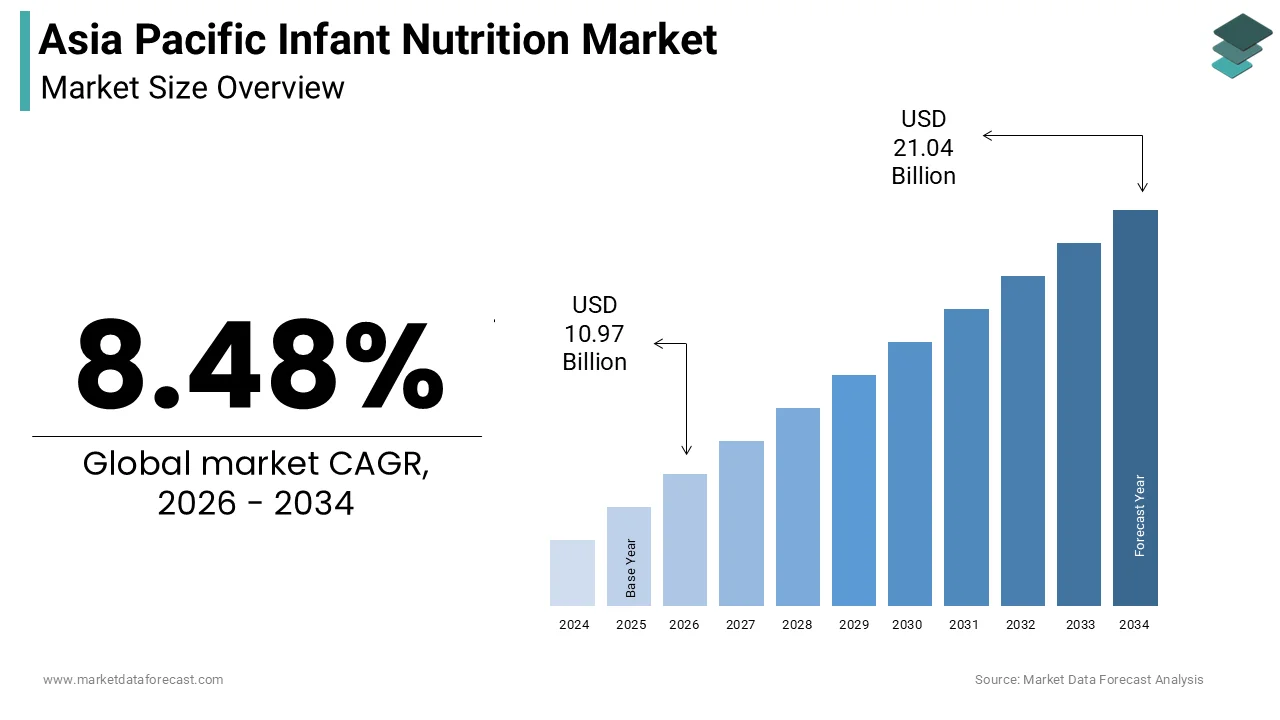
- Market Valuation: Valued at USD 10.11 billion in 2025, reaching USD 10.97 billion in 2026, and projected to expand to USD 21.04 billion by 2034, growing at a robust CAGR of 8.48% from 2026 to 2034.
- Primary Growth Drivers: Rising disposable incomes across emerging economies, increasing urban working-class populations, stringent quality and safety standards post-historical scares, and strong consumer preference for imported and premiumized infant nutrition brands.
Key Market Segment Metrics
| Category | Leading Segment (Base Position) | Fastest-Growing / High-Growth Segment |
|---|---|---|
| By Product Type | Starting & Follow-On Milk Formula (held dominant baseline market share due to essential infant feeding needs) | Special & Toddlers Milk Formula (projected at high growth rates driven by specialized health formulations and organic options) |
| By Distribution Channel | Supermarkets & Chemist/Pharmacist/Drugstores (captured major market share due to parental trust, safety assurance, and broad product availability) | Online Retail (anticipated at the fastest growth rate driven by cross-border e-commerce platforms, digital convenience, and home delivery) |
| By Region / Country | China (market leader with profound ripple effects globally, driven by massive consumer demand and strict regulatory frameworks) | India & Southeast Asia (expected to register high growth rates backed by rising urbanization, growing middle-class populations, and expanding retail infrastructure) |
Major Market Players & Industry Landscape
Market Structure: Highly competitive, safety-critical multinational landscape where brand trust, clinical validation, strict government compliance, and premium import positioning dictate market dominance.
Key Companies: Mead Johnson Nutrition, Beingmate Baby & Child Food Co., The Kraft Heinz Company, Synutra International, Nestlé S.A., Meiji Holdings Co. Ltd., Pfizer Inc., Groupe Danone, and FrieslandCampina.
 Download Free Sample Report
Asia Pacific Infant Nutrition Market Size
The size of the Asia Pacific infant nutrition market was calculated to be USD 10.11 billion in 2025 and is anticipated to be worth USD 21.04 billion by 2034, from USD 10.97 billion in 2026, growing at a CAGR of 8.48% during the forecast period. This Market consists of different sets of products from different infant formulas to a range of foods for babies.
The most significant trends currently driving the Infant Nutrition Market is the dynamic and competitive environment in the Chinese market. Due to the size and rapid growth of this market, the changes in China are having profound ripple effects throughout the global Infant Nutrition Market which in turn is affecting the majority of global manufacturers. China’s large base and rapidly growing volume of consumers with increasing purchasing power is very attractive to multinational brands; however, the 2008 melamine infant formula issues still overshadow the market and has created an environment where consumers are concerned with the health and safety of infant formula. In turn, government regulations continue to rise. Although there is robust demand for Infant Nutrition in China, particularly imported brands perceived to be of higher quality compared to local brands, limitations on these statements have not been evaluated by the Food and Drug Administration. These products are not intended to diagnose, treat, cure, or prevent any disease.
This Research Report on Asia Pacific infant nutrition market is segmented, and sub segmented into following categories
Asia Pacific Infant Nutrition Market By Product Type
- Follow-On Milk Formula
- Starting Milk Formula
- Special Milk Formula
- Toddlers Milk Formula
Asia Pacific Infant Nutrition Market By Distribution Channel
- Specialty Outlets
- Online
- Supermarkets
- Chemist/Pharmacist/Drugstore
- Others
Asia Pacific Infant Nutrition Market By Region
- India
- Japan
- China
- Australia
- Singapore
- Malaysia
- South Korea
- New Zealand
- Southeast Asia
KEY MARKET PLAYERS
Major key Players in the Infant APAC Infant Nutrition Market are Mead Johnson Nutrition, Beingmate Baby & Child Food Co, The Kraft Heinz Company, Synutra International, Nestlé S.A., Meiji Holdings Co. Ltd, Pfizer Inc, Groupe Danone, and FrieslandCampina