- Product Description Description
- Table of Contents TOC
- List of Table & Figure LOT
- Get Free Sample PDF Sample PDF
Market Size, 2025
$0.29 BnMarket Estimate, 2026
$0.32 BnMarket Forecast, 2034
$0.67 BnCAGR, 2026–2034
9.7%Executive Summary: Asia Pacific Laboratory Information System Market
- Market Scope: Comprehensive regional Asia-Pacific laboratory information system (LIS) market analysis covering software and services, deployment models, end-user settings, and country-level leadership frameworks.
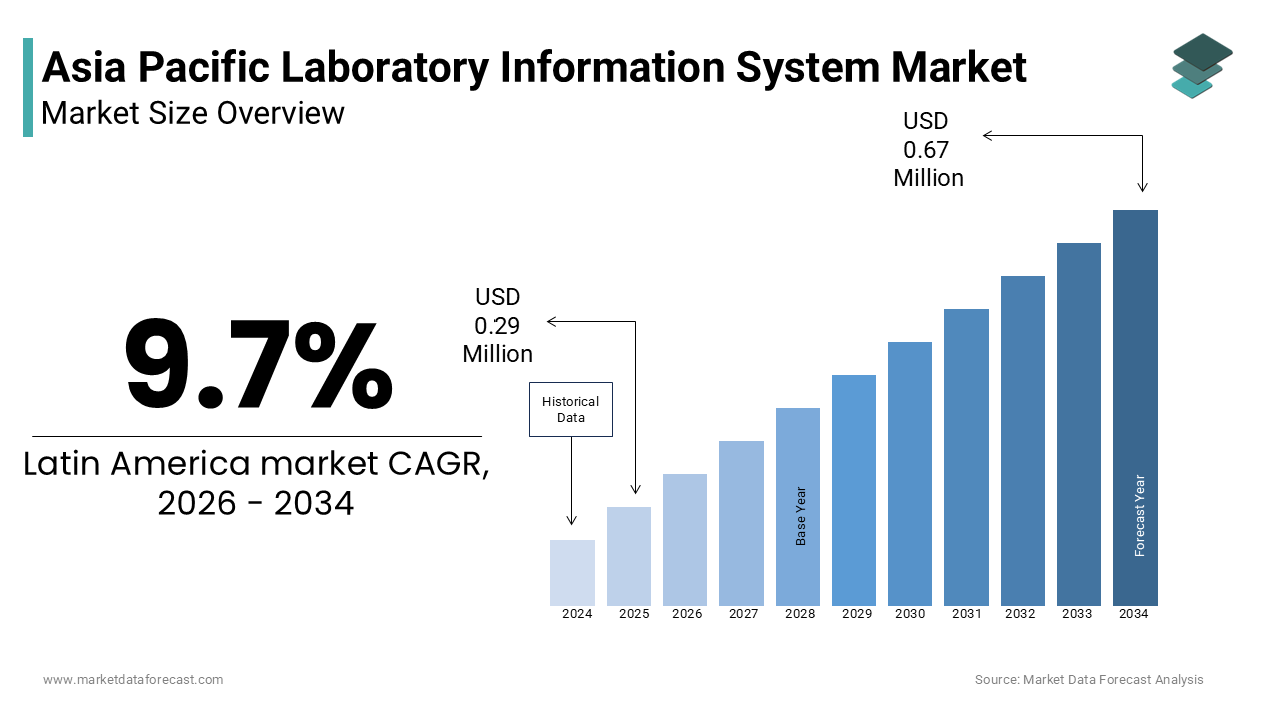
- Market Valuation: Valued at USD 0.29 billion (2025), estimated at USD 0.32 billion (2026), and projected to reach USD 0.67 billion by 2034, registering a strong CAGR of 9.7% (2026–2034).
- Primary Growth Drivers: Escalating chronic disease epidemics (with 67 million adults in the Western Pacific living with diabetes), regulatory harmonization mandates, cloud-native architecture transitions, and AI workforce augmentation.
Key Market Segment Metrics (2026–2034)
| Category | Leading Segment (2025 Position) | Fastest-Growing Segment |
|---|---|---|
| By Component | LIS Software (held the largest share in 2025) | Services (predicted to expand at a rapid CAGR of 15.4%) |
| By Deployment Model | On-Premises Deployment (captured the highest share in 2025 due to data residency rules) | Cloud-Based LIS (estimated to record the fastest CAGR of 23.2%) |
| By End-User | Hospitals (led end-users with a 60.5% share in 2025) | Independent Laboratories (projected to register a high CAGR of 17.7%) |
| By Country Leadership | China (dominated the regional market with a 31.3% share in 2025) | ASEAN Markets (expanding via localized health platforms and rural access initiatives) |
Major Market Players & Market Structure
Market Structure: Competitive regional digital health landscape featuring multinational corporations leveraging integrated EHR-LIS platforms and domestic vendors competing through regulatory alignment and localized language support.
Key Companies: McKesson, Cerner Corporation, Epic System Corporation, SCC Software Computers, Medical Information Technology, Labware, Sunquest Information Systems, Compugroup Medical, and Evident.
Asia Pacific Laboratory Information System Market Size
The Asia Pacific Laboratory Information System Market size was valued at USD 0.29 billion in 2025 and is anticipated to reach USD 0.32 billion in 2026 from USD 0.67 billion by 2034, growing at a CAGR of 9.7% during the forecast period from 2026 to 2034.
According to the World Health Organization Regional Office for the Western Pacific, noncommunicable diseases account for 80% of all deaths in the region, generating massive testing volumes that manual processes cannot sustain. According to the Asian Development Bank, healthcare expenditure in developing Asia is projected to reach 1.2 trillion dollars annually by 2030, necessitating efficiency gains through automation rather than linear workforce expansion. As per the Organisation for Economic Co-operation and Development, countries like Japan and South Korea spend over 4% of GDP on healthcare yet face severe labor shortages, making laboratory informatics a critical lever for maintaining service levels without proportional staffing increases. Consequently, this market functions as a vital enabler of health system resilience where technology adoption is increasingly dictated by demographic inevitabilities and productivity mandates rather than discretionary IT budgets or isolated digitization projects.
MARKET DRIVERS
Chronic Disease Epidemics Necessitating High Volume Data Management
The escalating prevalence of diabetes, cardiovascular disease and cancer across Asia Pacific creates structural demand for laboratory information systems capable of processing millions of test results with minimal human intervention, which is primarily driving the expansion of the Asia-pacific laboratory information system market. According to the International Diabetes Federation, 67 million adults in the Western Pacific region live with diabetes as of 2024, requiring regular HbA1c monitoring and renal function testing that generates continuous data streams overwhelming paper-based or legacy systems. According to China's National Health Commission, chronic disease patients accounted for 75% of total hospital visits in 2024, translating to approximately 3 billion annual laboratory tests nationwide that must be integrated into electronic health records for coordinated care management. According to India's National Cancer Registry Programme, 1.5 million new cancer cases were documented in 2024, each requiring complex histopathology workflows and molecular diagnostics that depend on specialized LIS modules for specimen tracking and result interpretation. Unlike acute care episodes which are episodic and finite, chronic disease management demands longitudinal data continuity across multiple testing sites and time periods. This epidemiological reality transforms LIS from optional administrative tools into mandatory clinical infrastructure because manual transcription errors and delayed result delivery directly compromise treatment efficacy for conditions where timely therapeutic adjustment determines patient outcomes and long-term healthcare costs.
Regulatory Harmonization and Accreditation Mandates Accelerating Digital Adoption
Government-led quality assurance frameworks and international accreditation requirements are compelling laboratories to adopt compliant information systems regardless of organizational size or resource availability, which is further propelling the regional market growth. As per the Joint Commission International, over 850 healthcare facilities across Asia Pacific achieved JCI accreditation by the end of 2024, with laboratory data integrity and traceability serving as non-negotiable audit criteria that effectively mandate validated LIS implementation. According to Australia's National Association of Testing Laboratories, ISO 15189:2022 alignment guidelines were revised in 2024, requiring all accredited medical laboratories to demonstrate automated audit trails and electronic signature capabilities that only modern LIS platforms can provide consistently. According to Singapore's Ministry of Health, mandatory laboratory licensing regulations were implemented in 2024 stipulating real-time reporting of notifiable disease test results to national surveillance databases, creating legal imperatives for system interoperability absent in voluntary adoption scenarios. According to Thailand's Department of Medical Sciences, LIS integration was mandated for all provincial hospitals in 2024 as a prerequisite for universal health coverage reimbursement, linking financial sustainability directly to digital maturity. These regulatory pressures eliminate the optionality traditionally associated with IT investments by embedding compliance requirements into licensing, accreditation, and payment mechanisms. Laboratories face existential risks from noncompliance including license revocation and revenue loss, ensuring sustained demand driven by institutional survival imperatives rather than efficiency optimization alone.
MARKET RESTRAINTS
Fragmented Regulatory Landscapes Increasing Compliance Complexity
Divergent national data privacy laws, localization requirements, and technical standards across Asia Pacific jurisdictions are a major restraint on the Asia-pacific laboratory information system market. According to the Asian Business Law Institute, 14 distinct personal data protection regimes now operate across ASEAN member states alone, each imposing unique consent mechanisms, breach notification timelines, and cross-border transfer restrictions that prevent standardized regional product offerings. According to China's Personal Information Protection Law enacted in 2021, health data storage within mainland borders and security assessments before any export are required, forcing vendors to maintain separate infrastructure and codebases rather than leveraging global cloud architectures. According to Indonesia's Electronic Systems and Transactions Regulation amended in 2024, government approval is mandated for electronic system operators handling strategic health data, adding 6 to 12 month certification delays per jurisdiction according to industry compliance surveys. According to Vietnam's Cybersecurity Law, local data mirroring is required for all digital health platforms, duplicating hosting expenses and complicating disaster recovery planning. This regulatory heterogeneity fragments what could be unified regional markets into isolated national silos where economies of scale remain unrealized. Vendors must invest disproportionately in legal advisory services, local partnerships, and customized development rather than core product innovation, inflating solution costs and limiting feature parity across geographies despite identical underlying clinical needs.
Legacy Infrastructure Incompatibility Hindering System Integration
Widespread persistence of outdated laboratory instruments and hospital information systems creates technical barriers that delay or prevent successful LIS implementation across diverse Asia Pacific healthcare settings, which is further hampering the LIS market growth in this region. According to the Healthcare Information and Management Systems Society Asia Pacific survey conducted in 2024, 58% of hospitals in Southeast Asia still operate laboratory analyzers manufactured before 2010 lacking standard HL7 or ASTM interfaces required for automated bidirectional communication with modern LIS platforms. According to India's public health infrastructure assessment, 65% of district hospitals use custom-built or discontinued HIS solutions with proprietary database schemas incompatible with commercial LIS APIs, necessitating expensive middleware development costing 40% to 60% of total project budgets. According to the Philippines' Department of Health, only 22% of rural health units possess reliable internet connectivity meeting minimum bandwidth thresholds for cloud-based LIS operation, forcing reliance on offline-capable alternatives with limited functionality. According to Japan's medical device registry, 45% of installed laboratory equipment exceeds the manufacturer support lifecycle, leaving laboratories dependent on reverse-engineered interface drivers that break during vendor updates. These technical debt burdens transform LIS projects from straightforward software deployments into complex system integration endeavors where hidden compatibility work consumes resources allocated for user training and change management, causing timeline slippage and scope reduction that undermines expected productivity gains.
MARKET OPPORTUNITIES
Cloud-Native Architectures Enabling Rural Healthcare Access Expansion
Transition to Software-as-a-Service delivery models presents unprecedented opportunities to extend laboratory informatics capabilities to underserved rural and periurban communities previously excluded due to capital constraints. According to the Asian Development Bank, cloud computing adoption in Southeast Asian healthcare grew 35% year-on-year in 2024 as telecommunications infrastructure expanded to cover 92% of population centers with broadband access. According to Indonesia's Ministry of Health, the SATUSEHAT integrated health platform was launched in 2024 connecting 12,000 community health centers via cloud-hosted LIS modules, eliminating upfront server hardware costs that historically blocked digitization in resource-limited settings. According to Bangladesh's Directorate General of Health Services, a mobile-first cloud LIS was deployed across 4,500 union-level facilities in 2024, enabling real-time tuberculosis test reporting from areas where electricity reliability averages only 8 hours daily according to World Bank energy access data. Cloud-native architectures convert large capital expenditures into predictable operational expenses aligned with variable testing volumes, making sophisticated informatics economically viable for small laboratories serving low-income populations. Multi-tenant platforms enable centralized maintenance and automatic updates that rural facilities cannot staff locally, democratizing access to enterprise-grade functionality previously reserved for urban tertiary hospitals. This delivery model transformation unlocks latent demand representing millions of underserved patients while creating recurring revenue streams for vendors beyond traditional perpetual licensing paradigms.
Artificial Intelligence Integration Enhancing Diagnostic Throughput and Accuracy
Embedding machine learning algorithms within LIS platforms creates opportunities to address critical workforce shortages while improving diagnostic quality across high-volume testing environments. According to the World Health Organization Western Pacific Region workforce analysis published in 2024, the region faces a shortage of 2.8 million health professionals including laboratory scientists, making AI-assisted triage and validation essential for maintaining service levels amid rising test volumes. According to Seoul National University Hospital, an AI-powered hematology slide review module was implemented in 2024 reducing manual microscopy workload by 45% while maintaining 99.2% concordance with senior pathologist readings according to peer-reviewed validation study. According to the National University Health System in Singapore, predictive analytics were deployed within LIS in 2024 identifying sepsis risk 6 hours earlier than conventional scoring systems, enabling preemptive intervention that reduced ICU admissions by 18% per internal audit. According to China's National Medical Products Administration, 12 AI-enabled laboratory diagnostic software products were approved in 2024 specifically for integration with LIS platforms, creating regulatory pathways for embedded intelligence beyond standalone device classifications. These capabilities transform LIS from passive data repositories into active decision support systems that augment limited human expertise. By automating routine cognitive tasks and flagging anomalies for expert attention, AI integration enables existing workforces to manage higher complexity caseloads without proportional staffing increases, addressing fundamental supply-demand imbalances constraining regional healthcare delivery capacity.
MARKET CHALLENGES
Cybersecurity Vulnerabilities Threatening Patient Data Integrity
Escalating cyberattacks targeting healthcare organizations across Asia Pacific expose critical vulnerabilities in laboratory information systems that compromise patient safety and erode institutional trust, which is a significant challenge to the Asia-pacific laboratory information system market growth. According to the Interpol Global Cybercrime Assessment 2024, healthcare sector ransomware attacks in Asia increased 78% year-on-year with laboratories identified as primary entry points due to interconnected analyzer networks lacking segmentation from administrative systems. According to the Office of the Australian Information Commissioner, 142 health data breaches were reported in 2024 involving laboratory records, exposing sensitive genetic and diagnostic information for over 2.3 million individuals and triggering regulatory penalties exceeding 15 million dollars collectively. According to the National Center of Neurology and Psychiatry in Japan, catastrophic LIS disruption was suffered in 2024 when ransomware encrypted 8 years of accumulated test data, forcing a 3-week reversion to manual processes that delayed 12,000 patient diagnoses according to official incident report. According to Thailand's Personal Data Protection Committee, enforcement notices were issued to 6 hospital laboratories in 2024 for inadequate encryption of stored patient specimen data, highlighting widespread noncompliance with basic security controls. These incidents reveal that many Asia Pacific laboratories operate LIS platforms with insufficient security hardening, outdated patch management, and absent incident response plans. Recovery costs frequently exceed initial system investment while reputational damage persists beyond technical remediation, creating risk exposure that outpaces organizational preparedness and regulatory enforcement capacity across the region.
Workforce Digital Literacy Gaps Undermining System Utilization
Insufficient technical competency among laboratory personnel prevents effective utilization of advanced LIS functionalities despite successful installation and configuration across many Asia Pacific healthcare facilities, which is further challenging the regional market expansion. According to the UNESCO Institute for Statistics education assessment published in 2024, only 34% of healthcare workers in lower-middle-income Asia Pacific nations possess intermediate digital skills necessary for navigating complex informatics systems beyond basic data entry. According to the Vietnam Ministry of Health survey of 500 provincial laboratory staff conducted in 2024, 62% could not generate custom reports or perform advanced query functions independently, relying instead on IT department assistance that introduces 3 to 5 day delays for routine analytical tasks. According to WHO humanitarian situation reports, post-coup brain drain in Myanmar reduced experienced laboratory informaticians by an estimated 70%, leaving remaining staff unable to maintain system configurations or troubleshoot integration failures. Even in technologically advanced Japan, the Ministry of Health Labour and Welfare documented that 45% of laboratory technicians aged 55 and above require supervised operation for LIS modules introduced after 2020, creating generational competency divides that slow workflow optimization. Training programs often focus narrowly on initial go-live procedures without ongoing skill development aligned with system upgrades and evolving clinical protocols. This human capital deficit means expensive LIS capabilities remain underutilized or misused, preventing realization of expected efficiency gains and perpetuating reliance on parallel manual processes that undermine data integrity and introduce error risks the systems were designed to eliminate.
REPORT COVERAGE
| REPORT METRIC | DETAILS |
| Market Size Available | 2025 to 2034 |
| Base Year | 2025 |
| Forecast Period | 2026 to 2034 |
| CAGR | 9.7% |
| Segments Covered | By Component, End-User, Delivery Mode and Region |
| Various Analyses Covered | Regional & Country Level Analysis, Segment-Level Analysis, DROC, PESTLE Analysis, Porter’s Five Forces Analysis, Competitive Landscape, Analyst Overview on Investment Opportunities |
| Countries Covered | India, China, Japan, South Korea, Australia, New Zealand, Thailand, Malaysia, Vietnam, the Philippines, Indonesia, Singapore, and the Rest of APAC. |
| Market Leaders Profiled | McKesson, Cerner Corporation, Epic System Corporation, SCC Software Computers, Medical Information Technology, Labware, Sunquest Information Systems, Compugroup Medical, and Evident. |
SEGMENTAL ANALYSIS
By Component Insights
The LIS software segment dominated the market by accounting for the largest share of the regional market in 2025 because vendors have transitioned from perpetual licensing to subscription models that generate predictable recurring revenue while enabling continuous feature updates aligned with evolving clinical needs. According to the IDC Health Insights Asia Pacific 2024 report, 78% of new LIS contracts in the region now utilize SaaS or subscription-based pricing structures, reflecting vendor strategy to stabilize cash flows against volatile capital expenditure cycles common in emerging markets. According to China's National Health Commission, electronic medical record system upgrades were mandated for all tertiary hospitals in 2024, triggering replacement demand for LIS software modules integrated with national health information platforms rather than standalone hardware purchases. According to the Australia Digital Health Agency, 92% of public hospital LIS procurements in 2024 included multi-year software maintenance agreements covering regulatory updates and interoperability enhancements, embedding ongoing costs into operational budgets insulated from capital approval delays. Unlike hardware which depreciates over 5 to 7 years and requires replacement cycles, software generates continuous value through functional expansion, compliance updates, and integration capabilities that justify sustained investment independent of physical asset lifecycles. This business model transformation ensures software maintains revenue leadership as vendors prioritize annuity streams over one-time sales, aligning their financial incentives with customer success metrics rather than equipment shipment volumes.

However, the LIS services segment is predicted to expand at a CAGR of 15.4% over the forecast period in the regional market owing to the increasing implementation complexity requiring specialized professional services beyond basic installation. According to the KPMG Asia Pacific Healthcare Technology Survey 2024, average LIS implementation projects now require 18 months and 2,400 consultant hours compared to 12 months and 1,500 hours in 2019, reflecting expanded scope including workflow redesign, data migration, interface development, and user training across multi-site deployments. According to the Vietnam Ministry of Health, 65% of provincial hospital LIS implementations experienced timeline slippage exceeding 6 months in 2024 due to insufficient local expertise in change management and clinical workflow optimization, creating demand for external advisory services. According to the Philippines Department of Health, 35% of its 2024 digital health budget was allocated specifically for training and technical assistance rather than software licensing, recognizing that technology adoption fails without parallel human capital development. According to project disclosures, the Indonesia SATUSEHAT platform rollout required the deployment of 800 field technicians across the archipelago to provide on-site configuration and user support at community health centers lacking IT staff. This service intensity reflects the fundamental reality that LIS success depends more on organizational adaptation than technical installation. As systems grow more sophisticated and integrated, service revenue grows disproportionately because each software dollar requires multiple service dollars for successful realization of expected benefits, creating structural growth acceleration independent of license sales velocity.
By End User Insights
The hospitals segment led the market by holding 60.5% of the Asia-pacific market share in 2025. The dominance of hospitals segment in the Asia-pacific market is primarily driven by their concentration of high-complexity testing volumes and integrated care coordination requirements. According to World Health Organization Western Pacific Region hospital statistics from 2024, tertiary hospitals in the region perform an average of 2.8 million tests annually per facility, representing 75% of total diagnostic activity and generating corresponding LIS demand proportional to throughput intensity. According to China's National Health Commission, Grade A tertiary hospitals conducted 4.2 billion laboratory tests collectively in 2024, requiring enterprise-grade LIS platforms capable of managing multidisciplinary workflows spanning pathology, microbiology, biochemistry, and molecular diagnostics within unified systems. According to the Japan Ministry of Health Labour and Welfare, university hospitals average 350 distinct test types daily versus 45 types at clinics, necessitating sophisticated LIS functionality for result validation, critical value alerting, and clinician decision support absent in simpler settings. According to institutional data, the All India Institute of Medical Sciences network processes 18 million tests annually across 23 institutes using centralized LIS platforms integrated with electronic medical records for seamless care continuity. Unlike independent laboratories focused on specific test menus or clinics handling routine screening, hospitals manage comprehensive diagnostic portfolios requiring deep LIS integration with pharmacy, radiology, and nursing systems. This integration complexity creates higher per-facility spending and longer vendor lock-in periods, anchoring hospital segment dominance through structural dependencies that resist fragmentation or outsourcing trends affecting other end-user categories.
On the other hand, the independent laboratories segment is predicted to register a CAGR of 17.7% during the forecast period in this regional market owing to the healthcare system consolidation trends favoring centralized diagnostic service models. According to the Frost & Sullivan Asia Pacific Diagnostics Market Report 2024, independent reference laboratory volume grew 28% year-on-year as hospitals outsourced esoteric testing to achieve cost efficiencies and access specialized assays unavailable in-house. According to industry reports, Dr. Lal PathLabs and SRL Diagnostics collectively added 450 collection centers and 12 regional processing labs in 2024, expanding geographic reach and testing capacity requiring multi-site LIS platforms with centralized data management and distributed order entry capabilities. According to financial reports, China's KingMed Diagnostics reported 35% revenue growth in 2024 driven by hospital outsourcing partnerships under DRG payment reforms incentivizing diagnostic cost containment through specialized providers. According to corporate disclosures, Australia's Sonic Healthcare acquired 3 regional laboratories in 2024, consolidating market share and driving LIS standardization across acquired entities to achieve operational synergies. Unlike hospital laboratories constrained by institutional budgets and legacy systems, independent labs operate with commercial agility enabling rapid technology adoption aligned with business growth strategies. Consolidation creates multiplier effects where each acquisition triggers LIS integration projects and platform harmonization initiatives, generating disproportionate technology spending relative to organic volume growth. Commercial orientation also makes independent labs early adopters of advanced analytics and customer-facing digital portals that differentiate services in competitive markets, accelerating LIS investment beyond pure operational necessity.
By Delivery Mode Insights
The on-premises segment dominated the market by capturing the highest share of the regional market in 2025 because stringent data residency regulations and institutional risk aversion favor locally hosted systems over cloud alternatives despite higher total cost of ownership. According to the Asian Business Law Institute data sovereignty assessment 2024, 11 Asia Pacific nations mandate health data storage within national borders, effectively prohibiting foreign-hosted cloud LIS solutions for public sector and regulated private facilities. According to China's Personal Information Protection Law, critical health infrastructure operators are required to store data domestically and undergo security assessments before any cross-border transfer, compelling hospitals and laboratories to maintain on-premises infrastructure regardless of cloud economics. According to Indonesia's Government Regulation No. 71 of 2019 on Electronic Systems and Transactions, government agencies and strategic health facilities are mandated to use nationally located data centers, excluding international cloud providers from significant market segments. According to Ministry of Health guidance interpreting the Japan Act on Protection of Personal Information, medical institutions are required to obtain explicit patient consent for cloud hosting, creating administrative burdens that make on-premises the default choice for risk-averse administrators. These regulatory frameworks create structural preference for on-premises deployment independent of technological maturity or cost considerations. Until data localization requirements relax or sovereign cloud alternatives achieve parity with global providers, on-premises will maintain dominance as the compliance-safe default despite cloud's operational advantages.
However, the cloud-based LIS segment is estimated to record the fastest CAGR of 23.2% over the forecast period in this regional market owing to the urgent need to extend diagnostic capabilities to resource-constrained rural and periurban facilities. According to the Asian Development Bank rural health infrastructure assessment 2024, cloud LIS adoption in Southeast Asian community health centers grew 45% year-on-year as telecommunications coverage expanded to 92% of population centers, enabling reliable SaaS access previously impossible. According to Bangladesh's Directorate General of Health Services, a cloud LIS was deployed across 4,500 union-level facilities in 2024, eliminating a 15 million dollar upfront server hardware requirement that would have delayed digitization by 5 years under traditional procurement cycles. According to health ministry reports, the Indonesia SATUSEHAT platform connected 12,000 Puskesmas via cloud-hosted LIS modules in 2024, leveraging centralized infrastructure to deliver enterprise functionality to facilities lacking IT staff or climate-controlled server rooms. According to the Vietnam Ministry of Health, 60% of the 2024 digital health budget was allocated to cloud services rather than hardware procurement, recognizing that rural facilities cannot sustain on-premises operations amid chronic technician shortages. Cloud converts prohibitive capital expenditure into manageable operational expense aligned with variable testing volumes and uncertain funding streams characteristic of rural healthcare. Multi-tenant architectures enable centralized maintenance and automatic updates impossible for understaffed rural facilities, democratizing access to sophisticated informatics previously reserved for urban tertiary hospitals. This access imperative drives cloud growth independent of commercial ROI calculations as governments prioritize equity objectives over pure efficiency metrics.
COUNTRY ANALYSIS
China Laboratory Information System Market Analysis
China dominated the market with 31.3% of the regional market share in 2025 and is projected to experience robust expansion over the next few years due to massive healthcare infrastructure scale and government-mandated digital transformation initiatives. According to National Health Commission statistics, China's 37,000 hospitals conducted 9.8 billion laboratory tests in 2024, generating unparalleled LIS demand volume that exceeds the next three countries combined. According to the 14th Five-Year Plan for National Health, 180 billion yuan was allocated specifically for smart hospital construction between 2021 and 2025, with LIS integration serving as a mandatory component for tertiary hospital grading assessments affecting reimbursement rates and institutional prestige. Domestic vendors including Winning Health and Neusoft captured 65% of public hospital LIS contracts in 2024, benefiting from cybersecurity review requirements favoring indigenous suppliers over foreign competitors under Data Security Law provisions. However, regional disparities persist, with eastern coastal provinces achieving 95% LIS penetration versus 58% in western regions according to a Chinese Hospital Association digital maturity survey, highlighting ongoing equity challenges within national averages. China's market leadership stems from combining centralized policy direction with decentralized implementation at unprecedented scale, creating benchmark effects influencing vendor product roadmaps and regional best practices throughout Asia Pacific despite a unique regulatory environment limiting direct applicability elsewhere.
Japan Laboratory Information System Market Analysis
Japan is expected to maintain steady and stable growth in the coming years and is characterized by advanced technological sophistication, aging population-driven testing volumes, and conservative deployment preferences favoring proven on-premises systems. As per the Ministry of Health Labour and Welfare Medical Economics Survey 2024, Japan's 8,300 hospitals performed 4.2 billion laboratory tests annually, with per-capita testing frequency 2.3 times the regional average, reflecting an intensive diagnostic culture embedded in the universal health coverage model. According to the Next Generation Medical Infrastructure Law enacted in 2024, 120 billion yen was allocated for hospital information system modernization, including LIS upgrades to support regional health information sharing networks, though the adoption pace remains measured due to rigorous validation requirements and institutional risk aversion. Domestic vendors Fujitsu and NEC maintain 70% market share through decades-long hospital relationships and customized implementations deeply integrated with Japanese-language workflows and regulatory reporting formats resistant to foreign platform displacement. Workforce shortages intensified in 2024, with the laboratory technician vacancy rate reaching 18% according to the Japan Society of Clinical Laboratory Technologists, creating urgency for automation and AI-assisted interpretation features driving premium LIS investment despite overall market maturity. Japan's market position reflects the paradox of technological leadership coexisting with deployment conservatism, creating opportunities for vendors balancing innovation with stability assurances aligned with institutional cultural norms.
India Laboratory Information System Market Analysis
India is poised for accelerated development in the years ahead and distinguished by an explosive growth trajectory, price-sensitive procurement dynamics, and dual-track development serving both elite private hospitals and mass-market public health programs. According to the NITI Aayog Health Systems Assessment 2024, India's laboratory testing volume grew 25% year-on-year, reaching 3.8 billion tests as the Ayushman Bharat insurance scheme expanded coverage to 550 million beneficiaries, generating unprecedented public sector LIS demand. Private hospital chains Apollo and Fortis invested 2,800 crore rupees in LIS modernization during 2024, adopting cloud-native platforms with AI analytics to differentiate premium services and optimize operational efficiency amid thin margins. According to the Ayushman Bharat Digital Mission, ABDM-compliant LIS integration was mandated for empaneled laboratories in 2024, creating a compliance-driven upgrade cycle affecting 15,000 facilities previously operating disparate systems. Domestic vendors Insta HealthTech and CrelioHealth captured 55% of the mid-market segment through localized pricing and vernacular language support inaccessible to multinational competitors focused on premium tiers. Currency depreciation of 5% against the dollar in 2024 according to Reserve Bank data amplified price sensitivity favoring indigenous solutions despite functional gaps versus global platforms. India's market trajectory demonstrates how policy-driven inclusion and private sector competition combine to create growth dynamics decoupled from GDP per capita correlations observed in mature markets.
COMPETITIVE LANDSCAPE
Competition in the Asia Pacific Laboratory Information System market features intense rivalry among multinational health technology corporations regional software vendors domestic IT conglomerates and emerging startups vying for position across fragmented national jurisdictions with divergent regulatory frameworks procurement mechanisms and technical maturity levels. Multinational leaders leverage integrated EHR LIS platforms global validation databases and brand recognition to dominate tertiary hospital segments in developed markets where risk aversion favors established vendors with comprehensive compliance documentation. Domestic vendors in China India and South Korea compete through regulatory alignment localized language support government preference policies and price competitiveness capturing public sector and mid market share inaccessible to foreign firms facing data sovereignty barriers. Regional specialists gain ground through superior implementation responsiveness customized workflow adaptation and managed service capabilities addressing workforce gaps that multinational support models cannot sustain profitably at scale. Differentiation increasingly derives from interoperability certification national health platform integration and AI enabled decision support rather than core LIS functionality as baseline capabilities converge toward commoditization. Barriers to entry remain high due to regulatory approval complexity clinical validation requirements and long sales cycles favoring incumbents with proven track records and existing customer relationships. Success ultimately depends on balancing global technological sophistication with deep contextual adaptation across heterogeneous markets where uniform regional strategies fail without country specific customization reflecting local regulatory priorities infrastructure realities and cultural workflows unique to each national ecosystem.
KEY MARKET PLAYERS
A few of the notable companies operating in the Asia Pacific laboratory information system market include
- McKesson
- Cerner Corporation
- Epic System Corporation
- SCC Software Computers
- Medical Information Technology
- Labware
- Sunquest Information Systems
- Compugroup Medical
- Evident
Top Players in the Asia Pacific Laboratory Information System Market
Cerner Corporation (Oracle Health)
Cerner Corporation maintains significant involvement in the Asia Pacific Laboratory Information System market through integrated electronic health record platforms serving major hospital networks across Australia Japan and Singapore. The company recently enhanced its Millennium LIS module with AI driven result validation capabilities specifically calibrated for regional reference ranges and regulatory reporting requirements in 2024. Cerner partnered with Singapore’s National University Health System to implement cloud native laboratory informatics supporting real time public health surveillance integration mandated by Ministry of Health licensing regulations. Educational initiatives trained over 500 laboratory professionals across Southeast Asia on advanced workflow optimization addressing critical digital literacy gaps limiting system utilization. These strategic actions reinforce commitment to building local technical capacity while supporting national digital health infrastructure objectives beyond transactional software licensing throughout the diverse Asia Pacific region.
Roche Diagnostics
Roche Diagnostics contributes substantially to the Asia Pacific Laboratory Information System landscape through navify Digital Pathology platform integrating LIS functionality with diagnostic instruments across China India and South Korea. The company launched localized Chinese language interface compliant with Personal Information Protection Law data residency requirements in 2024 enabling domestic deployment without cross border transfer restrictions. Roche collaborated with India’s Dr Lal PathLabs to implement centralized multi site LIS architecture supporting 450 collection centers and 12 regional processing labs added during 2024 expansion. Technical service teams deployed across Vietnam and Philippines provide on site configuration support addressing workforce shortages hindering independent system management. These efforts demonstrate focus on regulatory compliance and operational enablement tailored to unique Asia Pacific infrastructure constraints rather than global standardized approaches ensuring sustained relevance across heterogeneous markets.
Siemens Healthineers
Siemens Healthineers plays a vital role in the Asia Pacific Laboratory Information System market through Atellica CI Solutions combining analyzer hardware with embedded LIS modules optimized for mid tier hospitals across Thailand Malaysia and Indonesia. The company established regional training center in Bangkok during 2024 certifying 300 technicians on integrated workflow management reducing dependency on external consultants amid chronic informatician shortages. Siemens partnered with Indonesia’s SATUSEHAT national digital health platform to ensure Atellica systems achieve interoperability certification required for BPJS Kesehatan reimbursement eligibility affecting 28000 connected facilities. Cloud hosted managed service offerings launched in Philippines and Vietnam enable rural laboratories to access enterprise grade functionality without capital investment or dedicated IT staff. These localized adaptations reflect deep understanding that success requires embedded support systems addressing specific operational realities and regulatory landscapes unique to developing Asia Pacific healthcare ecosystems beyond product specifications alone.
Top Strategies Used by Key Market Participants
Key players in the Asia Pacific Laboratory Information System market prioritize localization strategies over global standardization to address unique regulatory environments data sovereignty requirements infrastructure limitations and workforce capability gaps across diverse national contexts. Companies invest in regional data centers sovereign cloud partnerships and local technical teams to comply with data residency mandates in China Indonesia and Vietnam while maintaining service quality despite geographic dispersion. Strategic collaborations with government health ministries national digital health agencies and accreditation bodies facilitate regulatory alignment standards harmonization and public sector procurement eligibility creating institutional trust barriers against noncompliant competitors. Portfolio adaptation emphasizes modular architectures enabling phased adoption aligned with variable budget cycles and infrastructure maturity levels rather than monolithic deployments requiring upfront capital unavailable in resource constrained settings. Educational investments target critical digital literacy gaps through vocational training university curriculum partnerships and certification programs ensuring human capital development matches technological sophistication preventing underutilization of expensive systems. Public private engagement aligns commercial offerings with national digital health strategies universal health coverage digitization and medical tourism excellence initiatives creating shared value propositions transcending traditional vendor customer dynamics. Supply chain resilience initiatives including local hosting redundant connectivity and offline capable functionality mitigate infrastructure volatility risks endemic to archipelagic and rural geographies ensuring continuous operation despite environmental challenges. These multifaceted approaches reflect sophisticated understanding that sustainable market position requires embedding within local health ecosystems rather than maintaining distant transactional relationships vulnerable to regulatory shifts and infrastructure disruptions.
MARKET SEGMENTATION
This research report on the Asia Pacific laboratory information system market has been segmented and sub-segmented into the following categories.
By Component
- LIS Software
- LIS Services
- LIS Hardware
By End-users
- Hospitals
- Independent Laboratories
- Clinics
- Others
By Delivery Mode
- Cloud-Based
- On-premises
By Country
- India
- China
- Japan
- South Korea
- Australia
- New Zealand
- Thailand
- Malaysia
- Vietnam
- Philippines
- Indonesia
- Singapore
- Rest of APAC