- Product Description Description
- Table of Contents TOC
- List of Table & Figure LOT
- Get Free Sample PDF Sample PDF
Market Size, 2025
$1.56 BnMarket Estimate, 2026
$1.70 BnMarket Forecast, 2034
$3.44 BnCAGR, 2026–2034
9.18%Executive Summary: Asia Pacific Mass Spectrometry Market
- Market Scope: Comprehensive regional analysis tracking hybrid and single mass spectrometry technologies (Triple Quadrupole, Q-TOF, FTMS, Ion Trap, TOF) across pharmaceutical, biotech, environmental, and food & beverage testing applications in APAC.
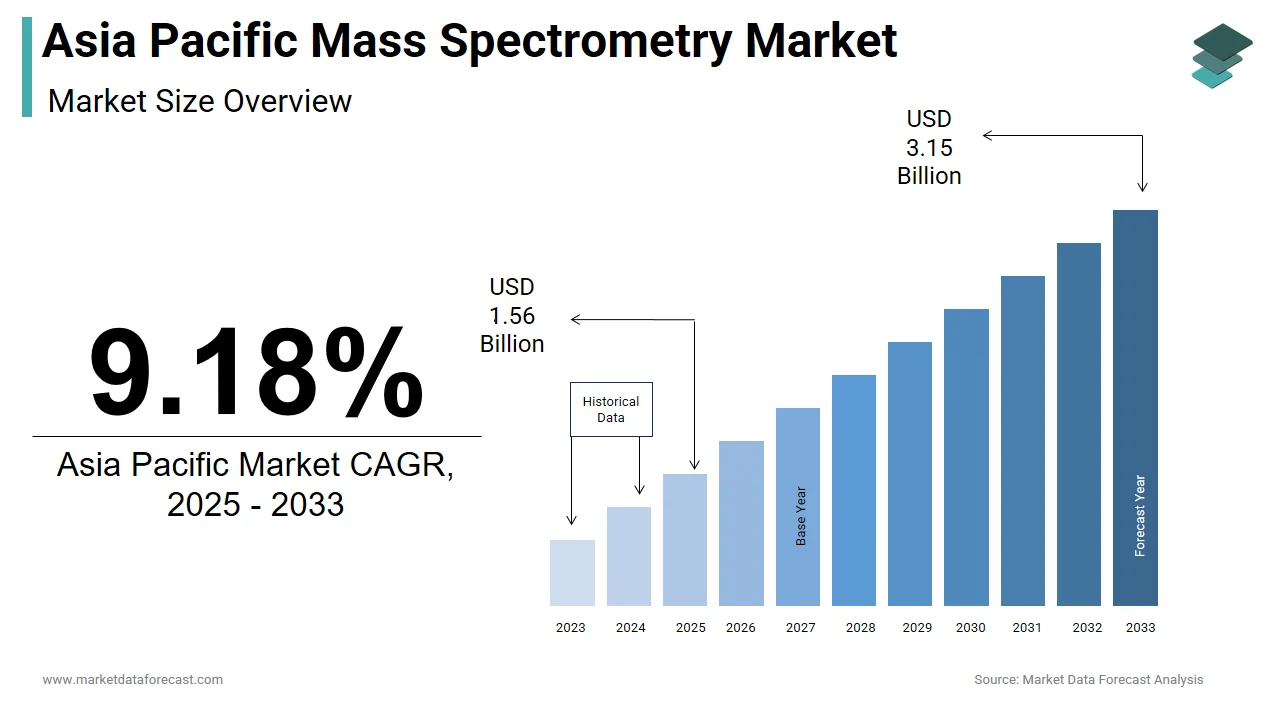
- Market Valuation: Valued at USD 1.56 billion in 2025, reaching USD 1.70 billion in 2026, and projected to expand to USD 3.44 billion by 2034, growing at a robust CAGR of 9.18% during the forecast period (2026–2034).
- Primary Growth Drivers: Increasing technological adoption and government initiatives, growing R&D investments in drug discovery, stringent food and environmental quality monitoring, and miniaturization trends in proteomics and metabolomics. Key restraints include high instrument costs and a shortage of skilled personnel.
Key Market Segment Metrics (2026–2034)
| Category | Leading Segment / Focus Area | Key Insights & Trends |
|---|---|---|
| By Technology | Hybrid Mass Spectrometry (Triple Quadrupole, Q-TOF) | Driven by demand for increased speed, improved resolution, high accuracy, and hyphenated techniques. |
| By Application | Pharmaceutical & Biotech Applications | Extensively used across early drug discovery, clinical trials, and food & beverage quality assurance. |
| By Country / Region | China (Prominent market share) & Japan (Leading regional market) | China excels in technology acceptance and R&D expenditure; Japan leads through advanced healthcare infrastructure and clinic analysis; India shows strong growth backed by government funding and food testing demand. |
Major Market Players & Market Structure
Market Structure: Highly competitive and technology-driven landscape comprising global analytical instrument manufacturers providing advanced mass spectrometry solutions for research, clinical, and industrial testing.
Key Companies: Thermo Fisher Scientific, Sciex, Agilent Technologies, Waters Corporation, Shimadzu Corporation, Bruker, PerkinElmer, Jeol, Flir Systems, MKS Instruments, Analytik Jena, Hiden Analytical, Dani Instruments, Rigaku, Leco, Kore Technology, Extrel CMS, Masstech, Ametek Process Instruments, and Advion.
 Download Free Sample Report
Asia Pacific Mass Spectrometry Market Size
The size of the Asia Pacific mass spectrometry market was worth USD 1.56 billion in 2025. The Asia Pacific market is anticipated to grow at a CAGR of 9.18% from 2026 to 2034 and be worth USD 3.44 billion by 2034 from USD 1.70 billion in 2026.
MARKET DRIVERS
Advanced Mass Spectrometry Techniques Propel APAC Market Growth
The APAC mass spectrometry market is being driven by factors such as increasing technological adoption and government initiatives. Growing investments and funding in drug discovery development are also boosting the mass spectrometry market forward. Technology plays a vital role in product development or improvement. Innovations in icon chromatography-mass spectrometry systems provide significant opportunities for the market in emerging countries to implement various applications such as environmental analysis, chemical analysis, and others. Growing demand for tandem and hyphenated techniques and the adoption of advanced mass spectrometry technologies such as increased speed, improved resolution, and high accuracy propel market growth.
However, the rising mass spectrometry usage in proteomics, metabolomics, and pharmaceutical sectors and increasing miniaturization trends are expected to drive growth. Increased investment in research and development in Asian countries is expected to drive market growth. Other trends, such as favorable government regulations on drug protection and growing concern about the quality of food products, fuel the market growth. The government takes initiatives to monitor pollution and environmental testing and rapid growth for mass spectrometry, which is expected to drive market growth. Mass spectrometry is used extensively in the pharmaceutical industry, from the early stages of drug discovery to late-stage development and clinical trials.
MARKET RESTRAINTS
High Costs and Skill Shortage Limit Spectrometry Market Expansion in APAC
Spectrometry instruments are equipped with advanced features and functionalities and are valued at a cost that underdeveloped countries cannot afford. Academic research laboratories require greater use of these spectrometry instruments, but market development is expected to be limited due to stringent government regulatory guidelines. However, one of the challenging factors for market growth is a shortage of qualified people with relevant experience and knowledge required to use spectrometry equipment efficiently. Errors such as misplacing a sample in GC-MS or LC-MS and issues such as fingerprints or bubbles in the solution can affect the consistency of the result.
GEOGRAPHICAL ANALYSIS

Geographically, the Asia Pacific Mass Spectrometry Market is expected to grow significantly. Factors such as increasing acceptance of quality management and analytical processes by the food and beverage and pharmaceutical industries primarily contribute to the APAC market. Japan, China, and India are expected to contribute significantly to this regional market to set new growth heights. Growing pharmaceutical industries, biotechnology firms, and research institutes focusing on drug discovery and development boost the region's largest market share.
Within APAC, the Japanese market is predicted to lead the APAC mass spectrometry market during the forecast period due to the rising research and developing activities and establishment of new competitors in the Asian countries. The market is anticipated to contribute to the regional market with influential growth factors such as growth opportunities in-clinic analysis, growing end-user industries, and advanced healthcare infrastructure.
In 2025, China had the most prominent mass spectrometry market share, and it is projected to rise even further in the coming years. The region has seen advanced technology acceptance, the presence, availability of regional brands, and increased R&D expenditure, both of which are expected to fuel market growth. However, the market is strong exhibit growth in the APAC region owing to the rapid evolution of healthcare and life science research and support from the government.
India is a promising country with a larger market share in mass spectrometry in the APAC regional market growth. Government reimbursement programs, incentives, investments, and government funding contribute to developing the country's mass spectrometry market. Technological advancements in the market, the introduction of new products in the market, and the rising demand for mass spectrometry in food testing processes are more likely to fuel market growth in this region.
KEY MARKET PLAYERS
Noteworthy companies playing a leading role in the APAC mass spectrometry market profiled in this report are Thermo Fisher Scientific, Sciex, Agilent Technologies, Waters Corporation, Shimadzu Corporation, Bruker, PerkinElmer, Jeol, Flir Systems, MKS Instruments, Analytik Jena, Hiden Analytical, Dani Instruments, Rigaku, Leco, Kore Technology, Extrel CMS, Masstech, Ametek Process Instruments, and Advion.
MARKET SEGMENTATION
This Asia Pacific mass spectrometry market research report is segmented and sub-segmented into the following categories.
By Technology
- Hybrid mass Spectrometry
- Triple Quadrupole (Tandem)
- Quadrupole TOF (Q-TOF)
- FTMS (Fourier Transform Mass Spectrometry)
- Single Mass Spectrometry
- Ion Trap
- Quadrupole
- Time-Of-Flight (TOF)
- Other Mass Spectrometry
By Application
- Pharmaceutical Applications
- Biotech Applications
- Petrochemical Applications
- Environmental Testing
- Food & Beverage Testing
- Other Applications
By Country
- India
- China
- Japan
- South Korea
- Australia
- New Zealand
- Thailand
- Malaysia
- Vietnam
- Philippines
- Indonesia
- Singapore
- Rest Of APAC