- Product Description Description
- Table of Contents TOC
- List of Table & Figure LOT
- Get Free Sample PDF Sample PDF
Market Size, 2025
$6.47 BnMarket Estimate, 2026
$6.94 BnMarket Forecast, 2034
$12.13 BnCAGR, 2026–2034
7.23%Executive Summary: Mass Spectrometry Market
- Market Scope: Comprehensive global mass spectrometry market analysis covering technology segments, application verticals, regional leadership frameworks, and clinical/biopharmaceutical adoption metrics.
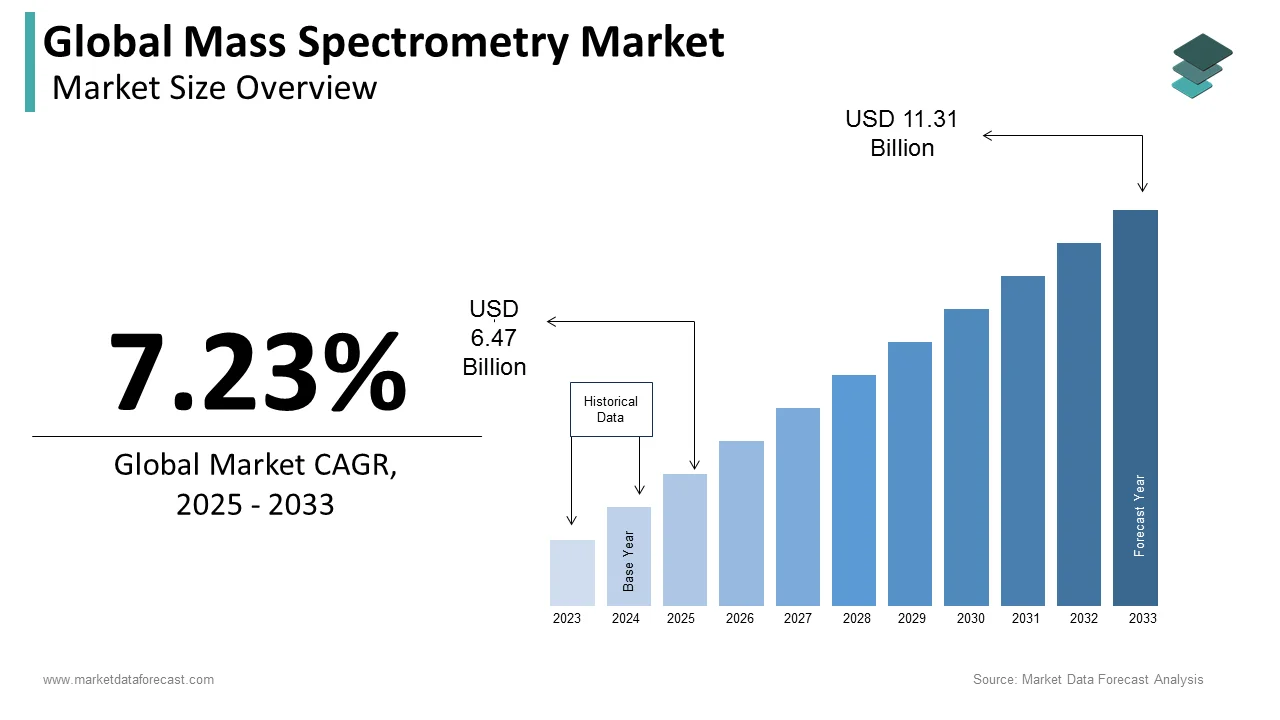
- Market Valuation: Valued at USD 6.47 billion (2025), estimated at USD 6.94 billion (2026), and projected to reach USD 12.13 billion by 2034, registering a robust CAGR of 7.23% (2026–2034).
- Primary Growth Drivers: Extensive adoption in drug discovery, biosimilar comparability studies, and clinical diagnostics. Key industry metrics include over 70% of global drug-discovery pipelines incorporating mass spectrometry, >90% of biosimilar studies relying on high-resolution MS, and more than 4 million U.S. newborns screened annually using tandem MS to detect >50 metabolic disorders.
Key Market Segment Metrics (2026–2034)
| Category | Leading Segment (2025 Position) | Fastest-Growing Segment |
|---|---|---|
| By Technology | Hybrid Mass Spectrometry (led with a 56.4% share in 2025, supported by high resolution and sensitivity) | Single Mass Spectrometry (estimated to grow at a 9.4% CAGR with automated workflows reducing turnaround time by up to 50%) |
| By Application / End Use | Pharmaceuticals (held the major application share in 2025 across discovery, development, and manufacturing) | Clinical Diagnostics & Environmental Testing Applications |
| By Distribution & Supply | Direct OEM Sales & Specialized Analytical Equipment Distribution Networks | Cloud-Integrated Analytical Software & As-a-Service Lab Solutions |
| By Region / Country | North America (dominated with 38.3% of the global market in 2025), followed by Europe (29.2%, where Germany contributes >40% of MS instrument manufacturing) | Asia-Pacific (driven by rapid research expansion, including >1,500 new MS system installations across Chinese institutes in 2023) |
Major Market Players & Market Structure
Market Structure: Highly competitive global analytical instrumentation and life-sciences technology landscape featuring leading multinational equipment manufacturers competing intensely on high-resolution systems, automation, portability, regulatory compliance, AI-enabled data analysis, and application-specific performance.
Key Companies: Thermo Fisher Scientific, Sciex, Agilent Technologies, Waters Corporation, Shimadzu Corporation, Bruker, PerkinElmer, Jeol, Flir Systems, MKS Instruments, Analytik Jena, Hiden Analytical, Dani Instruments, Rigaku, Leco, Kore Technology, Extrel CMS, Masstech, Ametek Process Instruments, and Advion.
Global Mass Spectrometry Market Size
The size of the global mass spectrometry market was worth USD 6.47 billion in 2025. The global market is anticipated to grow at a CAGR of 7.23% from 2026 to 2034 and be worth USD 12.13 billion by 2034 from USD 6.94 billion in 2026.
Mass Spectrometry (MS) is capable of identifying and quantifying molecules based on their mass-to-charge ratio by enabling the precise characterization of complex biological, chemical, and environmental samples. These systems are integral to proteomics, metabolomics, pharmaceutical development, and forensic toxicology, where high-resolution detection is non-negotiable. As of 2023, over 70% of global drug discovery pipelines incorporate mass spectrometry at stages, according to the U.S. Food and Drug Administration (FDA).
MARKET DRIVERS
Rising Demand for Precision in Pharmaceutical Quality Control and Compliance
The escalating demand for precision in pharmaceutical quality control and regulatory compliance is solely fuelling the growth of the mass spectrometry market. The number of new molecular entities approved by the FDA reached 55 in 2023, each requiring extensive mass spectrometry-based characterization for identity, purity, and stability testing, according to the FDA’s Center for Drug Evaluation and Research (CDER). In the biosimilars sector, over 90% of comparability studies rely on high-resolution MS to confirm structural similarity between reference and copy products, as mandated by the European Medicines Agency (EMA). In 2022, Pfizer utilized tandem mass spectrometry in over 12,000 batch release tests for its COVID-19 vaccine, ensuring lipid nanoparticle consistency, as disclosed in its manufacturing transparency report.
Expanding Use of Mass Spectrometry in Clinical Diagnostics
The integration of mass spectrometry into clinical diagnostics in endocrinology, toxicology, and rare disease screening is also accelerating the growth of the mass spectrometry market. In the United States, over 4 million newborns are screened annually using tandem mass spectrometry (MS/MS) to detect more than 50 metabolic disorders, including phenylketonuria and medium-chain acyl-CoA dehydrogenase deficiency, according to the Centers for Disease Control and Prevention (CDC). In adult diagnostics, liquid chromatography-mass spectrometry (LC-MS) has become the gold standard for measuring steroid hormones, with Mayo Clinic reporting that 95% of cortisol and testosterone assays in its reference lab are performed via MS due to superior specificity over immunoassays.
MARKET RESTRAINTS
High Operational Complexity and Shortage of Skilled Expertise
The high operational complexity and requirement for specialized expertise, which limits adoption in resource-constrained settings, is limiting the growth of the mass spectrometry market. According to the World Health Organization (WHO), fewer than 30% of clinical laboratories in low- and middle-income countries possess the technical staff capable of operating high-end MS systems, despite growing disease burdens requiring advanced diagnostics. In sub-Saharan Africa, only 12 countries have functional MS units in national reference labs, as reported by the African Society for Mass Spectrometry (AfSMS). The technology demands rigorous sample preparation, calibration, and data interpretation, often requiring professionals with advanced training in analytical chemistry.
High Acquisition and Maintenance Costs Limiting Mass Spectrometry Adoption
The prohibitive acquisition and maintenance cost of high-resolution mass spectrometry systems, which restricts access for smaller institutions and emerging economies, is also hindering the growth of the mass spectrometry market. For many regional hospitals and universities, this represents an insurmountable capital investment. In India, despite a growing biotech sector, only 180 high-resolution MS systems were operational in 2023 across 1.2 million square kilometers, as documented by the Department of Science and Technology (DST). Even in developed nations, budget constraints force shared facility models, leading to instrument overuse and scheduling bottlenecks. The European Association of Hospital Pharmacists (EAHP) reported that MS instrument downtime due to maintenance backlogs exceeded 15% in 2022, affecting drug purity testing in hospital compounding units.
MARKET OPPORTUNITIES
Miniaturization and Portability Expanding Mass Spectrometry Applications
The miniaturization and portability of mass spectrometry systems by enabling field-deployable applications in environmental monitoring, food safety, and point-of-care diagnostics is creating new opportunities for the growth of the mass spectrometry market. Commercially, handheld MS devices like the REIMS (Rapid Evaporative Ionization Mass Spectrometry) system are being used in operating rooms to distinguish tumor from healthy tissue in real time during cancer surgery, with Imperial College London reporting a 94% accuracy rate in breast cancer resections. In agriculture, portable MS units are detecting pesticide residues on produce within minutes at border checkpoints, reducing inspection time by 70%, according to the International Plant Protection Convention (IPPC).
AI-Driven Data Analysis Enhancing Accuracy and Speed in Mass Spectrometry
The integration of artificial intelligence (AI) with data analysis is accelerating interpretation and reducing human error, which is expected to enhance the growth of the mass spectrometry market in the coming years. Modern MS generates terabytes of complex spectral data, and AI algorithms can now identify molecular signatures 50 times faster than manual methods, according to a 2023 study published in Nature Methods by the Broad Institute. Google’s DeepMass: Spec project demonstrated that neural networks could predict mass spectra for unknown compounds with 88% accuracy, enhancing metabolite identification in drug discovery.
MARKET CHALLENGES
Lack of Standardization and Interoperability in Mass Spectrometry Data
The lack of standardized data formats and interoperability between instrument vendors, which hampers data sharing and reproducibility, is quietly challenging the growth of the mass spectrometry market. According to the Global Alliance for Genomics and Health (GA4GH), over 80% of MS data generated in proteomics studies cannot be directly compared across platforms due to proprietary file formats and vendor-specific software ecosystems. In 2022, a multi-center study coordinated by the European Bioinformatics Institute (EBI) found that only 45% of submitted MS datasets were reusable without significant reprocessing. This fragmentation impedes meta-analyses and collaborative research, particularly in large-scale initiatives like the Cancer Moonshot.
Environmental Impact from High Energy Consumption and Solvent Waste
The environmental footprint associated with the operation of mass spectrometry systems, in terms of energy consumption and solvent use, is also impeding the growth of the mass spectrometry market. Additionally, the reliance on high-purity solvents like acetonitrile and methanol results in significant chemical waste A typical pharmaceutical lab generates over 500 liters of organic solvent waste per MS unit annually, according to the American Chemical Society (ACS). The disposal and recycling of these solvents pose logistical and ecological challenges, especially in regions with weak regulatory enforcement. While green chemistry initiatives promote solvent recycling and ultra-high-performance LC (UHPLC) to reduce volumes, adoption is uneven.
REPORT COVERAGE
| REPORT METRIC | DETAILS |
| Market Size Available | 2025 to 2034 |
| Base Year | 2025 |
| Forecast Period | 2026 to 2034 |
| Segments Covered | By Technology, Application, and Region |
| Various Analyses Covered | Global, Regional & Country Level Analysis; Segment-Level Analysis, Drivers, Restraints, Opportunities, Challenges; PESTLE Analysis; Porter’s Five Forces Analysis, Competitive Landscape; Analyst Overview of Investment Opportunities |
| Regions Covered | North America, Europe, Asia Pacific, Latin America, the Middle East, and Africa |
| Market Leader Profiled | Thermo Fisher Scientific, Sciex, Agilent Technologies, Waters Corporation, Shimadzu Corporation |
SEGMENTAL ANALYSIS
By Technology Insights
The hybrid segment was the largest and held 56.4% of the mass spectrometry market share in 2025, with its superior analytical capabilities, combining two or more mass analyzers such as quadrupole-time-of-flight (Q-TOF) or triple quadrupole-ion trap systems to achieve high resolution, sensitivity, and structural elucidation in complex matrices. The European Medicines Agency (EMA) mandates the use of hybrid MS for confirmatory testing in residue analysis of veterinary drugs in food, reinforcing its regulatory indispensability. Additionally, hybrid systems support advanced applications like native MS for intact protein analysis and imaging MS for spatial metabolomics by making them the preferred choice in cutting-edge research and quality control environments.
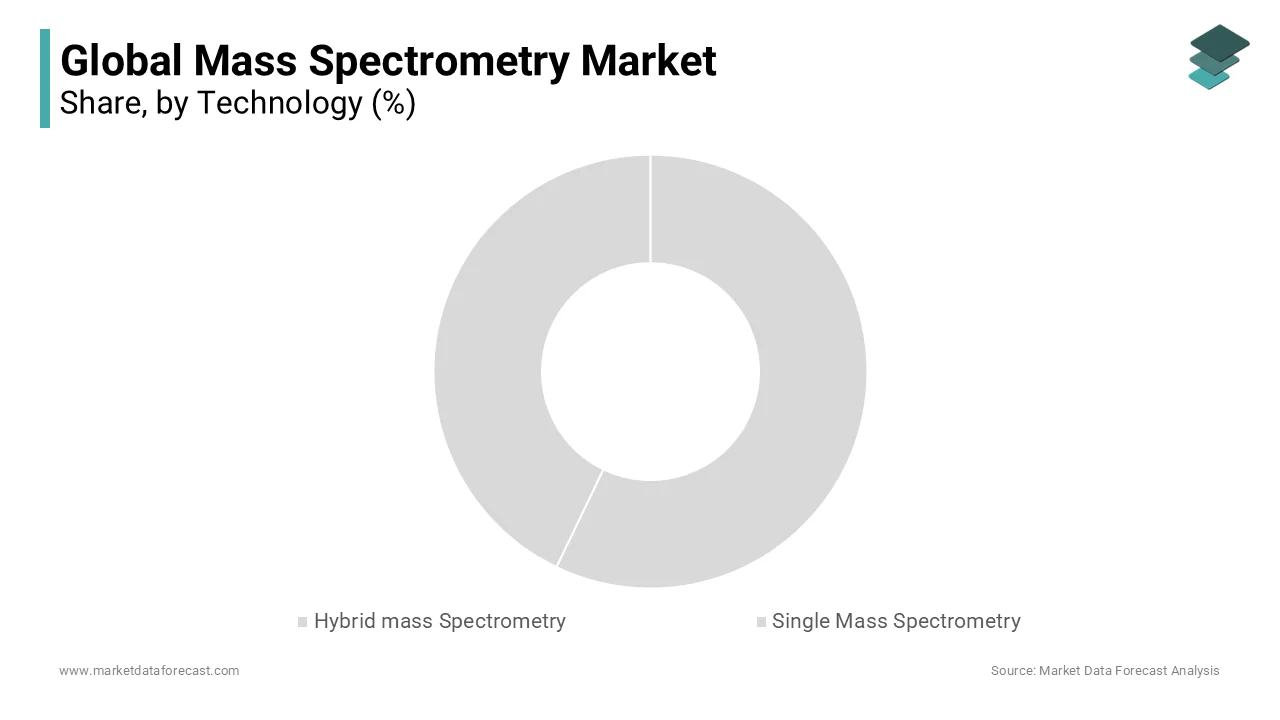
The single segment is estimated to grow at a CAGR of 9.4% during the forecast period, with the increasing deployment of compact, cost-effective single-analyzer systems such as single quadrupole and single ion trap instruments in routine testing environments where high throughput and operational simplicity are prioritized. The technology’s compatibility with automated workflows has enabled integration into high-volume laboratories, reducing turnaround time by up to 50%. In emerging economies, single MS units are being adopted in food safety testing; India’s Food Safety and Standards Authority (FSSAI) deployed over 200 single quadrupole systems in regional labs in 2023 to detect pesticide residues, as per its annual infrastructure report.
By Application Insights
The pharmaceuticals segment held the major share of the global mass spectrometry market in 2025 and is expected to continue dominating the market throughout the forecast period. The growth of the segment is primarily driven by the increasing usage of mass spectrometry in drug discovery, development, and manufacturing. The growing prevalence of chronic diseases is fuelling the need for new and effective drugs. Mass spectrometry plays a vital role in the development of these drugs as it is used to identify potential drug candidates and their modalities. In addition, rising emphasis on personalized medicine and increasing requirements from regulatory bodies such as the FDA and EMA for the approval of drugs further fuel the segment’s growth rate.
The biotech segment is predicted to occupy a substantial share of the global mass spectrometry market during the forecast period. The rising usage of mass spectrometry in genomics, proteomics, and other life science technologies and increasing demand for new biologic drugs primarily boost the segmental growth. Furthermore, the increasing adoption of personalized medicine fuels the growth rate of the segment.
REGIONAL ANALYSIS
North America Mass Spectrometry Market Analysis
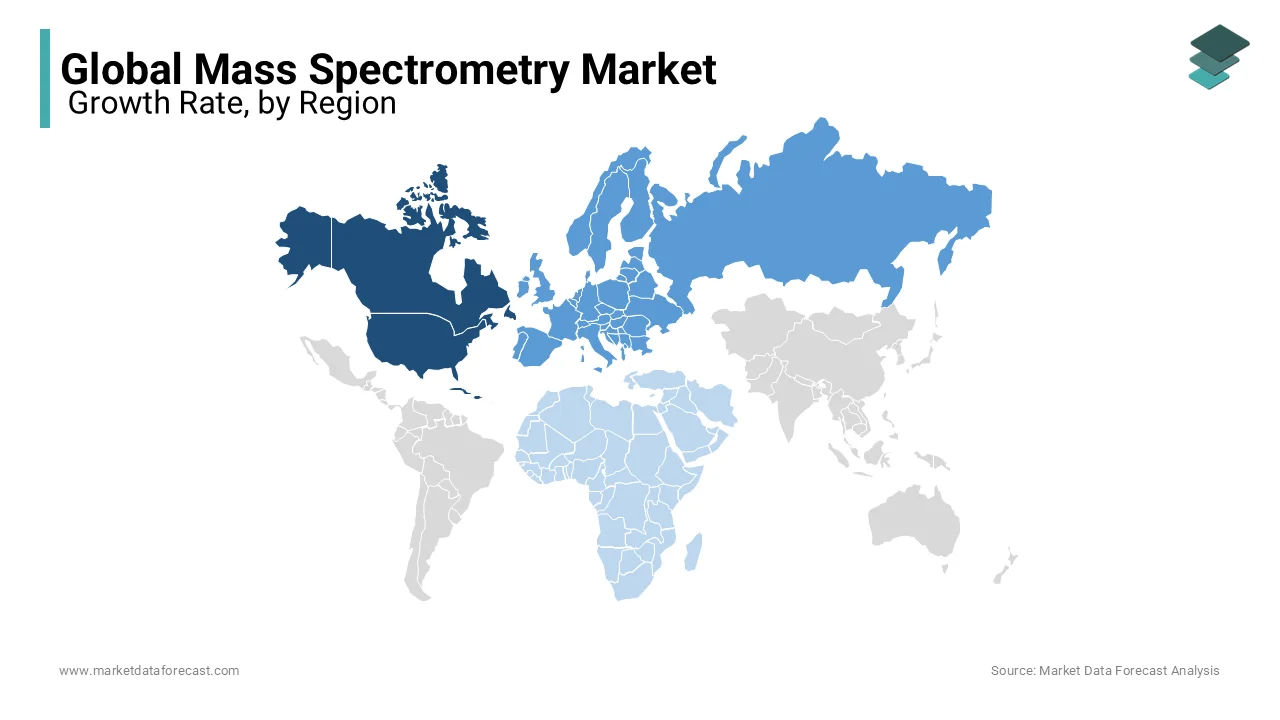
North America was the largest contributor to the global mass spectrometry market with 38.3% of share in 2025. The United States mass spectrometry market growth is driven by the region’s scientific and technological epicenter, which hosts the highest concentration of research institutions, pharmaceutical companies, and regulatory agencies relying on MS for drug development and compliance. The FDA mandates mass spectrometry for impurity profiling in over 90% of new drug applications, reinforcing its role in regulatory submissions. Academic powerhouses like Harvard, Stanford, and MIT operate advanced MS facilities supporting proteomic and environmental research.
Europe Mass Spectrometry Market Analysis
Europe mass spectrometry market held 29.2% of the share in 2025, with a well-established network of academic research centers, clinical diagnostics labs, and stringent regulatory frameworks. Germany stands out as a technological leader, contributing over 40% of Europe’s MS instrument manufacturing, with companies like Bruker and Shimadzu’s European divisions headquartered in Bremen and Duisburg, respectively. In the UK, the National Health Service (NHS) has integrated tandem MS into national newborn screening programs, testing over 700,000 infants annually for 25+ metabolic disorders, as reported by Public Health England. France and the Netherlands are advancing MS in environmental monitoring, with the French Agency for Food, Environmental and Occupational Health & Safety (ANSES) using MS to detect microplastics in drinking water.
Asia Pacific Mass Spectrometry Market Analysis
Asia Pacific mass spectrometry market growth is fueled by rising investment in healthcare infrastructure and biopharmaceutical innovation. China leads the regional surge, with the Ministry of Science and Technology reporting that over 1,500 new MS systems were installed in 2023 across research institutes and pharmaceutical firms. The country’s National Medical Products Administration (NMPA) now requires MS-based analysis for biosimilar comparability studies, aligning with international regulatory standards.
Latin America Mass Spectrometry Market Analysis
Latin America mass spectrometry market growth is likely to grow at a steady pace during the forecast period. The Oswaldo Cruz Foundation (Fiocruz) is a leading public health institution, operates one of the largest MS facilities in Latin America, conducting drug purity testing and infectious disease research. In 2023, Fiocruz used MS to analyze over 10,000 samples for antimicrobial resistance markers, contributing to Brazil’s national surveillance program, as reported by the Pan American Health Organization (PAHO).
Middle East and Africa Mass Spectrometry Market Analysis
The Middle East and Africa mass spectrometry market growth is likely to grow with the strategic investment in analytical infrastructure. Saudi Arabia leads the region with its Vision 2030 initiative, which includes a $1.3 billion investment in research and development in pharmaceuticals and environmental science. King Abdullah University of Science and Technology (KAUST) has established a state-of-the-art MS core facility supporting projects in desalination chemistry and cancer proteomics. South Africa hosts the most advanced MS infrastructure on the continent, with the Council for Scientific and Industrial Research (CSIR) operating high-resolution systems for mining and environmental analysis.
COMPETITIVE LANDSCAPE
The mass spectrometry market features a concentrated yet highly competitive environment, dominated by a select group of multinational corporations with deep expertise in analytical instrumentation. Competition is defined not by price alone but by technological superiority, regulatory compliance, application-specific performance, and after-sales support. While Thermo Fisher, Waters, and Shimadzu lead in innovation and global reach, regional players and academic spin-offs are emerging with niche capabilities in portable MS and data analysis software. The barrier to entry remains high due to the complexity of instrument design, stringent quality standards, and the need for extensive validation. However, demand for decentralized testing and sustainable operations is driving innovation in miniaturization and green chemistry integration.
KEY MARKET PARTICIPANTS
Some of the companies that are playing a dominating role in the global mass spectroscopy market include
- Thermo Fisher Scientific
- Sciex
- Agilent Technologies
- Waters Corporation
- Shimadzu Corporation
- Bruker
- PerkinElmer
- Jeol
- Flir Systems
- MKS Instruments
- Analytik Jena
- Hiden Analytical
- Dani Instruments
- Rigaku
- Leco
- Kore Technology
- Extrel CMS
- Masstech
- Ametek Process Instruments
- Advion
TOP LEADING PLAYERS IN THE MARKET
- Thermo Fisher Scientific plays a pivotal role in the mass spectrometry market through its industry-leading Orbitrap technology, which delivers ultra-high resolution and mass accuracy for proteomics, metabolomics, and pharmaceutical analysis. In the Asia Pacific region, the company has strengthened its footprint by establishing regional application support centers in Shanghai, Tokyo, and Singapore, enabling local researchers to optimize workflows for drug discovery and clinical diagnostics. In 2023, Thermo Fisher launched the Orbitrap Astral platform, designed for next-generation proteomics, and deployed it in collaboration with the Institute of Medical Science at the University of Tokyo for cancer biomarker research. The company also partnered with India’s National Centre for Cell Science (NCCS) to train over 500 scientists in advanced MS techniques. Additionally, Thermo Fisher expanded its service network in South Korea to reduce instrument downtime by offering on-site calibration and preventive maintenance.
- Shimadzu Corporation, headquartered in Japan, is a cornerstone of the mass spectrometry landscape in the Asia Pacific, leveraging its regional presence to deliver tailored solutions for pharmaceutical, environmental, and food safety applications. The company’s LCMS-9030 and GCMS-TQ8050 systems are widely adopted across Southeast Asia for pesticide residue and contaminant analysis, meeting stringent regulatory requirements in countries like Thailand and Vietnam. In 2023, Shimadzu collaborated with the Philippine Department of Health to deploy tandem MS units in regional laboratories for newborn screening, enhancing early detection of metabolic disorders. The company also established a joint research initiative with Taiwan’s National Health Research Institutes to develop MS-based methods for traditional medicine standardization. In Australia, Shimadzu equipped CSIRO’s environmental labs with high-sensitivity MS systems to monitor microplastic pollution in marine ecosystems.
- Waters Corporation has significantly influenced the mass spectrometry market in the Asia Pacific by integrating its MS technologies with chromatography systems to enhance analytical precision in pharmaceutical and clinical research. The company’s Xevo and SYNAPT platforms are widely used in drug development workflows across India, China, and South Korea, where regulatory alignment with U.S. and EU standards is crucial. In 2023, Waters launched the SELECT SERIES Cyclic IMS in collaboration with Peking Union Medical College Hospital to advance structural biology research using ion mobility-enhanced MS. The company also initiated a training program in Malaysia, partnering with the Ministry of Health to standardize MS-based therapeutic drug monitoring in public hospitals. In Japan, Waters supported regulatory submissions for biosimilars by providing validated MS workflows compliant with PMDA requirements. Additionally, the company expanded its digital support infrastructure, introducing cloud-based data analysis tools for remote access in rural research centers.
TOP STRATEGIES USED BY THE KEY MARKET PARTICIPANTS
Key players in the mass spectrometry market are employing strategies centered on technological innovation, regional localization, regulatory alignment, and ecosystem development to promote their positions. Companies are investing in next-generation platforms that combine high resolution, speed, and ease of use, such as cyclic ion mobility and AI-integrated data analysis. Expansion into high-growth regions is being accelerated through localized service networks, application support centers, and partnerships with government and academic institutions. Regulatory compliance is a core focus, with vendors pre-validating instruments for pharmacopeial standards in the U.S., EU, and Asia. Open-access software platforms and cloud-based data management tools are being introduced to enhance user experience and interoperability. Additionally, firms are strengthening their training programs to address the global shortage of MS expertise, particularly in emerging markets. Collaborations with diagnostic labs, biopharma companies, and environmental agencies enable real-world validation and market-specific customization by ensuring sustained relevance in a highly specialized and evolving analytical landscape.
GLOBAL MASS SPECTROMETRY MARKET NEWS
- In January 2023, Thermo Fisher Scientific launched the Orbitrap Astral mass spectrometer at the ASMS Conference in Singapore, introducing a new platform for high-speed, high-sensitivity proteomics tailored for pharmaceutical and academic research in Asia.
- In June 2023, Shimadzu Corporation deployed tandem mass spectrometry systems in 15 regional laboratories across the Philippines in collaboration with the Department of Health to enhance newborn screening for metabolic disorders.
- In September 2023, Waters Corporation initiated a training partnership with Malaysia’s Ministry of Health to standardize therapeutic drug monitoring using its Xevo TQ-S MS systems in public hospitals nationwide.
- In February 2024, Thermo Fisher Scientific expanded its service and application support center in Shanghai, increasing technical staffing by 40% to meet rising demand from Chinese biopharmaceutical companies.
- In November 2023, Shimadzu launched the GCMS-TQ8050 triple quadrupole system in Thailand, specifically designed for pesticide residue analysis in agricultural exports to meet EU regulatory requirements.
MARKET SEGMENTATION
This market research report on the global mass spectrometry market has been segmented based on technology, application, and region.
By Technology
-
Hybrid mass Spectrometry
-
Triple Quadrupole (Tandem)
- Quadrupole TOF (Q-TOF)
- FTMS (Fourier Transform Mass Spectrometry)
-
- Single Mass Spectrometry
- Ion Trap
- Quadrupole
- Time-Of-Flight (TOF)
- Other Mass Spectrometry
By Application
- Pharmaceutical Applications
- Biotech Applications
- Petrochemical Applications
- Environmental Testing
- Food & Beverage Testing
- Other Applications
By Region
- North America
- Europe
- Asia Pacific
- Latin America
- Middle East and Africa