- Product Description Description
- Table of Contents TOC
- List of Table & Figure LOT
- Get Free Sample PDF Sample PDF
Market Size, 2025
$481.48 MnMarket Estimate, 2026
$525.68 MnMarket Forecast, 2034
$1,061 MnCAGR, 2026–2034
9.18%Executive Summary: Asia-Pacific Nurse Call Systems Market
- Market Scope: Comprehensive Asia-Pacific nurse call systems market analysis covering system types, communication technologies, application use cases, end-user settings, and country-level adoption dynamics.
- Market Valuation: Valued at USD 481.48 million (2025), estimated at USD 525.68 million (2026), and projected to reach USD 1,061.00 million by 2034, registering a robust CAGR of 9.18% (2026–2034).
- Primary Growth Drivers: Rising demand for advanced patient monitoring and communication systems, tightening patient-to-nurse ratios, growing healthcare infrastructure investments, and a rapidly aging demographic profile across Asian nations. Key restraints include high implementation costs and strict regulatory hurdles in developing economies.
Key Market Segment Metrics (2026–2034)
| Category | Leading Segment (2025 Position) | Fastest-Growing Segment |
|---|---|---|
| By Type | Integrated Communication Systems (preferred for unifying clinical alarms, alerts, and enterprise-wide workflows) | Mobile Systems (driven by expanding caregiver mobility and smartphone-based clinical communication) |
| By Technology | Wired Communication (dominant in traditional hospital infrastructures for maximum reliability and zero-interference uptime) | Wireless Communication (expanding rapidly due to flexible retrofitting and lower installation complexity) |
| By Application | Alarms & Communications (anchored as the core operational requirement for patient-to-nurse signaling) | Fall Detection & Prevention / Workflow Optimization (fueled by automated bed-exit monitoring and safety mandates) |
| By End User | Hospitals (held the highest market share due to high patient admission volumes and critical care demands) | Long-Term Care Facilities & Clinics (surging due to regional aging populations and extended care requirements) |
| By Country | China (led regional revenue share backed by massive hospital networks and health infrastructure modernization) | India (projected as a high-growth market driven by hospital accreditation standards and domestic manufacturing) |
Major Market Players & Market Structure
Market Structure: Highly competitive medical technology ecosystem featuring prominent global players and localized manufacturers competing on workflow software integration, reliability, multi-device compatibility, and regional compliance.
Key Companies: Ascom Holding AG, Honeywell International Inc., Siemens, Austco Healthcare, STANLEY Healthcare, Critical Alert Systems, and Rauland.
 Download Free Sample Report
Asia Pacific Nurse Call Systems Market Size
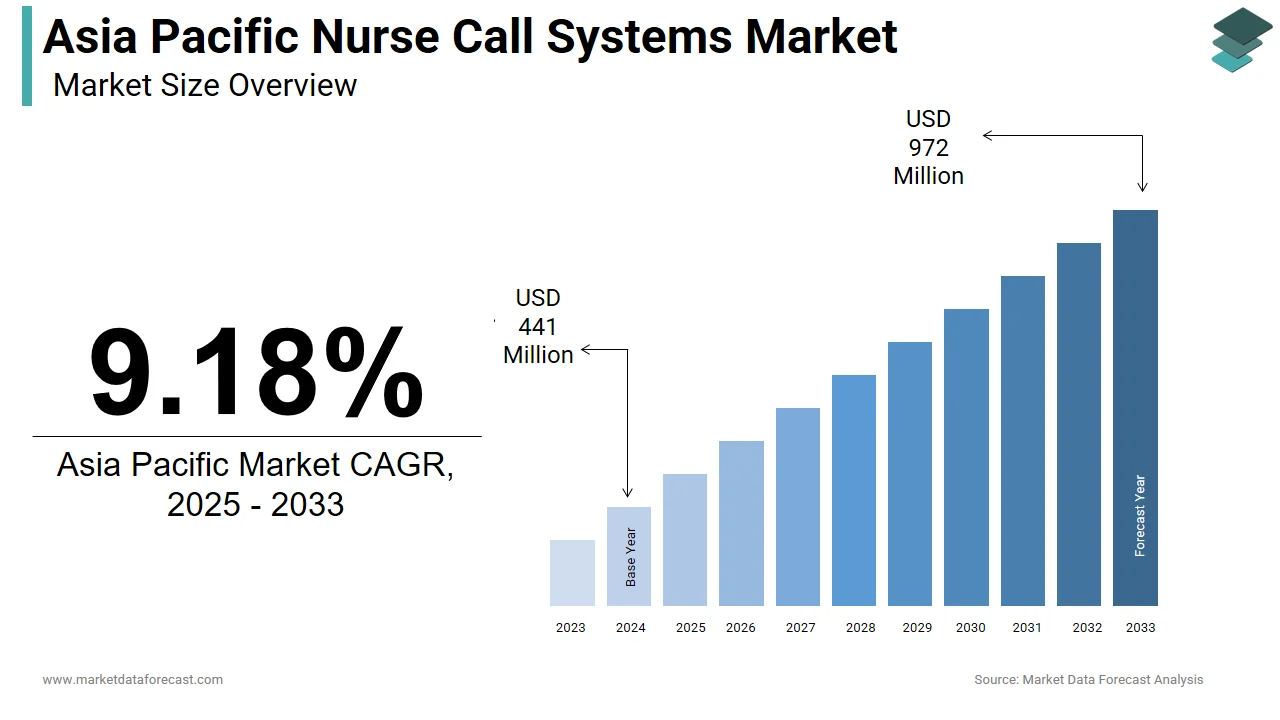
The Asia-Pacific nurse call systems market was valued at USD 481.48 million in 2025. The market is estimated at USD 525.68 million in 2026 and is projected to reach USD 1,061 million by 2034, growing at a CAGR of 9.18% from 2026 to 2034.
MARKET DRIVERS
Rising Demand for Patient Monitoring and Communication Systems in Asia Pacific
The Asia Pacific Nurse Call systems market is expected to grow significantly growing due to various communication and patient monitoring purposes. In the Asia Pacific region's current market scenario, a growing awareness of patient monitoring nurse call devices increases market growth. The demand for these devices has been increased more in emerging countries such as India and China. Diverse applications of nurse call systems and the adoption of technologies in nurse call systems are accelerating the market growth. The nurse call systems enable customized communication between patients and nurses, clinicians and caregivers for better patient satisfaction. The nurse call systems have become an integral part of the hospital's communication systems due to their beneficial factors. Also, rising work pressure and the diminishing number of patients to nurse ratio is lead to the acceleration in demand for the nurse call systems in the healthcare market.
However, the growing need for workforce optimization in hospitals and critical care centers could lead to market growth. On the other hand, the rising government healthcare infrastructure, the proliferation of chronic diseases, and the acceleration of the aging population in Asian countries are most likely to create market growth. Improving the safety and efficacy of the patients is further increases the market growth. The market players are provided multiple growth opportunities to the Asia Pacific region's market players, projected to boost the nurse call systems' revenue.
MARKET RESTRAINTS
High Implementation Costs and Strict Regulations Limit Adoption in Developing Nations
The effectiveness of the nurse call systems is primarily dependent on the hardware, software, and staff training levels in a healthcare facility. Also, these systems involve high costs for implementation, which is a high burden to underdeveloped countries. Furthermore, stringent government regulations of Asian countries on the nurse call systems impede the market growth.
REPORT COVERAGE
| REPORT METRIC | DETAILS |
| Market Size Available | 2025 to 2034 |
| Base Year | 2025 |
| Forecast Period | 2026 to 2034 |
| Segments Covered | By Type, Technology, Application, End User, and Region. |
| Various Analyses Covered | Global, Regional and Country-Level Analysis, Segment-Level Analysis, Drivers, Restraints, Opportunities, Challenges; PESTLE Analysis; Porter’s Five Forces Analysis, Competitive Landscape, Analyst Overview of Investment Opportunities |
| Countries Covered | India, China, Japan, South Korea, Australia, New Zealand, Thailand, Malaysia, Vietnam, Philippines, Indonesia, Singapore, Rest of APAC |
| Market Leaders Profiled | Ascom Holding AG, Honeywell International Inc., Siemens, Austco Healthcare, STANLEY Healthcare, Critical Alert Systems, and Rauland |
COUNTRY LEVEL ANALYSIS
Geographically, the Asia Pacific nurse call systems market is expected to account for a significant market share in the global market during the forecast period. Growing awareness in the Asian countries and demand for nurse call systems create market growth in this region.
In regional market growth, China dominated the nurse call systems market with the most considerable revenue share. The Chinese market is anticipated to grow further due to the improving healthcare infrastructure, and China witnessed significant manufacturers in this region.
The Indian market is one of the fastest-growing regions in the Asia Pacific region in nurse call systems. India is most likely to grow at a healthy rate due to the growing importance of accreditation from healthcare regulatory authorities in hospitals. Domestic manufacturers in India aim for supremacy in the parent country to fascinate domestic consumers, boosting market revenue.
The Japanese market forecasted to account for a substantial market share of nurse call systems during the forecast period. The market growth depends on the rising chronic diseases and growing healthcare expenditure in this region.
KEY MARKET PLAYERS
Ascom Holding AG, Honeywell International Inc., Siemens, Austco Healthcare, STANLEY Healthcare, Critical Alert Systems, and Rauland are some of the noteworthy companies operating in the Asia Pacific nurse call systems market.
MARKET SEGMENTATION
This research report on the Asia Pacific nurse call systems market has been segmented and sub-segmented into the following categories.
By Type
- Button-Based Systems
- Integrated Communication Systems
- Mobile Systems
- Intercom Systems
By Technology
- Wired communication
- Wireless communication
By Application
- Alarms & Communications
- Workflow Optimization
- Wanderer Control
- Fall Detection & Prevention
By End User
- Hospitals
- Long-term Care Facilities
- Clinics & Physician Offices
By Country
- India
- China
- Japan
- South Korea
- Australia
- New Zealand
- Thailand
- Malaysia
- Vietnam
- Philippines
- Indonesia
- Singapore
- Rest of Asia Pacific