- Product Description Description
- Table of Contents TOC
- List of Table & Figure LOT
- Get Free Sample PDF Sample PDF
Market Size, 2025
$13.67 BnMarket Estimate, 2026
$14.19 BnMarket Forecast, 2034
$19.19 BnCAGR, 2026–2034
3.84%Executive Summary: Asia Pacific Oral Care Market
- Market Scope: Comprehensive market analysis of the Asia Pacific (APAC) oral care ecosystem, evaluating product categories, consumer applications, distribution channels, and country-level growth dynamics.
- Market Valuation: Valued at USD 13.67 billion (2025), estimated at USD 14.19 billion (2026), and projected to reach USD 19.19 billion by 2034, registering a steady CAGR of 3.84% (2026–2034).
- Primary Growth Drivers: Rising incidence of dental disorders and cavities, poor oral habits (sugary foods, tobacco usage), growing geriatric population susceptible to tooth loss, and innovative product launches such as electric toothbrushes and herbal formulations.
Key Market Segment Metrics (2026–2034)
| Category | Leading Segment (2025 Position) | Fastest-Growing Segment (2026–2034) |
|---|---|---|
| By Product Type | Toothpaste & Manual Toothbrushes (dominate daily consumer adoption and routine oral hygiene maintenance across households) | Electric Toothbrushes & Mouthwashes (growing rapidly due to rising disposable incomes, premiumization, and enhanced cleaning efficacy) |
| By Application / End-User | Adults (capture the largest market share backed by high commercial product utilization) | Geriatric Population (experiencing high expansion driven by rising age-related dental issues, gum pain, and tooth loss) |
| By Distribution Channel | Supermarkets / Hypermarkets & Pharmacies (account for the primary volume of retail sales through physical accessibility) | Online Retail / E-Commerce Platforms (surging via digital penetration, direct-to-consumer marketing, and pharmacy delivery sites) |
| By Country / Region | China (led the APAC oral care market through massive manufacturing capabilities, eco-friendly product innovations, and strategic M&As) | India and Japan (growing considerably through digital retail accessibility, clinical trial centers, and virtual dental care facilities) |
Major Market Players & Market Structure
Market Structure: A highly competitive consumer goods marketplace dominated by multinational FMCG conglomerates focusing on brand loyalty, sustainable packaging, and advanced oral hygiene portfolios.
Key Companies: Procter & Gamble (P&G), Unilever, Colgate-Palmolive Company, Church & Dwight Co., Inc., GlaxoSmithKline PLC (GSK), Sunstar Suisse SA, Henkel AG & Co. KGaA, and Hawley & Hazel (BVI) Co. Ltd.
 Download Free Sample Report
Asia Pacific Oral Care Market Size
The size of the Asia Pacific oral care market was worth USD 13.67 billion in 2025. The Asia Pacific market is anticipated to grow at a CAGR of 3.84% from 2026 to 2034 and be worth USD 19.19 billion by 2034 from USD 14.19 billion in 2026.
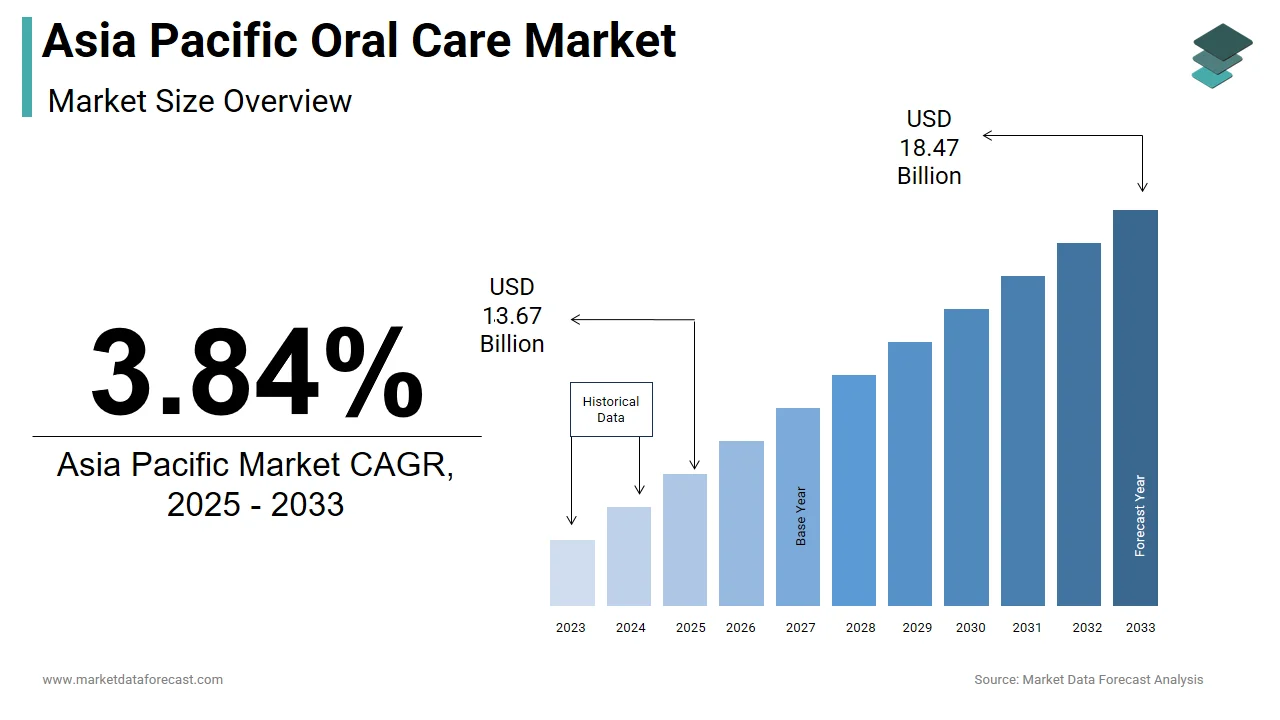
Oral care, also known as oral hygiene or mouth care, is the practice of keeping the mouth, teeth, gums, and entire oral cavity clean and healthy to prevent disease, pain, and infection. It involves looking after not just the teeth, but also the tongue, lips, and supporting tissues to maintain normal function like eating, speaking, and smiling. As per sources, households across the region are shifting permanently from occasional treatments to regular preventive care, accelerating the deployment of smart technologies in electric oral appliances. According to the World Health Organization, the South-East Asia and Western Pacific regions combined carry the world's heaviest dental caries load with over 990 million untreated cases in permanent teeth. This escalating morbidity profile has accelerated public health initiatives and elevated consumer consciousness regarding personal hygiene. Consequently, regional households are transitioning from basic commodity pastes toward advanced multi-benefit formulations and premium prophylactic equipment.
MARKET DRIVERS
Rising Disposable Incomes and Urbanization
Rapid economic expansion and urban migration are occurring across emerging economies, which accelerates the growth of the Asia Pacific oral care market. These changes are shifting consumer spending priorities toward premium lifestyle and personal wellness goods. As per the National Bureau of Statistics of China, rural residents' disposable income experienced a real increase of 6.3% after adjusting for price factors, stimulating widespread consumption adjustments across non-urban regions. This income growth directly influences household purchasing behavior, facilitating a transition from traditional low-cost hygiene goods to advanced discretionary items such as electric toothbrushes, customized orthodontic aligners, and professional whitening treatments. The resulting expansion in discretionary spending power creates substantial revenue opportunities for manufacturers targeting middle-class demographics in tier-2 and tier-3 urban centers throughout nations like India, Indonesia, and Vietnam.
Proliferation of Preventive Dental Care Initiatives
Government-led public health interventions and institutional school programs are actively changing consumer habits, which further contributes to the expansion of the Asia Pacific oral care market. They are driving demand away from reactive treatments and toward regular preventive maintenance. According to the Ministry of Health and Family Welfare, the Indian government leverages public-private partnerships under the National Oral Health Programme to integrate portable radiography services and community campaigns into primary health infrastructure. This institutional focus is reinforced by infrastructure growth, as per the Ministry of Health, Labour and Welfare, which noted that patient visits for oral health management are rising as the system transitions toward prevention-oriented care nationwide. These clinical expansions encourage adult populations to seek regular professional cleanings. They also encourage them to purchase specialized consumer items like remineralizing toothpastes and interdental brushes to manage enamel erosion and gingival inflammation proactively.
MARKET RESTRAINTS
High Penetration of Counterfeit and Substandard Products
The widespread availability of unauthorized and counterfeit oral care items undermines consumer trust, which hampers the growth of the Asia Pacific market. It also disrupts legitimate market expansion channels. As per the World Health Organization, health ministries across the region are deploying a unified Regional Action Plan to integrate essential oral healthcare directly into primary health services. The proliferation of cheap, unregulated imitation toothpastes and manual toothbrushes poses serious safety risks due to uncontrolled abrasive formulas and toxic chemical compositions. When consumers inadvertently purchase these substandard substitutes, they experience adverse health effects or poor cleaning efficacy. As a result, overall brand skepticism increases, which dampens the adoption velocity of certified premium oral wellness products.
Inadequate Public Dental Reimbursement Frameworks
Limited government insurance coverage for routine dental procedures restricts consumer investment, which hinders the expansion of the Asia Pacific oral care market. This restriction prevents people from spending money on comprehensive, long-term oral disease prevention. According to the World Health Organization, out-of-pocket expenditure accounts for over 48% of total healthcare costs in several developing Asia Pacific sub-regions, with essential dental care largely excluded from universal health coverage benefit packages. Because preventive treatments and advanced periodontal therapies remain an out-of-pocket financial burden for lower-income households, patients typically delay seeing a professional until symptoms become severe. This systemic affordability barrier constrains the addressable market size for high-end therapeutic mouthwashes, specialized restorative gels, and professional clinical interventions.
MARKET OPPORTUNITIES
Surge in Direct-To-Consumer Digital Retail Channels
E-commerce platforms and specialized online retail ecosystems are expanding rapidly, which paves the way for the growth of https://www.marketdataforecast.com/market-reports/global-mouthwash-marketthe Asia Pacific oral care market. This expansion is revolutionizing product discovery and purchase accessibility for regional buyers. As per sources, digital commerce platforms are expanding consumer access to dental diagnostics across the region, prompting national health programs to scale virtual counseling infrastructure for remote villages. Digital marketplaces allow emerging niche brands to bypass traditional brick-and-mortar retail bottlenecks, reaching remote consumers in secondary and tertiary cities directly. This digital transformation enables targeted marketing, consumer data analytics, and subscription-based delivery models for specialized oral care regimens, unlocking new revenue streams across previously underserved demographic segments.
Ascendancy of Clean Label and Sustainable Formulations
Shifting consumer preferences toward eco-friendly products and natural ingredients are driving extensive portfolio innovation, which propels the expansion of the Asia Pacific oral care market. This push is forcing major industry manufacturers to change. Additionally, as per research, member states are enacting unified regulatory frameworks under the Global Traditional Medicine Strategy to standardize botanical ingredients used in indigenous oral care practices. Environmentally conscious buyers increasingly demand biodegradable packaging, responsibly sourced herbal ingredients, and cruelty-free certifications. Brands can capture high-value market segments by using sustainable manufacturing practices and transparent, clean-label formulas. This eco-friendly strategy allows businesses to secure long-term loyalty from environmentally aware Millennial and Gen Z shoppers.
MARKET CHALLENGES
Intense Price Competition from Unorganized Local Players
The heavy market presence of low-cost and unorganized domestic manufacturers creates severe margin pressures, which is a major challenge to the Asia Pacific oral care market. These pressures heavily impact established multinational corporations. As per sources, fragmented local enterprises account for a significant portion of volume sales in developing regional economies by offering deeply discounted basic paste formulations. These unorganized operators maintain minimal overhead costs and bypass stringent regulatory compliance standards, allowing them to underprice multinational brands. Consequently, premium manufacturers face compressed profit margins and must invest heavily in marketing campaigns to convince price-sensitive consumer bases of the long-term clinical value associated with scientifically validated formulations.
Complex Regulatory Compliance and Halal Certification Requirements
Navigating diverse regulatory frameworks and stringent cross-border export standards creates major operational hurdles, which constrain the expansion of the Asia Pacific oral care market. These challenges heavily impact international market entrants. According to the World Health Organization Action Plan for Oral Health in South-East Asia 2022–2030, member states are actively expanding the training of mid-level oral health professionals and community health workers to deliver fundamental preventative services in rural sectors. Companies must secure specialized regional certifications, such as mandatory Halal compliance for products sold in Muslim-majority nations like Indonesia and Malaysia, while simultaneously meeting varying safety standards set by individual national health ministries. These complex administrative procedures frequently delay product launches, increase compliance expenditures, and restrict the agility of foreign brands attempting to scale operations rapidly across multiple jurisdictions.
REPORT COVERAGE
| REPORT METRIC | DETAILS |
| Market Size Available | 2025 to 2034 |
| Base Year | 2025 |
| Forecast Period | 2026 to 2034 |
| Segments Covered | By Product Type, Application, Distribution Channel, and Country |
| Various Analyses Covered | Global, Regional, and Country-Level Analysis, Segment-Level Analysis, Drivers, Restraints, Opportunities, Challenges; PESTLE Analysis; Porter’s Five Forces Analysis, Competitive Landscape, Analyst Overview of Investment Opportunities |
| Countries Covered |
|
| Market Leaders Profiled | Procter & Gamble, Unilever, Colgate-Palmolive Company, Church & Dwight Co., Inc., GlaxoSmithKline PLC, Sunstar Suisse SA, Haleon, Henkel AG & Co. KGaA, and Hawley & Hazel (BVI) Co. Ltd |
SEGMENT ANALYSIS
By Product Type Insights
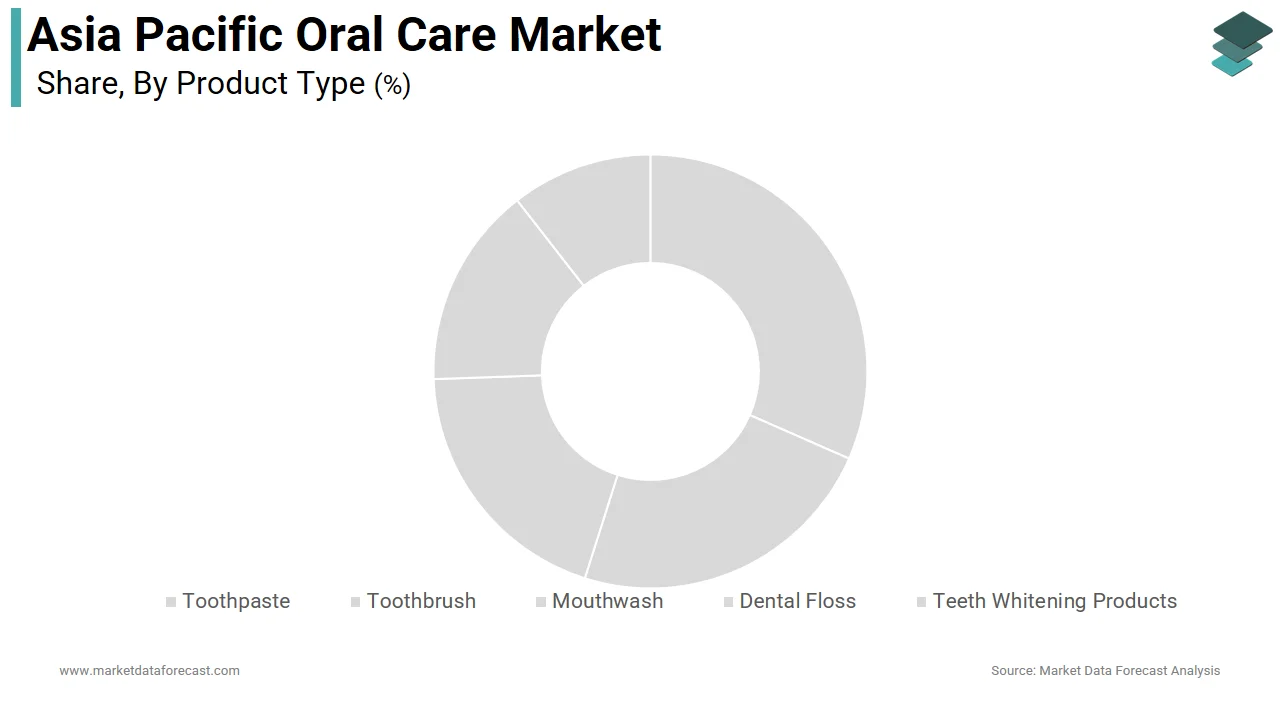
The toothpaste segment was the largest in 2025 and occupied a 45.9% share of the Asia Pacific oral care market. This prominence of the segment was supported by its status as an indispensable daily hygiene essential across all demographic strata. According to the Ministry of Commerce and Industry of India, urban consumers are expanding sales of fast-moving consumer goods by adopting premium oral hygiene products over basic choices. As per the World Health Organization, untreated dental caries affect nearly 2.5 billion people globally, which remains the single most common health condition worldwide. This high disease prevalence guarantees steady, recurring household replenishment cycles that sustain the segment's dominant market valuation. Furthermore, extensive marketing campaigns executed by multinational corporations and domestic herbal brands continuously reinforce the necessity of specialized toothpastes, effectively shielding the segment from substitution threats.
The Electric Toothbrush segment is likely to experience the fastest CAGR of 7.7% between 2026 and 2034. According to the National Health Service of the United Kingdom, electric toothbrushes provide an effective option for removing plaque and maintaining oral health compared to manual alternatives. As per the Cochrane Collaboration, electric toothbrushes reduce dental plaque by 21% and gingivitis by 11% more effectively than manual brushes when evaluated over clinical use exceeding three months. This clinical validation heavily influences tech-savvy, affluent urban demographics in countries like China, South Korea, and Japan to invest in high-end personal wellness electronics. Consequently, the rapid proliferation of Bluetooth-connected smart brushes equipped with real-time pressure sensors and coaching applications serves as a primary catalyst accelerating the segment growth rate.
By Distribution Channel Insights
The supermarkets and hypermarkets segment maintained the lead in the Asia Pacific oral care market and captured a 35.1% share in 2025. This leading position of the segment was attributed to high foot traffic, attractive in-store promotions, and consumers' ability to physically examine products before purchasing. According to the Ministry of Commerce and Industry of India, urban consumers are expanding sales of fast-moving consumer goods by adopting premium oral hygiene products over basic choices. As per the National Health Service of the United Kingdom, electric toothbrushes provide an effective option for removing plaque and maintaining oral health compared to manual alternatives. This dominant retail positioning allows established oral care brands to secure prime shelf-space visibility, facilitating direct consumer comparison and high-volume turnover that digital channels are still scaling to match in suburban and rural-adjacent territories.
The online retail segment is expected to exhibit a noteworthy CAGR of 8.4% over the forecast period. This rapid expansion of the segment is propelled by the explosion of quick-commerce platforms, the rise of direct-to-consumer (D2C) brands, and the shift toward premium, specialized oral care devices. According to the National Institutes of Health of the United States, digital consumer habits are accelerating the widespread adoption of specialized personal hygiene items through direct online exposure. Moreover, as per the International Trade Administration, the e-commerce market value across the entire Asia Pacific region will grow to over 28.9 trillion dollars by 2026. This massive digital shift enables direct-to-consumer niche brands to bypass traditional retail gatekeepers, offering subscription delivery models for specialty items like whitening strips and bamboo toothbrushes directly to tech-savvy millennials residing in tier-2 and tier-3 cities.
COUNTRY-LEVEL ANALYSIS
China Oral Care Market Analysis
China remained dominant in the Asia Pacific oral care market and accounted for a 33.9% share in 2025. This dominance of the Chinese market was driven by rapid urbanization and aggressive consumer trade-ups toward premium personal care items. According to the National Bureau of Statistics of China, the per capita disposable income of urban residents increased to 56,502 yuan, reflecting a nominal year-on-year growth of 4.3%. According to the National Health Commission of China, nationwide health promotion projects coordinate with non-profit groups to distribute electric toothbrushes to university students to build preventive care habits. This drives sales volumes for electric toothbrushes and specialized sensitivity toothpastes across tier-1 and tier-2 municipalities.
India Oral Care Market Analysis
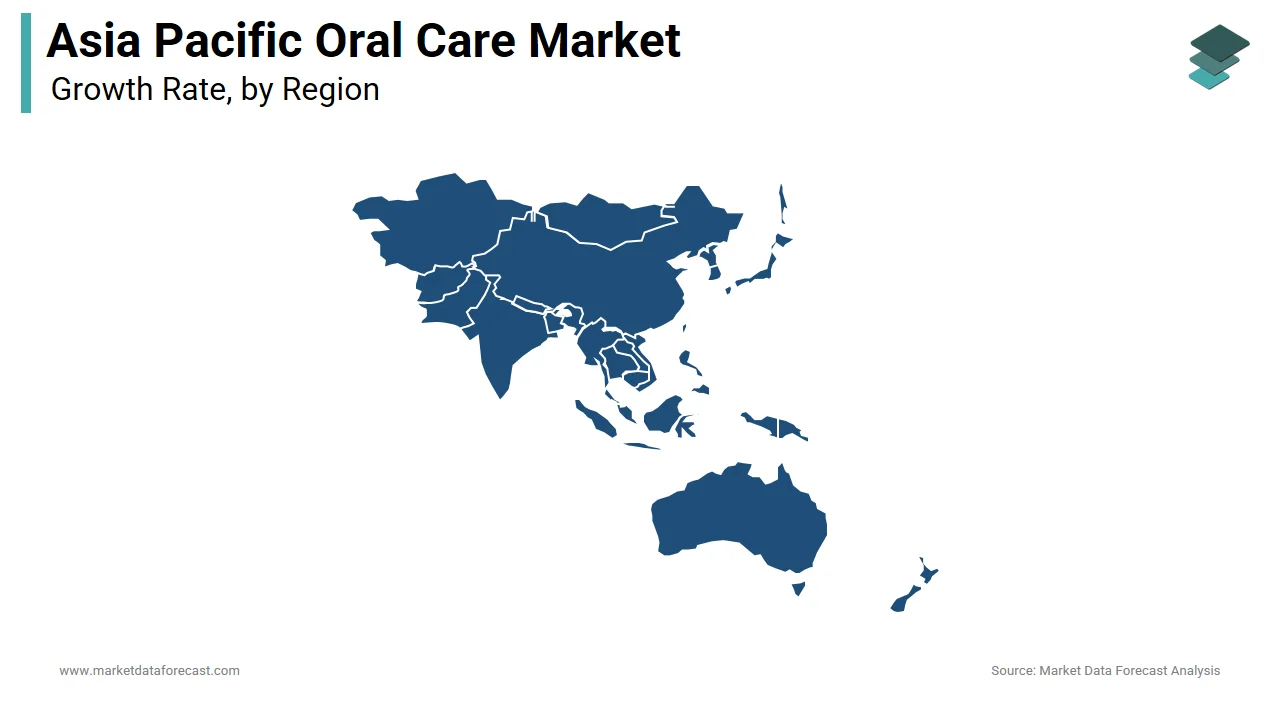
India is the fastest-growing country in the Asia Pacific oral care market. This swift growth of the country’s market is fuelled by rapid urbanization, rising disposable incomes, and an increasing focus on preventive dental hygiene. According to the Ministry of Commerce and Industry of India, urban consumers are expanding sales of fast-moving consumer goods by adopting premium oral hygiene products over basic choices. As per the Cochrane Collaboration, electric toothbrushes reduce dental plaque by 21% and gingivitis by 11% more effectively than manual brushes when evaluated over clinical use exceeding three months.
Japan Oral Care Market Analysis
Japan witnesses steady growth in the Asia Pacific oral care market because of sophisticated consumer demand for high-end preventive therapeutics and functional oral cosmetics. According to the Statistics Bureau of Japan, individuals aged 65 and older comprise over 29% of the national population, marking the highest elderly population ratio worldwide outside of Monaco. As per the Ministry of Health, Labour and Welfare of Japan, the national population is estimated to decline from its current level down to 86.74 million by the year 2060.
South Korea Oral Care Market Analysis
South Korea occupies a vital position in the Asia Pacific oral care market. It is a high-value regional innovation hub, driven by strong cultural emphases on personal grooming, flawless aesthetics, and advanced cosmetic dentistry. According to the Ministry of Commerce and Industry of India, urban consumers are expanding sales of fast-moving consumer goods by adopting premium oral hygiene products over basic choices. As per the National Health Service of the United Kingdom, electric toothbrushes provide an effective option for removing plaque and maintaining oral health compared to manual alternatives.
Australia Oral Care Market Analysis
Australia is also a key player in the Asia-Pacific oral care market due to strict therapeutic goods regulations and high consumer health literacy. Buyers are highly willing to spend money on technological upgrades. The power toothbrush segment, specifically electric and sonic models, is the fastest-growing product category in the country, with users actively investing in smart toothbrushes that sync with phone apps to track brushing coverage and protect enamel. According to the Australian Bureau of Statistics, national expenditure on healthcare and pharmacy transactions is reported through integrated national accounting frameworks to track total domestic pharmaceutical supply. As per the Australian Dental Association, 65% of domestic consumers do not know there is a direct connection between their oral cavity and systemic general health.
COMPETITIVE LANDSCAPE
Competition within the Asia Pacific oral care market is exceptionally intense, characterized by a dynamic interplay between entrenched multinational giants and agile domestic manufacturers. Industry participants constantly vie for consumer attention across diverse demographic landscapes ranging from hyper-urbanized tech hubs to rapidly modernizing rural districts. Major multinational corporations leverage their extensive capital resources, advanced technological capabilities, and deep research infrastructure to introduce premium, high-margin product innovations such as smart electric toothbrushes and clinical whitening treatments. Meanwhile, regional and local competitors challenge established players by offering cost-effective, traditional, and herbal formulations tailored specifically to local cultural preferences and price-sensitive consumer segments. Price competition remains fierce, forcing brands to optimize supply chains and refine marketing expenditures continuously. Furthermore, the rapid proliferation of e-commerce platforms has democratized market access, allowing emerging niche brands to bypass traditional retail barriers and compete directly with industry leaders. Consequently, key participants increasingly rely on targeted digital engagement, sustainability credentials, and strategic professional endorsements to differentiate their product offerings, maintain profit margins, and secure long-term brand loyalty in this rapidly expanding regional environment.
KEY MARKET PLAYERS
The leading companies operating in the Asia Pacific oral care market include:
- Procter & Gamble
- Unilever
- Colgate-Palmolive Company
- Church & Dwight Co., Inc.
- GlaxoSmithKline PLC
- Sunstar Suisse SA
- Haleon
- Henkel AG & Co. KGaA
- Hawley & Hazel (BVI) Co. Ltd.
TOP PLAYERS IN THE MARKET
- Colgate Palmolive maintains a commanding presence across the Asia Pacific oral care sector by supplying high-quality toothpastes, manual toothbrushes, and specialized clinical rinses that cater to millions of households. The enterprise heavily contributes to market expansion through extensive retail distribution networks and continuous investments in scientifically validated oral hygiene solutions. To reinforce its market position, the company focuses on advancing eco-friendly packaging initiatives, transitioning its entire manufacturing line of tubes to recyclable formats, and expanding digital consumer outreach. Furthermore, the firm routinely launches localized herbal formulations tailored directly to traditional consumer preferences across emerging economies, successfully capturing rising middle-class demand and securing long-term brand loyalty throughout diverse regional territories.
- Procter and Gamble contributes significantly to the regional oral care landscape through its advanced portfolio of electric toothbrushes, whitening treatments, and premium toothpaste formulations. The organization drives market growth by leveraging cutting-edge consumer analytics and introducing technology-enabled personal care products that elevate daily hygiene standards. To strengthen its competitive standing, the corporation invests heavily in direct-to-consumer digital commerce platforms and targeted social media marketing campaigns designed to engage tech-savvy millennial demographics. Additionally, the entity collaborates with dental professionals across major metropolitan centers to promote clinical efficacy, driving higher adoption rates for premium oral wellness devices across urban households in East Asia and Southeast Asia.
- Haleon plays a vital role in the regional market by offering specialized therapeutic oral care brands focused on sensitivity relief, gum protection, and advanced periodontal health maintenance. The company contributes significantly to consumer education by partnering with dental associations to champion preventive care and highlight the crucial link between oral hygiene and systemic well-being. To fortify its market presence, the enterprise scales up distribution partnerships across retail pharmacies and medical clinics, ensuring widespread product accessibility for aging populations. Moreover, the firm continuously optimizes its supply chain resilience, deploys targeted digital promotional strategies, and introduces clinically proven restorative formulations to address growing consumer demand for specialized dental health management.
Top Strategies Used by Key Market Participants
- Aggressive portfolio diversification into premium product categories such as smart electric toothbrushes and specialized sensitivity formulations.
- Strategic expansion of digital commerce and direct-to-consumer retail channels to capture online-first shoppers in emerging regional hubs.
- Extensive investment in localized manufacturing infrastructure to optimize operational costs and adhere strictly to regional regulatory requirements.
- Deployment of science-led consumer education campaigns in partnership with dental professionals to drive preventive oral care adoption.
- Integration of sustainable packaging formats and circular economy practices to appeal to environmentally conscious millennial and generation Z consumers.
MARKET SEGMENTATION
This Asia Pacific oral care market research report is segmented and sub-segmented into the following categories.
By Product Type
-
Toothpaste
-
Toothbrush
-
Manual Toothbrush
-
Electric Toothbrush
-
-
Mouthwash
-
Dental Floss
-
Teeth Whitening Products
-
Other Oral Care Products (e.g., gels, powders, etc.)
By Application / End-User
- Adults
- Children
- Geriatric Population
By Distribution Channel
- Supermarkets/Hypermarkets
- Pharmacies/Drug Stores
- Online Retail
- Specialty Stores
- Others (Convenience stores, dental clinics, etc.)
By Country
- India
- China
- Japan
- South Korea
- Australia
- New Zealand
- Thailand
- Malaysia
- Vietnam
- Philippines
- Indonesia
- Singapore
- Rest Of APAC