- Product Description Description
- Table of Contents TOC
- List of Table & Figure LOT
- Get Free Sample PDF Sample PDF
Market Size, 2025
$744.00 MnMarket Estimate, 2026
$810.96 MnMarket Forecast, 2034
$1,615.89 MnCAGR, 2026–2034
9.00%Executive Summary: Asia Pacific Proteases Market
- Market Scope: Comprehensive market assessment of the Asia-Pacific proteases sector covering source types, industrial applications, product classifications, country-level performance, and key industry players.
- Market Valuation: Valued at USD 744 million in 2025, estimated at USD 810.96 million in 2026, and projected to reach USD 1,615.89 million by 2034, expanding at a compound annual growth rate (CAGR) of 9.00% during the forecast period from 2026 to 2034.
- Primary Growth Drivers: Rapid expansion of food and beverage and detergent industries, increasing demand for efficient cleaning formulations, growing applications in the pharmaceuticals sector, and the ability of proteases to reduce industrial production costs.
Key Market Segment Metrics (2026–2034)
| Category | Leading Segment Focus | Fastest-Growing / High-Impact Focus |
|---|---|---|
| By Source | Microbial (genetically modified strains for enhanced stability) | Plant and Animal Segments |
| By Application | Food & Beverages and Laundry & Dishwashing Detergents | Healthcare & Pharmaceuticals |
| By Product | Microbial, Plant, Animal, and Renin | Alkaline Proteases |
| By Country / Region | Asia-Pacific (Third-largest regional market globally & fastest-growing) | India, China, Japan, and Australia |
Major Market Players & Market Structure
Market Structure: Highly competitive landscape led by specialized enzyme manufacturers and multinational biotechnology firms focusing on genetic modification, catalytic stability, and diverse industrial applications.
Key Companies: Amano Enzyme Inc., Novozymes, Advanced Enzyme Technologies Ltd., DuPont Nutrition and Biosciences, Biocatalysts Limited, Associated British Foods PLC, Hansen Holdings A/S, and AB Enzymes.
 Download Free Sample Report
Asia Pacific Proteases Market Size
The Asia Pacific Proteases market was valued at USD 744 million in 2025, is estimated to reach USD 810.96 million in 2026, and is projected to reach USD 1,615.89 million by 2034, growing at a CAGR of 9.00% from 2026 to 2034.

The proteases are enzymes that catalyze the hydrolysis of peptide bonds in proteins and serves critical functions, across food processing detergent formulation leather tanning and pharmaceutical manufacturing. According to the World Health Organization, diarrheal diseases cause 525000 child deaths annually in low and middle income countries where protease based digestive aids offer therapeutic potential. These agricultural intensity and healthcare gaps create substantial addressable markets for protease manufacturers operating within diverse Asian economies.
MARKET DRIVERS
Rising Aquaculture Production Drives Feed Enzyme Demand
The expansion of aquaculture operations in animal feed formulations is fuelling the growth of the Asia Pacific proteases market. As per the study, Asia accounted for 89% of global aquaculture production by volume in 2022 with China alone producing 34 million metric tons of farmed fish. This massive scale requires efficient protein digestion enhancers to optimize feed conversion ratios and reduce environmental nitrogen discharge. Proteases break down complex plant proteins in soybean and rapeseed meals making amino acids more bioavailable for aquatic species. Vietnamese shrimp farms now incorporate protease supplements at rates of 200 grams per ton of feed, according to the Vietnam Association of Seafood Exporters and Processors. Indonesian poultry integrators use protease blends to improve digestibility of locally sourced cassava and palm kernel meals, as per the study. These adoption patterns reflect how resource constraints and cost pressures drive enzymatic innovation throughout the regional aquaculture supply chain.
Growing Detergent Industry Adoption Supports Market Expansion
The detergent manufacturing sector is to enhance cleaning performance, while reducing environmental impact is elevating the growth of the Asia Pacific proteases market. Proteases effectively remove protein based stains such as blood egg and grass from fabrics enabling lower washing temperatures and reduced water consumption. Japanese manufacturers lead technological advancement with Kao Corporation developing cold water active proteases that maintain efficacy at 15 degrees Celsius. Thai detergent producers source approximately 4500 metric tons of industrial enzymes annually with proteases representing 30% of total volume, according to the study.
MARKET RESTRAINTS
Stringent Regulatory Approval Processes Limit Market Entry
The complex regulatory frameworks governing enzyme approval for new entrants and product innovations is declining the growth of the Asia Pacific proteases market. The Chinese Ministry of Agriculture and Rural Affairs requires 18 to 24 months for novel feed enzyme registration involving extensive safety trials and documentation reviews. As per the Indian Food Safety and Standards Authority, approved only 7 new enzyme preparations between 2020 and 2023, despite receiving 34 applications demonstrating stringent scrutiny levels. South Korean Ministry of Food and Drug Safety requires Good Manufacturing Practice certification from recognized international bodies before considering local registration applications. These prolonged approval cycles delay product launches and increase development costs disproportionately for small and medium enterprises. The Association of Southeast Asian Nations Harmonization Working Group notes that only 4 member states have mutually recognized enzyme approval protocols forcing companies to navigate divergent national requirements.
Limited Technical Expertise Hinders Optimal Application
The insufficient technical knowledge among end users prevents optimal protease utilization is impeding the growth of the Asia pacific protease market. Philippine food processors experience 15% higher enzyme wastage due to improper storage conditions and incorrect dosage calculations, according to the survey data. Bangladesh textile mills frequently substitute proteases with harsh chemical alternatives because operators cannot monitor pH and temperature parameters required for enzymatic efficiency, as noted by the Bangladesh Textile Mills Association. The member companies have never received formal training on enzyme application techniques limiting adoption to basic detergent formulations. Indonesian small scale soy sauce producers continue traditional fermentation methods despite available protease accelerators because they lack understanding of enzyme kinetics and substrate specificity. Educational institutions across the region offer limited specialized courses in industrial enzymology with only 3 universities in Thailand providing dedicated programs, according to the study.
MARKET OPPORTUNITIES
Expansion of Plant Based Protein Processing Creates New Applications
The rapid growth of plant-based protein manufacturing in texture modification and flavor enhancement is major factor to level up the growth of the Asia Pacific proteases market. Proteases modify pea soy and wheat proteins to improve solubility mouthfeel and nutritional bioavailability essential for consumer acceptance. Beyond Meat established a Shanghai production facility in 2022 that utilizes proprietary enzymatic treatments to replicate meat fiber structures according to company disclosures. Japanese researchers at Kyoto University developed heat stable proteases that function during extrusion cooking processes enabling continuous production lines for textured vegetable proteins. Australian ingredient suppliers report annual growth in protease sales to plant based meat manufacturers, according to the survey
Biopharmaceutical Manufacturing Growth Drives High Value Protease Demand
The expanding biopharmaceutical production capabilities for high purity proteases used in drug manufacturing and quality control applications is likely to escalate the growth of the Asia Pacific proteases market. Proteases facilitate monoclonal antibody purification by cleaving fusion tags and removing host cell proteins during downstream processing. As per the Chinese National Medical Products Administration, approved 47 biosimilar products in 2023, necessitating standardized protease protocols for comparative analytical testing. Indian vaccine manufacturers use trypsin and other proteases for viral inactivation and antigen preparation with the Serum Institute of India processing 1.5 billion doses annually, as per the study.
MARKET CHALLENGES
Supply Chain Volatility for Raw Materials Disrupts Production
Fluctuating availability and pricing of raw materials used in protease production is a major challenge for the growth of the Asia Pacific proteases market. As per the International Grains Council, global soybean meal prices varied by 35% between 2021 and 2023, affecting fermentation substrate costs for microbial protease production. Indian manufacturers face intermittent power supply disruptions with average outage durations of 4 hours weekly in industrial zones, as reported by the study. These supply chain instabilities force manufacturers to maintain larger inventory buffers increasing working capital requirements, while compromising ability to offer competitive pricing to cost sensitive customers in emerging countries.
Competition from Chemical Alternatives Limits Price Premiums
Established chemical processing methods provide cost effective alternatives for manufacturers in traditional industrial applications that is also to inhibit the growth of the Asia Pacific proteases market. Indian detergent formulators can achieve comparable stain removal using bleach activators at lower cost than enzymatic systems, according to the analysis. The Philippine Food Processors Association notes that small scale operators avoid protease adoption because minimum order quantities from suppliers exceed their monthly production volumes creating accessibility barriers. South Korean seafood processors prefer mechanical deboning over protease assisted recovery because labor costs remain sufficiently low to justify manual methods as documented by the Korea Seafood Processors Cooperative.
REPORT COVERAGE
| REPORT METRIC | DETAILS |
| Market Size Available | 2025 to 2034 |
| Base Year | 2025 |
| Forecast Period | 2026 to 2034 |
| CAGR | 6.88% |
| Segments Covered | By Source, Application, Product, and Region |
| Various Analyses Covered | Regional & Country Level Analysis, Segment-Level Analysis, DROC, PESTLE Analysis, Porter’s Five Forces Analysis, Competitive Landscape, Analyst Overview on Investment Opportunities |
| Regions Covered | India, China, Japan, South Korea, Australia, New Zealand, Thailand, Malaysia, Vietnam, Philippines, Indonesia, Singapore, and the Rest of Asia-Pacific |
| Market Leaders Profiled | Amano Enzyme Inc., Novozymes, Advanced Enzyme Technologies Ltd., DuPont Nutrition and Biosciences, Biocatalysts Limited, Associated British Foods PLC, Hansen Holdings A/S, and AB Enzymes |
SEGMENTAL ANALYSIS
By Source Insights
The microbial proteases segment was accounted in holding 49.2% of the Asia Pacific proteases market share in 2025 due to their cost effectiveness and versatility in industrial applications. Bacterial strains such as Bacillus subtilis produce alkaline proteases ideal for detergent formulations, while fungal species like Aspergillus oryzae generate acid stable variants suitable for food processing. Indian biotechnology firms utilize submerged fermentation techniques achieving yields of 15000 units per milliliter, reducing production costs by 35% compared to extraction methods, according to the study. These microorganisms adapt readily to genetic modification enabling manufacturers to engineer strains with enhanced thermal stability and pH tolerance specific to regional industrial requirements.
The plant derived proteases segment is likely to register a fastest CAGR of 8.2% throughout the forecast period with the consumer preference for natural ingredients and clean label trends. The plant enzymes avoid allergen concerns associated with microbial sources by making them attractive for premium food applications in health-conscious markets. Papain from papaya latex and bromelain from pineapple stems offer mild proteolytic activity suitable for meat tenderization and digestive supplements without harsh chemical residues. Chinese traditional medicine manufacturers incorporate plant proteases into herbal formulations for anti-inflammatory treatments with sales growing 15% yearly, as per the research. Vietnamese farmers now intercrop papaya with rubber plantations providing dual income sources, while supplying raw materials to enzyme extractors, according to the study.
By Application Insights
The laundry and dish washing detergents segment was the largest by holding 39.1% of the Asia Pacific proteases market share in 2025 with the urbanization and rising hygiene standards across developing nations. Proteases enable effective stain removal at lower temperatures reducing energy consumption by 30% per wash cycle, according to the study. Thai households spend an average of 12 dollars monthly on cleaning products with enzyme based variants commanding 20% price premiums due to perceived superior performance, as per the data. South Korean companies lead innovation with LG Chem developing cold water active proteases that maintain efficacy below 20 degrees Celsius addressing energy conservation goals. This widespread adoption across diverse income segments sustains robust demand, while regulatory pressures against phosphates and bleaching agents further accelerate transition toward enzymatic cleaning solutions throughout the region.
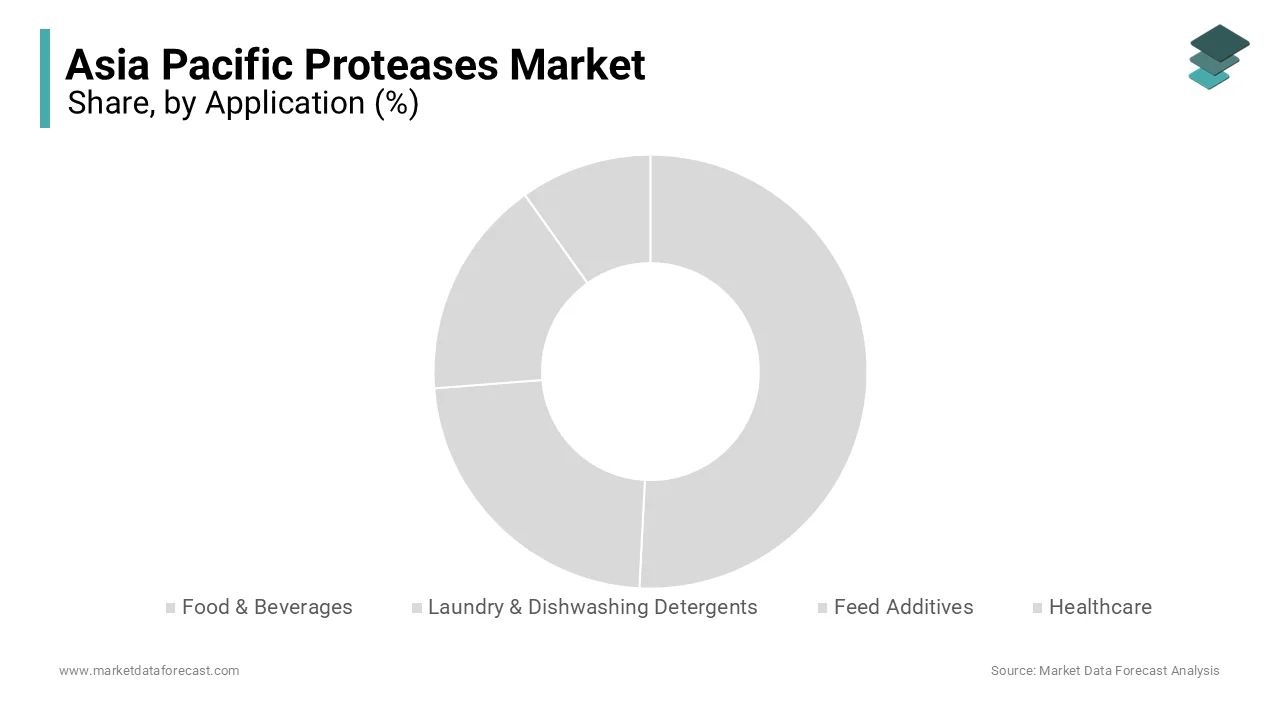
The health care application segment is likely to witness a fastest CAGR of 9.5% from 2026 to 2034 with the aging populations and increasing prevalence of chronic digestive disorders. Australian clinical trials demonstrated that bromelain supplements reduced post-surgical inflammation by 40% leading to increased prescription rates among orthopedic surgeons, according to the survey. These clinical validations and reimbursement expansions drive sustained growth in therapeutic applications beyond traditional supplement categories.
By Product Insights
The microbial products segment was the largest by holding 60.2% of the Asia Pacific proteases market share in 2025 due to superior production economics and application flexibility across industrial sectors. Indian facilities utilize agro industrial waste such as rice bran and molasses, as fermentation substrates lowering raw material expenses by 25%, as per the report. Vietnamese producers export 12000 metric tons of microbial proteases annually primarily to textile and leather industries in neighboring countries, according to the data. Australian manufacturers focus on high value specialty proteases for research applications commanding prices 5 times higher than industrial grades, according to the analysis.
The animal derived proteases segment is expected to grow at a fastest CAGR of 7.8% from 2026 to 2034 with the demand for specific enzymatic activities unavailable from microbial sources. Thai seafood processors use fish derived proteases for surimi production achieving superior gel strength compared to microbial alternatives, according to the studies. These specialized applications requiring unique substrate specificity ensure continued growth, despite higher production costs and ethical considerations surrounding animal sourcing practices.
REGIONAL ANALYSIS
China Market Analysis
China was the largest contributor in the Asia Pacific proteases market by holding 40.3% of the share in 2026 with the massive industrial base and domestic manufacturing capabilities. Shanghai based enzyme producers invested 450 million dollars in fermentation facility upgrades during 2023 by improving yield efficiency by 18%, according to the reports. Domestic pharmaceutical companies increased protease procurement for drug manufacturing following National Medical Products Administration approval of 12 new enzyme based therapeutics in 2023.
India Market Analysis
India proteases market was ranked second by occupying 19.8% of the share in 2025 with the strong domestic consumption and growing export orientation in specialty segments. Indian dairy processors utilize 85000 metric tons of microbial rennet annually for paneer and cheese production, reflecting expanding organized dairy sector growth. Gujarat based enzyme manufacturers achieved cost reduction through integration with sugar mills utilizing molasses as fermentation substrate, according to the Gujarat Sugar Mills Association byproduct utilization report. These developments demonstrate India's transition from low cost producer to value added exporter leveraging agricultural byproducts and skilled biotechnology workforce.
Japan Market Analysis
Japan proteases market growth is substantially growing with the high value specialty enzymes for pharmaceutical and precision food applications. Japanese researchers developed 23 novel protease variants in 2023 specifically designed for monoclonal antibody purification processes, according to the data. Japanese food processors utilize heat stable proteases for soy sauce fermentation reducing production time from 6 months to 3 months, while maintaining flavor profiles, as per the study.
South Korea Market Analysis
South Korea proteases market growth is likely to grow with the robust biopharmaceutical sector and advanced cosmetic industry demand for specialized enzymatic solutions. Samsung Biologics and Celltrion together operate 18 bioreactor facilities requiring validated enzymatic tools for downstream processing according to corporate sustainability disclosures. The Korean Food and Drug Administration approved 12 protease based medical foods for digestive health in 2023 expanding reimbursement coverage under national health insurance schemes. These diverse high value applications leverage South Korea's advanced manufacturing capabilities and strong intellectual property protection framework attracting multinational enzyme suppliers establishing regional technical centers.
Australia Market Analysis
Australia proteases market growth is likely to grow with the high quality production standards and focus on agricultural and pharmaceutical export opportunities. Australian winemakers utilize 3200 metric tons of proteases annually for protein stabilization preventing haze formation in white wines, according to the study. Melbourne based biotechnology firms developed cold active proteases for detergent applications targeting energy efficient washing protocols preferred in European countries with export value reaching 35 million dollars in 2023, as per the study. The Commonwealth Scientific and Industrial Research Organisation invested 18 million dollars in enzyme engineering research facilities in 2023, focusing on extreme environment adapted proteases for industrial applications.
COMPETITIVE LANDSCAPE
The Asia Pacific Proteases Market features intense competition among global giants and regional specialists vying for dominance, across diverse industrial segments. Multinational corporations leverage advanced research capabilities and extensive distribution networks to offer comprehensive enzyme solutions, while local players compete on price and customization for specific regional needs. Technological innovation serves as a key differentiator with companies investing heavily in developing specialized proteases for emerging applications such as plant-based proteins and biopharmaceuticals. Regulatory compliance and quality certifications increasingly influence purchasing decisions especially in food and pharmaceutical sectors driving consolidation among suppliers who can meet stringent standards. Price sensitivity remains high in traditional applications like detergents and textiles forcing manufacturers to continuously optimize production efficiency.
KEY MARKET PLAYERS
Some of the key players in the Asia Pacific proteases market are
- Amano Enzyme Inc.
- Novozymes
- Advanced Enzyme Technologies Ltd.
- DuPont Nutrition and Biosciences
- Biocatalysts Limited
- Associated British Foods PLC
- Hansen Holdings A/S
- AB Enzymes
Top Players in the Market
- Novozymes maintains a dominant presence in the Asia Pacific region through its extensive portfolio of industrial and food grade enzymes. The company recently expanded its production facility in Wuxi China to increase capacity for microbial proteases used in detergent and feed applications. This strategic investment supports growing regional demand, while reducing lead times for local customers. Novozymes collaborates closely with Asian universities to develop customized enzyme solutions tailored to specific regional raw materials such as rice bran and cassava. Their technical service teams provide on site support to small and medium enterprises helping optimize dosage and application parameters. The company also launched several cold active protease variants designed for energy efficient washing processes preferred by environmentally conscious consumers in Japan and South Korea.
- DuPont Nutrition and Biosciences leverages its strong distribution network and research capabilities to serve diverse sectors, including food beverage and animal nutrition. The company introduced new heat stable protease formulations specifically designed for extrusion processes in plant-based meat production facilities, across Singapore and Thailand. DuPont partners with local feed millers in India and Vietnam to demonstrate efficacy of protease blends in improving digestibility of regional ingredients like palm kernel meal. Their recent acquisition of specialized enzyme startups enhances their intellectual property portfolio in high value pharmaceutical grade proteases. The company invests heavily in customer education programs conducting workshops on optimal enzyme usage for textile and leather processors in Bangladesh and Indonesia.
- AB Enzymes focuses on delivering high quality specialty proteases for food processing and technical applications, across Asia Pacific countries. The company established a new technical center in Shanghai to support customers in China with rapid product development and application testing services. AB Enzymes recently launched a range of organic certified proteases catering to the growing demand for clean label ingredients in premium food products across Australia and New Zealand. They collaborate with Japanese researchers to develop enzymes suitable for traditional fermentation processes such as soy sauce and miso production. The company also expanded its logistics infrastructure in Southeast Asia ensuring reliable supply to manufacturers in Thailand and Malaysia. Their commitment to sustainability is evident in initiatives to reduce carbon footprint of enzyme production through renewable energy adoption at manufacturing sites.
Top Strategies Used by Key Market Participants
Key players in the Asia Pacific Proteases Market employ several strategic approaches to maintain competitive advantage and drive growth. Companies focus heavily on expanding local manufacturing capacities to reduce costs and improve supply chain reliability for regional customers. Strategic partnerships with local distributors and technical service providers enable deeper market penetration especially in emerging economies like Vietnam and Indonesia. Investment in research and development centers within Asia allows firms to develop customized enzyme solutions tailored to regional raw materials and processing conditions. Mergers and acquisitions of smaller specialized enzyme producers help large companies broaden their product portfolios and access niche applications in pharmaceuticals and cosmetics. Launching eco-friendly and energy efficient protease variants aligns with increasing regulatory pressure and consumer preference for sustainable industrial practices. Providing comprehensive technical support and training programs helps overcome knowledge gaps among small and medium enterprises facilitating wider adoption of enzymatic technologies.
MARKET SEGMENTATION
This research report on the Asia Pacific proteases market has been segmented and sub-segmented into the following categories.
By Source
- Microbial
- Plant and Animal Segments
By Application
- Food & Beverages
- Laundry & Dishwashing Detergents
- Feed Additives
- Healthcare
By Product
- Microbial
- Plant
- Animal
- Renin
- Alkaline
By Country
- India
- China
- Japan
- South Korea
- Australia
- New Zealand
- Thailand
- Malaysia
- Vietnam
- Philippines
- Indonesia
- Singapore
- Rest of Asia Pacific