- Product Description Description
- Table of Contents TOC
- List of Table & Figure LOT
- Get Free Sample PDF Sample PDF
Market Size, 2025
$0.48 BnMarket Estimate, 2026
$0.49 BnMarket Forecast, 2034
$1.49 BnCAGR, 2026–2034
15.18%Asia Pacific Solar Street Lighting Market Size
The Asia Pacific Solar Street Lighting Market size was valued at USD 0.48 billion in 2025 and is anticipated to reach USD 0.49 billion in 2026 from USD 1.49 billion by 2034, growing at a CAGR of 15.18% during the forecast period from 2026 to 2034.
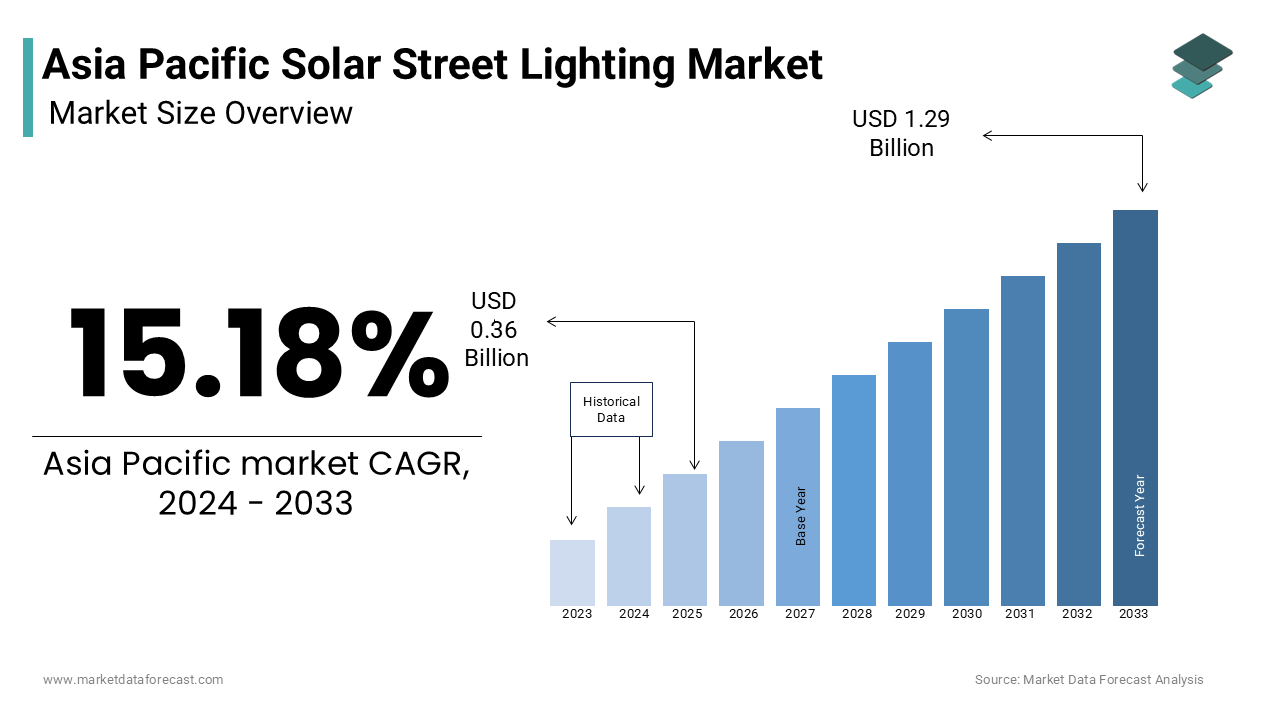
The solar street lighting systems are increasingly adopted in urban, semi-urban, and remote areas to reduce dependency on grid electricity, lower maintenance costs, and support sustainable development goals. Governments across the region are promoting solar street lighting as part of smart city initiatives, rural electrification programs, and climate action plans. As per the International Energy Agency (IEA), over 60% of new street lighting installations in Southeast Asia in 2023 were solar-powered, driven by falling solar PV costs and rising energy demand.
MARKET DRIVERS
Government Initiatives and Rural Electrification Programs
The increasing support from governments through rural electrification programs and infrastructure development schemes is driving the growth of the Asia Pacific solar street lighting market. In India, the Ministry of New and Renewable Energy (MNRE) has facilitated the installation of over 10 million solar street lights since 2015 under the National Solar Street Lighting Program, which is aiming to replace conventional street lighting in both urban and rural settings.
Rising Urbanization and Smart City Development
The rapid pace of urbanization and the proliferation of smart city projects across major metropolitan areas is propelling the growth of the Asia Pacific solar street lighting market. As per the United Nations, Asia’s urban population is projected to increase by 1.2 billion by 2050, necessitating sustainable infrastructure solutions, including energy-efficient public lighting.
MARKET RESTRAINTS
High Initial Investment and Cost Constraints
The high initial investment required for procurement and installation in low-income and rural communities is restraining the growth of the Asia Pacific solar street lighting market. Although the long-term operational savings are significant, the upfront costs of photovoltaic modules, LED fixtures, and battery systems often exceed the budgetary limits of local governments and municipalities. In countries like Indonesia and Vietnam, local authorities have reported delays in rural lighting projects due to funding shortages and limited access to financing. Additionally, in India, despite government subsidies, many state-run tenders for solar street lighting face low participation due to concerns over payment delays and procurement inefficiencies.
Performance Variability in Low Sunlight Conditions
The variability in system performance under low sunlight conditions, which can impact reliability and user confidence is also propelling the growth of the Asia Pacific solar street lighting market. According to the International Renewable Energy Agency (IRENA), regions with prolonged monsoon seasons or high levels of air pollution experience reduced solar irradiance, leading to diminished battery charging efficiency. In countries like Thailand and the Philippines, where seasonal cloud cover and heavy rainfall are common, solar street lights often fail to provide consistent illumination for multiple nights.
MARKET OPPORTUNITIES
Integration with Smart City and IoT Technologies
The integration with smart city and IoT technologies, enabling advanced control, monitoring, and data-driven urban planning is ascribed to fuel the new opportunities for the growth of the Asia Pacific solar street lighting market. In Singapore, the Smart Nation initiative has led to the deployment of intelligent solar street lights equipped with motion sensors and adaptive lighting features. As per the Korea Institute of Science and Technology (KIST), integrating IoT into solar lighting allows for remote diagnostics, predictive maintenance, and dynamic brightness adjustment, enhancing efficiency and reducing operational costs. These advancements are transforming solar street lighting into a key component of next-generation urban infrastructure.
Expansion of Off-Grid and Remote Area Electrification Projects
The growing emphasis on off-grid and remote area electrification presents a substantial opportunity for the growth of the Asia Pacific solar street lighting market. According to the International Energy Agency (IEA), approximately 60 million people in the Asia Pacific region still rely on kerosene and diesel for lighting, contributing to high energy costs and environmental pollution. In response, governments and development agencies are prioritizing solar-based public lighting to improve energy access and safety. In Indonesia, the Ministry of Energy and Mineral Resources has launched the “One Village One Solar” initiative, aiming to electrify 10,000 remote villages with solar lighting by 2027.
MARKET CHALLENGES
Maintenance and Component Replacement Issues
The difficulty in maintaining and replacing system components in remote and rural areas where technical expertise and service infrastructure are limited is acting as barrier for the growth of Asia Pacific solar street lighting market. According to the International Renewable Energy Agency (IRENA), poor after-sales service and lack of trained technicians result in high failure rates and reduced system longevity.
Quality and Standardization Gaps in Product Offerings
The lack of uniform quality standards and the presence of substandard products, which can undermine consumer confidence and project success is substantially to hamper the growth of the Asia Pacific solar street lighting market. According to the Bureau of Indian Standards (BIS), a significant portion of imported solar lighting components does not meet prescribed efficiency and durability benchmarks, leading to early system failures and increased maintenance costs. In Vietnam, the Ministry of Industry and Trade has issued multiple advisories regarding low-quality solar panels and batteries being sold in the market, which fail to deliver promised performance. Similarly, in Thailand, the Department of Alternative Energy Development and Efficiency (DEDE) has reported that inconsistent product specifications among manufacturers make it difficult for buyers to assess performance and longevity.
REPORT COVERAGE
| REPORT METRIC | DETAILS |
| Market Size Available | 2025 to 2034 |
| Base Year | 2025 |
| Forecast Period | 2026 to 2034 |
| CAGR | 15.18% |
| Segments Covered | By Type, Product Type, Application and Country |
| Various Analyses Covered | Regional & Country Level Analysis, Segment-Level Analysis, DROC, PESTLE Analysis, Porter’s Five Forces Analysis, Competitive Landscape, Analyst Overview on Investment Opportunities |
| Countries Covered | India, China, Japan, South Korea, Australia, New Zealand, Thailand, Malaysia, Vietnam, the Philippines, Indonesia, Singapore, and the Rest of APAC. |
| Market Leaders Profiled | Philips Lighting, Tata Power Solar, Su-Kam Power Systems, Omega Solar, Bisol Group, Solar Street Lights USA, Urja Global Ltd., Sunna Design, Sol Inc., and Bridgelux Inc. |
SEGMENTAL ANALYSIS
By Type Insights
The standalone segment dominated the Asia Pacific solar street lighting market by capturing a dominant share in 2024 with the self-sufficient lighting units that operate independently of the electrical grid, making them ideal for rural, remote, and off-grid applications. According to the International Energy Agency (IEA), over 60% of new solar street lighting installations in Southeast Asia in 2023 were standalone systems, driven by the need for electrification in off-grid villages and rural infrastructure development.
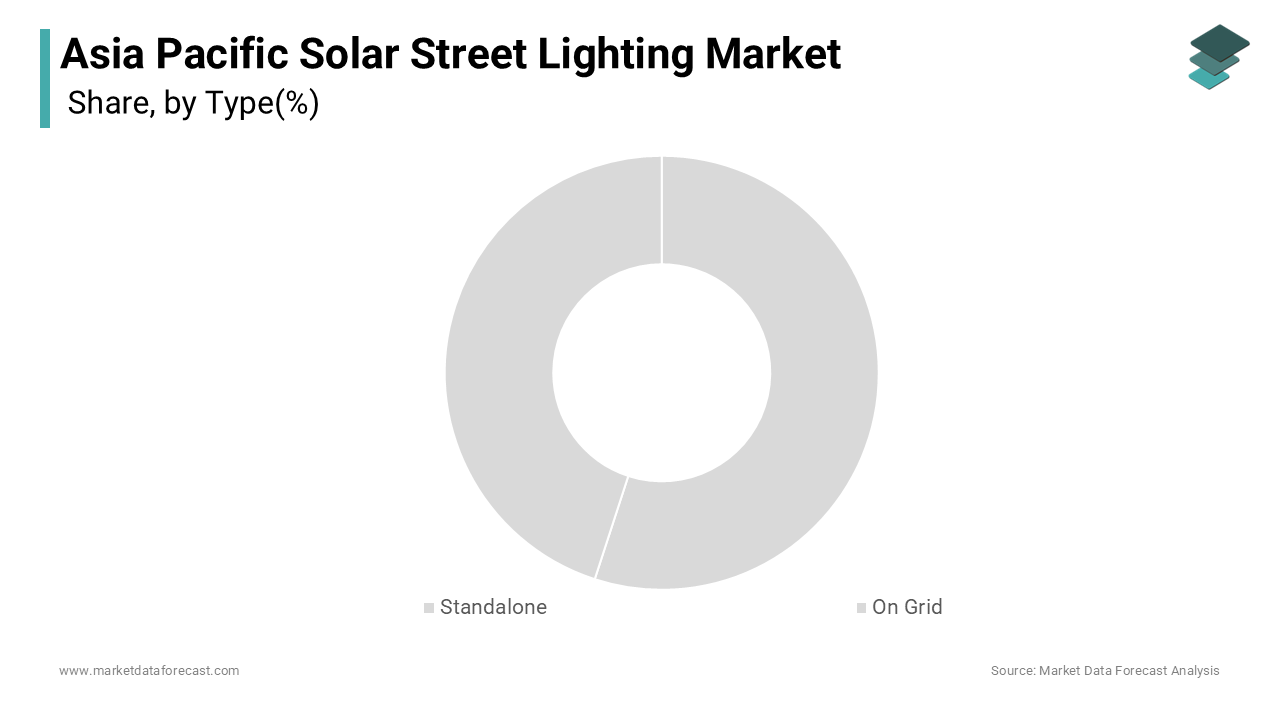
The on-grid segment is lucratively growing with a CAGR of 13.6% from 2025 to 2033. According to the International Renewable Energy Agency (IRENA), urban municipalities in China and Japan are increasingly adopting on-grid solar lighting as part of smart city initiatives to reduce electricity consumption and carbon emissions. Similarly, in Australia, the New South Wales government launched a pilot program integrating on-grid solar street lights with energy management systems to optimize power usage.
By Product Type Insights
The Light Emitting Diode (LED) solar street lights segment was the largest and held a prominent share of the Asia Pacific solar street lighting market in 2024. LEDs are preferred for their high energy efficiency, longer lifespan, and superior light output compared to traditional Compact Fluorescent Lamps (CFLs). According to the International Energy Agency (IEA), LED lighting consumes up to 50% less power than CFL alternatives while delivering better illumination levels, making them ideal for solar-powered applications. In India, the Bureau of Energy Efficiency (BEE) reported that over 95% of new government-funded solar street lighting tenders in 2023 specified LED-based systems due to their reliability and cost-effectiveness. Similarly, in China, the National Development and Reform Commission (NDRC) has mandated LED lighting for all new solar street lighting deployments under its Green Lighting Program.
The Compact Fluorescent Lamps (CFL) segment is likely to grow with an expected CAGR of 6.2% from 2025 to 2033 with low-income and off-grid communities where initial cost considerations outweigh long-term efficiency benefits. In Bangladesh, the Infrastructure Development Company Limited (IDCOL) reported that over 15% of its rural solar lighting installations in 2023 were CFL-based, catering to economically disadvantaged areas.
By Application Insights
The commercial application segment was accounted in holding 52.3% of the Asia Pacific solar street lighting market share in 2024 with the municipal roads, commercial complexes, townships, and public infrastructure projects. According to the United Nations, Asia’s urban population is projected to grow by 1.2 billion by 2050, driving the need for energy-efficient public lighting solutions. In China, the Ministry of Housing and Urban-Rural Development reported that over 300 cities have adopted solar street lighting as part of their smart city initiatives, with commercial applications forming the majority of installations. In Singapore, the Land Transport Authority (LTA) has deployed solar street lights in multiple business districts and transport hubs to support the country’s sustainability goals. Similarly, in India, the Smart Cities Mission has mandated the use of solar lighting in commercial zones to reduce municipal energy costs.
The industrial segment is anticipated to grow with a CAGR of 14.8% from 2025 to 2033 with the increasing deployment of solar lighting in industrial parks, logistics hubs, and manufacturing zones that require reliable and cost-effective illumination. According to the International Energy Agency (IEA), industrial energy consumption in the Asia Pacific region is expected to increase by 35% by 2030, prompting companies to adopt energy-efficient lighting solutions. In India, the Ministry of Power reported that over 100 industrial parks have adopted solar street lighting to reduce grid dependency and operational costs. In China, the State Grid Corporation has promoted solar lighting in logistics and manufacturing zones to support its green industrialization strategy. Similarly, in Thailand, the Eastern Economic Corridor (EEC) has mandated solar lighting for new industrial developments to enhance sustainability.
REGIONAL ANALYSIS
India Solar Street Lighting Market Insights
India was the top performer of the Asia Pacific solar street lighting market by accounting for 32.3% of the share in 2025 with the government support, rural electrification programs, and urban infrastructure development initiatives have driven large-scale adoption. According to the Ministry of New and Renewable Energy (MNRE), India has installed over 10 million solar street lights since 2015 under the National Solar Street Lighting Program. The Smart Cities Mission has further accelerated deployment in urban centers, with more than 25 cities integrating solar lighting into their infrastructure. Additionally, the Deen Dayal Upadhyaya Gram Jyoti Yojana (DDUGJY) has funded solar lighting in thousands of rural villages, improving energy access and security.
China Solar Street Lighting Market Insights
China was ranked second in the Asia Pacific solar street lighting market by capturing 25.3% of share in 2025 with the rapid urbanization and emphasis on sustainable infrastructure have led to widespread deployment of solar lighting in both urban and rural areas. According to the Ministry of Housing and Urban-Rural Development, over 300 Chinese cities have incorporated solar street lights into their smart city initiatives. The State Grid Corporation has mandated solar lighting for new public infrastructure projects in several provinces, including Guangdong and Zhejiang. Additionally, the National Development and Reform Commission (NDRC) has promoted solar lighting as part of its Green Lighting Program to reduce carbon emissions from public lighting.
Australia Solar Street Lighting Market Insights
Australia solar street lighting market is likely to grow with a prominent CAGR during the forecast period with the renewable energy and climate action has spurred the adoption of solar lighting in urban and regional areas. According to the Australian Renewable Energy Agency (ARENA), over 200,000 solar street lights have been installed nationwide since 2018, with major deployments in New South Wales and Victoria. The City of Sydney has integrated solar lighting into its sustainability roadmap, aiming to achieve net-zero emissions by 2035. Similarly, Queensland’s Department of Transport and Main Roads has launched a solar lighting initiative for highways and regional roads to reduce grid dependency.
Japan Solar Street Lighting Market Insights
Japan solar street lighting market growth is driven by the energy resilience and climate sustainability has driven the deployment of solar lighting in urban and disaster-prone areas. According to the Ministry of Economy, Trade and Industry (METI), Japan has mandated solar lighting for new public infrastructure projects as part of its Green Growth Strategy. Tokyo’s Metropolitan Government has integrated solar street lights into its smart city development plans, particularly in high-traffic zones and transport hubs. Additionally, the New Energy and Industrial Technology Development Organization (NEDO) has supported pilot projects using intelligent solar lighting with adaptive control systems.
Indonesia Solar Street Lighting Market Insights
Indonesia solar street lighting market is likely to grow with the archipelago and significant rural population have made solar lighting a key solution for electrification and infrastructure development. According to the Ministry of Energy and Mineral Resources, Indonesia has deployed over 500,000 solar street lights in off-grid villages under its National Electrification Program. The “One Village One Solar” initiative aims to electrify 10,000 remote villages by 2027, accelerating the adoption of solar lighting in island provinces. Additionally, local governments in Papua and Maluku have partnered with international aid organizations to install solar street lights in rural schools and community centers.
COMPETITIVE LANDSCAPE
The Asia Pacific solar street lighting market is characterized by a dynamic and evolving competitive landscape, with a mix of global brands, regional players, and local manufacturers vying for market share. The industry is highly fragmented, particularly in emerging economies where government tenders and rural electrification programs drive demand. Established players leverage their brand reputation, technological expertise, and distribution networks to maintain a competitive edge, while new entrants focus on cost-effective solutions and niche applications. The growing emphasis on smart cities, energy efficiency, and sustainable infrastructure has intensified competition, prompting companies to differentiate themselves through product innovation, integrated IoT-enabled features, and after-sales service excellence. Additionally, the increasing availability of financing options and public-private partnerships has enabled smaller players to compete more effectively.
KEY MARKET PLAYERS
Some of the companies that are playing a dominating role in the Asia Pacific Solar Street Lighting Market include
- Philips Lighting
- Tata Power Solar
- Su-Kam Power Systems
- Omega Solar
- Bisol Group
- Solar Street Lights USA
- Urja Global Ltd.
- Sunna Design
- Sol Inc.
- Bridgelux Inc.
Top Players in the Asia Pacific Solar Street Lighting Market
Syska Henkel
Syska Henkel is a leading player in the Asia Pacific solar street lighting market, known for its wide range of energy-efficient and durable solar lighting solutions. The company has played a significant role in advancing solar lighting adoption across rural and urban applications in India and Southeast Asia. Syska Henkel has contributed to reducing dependency on grid electricity and promoting sustainable public infrastructure by integrating smart technologies and high-performance LED systems. Its commitment to innovation and quality has made it a trusted brand in both government and private sector lighting projects.
Bridgelux
Bridgelux has established a strong presence in the Asia Pacific solar street lighting market by providing high-efficiency LED lighting components tailored for solar-powered applications. The company’s focus on developing advanced LED modules has enabled manufacturers across the region to produce high-performance solar street lights with longer lifespans and better illumination. Bridgelux’s contributions to lighting technology have supported the broader adoption of solar lighting in smart cities, industrial zones, and municipal infrastructure, reinforcing its role as a key enabler of sustainable urbanization.
Havells India Limited
Havells India is a dominant force in the Asia Pacific solar street lighting market, offering a comprehensive portfolio of solar lighting products designed for residential, commercial, and public infrastructure applications. The company has been instrumental in supplying large-scale solar lighting solutions under government rural electrification and smart city programs. Havells’ integration of cutting-edge LED technology with robust solar power systems has significantly enhanced the efficiency and reliability of solar street lighting across the region. Its strong distribution network and focus on innovation continue to drive its market leadership.
Top Strategies Used by Key Market Participants
Product Innovation and Technology Integration
Key players are focusing on continuous product innovation by integrating smart technologies such as motion sensors, remote monitoring, and adaptive lighting systems into solar street lights. These enhancements improve energy efficiency, reduce maintenance costs, and offer better control, making solar lighting more attractive to urban planners and municipalities.
Strategic Partnerships with Government and Municipal Bodies
To ensure large-scale deployment, leading companies are forming strategic partnerships with government agencies and local authorities. These collaborations help companies align their product offerings with national electrification and sustainability goals, securing long-term contracts and ensuring consistent demand.
Expansion into Rural and Off-Grid Markets
Recognizing the potential in underserved regions, market participants are expanding their reach into rural and off-grid areas through cost-effective and modular solar lighting solutions. Companies are tapping into new customer segments and driving market growth across the Asia Pacific by offering financing models and localized service support.
RECENT MARKET DEVELOPMENTS
- In January 2024, Havells India launched a new line of AI-integrated solar street lights designed for smart city applications, which is featuring adaptive brightness control and real-time performance monitoring.
- In March 2024, Syska Henkel partnered with a leading rural development foundation to deploy solar street lighting in over 1,000 remote villages across India and Nepal by enhancing its presence in off-grid markets.
- In June 2024, Bridgelux announced a collaboration with a major Chinese solar lighting manufacturer to co-develop high-efficiency LED modules tailored for tropical and high-humidity environments across Southeast Asia.
- In September 2024, a major Japanese electronics firm entered into a joint venture with an Australian infrastructure company to supply solar street lighting for regional smart mobility projects.
- In November 2024, a leading South Korean solar technology company expanded its manufacturing facility in Vietnam to increase production capacity and meet growing demand for solar lighting solutions across the ASEAN region.
MARKET SEGMENTATION
This research report on the Asia Pacific Solar Street Lighting Market is segmented and sub-segmented into the following categories.
By Type
- Standalone
- On Grid
By Product Type
- Compact Fluorescent Lamps (CFL)
- Light Emitting Diode (LED)
By Application
- Residential
- Commercial
- Industrial
By Country
- India
- China
- Japan
- South Korea
- Australia
- New Zealand
- Thailand
- Malaysia
- Vietnam
- Philippines
- Indonesia
- Singapore
- Rest of APAC