- Product Description Description
- Table of Contents TOC
- List of Table & Figure LOT
- Get Free Sample PDF Sample PDF
Market Size, 2025
$249 MnMarket Estimate, 2026
$274.15 MnMarket Forecast, 2034
$592 MnCAGR, 2026–2034
10.10%Executive Summary: Asia Pacific Adhesion Barrier Market
- Market Scope: Comprehensive regional analysis of the Asia Pacific adhesion barrier market covering product formats (synthetic vs. natural), physical forms (film, gel, liquid), surgical specialties, and country-level distribution frameworks across 12 major nations and regional sub-segments.
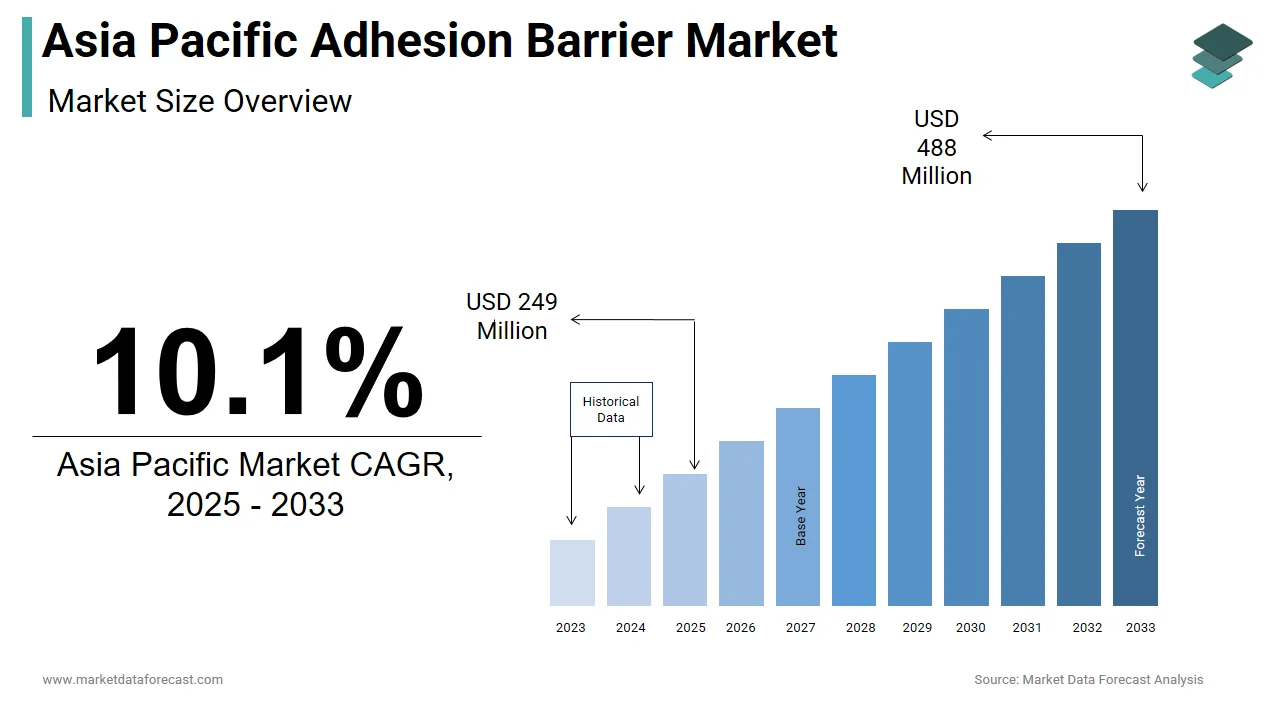
- Market Valuation & Forecast: Valued at USD 249 million in 2025, estimated at USD 274.15 million in 2026, and projected to reach USD 592 million by 2034, registering a robust compound annual growth rate (CAGR) of 10.1% from 2026 to 2034.
- Primary Growth Drivers: Rapidly growing geriatric population, rising incidence of chronic disorders requiring surgical interventions, expanding private hospital infrastructure, and surging medical tourism across developing economies like China and India. Counterbalancing restraints include high surgical costs, limited product applications, and extensive clinical trial approval cycles.
Key Asia Pacific Adhesion Barrier Market Segment Metrics (2026–2034)
| Category | Leading Segment Focus | Strategic Growth Vectors |
|---|---|---|
| By Product Type | Synthetic Adhesion Barriers (lead market consumption due to biocompatibility, cost-effectiveness, and wide commercial availability) | Natural Adhesion Barriers (experiencing steady integration through protein and collagen-based tissue formulations) |
| By Product Form | Film and Gel Formulations (dominate procedural preferences owing to ease of placement during open and laparoscopic surgeries) | Liquid Formulations (expanding across complex geometries and minimally invasive access pathways) |
| By Surgical Application | Gynecological & General/Abdominal Surgeries (account for the highest volume of post-surgical adhesion prevention use) | Cardiovascular, Orthopedic, & Urological Procedures (fast-growing application domains due to rising surgery rates) |
| By Country / Region | China & India (act as major revenue centers driven by massive patient volumes, dense populations, and upgrading healthcare facilities) | Japan, South Korea, & Southeast Asia (high-growth hubs anchored by advanced medical tech adoption and specialized care centers) |
Major Asia Pacific Adhesion Barrier Market Players & Competitive Landscape
Market Structure: Highly competitive landscape featuring global medical technology leaders alongside specialized regional manufacturers expanding their distribution networks into high-potential developing markets across APAC.
Key Industry Companies: Baxter International Inc., Medtronic Plc., C. R. Bard, Inc., Johnson & Johnson, Sanofi Group, Atrium Medical Corporation, Integra LifeSciences Corporation, Anika Therapeutics Inc., FzioMed, Inc., and MAST Biosurgery AG.
Asia Pacific Adhesion Barrier Market Size
The size of the Asia Pacific adhesion barrier market was worth USD 249 million in 2025. The Asia Pacific market is anticipated to grow at a CAGR of 10.1% from 2026 to 2034 and be worth USD 592 million by 2034 from USD 274.15 million in 2026.
MARKET DRIVERS
Growing Surgeries and Awareness Drive Adhesion Barriers Market in APAC
The region's demand for better healthcare facilities, medical devices, and technologies is being driven by a rapidly growing geriatric population, an epidemiological shift from infectious to chronic diseases, increased life expectancy, the expansion of private-sector hospitals in these areas, and an increased demand for surgical interventions. Because no alternative medications are available for surgical adhesion prevention, using adhesion barriers is an effective way to reduce or avoid the occurrence, severity, extent, and consequences of post-surgical adhesions. Adhesive barriers are the only option for post-surgical adhesions, which is projected to increase demand for them throughout the forecast period. The use of adhesion barriers is becoming more common as the number of surgical operations grows. Growing awareness about the usage of adhesion barriers after surgery in the Asia Pacific region is expected to fuel demand for adhesion barriers and, as a result, contribute to market development during the forecast period.
MARKET RESTRAINTS
The APAC Adhesion Barrier Market is expected to be hampered by the restricted uses of a few product types of adhesion barriers and the high cost of surgeries.
MARKET OPPORTUNITIES
The growing need for and availability of adhesion barriers for use in abdominal, gynecologic, orthopedic, cardiovascular, reconstructive, and urological procedures is likely to provide huge growth opportunities for APAC Adhesion barrier manufacturers. The expansion of this market is being fueled by an increase in the number of surgeries and sports-related injuries, as well as an increase in the elderly population and increased awareness of adhesion formation and related diseases.
The growing disease burden and amount of surgical procedures performed in this region are likely to provide growth opportunities for adhesion barrier market players. Because of the serious consequences of post-surgery adhesions in patients, the market for treatments like adhesion barriers is growing. In addition, as the number of surgeries performed in the APAC region rises, the relevance of these products will expand in the future years.
MARKET CHALLENGES
With the increased risk of post-operative adhesion, however, the industry continues to face challenges in terms of accessibility, health education, and awareness of the importance of treatment. New adhesion barriers need significant investment, and new products often take more than 7–8 years to gain marketing approval. The cost and time it takes for a product to undergo clinical trials and then pass those tests is extremely expensive, with just a small possibility of the product receiving approval.
GEOGRAPHICAL ANALYSIS
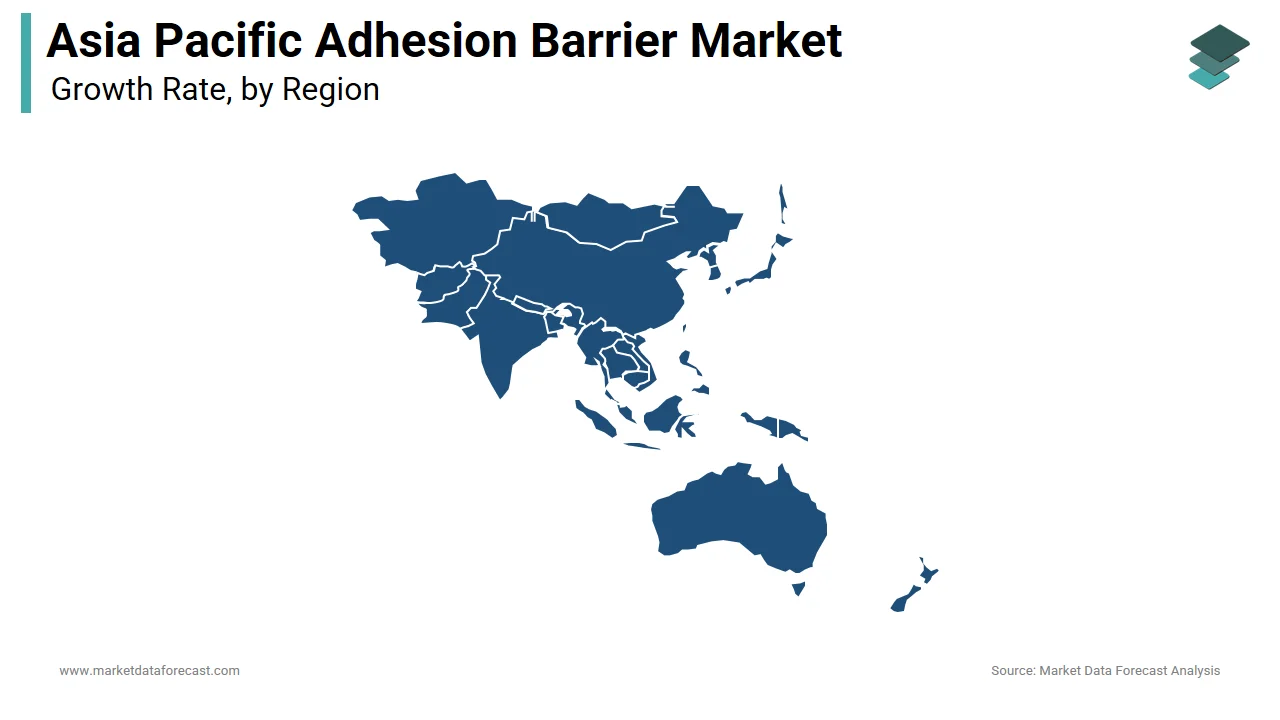
The adhesion barrier market in APAC is expected to develop at the quickest rate during the forecast period, owing to rising medical tourism and an ageing population that is more vulnerable to injuries and fractures, all of which lead to a rise in the number of surgeries. Furthermore, major firms are investing in the region's undeveloped market as part of their business strategy, resulting in the region's fastest development. Due to the expanding elderly population and increasing prevalence of cardiac and neurosurgery, which necessitate surgical treatments, Asia-Pacific is expected to surpass all other areas by recording the greatest CAGR from 2025 to 2033.
Furthermore, the market in the area is expected to be driven by increased private sector investment in healthcare and quickly developing medical tourism. Due to its enormous population and developing healthcare industry, Asia Pacific is the most lucrative healthcare market. With a large and expanding population, the total disease prevalence in nations like China and India is increasing at an alarming rate.
KEY MARKET PLAYERS
The Top companies leading in the Asia Pacific adhesion barrier market profiled in the report are Baxter International Inc., Medtronic Plc., C. R. Bard, Inc., Johnson & Johnson, Sanofi Group, Atrium Medical Corporation, Integra Lifesciences Corporation, Anika Therapeutics Inc., FzioMed, Inc., and MAST Biosurgery AG.
MARKET SEGMENTATION
This Asia Pacific adhesion barrier market research report is segmented and sub-segmented into the following categories.
By Product
- Synthetic
- Natural
By Product Form
- Film
- Gel
- Liquid
By Surgical Application
- Gynecological
- Cardiovascular
- Neurological
- Orthopaedic
- General/Abdominal
- Urological
- Reconstructive
By Country
- India
- China
- Japan
- South Korea
- Australia
- New Zealand
- Thailand
- Malaysia
- Vietnam
- Philippines
- Indonesia
- Singapore
- Rest Of APAC