- Product Description Description
- Table of Contents TOC
- List of Table & Figure LOT
- Get Free Sample PDF Sample PDF
Market Size, 2025
$1.85 BnMarket Estimate, 2026
$2.10 BnMarket Forecast, 2034
$5.71 BnCAGR, 2026–2034
13.34%Executive Summary: Asia Pacific Agricultural Grow Lights Market
- Market Scope: Comprehensive analysis of the Asia Pacific agricultural grow lights market covering technologies, installation types, light spectrums, applications, country-level dynamics, growth drivers, and competitive landscapes.
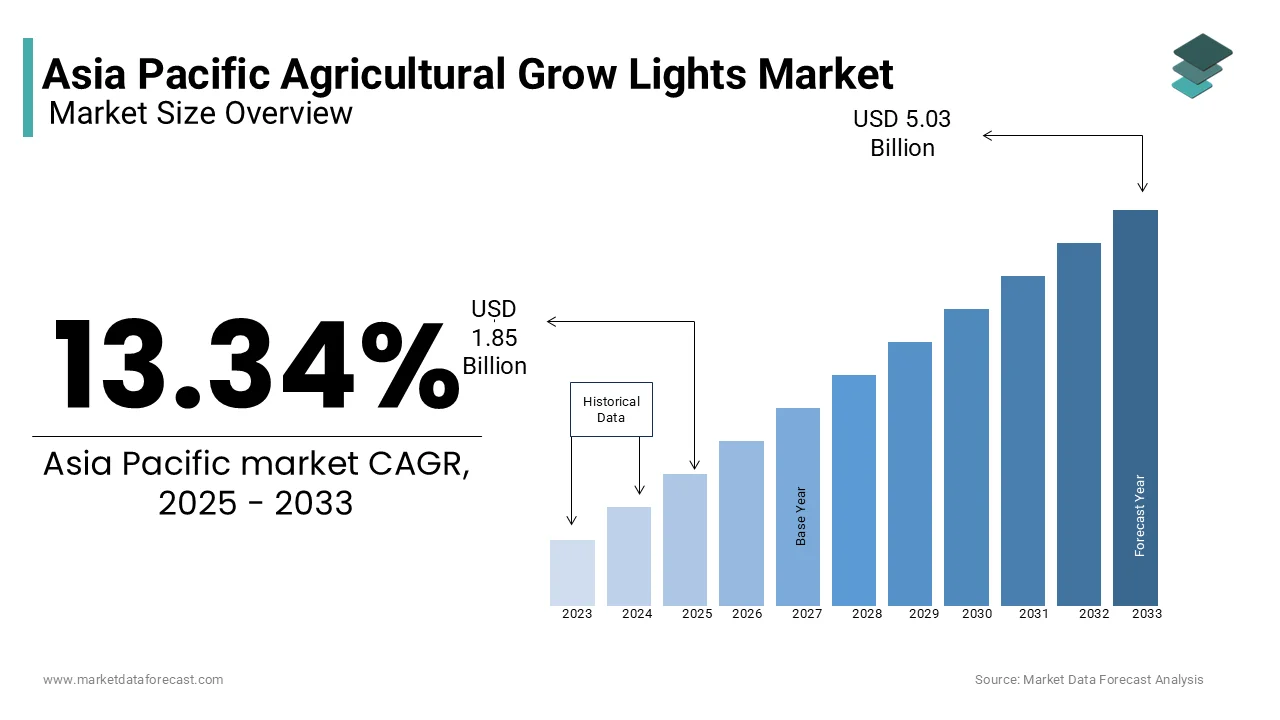
- Market Valuation: Valued at USD 2.10 billion (2025), estimated at USD 2.63 billion (2026), and projected to reach USD 5.71 billion by 2034, registering a robust CAGR of 13.34% during the forecast period (2026–2034).
- Primary Growth Drivers: Proliferation of commercial greenhouse and vertical farming practices, depleting availability of arable land coupled with rising food demand, and the high efficiency, low energy consumption, and precise spectral control offered by LED grow lights.
Key Market Segment Metrics (2026–2034)
| Category | Leading Segment (2025 Position) | Fastest-Growing Segment |
|---|---|---|
| By Technology | HID & Fluorescent Lighting (historically popular among traditional commercial growers and hobbyists) | LED Technology (experiencing rapid growth due to superior energy efficiency, lower heat output, and customized light spectra) |
| By Type of Installation | Retrofit Installations (holds a larger market share as existing agricultural facilities upgrade to advanced lighting systems) | New Installations (driven by the continuous expansion of modern vertical farms and high-tech greenhouses) |
| By Application | Commercial Greenhouses (account for major volume usage across extensive agricultural operations) | Vertical Farming & Indoor Plant Factories (growing rapidly in space-constrained urban economies like Japan and Singapore) |
| By Region / Country | China & Japan (anchor regional demand through extensive warehouse plant factories and commercial greenhouse setups) | India, South Korea, & Rest of APAC (registering high CAGR driven by government agricultural investments and modern farming adoption) |
Major Market Players & Market Structure
Market Structure: Moderately competitive lighting technology and horticultural engineering landscape featuring global electronics conglomerates and specialized agricultural lighting firms competing on energy efficiency, wavelength precision, and durability.
Key Companies: Royal Philips, General Electric Company, Osram Licht AG, Gavita Holland B.V., LumiGrow, Inc., Heliospectra AB, Transcend Lighting Inc., Iwasaki Electric Co., Ltd., Illumitex Inc., Hortilux Schreder B.V., Sunlight Supply Inc., and others.
 Download Free Sample Report
Asia Pacific Agricultural Grow Lights Market Size
The Asia Pacific agricultural grow lights market was size valued at USD 1.63 billion in 2024 and is anticipated to reach a valuation of USD 2.10 billion in 2025 from USD 5.71 billion by 2034, growing at a CAGR of 13.34% during the forecast period from 2026 to 2034.
LED grow lights are more efficient and powerful as compared to the older generation high-pressure sodium and metal halide bulb grow lights. They lower the electricity bill and produce less heat. Less heat allows putting the light closer to plants, they do not get burned. The quality of light is better for growing with LED specialized grow lights. These specialized grow lights provide homogeneous light distribution. Light distribution at precisely the right wavelengths is made possible. LED light sources offer light distribution for good photosynthetic response. Vendors are able to stimulate plant growth. Flora series LEDs provide accelerated photosynthesis and energy savings.
MARKET DRIVERS
Grow lights, especially LEDs are used extensively in farming-related applications, due to the advantages they offer such as high reliability, low power consumption, and spectral intensity. The increasing commercial greenhouse and vertical farming practices, which require the use of different grow lights, are driving the growth of the overall grow lights market. Factors such as constantly growing demand for food coupled with depleting availability of land for farming is further going to aid the market growth. Moreover, plant factories that allow the growing of vegetables indoors all year-round using LED lights that minimize power consumption. It artificially creates the environment necessary for plants to grow by controlling the amount of culture solution, air, and light from light-emitting diodes. Because the amount of light, temperature, humidity, and carbon dioxide concentration levels can be optimized without being affected by the weather, not only is the growth rate better than those grown in open fields, even the yield is at least ten times higher.
REPORT COVERAGE
| REPORT METRIC | DETAILS |
| Market Size Available | 2025 to 2034 |
| Base Year | 2025 |
| Forecast Period | 2026 to 2034 |
| CAGR | 13.34% |
| Segments Covered | By Technology, Type of Installation, And By Country |
|
Various Analyses Covered | Global, Regional & Country Level Analysis, Segment-Level Analysis, DROC, PESTLE Analysis, Porter’s Five Forces Analysis, Competitive Landscape, Analyst Overview on Investment Opportunities |
|
Regions Covered | India, China, Japan, South Korea, Australia, New Zealand, Thailand, Malaysia, Vietnam, Philippines, Indonesia, Singapore and Rest of APAC |
|
Market Leaders Profiled | Royal Philips, General Electric Company, Osram Licht AG, Gavita Holland B.V., LumiGrow, Inc., Heliospectra AB, Transcend Lighting Inc., Iwasaki Electric Co., Ltd., Illumitex Inc., Hortilux Schreder B.V. and Sunlight Supply Inc. |
SEGMENT ANALYSIS
By Technology
Traditional lighting technologies such as high-intensity discharge (HID) and fluorescent lighting are quite popular among commercial growers as well as hobbyists. Even though LED grow light is a new technology, it is proving to be far more effective than other lighting technologies. Though LED grow lights are expensive, their long-term benefits in terms of energy efficiency make them an ideal option for indoor plant cultivation.
By Type of Installation
The market for retrofit installations is likely to hold a larger market share during the forecast period. Retrofitting is defined as removal of an existing grow light and installing a new one, either of the same lighting technology or of a different lighting technology. New installations are generally characterized by the expansion of existing facilities or setting up of a new facility, such as a new greenhouse or a vertical farm.
COUNTRY ANALYSIS
On the basis of geography, the market is analyzed under various regions namely India, China, Japan, Australia and South Korea. Asia Pacific is expected to register the highest CAGR in the coming years. In places, like Japan, where there is a deficiency in the environment, plant factories have continued to thrive with the use of LED grow lights in large warehouse type entities that provide food for the general public and for people who need specialized nutrition.
KEY MARKET PLAYERS
The market is dominated by companies like Royal Philips, General Electric Company, Osram Licht AG, Gavita Holland B.V., LumiGrow, Inc., Heliospectra AB, Transcend Lighting Inc., Iwasaki Electric Co., Ltd., Illumitex Inc., Hortilux Schreder B.V. and Sunlight Supply Inc.
MARKET SEGMENTATION
This research report on the Asia Pacific agricultural grow lights market is segmentd and sub-segmneted into the following categories.
By Technology
- HID
- Fluorescent
- LED
- Induction
- Plasma
By Type of Installation
- New and Retrofit
By Spectrums
- Performance Partial Spectrum
- Full Spectrum
By Application
- Indoor Farming
- Commercial Greenhouse
- Vertical Farming
- Research
By Country
- India
- China
- Japan
- South Korea
- Australia
- New Zealand
- Thailand
- Malaysia
- Vietnam
- Philippines
- Indonesia
- Singapore
- Rest of APAC