Asia Pacific AI Chipsets Market Research Report – Segmented By Chipset (CPU, GPU, FPGA, ASIC, Others), Workload Domain, Computing Technology, and Country (India, China, Japan, South Korea, Australia, New Zealand, Thailand, Malaysia, Vietnam, Philippines, Indonesia, Singapore and Rest of APAC) - Industry Analysis From 2026 to 2034
Market Size, 2025
$13.58 BnMarket Estimate, 2026
$17.42 BnMarket Forecast, 2034
$127.42 BnCAGR, 2026–2034
28.24%Asia Pacific AI Chipsets Market Report Summary
The Asia Pacific AI chipsets market was valued at USD 13.58 billion in 2025, is estimated to reach USD 17.42 billion in 2026, and is projected to reach USD 127.42 billion by 2034, growing at a CAGR of 28.24% during the forecast period from 2026 to 2034. The growth of the Asia Pacific AI chipsets market is driven by the rapid adoption of artificial intelligence across smartphones, data centers, surveillance systems, autonomous technologies, and industrial automation. Strong government initiatives supporting semiconductor self-reliance in China, India, Japan, and South Korea are accelerating domestic chip development. Increasing deployment of edge AI, rising investments in cloud AI infrastructure, and the growing use of AI in smart cities, healthcare, and telecom networks are further fueling market growth. Moreover, the integration of AI with 5G infrastructure, electric vehicles, and next-generation consumer electronics is strengthening long-term demand for specialized AI processors across the region.
Key Market Trends
- Rising adoption of edge AI processors (NPUs) in smartphones, cameras, IoT devices, and automotive systems to enable real-time on-device intelligence.
- Growing investments in domestic semiconductor manufacturing and AI chip design under national digital sovereignty programs.
- Increasing deployment of AI data centers and high-performance computing clusters to support generative AI and large language models.
- Rising demand for high-bandwidth memory (HBM) and advanced interconnect technologies to enhance AI training performance.
- Expanding integration of AI chipsets into telecom infrastructure, 5G networks, and emerging 6G ecosystems.
Segmental Insights
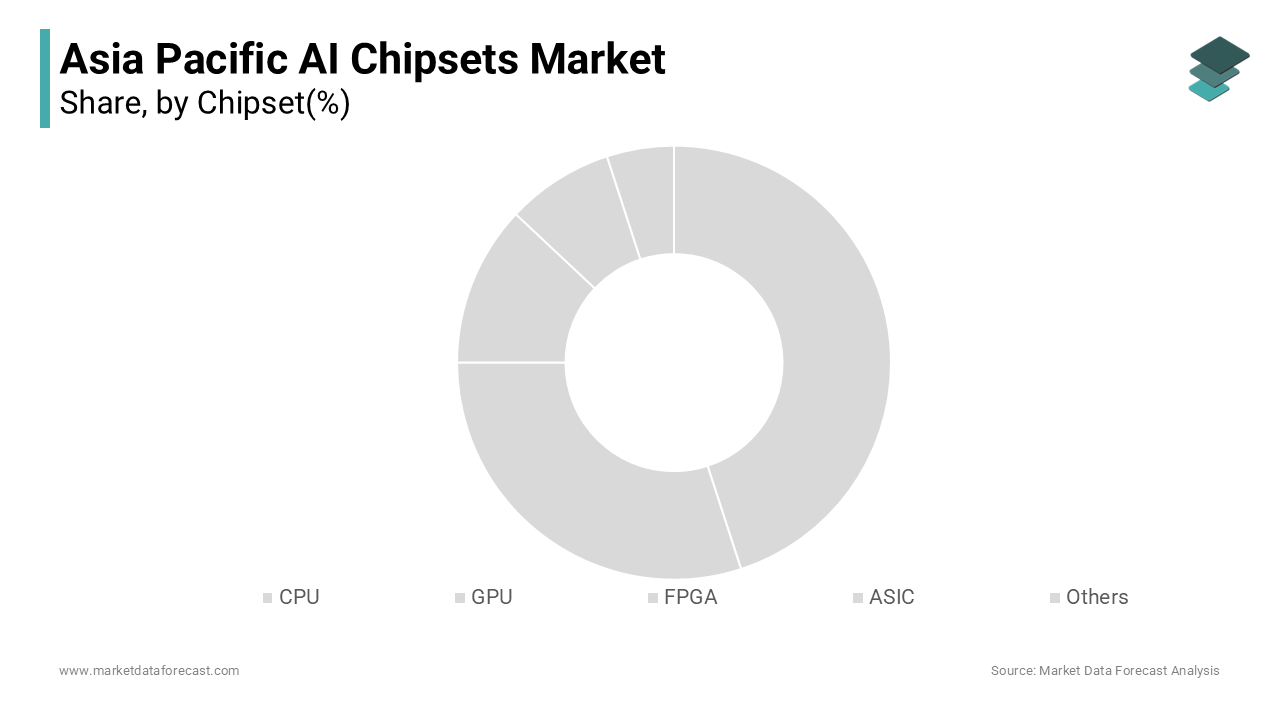
- Based on chipset, the NPU (Neural Processing Unit) segment was the largest and held a significant share of the Asia Pacific AI chipsets market in 2025. The segment’s dominance is attributed to the widespread integration of NPUs in smartphones, edge devices, and automotive systems, where energy-efficient on-device inference is essential.
- Based on workload domain, the inference segment accounted for 63.6% of the market share in 2025, driven by the extensive deployment of AI workloads across consumer electronics, surveillance systems, industrial automation, and smart infrastructure.
- Based on computing technology, the edge AI computing segment is gaining strong traction as organizations increasingly prioritize low-latency processing, reduced cloud dependency, and enhanced data privacy.
Regional Insights
- The Asia Pacific AI chipsets market is witnessing strong growth across major economies, supported by government-led digitization initiatives, increasing AI adoption, and expanding semiconductor ecosystems.
- China was the largest contributor, accounting for 46.3% of the regional market share in 2025, driven by state-backed semiconductor programs, large-scale AI deployment, and strong demand from domestic hyperscalers.
- South Korea holds a strategic position due to its leadership in advanced semiconductor manufacturing, memory technologies, and AI integration across smartphones, displays, robotics, and telecom infrastructure.
- Japan continues to play a critical role in high-reliability AI semiconductors and industrial AI integration, supported by strong applications in robotics, automotive systems, healthcare, and supercomputing platforms.
- India is emerging as a high-potential growth market supported by government semiconductor initiatives, rising AI adoption across sectors, and growing domestic AI chip design capabilities.
- Singapore serves as a regional hub for AI research, data centers, and advanced computing, with strong adoption of AI chipsets in smart city projects, public infrastructure, and cloud AI services.
Competitive Landscape
The Asia Pacific AI chipsets market is characterized by intense competition between global semiconductor giants, regional technology leaders, and emerging domestic innovators. Market competition is increasingly shaped by technological sovereignty, energy efficiency, ecosystem compatibility, and government alignment rather than raw performance alone. Leading companies are focusing on developing proprietary AI accelerators, expanding domestic manufacturing, investing in advanced packaging and memory technologies, and building full-stack hardware–software ecosystems. Strategic collaborations with governments, hyperscalers, telecom operators, and research institutions are strengthening competitive positioning across the region. Prominent players in the Asia Pacific AI chipsets market include NVIDIA Corporation, Intel Corporation, Advanced Micro Devices (AMD), Qualcomm Technologies Inc., Huawei Technologies Co. Ltd., Samsung Electronics Co. Ltd., IBM Corporation, Micron Technology Inc., Apple Inc., Texas Instruments Incorporated, and NXP Semiconductors N.V.
Asia Pacific AI Chipsets Market Size
The Asia Pacific AI Chipsets Market size was valued at USD 13.58 billion in 2025 and is anticipated to reach USD 17.42 billion in 2026 from USD 127.42 billion by 2034, growing at a CAGR of 28.24% during the forecast period from 2026 to 2034.
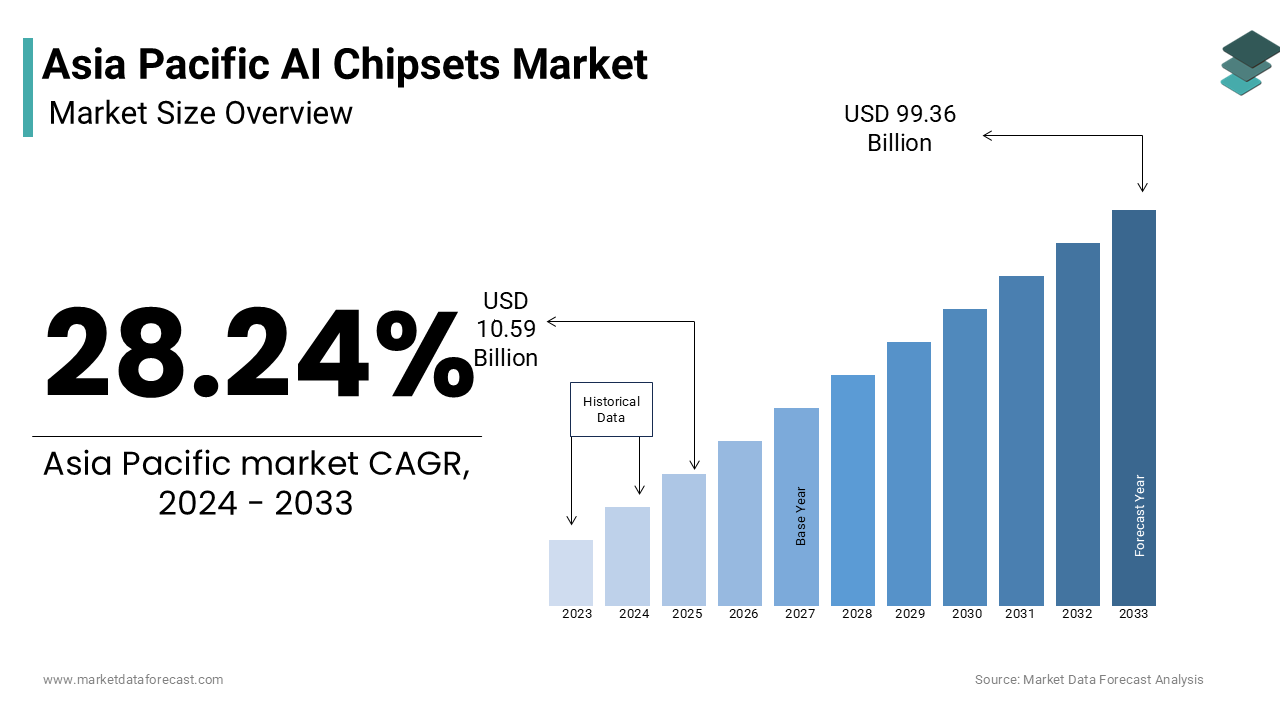
AI chipsets refers to the specialized semiconductor devices engineered to accelerate artificial intelligence workloads, including machine learning inference, deep neural network processing, and real-time data analytics across diverse applications such as smart devices, autonomous systems, and cloud infrastructure. Unlike general-purpose processors, AI chipsets, encompassing GPUs, TPUs, NPUs, and custom ASICs, are optimized for parallel computation, enabling rapid execution of matrix operations essential for AI model deployment. In the Asia Pacific region, the proliferation of AI-driven technologies is deeply intertwined with national digital transformation agendas. China has integrated AI semiconductor development into its 14th Five-Year Plan, prioritizing self-reliance in high-tech components to reduce dependence on foreign suppliers.
In India, the government’s Semiconductor Mission has allocated USD 10 billion to foster local chip design and fabrication, with AI chipsets identified as a strategic focus area. These developments underscore a structural shift: AI chipsets are no longer auxiliary components but foundational enablers of intelligent infrastructure across the region.
MARKET DRIVERS
Expansion of Edge AI Deployments in Industrial and Consumer Applications
The rapid expansion of edge AI across manufacturing, retail, and consumer electronics is a primary catalyst for AI chipset demand in the Asia Pacific region. Unlike cloud-centric AI models, edge AI processes data locally on devices, reducing latency and enhancing privacy critical for real-time applications in smart factories and surveillance systems. These systems rely on NPUs embedded in vision chips to analyze high-resolution camera feeds without relying on external servers. Consumer electronics are also driving adoption; This shift toward decentralized intelligence is increasing the need for power-efficient, high-throughput AI chipsets tailored to specific regional use cases, fueling sustained demand across verticals.
Government-Led Initiatives to Achieve Semiconductor Sovereignty
The concerted push by national governments to achieve semiconductor self-sufficiency and technological autonomy is a defining force behind the growth of the Asia Pacific AI chipsets market. Geopolitical disruptions and supply chain vulnerabilities have prompted countries to prioritize domestic AI chip design and manufacturing. This has led to significant investments in firms like Huawei’s HiSilicon and Cambricon Technologies, which have developed AI accelerators for data centers and autonomous vehicles. Japan has revived its semiconductor industry through the Rapidus Corporation initiative, backed by USD 3.2 billion in public funding, to develop 2nm AI processors for next-generation computing. These state-backed programs are not only reducing import dependency but also fostering innovation ecosystems where AI chip designers can collaborate with universities and industrial partners, accelerating regional technological maturation.
MARKET RESTRAINTS
Shortage of Skilled Semiconductor Design and Fabrication Talent
The acute shortage of skilled professionals in semiconductor design, verification, and advanced manufacturing is a critical impediment to the expansion of the Asia Pacific AI chipsets market. Despite rising investments, the region faces a widening talent gap that hampers innovation and production scalability. The complexity of AI chip development, requiring expertise in machine learning algorithms, low-power circuit design, and 3D packaging, further narrows the talent pool. Taiwan, despite its dominance in foundry services, faces retention challenges as global tech firms lure engineers with higher compensation. This scarcity delays product development cycles and increases reliance on foreign expertise, undermining the region’s goal of technological sovereignty. Without systemic reforms in STEM education and industry-academia collaboration, the talent deficit will continue to constrain the pace of AI chipset innovation.
Geopolitical Restrictions on Access to Advanced Semiconductor Tools and Equipment
The Asia Pacific AI chipsets market is increasingly constrained by geopolitical restrictions limiting access to critical semiconductor fabrication tools and design software. The United States’ export controls on advanced lithography equipment, particularly extreme ultraviolet (EUV) machines manufactured by ASML, have significantly impacted the ability of Chinese and Russian firms to produce sub-7nm AI chips. Additionally, restrictions on EDA software from U.S.-based firms like Synopsys and Cadence, hinder the design of complex AI chip architectures. As per the China Integrated Circuit Industry Investment Fund, over 90% of high-end AI chip designs in China still depend on imported EDA tools, leaving the sector vulnerable to sanctions. Japan and the Netherlands have aligned with U.S. policies, tightening export regulations on dual-use technologies. This has forced companies like Huawei to develop alternative design workflows, but progress remains slow. The lack of indigenous lithography and design infrastructure delays time-to-market and compromises performance parity with global leaders. These external constraints are not merely logistical but strategic, threatening the region’s ambitions for AI hardware independence.
MARKET OPPORTUNITIES
Integration of AI Chipsets in 5G and Beyond-5G Communication Infrastructure
The integration of AI accelerators within 5G and future 6G telecommunications networks to enable intelligent signal processing, beamforming, and network optimization is a transformative opportunity in the Asia Pacific AI chipsets market. As the region deploys dense 5G networks, AI-powered base stations are required to manage dynamic spectrum allocation, interference reduction, and predictive maintenance. These chips, often based on custom ASICs or FPGAs, process massive data streams to optimize latency and bandwidth utilization. With 6G research underway in China and Japan, anticipated to launch by 2030, AI chipsets will be fundamental to terahertz frequency management and holographic beamforming. This convergence of AI and telecom infrastructure is creating a dedicated market for low-power, high-throughput neural processors, positioning semiconductor firms at the core of next-generation connectivity.
Rise of AI-Powered Surveillance and Public Safety Systems
The widespread deployment of AI-powered surveillance systems across Asia Pacific presents a significant growth avenue for AI chipset manufacturers. Governments are increasingly adopting intelligent video analytics for urban security, traffic management, and public health monitoring, all of which rely on edge-based AI processors for real-time facial recognition, behavior analysis, and anomaly detection. These systems prioritize low-latency inference, favoring NPUs and vision processing units over cloud-based solutions. As urbanization accelerates and security demands grow, the need for scalable, energy-efficient AI chipsets in surveillance infrastructure will continue to expand, offering sustained market opportunities.
MARKET RESTRAINTS
High Capital Intensity and Long Development Cycles for Advanced AI Chips
The development and production of advanced AI chipsets in the Asia Pacific region face significant challenges due to the enormous capital investment and extended timelines required for design, fabrication, and validation. Creating a competitive AI accelerator, especially at nodes below 7nm, demands access to cutting-edge foundries, expensive EDA tools, and multi-year R&D cycles. The lack of domestic EUV lithography capabilities further delays production, forcing reliance on TSMC or Samsung, which increases costs and reduces supply chain control. Additionally, the verification process for AI chip functionality can take several months, during which market demands may shift. This high barrier to entry stifles innovation and consolidates market power among a few well-funded players, limiting competition and slowing regional technological diversification.
Fragmentation in AI Frameworks and Hardware Compatibility
A growing challenge in the Asia Pacific AI chipsets market is the fragmentation of AI software frameworks and the resulting lack of hardware interoperability, which complicates chipset adoption and integration. Developers utilize diverse frameworks such as TensorFlow, PyTorch, and PaddlePaddle, each with distinct optimization requirements, while AI chip vendors offer proprietary toolchains that often lack cross-platform support. This fragmentation reduces the agility of OEMs and discourages standardization, fragmenting the ecosystem into siloed solutions. Without unified software-hardware interfaces or open standards for AI inference, the scalability of AI chipsets remains constrained, undermining their potential for widespread deployment across heterogeneous environments.
REPORT COVERAGE
| REPORT METRIC | DETAILS |
| Market Size Available | 2025 to 2034 |
| Base Year | 2025 |
| Forecast Period | 2026 to 2034 |
| CAGR | 28.24% |
| Segments Covered | By Chipset, Workload Domain, Computing Technology and Country |
| Various Analyses Covered | Regional & Country Level Analysis, Segment-Level Analysis, DROC, PESTLE Analysis, Porter’s Five Forces Analysis, Competitive Landscape, Analyst Overview on Investment Opportunities |
| Countries Covered | India, China, Japan, South Korea, Australia, New Zealand, Thailand, Malaysia, Vietnam, the Philippines, Indonesia, Singapore, and the Rest of APAC. |
| Market Leaders Profiled | NVIDIA Corporation, Intel Corporation, Advanced Micro Devices Inc. (AMD), Qualcomm Technologies Inc., Huawei Technologies Co. Ltd., Samsung Electronics Co. Ltd., IBM Corporation, Micron Technology Inc., Apple Inc., Texas Instruments Incorporated, and NXP Semiconductors N.V. |
SEGMENTAL ANALYSIS
By Offerings Insights
The NPU (Neural Processing Unit) segment dominated the Asia Pacific AI chipsets market by capturing 35.3% of total unit shipments in 2025. This lead position is due to the NPU’s architectural specialization in accelerating deep learning inference tasks with high energy efficiency, making it ideal for mobile, edge, and automotive AI applications. A primary driver of NPU dominance is its integration into system-on-chips (SoCs) for smartphones and IoT devices, which constitute the largest volume segment in the region. These NPUs handle on-device tasks such as facial recognition, voice assistants, and camera optimization, reducing reliance on cloud processing and enhancing privacy. Additionally, automotive AI adoption is amplifying NPU demand. The scalability of NPU designs across power and performance tiers ensures applicability from budget phones to premium EVs, solidifying its position as the most widely deployed AI accelerator in the region.
The HBM (High Bandwidth Memory) segment is experiencing the fastest growth within the offerings category and is projected to expand at a CAGR of 26.4% from 2025 to 2033. This surge is driven by the escalating data throughput demands of AI training and high-performance computing (HPC) systems, where conventional DDR memory architectures are insufficient. HBM’s 3D-stacked design enables significantly higher bandwidth critical for AI workloads involving large language models and generative AI. Each AI training node now requires up to 120GB of HBM, a tenfold increase from 2020 configurations. Additionally, Japan’s RIKEN institute confirmed that its Fugaku supercomputer upgrades now prioritize HBM integration to accelerate AI-driven drug discovery. With AI training clusters in India and Singapore also adopting HBM-based GPU stacks, the technology has become indispensable for scalable AI infrastructure, transforming memory from a passive component into a performance-defining element.
By Network Insights
The interconnects segment held the largest share of the Asia Pacific AI chipsets network market with 57.3% of total revenue in 2025. This dominance is rooted in the critical role of high-speed interconnects, such as NVLink, CXL, and proprietary optical fabrics, in enabling seamless communication between AI processors, memory, and storage in data centers. As AI models grow in complexity, the need for ultra-low-latency, high-bandwidth links between GPUs and NPUs has become paramount. The deployment of AI supercomputers across South Korea and India further amplifies demand. Additionally, the rise of disaggregated data centers, where compute, memory, and storage are decoupled, relies heavily on advanced interconnects for dynamic resource allocation. This architectural necessity ensures that interconnects remain the backbone of AI infrastructure scalability.
The NIC (Network Interface Controller) segment is the fastest-growing component in the network category, projected to grow at a CAGR of 22.8% from 2023 to 2030, according to the Asia-Pacific Network Infrastructure Research Group. This acceleration is fueled by the increasing deployment of AI-optimized NICs, also known as SmartNICs, which offload networking, security, and virtualization tasks from CPUs to improve AI workload efficiency. These NICs integrate programmable logic (FPGA or ASIC-based) to accelerate packet processing, enabling faster model synchronization during distributed training. Additionally, 5G edge AI applications in South Korea and Japan rely on SmartNICs to route AI inference requests from base stations to nearby servers with minimal delay. The convergence of AI, cloud-native architectures, and low-latency networking is transforming NICs from passive connectivity devices into intelligent gateways, driving their rapid adoption across AI infrastructure.
By Function Insights
The inference segment dominated the Asia Pacific AI chipsets market by representing 63.6% of total deployments in 2025. This preeminence is driven by the widespread deployment of AI models in real-world applications where low latency, power efficiency, and scalability are critical. Unlike training, which is centralized in data centers, inference occurs at the edge, on smartphones, surveillance cameras, autonomous vehicles, and industrial robots, creating massive volume demand. These include NPUs in smartphones, vision processors in security cameras, and microcontrollers in smart appliances. The rise of on-device AI, driven by privacy concerns and connectivity limitations, further amplifies inference demand. This functional ubiquity ensures that inference remains the dominant use case for AI chipsets across the region.
The training segment is growing at the fastest rate, with a projected CAGR of 24.1% from 2023 to 2030, according to the China National Center for Artificial Intelligence Innovation. This acceleration is driven by the exponential growth of large language models (LLMs), generative AI, and national AI infrastructure investments. Training requires high-performance AI chipsets, typically GPUs, TPUs, or custom ASICs, capable of handling massive parallel computations. South Korea’s Samsung and LG are investing in private AI training clusters to develop proprietary language models, with the Korea Institute of Science and Technology Information confirming that domestic AI training infrastructure spending rose in 2023. Additionally, the emergence of sovereign AI initiatives, where countries seek to train models on localized data, further fuels demand for domestic training infrastructure. As per the Institute of Electrical and Electronics Engineers, the average number of AI training chips per data center in the region increased from 120 in 2020 to 480 in 2023, reflecting the intensifying computational demands of next-generation AI.
REGIONAL ANALYSIS
China occupied the central position in the Asia Pacific AI chipsets market by commanding 46.3% of regional revenue in 2025. Its dominance is anchored in its vast ecosystem of AI startups, hyperscalers, and state-backed semiconductor initiatives. With a large number of AI companies operating nationwide, China has prioritized domestic AI chipset development to reduce reliance on foreign technology. The government’s 14th Five-Year Plan allocates significant amount to semiconductor self-sufficiency, with AI accelerators as a core focus. Additionally, Alibaba and Tencent are designing custom AI chips optimized for inference and cloud workloads. The integration of AI into smart cities, surveillance, and EVs further amplifies demand. Hence, China’s scale of deployment is unmatched, making it the primary engine of AI chipset innovation and consumption in the region.
South Korea holds a strategic position as a technological innovator in the Asia Pacific AI chipsets market. The country’s strength lies in its advanced semiconductor manufacturing and R&D capabilities, particularly in memory and logic chips essential for AI workloads. Samsung’s Exynos and Neural Processing Units are embedded in millions of smartphones and automotive systems, enabling on-device AI inference. The country’s integration of AI into robotics, displays, and 5G infrastructure further drives chipset demand, positioning it as a leader in both memory and logic AI components.
Japan plays a pivotal role in advancing AI chipset reliability and industrial integration within the Asia Pacific market. The country’s influence stems from its leadership in high-reliability semiconductors and AI-driven industrial automation. Renesas and Toshiba have developed AI microcontrollers for robotics and automotive systems. Fujitsu’s A64FX processor, used in the Fugaku supercomputer, supports AI-accelerated scientific simulations, including pandemic modeling and climate prediction. Japan’s focus on Society 5.0, a human-centered smart society, drives AI adoption in healthcare, mobility, and disaster response, all requiring robust, low-power AI chips. Additionally, Japanese firms are pioneering optical interconnects and CXL-based memory expansion for AI clusters. This fusion of precision engineering, industrial application, and long-term reliability ensures Japan’s sustained relevance in high-value AI chipset segments.
India has emerged as a high-potential market in the Asia Pacific AI chipsets landscape. Its significance lies in its rapidly expanding digital infrastructure and government-led semiconductor initiatives. Companies like Tata Electronics and ISRO’s semiconductor division are developing AI accelerators for defense, space, and smart city applications. Additionally, startups like Arya.ai and DarwinAI are designing edge AI chips for agriculture and healthcare. While domestic manufacturing is nascent, India’s growing design talent and strategic partnerships with global firms position it as a future hub for AI chipset innovation.
Singapore has established itself as a regional hub for AI research and advanced computing in the Asia Pacific AI chipsets market. Its role is defined by its world-class research institutions, data center density, and pro-innovation regulatory environment. The country’s Smart Nation Initiative drives demand for AI chipsets in intelligent transport systems, facial recognition at border checkpoints, and predictive maintenance in public infrastructure. While not a manufacturing base, its focus on high-value design, testing, and algorithm-hardware co-optimization positions it as a critical node in the regional AI chipset ecosystem.
COMPETITIVE LANDSCAPE
The competition in the Asia Pacific AI chipsets market is characterized by a dynamic interplay between technological sovereignty, industrial scale, and innovation velocity. Established semiconductor giants such as Samsung, SK Hynix, and Huawei compete with emerging domestic players and global entrants adapting to regional demands. The race is no longer solely about raw computational power but encompasses energy efficiency, software compatibility, and ecosystem integration. Chinese firms are advancing rapidly in AI ASIC development to circumvent export controls, while Japanese and South Korean companies leverage strengths in memory and precision manufacturing. India and Southeast Asian nations are fostering design startups and attracting foreign investment to build indigenous capabilities. The rise of edge AI has lowered entry barriers, enabling specialized firms to target niche applications in surveillance, mobility, and robotics. However, the high cost of advanced node fabrication and reliance on foreign EDA tools and lithography equipment create structural imbalances. Collaboration between governments, academia, and industry is becoming essential to overcome talent shortages and infrastructure gaps. This evolving landscape fosters innovation but intensifies pressure on margins and time-to-market, requiring players to balance strategic autonomy with global interoperability.
KEY MARKET PLAYERS
Key market players in the Asia Pacific AI Chipsets Market include
- NVIDIA Corporation
- Intel Corporation
- Advanced Micro Devices Inc. (AMD)
- Qualcomm Technologies Inc.
- Huawei Technologies Co. Ltd.
- Samsung Electronics Co. Ltd.
- IBM Corporation
- Micron Technology Inc.
- Apple Inc.
- Texas Instruments Incorporated
- NXP Semiconductors N.V.
Top Players in the Asia Pacific AI Chipsets Market
Huawei Technologies is a pivotal force in the Asia Pacific AI chipsets market, driving innovation through its Ascend series of AI processors designed for both training and inference. The company has integrated its Ascend 910B chips into cloud data centers across China and Southeast Asia, enabling large-scale AI model development independent of U.S. technology. Huawei has deepened collaborations with local governments and enterprises to deploy AI chip-powered solutions in smart cities, telecommunications, and autonomous driving. In 2023, it launched the Atlas 900 AI cluster in partnership with China Mobile, utilizing Ascend chips to accelerate AI workloads in 5G network optimization. The company has also expanded its MindSpore AI framework to ensure seamless software-hardware integration, enhancing developer adoption. By investing in domestic semiconductor supply chains and establishing AI computing hubs in countries like Thailand and Malaysia, Huawei is reinforcing its position as a regional leader in sovereign AI infrastructure.
Samsung Electronics plays a transformative role in the Asia Pacific AI chipsets market by combining advanced logic and memory technologies to deliver end-to-end AI solutions. Its Exynos SoCs, embedded with high-performance NPUs, power millions of smartphones, tablets, and automotive systems across the region. Samsung has also developed the SA5 ASIC, a custom AI training chip aimed at hyperscalers and data centers, reducing dependency on foreign accelerators. The company is expanding its foundry capabilities to manufacture AI chipsets for third-party designers, leveraging its 3nm GAA process for energy-efficient AI workloads. In 2023, Samsung partnered with SK Telecom to deploy AI servers using its HBM3 memory and custom accelerators for Korea’s domestic large language model development. Additionally, its investments in neuromorphic and photonic computing research through the Samsung Advanced Institute of Technology are positioning it at the forefront of next-generation AI hardware innovation in the region.
SK Hynix is a cornerstone of the Asia Pacific AI chipsets ecosystem, specializing in high-bandwidth memory solutions that are critical for AI training performance. The company is the world’s second-largest producer of HBM3 and HBM3E memory, supplying leading AI server manufacturers and data centers across China, Japan, and South Korea. SK Hynix has accelerated production ramp-up to meet surging demand from AI cluster deployments, with its Yongsan fab operating at full capacity since early 2023. The company introduced the 24GB HBM3E chip in late 2023, delivering 920 GB/s bandwidth per stack, a critical enabler for generative AI workloads. It has also partnered with NVIDIA and domestic AI firms to co-optimize memory performance in GPU-based systems. Through its strategic focus on advanced packaging and CXL-based memory expansion, SK Hynix is redefining memory’s role in AI infrastructure, ensuring sustained leadership in a component category that is now central to AI performance scalability.
Top Strategies Used by Key Market Participants
Key players in the Asia Pacific AI chipsets market are leveraging vertical integration, strategic partnerships with hyperscalers, investment in domestic fabrication, co-design of hardware and software stacks, and expansion into edge AI applications to consolidate their market presence. Companies are prioritizing energy efficiency, low-latency processing, and compatibility with major AI frameworks to enhance adoption. Foundry alliances, R&D localization, and government-backed semiconductor initiatives are being utilized to overcome supply chain constraints. Firms are also developing specialized accelerators for sectors such as automotive, healthcare, and industrial automation, ensuring application-specific optimization. The integration of HBM and advanced interconnects is central to performance differentiation, while open ecosystem development is fostering developer engagement and long-term platform loyalty across diverse technological domains.
RECENT MARKET DEVELOPMENTS
- In June 2023, Huawei launched the Ascend 910B AI training chip and integrated it into the Atlas 900 AI cluster, enabling domestic Chinese data centers to achieve high-performance AI model training without reliance on foreign semiconductor technology.
- In September 2023, SK Hynix began mass production of its 24GB HBM3E memory at its Icheon facility, delivering 920 GB/s bandwidth per stack to support next-generation AI servers and large language model training clusters across South Korea and Japan.
- In January 2025, Samsung Electronics announced the development of its SA5 ASIC, a custom AI accelerator designed for hyperscale data centers, aiming to capture demand from domestic and regional cloud providers seeking alternatives to U.S.-based chips.
- In March 2023, Alibaba Group unveiled its next-generation Hanguang 800 NPU, optimized for inference workloads in e-commerce and cloud services, and deployed it across 80% of its data centers in China to enhance AI processing efficiency.
- In May 2025, Tata Electronics partnered with the Indian Institute of Technology Madras to establish a joint AI chipset design center in Chennai, focusing on edge AI accelerators for defense, healthcare, and smart infrastructure applications.
MARKET SEGMENTATION
This research report on the Asia Pacific AI Chipsets Market is segmented and sub-segmented into the following categories.
By Chipset
- CPU
- GPU
- FPGA
- ASIC
- Others
By Workload Domain
- Training
- Inference
By Computing Technology
- Cloud AI Computing
- Edge AI Computing
By Country
- India
- China
- Japan
- South Korea
- Australia
- New Zealand
- Thailand
- Malaysia
- Vietnam
- Philippines
- Indonesia
- Singapore
- Rest of APAC
Frequently Asked Questions
What are AI chipsets?
AI chipsets are specialized processors designed to accelerate artificial intelligence workloads such as machine learning and deep learning.
What is the Asia Pacific AI chipsets market?
It refers to the regional market for AI-focused semiconductors used across devices, data centers, automotive, and industrial applications in Asia Pacific.
What is driving the growth of the AI chipsets market in Asia Pacific?
Growth is driven by rising adoption of AI in smartphones, cloud computing, IoT, autonomous vehicles, and smart manufacturing.
Which industries use AI chipsets the most?
Major users include consumer electronics, data centers, automotive, healthcare, finance, and industrial automation.
What types of AI chipsets are available?
Common types include GPUs, ASICs, FPGAs, NPUs, and AI accelerators.
Why are GPUs important in AI processing?
GPUs handle parallel processing efficiently, making them ideal for training and running AI models.
How are AI chipsets used in smartphones?
They power features such as facial recognition, voice assistants, camera enhancement, and on-device AI processing.
What role do AI chipsets play in data centers?
They enable faster AI model training, real-time data processing, and advanced analytics.
Which countries lead the AI chipset market in Asia Pacific?
China, South Korea, Japan, Taiwan, and India are major contributors due to strong semiconductor ecosystems.
What is the future outlook for the Asia Pacific AI chipsets market?
The market is expected to grow rapidly with continued innovation and increasing AI adoption across industries.
Related Reports
Access the study in MULTIPLE FORMATS
Purchase options starting from
$ 2000
Didn’t find what you’re looking for?
TALK TO OUR ANALYST TEAM
Need something within your budget?
NO WORRIES! WE GOT YOU COVERED!
Call us on: +1 888 702 9696 (U.S Toll Free)
Write to us: sales@marketdataforecast.com