- Product Description Description
- Table of Contents TOC
- List of Table & Figure LOT
- Get Free Sample PDF Sample PDF
Market Size, 2025
$0.28 BnMarket Estimate, 2026
$0.30 BnMarket Forecast, 2034
$0.56 BnCAGR, 2026–2034
8.00%Asia Pacific Gas Analyzer Systems Market Size
The Asia Pacific Gas Analyzer Systems Market size was valued at USD 0.28 billion in 2025 and is anticipated to reach USD 0.30 billion in 2026 from USD 0.56 billion by 2034, growing at a CAGR of 8.00% during the forecast period from 2026 to 2034.
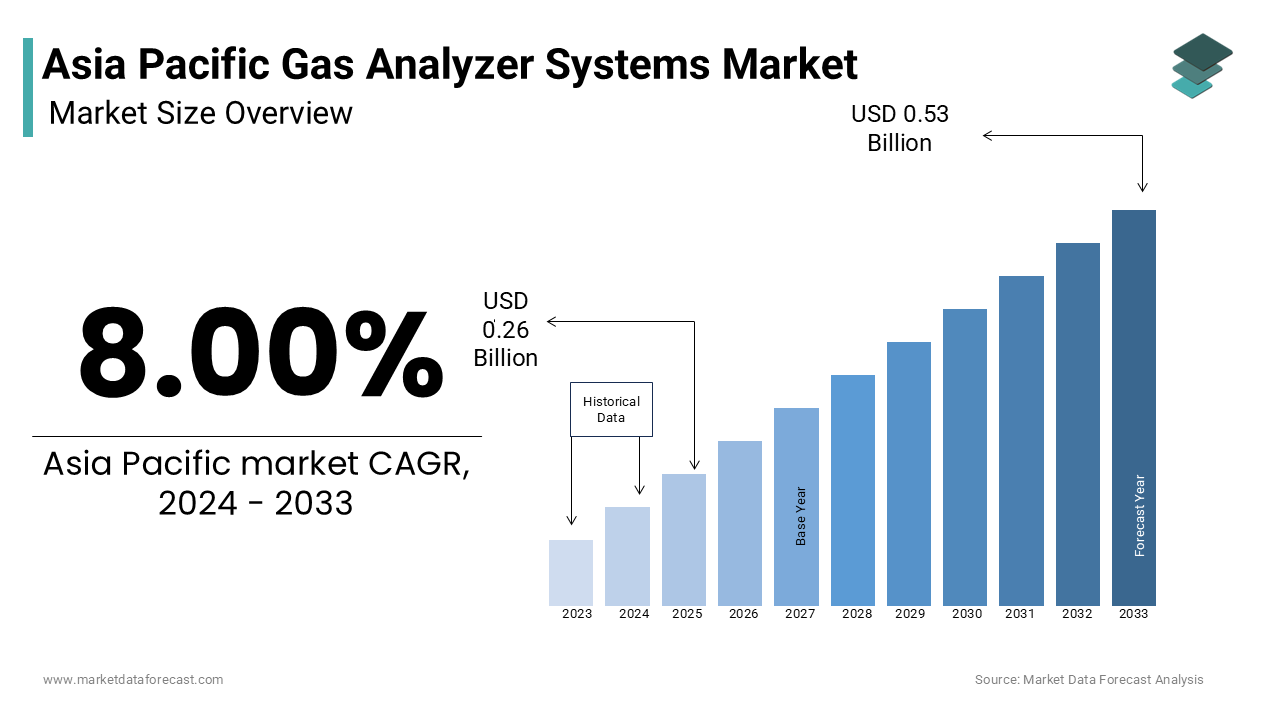
Gas analyzer systems refer to the advanced instrumentation designed to detect, measure, and monitor the concentration of gaseous components in industrial, environmental, and safety-critical applications. These systems utilize technologies such as infrared spectroscopy, paramagnetic detection, thermal conductivity, and laser-based sensing to provide real-time data on gases including oxygen, carbon monoxide, sulfur dioxide, methane, and volatile organic compounds. Their role extends beyond process optimization to ensuring regulatory compliance, worker safety, and environmental protection across sectors like petrochemicals, power generation, semiconductor manufacturing, and wastewater treatment. A defining feature of the region is its rapid industrial expansion, particularly in energy-intensive industries where emissions monitoring is now mandatory.
According to the Asian Development Bank, a large number of coal-fired power plants are currently operational in the region, each requiring continuous emissions monitoring systems (CEMS) equipped with gas analyzers to comply with national air quality standards. In China, the Ministry of Ecology and Environment mandates that all industrial boilers and furnaces above 10蒸 tons/hour be fitted with real-time gas monitoring systems, driving widespread adoption. Similarly, In Japan, the Industrial Safety and Health Act requires continuous monitoring of toxic and combustible gases in confined spaces, reinforcing the integration of portable and fixed gas analyzers in manufacturing. Hence, the demand for reliable, high-precision gas analysis has become a cornerstone of operational integrity and environmental stewardship across the region because of increasing urbanization and industrialization.
MARKET SEGMENTATION
Stringent Environmental Regulations and Emissions Monitoring Mandates
Governments across the Asia Pacific are enforcing increasingly rigorous air quality and industrial emission standards, making gas analyzer systems essential for compliance in energy, manufacturing, and chemical sectors. Also, India’s National Clean Air Programme (NCAP) targets a 40% reduction in PM10 levels by 2026, targets 131 non-attainment cities to install continuous emissions monitoring systems (CEMS). In South Korea, the Ministry of Environment enforces the Clean Air Conservation Act, which requires reporting from 1,200+ large-scale facilities, including petrochemical complexes in Ulsan and Yeosu. These legal frameworks transform gas analyzers from optional tools into regulatory necessities, driving sustained demand across both new installations and system upgrades.
Expansion of Oil & Gas and Petrochemical Infrastructure
The growth of upstream, midstream, and downstream hydrocarbon operations across Asia Pacific is a pivotal driver for gas analyzer systems, which are critical for process safety, efficiency, and emissions control. Moreover, China remains the largest importer of crude oil and liquefied natural gas (LNG), with the National Bureau of Statistics reporting that LNG import capacity reached 116 million tons per year at the end of 2023, supported by 29 terminals in operation. Also, in India, the Ministry of Petroleum and Natural Gas is expanding the Pradhan Mantri Urja Ganga pipeline network to cover 3,384 km, as per Gas Authority of India Limited (GAIL). Further, Indonesia’s Pertamina and Malaysia’s PETRONAS operate large-scale refineries and gas processing plants where analyzers monitor H2S, CO, and methane levels to prevent corrosion and explosions. Additionally, hydrogen production projects in Japan and South Korea, part of their decarbonization strategies, require ultra-precise analyzers to detect trace impurities that could damage fuel cells. As the region’s energy infrastructure expands and diversifies, gas analyzer systems remain indispensable for operational integrity and risk mitigation.
MARKET RESTRAINTS
High Initial Cost and Complex Maintenance Requirements
Their high capital cost and the technical expertise required for calibration, maintenance, and troubleshooting are significant barrier to the widespread adoption of gas analyzer systems in the Asia Pacific. These systems require regular calibration with certified gas standards, filter replacement, and software updates, often necessitating on-site service by trained technicians. In remote areas of Indonesia and the Philippines, access to qualified personnel is limited, leading to system downtime and non-compliance. Additionally, spare parts for foreign-made analyzers may take weeks to arrive, disrupting operations. Without localized service networks and affordable maintenance contracts, many operators resort to manual sampling or less accurate methods, constraining market growth, particularly in price-sensitive and logistically challenging regions.
Lack of Standardization and Interoperability Across Systems
The absence of unified technical standards and communication protocols for gas analyzer systems across Asia Pacific hampers integration, data sharing, and regulatory consistency. Different countries and industries adopt varying calibration methods, sensor technologies, and data reporting formats, creating fragmentation. In Southeast Asia, for instance, Thailand, Vietnam, and Myanmar use different emission thresholds and analyzer certification criteria, complicating cross-border operations for multinational firms. Additionally, proprietary software interfaces from manufacturers like ABB, Siemens, and Horiba limit interoperability with plant-wide control systems, requiring costly middleware solutions. In China, while national standards exist, local environmental bureaus often impose additional requirements, forcing operators to recalibrate or replace equipment. The lack of a regional harmonization framework increases compliance burden and discourages investment. Until governments and industry bodies establish common protocols for calibration, data format, and cybersecurity, the market will remain fragmented, limiting scalability and efficiency.
MARKET OPPORTUNITIES
Growth of Smart Manufacturing and Industrial IoT Integration
The rise of smart factories and Industrial Internet of Things (IIoT) across Asia Pacific presents a transformative opportunity for gas analyzer systems to evolve from standalone instruments into networked, data-driven components of intelligent industrial ecosystems. In Japan, the Society 5.0 initiative promotes the integration of real-time sensor data into predictive maintenance and process optimization platforms. Additionally, cloud-based platforms allow operators to access calibration logs, alarm histories, and performance trends from mobile devices, improving decision-making. As industries move toward autonomous operations, gas analyzers are becoming critical nodes in digital twin models, enabling simulation and optimization of process conditions. This shift from reactive to proactive monitoring is unlocking new value and positioning gas analyzers as strategic assets in the digital transformation of industry.
Expansion of Renewable Energy and Hydrogen Economy Initiatives
The transition toward clean energy in Asia Pacific is creating new applications for gas analyzer systems in biogas, hydrogen, and carbon capture infrastructure. South Korea’s Hydrogen Economy Roadmap includes the construction of 1,200 hydrogen stations by 2040. Carbon capture and storage (CCS) projects in Indonesia and Malaysia also rely on gas analyzers to monitor CO2 purity and leakage. As the region builds the infrastructure for a low-carbon future, gas analyzer systems are becoming essential for ensuring safety, efficiency, and regulatory compliance in emerging energy systems.
MARKET CHALLENGES
Sensor Drift and Environmental Interference in Harsh Operating Conditions
The degradation of sensor accuracy due to environmental stressors such as high humidity, temperature fluctuations, and particulate contamination—common in tropical and industrial environments, is a persistent technical challenge in the Asia Pacific gas analyzer systems market. In Southeast Asia, where relative humidity is often high, infrared and electrochemical sensors are prone to condensation, leading to signal drift and false alarms. In coal-fired power plants across India and Vietnam, dust and sulfur compounds coat optical windows and sampling lines, reducing sensitivity and increasing maintenance frequency. In offshore platforms in the South China Sea, salt spray and vibration further accelerate wear. Additionally, cross-sensitivity, where analyzers respond to non-target gases, remains a concern, particularly in complex industrial atmospheres. Without robust environmental hardening, self-diagnostic capabilities, and adaptive calibration, gas analyzers struggle to maintain reliability, undermining trust and operational continuity.
Skilled Workforce Shortage for Operation and Calibration
The effective deployment of gas analyzer systems is constrained by a critical shortage of trained personnel capable of operating, calibrating, and interpreting data from advanced instrumentation. In emerging economies like Vietnam, the Philippines, and Bangladesh, technical education in industrial instrumentation remains underdeveloped. This gap results in delayed maintenance, incorrect calibration, and non-compliance with environmental regulations. In Japan and South Korea, while training is more advanced, an aging workforce is retiring faster than new talent is being trained, creating knowledge transfer bottlenecks. Additionally, the increasing complexity of multi-gas and multi-technology analyzers demands continuous upskilling. Without expanded vocational programs, manufacturer-led certification, and digital training platforms, the human capital gap will remain a systemic barrier to the safe and efficient use of gas analyzer systems across the region.
REPORT COVERAGE
| REPORT METRIC | DETAILS |
| Market Size Available | 2025 to 2034 |
| Base Year | 2025 |
| Forecast Period | 2026 to 2034 |
| CAGR | 8.00% |
| Segments Covered | By Product Type, Technology, End-User and Country |
| Various Analyses Covered | Regional & Country Level Analysis, Segment-Level Analysis, DROC, PESTLE Analysis, Porter’s Five Forces Analysis, Competitive Landscape, Analyst Overview on Investment Opportunities |
| Countries Covered | India, China, Japan, South Korea, Australia, New Zealand, Thailand, Malaysia, Vietnam, the Philippines, Indonesia, Singapore, and the Rest of APAC. |
| Market Leaders Profiled | ABB Ltd., Advanced Micro Instruments, AVL List GmbH, Bhoomi Process Management, Bühler Technologies, Daiichi Nekken, DURAG Group, Ecotech, Emerson Electric Co., Endee Engineers, ENVEA, Fuji Electric Co. Ltd., Horiba Group, Leybold, Mettler Toledo, Sarvesh Analytics, Servomex, Shimadzu Corporation, SICK AG, Siemens, Thermo Fisher Scientific, and Yokogawa Electric |
SEGMENTAL ANALYSIS
By Product Type Insights
The fixed gas analyzer systems segment dominated the Asia Pacific market by capturing an estimated 63.6% share in 2024. The widespread deployment of fixed gas analyzers is driven by regulatory mandates requiring real-time emissions tracking from large industrial and energy facilities. In China, the Ministry of Ecology and Environment requires all coal-fired power plants and major industrial boilers to install Continuous Emissions Monitoring Systems (CEMS), which rely on fixed analyzers for measuring SO₂, NOₓ, CO, and particulate matter. As per the China Electricity Council, over 1,000 gigawatts of thermal power capacity are now equipped with CEMS, each integrating multiple fixed gas analyzers. These legal requirements make fixed analyzers non-negotiable infrastructure, ensuring their dominance in the regional market. Fixed gas analyzers are deeply embedded in plant-wide automation and safety networks, where they provide real-time feedback for process optimization and emergency shutdown protocols. In oil refineries and LNG terminals across South Korea and Malaysia, fixed analyzers monitor hydrogen sulfide (H₂S), methane, and oxygen levels to prevent explosions and ensure product quality. In semiconductor manufacturing facilities in Taiwan and Singapore, ultra-pure gas lines require fixed analyzers to detect trace impurities that could compromise wafer yields. Additionally, fixed systems are integrated with Distributed Control Systems (DCS) and Safety Instrumented Systems (SIS), enabling automated responses such as valve closure or ventilation activation. This seamless integration into critical control loops makes fixed analyzers indispensable for operational continuity and risk mitigation in high-hazard environments.
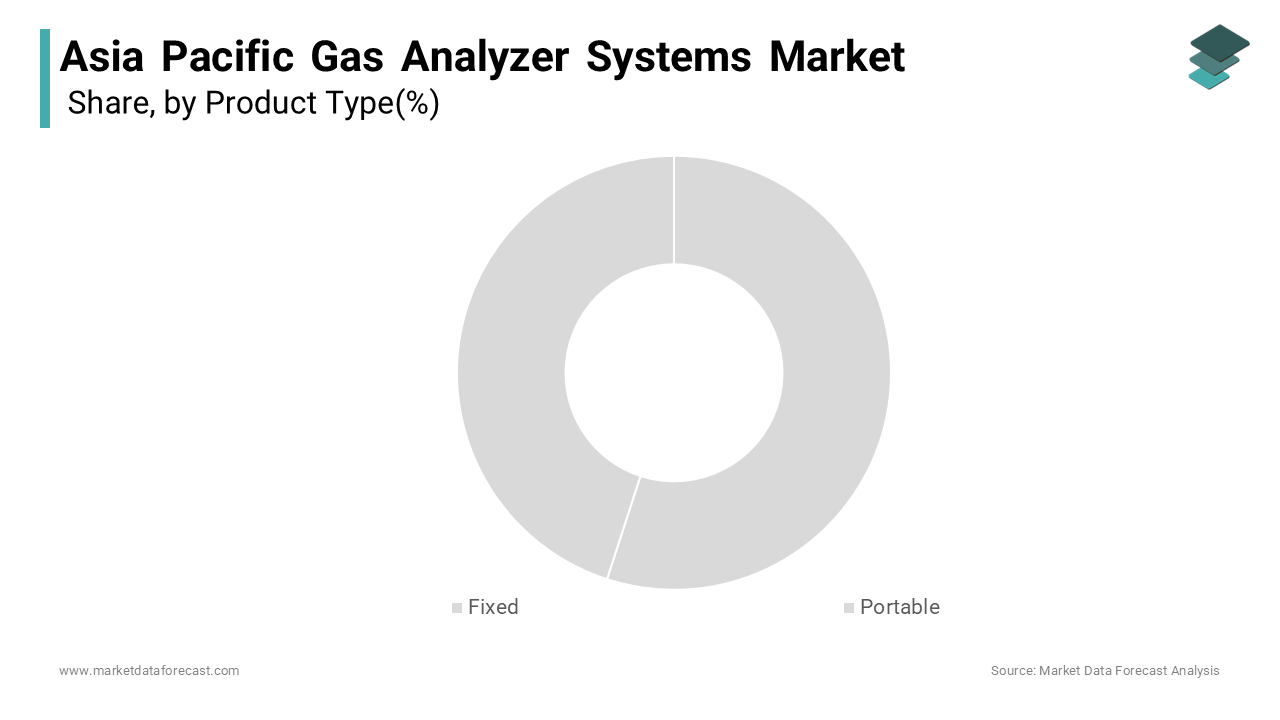
The portable gas analyzer systems segment is projected to grow at the highest CAGR of 10.2% from 2026 to 2034. This rapid expansion is fueled by rising demand for flexible, on-site monitoring across diverse industrial and environmental applications. Portable gas analyzers are essential for ensuring worker safety during maintenance, inspection, and emergency response in confined spaces such as tanks, sewers, and pipelines. In Addition, regulatory bodies are mandating pre-entry gas testing. These devices detect oxygen deficiency, combustible gases, and toxic vapors in real time, enabling immediate evacuation. As industrial safety standards tighten, portable analyzers are becoming standard issue for field personnel. Environmental agencies and utility operators are increasingly deploying portable gas analyzers for on-site emissions audits, pipeline leak detection, and landfill monitoring. These mobile systems offer rapid deployment, GPS-tagged data logging, and wireless reporting, making them ideal for dynamic field operations. As environmental enforcement becomes more proactive, the demand for portable, high-accuracy analyzers is accelerating across the region.
By Technology Insights
The NDIR technology segment prevailed in the market and held the largest share of the Asia Pacific gas analyzer systems market at 31.4% of total revenue in 2024. This dominance is credited to its reliability, selectivity, and broad applicability in detecting greenhouse gases and hydrocarbons. NDIR analyzers are widely used due to their ability to precisely detect gases with strong infrared absorption, such as carbon dioxide, methane, and various hydrocarbons. In power plants and cement factories, NDIR systems are the preferred choice for measuring CO₂ emissions under national carbon reporting schemes. According to the International Energy Agency, China emits over 10 billion tons of CO₂ annually, with NDIR-based CEMS installed in over 80% of large emitters, as verified by the Ministry of Ecology and Environment. In the oil and gas sector, NDIR analyzers monitor methane content in natural gas streams to ensure calorific value compliance. Additionally, in biogas plants, NDIR systems measure CH₄ and CO₂ concentrations to optimize digester performance. The technology’s immunity to cross-interference from non-IR-active gases and its long-term stability make it the gold standard for regulatory and industrial applications. NDIR analyzers require minimal maintenance compared to electrochemical or paramagnetic systems, as they have no consumable parts and are less prone to drift. In industrial settings with high dust, humidity, and vibration, common in India, Indonesia, and Vietnam, NDIR systems maintain accuracy with only periodic optical window cleaning and calibration. In addition, electrochemical cells degrade after 1–2 years, especially in high-temperature environments. Additionally, modern NDIR systems incorporate self-diagnostics, automatic zeroing, and digital signal processing, enhancing reliability. Their robustness makes them ideal for continuous monitoring in remote or unmanned facilities, such as offshore platforms and pipeline compressor stations. As industries prioritize operational continuity and cost efficiency, NDIR technology remains the preferred choice for critical gas measurement applications.
The “Other Technologies” segment, led by Tunable Diode Laser Absorption Spectroscopy (TDLAS) and is experiencing the fastest growth with a projected CAGR of 11.8% in the coming years. TDLAS is gaining traction due to its superior selectivity, speed, and ability to perform in-situ measurements. Unlike traditional extractive analyzers that require gas sampling lines, TDLAS enables in-situ measurement by projecting a laser beam directly across a duct or stack, providing real-time data without transport lag. The Korea Iron and Steel Association notes that TDLAS installations have reduced unplanned shutdowns in steel plants. In China, TDLAS is being adopted in ultra-supercritical power plants to monitor H₂O and O₂ in high-pressure steam lines, where conventional analyzers fail. This ability to operate in extreme conditions—high temperature, pressure, and corrosive environments—makes TDLAS indispensable for next-generation industrial processes. TDLAS offers parts-per-billion (ppb) level detection, making it ideal for applications requiring extreme precision. In hydrogen production and fueling stations, TDLAS detects trace CO and H₂O that can poison fuel cell catalysts. In semiconductor fabs, TDLAS monitors ultra-trace moisture in nitrogen purge lines, where even 10 ppb can affect yield. TDLAS adoption in Asian fabs grew in 2023. Additionally, in carbon capture projects, TDLAS verifies CO₂ purity during compression and transport. As clean energy and high-tech manufacturing expand, TDLAS is becoming the technology of choice for mission-critical gas analysis.
By End-User Vertical Insights
The oil and gas sector commanded the market by securing the biggest share of the Asia Pacific gas analyzer systems market of 29.1% of total revenue in 2024. This lead position is driven by the region’s extensive hydrocarbon infrastructure and stringent safety and emissions requirements. Gas analyzers are essential for detecting explosive, toxic, and asphyxiant gases across the oil and gas value chain. In offshore platforms, fixed and portable analyzers monitor H₂S, CH₄, and O₂ to prevent fires and protect personnel. In LNG terminals, analyzers ensure gas composition meets pipeline specifications, detecting impurities like CO₂ and H₂O that could cause hydrate formation. In refineries, continuous monitoring of flare gas composition ensures combustion efficiency and regulatory compliance. These safety-critical applications make gas analyzers a non-negotiable infrastructure in the sector. Governments are enforcing strict limits on methane emissions and flaring, driving analyzer adoption. As ESG reporting becomes mandatory, operators use analyzer data to demonstrate compliance and reduce carbon footprints, ensuring sustained demand.
The pharmaceutical vertical is the fastest-growing end-user segment and is projected to grow at a CAGR of 10.5% from 2026 to 2034. This growth is driven by stringent quality control and contamination prevention requirements. Pharmaceutical manufacturing requires ultra-clean environments where trace gases can compromise product integrity. These systems ensure inert atmosphere integrity during lyophilization and sterile filling, preventing oxidation and microbial growth. The rise of biologics, vaccines, and injectables has increased demand for controlled atmosphere processing. In biosafety level 3 (BSL-3) labs and vaccine plants, gas analyzers monitor CO₂ in incubators and O₂ in fermentation tanks. As Asia becomes a global hub for contract manufacturing and vaccine production, the need for precision gas analysis is accelerating, positioning the pharmaceutical sector as the fastest-growing market.
REGIONAL ANALYSIS
China Gas Analyzer Systems Market Insights
China led the Asia Pacific gas analyzer systems market by commanding 37.5% of regional revenue in 2024. As the region’s industrial and regulatory leader, China’s dominance is driven by its vast energy and manufacturing base and aggressive environmental enforcement. The Ministry of Ecology and Environment mandates Continuous Emissions Monitoring Systems (CEMS) in various industrial units. Additionally, China’s rapid expansion of LNG import terminals, now totaling 26, requires extensive gas quality monitoring. In the semiconductor sector, fabs in Shanghai and Shenzhen rely on ultra-precise analyzers for process gas control. With strong domestic demand and growing manufacturing of analyzers by firms like Sichuan Sipin, China remains the market leader.
India Gas Analyzer Systems Market Insights
India is emerging as a high-growth market due to tightening environmental regulations and industrial expansion. The National Clean Air Programme (NCAP) has driven CEMS adoption in non-attainment cities, with the Central Pollution Control Board confirming that various industrial units have installed certified analyzers. In pharmaceuticals, the CDSCO’s GMP enforcement has led to widespread analyzer adoption in cleanrooms. However, challenges remain in SME compliance due to cost and technical expertise. To address this, the government is promoting indigenous manufacturing under the PLI scheme. With rising urbanization and industrialization, India’s demand for gas analyzers is set to accelerate.
Japan Gas Analyzer Systems Market Insights
Japan is a leader in high-precision, safety-critical gas analysis. The country’s aging industrial infrastructure requires continuous monitoring for seismic and corrosion risks. The New Energy and Industrial Technology Development Organization (NEDO) supports R&D in laser-based analyzers for clean energy. Additionally, Japan’s semiconductor and pharmaceutical sectors demand ultra-precise monitoring. With strong regulatory frameworks and technological leadership, Japan remains a premium market for advanced gas analyzer systems.
South Korea Gas Analyzer Systems Market Insights
South Korea is a hub for advanced manufacturing and emissions control. The Ministry of Environment enforces strict air quality laws, requiring CEMS in a notable number of large facilities. In semiconductors, Samsung and SK Hynix integrate gas analyzers into fabrication lines to ensure process purity. Additionally, South Korea’s hydrogen economy roadmap includes 660 hydrogen stations by 2030, all requiring certified gas analysis. With strong government-industry collaboration and a focus on smart factories, South Korea is a key growth market.
Australia Gas Analyzer Systems Market Insights
Australia is a leader in mining, LNG, and environmental monitoring. Additionally, Australia’s carbon farming initiatives use portable analyzers to measure soil and vegetation emissions. With vast natural resources and strong safety regulations, Australia remains a stable, high-value market for gas analyzer systems.
KEY MARKET PLAYERS
The key players in the Asia Pacific Gas Analyzer Systems Market include
- ABB Ltd.
- Advanced Micro Instruments
- AVL List GmbH
- Bhoomi Process Management
- Bühler Technologies
- Daiichi Nekken
- DURAG Group
- Ecotech
- Emerson Electric Co.
- Endee Engineers
- ENVEA
- Fuji Electric Co. Ltd.
- Horiba Group
- Leybold
- Mettler Toledo
- Sarvesh Analytics
- Servomex
- Shimadzu Corporation
- SICK AG
- Siemens
- Thermo Fisher Scientific
- Yokogawa Electric
COMPETITIVE LANDSCAPE
The competitive landscape of the Asia Pacific gas analyzer systems market is defined by a convergence of technological sophistication, regulatory complexity, and regional diversification. At the high end, global industrial giants like ABB, Siemens, and Honeywell dominate with integrated, safety-certified systems that serve large-scale infrastructure and regulated industries. Their strength lies in brand trust, global compliance expertise, and deep integration with automation ecosystems. However, a growing cohort of regional and specialized players is challenging this dominance by offering cost-optimized solutions tailored to local industrial needs, particularly in SMEs and emerging sectors. Japanese and South Korean firms emphasize precision and reliability in high-tech manufacturing, while Chinese companies are rapidly advancing in mid-tier systems with strong domestic support. The market is also witnessing disruption from startups introducing wireless, cloud-connected, and AI-enhanced analyzers that simplify deployment and data interpretation. Competition is no longer solely about hardware performance but extends to digital capabilities, service responsiveness, and lifecycle support. Regulatory fragmentation across countries adds complexity, requiring players to adapt quickly to evolving standards. Success hinges on the ability to balance technological leadership with localized execution, ensuring that gas analyzer systems are not only accurate and durable but also accessible, interoperable, and future-ready in an era of industrial transformation.
Top Players in the Asia Pacific Gas Analyzer Systems Market
ABB Ltd.
ABB stands as a pivotal force in the Asia Pacific gas analyzer systems market, leveraging its global expertise in industrial automation and measurement technologies. The company offers a comprehensive portfolio of fixed and portable gas analyzers utilizing advanced principles such as paramagnetic, infrared, and laser-based detection, tailored for critical applications in oil and gas, power, and chemical industries. ABB’s systems are engineered for high reliability, seamless integration with distributed control systems, and compliance with international safety and emissions standards. Its domain-specific solutions, such as process gas analyzers for LNG and combustion optimization systems for thermal power plants, reflect deep industry understanding. Globally, ABB contributes to the advancement of smart sensing and digitalization in industrial processes, with its analyzers forming integral components of Industry 4.0 ecosystems. Through its extensive service network and collaborative R&D initiatives, ABB continues to shape the evolution of gas analysis, ensuring operational safety, efficiency, and environmental accountability across complex industrial landscapes.
Siemens AG (Siemens Smart Infrastructure)
Siemens Smart Infrastructure plays a transformative role in the gas analyzer systems market by integrating precision sensing with digital building and industrial automation platforms. The company specializes in fixed gas detection systems for fire safety, ventilation control, and process monitoring, particularly in high-risk environments such as tunnels, data centers, and manufacturing facilities. Siemens’ gas analyzers are designed for interoperability with its Desigo building management systems, enabling centralized monitoring and predictive diagnostics. The company emphasizes fail-safe design, cybersecurity, and compliance with global standards, making its solutions trusted in mission-critical infrastructure. On the global stage, Siemens drives innovation in sensor fusion, IoT-enabled analytics, and energy-efficient building operations. Its commitment to sustainability is evident in the deployment of gas monitoring systems that optimize HVAC performance and reduce carbon emissions. By bridging physical sensing with digital intelligence, Siemens redefines gas analysis as a strategic enabler of resilient, intelligent infrastructure across urban and industrial settings.
Honeywell International Inc.
Honeywell is a leading innovator in the Asia Pacific gas analyzer systems market, known for its robust, safety-certified solutions across industrial, commercial, and hazardous environments. The company provides a wide range of fixed and portable analyzers for detecting combustible, toxic, and oxygen-deficient gases, with a strong focus on worker safety and regulatory compliance. Honeywell’s systems are widely deployed in refineries, chemical plants, and confined space operations, where reliability under extreme conditions is paramount. The company integrates its gas detection technologies into broader safety and automation platforms, enabling real-time alerts, remote monitoring, and emergency response coordination. Globally, Honeywell contributes to advancing industrial safety standards through continuous R&D in sensor durability, wireless connectivity, and AI-driven diagnostics. Its collaboration with regulatory bodies and OEMs has helped shape best practices in gas monitoring. By combining engineering excellence with digital transformation, Honeywell ensures that gas analyzer systems are not only protective devices but integral components of intelligent, responsive industrial ecosystems.
Top Strategies Used by Key Market Participants
One major strategy employed by leading players is vertical integration of gas analyzer systems with broader industrial automation and safety platforms, enabling seamless data flow into DCS, SCADA, and building management systems. This integration enhances operational visibility, supports predictive maintenance, and strengthens compliance reporting.
Another key approach is the localization of manufacturing, service networks, and technical support to meet regional regulatory requirements and reduce deployment lead times. Companies are establishing regional calibration centers, training programs, and partnerships with local system integrators to improve responsiveness and customer trust in diverse markets.
A third critical strategy is investment in next-generation sensing technologies such as tunable diode laser absorption spectroscopy (TDLAS), photoacoustic detection, and AI-enabled diagnostics to differentiate offerings and address emerging applications in hydrogen, carbon capture, and semiconductor manufacturing, positioning firms at the forefront of high-growth, high-precision sectors.
RECENT MARKET DEVELOPMENTS
- In March 2023, ABB launched a new laser-based gas analyzer for methane detection in LNG terminals across Southeast Asia, enhancing safety and emissions compliance for operators in Indonesia and Malaysia.
- In July 2023, Siemens established a regional gas detection training and calibration center in Singapore to support industrial clients in ASEAN countries, improving service turnaround and technical reliability.
- In November 2023, Honeywell partnered with a leading Indian engineering firm to co-develop a localized CEMS solution for small and medium thermal power plants, addressing cost and compliance challenges in emerging markets.
- In January 2024, Yokogawa Electric introduced a next-generation TDLAS analyzer for hydrogen purity monitoring, targeting fuel cell and green hydrogen projects in Japan and South Korea.
- In April 2024, Emerson Automation Solutions launched a cloud-connected portable gas analyzer with real-time GPS tagging and AI-driven diagnostics, aimed at improving field safety and reporting efficiency in Australian mining and oil & gas operations.
MARKET SEGMENTATION
This research report on the Asia Pacific portable air compressor market is segmented and sub-segmented into the following categories.
By Product Type
- Fixed
- Portable
By Technology
- Electrochemical
- Paramagnetic
- Zirconia (ZR)
- Non-dispersive IR (NDIR)
- Other Technologies
By End-user
- Oil and Gas
- Chemical and Petrochemical
- Water and Wastewater
- Pharmaceutical
- Utility
- Food and Beverage
- Other End-user Verticals
By Country
- India
- China
- Japan
- South Korea
- Australia
- New Zealand
- Thailand
- Malaysia
- Vietnam
- Philippines
- Indonesia
- Singapore
- Rest of APAC