- Product Description Description
- Table of Contents TOC
- List of Table & Figure LOT
- Get Free Sample PDF Sample PDF
Market Size, 2025
$18.74 BnMarket Estimate, 2026
$20.20 BnMarket Forecast, 2034
$36.87 BnCAGR, 2026–2034
7.78%Asia Pacific Automotive Casting Market Summary
The Asia Pacific automotive casting market was valued at USD 18.74 billion in 2025 and is anticipated to reach a valuation of USD 20.20 billion in 2026 and USD 36.78 billion by 2034, growing at a CAGR of 7.78%, from 2026 to 2034.
Key Market Trends & Insights
- China stood as the undisputed leader in the Asia Pacific Market in 2025.
- Japan occupies a pivotal position in the Asia Pacific market in 2025.
- India has emerged as a key player in the Asia Pacific market in 2025.
- Based on the Material, the aluminium segment is expected to emerge as the prominent market in 2025.
- Based on Process, the die casting segment led the Asia Pacific market in 2025.
- Based on the Application, the engine segment remains the largest market in 2025.
- By Vehicle, the passenger vehicles segment is leading the Asia Pacific market in 2025.
Market Size & Forecast
2026 Market Size: USD 20.20 Billion
2034 projected Market Size: USD 36.78 Billion
CAGR (2026 to 2034): 7.78%
China: Largest Market in 2025
Japan: Strongest Growth Region
Asia Pacific Automotive Casting Market Size
The Asia Pacific automotive casting market was valued at USD 18.74 billion in 2025 and is anticipated to reach a valuation of USD 20.20 billion in 2026 and USD 36.78 billion by 2034, growing at a CAGR of 7.78%, from 2026 to 2034.
Automotive casting refers to the metal components manufactured through casting techniques, such as die casting, sand casting, and investment casting, for use in vehicle engines, transmissions, chassis, and structural systems. These components, predominantly made from aluminum, magnesium, and iron alloys, are critical for achieving lightweighting, durability, and precision in modern automotive manufacturing. The region has emerged as a global epicenter for both automotive production and component supply, driven by extensive industrialization and a dense network of original equipment manufacturers (OEMs) and tier suppliers.
As of 2023, the Asia Pacific region accounted for over 58% of global vehicle production, according to the International Organization of Motor Vehicle Manufacturers, reinforcing its dominance in automotive manufacturing ecosystems. The scale of production necessitates a robust and technologically advanced casting infrastructure. Additionally, rapid urbanization and rising disposable incomes across Southeast Asian nations have amplified vehicle ownership rates, further stimulating demand for cast automotive parts. The integration of advanced casting technologies, including high-pressure die casting and vacuum-assisted processes, has enabled manufacturers to meet stringent performance and emission standards. With governments across the region promoting domestic manufacturing under initiatives such as “Make in India” and “China 2025,” the casting sector is witnessing substantial investments in automation and material science innovation.
MARKET DRIVERS
Expansion of Electric Vehicle Production Requiring Lightweight Cast Components
The rapid proliferation of electric vehicles (EVs) across the Asia Pacific region is fundamentally reshaping the demand for advanced automotive castings, particularly lightweight aluminum and magnesium alloy components. Unlike conventional internal combustion engine vehicles, EVs require optimized weight distribution and increased energy efficiency to maximize battery range, making structural die-cast parts indispensable. China leads this transition, with over 8 million EVs sold in 2023, prompting OEMs like BYD, NIO, and Xpeng to adopt large-scale aluminum die-castings for chassis and battery enclosures. Tesla’s Gigafactory in Shanghai has further catalyzed the adoption of mega-casting technologies, influencing local suppliers to invest in high-pressure die-casting (HPDC) machinery capable of producing single-piece underbodies. Moreover, India’s EV market expanded, driving foundries in Pune and Chennai to upgrade their capabilities. The shift toward gigacasting, where entire vehicle sections are cast as single units, reduces part count, significantly cutting assembly time and material waste. This technological shift is supported by government incentives for EV manufacturing in Thailand, South Korea, and Indonesia, further embedding casting innovation into the regional supply chain.
Rising Domestic Vehicle Production and Localization of Supply Chains
The sustained growth in domestic automotive manufacturing across Asia Pacific nations is a pivotal force driving demand for locally produced cast components. Countries such as Thailand, Vietnam, and Indonesia are increasingly positioning themselves as regional production hubs, reducing reliance on imported parts and fostering domestic foundry development. In 2023, Thailand produced over 1.8 million vehicles, maintaining its status as Southeast Asia’s largest automotive producer, as per the Thailand Automotive Institute. This upsurge in production volume necessitates a parallel expansion in casting infrastructure to supply engine blocks, transmission cases, and suspension components. Localization not only reduces logistics costs but also aligns with national industrial policies promoting self-reliance. For instance, Indonesia’s downstream nickel policy has spurred investment in EV battery and component manufacturing, indirectly boosting demand for precision castings used in electric drivetrains. Furthermore, India’s Production Linked Incentive (PLI) scheme has attracted over $2.1 billion in investments in automotive component manufacturing since 2021, as per the Department for Promotion of Industry and Internal Trade. This ecosystem growth ensures sustained demand for both ferrous and non-ferrous castings, particularly as new manufacturing zones in western and southern India expand their foundry capacities.
MARKET RESTRAINT
Volatility in Raw Material Supply and Pricing of Critical Alloys
The Asia Pacific automotive casting industry faces significant headwinds due to the fluctuating availability and pricing of essential raw materials, particularly aluminum, magnesium, and rare earth elements used in high-performance alloys. Magnesium, a critical alloying element for lightweight components, saw even more pronounced volatility. Although prices moderated in 2023, supply instability persists due to environmental crackdowns on small-scale producers in Shaanxi province. This volatility directly impacts casting manufacturers’ cost structures and profit margins, especially for small and medium enterprises lacking hedging mechanisms. Additionally, the region’s reliance on imported bauxite and coke for ferrous casting exacerbates exposure to global trade disruptions. Geopolitical tensions in the South China Sea and export restrictions on critical minerals further threaten material security. Without stable access to affordable raw materials, long-term investment in advanced casting technologies remains constrained, particularly in emerging markets where capital reserves are limited.
Stringent Environmental Regulations Impacting Traditional Foundry Operations
Environmental compliance has emerged as a formidable challenge for traditional foundries across the Asia Pacific region, where aging infrastructure struggles to meet evolving emissions and waste disposal standards. The cost of installing baghouse filters, scrubbers, and closed-loop cooling systems can exceed that of a facility, a significant burden for SMEs. These environmental pressures not only increase operational costs but also delay project approvals and expansions, slowing the sector’s modernization and competitiveness on a global scale.
MARKET OPPORTUNITY
Adoption of Advanced Die-Casting Technologies for EV Structural Components
The transition toward electric mobility in the Asia Pacific region is unlocking unprecedented opportunities for the adoption of next-generation high-pressure and vacuum-assisted die-casting technologies, particularly in the production of large, integrated structural components. Automakers are increasingly embracing gigacasting—a process that enables entire vehicle underbodies to be cast as single units—reducing part count, assembly time, and overall vehicle weight. In 2023, Tesla’s Shanghai Gigafactory began full-scale production using 6,000-ton and 9,000-ton die-casting machines, setting a benchmark for regional OEMs. These machines enable the production of complex aluminum alloy components with wall thicknesses as low as 2.5 mm, enhancing crashworthiness and energy efficiency. Moreover, Japan’s Toyota and South Korea’s Hyundai have initiated pilot programs for rear underbody mega-casting in their EV platforms, signaling broader industry adoption. With governments offering capital subsidies for smart manufacturing, foundries in India and Thailand are also upgrading to semi-solid and vacuum die-casting systems. This technological leap not only reduces production costs but also aligns with the region’s sustainability goals by minimizing material waste and energy consumption.
Growth of Automotive Export Hubs in Southeast Asia
Southeast Asia is evolving into a strategic export-oriented automotive manufacturing hub, creating substantial opportunities for the region’s automotive casting sector. Countries such as Thailand, Indonesia, and Vietnam are leveraging favorable trade agreements, competitive labor costs, and improved port infrastructure to position themselves as export gateways for both internal combustion engine and electric vehicles. This export-driven model necessitates a reliable and scalable supply of cast components, particularly for pickup trucks and compact SUVs, which dominate export volumes. Foundries in these countries are investing in ISO/TS 16949-certified production lines to meet international quality standards. With Japan and South Korea transferring older production lines to Southeast Asia, there is a growing need for backward integration in casting, prompting joint ventures between local foundries and global suppliers like Hitachi Metals and Hyundai WIA.
MARKET CHALLENGE
Technological Disparity Between Large and Small Foundries
The pronounced technological gap between large, integrated foundries and the vast network of small and medium-sized enterprises (SMEs) that dominate the sector is a critical challenge confronting the Asia Pacific automotive casting market. While major players in China, Japan, and South Korea have adopted automated die-casting cells, real-time process monitoring, and AI-driven quality control, a significant portion of regional foundries still rely on manual labor and outdated equipment. This disparity hinders supply chain integration, as OEMs increasingly demand traceability, consistency, and zero-defect casting standards. The cost of upgrading to Industry 4.0-compliant systems, such as integrated melt management and predictive maintenance, can exceed $1 million, a prohibitive investment for SMEs with thin margins. Furthermore, skilled labor shortages exacerbate the issue. Without access to technical support and financing, smaller foundries risk exclusion from high-value contracts, particularly in the EV and export segments. This fragmentation threatens the region’s ability to achieve uniform quality benchmarks and could delay the adoption of next-generation casting techniques across the broader supply chain.
Increasing Competition from Alternative Manufacturing Processes
The Asia Pacific automotive casting industry is encountering intensified competition from alternative manufacturing technologies that offer comparable strength, lower weight, and greater design flexibility. Processes such as hydroforming, additive manufacturing (3D printing), and multi-material stamping are gaining traction in critical automotive applications, eroding the traditional dominance of metal casting. Moreover, Hyundai has integrated 3D-printed metal components into prototype EVs, enabling complex lattice structures that are unachievable through conventional casting. While casting remains cost-effective for high-volume production, alternative methods are proving advantageous for low-to-medium batch runs, especially in high-performance and luxury segments. Additionally, advanced high-strength steel (AHSS) stamping, supported by Japan Steel Works and POSCO, allows for lightweight body structures without the porosity risks associated with large aluminum castings. As design complexity and customization demands rise, casting must evolve beyond traditional geometries to remain competitive. Without significant innovation in process control and material science, the casting sector risks losing market share to these agile, digitally enabled manufacturing alternatives.
REPORT COVERAGE
| REPORT METRIC | DETAILS |
| Market Size Available | 2025 to 2034 |
| Base Year | 2025 |
| Forecast Period | 2026 to 2034 |
| CAGR | 7.78% |
| Segments Covered | By Material, Process, Application, vehicle, Country |
| Various Analyses Covered | Global, Regional and Country Level Analysis; Segment-Level Analysis; DROC; PESTLE Analysis; Porter’s Five Forces Analysis; Competitive Landscape; Analyst Overview of Investment Opportunities |
| Regions Covered | India, China, Japan, South Korea, Australia, New Zealand, Thailand, Malaysia, Vietnam, Philippines, Indonesia, Singapore, and the Rest of APAC |
| Market Leaders Profiled | CFS Foundry, Endurance Technologies, Regensburger Druckgusswerk Wolf GmbH, Bell Foundry, Impro, Zetwerk, Zollern GmbH, Gibbs Die Casting, and Ryobi, Dynacast. |
SEGMENTAL ANALYSIS
By Material Insights
The aluminium segment is emerging as the prominent material in the Asia Pacific automotive casting market by commanding an estimated 4.5% share in 2025. This dominance is primarily fueled by the material’s intrinsic advantages in lightweighting, which directly supports fuel efficiency and emissions reduction targets across both internal combustion engine (ICE) and electric vehicles (EVs). The push for vehicle weight reduction is intensifying, with automakers striving to meet regional CO₂ regulations. In addition, OEMs are increasingly substituting cast iron components with high-strength aluminium alloys, particularly in engine blocks, transmission housings, and structural EV components. Furthermore, advancements in high-pressure die-casting (HPDC) and vacuum-assisted processes have enabled the production of complex, thin-walled aluminium castings with enhanced structural integrity, making them ideal for EV battery enclosures and chassis modules. Tesla’s Shanghai Gigafactory has catalyzed regional foundries to adopt gigacasting techniques using proprietary aluminium alloys, reinforcing the material’s strategic importance.
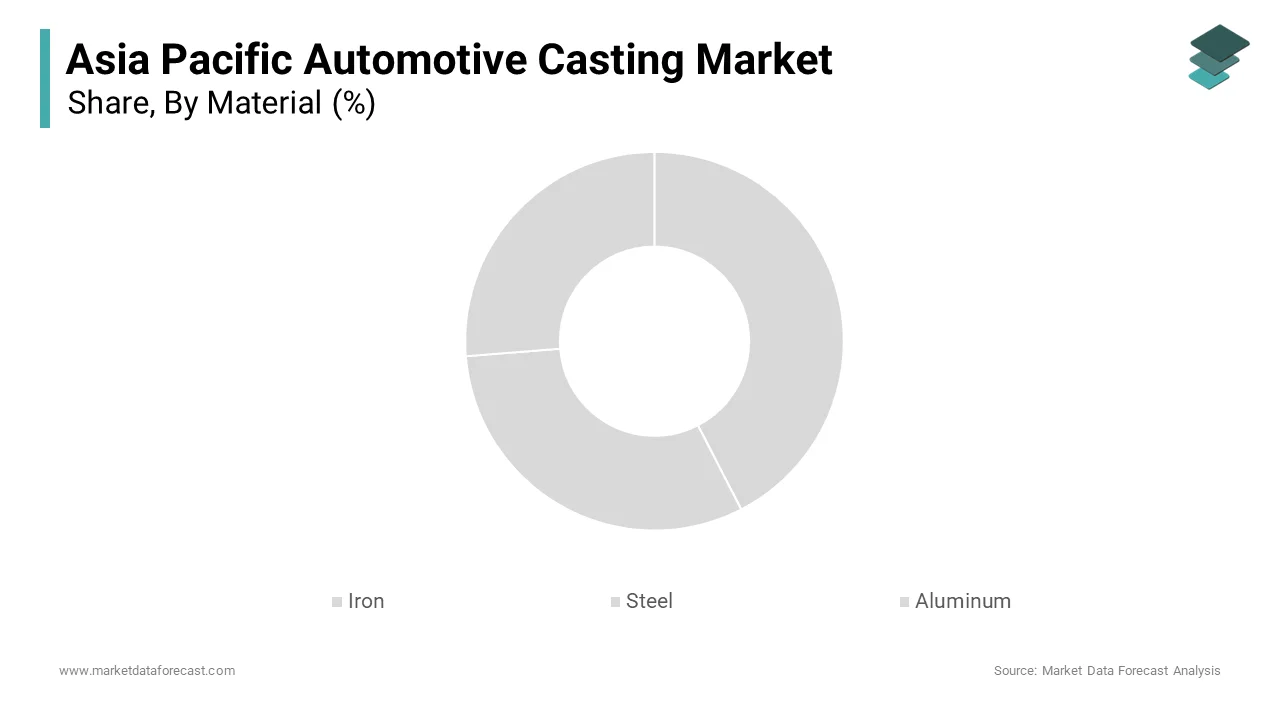
The aluminium is also the fastest-growing material segment in the Asia Pacific automotive casting market and is projected to expand at a CAGR of 7.8% from 2025 to 2033. This accelerated growth is largely driven by the region’s aggressive electrification agenda, where weight reduction is critical for extending battery range and improving vehicle dynamics. Additionally, governments across India, Thailand, and Indonesia are incentivizing local EV manufacturing, which in turn stimulates demand for high-integrity aluminium castings. Moreover, innovations in alloy development, such as Tesla’s proprietary 390-series aluminium-silicon alloy, enable heat-treatable, high-ductility castings suitable for structural applications. As foundries in Japan and South Korea adopt semi-solid die-casting (SSDC) for improved porosity control, the quality and reliability of aluminium components continue to rise, further solidifying its position as the material of choice for next-generation mobility platforms.
By Process Insights
The die casting segment led the Asia Pacific automotive casting market by accounting for 52.6% of total production volume in 2025. This dominance is rooted in the process’s ability to deliver high-precision, complex-shaped components at scale, particularly for lightweight aluminium parts essential in modern vehicle architectures. The proliferation of high-pressure die casting (HPDC) machines across China, Japan, and South Korea has enabled mass production of critical components such as transmission cases, engine covers, and EV battery housings. The rise of electric mobility has further amplified demand for die-cast structural components. Additionally, advancements in vacuum-assisted die casting have significantly reduced porosity and improved mechanical properties, making die-cast parts suitable for safety-critical applications. With governments promoting smart manufacturing and automation, die casting is benefiting from integration with robotics and real-time quality monitoring systems, enhancing yield rates and consistency across high-volume production lines.
The investment casting segment is the fastest-growing process in the Asia Pacific automotive casting market and is projected to grow at a CAGR of 6.5% from 2025 to 2033. Its growth is being propelled by rising demand for high-precision, near-net-shape components in performance and electric vehicles. Unlike sand or die casting, investment casting enables intricate geometries and superior surface finishes, making it ideal for turbocharger housings, exhaust manifolds, and EV motor components. Moreover, the expansion of hybrid powertrains in Japan and South Korea has increased the need for lightweight, heat-resistant castings in exhaust gas recirculation (EGR) systems. The process is also gaining traction in EV drivetrains. Additionally, the adoption of ceramic shell technologies and automated wax pattern assembly lines has reduced lead times and improved dimensional accuracy, making the process more viable for mid-volume production. As emission norms tighten and powertrain complexity increases, investment casting is emerging as a critical enabler of advanced engineering solutions.
By Application Insights
The engine segment remains the largest application area in the Asia Pacific automotive casting market by capturing an estimated 44.2% share in 2025. This lead position is underpinned by the continued reliance on internal combustion engines (ICE) across emerging markets, where affordability and fuel infrastructure favor traditional powertrains. Engine blocks, cylinder heads, and intake manifolds, primarily made from cast iron and aluminium alloys, remain essential components. In India, where ICE vehicles constituted 97% of sales in 2023, the demand for durable, cost-effective cast iron engine blocks remains robust. Furthermore, advancements in engine efficiency, such as downsizing and turbocharging, have increased the complexity of cast components, driving demand for high-integrity processes. Japanese OEMs like Honda and Toyota continue to refine their Earth Dreams and Dynamic Force engines, incorporating lightweight aluminium blocks with plasma-sprayed cylinder liners, further reinforcing the engine segment’s centrality in the casting ecosystem.
The suspension segment is the fastest-growing application in the Asia Pacific automotive casting market and is projected to expand at a CAGR of 7.2% from 2025 to 2033. This rapid growth is driven by the increasing demand for enhanced ride comfort, handling stability, and noise-vibration-harshness (NVH) performance across both passenger and commercial vehicles. Modern suspension systems increasingly incorporate aluminium die-cast knuckles, control arms, and subframes to reduce unsprung mass and improve fuel efficiency. Electric vehicles, in particular, benefit from lightweight suspension components to offset battery weight and improve agility. Besides, India’s commercial vehicle sector is adopting lightweight cast suspension parts to meet Bharat Stage VI emission norms, which emphasize fuel efficiency and reduced particulate emissions. Moreover, foundries in Thailand and Indonesia are investing in high-pressure die-casting cells to meet OEM demands for precision suspension components. As vehicle dynamics become a key differentiator in competitive markets, the suspension segment is poised for sustained expansion, supported by material innovation and advanced casting techniques.
By Vehicle Insights
The passenger vehicles segment led the Asia Pacific automotive casting market by holding a 65.3% share in 2025. This dominance reflects the region’s massive consumer base, rising urbanization, and growing middle-class populations that fuel demand for personal mobility. The shift toward SUVs and crossovers, particularly in China and Southeast Asia, has further amplified casting demand due to their larger size and heavier component requirements. Additionally, the rapid adoption of electric passenger vehicles is reshaping casting needs. With governments promoting domestic manufacturing through incentives and infrastructure development, the passenger vehicle segment continues to drive investment in advanced casting technologies, ensuring its continued market leadership.
The commercial vehicle segment is emerging as the fastest-growing in the Asia Pacific automotive casting market and is projected to grow at a CAGR of 6.9% from 2025 to 2033. This acceleration is driven by expanding logistics networks, e-commerce growth, and infrastructure development across emerging economies. Heavy-duty trucks and buses require robust cast components such as engine blocks, brake drums, and differential housings, typically made from durable grey iron and ductile iron. This upswing is supported by government initiatives like the Bharatmala Pariyojana, which has spurred demand for freight transport. Additionally, the electrification of commercial fleets is creating new opportunities for aluminium casting in electric buses and last-mile delivery vans. As urban freight and public transport electrify, the commercial vehicle casting market is undergoing a structural shift, blending traditional iron casting with advanced lightweight solutions.
COUNTRY-LEVEL ANALYSIS
China
China stood as the undisputed leader in the Asia Pacific automotive casting market by commanding an estimated 46.3% share in 2025. As the world’s largest vehicle producer, China manufactured millions of units in 2023, necessitating a vast and technologically advanced casting infrastructure. The country hosts a notable number of foundries, including global leaders like Ningbo Joyson and Chongqing Hongqing, which supply cast components to both domestic and international OEMs. The government’s “Made in China 2025” initiative has accelerated the adoption of smart foundries equipped with IoT-enabled monitoring and robotic automation. Tesla’s Shanghai Gigafactory has catalyzed the shift toward gigacasting, prompting local suppliers to invest in 6,000-ton HPDC machines. Additionally, China produces a key share of the world’s magnesium, a critical alloying element, giving it a strategic advantage in lightweight casting. Hence, China’s casting sector is at the forefront of innovation, integrating AI-driven defect detection and closed-loop recycling systems to maintain global competitiveness.
Japan
Japan occupies a pivotal position in the Asia Pacific automotive casting market. Renowned for its precision engineering and high-quality manufacturing standards, Japan produces some of the most advanced cast components for global OEMs, including Toyota, Honda, and Nissan. The country’s casting sector is characterized by a strong focus on R&D. Japanese foundries specialize in high-integrity die-cast aluminium parts for hybrid and electric vehicles, with companies like Hitachi Metals and Toyota Auto Body leading in vacuum-assisted casting technologies. Furthermore, Japan’s aging population has accelerated automation in foundries. Despite declining domestic vehicle production, Japan remains a technology exporter, licensing advanced casting processes to Southeast Asian partners. Its emphasis on zero-defect manufacturing and sustainability ensures its continued influence in high-end automotive casting.
India
India has emerged as a key player in the Asia Pacific automotive casting market. The country’s casting industry is undergoing rapid transformation, driven by government initiatives like the Production Linked Incentive (PLI) scheme, which has attracted significant funds in investments in automotive components since 2021. India produced over 5 million vehicles in 2023, with a growing emphasis on localization. The casting sector, concentrated in clusters like Rajkot, Pune, and Coimbatore, supplies a notable share of domestic OEM requirements. However, aluminium casting is gaining traction, particularly for EVs; Tata Motors and Mahindra are increasingly adopting die-cast aluminium suspension and battery components. Additionally, India’s low labor costs and expanding steel and aluminium refining capacity make it an attractive destination for global casting investments. Thus, the casting sector is poised for sustained growth, supported by skill development programs and green manufacturing incentives.
South Korea
South Korea holds a notable share of the Asia Pacific automotive casting market. The country’s casting industry is closely aligned with its dominant automotive OEMs, Hyundai, Kia, and Genesis, which are rapidly transitioning to electric and hybrid platforms. Additionally, Korean foundries are pioneering semi-solid die-casting (SSDC) and thixoforming technologies to produce high-strength, low-porosity parts for structural applications. POSCO and Korea Zinc are investing in high-purity alloy production to support these advanced processes. So, South Korea is leveraging its technological edge to lead in next-generation casting solutions for global EV platforms.
KEY MARKET PLAYERS
CFS Foundry, Endurance Technologies, Regensburger Druckgusswerk Wolf GmbH, Bell Foundry, Impro, Zetwerk, Zollern GmbH, Gibbs Die Casting, and Ryobi, Dynacast. The market players that are dominating the Asia Pacific automotive casting market.
Top Players In The Market
Nemak
Nemak, a global leader in lightweight automotive components, plays a pivotal role in the Asia Pacific automotive casting market through its advanced aluminum die-casting solutions tailored for electric vehicles. The company operates state-of-the-art facilities in China and Thailand, focusing on large structural castings such as battery trays and chassis modules. In recent years, Nemak has intensified its R&D investments to develop proprietary alloys and high-pressure die-casting (HPDC) technologies compatible with gigacasting trends.
The company has also strengthened partnerships with local battery manufacturers to co-develop integrated casting solutions. By aligning with regional electrification goals and adopting Industry 4.0 practices, Nemak has positioned itself at the forefront of next-generation casting innovation in the region, enhancing its technological footprint and supply chain integration.
Faw Foundry Co., Ltd.
Faw Foundry, a subsidiary of China FAW Group, is a dominant force in the Asia Pacific casting landscape, specializing in iron and aluminum castings for engines, transmissions, and commercial vehicles. The company has expanded its capabilities to support the growing demand for lightweight components in new energy vehicles. Faw Foundry has deep integration with domestic OEMs, supplying critical cast parts for FAW-Volkswagen and FAW Toyota joint ventures. It has also invested in vacuum-assisted die-casting technology to meet stringent EV component standards. By leveraging China’s industrial policy support and scaling low-carbon manufacturing processes, including closed-loop sand reclamation and energy recovery systems, Faw Foundry has reinforced its role as a technologically advanced, vertically integrated supplier shaping the regional casting ecosystem.
Hitachi Metals (now part of Mitsubishi Materials Corporation)
Following its integration into Mitsubishi Materials in 2023, Hitachi Metals continues to exert significant influence in the Asia Pacific automotive casting market through high-precision aluminum and ductile iron components. The company maintains advanced production facilities in Japan and Thailand, supplying critical drivetrain and engine parts to Toyota, Honda, and Nissan. Its expertise in thin-wall die-casting and heat-resistant alloys has made it a preferred partner for hybrid and electric vehicle platforms. It has also enhanced digital twin modeling for process optimization and defect prediction. By combining Mitsubishi’s material science capabilities with Hitachi’s engineering legacy, the merged entity is accelerating innovation in lightweight, high-integrity castings, ensuring sustained competitiveness in the evolving mobility landscape across Asia Pacific.
Top Strategies Used By The Key Market Participants
Key players in the Asia Pacific automotive casting market are deploying strategic initiatives to maintain technological leadership and expand their footprint. A dominant strategy is investment in advanced die-casting technologies, particularly high-pressure and vacuum-assisted systems, to meet the demand for large, lightweight structural components in electric vehicles. Companies are also pursuing vertical integration by securing upstream access to aluminum and magnesium alloys to mitigate raw material volatility. Strategic partnerships with EV OEMs and battery manufacturers are enabling the co-development of integrated casting solutions. Digital transformation is another critical focus, with firms adopting AI-driven quality control, predictive maintenance, and smart foundry systems to enhance precision and reduce waste. Geographic expansion into emerging markets such as Vietnam and Indonesia allows access to lower-cost manufacturing bases and growing regional demand. Additionally, companies are aligning with national industrial policies—such as China’s Made in China 2025 and India’s PLI scheme—to leverage government incentives. Sustainability initiatives, including energy recovery systems and closed-loop recycling, are being implemented to comply with tightening environmental regulations and appeal to eco-conscious OEMs.
COMPETITION OVERVIEW
The competitive landscape of the Asia Pacific automotive casting market is marked by a blend of established industrial giants, agile regional foundries, and emerging technology-driven suppliers. Intense rivalry exists as companies strive to capture value in the rapidly evolving electric vehicle ecosystem. Incumbents such as Faw Foundry and Mitsubishi Materials leverage deep OEM relationships and large-scale production capabilities, while global specialists like Nemak focus on innovation in gigacasting and lightweight materials. The market is witnessing a strategic shift from volume-based competition to differentiation through technological superiority, process precision, and sustainability credentials. Local foundries in India, Thailand, and Indonesia are modernizing operations to meet international quality standards and integrate into global supply chains. Meanwhile, Chinese players are scaling automation and digitalization to enhance yield rates and reduce emissions. The entry of EV-focused startups and tiered suppliers has intensified pressure on traditional casting methods, pushing firms to adopt semi-solid die-casting, AI-based defect detection, and modular design approaches. Geopolitical factors, including trade policies and raw material access, further influence competitive dynamics. Companies are increasingly forming joint ventures with Japanese and European technology partners to upgrade capabilities. As OEMs demand fewer, larger, and more complex cast parts, the competitive edge is shifting toward integrated engineering solutions, rapid prototyping, and end-to-end supply chain resilience, redefining leadership in the regional casting domain.
RECENT HAPPENINGS IN THE MARKET
- In January 2023, Nemak launched a 7,200-ton high-pressure die-casting cell at its Zhangjiagang facility in China, enabling production of single-piece EV underbodies for Chinese OEMs, enhancing its technological leadership in gigacasting.
- In June 2023, Faw Foundry inaugurated a smart foundry in Changchun, integrating AI-based quality inspection and automated molding lines to improve efficiency and support new energy vehicle production.
- In October 2023, Hitachi Metals, under Mitsubishi Materials, deployed a semi-solid die-casting (SSDC) line at its Kamaishi plant in Japan, producing high-strength, low-porosity components for hybrid and electric drivetrains.
- In March 2025, Hyundai WIA expanded its aluminum casting capacity in Ulsan, South Korea, investing $180 million to supply structural parts for Hyundai’s IONIQ series of electric vehicles.
- In May 2025, Toyota Auto Body enhanced its vacuum-assisted die-casting capabilities in Thailand, increasing production of lightweight EV components for regional and export markets.
MARKET SEGMENTATION
This research report on the Automotive casting market is segmented and sub-segmented into the following categories.
By Material Type
- Iron
- Steel
- Aluminum
By Process
- Sand Casting
- Die Casting
- Investment Casting
By Application
- Engine
- Transmission
- Suspension
By Vehicle
- Commercial vehicles
- Passenger vehicles
By Country
- India
- China
- Japan
- South Korea
- Australia
- New Zealand
- Thailand
- Malaysia
- Vietnam
- Philippines
- Indonesia
- Singapore
- Rest of APAC