Asia Pacific Automotive Speaker Market Size, Share, Growth, Trends, And Forecast Research Report, Segmented By Type, Vehicle, Installation, Technology, And Country (India, China, Japan, South Korea, Australia, New Zealand, Thailand, Malaysia, Vietnam, Philippines, Indonesia, Singapore and Rest of APAC), Industry Analysis From (2025 to 2033)
Asia Pacific Automotive Speaker Market Summary
The Asia Pacific Automotive Speaker market was valued at USD 2.33 billion in 2024 and is anticipated to reach USD 2.53 billion in 2025 to USD 4.48 billion by 2033, growing at a CAGR of 8.39% during the forecast period from 2025 to 2033.
Key Market Trends & Insights
- China stood as the undisputed leader in the Asia Pacific Market in 2024.
- Japan occupies a strategic position in the Asia Pacific market in 2024.
- India has emerged as a high-growth contender in the Asia Pacific market in 2024.
- Based on Type, the coaxial speaker segment dominated as a prominent market in 2024.
- By Vehicle Type, the passenger vehicle segment is leading the Asia Pacific market in 2024.
- Based on Installation, the door-mounted speaker installation segment held the Asia Pacific market in 2024.
Market Size & Forecast
2024 Market Size: USD 2.33 Billion
2033 projected Market Size: USD 4.48 Billion
CAGR (2025 to 2033): 8.39%
China: Largest Market in 2024
Japan: Strongest Growth Region
Asia Pacific Automotive Speaker Market Size
The Asia Pacific Automotive Speaker market was valued at USD 2.33 billion in 2024 and is anticipated to reach USD 2.53 billion in 2025 to USD 4.48 billion by 2033, growing at a CAGR of 8.39% during the forecast period from 2025 to 2033.

An automotive speaker is also known as a car speaker. It is a type of loudspeaker designed to reproduce sound within a vehicle's audio system. These speakers convert electrical signals into audible sound waves, allowing occupants to listen to music, radio, and other audio sources. Unlike generic audio equipment sectors, this market is defined by its integration within vehicle architectures, adhering to stringent electromagnetic compatibility, durability, and spatial constraints dictated by automotive design. As vehicles evolve into connected mobility platforms, the role of speakers has transcended basic audio reproduction to include active noise cancellation, voice-assisted navigation, and immersive in-cabin experiences.
The proliferation of electric vehicles (EVs) across China, Japan, and South Korea has further accelerated demand for high-fidelity audio systems, as the absence of engine noise elevates acoustic expectations. Urbanization trends in Southeast Asia are also reshaping consumer behaviour. Additionally, India’s vehicle production base, which exceeded 26 million units in 2023 according to the Society of Indian Automobile Manufacturers, underscores the region’s manufacturing gravity. With increasing telematics adoption and rising disposable incomes in Tier-2 and Tier-3 cities, the functional necessity of automotive speakers is being redefined beyond entertainment into domains of safety and human-machine interaction.
MARKET DRIVERS
Rising Consumer Demand for Premium In-Cabin Audio Experiences in New Vehicles
The escalating consumer preference for premium in-cabin audio environments, particularly in mid-to-high-end vehicle segments, is a pivotal force shaping the Asia Pacific automotive speaker market. As urban consumers in countries like China and South Korea exhibit heightened sensitivity to lifestyle enhancements, automakers are integrating high-end audio systems as standard features even in non-luxury models. This shift is further reinforced by the growing middle class. Automakers such as Toyota and Hyundai have responded by partnering with audio specialists. Besides, in Japan, where aging demographics prioritize comfort and clarity, voice-optimized speaker systems with noise-filtering capabilities are increasingly standard. The integration of digital signal processing (DSP) and multi-zone audio further elevates system complexity, increasing speaker count per vehicle. This convergence of affluence, technological expectation, and design innovation solidifies premium audio as a non-negotiable differentiator, directly expanding the speaker component market.
Expansion of Electric Vehicle Production and Its Acoustic Implications
The rapid expansion of electric vehicle (EV) manufacturing across the Asia Pacific region is fundamentally altering acoustic dynamics within vehicle cabins, thereby driving demand for advanced automotive speaker systems. Unlike internal combustion engine (ICE) vehicles, EVs operate with significantly reduced mechanical noise, making ambient and audio sounds more perceptible and subject to scrutiny. This acoustic transparency necessitates the deployment of sophisticated speaker arrays to manage soundscapes, including artificial engine sound synthesis for pedestrian safety and active noise control systems. China, the world’s largest EV market, produced over 7.5 million electric vehicles in 2023, accounting for 60% of global output, as per the China Passenger Car Association. Each new EV model, from NIO’s ET7 to BYD’s Seal, features at least 12-speaker setups, with premium variants incorporating up to 23 speakers integrated with Dolby Atmos or Meridian audio technologies. Furthermore, the absence of engine masking noise in EVs increases the audibility of road and wind noise, compelling OEMs to adopt active noise cancellation (ANC) systems that rely on precisely calibrated speaker networks. This technological pivot not only increases speaker volume per vehicle but also demands higher fidelity, durability, and integration with vehicle control units, thereby expanding the scope and value of the automotive speaker supply chain.
MARKET RESTRAINT
Persistent Cost Sensitivity in Emerging Automotive Markets
Cost sensitivity remains a significant impediment to the widespread adoption of advanced automotive speaker systems across several Asia Pacific economies. In nations such as Indonesia, Thailand, and India, where price-conscious buyers dominate the passenger vehicle segment, manufacturers prioritize affordability over premium infotainment features. In India, a large portion of vehicles sold in India were lower-priced, a segment where basic audio configurations with four speakers or fewer are standard. Automakers often exclude branded audio systems or advanced speaker arrays to maintain competitive pricing, limiting market expansion for high-value components. Moreover, after-sales upgrades remain limited due to a lack of awareness and technical expertise in local repair ecosystems. Even in rapidly growing EV segments, budget models like the Tata Tiago EV and Wuling Hongguang Mini EV feature minimal speaker setups to offset battery and motor costs. This economic reality forces audio component suppliers to operate under tight margin constraints, discouraging investment in R&D for region-specific acoustic solutions. Consequently, while premium models may showcase cutting-edge audio, the broader market remains anchored in basic configurations, constraining the overall growth trajectory of the automotive speaker industry in price-sensitive regions.
Supply Chain Vulnerabilities in Critical Electronic Components
The Asia Pacific automotive speaker market faces substantial disruption risks due to ongoing vulnerabilities in the supply of critical electronic components such as rare-earth magnets, printed circuit boards (PCBs), and semiconductor drivers. These materials are essential for producing high-efficiency, compact speakers capable of meeting modern vehicle integration requirements. China dominates the global supply of rare-earth elements, producing a substantial share of the world’s neodymium and dysprosium, which are crucial for high-performance speaker magnets. However, export restrictions and domestic prioritization for defense and renewable energy sectors have led to periodic shortages and price volatility. Furthermore, disruptions in PCB supply from southern China, where over 50% of automotive-grade boards are manufactured, have delayed speaker module deliveries. These dependencies on concentrated geographic sources create systemic fragility, especially as geopolitical tensions and export controls intensify. Without diversified sourcing or localized production capabilities, the scalability of advanced speaker systems remains constrained, undermining OEMs’ ability to meet rising demand consistently.
MARKET OPPORTUNITY
Integration of Automotive Speakers in Active Safety and Driver Assistance Systems
The integration of audio components into active safety and driver assistance systems, moving beyond entertainment to functional safety applications, is a transformative opportunity within the Asia Pacific automotive speaker market. Modern advanced driver assistance systems (ADAS) increasingly rely on auditory alerts to communicate collision risks, lane departures, and blind-spot warnings, particularly in high-density urban environments where visual distractions are prevalent. In Japan, mandatory installation of acoustic vehicle alerting systems (AVAS) for all new electric and hybrid vehicles has been enforced since 2021, requiring speakers to emit pedestrian-warning sounds at speeds below 20 km/h. Similarly, in South Korea, all EVs and plug-in hybrids include external sound-generating devices, creating a dedicated market for ruggedized, weather-resistant speaker units. Beyond external alerts, internal auditory cues are being optimized for cognitive response. This functional shift is prompting OEMs to deploy multi-speaker arrays with beamforming and spatial audio capabilities. In China, NIO’s ADAS suite utilizes cabin speakers to guide drivers with 3D positional alerts, enhancing situational awareness. This evolution positions automotive speakers as critical safety components, as well as opens new revenue streams and design collaborations between audio engineers and ADAS developers.
Growth of Connected and Autonomous Vehicle Fleets Requiring Immersive Audio Environments
The emergence of connected and autonomous vehicle (CAV) fleets across the Asia Pacific presents a paradigm shift in cabin design, where immersive audio environments become central to passenger experience and operational functionality. As vehicles transition toward higher levels of autonomy, the focus shifts from driver-centric controls to occupant-centric experiences, elevating the role of audio systems in productivity, relaxation, and entertainment. In Singapore, where autonomous shuttle trials have expanded across public zones, operators like ST Engineering are integrating multi-zone audio systems, allowing individual passengers to access personalized sound bubbles using directional speakers. This technology, developed in collaboration with Fraunhofer Institute, relies on phased-array speaker modules capable of isolating sound fields within the same cabin. Furthermore, fleet operators are exploring audio-based analytics, using cabin microphones and speakers for occupancy detection and mood sensing, enhancing service personalization. So, the demand for intelligent audio nodes is accelerating. This shift not only increases speaker count per vehicle but also drives demand for software-defined audio platforms, creating opportunities for suppliers to offer integrated hardware-software solutions tailored to autonomous mobility ecosystems.
MARKET CHALLENGE
Standardization Gaps in Audio Performance Metrics Across Regional Markets
The absence of harmonized standards for audio performance evaluation, leading to fragmented development cycles and inconsistent quality benchmarks across countries, is a critical challenge confronting the Asia Pacific automotive speaker market. Unlike safety or emissions regulations, which are increasingly aligned through regional agreements, acoustic performance criteria remain largely subjective and OEM-specific, complicating supplier scalability. In India, for example, there is no national standard for in-vehicle sound pressure level, frequency response, or total harmonic distortion, forcing manufacturers to adhere to internal benchmarks that vary widely between Maruti Suzuki, Tata Motors, and Mahindra. In contrast, Japan and South Korea follow stringent internal protocols influenced by consumer electronics heritage, with Honda and Hyundai conducting several hours of acoustic testing per vehicle model. This disparity results in delayed time-to-market for suppliers attempting to serve multiple jurisdictions. Moreover, the rise of custom audio branding, where OEMs partner with luxury audio firms, introduces additional complexity, as each collaboration establishes unique tuning philosophies. Hence, suppliers face increased R&D costs and logistical inefficiencies, undermining competitiveness in a market that demands both innovation and cost control.
Rapid Technological Obsolescence Due to Software-Centric Audio Evolution
The Asia Pacific automotive speaker market is increasingly vulnerable to rapid technological obsolescence as the industry shifts from hardware-centric audio systems to software-defined acoustic platforms. Traditional speaker manufacturers, which have historically focused on physical components such as voice coils, enclosures, and magnet assemblies, now face disruption from software-driven audio solutions that decouple sound quality from hardware limitations. Companies like Dirac Research and Harman Ignite are enabling OEMs to update audio profiles, noise cancellation algorithms, and spatial rendering through over-the-air (OTA) software updates, reducing reliance on high-cost speaker arrays. Besides, AI-powered audio optimization tools can dynamically adjust speaker output based on cabin occupancy, road conditions, and user preferences, further reducing the need for high-speaker-count configurations. For traditional manufacturers in Taiwan, Malaysia, and Vietnam, this transition poses existential risks, as their expertise lies in electromechanical design rather than digital signal processing or algorithm development. Without strategic partnerships or internal software capabilities, these firms risk marginalization in a market where acoustic performance is increasingly defined by code rather than copper and magnets.
REPORT COVERAGE
| REPORT METRIC | DETAILS |
| Market Size Available | 2024 to 2033 |
| Base Year | 2024 |
| Forecast Period | 2025 to 2033 |
| CAGR | 8.39% |
| Segments Covered | By Type, Vehicle, Installation, Technology, Country |
| Various Analyses Covered | Global, Regional and Country Level Analysis; Segment-Level Analysis; DROC; PESTLE Analysis; Porter’s Five Forces Analysis; Competitive Landscape; Analyst Overview of Investment Opportunities |
| Regions Covered | India, China, Japan, South Korea, Australia, New Zealand, Thailand, Malaysia, Vietnam, Philippines, Indonesia, Singapore, and the Rest of APAC |
| Market Leaders Profiled | Panasonic Holdings Corporation, Bose Corporation, Samsung Electronics Co., Ltd., Alps Alpine Co., Ltd., Pioneer Corporation, Sony Group Corporation, Masimo Corporation, Clarion, Focal. |
SEGMENTAL ANALYSIS
By Type Insights
The coaxial speaker segment dominated the Asia Pacific automotive speaker market by accounting for 56.3% of total unit shipments in 2024. This widespread adoption is credited to its structural and economic advantages in mass-market vehicle production. Coaxial speakers integrate a tweeter and mid-range driver into a single frame, enabling compact installation within constrained door panels and dashboards, critical in compact and subcompact vehicles that dominate regional sales. In India, where models like the Maruti Suzuki Swift and Hyundai Grand i10 constitute a notable share of annual passenger vehicle sales, manufacturers prioritize cost-effective, space-efficient audio solutions. The average coaxial unit costs less than a multi-component system, making it ideal for entry-level trims. Furthermore, in Indonesia and Thailand, where aftermarket replacements are common, coaxial units represent a significant portion of retail speaker sales due to simplified installation requirements. Their compatibility with factory wiring harnesses and minimal need for external crossovers further solidifies their appeal among OEMs and consumers alike. Even in higher-end models, coaxial speakers are often deployed in rear doors to balance performance and cost. This entrenched position in both OEM and aftermarket channels ensures the segment’s sustained dominance across diverse economic tiers.
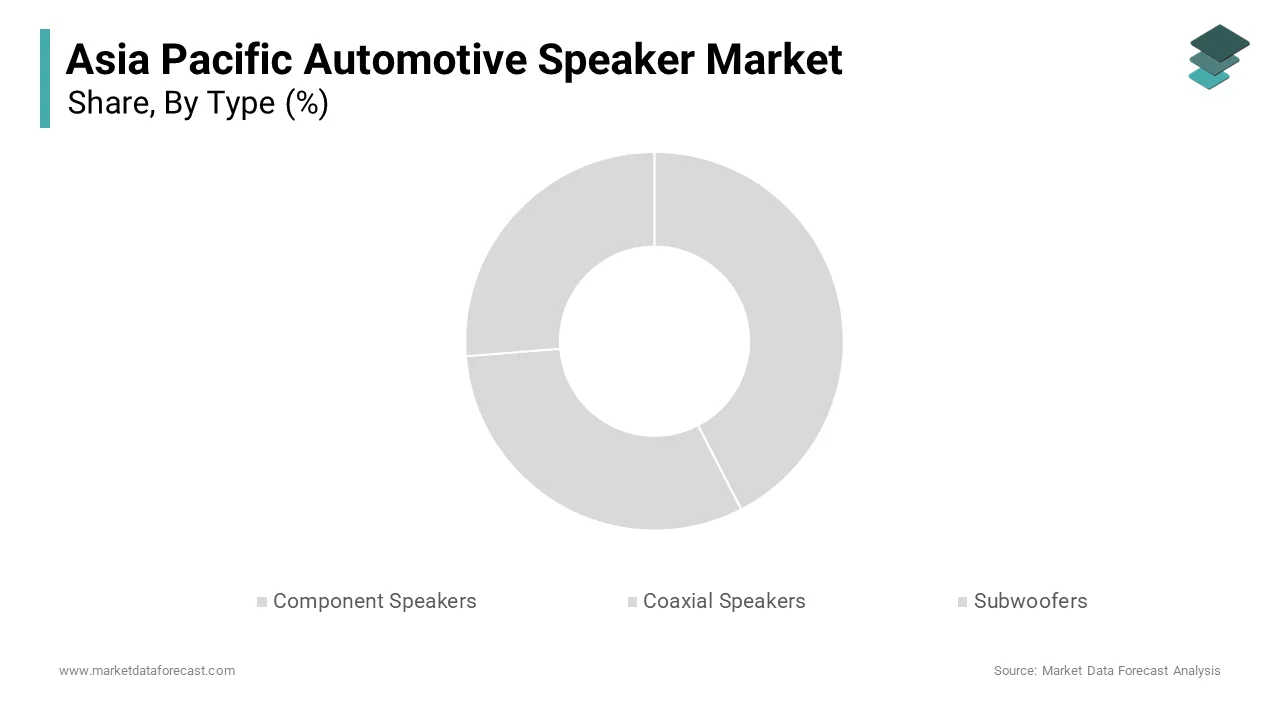
The component speaker segment is experiencing the fastest growth and is projected to expand at a CAGR of 9.3% from 2025 to 2033. This surge is driven by rising demand for high-fidelity audio in premium and electric vehicles. Component systems, featuring separate woofers, tweeters, and external crossovers, deliver superior sound staging and frequency separation, aligning with the acoustic expectations of discerning consumers in urban centers like Shanghai, Seoul, and Sydney. In China, the penetration of branded premium audio systems in EVs rose in recent years. These systems often include 12 to 18 speakers per vehicle, significantly increasing component speaker volume. Besides, the integration of Dolby Atmos and Meridian Surround Sound in models such as the BYD Seal and Lexus RZ mandates discrete driver placement for immersive audio rendering. The shift toward software-upgradable audio platforms further enhances the value of high-quality hardware, as advanced DSP tuning can only optimize performance if the underlying components support wide frequency response and low distortion. This synergy between hardware and software is redefining acoustic excellence, making component speakers indispensable in next-generation vehicles.
By Vehicle Insights
The passenger vehicle segment spearheaded the Asia Pacific automotive speaker market by commanding a substantial share of total speaker installations in 2024. This dominance of passenger vehicles is underpinned by the region’s massive scale of passenger car production and the growing integration of advanced infotainment systems. China alone produced over 26 million passenger vehicles in 2023, representing more than half of global output, according to the China Passenger Car Association. Urbanization and rising disposable incomes are key catalysts; in cities like Jakarta and Manila, consumers increasingly view in-car audio as a lifestyle necessity. Moreover, the rapid electrification of passenger fleets is amplifying speaker demand., EVs such as the Hyundai Kona Electric and MG ZS EV come standard with enhanced audio arrays to compensate for the absence of engine noise. This convergence of volume, technological advancement, and consumer expectation ensures the passenger vehicle segment remains the primary engine of market growth.
The two-wheeler segment is emerging as the fastest-growing segment in the automotive speaker market and is projected to grow at a CAGR of 11.7% from 2025 to 2033. Once considered an audio-irrelevant category, premium motorcycles and electric scooters are now incorporating integrated speaker systems for navigation alerts, Bluetooth connectivity, and rider-assistance functions. India’s electric two-wheeler landscape, which expanded year-on-year in 2023, is driving this trend. Brands like Ather Energy and Ola Electric are equipping scooters with dual-speaker systems for turn-by-turn navigation and app-based alerts. This functional evolution, from entertainment to operational utility, is redefining the acoustic landscape and opening a previously untapped market for compact, weather-resistant speaker modules.
By Installation Insights
The door-mounted speaker installation segment held the largest share of the market at 63.5% of all automotive speaker placements in the Asia Pacific region in 2024. This preeminence is because of the acoustic and ergonomic advantages of door cavities, which provide optimal space for mid-range and full-range drivers while contributing to balanced stereo imaging. In most passenger vehicles, front door panels house the primary left and right speakers, forming the foundation of the soundstage. Additionally, advancements in door sealing and vibration damping have improved acoustic efficiency, reducing sound leakage and distortion. These design refinements, combined with manufacturing standardization, make door mounting the most reliable and scalable installation method, ensuring its continued dominance across vehicle classes and price points.
The rear deck speaker installation segment is growing at the fastest rate, with a projected CAGR of 8.9% in the coming years. This acceleration is driven by the rising demand for immersive in-cabin audio experiences, particularly in SUVs, MPVs, and electric vehicles, where rear passenger comfort is a key selling point. Unlike traditional rear deck speakers used solely for ambient fill, modern systems are engineered for an active role in surround sound and noise cancellation. In China, NIO’s ET5 and ET7 models feature upward-firing speakers mounted on the rear deck to create a 3D audio field using Dolby Atmos technology, enhancing immersion for all occupants. Additionally, the proliferation of ride-hailing and family-oriented vehicles has elevated rear-seat experience expectations. Furthermore, rear decks offer a stable, enclosed environment ideal for subwoofers and mid-range drivers, enabling richer bass response without door flex. This functional and experiential upgrade is transforming the rear deck from a passive zone into a critical node in advanced audio architectures.
COUNTRY ANALYSIS
China stood as the undisputed leader in the Asia Pacific automotive speaker market by capturing 44.3% of regional revenue in 2024. Its dominance is credited to its position as the world’s largest automotive production and consumption hub, with millions of vehicles produced annually. The country’s rapid transition to electric mobility has catalyzed demand for high-end audio systems, as EV manufacturers differentiate their offerings through immersive cabin experiences. Brands equip their vehicles with 18- to 23-speaker setups featuring Dolby Atmos and AI-driven sound optimization. Moreover, the domestic supply chain for audio components is highly developed, with companies like AAC Technologies and Goertek supplying acoustics to both local and global OEMs. The integration of smart cockpits and voice assistants further elevates speaker functionality, transforming them into critical interfaces for human-machine interaction. Thus, the demand for reliable, high-performance audio nodes continues to rise. This convergence of scale, innovation, and digital integration ensures China’s preeminence in shaping the region’s acoustic future.
Japan occupies a strategic position as a technology pioneer in the Asia Pacific automotive speaker market. The country’s influence stems from its legacy of high-fidelity audio engineering and deep integration between automakers and electronics giants like Sony, Pioneer, and Alpine. Japanese consumers exhibit a pronounced preference for acoustic precision, with a notable share of new vehicles featuring branded audio systems. The country’s aging population also drives demand for voice clarity and hearing-assist audio features. This fusion of regulatory rigor, technological sophistication, and demographic specificity positions Japan as a benchmark for premium audio innovation in the region.
India has emerged as a high-growth contender in the Asia Pacific automotive speaker market. Its significance lies in its expanding vehicle production base and rising consumer appetite for digital features in affordable cars. The proliferation of connected infotainment systems has driven speaker adoption even in entry-level models. Brands like Maruti Suzuki, Hyundai, and Tata are integrating Bluetooth-enabled audio systems as standard, increasing the average speaker count from 2.1 to 4.3 per vehicle. Furthermore, the government’s FAME-II scheme has accelerated electric two-wheeler adoption, with models like Ather and Ola incorporating dual-speaker setups for navigation and alerts. Urbanization and youth demographics are amplifying demand for in-car entertainment, transforming vehicles into mobile media hubs. While premium audio remains limited to luxury imports, the sheer scale of volume growth ensures India’s rising influence in the regional speaker ecosystem.
South Korea plays a pivotal role in advancing intelligent audio systems within the Asia Pacific automotive speaker market. The country’s strength lies in its convergence of automotive engineering and consumer electronics, with Hyundai, Kia, and Genesis vehicles featuring cutting-edge audio technologies developed in collaboration with Harman and Samsung. The government’s K-UAM (Korean Urban Air Mobility) and smart city initiatives are also driving demand for voice-interactive cabins, where speakers serve as primary output devices for AI assistants. This software-defined approach allows OEMs to enhance sound quality post-purchase, increasing the functional lifespan of speaker hardware. With a strong focus on R&D and digital infrastructure, South Korea is shaping the future of adaptive, intelligent audio ecosystems in the region.
KEY MARKET PLAYERS
Panasonic Holdings Corporation, Bose Corporation, Samsung Electronics Co., Ltd., Alps Alpine Co., Ltd., Pioneer Corporation, Sony Group Corporation, Masimo Corporation, Clarion, Focal. Are the market players that are dominating the Asia Pacific automotive speaker market?
Top Players In The Market
Harman International (a Samsung subsidiary) is a dominant force in the Asia Pacific automotive speaker market, delivering premium audio systems to leading OEMs such as Toyota, Hyundai, and NIO. The company integrates advanced technologies like QuantumLogic Surround and Clari-Fi into its speaker solutions, enhancing in-cabin audio fidelity across vehicle segments. Harman has strengthened its regional footprint through localized R&D centers in India and China, enabling rapid customization for diverse consumer preferences. The company also expanded its manufacturing capabilities in Vietnam to mitigate supply chain risks and support EV manufacturers in Southeast Asia. Harman’s strategic partnerships with electric mobility startups and its focus on AI-driven acoustic optimization have solidified its reputation as a technology leader, enabling seamless integration of speakers into next-generation connected and autonomous vehicles across the region.
Pioneer Corporation maintains a strong presence in the Asia Pacific automotive speaker market through its high-performance OEM and aftermarket audio solutions. Known for its expertise in digital signal processing and speaker engineering, Pioneer supplies integrated systems to Japanese automakers including Honda, Nissan, and Subaru. The company has intensified its focus on electric vehicles, developing lightweight, energy-efficient speaker modules that reduce acoustic distortion in noise-sensitive EV cabins. It also deepened collaborations with Mazda on spatial audio systems for the MX-30 EV. With a robust distribution network across Southeast Asia and India, Pioneer continues to innovate in compact speaker design, catering to compact vehicles while maintaining acoustic precision, reinforcing its relevance in both factory-fitted and upgrade segments.
Alpine Electronics (a part of Alps Alpine Co., Ltd.) is a key contributor to the Asia Pacific automotive speaker ecosystem, specializing in integrated infotainment and audio solutions for premium and mid-tier vehicles. The company supplies speaker systems and control units to Toyota, Lexus, and several Chinese EV brands, emphasizing seamless connectivity and acoustic clarity. Alpine has invested heavily in developing multi-zone audio technologies that allow individual sound profiles within the same cabin, a feature increasingly adopted in luxury SUVs and MPVs. The company also enhanced its software capabilities to support adaptive audio tuning based on driving conditions. With engineering hubs in Japan and Thailand, Alpine continues to align its speaker innovations with regional mobility trends, including electrification and advanced driver assistance integration, ensuring sustained technological leadership.
Top Strategies Used by Key Market Participants
Key players in the Asia Pacific automotive speaker market are deploying advanced product differentiation, strategic OEM collaborations, vertical integration, regional manufacturing localization, and software-defined audio development to strengthen their competitive positioning. Companies are investing in high-fidelity speaker systems with noise-adaptive algorithms and immersive sound technologies to align with rising consumer expectations in premium and electric vehicles. Partnerships with EV manufacturers and audio branding alliances are accelerating technology integration. Firms are also expanding production facilities in Southeast Asia to reduce logistics costs and respond swiftly to regional demand. Additionally, the shift toward over-the-air upgradable audio platforms is enabling long-term customer engagement and value retention, reinforcing brand loyalty and technological leadership across diverse market segments.
COMPETITION OVERVIEW
The competition in the Asia Pacific automotive speaker market is intensifying as global and regional players navigate a landscape shaped by rapid technological evolution, shifting consumer preferences, and the rise of electric mobility. Established audio specialists such as Harman, Pioneer, and Alpine compete with emerging Chinese suppliers like Goertek and AAC Technologies, which leverage cost efficiency and proximity to EV manufacturers. Differentiation increasingly hinges on software integration, spatial audio capabilities, and compatibility with advanced driver assistance systems. OEMs are demanding scalable, modular speaker solutions that support over-the-air updates and multi-functional roles beyond entertainment. The market is also witnessing consolidation, with electronics firms acquiring audio startups to enhance R&D capabilities. Localized production and joint development agreements are critical for responsiveness, especially in high-growth markets like India and Indonesia. While Japanese and South Korean firms lead in acoustic engineering, Chinese companies are advancing rapidly in miniaturization and smart audio integration. This dynamic environment fosters innovation but pressures margins, compelling players to balance performance, cost, and scalability. The absence of standardized acoustic benchmarks further fragments the competitive field, enabling niche players to thrive through specialized offerings.
RECENT HAPPENINGS IN THE MARKET
- In March 2023, Harman International launched a software-defined audio platform in collaboration with XPeng Motors, enabling over-the-air sound profile updates for vehicles across China and Southeast Asia, enhancing user experience and long-term engagement.
- In June 2022, Pioneer Corporation introduced its FOCUS series of automotive speakers in Japan and South Korea, featuring improved thermal stability and reduced distortion for electric vehicles, strengthening its technological edge in high-performance audio.
- In September 2023, Alps Alpine opened a new R&D center in Bangkok, focusing on compact, multi-zone speaker systems for ASEAN markets, improving regional responsiveness and customization for local OEMs.
- In January 2024, Goertek expanded its manufacturing facility in Vietnam to increase production capacity for acoustic modules, targeting growing demand from EV makers in Southeast Asia and reducing dependency on Chinese supply chains.
- In May 2023, AAC Technologies partnered with NIO to co-develop immersive 3D audio systems using beamforming speaker arrays, integrating advanced noise cancellation and voice interaction for next-generation electric vehicles in China.
MARKET SEGMENTATION
This research report on the Asia Pacific automotive speaker market is segmented and sub-segmented into the following categories.
By Type
- Component Speakers
- Coaxial Speakers
- Subwoofers
By Vehicle Type
- Passenger Vehicles
- Hatchbacks
- Sedans
- Suvs & Crossovers
- Commercial Vehicles
- Trucks & Vans
- Buses & Coaches
- Emergency Response Vehicles
- Two-Wheelers
By Installation Type
- Door Speakers
- Dashboard Speakers
- Rear Deck Speakers
By Technology Type
- Bluetooth & Wireless Connectivity
- Smart Speakers
- Multi-zone
By Country
- India
- China
- Japan
- South Korea
- Australia
- New Zealand
- Thailand
- Malaysia
- Vietnam
- Philippines
- Indonesia
- Singapore
- Rest of APAC
Frequently Asked Questions
What is the current market size of the Asia Pacific automotive speaker market?
As of 2024, the Asia Pacific automotive speaker market is estimated at USD 2.33 billion, driven by rising vehicle production, demand for premium audio experiences, and integration of smart infotainment systems.
What is the projected market value by 2033?
The market is expected to reach approximately USD 4.48 billion by 2033, fueled by advancements in audio technology and increasing vehicle electrification.
What is the expected CAGR during the forecast period (2025–2033)?
The market is anticipated to grow at a CAGR of 8.39% from 2025 to 2033, reflecting strong consumer demand and technological evolution in automotive audio.
Which countries are leading the market in the Asia Pacific region?
China, Japan, South Korea, and India are the dominant markets. China leads in volume due to its massive automotive production, while Japan and South Korea drive innovation in high-fidelity audio systems.
What types of automotive speakers are included in this market?
The market includes tweeters, woofers, subwoofers, full-range speakers, and digital active speakers, used in factory-installed (OEM) and aftermarket audio systems.
What are the key vehicle segments driving demand?
Both passenger vehicles (especially SUVs and luxury sedans) and electric vehicles (EVs) are major contributors, with EVs offering quieter cabins that enhance audio system performance and consumer expectations.
How is the rise of electric vehicles impacting speaker demand?
Electric vehicles have lower cabin noise, making high-quality audio more noticeable. This has led automakers to partner with premium audio brands (e.g., Harman, Bose) to offer enhanced sound systems as a differentiator.
Are OEMs or the aftermarket larger contributors to the market?
Currently, OEM installations hold a larger share due to factory integration of branded audio systems. However, the aftermarket is growing rapidly, especially in countries like India and Indonesia, where consumers upgrade audio post-purchase.
What role do infotainment systems play in speaker adoption?
Modern infotainment platforms with Bluetooth, voice assistants, and streaming apps require high-performance speakers to deliver clear, immersive sound, directly increasing speaker complexity and value per vehicle.
Which audio technology trends are shaping the market?
Key trends include active noise cancellation (ANC) integration, spatial audio, multi-zone sound systems, and AI-driven sound optimization based on cabin acoustics and driving conditions
Related Reports
Access the study in MULTIPLE FORMATS
Purchase options starting from
$ 2000
Didn’t find what you’re looking for?
TALK TO OUR ANALYST TEAM
Need something within your budget?
NO WORRIES! WE GOT YOU COVERED!
Call us on: +1 888 702 9696 (U.S Toll Free)
Write to us: sales@marketdataforecast.com