- Product Description Description
- Table of Contents TOC
- List of Table & Figure LOT
- Get Free Sample PDF Sample PDF
Market Size, 2025
$1.64 BnMarket Estimate, 2026
$1.90 BnMarket Forecast, 2034
$6.09 BnCAGR, 2026–2034
15.7%Asia Pacific Biochar Market Research Report: Size, Share, Trends & Forecasts (2026–2034)
- Market Scope: Comprehensive Asia Pacific biochar market analysis covering agricultural applications, industrial wastewater/construction segments, batch and continuous pyrolysis technologies, pyrolysis and gasification manufacturing methods, and localized smallholder farming dynamics.
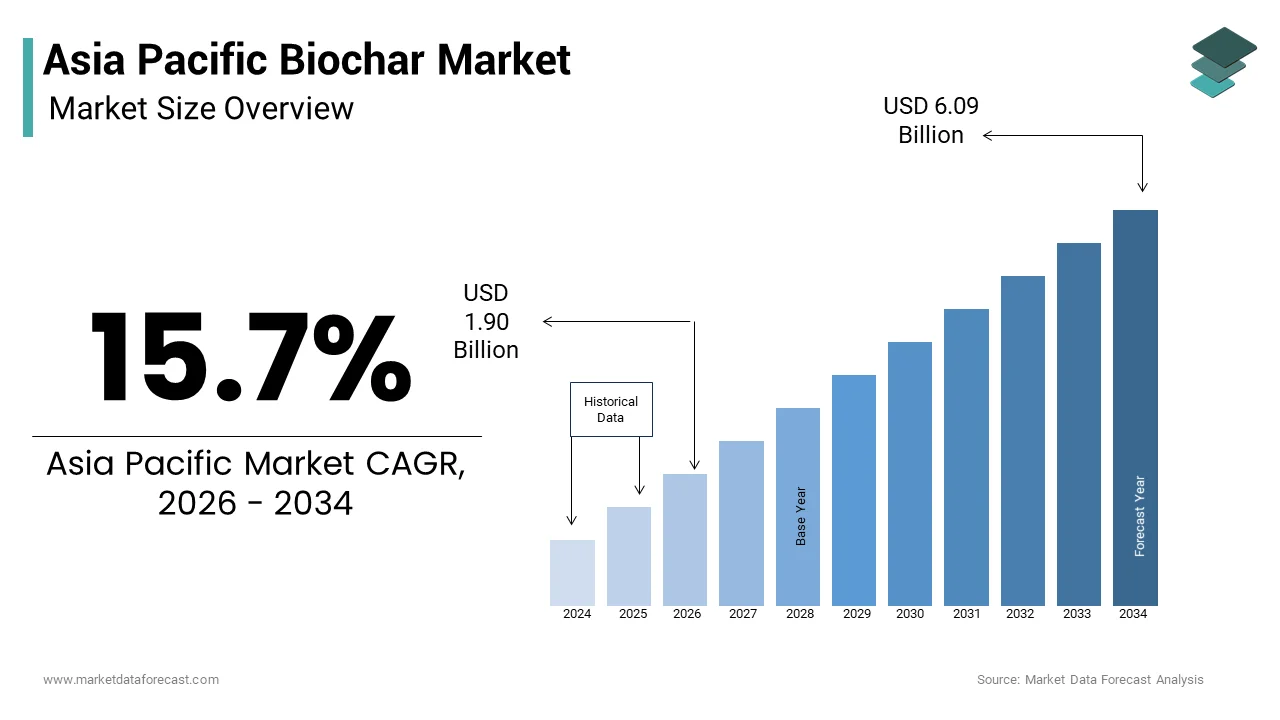
- Market Valuation: Valued at USD 1.64 billion in 2025, estimated at USD 1.90 billion in 2026, and projected to reach USD 6.09 billion by 2034, registering a strong CAGR of 15.7% from 2026 to 2034.
- Primary Growth Drivers: Government mandates and bans against open field crop residue burning creating structured feedstock supply chains, alongside critical tropical soil acidity remediation imperatives.
Key Asia Pacific Biochar Market Segment Metrics (2026–2034)
| Category | Leading Segment (2025 Position) | Fastest-Growing Segment |
|---|---|---|
| By Application | Agriculture segment (held the majority market share in 2025 due to massive scale and soil remediation needs) | Others / Industrial & Environmental (projected at the fastest CAGR of 24.6% driven by green construction and wastewater filtration) |
| By Technology | Batch pyrolysis kilns (occupied a 58.4% majority share in 2025 due to low capital requirements and decentralized deployment) | Continuous pyrolysis (expected to exhibit a noteworthy CAGR of 21.3% driven by industrial throughput and carbon credit verification) |
| By Manufacturing | Pyrolysis segment (led market share in 2025 based on technological maturity and traditional charcoal-making heritage) | Gasification (predicted to witness the highest CAGR of 19.8% due to dual-output models combining biochar and renewable energy) |
| By Region | Key regional hubs include China, India, Japan, South Korea, and Southeast Asia (led by active national straw-burning bans) | Fast-expanding agricultural residue utilization zones across South and Southeast Asia |
Major Asia Pacific Biochar Industry Players & Competitive Landscape
Market Structure: Competitive landscape comprising specialized local producers, decentralized equipment suppliers, and global sustainability technology providers focused on carbon credit verification and agricultural residue valorization.
Key Companies: Biochar Products Inc., Diacarbon Energy Inc., Agri-Tech Producers LLC, Genesis Industries, Green Charcoal International, Vega Biofuels Inc., The Biochar Company, Cool Planet Energy Systems Inc., Full Circle Biochar, and Pacific Pyrolysis Pty Ltd.
Asia Pacific Biochar Market Size
The Asia Pacific biochar market size was valued at USD 1.64 billion in 2025 and is anticipated to reach a valuation of USD 1.90 billion in 2026 from USD 6.09 billion by 2034, growing at a CAGR of 15.7% from 2026 to 2034.
Current Intro Definition of the Asia Pacific Biochar Market
Biochar is a fine-grained, highly porous, charcoal-like substance made by heating organic waste, such as wood chips, crop residues, or manure, in a closed container with little to no oxygen. This clean heating process is called pyrolysis. Unlike generic global definitions, this market is uniquely characterized by its integration with traditional agronomic practices such as charcoal amended soils in Japan and rice husk utilization in Southeast Asia, now being formalized through modern carbon sequestration frameworks and circular economy policies. According to the Food and Agriculture Organization, Asia-Pacific agricultural systems are expanding biochar production as a sustainable method to recycle crop waste, improve soil health, and mitigate regional greenhouse gas emissions. As per the Asian Development Bank, smallholder farms in Southeast Asia are increasingly adopting localized biochar production technologies to enhance soil water retention and buffer fluctuating nutrient levels during severe monsoon seasons. Apart from these, according to the Intergovernmental Panel on Climate Change, scaling up biochar soil application across regional cropland networks functions as an active carbon-sink trend that improves long-term global mitigation capacity. This market definition thus extends beyond commercial commodity trading to include informal rural production networks, government led straw management programs, and pilot scale carbon credit verification initiatives specific to the region’s developmental and environmental context.
MARKET DRIVERS
Government Mandates Against Crop Residue Burning Creating Feedstock Supply Chains
Severe transboundary haze crises and domestic air quality emergencies have compelled governments across South and Southeast Asia to implement strict bans on open field burning, which fuels the growth of the Asia Pacific biochar market. This transforms previously wasted biomass into regulated feedstock streams that directly supply biochar production facilities. According to the ASEAN Specialised Meteorological Centre, Southeast Asian countries are expanding real-time satellite monitoring and zero-burning enforcement frameworks to track hotspot locations and control transboundary smoke haze from land-clearing fires. As per the Press Information Bureau, India's National Clean Air Programme coordinates with target cities and states to allocate specialized funds for tracking PM10 reduction, driving technical interventions to manage biomass waste and agricultural residue burning. According to the Ministry of Ecology and Environment, China's regional comprehensive straw utilization rate exceeded 88% due to active machinery subsidies, generating a consistent agricultural residue supply chain for biochar production networks. These regulatory interventions convert environmental externalities into economic inputs, de risking feedstock procurement for investors who previously faced uncertainty regarding biomass availability and logistics. The driver is fundamentally policy induced rather than market organic, meaning growth trajectories correlate directly with enforcement intensity and subsidy continuity rather than end user willingness to pay for soil health benefits alone.
Soil Acidity Remediation Imperatives in Tropical Monsoon Agriculture
Decades of intensive nitrogen fertilizer use and high rainfall leaching have driven widespread soil acidification across tropical areas in the region, which in turn accelerates the expansion of the Asia Pacific biochar market. This creates a non-discretionary demand for alkaline biochar amendments among smallholder farmers who want to maintain crop yields without increasing chemical input costs. As per the International Rice Research Institute, agricultural systems in Southeast Asia are integrating specialized nutrient management practices and biochar applications to mitigate the constraint of low soil pH on regional crop yields. According to the Commonwealth Scientific and Industrial Research Organisation, applying biochar to highly weathered acidic soils systematically enhances long-term plant productivity, raises soil pH, and boosts overall phosphorus use efficiency. As per the Ministry of Agriculture, Forestry and Fisheries, Japan is accelerating its national "MeaDRI" strategy to commercialize negative emissions technologies by expanding the soil application of certified biochar across commercial agricultural lands. This driver operates through agronomic necessity rather than environmental altruism. Farmers adopt biochar because degraded soils threaten livelihoods, making demand resilient to economic downturns that might suppress voluntary sustainability purchases. The convergence of traditional knowledge and contemporary soil science creates culturally embedded adoption pathways absent in Western markets where biochar remains largely experimental.
MARKET RESTRAINTS
Feedstock Logistics Fragmentation Across Smallholder Landscapes
The predominance of small landholdings across the region creates severe logistical barriers to economical biomass aggregation, which impedes the growth of the Asia Pacific biochar market. Collection costs frequently exceed feedstock value when sourcing from millions of fragmented farms rather than consolidated industrial plantations. According to the Asian Productivity Organization, regional agricultural systems across Southeast Asia are deploying modernized aggregate procurement strategies to overcome supply vulnerabilities caused by highly fragmented smallholder farming landscapes. As per the Indonesian Palm Oil Research Institute, decentralized processing and clustering schemes for empty fruit bunches are expanding across oil palm networks to lower overall logistics and transport costs for bioenergy facilities. According to NITI Aayog, India's power sector infrastructure is reforming agricultural residue supply networks to stabilize feedstock availability and boost capacity utilization across nationwide biomass energy installations. This structural fragmentation means economies of scale achievable in Western biochar markets are often unattainable in Asia outside plantation monocultures, forcing producers to either absorb unsustainable logistics costs or locate near large point sources like rice mills and sugar factories that limit geographic expansion and feedstock diversity. This constraint will keep suppressing viable project development. This happens despite abundant theoretical biomass resources, unless we use innovative decentralized processing models or cooperative aggregation mechanisms.
Absence of Harmonized Quality Standards Undermining Buyer Confidence
A lack of regional biochar certification schemes creates opacity in the Asia Pacific biochar market. Buyers cannot distinguish stable carbon from low-quality char, suppressing premium pricing and institutional procurement. As per the International Biochar Initiative, transnational carbon markets are driving regional commercial networks to standardize testing protocols and harmonize biochar certifications for cross-border carbon-sink procurement. According to the Department of Agriculture, Fisheries and Forestry, the Australian agricultural sector utilizes strict pyrogenic biocarbon testing standards to verify fixed carbon thresholds and secure verifiable emission offsets for corporate buyers. As per the Forestry Agency, Japan's green innovation strategy is increasing the import and domestic application of certified biochar to expand high-value agricultural carbon sequestration networks. This standardization vacuum prevents development of transparent pricing mechanisms where quality differentials are rewarded, forcing reputable producers to compete on price against substandard alternatives while bearing higher compliance costs. Market maturation will remain constrained by information asymmetry. This asymmetry disadvantages both quality conscious buyers and legitimate suppliers investing in proper production technology until harmonized regional frameworks emerge through ASEAN or APEC coordination.
MARKET OPPORTUNITIES
Carbon Credit Revenue Streams Through Verified Methodologies
Carbon market methodologies for Asian biochar are unlocking growth areas for the Asia Pacific biochar market. These funds bridge the gap between production costs and what smallholder farmers are willing to pay, especially for projects that also avoid methane from rice paddies. According to Verra, voluntary carbon markets are accelerating the registry and validation of pyrogenic biocarbon removals under the standardized VM0044 biochar methodology. As per the Gold Standard, transnational agricultural development frameworks are expanding public consultations on specialized biochar and land-use carbon removal methodologies to improve voluntary market credibility. According to Climate Impact X, international environmental product platforms are scaling up standardized spot and forward contracts for fully approved carbon removals to satisfy corporate net-zero demand. This opportunity transforms biochar from marginal soil amendment to bankable climate asset, attracting impact capital and development finance that pure agricultural economics cannot justify. Crucially, Asian methodologies incorporate local feedstocks and smallholder contexts that Western protocols exclude, creating differentiated supply that commands pricing premiums in corporate net zero portfolios seeking geographic diversification and social impact narratives alongside carbon accounting compliance.
Industrial Wastewater Treatment Applications in Rapidly Urbanizing Economies
Accelerating industrialization and tightening effluent regulations across developing Asia create substantial non-agricultural demand for biochar, which is predicted to drive the expansion of the Asia Pacific biochar market. Biochar serves as a low-cost adsorbent replacing activated carbon in textile dyeing, mining, and municipal wastewater treatment facilities facing compliance pressures. As per the United Nations Economic and Social Commission for Asia and the Pacific, regional infrastructure networks are expanding data management capacities and ambient monitoring protocols to address intensifying domestic and industrial wastewater management deficits. According to the Department of Industrial Works, manufacturing enterprises in Thailand are optimizing biochar production from spent adsorbent materials to mitigate strict industrial waste disposal costs. As per the Cooperative Research Centre for Contamination Assessment and Remediation of the Environment, industrial processing sectors are deploying modified pyrogenic biocarbon filters as highly efficient, low-cost options for advanced wastewater treatment and environmental remediation. This industrial pivot diversifies revenue bases beyond seasonal agricultural demand, providing year round offtake agreements with municipal and industrial clients whose procurement decisions are driven by regulatory compliance rather than crop yield responses. As urbanization continues and enforcement intensifies, this segment offers a scalable outlet for lower grade biochars. These materials are unsuitable for premium agricultural markets but perfectly adequate for bulk contaminant adsorption applications.
MARKET CHALLENGES
Technical Knowledge Gaps Among Extension Services Limiting Adoption
Most farmers in the region are unaware of the correct way to use it, despite clear proof that biochar works in labs, which slows down the growth of the Asia Pacific biochar market. This lack of knowledge causes poor results, so farmers refuse to buy it again or tell others to use it. According to the International Fertilizer Development Center, agricultural extension services are integrating multi-location crop performance assessments to define localized biochar application rates for optimal soil enrichment. As per the Indian Council of Agricultural Research, the Krishi Vigyan Kendra network is expanding field training programs to demonstrate the value of biochar technology in maintaining long-term soil health card parameters for smallholders. The knowledge transfer deficit means technical potential does not translate to field performance, creating perception gaps between researcher optimism and farmer reality. Addressing this requires sustained investment in extension capacity building and localized decision support tools rather than simply increasing production capacity, yet funding priorities often favor hardware over human capital development essential for durable market creation.
Competition From Subsidized Chemical Fertilizers Distorting Value Propositions
Pervasive government fertilizer subsidy programs across the region artificially depress synthetic nutrient prices, which holds back the expansion of the Asia Pacific biochar market. This makes biochar’s long-term soil health benefits economically uncompetitive against immediate yield responses from urea and DAP, despite true cost accounting revealing hidden environmental and degradation expenses. As per the International Food Policy Research Institute, government interventions in fertilizer pricing modify the cost competitiveness of alternative organic soil amendments across developing economies. According to the Ministry of Agriculture, smallholder farming systems leverage targeted input support and agroecological nutrient management plans to balance chemical inputs with sustainable soil health solutions. The policy induced market failure shows biochar must compete not on agronomic merit but against politically entrenched subsidy regimes that prioritize short term food security over long term soil resilience. Adoption will remain confined to niche segments where chemical fertilizers fail or premium markets justify higher costs. This limitation will persist until subsidy structures internalize environmental externalities or biochar receives equivalent public support for its ecosystem values.
REPORT COVERAGE
| REPORT METRIC | DETAILS |
| Market Size Available | 2025 to 2034 |
| Base Year | 2025 |
| Forecast Period | 2026 to 2034 |
| CAGR | 15.7%, |
| Segments Covered | By Application, Technology, Manufacturing, Feedstock |
| Various Analyses Covered | Global, Regional & Country Level Analysis, Segment-Level Analysis, DROC, PESTLE Analysis, Porter’s Five Forces Analysis, Competitive Landscape, Analyst Overview of Investment Opportunities |
| Regions Covered | India, China, Japan, South Korea, Australia, New Zealand, Thailand, etc |
| Market Leaders Profiled | Biochar Products Inc., Diacarbon Energy Inc., Agri-Tech Producers LLC, Genesis Industries, Green Charcoal International, Vega Biofuels Inc., The Biochar Company, Cool Planet Energy Systems Inc., Full Circle Biochar, and Pacific Pyrolysis Pty Ltd. |
SEGMENTAL ANALYSIS
By Application Insights
Agriculture
In 2025, the agriculture segment held the majority share in the Asia Pacific biochar market. This dominance was driven by the sector’s massive scale, urgent soil remediation needs across degraded tropical and subtropical croplands, and strong integration with government-led sustainable farming initiatives that subsidize adoption and de-risk farmer experimentation. Biochar acts as a core soil amendment that solves deep agronomic problems across millions of hectares, bypassing the limits of traditional inputs to meet strict environmental rules. Decades of intensive monoculture and excessive chemical fertilizer use have degraded vast tracts of Asian agricultural land creating non discretionary demand for biochar as a restorative amendment capable of rebuilding soil organic carbon buffering acidity and improving nutrient retention in ways synthetic inputs cannot replicate. According to the Food and Agriculture Organization, agricultural sectors across South and Eastern Asia are deploying regional soil management initiatives to address human-induced land degradation causing severe yield gaps for smallholder farmers. As per China's Ministry of Agriculture and Rural Affairs, national agricultural extension systems expand integrated straw returning and soil management strategies to restore degraded black soil networks and improve crop nutrient uptake. This remediation function transforms biochar from optional sustainability product to essential production input where adoption correlates directly with yield gap closure potential rather than environmental premiums ensuring demand resilience even during periods of low crop prices or input cost inflation that might suppress voluntary green purchases.
Public sector interventions across Asia Pacific systematically lower adoption barriers through direct subsidies free distribution programs and extension service integration that de risk farmer experimentation and create artificial demand floors independent of commercial market dynamics. As per the Ministry of Agriculture, Forestry and Fisheries, Japan's green strategy implements greenhouse gas reduction labeling systems and biochar pilot programs to scale up carbon sequestration within sustainable supply chains. According to the Department of Agricultural Extension, agricultural development agencies in Thailand utilize practical field demonstration plots to evaluate multi-treatment rice-straw biochar applications and foster sustainable crop management practices. The public investments effectively socialize early adoption risks that private markets cannot bear alone accelerating diffusion curves by decades compared to purely commercial trajectories observed in regions lacking comparable institutional support. The resulting demand is policy elastic expanding and contracting with budget allocations rather than end user willingness to pay yet providing crucial foundation upon which commercial markets can eventually mature as subsidy dependence decreases and intrinsic value propositions strengthen through accumulated farmer experience and demonstrated return on investment.
Others (Industrial and Environmental Applications)
The "Others" segment is likely to experience the fastest CAGR of 24.6% between 2026 and 2034. Diversified, non-agricultural applications are unlocking new revenue streams insulated from seasonal farming cycles and commodity price volatility affecting traditional soil amendment markets. This segment includes industrial filtration, construction materials, animal feed additives, and environmental remediation. Tightening environmental regulations across rapidly industrializing Asian economies are driving adoption of biochar as cost effective adsorbent for heavy metals dyes and organic contaminants in industrial wastewater treatment where activated carbon proves prohibitively expensive for small and medium enterprises facing compliance pressures. According to the United Nations Economic and Social Commission for Asia and the Pacific, regional water networks are expanding monitoring indicators and technical interventions to manage domestic and industrial wastewater discharge deficits. As per the Department of Industrial Works, regional manufacturing clusters in Thailand optimize local adsorbent configurations and spent biochar protocols to control effluent levels and satisfy environmental standards. This industrial pivot creates year round demand decoupled from agricultural seasonality providing stable offtake agreements for producers while addressing genuine environmental externalities that command regulatory tolerance and occasional public co funding unavailable to purely commercial applications.
Emerging integration of biochar into concrete asphalt and insulation materials is creating substantial new demand channels as green building certification schemes and embodied carbon regulations incentivize carbon negative construction inputs across urbanizing Asia Pacific markets pursuing net zero infrastructure goals. As per the Global Alliance for Buildings and Construction, transnational built environment frameworks enforce priority international action plans to expand low-carbon cement procurement and lower global material emissions. According to the Building and Construction Authority, Singapore's construction sector leverages the BCA Green Mark Certification Scheme to evaluate environmental performance and promote alternative carbon-neutral aggregate integration in building designs. This construction integration transforms biochar from agricultural niche to mainstream industrial commodity with demand elasticity tied to urbanization rates and green building policy stringency rather than farm economics potentially exceeding agricultural volumes as cities expand and decarbonization mandates tighten across region’s massive built environment sector.
By Technology Insights
Batch Pyrolysis Kiln
The batch pyrolysis kilns segment remained the largest in the Asia Pacific biochar market and occupied a 58.4% share in 2025. This prominence of the segment was supported by low capital requirements, operational simplicity, and suitability for decentralized rural deployment, where feedstock availability is seasonal and dispersed across smallholder landscapes rather than concentrated at industrial scales. Low Capital Accessibility for Rural Enterprises and Cooperatives Batch kiln technology requires minimal upfront investment compared to continuous systems enabling village level enterprises farmer cooperatives and microentrepreneurs to enter biochar production without access to formal financing or technical expertise that characterize industrial operators in developed markets. According to the Asian Productivity Organization, rural cooperative structures in developing Asian economies scale up decentralized biocarbon conversion units to bypass the high capital prerequisites of advanced continuous processing infrastructures. As per the Alternative Energy Promotion Centre, national renewable energy frameworks in Nepal integrate decentralized biomass gasification and pyrogenic carbon initiatives to promote sustainable waste recycling among rural smallholders. The accessibility democratizes production distributing economic benefits across rural populations rather than concentrating them in capital intensive facilities owned by urban corporations aligning with inclusive development objectives that attract donor funding and government support unavailable to purely commercial ventures focused on profit maximization over social impact.
Batch kilns can be started and stopped frequently without thermal stress or efficiency penalties accommodating highly seasonal biomass supply patterns characteristic of Asian agriculture where residues concentrate during harvest windows spanning weeks rather than flowing continuously year round like industrial wood processing waste streams. As per the National Institute of Rural Development and Panchayati Raj, regional agricultural zones optimize localized biomass procurement strategies to handle severe seasonal crop residue surpluses during compressed harvesting windows. According to the Indonesian Palm Oil Research Institute, agricultural processors deploy decentralized clustering configurations to accommodate seasonal variations in smallholder biomass availability and minimize regional transit costs. This temporal flexibility matches technology to resource reality rather than forcing resource adaptation to technology requirements preserving economic viability in contexts where feedstock logistics remain fragmented and unpredictable despite theoretical abundance documented in national biomass assessments.
Continuous Pyrolysis
The continuous pyrolysis segment is expected to exhibit a noteworthy CAGR of 21.3% during the forecast period. Industrial-scale producers are seeking higher throughput, consistent quality, and energy recovery efficiencies necessary to serve emerging, high-value applications in carbon credits, construction materials, and export markets where batch kiln limitations become binding constraints. Voluntary carbon market methodologies for biochar increasingly require continuous process monitoring standardized operating parameters and real time emissions tracking to verify carbon sequestration permanence and avoid double counting creating technical prerequisites that batch kilns cannot satisfy without prohibitive instrumentation costs undermining project economics. According to Verra, voluntary carbon asset registries enforce rigorous operational auditing controls under the standardized VM0044 methodology to verify stable pyrogenic biocarbon storage parameters. As per Puro.earth, international environmental market standards utilize comprehensive material balance frameworks and audited lifecycle tracking to validate certified carbon dioxide removal offsets. This verification driven demand creates bifurcated market where premium segments accessible only to continuous operators capture disproportionate value justifying technology migration despite higher upfront costs through access to revenue streams unavailable to batch producers serving commoditized local agricultural markets.
Continuous pyrolysis systems enable efficient capture and utilization of syngas and bio oil co products for process heat generation electricity production or district heating applications that dramatically improve net energy balances and create additional revenue streams impossible to harness from open batch kilns where volatiles escape uncontrolled. As per the National Development and Reform Commission, industrial eco-farming developments expand continuous co-generation systems that recycle pyrolytic gases to elevate overall energy self-sufficiency margins. According to the Energy Policy and Planning Office, biomass-to-energy power installations in Thailand optimize integrated co-generation layouts to harness volatile gas streams and strengthen regional electricity distribution networks. This energy integration transforms biochar production from net energy consumer to net energy producer at sufficient scale fundamentally altering unit economics and enabling competition with fossil fuel alternatives in ways batch technology cannot achieve regardless of operational improvements or feedstock cost advantages.
By Manufacturing Insights
Pyrolysis
The pyrolysis segment led the Asia Pacific biochar market and captured a significant share in 2025. This leading position of the segment was attributed to its technological maturity, product versatility across diverse feedstocks, and alignment with both the traditional charcoal-making heritage and modern carbon sequestration standards that define contemporary market requirements. Pyrolysis is the most widely understood and practiced thermochemical conversion process across Asia Pacific leveraging centuries of traditional charcoal making knowledge in Japan Korea China and Southeast Asia that provides cultural foundation for modern biochar adoption and reduces technology transfer barriers hindering alternative processes. According to the National Forestry and Grassland Administration, regional forestry research institutions in China optimize thermal conversion and pyrolysis parameters to improve the processing of woody biomass and agricultural residues like bamboo and walnut shells. As per the Khadi and Village Industries Commission, traditional rural manufacturing clusters leverage the Gramodyog Vikas Yojana framework to deploy specialized technical training, provide processing machinery, and expand local employment structures. This embedded knowledge base means pyrolysis faces lower adoption friction than novel technologies requiring entirely new skill sets enabling faster scaling through upgrading existing assets rather than greenfield deployments dependent on foreign expertise and imported equipment that introduce currency risks and maintenance vulnerabilities absent in indigenous technology pathways.
Pyrolysis parameters can be adjusted across wide ranges to produce biochars optimized for different applications from high surface area activated carbon precursors to alkaline soil amendments to metallurgical reductants enabling single production platform to serve multiple revenue streams and adapt to shifting market signals without capital reinvestment. According to the Commonwealth Scientific and Industrial Research Organisation, specialized slow pyrolysis thermal conversion techniques process sustainable biomass into high-purity biocarbon to replace fossil fuels in industrial smelting and green metallurgy. As per the Ministry of Industry, agricultural processing sectors in Indonesia optimize multi-tier biocarbon production structures to convert abundant crop residues into localized soil health amendments and industrial materials. This versatility de risks investment by preventing lock in to single market segment vulnerable to demand shocks making pyrolysis the default choice for entrepreneurs navigating uncertain and evolving Asia Pacific biochar market landscape where application preferences and price signals remain fluid during early stage market development.
Gasification
The gasification segment is predicted to witness the highest CAGR of 19.8% from 2026 to 2034. Dual-output business models, which combine biochar production with renewable energy generation, attract policy support and private investment seeking to maximize revenue per ton of biomass in contexts where standalone char economics remain marginal. Gasification produces biochar as solid residue while generating combustible syngas that can be converted to electricity heat or upgraded to synthetic fuels creating two monetizable outputs from single feedstock input that improve project bankability and resilience against individual product price volatility affecting standalone char or energy projects. According to the Ministry of New and Renewable Energy, national waste-to-energy incentives in India integrate specialized bio-gasification programs to manage complex agricultural residues and expand clean energy infrastructure. As per the Ministry of Energy, Thailand's Alternative Energy Development Plan expands structural capacity targets for bio-power facilities to replace conventional generation with scalable, localized agricultural biomass infrastructure. Revenue stacking addresses the fundamental challenge of biochar economics, where standalone production often fails to achieve competitive returns against subsidized fertilizers or fossil energy. This positions gasification as a bridge technology that enables market entry during the transitional period before carbon pricing or premium agricultural markets mature sufficiently to support pure char production models.
Asian governments prioritizing renewable energy expansion and rural electrification view gasification as integrated solution addressing multiple policy objectives simultaneously channeling subsidies and concessional finance toward dual output projects that pure biochar production cannot access despite equivalent or superior carbon sequestration outcomes. As per the Asian Development Bank, regional climate development funds prioritize targeted co-financing investments in smallholder bioenergy installations to achieve clean energy integration and rural socio-economic co-benefits. According to the Just Energy Transition Partnership, national comprehensive investment plans allocate targeted capital streams to expand regional renewable energy penetration and scale down remote fossil-fuel dependence. This policy convergence creates artificial demand acceleration independent of pure market fundamentals as gasification projects compete for public resources against solar wind and other renewables on multidimensional criteria where char co benefit provides decisive advantage in scoring frameworks weighting rural livelihoods and soil health alongside megawatt hours generated.
By Feedstock Insights
Agricultural Waste
The agricultural waste segment dominated the Asia Pacific biochar market and accounted for a 67.9% share in 2025. This dominance of the segment was driven by massive generation volumes, existing collection infrastructure linked to crop processing industries, and policy mandates prohibiting open burning that created guaranteed supply streams at a negative or near-zero cost for producers located near aggregation points. Asia Pacific’s status as world’s primary rice wheat maize and sugarcane production region generates agricultural residues in quantities dwarfing forestry wastes or dedicated biomass plantations providing abundant feedstock base capable of supporting biochar industry scaling without competing with food production or causing deforestation concerns associated with woody biomass sourcing. According to the Food and Agriculture Organization, regional crop processing industries across Asia leverage expansive volumes of generated paddy residues to convert primary crop waste into sustainable biochar feedstocks. As per the Ministry of Agriculture and Farmers Welfare, national environmental and agricultural policies implement targeted diversion incentives and specialized biomass collection projects to eliminate field burning practices. This volumetric dominance means agricultural waste will remain primary feedstock regardless of technological preferences or quality considerations as sheer availability determines economic feasibility in capital constrained markets where long distance biomass transport destroys margins and limits viable facility locations to proximity of processing hubs.
Rice mills sugar factories palm oil mills and grain elevators already aggregate agricultural residues at industrial scales as part of core business operations providing ready made feedstock supply points where biochar producers can locate adjacent facilities avoiding costly primary collection logistics that plague forestry and plantation biomass sourcing in fragmented smallholder landscapes. According to the Office of the Cane and Sugar Board, regional processing factories optimize mill conveyor systems and sugar factory residue routing to supply consistent bagasse raw materials to integrated bioenergy systems. As per the Indonesian Palm Oil Association, commercial palm processing mills utilize specialized internal mechanical systems to route empty fruit bunches into alternative thermal conversion networks. This infrastructure leverage dramatically reduces entry barriers and operational risks compared to greenfield biomass supply chain development, making agricultural waste the default feedstock choice for commercially oriented projects. These projects seek predictable unit economics and scalable production volumes necessary to serve emerging industrial and export markets beyond local agricultural niches.
Animal Manure
The animal manure segment is estimated to register the fastest CAGR of 26.4% over the forecast period. This rapid growth of the segment is propelled by intensifying livestock waste management regulations, circular nutrient economy imperatives, and emerging recognition of manure biochar’s unique phosphorus-rich composition valuable for specific soil fertility applications where conventional wood or straw chars prove nutritionally incomplete. Rapid transition from extensive grazing to confined animal feeding operations across Asia Pacific has concentrated manure generation at industrial scales exceeding land absorption capacity creating regulatory compliance crises that force livestock producers to seek valorization pathways including pyrolysis that simultaneously address waste disposal obligations and generate saleable soil amendment products. As per the Food and Agriculture Organization; livestock development frameworks analyze increasing nutrient surplus hotspots and manure concentration trends to install specialized agricultural treatment structures. According to the Ministry of Ecology and Environment, national environmental pollution guidelines enforce stricter livestock waste management criteria to maximize resource recovery across intensive commercial farms. The regulatory compulsion creates captive feedstock supply at negative cost where producers pay waste handlers to remove manure inverting typical biomass economics and enabling biochar production profitability even at lower char selling prices than agricultural waste derived alternatives.
Manure derived biochar retains significant phosphorus potassium and micronutrient content lost during lignocellulosic biomass pyrolysis creating differentiated product valued for specific soil fertility applications where pure carbon chars require expensive mineral fertilizer blending to achieve balanced nutrition for crop production. According to the International Fertilizer Development Center, international fertilizer distribution lines implement alternative nutrient strategies to navigate volatile import pricing structures for chemical rock phosphates. As per the National Agriculture and Food Research Organization, Japanese agronomic field evaluation stations demonstrate that specialized manure-derived biochar mixtures enrich plant-available soil phosphorus to improve general vegetable cropping outputs. This nutritional differentiation enables manure biochar to command price premiums over conventional chars in phosphorus deficient regions justifying additional processing costs for pathogen elimination and odor control while creating market niches insulated from commodity competition based solely on carbon content or surface area metrics dominating generic biochar trading.
COUNTRY LEVEL ANALYSIS
China Biochar Market Analysis
China was the prominent player in the Asia Pacific biochar market and held a 35.8% share in 2025. This prominence of the Chinese market was propelled by comprehensive national straw utilization mandates, massive agricultural residue availability, and the integration of biochar into provincial carbon trading pilots that create both supply-push and demand-pull mechanisms unmatched elsewhere in the region. According to China's Ministry of Agriculture and Rural Affairs, the national comprehensive utilization rate of crop straw exceeded 88% as regional farming infrastructures increased fertilizer recycling practices. As per the National Development and Reform Commission, central development agencies coordinate with provincial departments to establish low-carbon farms and scale up biochar application for soil carbon enhancement. China’s dominance stems from unprecedented policy coordination linking air quality soil health and carbon market objectives into unified implementation framework that de risks private investment and creates guaranteed offtake channels through state owned agricultural enterprises and environmental remediation contractors serving public sector clients.
India Biochar Market Analysis
India followed closely in the Asia-Pacific biochar market and accounted for an 18.1% share in 2025. This position of the Indian market was supported by rapid, policy-driven scaling through the National Clean Air Programme, biomass infrastructure investments, the GOBARdhan manure management scheme, and integration with the soil health card program targeting millions of smallholders across diverse agroecological zones. As per the Cabinet of India, the GOBARdhan initiative scales up renewable fuel manufacturing infrastructure through a unified national scheme for compressed biogas to drive sustainable rural wealth creation. According to the Ministry of Agriculture and Farmers Welfare, national agricultural extension channels deploy soil health tracking cards and local training networks to encourage organic residue additions across commercial cultivation fields. India’s growth trajectory reflects unique convergence of urban air quality crisis rural sanitation imperatives and soil degradation challenges creating multiple policy entry points that collectively accelerate market development faster than any single driver could achieve alone distinguishing Indian market dynamics from more narrowly focused agricultural or carbon centric approaches elsewhere in region.
Japan Biochar Market Analysis
Japan maintains a premium positioning in the Asia Pacific biochar market. The country’s market is known for the world’s most sophisticated quality certification standards, deep cultural integration of traditional Sumi charcoal soil amendment practices, and advanced carbon farming protocol development enabling domestic offset generation for corporate net-zero compliance. According to the Ministry of Agriculture, Forestry and Fisheries, Japan's agricultural sector utilizes standardized greenhouse gas reduction labeling system rules to expand market visibility and provide clear environmental metrics for consumer product selections. As per the J-Credit Scheme, regional carbon reduction programs utilize structural methodologies for biochar application to agricultural land to quantify carbon storage and generate verifiable corporate compliance offsets. Japan’s market maturity reflects unique combination of cultural heritage regulatory sophistication and corporate demand that creates stable premium pricing environment insulated from commodity volatility affecting less differentiated markets elsewhere in region serving as model for quality driven value creation rather than volume based competition.
South Korea Biochar Market Analysis
South Korea is another key player in the Asia Pacific biochar market. It is positioned as a technology innovation hub and premium agricultural input market, where government R&D funding, advanced manufacturing capabilities, and a high-value specialty crop sector create demand for engineered biochar products serving precision agriculture and environmental remediation applications. As per the Rural Development Administration, South Korea's agricultural development frameworks deploy a centralized structural action plan to promote livestock manure biochar production and upgrade soil carbon storage options. According to the Korea Forest Service, national forest carbon-sink strategies expand specialized processing models for forest residues to enhance long-term domestic carbon dioxide mitigation capacity. South Korea’s market reflects advanced economy characteristics where technology differentiation quality consistency and regulatory compliance drive value creation rather than feedstock abundance or policy subsidies distinguishing it from developing Asia Pacific markets competing primarily on cost and volume metrics.
Australia Biochar Market Analysis
Australia is expected to grow significantly in the Asia Pacific biochar market. It serves as the methodology innovation leader, carbon credit market pioneer, and technology exporter. As per the Department of Climate Change, Energy, the Environment and Water, Australia's environmental management frameworks expand structural support for using forest residue biochar to mitigate wildfire risks and scale up long-term terrestrial carbon-sink capacity. According to the Clean Energy Regulator, Australia's carbon market framework utilizes standardized measurement methods to enable project developers to generate Australian Carbon Credit Units from qualified biocarbon projects. As per the Commonwealth Scientific and Industrial Research Organisation, national research laboratories lead field validation trials to map biochar crop performance metrics and calculate long-term soil carbon storage variables. Australia’s market leadership stems from regulatory sophistication research excellence and corporate demand maturity creating export oriented premium production model that influences global standards and attracts international capital seeking exposure to high integrity Asia Pacific carbon removals with transparent verification and legal permanence guarantees.
COMPETITIVE LANDSCAPE
Competition in the Asia Pacific biochar market exhibits highly fragmented dynamics where thousands of small scale rural producers coexist with handful of industrial scale operators serving distinct market segments with minimal direct overlap due to divergent quality standards customer bases and value propositions. Rural batch kiln operators dominate volume segments serving local agricultural markets through informal networks and government distribution programs where price sensitivity and accessibility matter more than certification or carbon verification creating vast low margin base insulated from commercial competition. Industrial continuous pyrolysis operators target premium segments including verified carbon credits export activated carbon and construction materials where quality consistency traceability and regulatory compliance create barriers excluding batch producers despite their cost advantages in feedstock and capital expenditure. National champions emerge in each major producing country leveraging domestic policy support feedstock access and cultural familiarity to defend home markets against regional expansion by foreign operators lacking equivalent institutional relationships and localized knowledge. Technology providers compete through licensing and service models rather than direct production capturing value from intellectual property and methodology expertise without bearing operational risks of biomass logistics and char marketing in volatile emerging markets. Innovation competition centers on energy integration quality verification and application specific formulation rather than basic pyrolysis chemistry which has largely commoditized after decades of traditional practice across region. Consolidation remains limited due to feedstock localization policy fragmentation and cultural specificity preventing pan regional scaling seen in other industrial sectors preserving diverse competitive landscape shaped by national contexts rather than global market forces.
KEY MARKET PLAYERS
Some of the major companies dominating the Asia-Pacific Biochar market are
- Biochar Products Inc.
- Diacarbon Energy Inc.
- Pacific Biochar Ltd
- Airex Energy Inc
- Agri-Tech Producers LLC
- Genesis Industries
- Green Charcoal International
- Vega Biofuels Inc.
- The Biochar Company
- Cool Planet Energy Systems Inc.
- Full Circle Biochar
- Pacific Pyrolysis Pty Ltd.
Top Players In The Market
- Pacific Biochar Ltd maintains significant involvement in the Asia Pacific biochar market through specialized production facilities in Thailand and Vietnam processing rice husk and coconut shell residues into certified agricultural and industrial grade biochar serving both domestic soil remediation needs and export activated carbon precursor markets. The company contributes regionally by establishing quality benchmarks aligned with European Biochar Certificate standards enabling Southeast Asian producers to access premium international carbon removal markets previously dominated by Western suppliers. Their initiatives reinforce technological leadership in tropical feedstock processing while bridging informal rural production with formal certification requirements essential for accessing corporate offtake agreements and carbon finance streams driving regional market maturation beyond subsistence applications.
- Airex Energy Inc participates extensively in Asia Pacific biochar market through proprietary CarbonFX torrefaction technology deployed across India Philippines and Indonesia converting agricultural residues and forestry waste into high energy density biocoal and soil amendment products serving dual renewable energy and agricultural markets simultaneously. The company contributes regionally by providing modular containerized production units requiring minimal site preparation and enabling decentralized deployment near dispersed smallholder feedstock sources where conventional large scale facilities prove economically unviable due to logistics constraints. Their moves position Airex as enabler of distributed production models matching Asia Pacific’s fragmented feedstock landscapes while integrating with national renewable energy and rural development policies that subsidize dual output systems over standalone char production.
- Biochar Industries Pty Ltd serves Asia Pacific biochar market as Australia based technology developer and methodology consultant specializing in ERF approved carbon credit project design verification services and agronomic performance validation across diverse Australian and Pacific Island soil climate combinations. The company contributes regionally by leading technical working groups informing Verra VM0044 and Gold Standard biochar methodology updates ensuring Asia Pacific specific conditions including tropical weathering rates and monsoon hydrology are properly represented in global carbon accounting frameworks rather than defaulting to temperate zone assumptions. Their initiatives establish Biochar Industries as knowledge infrastructure provider whose methodologies and evidence bases shape market rules and participant capabilities across region creating influence disproportionate to direct production volume through standards setting and technical assistance functions.
Top Strategies Used By Key Market Participants
Key players employ vertical integration strategies combining feedstock sourcing production technology and end use application development to capture value across entire supply chain rather than competing solely on commodity char pricing vulnerable to seasonal biomass fluctuations and policy subsidy changes. Companies pursue strategic partnerships with agricultural cooperatives mill operators and government agencies securing long term feedstock agreements and policy alignment that de risk capital intensive facility investments in contexts where spot market biomass procurement proves unreliable and politically sensitive. Geographic diversification balances exposure across mature carbon credit markets like Australia Japan and emerging agricultural application markets in Southeast Asia South Asia ensuring revenue stability when individual country policy frameworks shift or carbon prices fluctuate cyclically. Technology differentiation focuses on continuous pyrolysis energy integration and quality consistency enabling access to premium verified carbon removal segments where batch kiln producers cannot compete due to verification methodology requirements demanding automated monitoring and process control documentation. Strategic engagement with standards bodies methodology developers and government regulators shapes market rules favoring proprietary technologies and established quality systems creating first mover advantages when new compliance frameworks emerge. Dual output business models combining char production with renewable energy generation wastewater treatment or construction material integration diversify revenue streams beyond single product dependency improving project bankability and resilience against individual market segment downturns affecting pure play biochar producers.
MARKET SEGMENTATION
This research report on tEuropeanope biochar market is segmented and sub-segmented into the following categories.
By Application
- Agriculture
- Gardening
- Households
- Others
By Technology
- Microwave pyrolysis
- Continuous pyrolysis
- Batch pyrolysis kiln
- Gasified
- Hydrothermal
- Cookstove
- Others
By Manufacturing
- Gasification
- Pyrolysis
- Others
By Feedstock
- Agricultural waste
- Forestry waste
- Animal manure
- Biomass plantations
By Country
- India
- China
- Japan
- South Korea
- Australia
- New Zealand
- Thailand
- Malaysia
- Vietnam
- Philippines
- Indonesia
- Singapore
- Rest of APAC