- Product Description Description
- Table of Contents TOC
- List of Table & Figure LOT
- Get Free Sample PDF Sample PDF
Market Size, 2025
$540 MnMarket Estimate, 2026
$564.84 MnMarket Forecast, 2034
$809 MnCAGR, 2026–2034
4.6%Executive Summary: Asia Pacific Biodegradable Food Service Disposables Market
- Market Scope: Comprehensive regional Asia Pacific biodegradable food service disposables market analysis covering raw material categories, product variants, distribution channels, geographic leadership frameworks, key growth drivers, and strategic industry trends.
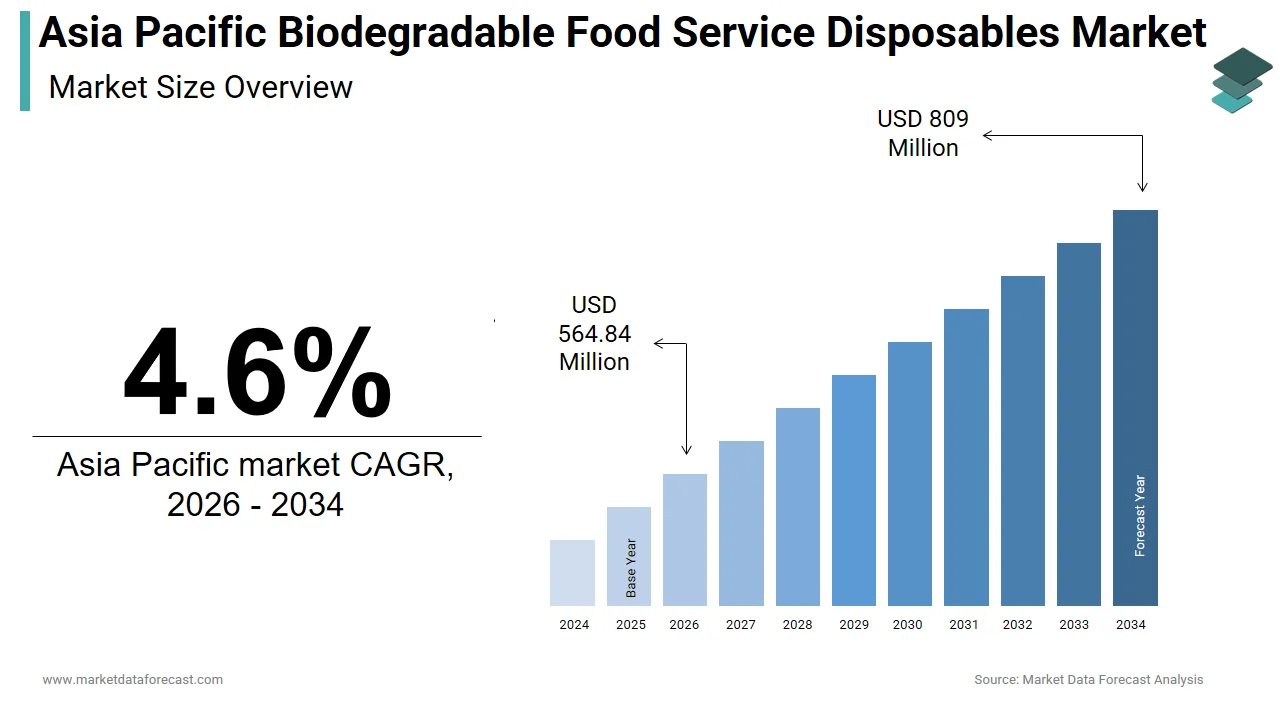
- Market Valuation: Valued at USD 540 million (2025), estimated at USD 564.84 million (2026), and projected to reach USD 809 million by 2034, registering a robust CAGR of 4.6% (2026–2034).
- Primary Growth Drivers: Stringent government regulations banning single-use plastics across China, India, and South Korea, alongside rising consumer demand for sustainable packaging in the food delivery sector. Notable trends include the rapid adoption of green procurement policies by hospitality firms and expanding e-commerce channels facilitating access to certified compostable products.
Key Market Segment Metrics (2026–2034)
| Category | Leading Segment (2025 Position) | Fastest-Growing Segment |
|---|---|---|
| By Raw Material | Pulp and paper (dominated raw materials with a 41.2% share in 2025) | Biopolymers (projected as the fastest-growing segment at a 15.8% CAGR) |
| By Product Type | Plates (held 28.3% product share in 2025) | Cutlery (expected to grow at a 17.2% CAGR) |
| By Distribution Channel | B2B distribution channel (led with a 46.5% share in 2025) | Online stores (anticipated to register a 21.4% CAGR) |
| By Region / Country | South Korea (top-performing country market, with India holding a 17.6% share in 2025) | Japan (likely to grow with a prominent CAGR during the forecast period) |
Major Market Players & Market Structure
Market Structure: Highly competitive eco-friendly packaging and food service disposables landscape featuring global and regional manufacturers competing through molded fiber container rollouts, cutlery facility expansions, home-compostable film introductions, and strategic delivery platform partnerships.
Key Companies: Huhtamaki Group, Biopak Pty Ltd., GreenPack Limited, Pactiv Evergreen Inc., Earthpack, Genpak LLC, Eco-Products, Inc., Georgia-Pacific LLC, Vegware, Dongguan Hengfeng High-Tech Co., Ltd., Novolex, Futamura, and Transpak.
 Download Free Sample Report
Asia Pacific Biodegradable Food Service Disposables Market Size
The size of the Asia Pacific biodegradable food service disposables market was worth USD 540 million in 2025. The Asia Pacific market is anticipated to grow at a CAGR of 4.6% from 2026 to 2034 and be worth USD 809 million by 2034 from USD 564.84 million in 2026.
The Asia Pacific biodegradable food service disposables market refers to the production, distribution, and use of single-use food packaging and serving items made from plant-based, compostable materials such as cornstarch, bagasse, PLA (polylactic acid), and bamboo. These products include plates, cutlery, cups, trays, and takeaway containers designed to reduce environmental impact compared to traditional plastics. According to the United Nations Environment Programme, over 12 million tons of plastic waste enter the ocean annually from the Asia Pacific region, prompting governments to implement bans on single-use plastics. In response, countries like India, China, and Australia have introduced regulatory frameworks promoting eco-friendly alternatives. As per the Australian Institute of Packaging, more than 60% of consumers in Australia prefer food outlets that use compostable packaging, reflecting a broader shift toward sustainability.
In Japan, as reported by the Ministry of the Environment, foodservice providers are increasingly adopting biodegradable utensils to meet national zero-waste goals. Similarly, in Southeast Asia, rising tourism and environmental concerns are driving the adoption of green packaging solutions.
MARKET DRIVERS
Increasing Government Regulations Against Single-Use Plastics
One of the primary drivers of the Asia Pacific biodegradable food service disposables market is the surge in government-imposed restrictions on single-use plastics. Governments across the region are implementing stringent policies to curb plastic pollution, compelling businesses to adopt eco-friendly alternatives. According to the United Nations Environment Programme, over 30 cities in China had enacted full or partial bans on non-biodegradable packaging by 2023 is significantly boosting the demand for compostable foodservice disposables.
In India, as per the Ministry of Environment, Forest and Climate Change, the Plastic Waste Management Amendment Rules of 2023 banned several categories of single-use plastics, including cutlery, straws, and plates, thereby accelerating the adoption of biodegradable substitutes. Similarly, in South Korea, the Ministry of Environment mandates that all food establishments phase out polystyrene and polyethylene-based packaging by 2027, encouraging widespread usage of plant-based disposable items. Additionally, as reported by the Department of Sustainability in New Zealand, local councils have mandated biodegradable packaging for all public events and food vendors operating in designated green zones. These policy-driven initiatives are reshaping supply chain practices and reinforcing the growth trajectory of the biodegradable food service disposables market across the Asia Pacific.
Rising Consumer Awareness and Demand for Sustainable Products
Another major driver propelling the Asia Pacific biodegradable food service disposables market is the growing consumer awareness regarding environmental sustainability and health-conscious consumption. As people become more informed about the adverse effects of plastic pollution, they are increasingly favoring brands that offer eco-friendly packaging options. According to the Nielsen Global Corporate Sustainability Report, nearly 75% of consumers in Singapore and Australia are willing to pay a premium for food served in biodegradable containers.
In Japan, as noted by the Tokyo Metropolitan Government, younger demographics are actively supporting restaurants that use compostable packaging, leading to a visible shift in brand strategies. Similarly, in India, a survey conducted by the Centre for Science and Environment found that over 65% of urban consumers now check for eco-labels before purchasing food from quick-service restaurants. Furthermore, as per Frost & Sullivan, food delivery platforms such as Grab in Southeast Asia and Swiggy in India have started prioritizing restaurants using sustainable packaging, offering them better visibility and incentives. This behavioral change among consumers is not only shaping corporate strategies but also strengthening the market position of biodegradable food service disposables across the Asia Pacific region.
MARKET RESTRAINTS
Higher Production and Material Costs Compared to Conventional Plastics
A significant restraint affecting the Asia Pacific biodegradable food service disposables market is the higher production cost associated with biodegradable materials when compared to conventional petroleum-based plastics. Manufacturing processes for compostable alternatives often involve sourcing organic feedstock such as corn starch, sugarcane fiber, and cassava, which can be more expensive and subject to agricultural price fluctuations. In Thailand, as per the Thai Plastic Industry Association, many small and medium-sized food vendors struggle to justify the financial burden of switching to compostable packaging due to tight profit margins. Moreover, as per Frost & Sullivan, inconsistent availability of raw materials and limited economies of scale further contribute to the cost disparity. These economic barriers hinder the widespread adoption of biodegradable disposables, particularly in price-sensitive markets across the Asia Pacific.
Limited Composting Infrastructure and End-of-Life Challenges
Another key restraint impacting the Asia Pacific biodegradable food service disposables market is the lack of well-established composting infrastructure necessary to ensure the proper disposal and breakdown of these materials. While biodegradable products are designed to decompose under specific conditions, many regions still lack sufficient industrial composting facilities, resulting in improper disposal and reduced environmental benefits. According to the Asian Development Bank, less than 15% of municipal waste management systems in Southeast Asia support organic waste segregation and composting. Additionally, as per the Institute for Local Self-Reliance in Australia, even in developed markets, consumer confusion around disposal methods leads to contamination of recycling streams and lower-than-expected composting rates. These infrastructural and behavioral challenges undermine the intended environmental benefits of biodegradable food service disposables across the Asia Pacific region.
MARKET OPPORTUNITIES
Surge in Food Delivery Services and Takeaway Culture
An emerging opportunity in the Asia Pacific biodegradable food service disposables market is the rapid expansion of online food delivery platforms and the growing culture of takeaway meals. With the rise of digital food ordering apps and changing lifestyles, the demand for convenient, single-use packaging has surged, which is creating a favorable environment for biodegradable alternatives to replace plastic-based containers. In India, as reported by RedSeer Strategy Consultants, the foodtech sector processed more than 400 million monthly orders in 2023, prompting delivery platforms like Zomato and Swiggy to introduce sustainability incentives for restaurants using compostable packaging. In China, Meituan and Elema, two of the largest food delivery services, have committed to reducing plastic use by promoting biodegradable containers through supplier partnerships.
Furthermore, as per Frost & Sullivan, major restaurant chains in Australia and Japan are transitioning to certified compostable packaging to align with consumer expectations and environmental pledges. This evolving foodservice landscape presents a strong growth avenue for biodegradable food service disposables in the Asia Pacific.
Adoption of Green Procurement Policies by Hotels and Catering Industries
Another promising opportunity in the Asia Pacific biodegradable food service disposables market is the increasing adoption of green procurement policies by hotels, event organizers, and large-scale catering companies. As part of their sustainability commitments, many hospitality firms are shifting away from plastic-based tableware and packaging in favor of compostable alternatives. According to the World Travel & Tourism Council, over 60% of luxury hotel chains in Japan and Australia have pledged to eliminate single-use plastics by 2025, directly influencing procurement decisions. In Singapore, as per the Singapore Environment Council, large-scale conferences and exhibitions now mandate the use of biodegradable food containers and utensils to meet city-level sustainability benchmarks. Similarly, in Malaysia, the Malaysian Green Building Index Council encourages the use of compostable disposables in certified green buildings, including commercial cafeterias and office canteens. Additionally, as reported by the Hong Kong Environmental Protection Department, high-end catering services at international airports and railway stations are gradually replacing plastic trays and cutlery with plant-based alternatives.
MARKET CHALLENGES
Performance Limitations Under High Heat and Moisture Conditions
One of the foremost challenges facing the Asia Pacific biodegradable food service disposables market is the performance limitations of certain compostable materials under high heat and moisture exposure. Unlike conventional plastics, many biodegradable alternatives lose structural integrity when exposed to hot or oily foods, leading to issues such as warping, leakage, and reduced durability. According to the Food Packaging Forum Foundation, several biodegradable containers fail to meet the thermal resistance required for steamed or deep-fried food applications by restricting their usability in regional cuisines that rely heavily on such preparation methods.
In China, as per the Chinese Academy of Agricultural Sciences, many biodegradable takeout boxes were found to degrade prematurely when exposed to high-humidity environments during monsoon seasons, causing logistical and customer satisfaction concerns. Additionally, as per Frost & Sullivan, foodservice operators frequently report dissatisfaction with the mechanical strength of certain biodegradable trays and bowls, especially in buffet and airline catering settings. These functional constraints continue to pose technical hurdles that need addressing for the widespread acceptance of biodegradable disposables in the Asia Pacific region.
Lack of Standardization and Certification Across the Region
Another critical challenge confronting the Asia Pacific biodegradable food service disposables market is the absence of uniform standards and certification mechanisms across different countries. The lack of standardized labeling and compostability verification creates confusion among consumers and businesses, hindering trust and market expansion. According to the International Organization for Standardization, varying national regulations on what constitutes “biodegradable” or “compostable” lead to inconsistencies in product quality and environmental claims.
In India, as per the Bureau of Indian Standards, multiple interpretations of compostability certifications have resulted in a mixed market where some products labeled as “eco-friendly” do not fully decompose under typical landfill conditions. In Indonesia, the Indonesian National Standardization Agency notes that the absence of a unified certification framework has led to market saturation with semi-degradable or partially recyclable products that do not meet global composting criteria. According to the Ministry of Ecology and Environment, China banned expanded polystyrene-based food containers in major cities starting in 2021, prompting swift adoption of biodegradable alternatives. Additionally, as per the China Light Industry Council, domestic producers supplied over 1.2 million tons of biodegradable packaging in 2023, which is supported by strong investments in PLA and bagasse processing facilities.
REPORT COVERAGE
| REPORT METRIC | DETAILS |
| Market Size Available | 2025 to 2034 |
| Base Year | 2025 |
| Forecast Period | 2026 to 2034 |
| Segments Covered | By Raw Material Type, Product Type, Distribution Channel, and Region. |
| Various Analyses Covered | Global, Regional and Country-Level Analysis, Segment-Level Analysis, Drivers, Restraints, Opportunities, Challenges; PESTLE Analysis; Porter’s Five Forces Analysis, Competitive Landscape, Analyst Overview of Investment Opportunities |
| Countries Covered | India, China, Japan, South Korea, Australia, New Zealand, Thailand, Malaysia, Vietnam, Philippines, Indonesia, Singapore, Rest of APAC |
| Market Leaders Profiled | Huhtamaki Group, Biopak Pty Ltd., GreenPack Limited, Pactiv Evergreen Inc., Earthpack, Genpak LLC, Eco-Products, Inc., Georgia-Pacific LLC, Vegware, and Dongguan Hengfeng High-Tech Co., Ltd. |
SEGMENTAL ANALYSIS
By Raw Material Type Insights
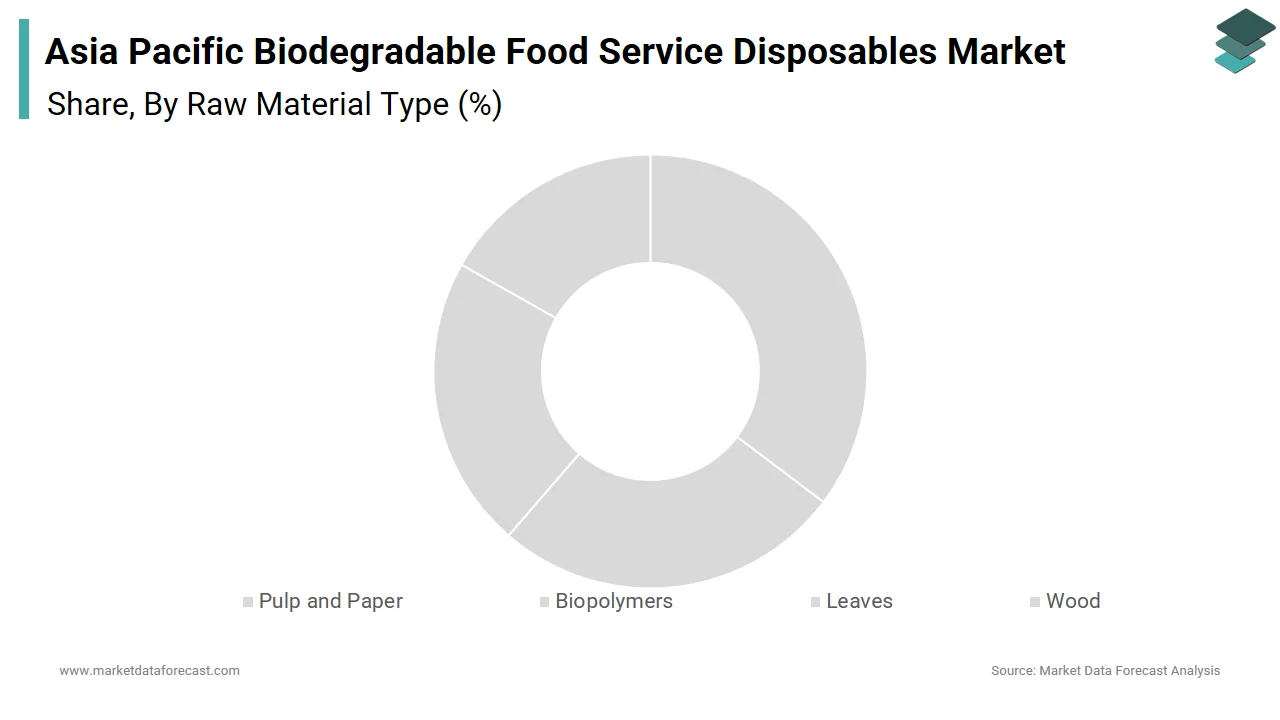
The Pulp and paper segment was the largest and held 41.2% of the Asia Pacific biodegradable food service disposables market share in 2025 due to the widespread availability of raw materials such as bamboo, sugarcane bagasse, and recycled fibers across countries like China, India, and Indonesia. These materials are extensively used in manufacturing items such as plates, bowls, containers, and food trays due to their heat resistance, low cost, and ease of recyclability.
The governments in several APAC nations have introduced regulations restricting single-use plastics, particularly in the foodservice sector. This has prompted quick-service restaurants (QSRs), cafes, and food delivery platforms to adopt pulp and paper-based packaging alternatives.
The biopolymers segment is likely to register a CAGR of 15.8% during the forecast period, with the rapid expansion driven by advancements in material science and growing demand for high-performance alternatives to conventional plastics. Polylactic acid (PLA), polyhydroxyalkanoates (PHA), and starch blends are increasingly being adopted for cutlery, cups, and rigid containers due to their superior durability, clarity, and compatibility with food contact standards. Major food brands and eco-conscious startups in Japan, South Korea, and Australia are prioritizing biopolymer-based packaging to align with corporate sustainability goals. Additionally, as noted by the Ellen MacArthur Foundation, investment in biorefineries and composting infrastructure across Southeast Asia is enabling more efficient disposal and recycling of biopolymer products.
By Product Type Insights
The plates segment was accounted for in holding 28.3% of the Asia Pacific biodegradable food service disposables market in 2025, which is largely driven by the extensive use of disposable plates in catering services, religious events, outdoor gatherings, and street food vendors across countries like India, Thailand, and Vietnam. In India alone, millions of leaf-based and pulp-molded plates are used daily for serving meals in homes, temples, and railway stations. The country’s deep-rooted cultural traditions favor biodegradable plate options made from areca leaves, banana leaves, or sugarcane fiber, reinforcing long-standing consumer acceptance. Moreover, as per NielsenIQ, organized QSR chains and food delivery aggregators in urban centers are increasingly adopting compostable plates to meet customer demand for eco-friendly packaging.
The cutlery segment is likely to experience a CAGR of 17.2% from 2026 to 2034, owing to the increasing adoption of biodegradable spoons, forks, knives, and chopsticks in fast-food chains, airlines, and home meal deliveries. As reported by Euromonitor International, food delivery platforms such as Meituan in China and Zomato in India have mandated the use of eco-friendly cutlery in their packaging guidelines to reduce plastic waste. Additionally, as per Frost & Sullivan, biopolymer-based cutlery, particularly those made from PLA, which are gaining traction due to their rigidity, heat resistance, and suitability for both hot and cold foods.
Furthermore, governments in Malaysia, Singapore, and South Korea have introduced policies discouraging plastic cutlery usage in food establishments. The demand for sustainable alternatives is expected to continue rising as consumers become more environmentally conscious.
By Distribution Channel Insights
The business-to-business (B2B) segment led the Asia Pacific biodegradable food service disposables market with 46.5% of the share in 2025. The restaurant industry in Asia Pacific generated over $1 trillion in revenue in 2023, which is escalating the scale of foodservice operations that rely on bulk procurement of disposable packaging. Many large-scale food operators prefer sourcing through B2B suppliers to ensure consistency in quality, volume, and pricing.
Additionally, as per McKinsey & Company, multinational QSR chains operating in the region—including McDonald's, KFC, and Domino’s have integrated biodegradable disposables into their global sustainability strategies by procuring directly from manufacturers or specialized distributors. With rising corporate ESG commitments and supply chain digitization, the B2B channel remains the dominant route for biodegradable product distribution in the APAC region.
The online stores segment is anticipated to register a CAGR of 21.4% in the coming years. The growth of the segment is attributed to the rapid growth is driven by the rise of e-commerce platforms and increased accessibility of eco-friendly products to small businesses and individual consumers. Platforms such as Amazon India, Alibaba, and Tokopedia now offer dedicated sections for biodegradable packaging, making it easier for SMEs and households to transition away from plastic. The younger consumers in countries like Australia, Japan, and South Korea are actively seeking out sustainable lifestyle products, which include compostable food containers and utensils, by purchasing through online retailers. The online channel is set to play an even greater role in shaping the future of the biodegradable disposables market in Asia Pacific.
COUNTRY LEVEL ANALYSIS
India was positioned second in the Asia Pacific biodegradable food service disposables market with 17.6% of the share in 2025. The country’s growth is primarily fueled by stringent government regulations against single-use plastics, rising awareness of environmental issues, and increasing adoption by the informal food economy. According to the Ministry of Environment, Forest and Climate Change, the Plastic Waste Management Amendment Rules of 2023 prohibited the manufacture and sale of several categories of single-use plastic items, including plates, cutlery, and straws. As noted by the Confederation of Indian Industry, this policy shift has led to a significant uptick in demand for alternatives made from bagasse, bamboo, and wheat straw.
Additionally, as per the India Brand Equity Foundation, e-commerce platforms such as Amazon India and Flipkart have launched dedicated sections for eco-friendly packaging, enabling both businesses and consumers to access certified compostable products easily.
Japan biodegradable food service disposables market is likely to grow with a prominent CAGR during the forecast period. The country maintains a strong presence due to its early adoption of green packaging standards, well-established composting infrastructure, and proactive government policies aimed at achieving a circular economy.
According to the Ministry of the Environment, Japan mandated the use of compostable packaging in public events and municipal food vendors under the Green Growth Strategy, reinforcing the shift away from petroleum-based plastics. Moreover, as reported by the Tokyo Metropolitan Government, leading restaurant chains and food delivery services have committed to eliminating non-recyclable packaging by 2025.
Australia's biodegradable food service disposables market is likely to grow in the coming years with the growing consumer awareness, government-backed plastic reduction strategies, and increasing adoption by environmentally conscious foodservice operators.
According to the Australian Institute of Packaging, over 65% of surveyed consumers in 2023 preferred restaurants that used compostable packaging, influencing brand decisions across major food chains. In response, as per the Department of Climate Change, Eat Club, Grill’d, and other QSRs have transitioned to biodegradable containers and cutlery to align with national sustainability commitments.
South Korea was the top performer in the Asia Pacific biodegradable food service disposables market. The country’s strong presence is driven by progressive urban policies, digital food ordering trends, and growing consumer consciousness regarding environmental impact.
According to the Korea Environment Corporation, over 300 municipalities have introduced mandatory compostable packaging guidelines for street food vendors and food courts, accelerating the transition from plastic-based disposables. In addition, as per the Korea Foodservice Industry Association, leading food delivery platforms such as Baedal Minjok and Coupang Eats have prioritized restaurants using biodegradable packaging, offering them visibility incentives and promotional support.
KEY MARKET PLAYERS
Some of the noteworthy companies in the APAC biodegradable food service disposables market profiled in this report are Huhtamaki Group, Biopak Pty Ltd., GreenPack Limited, Pactiv Evergreen Inc., Earthpack, Genpak LLC, Eco-Products, Inc., Georgia-Pacific LLC, Vegware, and Dongguan Hengfeng High-Tech Co., Ltd.
TOP LEADING PLAYERS IN THE MARKET
Huhtamaki Oyj
Huhtamaki is a global leader in sustainable food packaging and plays a significant role in the Asia Pacific biodegradable food service disposables market. The company has been actively expanding its plant-based product portfolio, focusing on molded fiber trays, compostable cups, and bagasse containers that align with regional sustainability goals. With manufacturing facilities across China, India, and Southeast Asia, Huhtamaki supports major foodservice chains and delivery platforms by providing scalable, eco-friendly packaging solutions.
Novolex (formerly Pactiv Evergreen Inc.)
Novolex is a key participant in the biodegradable food service disposables market by offering a diverse range of compostable products, including plates, clamshells, and cutlery made from renewable materials. The company’s strong presence in Australia, Japan, and South Korea is driven by strategic partnerships with QSRs and retail chains seeking to reduce plastic waste. Novolex continues to invest in R&D to enhance material performance and expand its footprint in emerging Asian markets.
Futamura Group
Futamura is a pioneering manufacturer of biodegradable and compostable packaging materials, particularly known for its NatureFlex™ cellulose films used in foodservice applications. The company has established itself as a preferred supplier for environmentally conscious brands across the Asia Pacific. By collaborating with regulatory bodies and industry associations, Futamura contributes to setting standards for compostable packaging, influencing both regional and international market dynamics.
TOP STRATEGIES USED BY KEY MARKET PARTICIPANTS
One of the primary strategies adopted by leading players in the Asia Pacific biodegradable food service disposables market is product innovation and material diversification, where companies continuously develop new biodegradable formulations to improve durability, heat resistance, and cost-efficiency. Another crucial approach is strategic partnerships and supply chain integration, with firms aligning with raw material suppliers, foodservice operators, and logistics providers to ensure consistent quality and availability. Additionally, market education and consumer engagement initiatives are widely pursued, allowing companies to build brand trust and drive demand through awareness campaigns, certifications, and sustainability storytelling tailored to local consumer preferences.
COMPETITION OVERVIEW
The competition in the Asia Pacific biodegradable food service disposables market is highly dynamic, shaped by the convergence of government mandates, shifting consumer expectations, and rapid product innovation. A mix of global corporations, regional manufacturers, and local startups coexist, each striving to capture market share through differentiation in material sourcing, product functionality, and pricing models. While multinational players like Huhtamaki and Novolex leverage their established distribution networks and certification expertise, domestic producers are gaining traction by offering cost-competitive alternatives tailored to local needs.
Consumer demand is increasingly influenced by environmental consciousness, particularly among urban populations and younger demographics who prioritize sustainability in their purchasing decisions. This has led to intensified competition in branding, with companies emphasizing transparency in sourcing and compostability claims. At the same time, food delivery platforms and restaurant chains are exerting influence over packaging choices, further shaping market dynamics. To maintain relevance, market participants are investing heavily in localized production, digital marketing, and collaboration with policymakers to align with evolving green regulations and consumer expectations across the region.
RECENT MARKET DEVELOPMENTS
- In February 2024, Huhtamaki launched a new line of molded fiber takeaway containers in Singapore and Malaysia, specifically designed for hot and oily foods. This initiative was aimed at addressingthe functional limitations of traditional biodegradable materials and enhancing usability in Southeast Asian cuisine.
- In July 2023, Novolex expanded its compostable cutlery production facility in India to meet rising demand from quick-service restaurants and food delivery platforms adhering to national plastic bans. This move was intended to strengthen Novolex’s position in one of the fastest-growing biodegradable packaging markets in the region.
- In November 2023, Futamura Group introduced a certified home-compostable film for food wrapping in Japan, targeting convenience stores and supermarket ready-to-eat sections. This development was aligned with the country’s push toward zero-waste retail environments and sustainable packaging adoption.
- In March 2024, Eco-Products, a subsidiary of Novolex, entered into a strategic partnership with Swiggy in India to supply biodegradable food containers to thousands of partner restaurants, supporting platform-level sustainability commitments and increasing brand visibility.
- In August 2023, Transpak, an Australian packaging distributor, launched an exclusive B2C e-commerce portal offering certified compostable disposables to households and small businesses, reflecting the growing consumer-driven demand for sustainable dining solutions.
MARKET SEGMENTATION
This Asia Pacific biodegradable food service disposables market research report is segmented and sub-segmented into the following categories.
By Raw Material Type
- Pulp and Paper
- Biopolymers
- Leaves
- Wood
By Product Type
- Cups
- Clamshells and Containers
- Plates
- Cutleries
- Others
By Distribution Channel
- Business-to-Consumer (B2C)
- Business to Business (B2B)
- Supermarkets and Hypermarkets
- Online Stores
- Others
By Country
- India
- China
- Japan
- South Korea
- Australia
- New Zealand
- Thailand
- Malaysia
- Vietnam
- Philippines
- Indonesia
- Singapore
- Rest Of APAC