- Product Description Description
- Table of Contents TOC
- List of Table & Figure LOT
- Get Free Sample PDF Sample PDF
Market Size, 2025
$714.8 MnMarket Estimate, 2026
$776.6 MnMarket Forecast, 2034
$1,507.3 MnCAGR, 2026–2034
8.64%Asia-Pacific Blood Pressure Monitoring Devices Market Size, Trends, and Forecast (2026–2034)
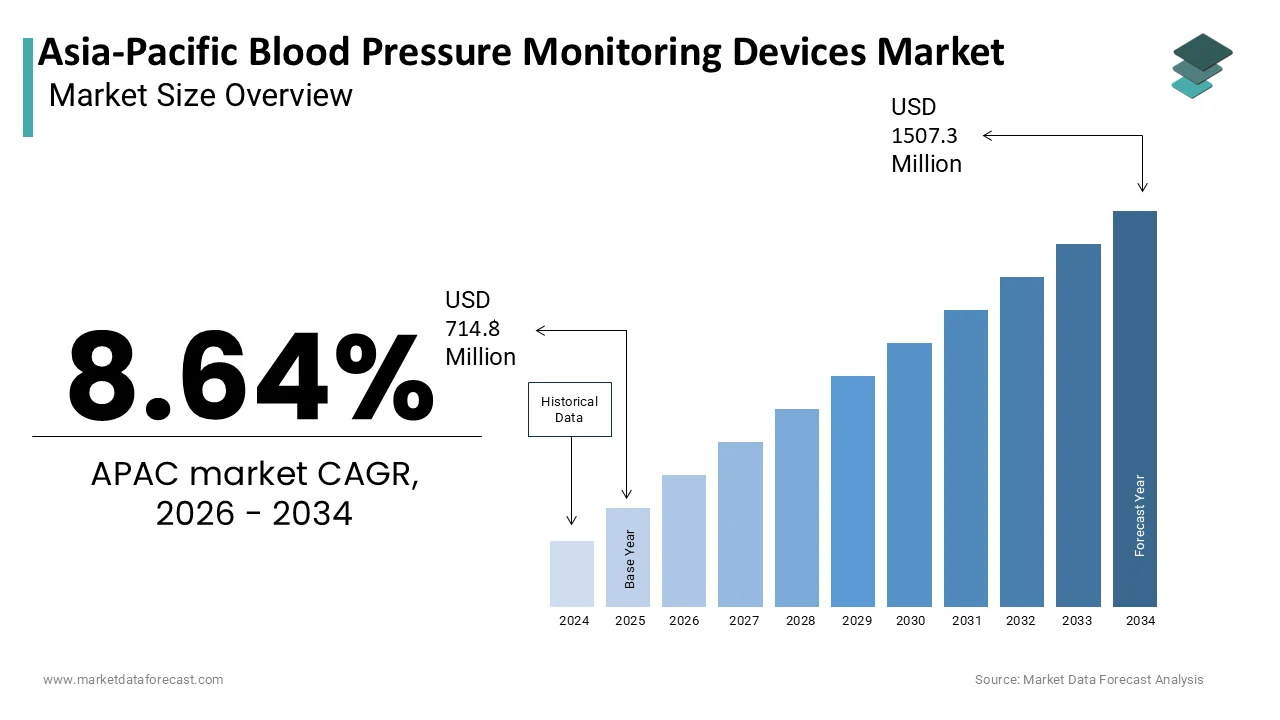
The Asia-Pacific Blood Pressure Monitoring Devices Market size was valued at USD 714.8 million in 2025, stands at USD 776.6 million in 2026, and is anticipated to reach USD 1507.3 million by 2034, expanding at a compound annual growth rate (CAGR) of 8.64% during the forecast period from 2026 to 2034. Growth is heavily driven by a massive regional hypertension epidemic, rapid demographic aging accelerating home monitoring adoption, and the widespread integration of connected digital health platforms.
Key Executive Metrics (At-a-Glance)
- 2025 Base Valuation: USD 714.8 Million
- 2026 Current Valuation: USD 776.6 Million
- 2034 Forecast Valuation: USD 1507.3 Million
- Forecast Period: 2026–2034
- Compound Annual Growth Rate (CAGR): 8.64% (2026–2034)
- Dominant Type Segment: Automated Digital Blood Pressure Monitors
- Fastest-Growing Type Segment: Ambulatory Blood Pressure Monitors (19.2% CAGR)
- Leading Country Markets: China (33.8% share in 2025) and Japan (21.5% share in 2025)
Core Market Drivers
- Hypertension Epidemic Scale: High adult hypertension prevalence rates across Asian populations create structural, non-negotiable demand for foundational diagnostic screening infrastructure.
- Ageing Demographic Transition: Rapid population aging in East and Southeast Asian nations accelerates self-monitoring adoption for chronic disease management.
Primary Market Restraints & Challenges
- Validation Gaps & Affordability Barriers: Proliferation of unvalidated monitors undermining clinical trust, coupled with high relative costs restricting access in low-income settings.
- Technical & Anthropometric Issues: Persistent cuff size mismatches and patient health literacy deficits causing systematic measurement errors.
Asia-Pacific Blood Pressure Monitoring Devices Market Segmentation Breakdown
| Segment Category | Largest / Dominant Segment | Fastest-Growing / Key Highlight |
|---|---|---|
| By Type | Automated Digital Monitors | Ambulatory Blood Pressure Monitors (19.2% CAGR) |
| By Country | China (33.8% share) & Japan (21.5% share) | India (Massive untreated patient reservoir & local manufacturing) |
Major Industry Players Profiled
Key corporations shaping the Asia-Pacific blood pressure monitoring devices market include GE HealthCare, Welch Allyn, A&D Medical Inc., SunTech Medical, Rossmax International Ltd., Spacelabs Healthcare Inc., Panasonic Corporation, Philips Healthcare, Contec Medical Systems Co., Ltd., OMRON Healthcare, and Microlife AG.
 Download Free Sample Report
Asia-Pacific Blood Pressure Monitoring Devices Market Size
The APAC Blood Pressure Monitoring Devices Market is projected to grow from USD 714.8 million in 2025 to USD 776.6 million in 2026 and reach USD 1507.3 million by 2034, registering a CAGR of 8.64% during the forecast period from 2026 to 2034.
A blood pressure monitoring device is a medical tool that measures the force of blood pushing against your artery walls. This domain serves as foundational diagnostic infrastructure, enabling detection, treatment, titration, and long-term control of elevated blood pressure, which remains the leading modifiable risk factor for stroke, heart disease,e and kidney failure throughout the region. According to the World Health Organisation, the total global number of adults aged 30 to 79 living with hypertension reached 1.4 billion in 2024, driving an active regional demand for accessible digital blood pressure monitoring and telemedicine screening tools. As per the World Health Organisation, the Western Pacific Region maintains a documented adult hypertension prevalence rate of 29%, marking the lowest regional percentage globally amid ongoing demographic transitions. According to the Asian Development Bank, noncommunicable diseases generate an economic toll of approximately 756.5 billion Philippine pesos per year in the Philippines, where they account for 68% of all national deaths. This market definition extends beyond device sales to encompass validation protocols, cuff sizing standards, user training programs, and data integration capabilities that collectively determine whether measured values translate into effective clinical decision-making across resource-stratified healthcare systems spanning high-income nations to remote rural clinics.
MARKET DRIVERS
Hypertension Epidemic Scale Creates Foundational Diagnostic Demand
Unprecedented hypertension prevalence across the region generates structural demand for these monitoring devices, which fuels the growth of the Asia Pacific Blood Pressure Monitoring Device Market. Governments are recognising measurement capacity as a prerequisite for achieving national NCD reduction targets. According to the World Health Organisation Global Report on Hypertension, an estimated 1.3 billion adults worldwide are affected by high blood pressure, with low- and middle-income nations bearing the vast majority of this expanding global cardiovascular chronic disease burden. As per the China Centre for Disease Control and Prevention, the national prevalence of hypertension among adults aged 18 and older stands at 27.5%, necessitating robust primary clinical infrastructure and screening systems to handle urban and rural disease cascades. Unlike discretionary medical devices, blood pressure monitors represent non-negotiable public health infrastructure where measurement capacity directly determines case finding, treatment initiation,n and control achievement. This epidemiological imperative transforms device procurement from a capital expenditure choice into mandatory health system investment, ensuring sustained demand independent of economic cycles or consumer preference fluctuations as nations pursue WHO HEARTS technical package implementation targets.
Ageing Demographic Transition Accelerates Home Monitoring Adoption
Rapid population ageing across developed and transitioning nations in the region drives a shift toward home blood pressure monitoring, which further accelerates the expansion of the Asia Pacific Blood Pressure Monitoring Device Market. Elderly patients require frequent measurements for polypharmacy management and frailty-adjusted treatment targets. As per Statistics Korea, the elderly population aged 65 and over comprises roughly one-fifth of the total citizenry, prompting expansive national insurance updates to scale medical hardware provision for an increasingly older demographic. According to Thailand's National Statistical Office, the country has transitioned into an aged society where more than 20% of its total population is 60 years or older, accelerating structural transformations within universal healthcare networks. The demographic inevitability creates a non-cyclical demand floor as biological ageing processes continue driving self-monitoring adoption regardless of economic conditions, ensuring sustained market growth through structural population dynamics rather than discretionary health spending.
MARKET RESTRAINTS
Device Validation Gaps Undermine Measurement Accuracy
Many unvalidated blood pressure monitors are sold across regional markets, which limits the growth of the Asia Pacific Blood Pressure Monitoring Device Market. This trend negatively affects physician choices and reduces trust in home testing. According to the international validation scientific non-profit STRIDE BP, a substantial proportion of blood pressure monitors commercially available worldwide fail to clear stringent validation protocols established by the ESH, AAMI, or ISO, creating clinical risks of misdiagnosis. As per the Directorate General of Drug Administration of Bangladesh, medical device imports and local distribution are subject to regular inspections and compliance guidelines to eliminate substandard diagnostic equipment from the pharmaceutical supply chain. The validation failures transform device proliferation into a potential harm source, undermining public health objectives and creating reluctance among clinicians to incorporate patient-generated data into treatment decisions despite guideline recommendations favouring out-of-office measurements.
Affordability Barriers Limit Access in Low-Income Settings
High relative cost of validated blood pressure monitors prevents equitable access across income strata in developing regions, which in turn hinders the expansion of the Asia Pacific Blood Pressure Monitoring Device Market. This occurs despite falling absolute prices in global markets. According to the World Bank Living Standards Measurement Study, multi-topic household datasets reveal significant structural income constraints in low-income rural economies, which deeply restrict household financial capacity to purchase non-subsidised medical diagnostic electronics. As per the Social Weather Stations, independent tracking highlights deep socio-economic inequalities regarding healthcare service access and consumer financial capabilities across the poorest and wealthiest Filipino demographics. The affordability gaps mean device ownership correlates strongly with socioeconomic status rather than clinical need, undermining universal health coverage goals and limiting the real-world impact of technological advances to affluent populations while vulnerable groups remain dependent on infrequent clinic measurements.
MARKET OPPORTUNITIES
Connected Device Integration Enables Remote Hypertension Management
Bluetooth- and cellular-enabled blood pressure monitors integrated with telehealth platforms create an opportunity to transform episodic clinic care into continuous remote management, which is expected to boost the growth of the Asia Pacific Blood Pressure Monitoring Device Market. This addresses specialist shortages and geographic barriers across the region. According to the International Telecommunication Union, expansive regional improvements in cellular connectivity and mobile network subscriptions lay the groundwork for digital health applications across the Asia-Pacific region. As per the Royal Flying Doctor Service, the deployment of virtual health strategies and remote care capabilities serves to optimise medical assessments and lower diagnostic hurdles for individuals in outback territories. The digital convergence transforms static devices into care coordination nodes extending specialist reach while generating recurring software and service revenue streams beyond one-time hardware sales, creating sustainable business models aligned with value-based care transitions.
Culturally Adapted Design Addresses Diverse User Needs
Development of blood pressure monitors incorporating language localisation, ergonomic adaptations, and health literacy-appropriate interfaces provides a pathway for the expansion of the Asia Pacific Blood Pressure Monitoring Device Market. This helps to increase adoption among elderly, rural, and low-education populations historically underserved by generic global products. According to HelpAge International, structural vulnerabilities and language restrictions pose persistent access barriers for older populations navigating modern medical technology and digital self-monitoring interfaces in developing economies. As per the Ministry of Health of Malaysia, localised health communications and multi-language patient education materials reinforce chronic care protocol adherence within primary care centres serving multiethnic demographics. According to the Consumer Affairs Agency of Japan, public safety notices and hardware accessibility regulations focus on expanding intuitive device configurations to minimise operational issues among senior demographics. The human-centred design innovations convert usability barriers into competitive differentiation opportunities, enabling premium positioning in markets where cultural relevance directly influences health behaviour compliance and preventive care engagement across diverse Asia Pacific societies.
MARKET CHALLENGES
Cuff Size Mismatch Causes Systematic Measurement Error
The widespread use of incorrectly sized blood pressure cuffs across the region creates pervasive measurement inaccuracy, which constrains the growth of the Asia Pacific Blood Pressure Monitoring Device Market. This inaccuracy undermines clinical validity regardless of device validation status or technological sophistication. According to the World Hypertension League, ensuring accurate blood pressure assessment in clinical and community environments requires utilising correctly proportioned and validated cuff dimensions tailored to individual arm anthropometrics. As per the National Institute of Preventive and Social Medicine, medical diagnostic standard evaluations emphasise regular calibration and specific anthropometric equipment parameters to safeguard accuracy across hospital patient populations. The anthropometric mismatches mean even validated devices produce erroneous data when paired with wrong cuffs, creating a hidden quality crisis that device certification alone cannot resolve, requiring systematic cuff sizing audits and supply chain adjustments across all healthcare tiers.
Health Literacy Deficits Limit Effective Self-Monitoring
Insufficient patient understanding of proper blood pressure measurement technique and result interpretation slows down the expansion of the Asia Pacific Blood Pressure Monitoring Device Market. This prevents home monitoring from translating into improved outcomes despite device availability across the region. According to the World Health Organisation, targeted public health initiatives focus on elevating basic health literacy to help community members measure baseline vitals accurately and interpret tracking milestones. As per the Indian Council of Medical Research, standardised public health data guidelines emphasise adherence to uniform operational techniques to maintain precise diagnostic recording parameters in field studies. The knowledge gaps transform device ownership into false security, where patients believe they are monitoring effectively while generating misleading data, highlighting the need for integrated education interventions beyond hardware distribution alone.
REPORT COVERAGE
| REPORT METRIC | DETAILS |
| Market Size Available | 2025 to 2034 |
| Base Year | 2025 |
| Forecast Period | 2026 to 2034 |
| Segments Covered | By Type and Region. |
| Various Analyses Covered | Global, Regional, and Country-Level Analysis, Segment-Level Analysis, Drivers, Restraints, Opportunities, Challenges; PESTLE Analysis; Porter’s Five Forces Analysis, Competitive Landscape, Analyst Overview of Investment Opportunities |
| Countries Covered | India, China, Japan, South Korea, Australia, New Zealand, Thailand, Malaysia, Vietnam, Philippines, Indonesia, Singapore, Rest of APAC |
| Market Leaders Profiled | GE HealthCare, Welch Allyn, A&D Medical Inc., SunTech Medical, Rossmax International Ltd. |
SEGMENTAL ANALYSIS
By Type Insights
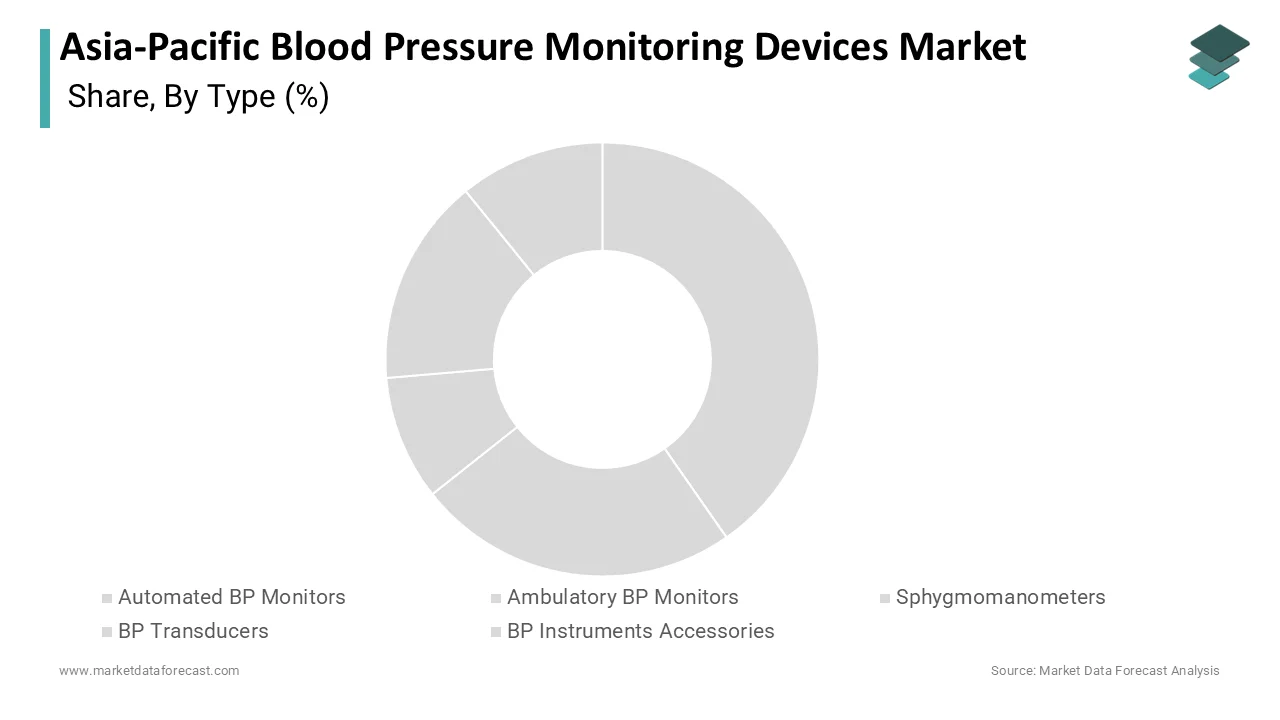
The automated digital blood pressure monitors segment dominated the Asia Pacific Blood Pressure Monitoring Device Market and accounted for a substantial share in 2025. This dominance of the segment was driven by clinical guideline recommendations favouring out-of-office measurements for hypertension diagnosis and management, which have transformed these devices from optional accessories into standard care infrastructure. According to the World Hypertension League, promoting the global transition toward using exclusively validated automated blood pressure monitoring devices serves as a vital component for reducing global non-communicable disease risks. As per the Heart Foundation, clinical guidelines and national consensus statements emphasise the strategic integration of automated office and out-of-office blood pressure tracking within primary care networks. Unlike mercury sphygmomanometers requiring trained observers or ambulatory monitors limited to specialised settings, automated digital devices enable unsupervised self-measurement at scale, aligning with task-shifting strategies essential for managing massive patient volumes amid specialist shortages. This guideline-driven normalisation transforms automated monitors into foundational public health tools, ensuring sustained dominance through clinical necessity rather than consumer preference alone.
Asian manufacturing hubs have achieved production efficiencies that reduced validated automated monitor prices to levels accessible across income strata, enabling volume-based market leadership unattainable for higher-cost alternatives. According to sources, expanding the automated electronic components manufacturing and distribution infrastructure lowers global product sourcing barriers to support decentralised home care. As per studies, the availability of core branded blood pressure monitors by companies like Omron and Microlife supports decentralised diagnostic access as the BPJS Kesehatan public insurance model evolves. The manufacturing economies create a virtuous cycle where lower prices increase adoption volumes, which further reduce unit costs through scale effects. Unlike premium ambulatory or professional-grade devices constrained by specialised components and low-volume production, automated monitors benefit from consumer electronics supply chain synergies enabling continuous price compression that expands the addressable market across developing Asia Pacific while maintaining acceptable margins for manufacturers.
The ambulatory blood pressure monitors segment is anticipated to witness the fastest CAGR of 19.2% from 2026 to 2034, due to emerging evidence linking nocturnal hypertension and non-dipping patterns to cardiovascular outcomes independent of daytime readings, prompting guideline updates mandating ABPM for specific patient populations. According to research, tracking nocturnal hypertension patterns and blood pressure variability through continuous clinical protocols allows medical providers to optimise cardiovascular risk assessment. As per the Korean Society of Hypertension, the real-world deployment of validated blood pressure tracking technologies aims to bridge gaps between guideline-based diagnostic ideals and actual clinical control rates. According to integrated healthcare data patterns from institutions like the National University Health System, remote patient telemetry and specialised cardiovascular clinical setups enhance treatment efficiency for metabolic conditions. As per Australia's Department of Health and Aged Care, specific service subsidies within the Medicare Benefits Schedule framework promote structured ambulatory blood pressure monitoring for clarifying clinical hypertension indicators. The evidence-driven paradigm shift transforms ABPM from a niche research tool into a mainstream diagnostic modality, explaining superior growth velocity despite higher unit costs and limited availability compared to automated home monitors.
Formalised diagnostic algorithms for apparent treatment-resistant hypertension increasingly mandate ambulatory monitoring as a confirmation step before escalating therapy or referring for secondary cause evaluation, accelerating segment growth through protocol-driven demand. According to regional chronic disease consensus reports, confirming a diagnosis of true resistant hypertension requires verifying out-of-office blood pressure metrics while ruling out medication non-adherence and white-coat anomalies. As per public tracking of Thailand's Universal Coverage Scheme, standardising multi-tiered treatment pathways across community facilities streamlines chronic diagnostic routing and helps control medical overhead. According to clinical registries tracking cardiovascular treatment adherence, standardising internal facility protocols serves to eliminate pseudo-resistance and lower inappropriate polypharmacy escalation. As per health insurance enhancement blueprints from the Department of Health of the Philippines, expanding targeted healthcare benefit pack options increases access to basic inpatient diagnostic testing services for under-resourced patient demographics. These protocol integrations embed ABPM into routine clinical workflows, transforming discretionary testing into mandatory diagnostic steps, ensuring sustained growth independent of physician awareness campaigns or patient demand generation efforts.
COUNTRY LEVEL ANALYSIS
China Blood Pressure Monitoring Device Market Analysis
China led the Asia Pacific blood pressure monitoring device market and captured a 33.8% share in 2025. This leading position of the Chinese market was attributed to the world's largest hypertensive population. As per the National Centre for Cardiovascular Diseases, China has approximately 245 million adults living with hypertension, creating massive domestic demand within its medical device and manufacturing ecosystem. According to the National Health Commission, China incorporates hypertension screening and management into its Basic Public Health Services program to cover urban and rural residents nationwide. As per the National Medical Products Administration, domestic medical device manufacturers like Yuwell and Andon satisfy mandatory medical electrical equipment safety standards under the GB 9706 series to supply domestic consumer and hospital markets. According to the State Council's Healthy China 2030 blueprint, the country aims to significantly improve chronic disease management and health awareness across its population by the year 2030. However, centralized volume-based procurement compresses margins. Provincial implementation variability causes access disparities.
Japan Blood Pressure Monitoring Device Market Analysis
Japan followed closely behind in the Asia Pacific blood pressure monitoring device market and secured a 21.5% share in 2025. This growth of the Japanese market was fuelled by the world's highest home monitoring penetration, advanced device sophistication, and mature replacement-driven demand dynamics. As per the Japanese Society of Hypertension, an estimated 43 million people in Japan have hypertension, making it a critical focus area for home blood pressure monitoring guidelines. The universal health insurance system covers physician-prescribed monitors for elderly and low-income patients,s with catastrophic illness provisions capping out-of-pocket expenses, ensuring equitable access across income strata. According to the Japanese Society of Hypertension, home blood pressure monitoring features such as irregular heartbeat detection and digital tracking play an integral role in real-world clinical practice guidelines. As per the Ministry of Health, Labour and Welfare of Japan, the rapidly ageing demographic profile increases the structural need for accessible medical devices and community-centred chronic disease prevention programs. Declining birth rates paradoxically increase per-patient device intensity as resources concentrate on smaller elderly cohorts requiring comprehensive cardiovascular monitoring. High validation standards exceeding ISO requirements create barriers for low-cost imports, protecting domestic manufacturers, though Chinese competitors are gaining ground through improved quality and aggressive pricing in mid-tier segments.
India Blood Pressure Monitoring Device Market Analysis
India maintains a significant presence in the Asia Pacific blood pressure monitoring device market due to a massive untreated patient reservoir, rapid domestic manufacturing growth, and government-led distribution programs creating dual-speed market dynamics. As per the World Health Organisation, an estimated 220 million people in India live with hypertension, with only about 12% having their blood pressure under control, driving massive public health demand for diagnostic and management solutions. According to the Ministry of Health and Family Welfare, the Pradhan Mantri Ayushman Bharat Health Infrastructure Mission scales up grassroots healthcare infrastructure, expanding diagnostic networks and critical care blocks across public facilities. As per the Ministry of Commerce and Industry, domestic medical device enterprises utilise Make in India production frameworks to expand local sourcing and boost competitive participation in public medical procurement programs. The private retail segment is growing annually, driven by urban middle-class health consciousness and e-commerce penetration. As per the National Health Authority, the expanding footprint of digital health networks and unified health accounts streamlines public care delivery, though the structural availability of specialised cardiologists remains unequal across rural and urban landscapes. State-level implementation variability causes geographic disparities.
South Korea Blood Pressure Monitoring Device Market Analysis
South Korea is also a key player in the Asia Pacific blood pressure monitoring device market because of advanced digital health integration, high treatment adherence rates, and sophisticated reimbursement frameworks supporting premium device adoption. As per the Korean Society of Hypertension, South Korea has approximately 13 million adults living with hypertension, with an overall awareness rate of 77% and an overall control rate of 59%. According to the National Health Insurance Service, Korea's public health insurance framework uses localised Big Data structures to incentivise consistent primary care attendance and ongoing chronic disease monitoring. As per the Ministry of Food and Drug Safety, domestic medical device developers coordinate with strict regulatory guidelines to launch digitised diagnostic instruments, expanding active domestic clinical validation channels. According to the Korea Disease Control and Prevention Agency, integrated chronic disease management initiatives link clinical metrics with mobile tools to improve compliance and control rates among urban populations. High generic competition compresses margins for basic models, pushing manufacturers toward connected and AI-enhanced devices to maintain revenue trajectories.
Australia Blood Pressure Monitoring Device Market Analysis
Australia contributes notably to the Asia Pacific blood pressure monitoring device market owing to stringent TGA regulatory oversight, Medicare reimbursement discipline, and Indigenous health equity initiatives shaping unique access patterns. According to the Australian Institute of Health and Welfare, nearly 39% of Australian adults have high blood pressure, with only 40% of that cohort achieving controlled blood pressure levels. As per the Department of Health and Aged Care, public subsidy frameworks like the Pharmaceutical Benefits Scheme ease structural financial out-of-pocket costs for cardiovascular medications and critical chronic therapies. According to the Department of Health and Aged Care, permanent Medicare Benefits Schedule telehealth services reduce regional consulting barriers, facilitating continuous blood pressure monitoring across rural communities. As per the Australian Institute of Health and Welfare, targeting high blood pressure in Aboriginal and Torres Strait Islander populations relies on culturally integrated community health frameworks to narrow historic healthcare inequities. Domestic manufacturer Welch Allyn maintains a niche position in professional-grade devices, though multinational dominance persists in the consumer segment due to global marketing scale. Geographic dispersion across the continent increases logistics costs, favouring distributors.
COMPETITIVE LANDSCAPE
Competition within the Asia Pacific blood pressure monitoring device market exhibits pronounced stratification characterized by distinct competitive arenas operating under different rules across income tiers, rs device categories,ies and national regulatory environments. Premium segments in Japan, Australia, South Korea, and urban China feature oligopolistic competition among multinational manufacturers competing on clinical validation, digital integration, and brand trust, with limited price sensitivity. Mid-tier markets across Southeast Asia display intense rivalry between Chinese, Indian,n and regional manufacturers, where STRIDE BP validation and government tender eligibility determine winners rather than pure lowest price selection. Low-income and donor-dependent segments operate under monopsony conditions where multilateral procurement agencies set technical specifications, creating barriers for suppliers lacking WHO prequalification or UNICEF partnership status. Barriers to entry vary dramatically from minimal for unvalidated e-commerce devices to substantial for clinically validated connected monitors requiring extensive testing and regulatory navigation, favoring established players. Validation registries create natural moats, as STRIDE BP listing becomes a de facto requirement for credible market participation, excluding hundreds of untested products despite lower prices. Cultural adaptation requirements create additional differentiation opportunities for locally embedded suppliers understanding patient usability needs versus global standardizers. This multi-layered competitive landscape prevents a unified regional strategy, forcing participants to maintain parallel business models tailored to specific country contexts rather than pursuing a homogeneous pan-Asia-Pacific approach common in more integrated markets.
KEY MARKET PLAYERS
Some of the companies that are playing a dominating role in the APAC Blood Pressure Monitoring Device Market include:
- GE HealthCare
- Welch Allyn
- A&D Medical Inc.
- SunTech Medical
- Rossmax International Ltd.
- Spacelabs Healthcare Inc.
- Panasonic Corporation
- Philips Healthcare
- Contec Medical Systems Co., Ltd.
- OMRON Healthcare
- Microlife AG
TOP LEADING PLAYERS IN THE MARKET
- Omron Healthcare Co Ltd maintains profound influence across the Asia Pacific blood pressure monitoring device landscape through six decades of clinical validation heritage and manufacturing excellence spanning consumer and professional segments. The company contributes extensively by maintaining STRIDE BP-listed devices across all price tiers, rs ensuring measurement accuracy and credibility that underpins physician trust and guideline recommendations throughout the region. Manufacturing facilities in China, Vietnam, and Japan ensure supply chain resilience against geopolitical disruptions while maintaining quality standards. Patient education programs across ASEAN countries improve measurement technique adherence, addressing health literacy barriers limiting effective self-monitoring. These initiatives reinforce clinical leadership and operational reliability without relying on market share metrics to demonstrate sustained competitive advantage in hypertension management infrastructure throughout diverse Asia Pacific healthcare systems.
- Yuwell Medical Equipment Co Ltd plays a pivotal role in the Asia Pacific blood pressure monitoring ecosystem through cost-competitive manufacturing scale, enabling mass market penetration across developing nations where affordability determines access equity. Their Shenzhen manufacturing cluster leverages consumer electronics supply chain synergies, enabling continuous price compression while maintaining ISO 13485 compliance, distinguishing them from unvalidated competitors dominating e-commerce platforms. Strategic partnerships with local assemblers in India Thailandla, nd and Malaysia circumvent import tariffs and satisfy domestic content requirements for public sector tenders. Digital health integration with regional telemedicine platforms including India’s eSanjeevani and Thailand’s Mor Prom extends value proposition beyond hardware sales. These accessibility focused strategies differentiate offerings through a price-performance balance while creating volume-based competitive moats, strengthening long-term positioning in price-sensitive emerging markets.
- Microlife AG has established a substantial presence in the Asia Pacific blood pressure monitoring device market through clinical validation specialization and a professional-grade accuracy reputation, bridging consumer and clinical segments across diverse regulatory environments. The company contributes uniquely by maintaining the highest number of STRIDE BP-validated models among European manufacturers,s with specific validation studies in Asian populations addressing anthropometric and arrhythmia prevalence differences versus Western cohorts. Manufacturing collaboration with Taiwanese OEMs ensures cost competitiveness versus a Swiss production base while maintaining European quality standards. Physician education initiatives across South Korea, Australia, a a, nd New Zealand build specialist advocacy influencing formulary inclusion and prescription recommendations. This clinical credibility strategy creates defensible positioning against both low-cost Chinese manufacturers and premium Japanese incumbents through evidence-based differentiation validated in regional populations rather than extrapolated Western data.
TOP STRATEGIES USED BY KEY MARKET PARTICIPANTS
Key players in the Asia Pacific blood pressure monitoring device market employ multifaceted strategic approaches to navigate extreme heterogeneity in purchasing power, regulatory maturity, and health literacy across the region. Clinical validation portfolio diversification ensures STRIDE BP listing across price tiers, maintaining credibility in premium segments while enabling participation in volume-based government tenders requiring documented accuracy. Manufacturing localization through assembly partnerships in India, Thailand, Indonesia, nd Malay,sia and Vietnam satisfies domestic mandates,ates reduces tariff exposure,osure and shortens supply chains versus pure import models. Digital health integration embedding Bluetooth connectivity and platform interoperability transforms static devices into care coordination nodes, generating recurring software revenue and aligning with national telehealth infrastructure investments. Culturally adapted design incorporating local language voice guidance, large displays,s and pictorial instructions addresses health literacy barriers, rs increasing effective utilization among elderly low-education populations. Professional channel cultivation through physician education, KOL engagement,t and guideline committee participation builds prescription-driven demand independent of consumer marketing spend. Tiered product architecture spanning basic validated models to AI-enhanced connected devices enables simultaneous capture of price-sensitive mass market and premium innovation segments without brand dilution. Regulatory navigation through proactive engagement with ASEAN harmonization initiatives and bilateral mutual recognition agreements accelerates multi-country launch timelines, reducing first-mover disadvantages versus domestic incumbents. These interconnected strategies collectively address fundamental market dynamics where affordability validation and cultural relevance determine competitive success beyond technological specifications alone.
MARKET SEGMENTATION
This research report on the Asia-Pacific blood pressure monitoring devices market has been segmented and sub-segmented into the following categories.
By Type
-
Automated BP Monitors
-
Ambulatory BP Monitors
-
Sphygmomanometers
-
Mercury
-
Aneroid
-
Digital
-
-
BP Transducers
-
BP Instruments Accessories
By Country
- India
- China
- Japan
- South Korea
- Australia
- New Zealand
- Thailand
- Malaysia
- Vietnam
- Philippines
- Indonesia
- Singapore
- Rest of APAC