- Product Description Description
- Table of Contents TOC
- List of Table & Figure LOT
- Get Free Sample PDF Sample PDF
Market Size, 2025
$59.86 BnMarket Estimate, 2026
$64.87 BnMarket Forecast, 2034
$123.40 BnCAGR, 2026–2034
8.37%Executive Summary: Asia-Pacific Cold Chain Market
- Market Scope: Comprehensive Asia-Pacific cold chain logistics industry analysis covering operations (refrigerated storage, transport), temperature segments (chilled, frozen), end-use applications (food & beverages, pharmaceuticals), regional leadership frameworks, strategic corporate developments, and competitive landscapes.
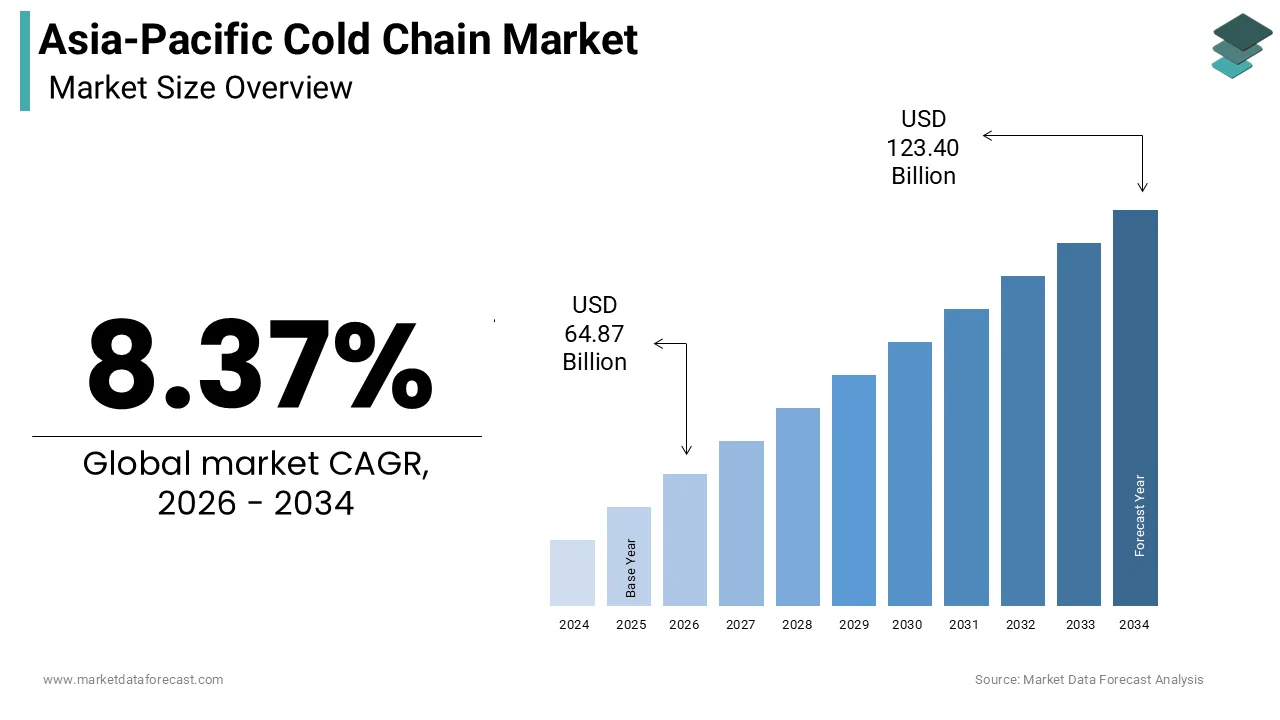
- Market Valuation: Valued at USD 59.86 billion (2025), estimated at USD 64.87 billion (2026), and projected to reach USD 123.40 billion by 2034, registering a strong CAGR of 8.37% (2026–2034).
- Primary Growth Drivers: Rapid urbanization, expanding food processing sectors, precise temperature-controlled pharmaceutical distribution needs, IoT real-time monitoring systems, and government infrastructure investments (e.g., India's PMKSY, China's 14th Five-Year Plan). Restraints include high capital expenditure requirements and fragmented regional supply chain standards.
Key Market Segment Metrics (2026–2034)
| Category | Leading Segment / Region (Position) | Fastest-Growing Segment |
|---|---|---|
| By Operation & Temperature | Refrigerated storage (dominated with a 57.5% revenue share in 2025) & Chilled temperature applications (54.4% share in 2025) | Refrigerated transport (fastest-growing at a CAGR of 9.4%) & Frozen temperature solutions (growing fastest at a CAGR of 9.8%) |
| By End-User Industry | Food and beverages sector (accounted for 62.2% of end-user demand in 2025) | Pharmaceuticals sector (advancing quickest at a CAGR of 10.2%, driven by vaccine and biotech logistics) |
| By Region / Country | China (led regionally with a 34.7% share in 2025 via government logistics investments and e-commerce acceleration) | Emerging economies expanding decentralized cold networks and smart-logistics infrastructure |
Major Market Players & Market Structure
Market Structure: Highly competitive Asia-Pacific temperature-controlled logistics ecosystem characterized by energy-efficient commercial freezer deployments, AI-integrated temperature monitoring fleets, R&D center expansions for adaptive refrigeration, and pharmaceutical ultra-low temperature storage upgrades.
Key Companies: Americold Logistics, Preferred Freezer Services, Burris Logistics, Lineage Logistics Holding LLC, Nichirei Logistics Group Inc., Panasonic Corporation, Carrier Global Corporation, Godrej Industries Limited, Mitsubishi Electric, and CJ Logistics.
Asia-Pacific Cold Chain Market Size
The cold chain market size in Asia-Pacific was valued at USD 59.86 billion in 2025. The regional market size is anticipated to grow at a CAGR of 8.37% from 2026 to 2034 and be worth USD 123.40 billion by 2034 from USD 64.87 billion in 2026.
The Asia Pacific cold chain market refers to the integrated network of temperature-controlled storage and transportation systems designed to preserve perishable goods such as food, pharmaceuticals, dairy products, and chemicals throughout their supply chain journey. This system includes refrigerated warehouses, cold storages, reefer trucks, rail transport, and last-mile delivery solutions that maintain product integrity from production to consumption. The cold chain is essential in reducing food wastage, ensuring food safety, and enabling the efficient distribution of vaccines and biologics—sectors that have gained heightened importance post-pandemic.
Asia Pacific has emerged as a focal point for cold chain expansion due to rapid urbanization, growing middle-class populations, and increasing government emphasis on food security and healthcare infrastructure. Also, according to the Food and Agriculture Organization (FAO), nearly one-third of all food produced globally is wasted, with developing countries in the region facing some of the highest losses due to inadequate cold storage facilities.
In addition, the rise of organized retail, e-commerce grocery platforms, and the need for vaccine logistics during global health crises have further intensified demand for reliable cold chain networks. Countries like India and China are investing heavily in modernizing logistics, while Southeast Asian nations are focusing on cross-border cold transport corridors. These developments show the critical role of cold chain systems in supporting economic growth, public health, and sustainability across the Asia Pacific region.
MARKET DRIVERS
Expansion of the Food Processing Industry
A major driver of the Asia Pacific cold chain market is the rapid expansion of the food processing industry, which relies heavily on temperature-controlled logistics to ensure product safety and shelf life. With rising disposable incomes and shifting dietary habits, there has been a surge in demand for processed and frozen foods, necessitating an efficient cold chain to handle production, storage, and distribution.
Moreover, according to the Food and Agriculture Organization (FAO), Asia contributes over 60% of global food production, yet a significant portion goes to waste due to inadequate cold storage and transport infrastructure. In response, governments in countries like India and Indonesia have launched initiatives to modernize food supply chains. For example, India’s Ministry of Food Processing Industries reported that investments under the Pradhan Mantri Kisan Sampada Yojana (PMKSY) exceeded $700 million between 2018 and 2023, aimed at expanding cold storage capacity and refrigerated transport networks.
Apart from these, multinational food processors and retailers such as Nestlé, Tyson Foods, and Walmart have increased their presence in the region, driving the need for standardized cold chain practices. In China, the State Administration for Market Regulation emphasized the importance of traceability and hygiene in food logistics, prompting private sector investments in smart cold storage facilities equipped with IoT-enabled monitoring systems. These developments collectively underline how the growth of the food processing sector is fueling the expansion of the cold chain market across the Asia Pacific.
Growth in Pharmaceutical and Vaccine Distribution
A further contributing factor to the Asia Pacific cold chain market is the expanding pharmaceutical and vaccine distribution sector, particularly in light of recent global health challenges. Vaccines, biologics, and temperature-sensitive medications require precise cold storage conditions to maintain efficacy, making a robust cold chain indispensable for healthcare logistics.
Like, according to the World Health Organization (WHO), approximately 50% of vaccines are wasted globally each year due to temperature control failures during transport and storage, especially in low- and middle-income countries. In response, several Asia Pacific nations have prioritized strengthening their medical cold chain infrastructure.
China has also made significant strides in this area, with the National Medical Products Administration mandating stricter cold chain compliance for pharmaceutical logistics. Meanwhile, Japan and South Korea have adopted ultra-low temperature freezers and real-time tracking systems to enhance vaccine distribution efficiency. With the ongoing development of mRNA-based therapeutics and personalized medicine, the demand for advanced cold chain solutions in the pharmaceutical sector is expected to continue rising, reinforcing its role as a major growth catalyst for the Asia Pacific cold chain market.
MARKET RESTRAINTS
High Initial Investment and Operating Costs
A major restraint for the Asia Pacific cold chain market is the high initial investment and operating costs associated with setting up and maintaining temperature-controlled storage and transport systems. Establishing cold storage facilities, purchasing refrigerated vehicles, and installing climate monitoring technologies require substantial capital expenditure, which often deters small and medium-sized enterprises (SMEs) from entering the sector.
According to the International Institute of Refrigeration (IIR), industrial refrigeration accounts for nearly 15% of total energy consumption in food logistics operations, significantly increasing operational expenses. In countries like Thailand and Vietnam, where electricity tariffs are relatively high, cold chain operators face additional financial burdens. As per the Energy Policy and Planning Office of Thailand, energy costs for cold storage businesses rose by 12% in 2023 due to fluctuating fuel prices and grid instability.
Moreover, compliance with international standards for food safety and pharmaceutical logistics necessitates continuous upgrades to equipment and processes. In India, the Food Safety and Standards Authority of India (FSSAI) introduced updated cold chain guidelines in 2023, requiring businesses to adopt digital monitoring systems—an added cost that many regional players struggle to absorb. These financial barriers limit market expansion and hinder the widespread adoption of efficient cold chain solutions across the Asia Pacific region.
Lack of Skilled Workforce and Technical Expertise
An additional significant constraint on the Asia Pacific cold chain market is the shortage of skilled labor and technical expertise required to manage complex refrigeration systems, logistics planning, and maintenance operations. A well-functioning cold chain depends not only on advanced infrastructure but also on trained personnel who can operate, monitor, and repair temperature-controlled environments effectively.
In addition, according to the International Labour Organization (ILO), many developing economies in the region lack formal training programs for cold chain technicians and logistics specialists. Similarly, in the Philippines, the Technical Education and Skills Development Authority (TESDA) identified a gap in certified professionals capable of handling high-tech cold chain equipment.
This skills deficit results in higher equipment downtime, improper temperature control, and increased spoilage rates, ultimately undermining consumer trust and business profitability. In response, some governments and private institutions have initiated vocational training programs, but progress remains slow. Without a concerted effort to develop human capital alongside infrastructure, the cold chain sector will continue to face operational challenges that impede its full potential in the Asia Pacific region.
MARKET OPPORTUNITIES
Adoption of Smart and IoT-Enabled Cold Chain Solutions
A significant opportunity within the Asia Pacific cold chain market lies in the adoption of smart and IoT-enabled cold chain solutions that enhance visibility, efficiency, and traceability across the supply chain. As industries increasingly prioritize real-time monitoring and data-driven decision-making, companies are integrating Internet of Things (IoT) technologies into refrigeration systems, transport fleets, and warehouse management.
In China, the Ministry of Transport encouraged the deployment of smart cold chain logistics through policy incentives, resulting in a surge of IoT-equipped refrigerated trucks and automated storage systems. Leading logistics providers such as SF Express and Cainiao Network have implemented cloud-connected sensors to track temperature fluctuations and optimize routing.
Like, in India, startups like Stellapps and GoBOLT have developed AI-driven cold chain platforms that provide end-to-end monitoring of perishable goods, reducing spoilage and improving delivery reliability. Japan has taken this a step further with blockchain-integrated cold chain systems that ensure transparency in pharmaceutical and seafood logistics. As digital transformation accelerates, the integration of smart technologies presents a transformative opportunity for the Asia Pacific cold chain market.
Government Initiatives and Infrastructure Investments
Government initiatives and strategic infrastructure investments represent a pivotal opportunity for the Asia Pacific cold chain market, particularly in emerging economies where logistical gaps have historically constrained food and pharmaceutical supply chains. Many national governments have recognized the economic and social benefits of modernizing cold chain systems and have allocated significant funding toward their development.
In India, the Ministry of Food Processing Industries launched the Pradhan Mantri Kisan Sampada Yojana (PMKSY) to establish new cold storage facilities, and refrigerated transport hubs. Similarly, in Indonesia, the Ministry of Trade collaborated with international agencies to implement the ASEAN Cold Chain Standards initiative, aiming to improve cross-border logistics and reduce spoilage in agricultural exports.
China has also prioritized cold chain modernization under its 14th Five-Year Plan, with the Ministry of Commerce reporting that over 200 new cold storage terminals were constructed in 2023 alone. Besides, Australia’s Department of Agriculture, Fisheries and Forestry has invested in sustainable cold chain projects to support export-oriented horticulture and seafood industries. These coordinated policy actions and infrastructural commitments are unlocking new pathways for growth in the Asia Pacific cold chain market.
MARKET CHALLENGES
Fragmented Supply Chain and Lack of Standardization
A major challenge facing the Asia Pacific cold chain market is the fragmented nature of the supply chain and the lack of standardized protocols across different regions and sectors. Unlike more mature markets in North America and Europe, where regulatory frameworks and logistics networks are highly integrated, many Asia Pacific countries operate with disparate systems that hinder seamless movement of temperature-sensitive goods.
In Southeast Asia, the ASEAN Single Window initiative aims to harmonize customs procedures, but implementation remains uneven across member states. Moreover, in India, according to the National Centre for Cold-chain Development (NCCD), variations in state-level policies result in logistical inefficiencies and higher spoilage rates for perishable commodities.
Furthermore, the lack of uniform temperature monitoring standards affects food safety and pharmaceutical integrity. This fragmentation impedes investment confidence and complicates coordination between stakeholders, posing a persistent challenge to the overall efficiency and scalability of the Asia Pacific cold chain market.
Environmental Concerns and Regulatory Pressures
Environmental concerns and evolving regulatory pressures pose another significant challenge for the Asia Pacific cold chain market, particularly regarding energy consumption and refrigerant emissions. Cold chain operations rely heavily on refrigeration systems that use hydrofluorocarbons (HFCs), potent greenhouse gases that contribute to climate change. As awareness of environmental sustainability grows, governments and regulatory bodies are imposing stricter guidelines on carbon emissions and energy efficiency in logistics.
Moreover, according to the Climate and Clean Air Coalition (CCAC), refrigeration accounts for a large share of HFC emissions in the Asia Pacific region. In response, several countries have begun phasing out high-global-warming-potential refrigerants.
In addition to regulatory compliance, the shift toward eco-friendly cooling technologies increases capital expenditures for cold chain operators. In India, the Bureau of Energy Efficiency (BEE) has introduced star ratings for refrigeration equipment, pushing manufacturers and logistics providers to invest in greener alternatives. While these measures align with global sustainability goals, they also present financial and operational hurdles for market participants seeking to balance compliance with cost-effectiveness.
REPORT COVERAGE
| REPORT METRIC | DETAILS |
| Market Size Available | 2025 to 2034 |
| Base Year | 2025 |
| Forecast Period | 2026 to 2034 |
| CAGR | 8.37% |
| Segments Covered | By Type, Temperature Type, Technology, Application, And Region |
|
Various Analyses Covered | Global, Regional & Country Level Analysis; Segment-Level Analysis; DROC, PESTLE Analysis; Porter’s Five Forces Analysis; Competitive Landscape; Analyst Overview of Investment Opportunities |
| Regions Covered | India, China, Japan, South Korea, Australia, New Zealand, Thailand, Malaysia, Vietnam, Philippines, Indonesia, Singapore, and Rest of Asia-Pacific |
| Market Leaders Profiled | Americold Logistics (U.S.), Preferred Freezer Services (U.S.), Burris Logistics (U.S.), Lineage Logistics Holding LLC (U.S.) and Nichirei Logistics Group Inc. (Japan) |
SEGMENTAL ANALYSIS
By Service Type Insights
The refrigerated storage segment secured the largest share of the Asia Pacific cold chain market, accounting for 57.5% of total revenue in 2025. This dominance is primarily attributed to the growing need for temperature-controlled warehousing to preserve perishable goods such as food products, pharmaceuticals, and dairy items across the region.
Also, according to the Food and Agriculture Organization (FAO), nearly one-third of all food produced globally is wasted, with developing economies in Asia facing particularly high losses due to inadequate storage infrastructure. Similarly, in China, as per the Ministry of Commerce, the country added more than 20 million cubic meters of cold storage capacity in 2023 alone, driven by rising demand for frozen seafood and vegetables.
Besides, the expansion of organized retail and e-commerce grocery platforms has increased reliance on centralized refrigerated warehouses to ensure product freshness and minimize spoilage. Japan’s advanced cold chain infrastructure also contributes significantly, with over 95% refrigerated transport coverage ensuring seamless connectivity between storage facilities and end consumers. These factors collectively reinforce the leading position of the refrigerated storage segment in the Asia Pacific cold chain market.
The refrigerated transport segment is projected to grow at the fastest rate, recording a CAGR of 9.4% from 2026 to 2034, driven by increasing demand for last-mile delivery solutions, expanding logistics networks, and the rise of online grocery services. As urbanization accelerates and consumer expectations shift toward fresh and frozen home deliveries, the need for efficient cold transport systems has surged.
Also, urban populations in the Asia Pacific region grew annually between 2015 and 2023, reaching more than 1.9 billion people. This demographic shift has fueled demand for doorstep delivery of perishable foods, necessitating investment in refrigerated trucks and vans. In China, according to the National Bureau of Statistics, refrigerated transport fleet size expanded by 12% in 2023 compared to the previous year, supported by government incentives and private sector participation.
Moreover, Southeast Asian countries like Indonesia and Thailand are investing in inter-island reefer logistics to support agricultural exports. Besides, digital tracking technologies integrated into transport fleets are improving supply chain visibility and compliance with food safety standards. These developments underscore the strong growth trajectory of the refrigerated transport segment in the Asia Pacific cold chain market.
By Temperature Insights
The chilled temperature range commanded the Asia Pacific cold chain market, capturing 54.4% of overall share in 2025. This segment primarily caters to perishable goods such as dairy, fruits, vegetables, meat, and seafood that require short-term preservation at temperatures typically between 0°C and 8°C.
According to the United Nations Food and Agriculture Organization (FAO), fresh produce accounts for a significant portion of daily dietary consumption across the Asia Pacific region, making chilled storage and transport essential to reduce post-harvest losses. In India, as per the estimations by the Indian Council of Agricultural Research (ICAR), up to 30% of fruits and vegetables were lost annually due to inadequate cold chain infrastructure before recent government interventions. With initiatives like the Pradhan Mantri Kisan Sampada Yojana (PMKSY), India has made considerable progress in deploying chilled storage facilities near farm clusters.
The preference for fresh food products in many parts of the region, coupled with regulatory emphasis on food safety, continues to drive the dominance of the chilled temperature segment in the Asia Pacific cold chain market.
The frozen temperature segment is expected to grow at the highest pace, registering a CAGR of 9.8%, driven by rising consumption of frozen food products, expanding pharmaceutical logistics, and increasing adoption of ultra-low temperature storage for vaccines and biologics.
In South Korea, as per the Korea Agro-Fisheries & Food Trade Corporation (aT Center), frozen seafood and ready-to-eat meals accounted for over 40% of household purchases in 2023, reflecting changing consumer habits and convenience-driven lifestyles.
In addition to food, the pharmaceutical industry is a major contributor to this growth. The World Health Organization (WHO) emphasized the importance of frozen logistics for vaccine storage, particularly for mRNA-based vaccines that require ultra-cold conditions. Also, Japan’s Ministry of Health, Labour and Welfare mandated stricter cold chain compliance for biopharmaceuticals, further boosting demand for frozen storage and transport solutions. These factors collectively contribute to the rapid expansion of the frozen temperature segment in the Asia Pacific cold chain market.
By End User Insights
The food and beverages segment held the biggest share of the Asia Pacific cold chain market, contributing 62.2% of total market revenue in 2025. This dominance is primarily driven by the region's vast agricultural output, growing middle-class population, and increasing reliance on organized retail and e-commerce platforms for food distribution.
According to the Food and Agriculture Organization (FAO), Asia produces over 60% of the world’s food, yet a significant portion is lost due to inadequate cold chain infrastructure. Urbanization and changing consumer preferences have further boosted demand for chilled and frozen food products. As per the Asian Development Bank (ADB), disposable incomes in the region grew by an average of 5.2% annually between 2018 and 2023, enabling greater spending on processed and convenience foods. Besides, the rise of online grocery platforms such as Alibaba Fresh, BigBasket, and Coupang Fresh has increased reliance on cold storage and transport to maintain product quality during home deliveries. These trends collectively underline the dominant role of the food and beverages sector in driving cold chain market growth across the Asia Pacific.
The pharmaceuticals segment is projected to advance at the quick pace, recording a CAGR of 10.2%, driven by the increasing demand for temperature-sensitive medicines, vaccines, and biologics across the Asia Pacific region. The expansion of healthcare infrastructure, government initiatives to improve vaccine logistics, and the rise of contract manufacturing organizations (CMOs) are key contributors to this growth. In addition, the Asia Pacific region has seen a surge in demand for biopharmaceuticals, including mRNA vaccines and monoclonal antibodies, which require stringent cold chain protocols. Similarly, in China, the National Medical Products Administration mandated stricter cold chain compliance for pharmaceutical logistics, prompting private sector investments in ultra-low temperature freezers and real-time monitoring systems.
Japan and South Korea have also adopted advanced cold chain technologies to enhance drug distribution efficiency. With increasing research and development in personalized medicine and cell-based therapies, the pharmaceuticals segment is poised for continued high-growth performance in the Asia Pacific cold chain market.
REGIONAL ANALYSIS
China Cold Chain Market Insights
China held a commanding share of the Asia Pacific cold chain market, contributing 34.7% of regional revenue in 2025. The country's dominant position is driven by its massive food and pharmaceutical industries, extensive government investments in logistics infrastructure, and rapid urbanization.
Also, China remains a global leader in pharmaceutical production, with the National Medical Products Administration mandating stricter cold chain compliance for biologics and vaccines. According to the China Association of the Medicine Industry (CMI), domestic investment in pharmaceutical cold chain logistics grew by 18% in 2023 compared to the previous year. The country's e-commerce boom, led by platforms like JD.com and Cainiao Network, has further accelerated the deployment of refrigerated transport solutions, reinforcing China’s leadership in the Asia Pacific cold chain market.
India Cold Chain Market Insights
India is emerging as a key growth engine due to rising disposable incomes, expanding food processing industries, and robust government initiatives aimed at modernizing logistics infrastructure. The country's cold chain sector has witnessed rapid transformation, particularly in response to the challenges of food wastage and vaccine distribution. According to the Indian Council of Agricultural Research (ICAR), these efforts contributed to a 20% reduction in post-harvest losses in select states.
Furthermore, India played a crucial role in global vaccine logistics during the pandemic. E-commerce giants like Amazon Fresh and BigBasket have also expanded their cold chain delivery networks, enhancing access to chilled and frozen products in urban centers. These developments position India as a rapidly evolving hub within the Asia Pacific cold chain market.
Japan Cold Chain Market Insights
Japan is distinguished by its highly developed logistics infrastructure, stringent food safety regulations, and advanced pharmaceutical cold chain capabilities. The country’s market is characterized by high-end refrigeration technology, precision temperature control, and widespread adoption of digital monitoring systems.
Japan maintains a high percentage of refrigerated transport coverage, ensuring seamless movement of perishable goods between cold storage facilities and retail outlets. The Ministry of Agriculture, Forestry, and Fisheries (MAFF) emphasized the importance of maintaining freshness in seafood and vegetable exports, leading to continuous upgrades in cold chain infrastructure.
Apart from these, Japan plays a leading role in pharmaceutical logistics, with companies like Mitsubishi Logistics and Nippon Express pioneering ultra-low temperature transport for vaccines and biologics. With ongoing innovation and integration of AI and blockchain technologies, Japan remains a key player in shaping cold chain best practices across the Asia Pacific region.
Australia Cold Chain Market Insights
Australia contributes a notable share of the Asia Pacific cold chain market, driven by high consumer awareness, a well-established food processing industry, and growing demand for temperature-controlled pharmaceutical logistics. The country's cold chain sector benefits from advanced infrastructure, strict regulatory oversight, and a focus on sustainability and food safety.
In addition, Australia’s healthcare industry has been strengthening its cold chain logistics to support vaccine distribution and biopharmaceutical research. Moreover, major supermarket chains like Woolworths and Coles have integrated cold chain logistics into their online grocery fulfillment centers, enhancing product availability and shelf life. These trends underline Australia’s strong foothold in the Asia Pacific cold chain market.
South Korea Cold Chain Market Insights
South Korea is distinguished by its high-tech logistics ecosystem, strong government support, and increasing demand for chilled and frozen food products. The country’s market benefits from a highly urbanized population, well-developed transportation networks, and a culture that emphasizes convenience and efficiency.
Pharmaceutical logistics is another key driver, with the Ministry of Health and Welfare mandating stricter cold chain compliance for biopharmaceuticals. Companies like CJ Logistics and Hanjin Transportation have invested heavily in refrigerated transport fleets equipped with real-time temperature tracking systems. Also, South Korea’s e-commerce sector, led by platforms like Coupang and Market Kurly, has boosted cold chain adoption through same-day delivery services for perishable goods. With continuous innovation and digital integration, South Korea maintains a strong and growing influence in the Asia Pacific cold chain market.
LEADING PLAYERS IN THE ASIA PACIFIC COLD CHAIN MARKET
One of the leading players in the Asia Pacific cold chain market is Panasonic Corporation , a Japanese multinational electronics manufacturer. Panasonic plays a crucial role in advancing refrigeration and temperature control technologies used across warehouses, transport systems, and retail cold storage. The company's innovations in energy-efficient cooling solutions have positioned it as a key contributor to sustainable cold chain development globally.
Another major player is Carrier Global Corporation , an American multinational with a strong presence in the Asia Pacific region. Carrier specializes in refrigeration, air conditioning, and cold transport solutions tailored for food logistics and pharmaceutical applications. Its strategic collaborations with regional governments and logistics providers have significantly enhanced cold chain accessibility and reliability across diverse climates.
Godrej Industries Limited , an Indian conglomerate, also holds a prominent position. Through its subsidiary Godrej Refrigeration, the company delivers affordable and efficient cold storage and transport equipment suited for local conditions. With a focus on rural electrification and farm-to-market cold logistics, Godrej has played a vital role in reducing food loss and strengthening supply chain resilience across India and neighboring countries.
TOP STRATEGIES USED BY KEY MARKET PARTICIPANTS
Key players in the Asia Pacific cold chain market employ several strategic approaches to reinforce their competitive edge. One major strategy is technology integration and digital transformation, where companies adopt IoT-enabled monitoring, AI-driven analytics, and blockchain-based traceability to enhance efficiency, transparency, and compliance across the cold chain.
Another critical approach is expanding regional footprint through partnerships and localized infrastructure development, allowing firms to establish a stronger presence in emerging markets such as India, Indonesia, and Vietnam, where demand for temperature-controlled logistics is growing rapidly.
Lastly, sustainability-driven innovation plays a pivotal role in strengthening market positions. Companies are investing in energy-efficient refrigeration systems, natural refrigerants, and solar-powered cold storage units to align with global environmental standards while catering to the increasing need for eco-friendly cold chain operations.
KEY MARKET PLAYERS AND COMPETITION OVERVIEW
Major Players of the Asia Pacific Cold Chain Market include Americold Logistics (U.S.), Preferred Freezer Services (U.S.), Burris Logistics (U.S.), Lineage Logistics Holding LLC (U.S.) and Nichirei Logistics Group Inc. (Japan).
The competition in the Asia Pacific cold chain market is marked by a convergence of global technology leaders and dynamic regional players striving to meet the rising demand for temperature-controlled logistics. While multinational corporations bring advanced engineering and standardized solutions, domestic firms offer cost-effective, localized alternatives that cater to specific climatic and infrastructural challenges. This mix fosters a highly competitive environment driven by innovation, regulatory adaptation, and evolving consumer expectations. Governments across the region are increasingly prioritizing food safety, vaccine distribution, and agricultural efficiency, further intensifying industry activity. Additionally, the rapid expansion of e-commerce grocery platforms has heightened the need for last-mile cold delivery capabilities, prompting companies to invest heavily in fleet modernization and smart monitoring systems. As sustainability becomes a focal point, firms are also competing to develop greener cold chain solutions, incorporating renewable energy sources and low-emission refrigerants. This multi-dimensional landscape ensures continuous evolution, with companies constantly recalibrating strategies to capture market share and improve service quality across the Asia Pacific region.
RECENT HAPPENINGS IN THE MARKET
- In February 2023, Panasonic Corporation launched a new line of energy-efficient commercial freezers designed specifically for small-scale cold storage facilities in rural India and Southeast Asia. This initiative aimed to support decentralized cold chain networks and reduce post-harvest losses among local farmers.
- In June 2023, Carrier Global Corporation partnered with a leading logistics provider in China to deploy AI-integrated temperature monitoring systems across refrigerated transport fleets, enhancing real-time visibility and ensuring compliance with strict food and pharmaceutical safety regulations.
- In October 2023, Godrej Industries introduced a modular cold room solution for micro-enterprises and cooperative farming groups in India, enabling easy installation and scalability for perishable goods storage without requiring extensive infrastructure.
- In March 2025, Mitsubishi Electric , a major player in industrial automation and climate control, expanded its cold chain division in Australia by setting up a dedicated R&D center focused on developing adaptive refrigeration systems for extreme weather conditions.
- In May 2025, CJ Logistics , South Korea’s largest integrated logistics provider, upgraded its pharmaceutical cold chain network with ultra-low temperature storage units, aiming to strengthen its capabilities in transporting mRNA vaccines and biologics across the Asia Pacific region.
MARKET SEGMENTATION
This research report on the Asia-Pacific cold chain market is segmented and sub-segmented into the following categories.
By Type
- Refrigerated Storage
- Transport
By Temperature Type
- Chilled
- Frozen
By End User
- Food and Beverages
- Pharmaceuticals
By Country
- India
- China
- Japan
- South Korea
- Australia
- New Zealand
- Thailand
- Malaysia
- Vietnam
- Philippines
- Indonesia
- Singapore
- Rest of Asia-Pacific