- Product Description Description
- Table of Contents TOC
- List of Table & Figure LOT
- Get Free Sample PDF Sample PDF
Market Size, 2025
$3.80 BnMarket Estimate, 2026
$4.06 BnMarket Forecast, 2034
$6.93 BnCAGR, 2026–2034
6.91%Asia Pacific Commercial Gensets Market Size
The Asia Pacific Commercial Gensets Market size was valued at USD 3.80 billion in 2025 and is anticipated to reach USD 4.06 billion in 2026 from USD 6.93 billion by 2034, growing at a CAGR of 6.91%. during the forecast period from 2026 to 2034.
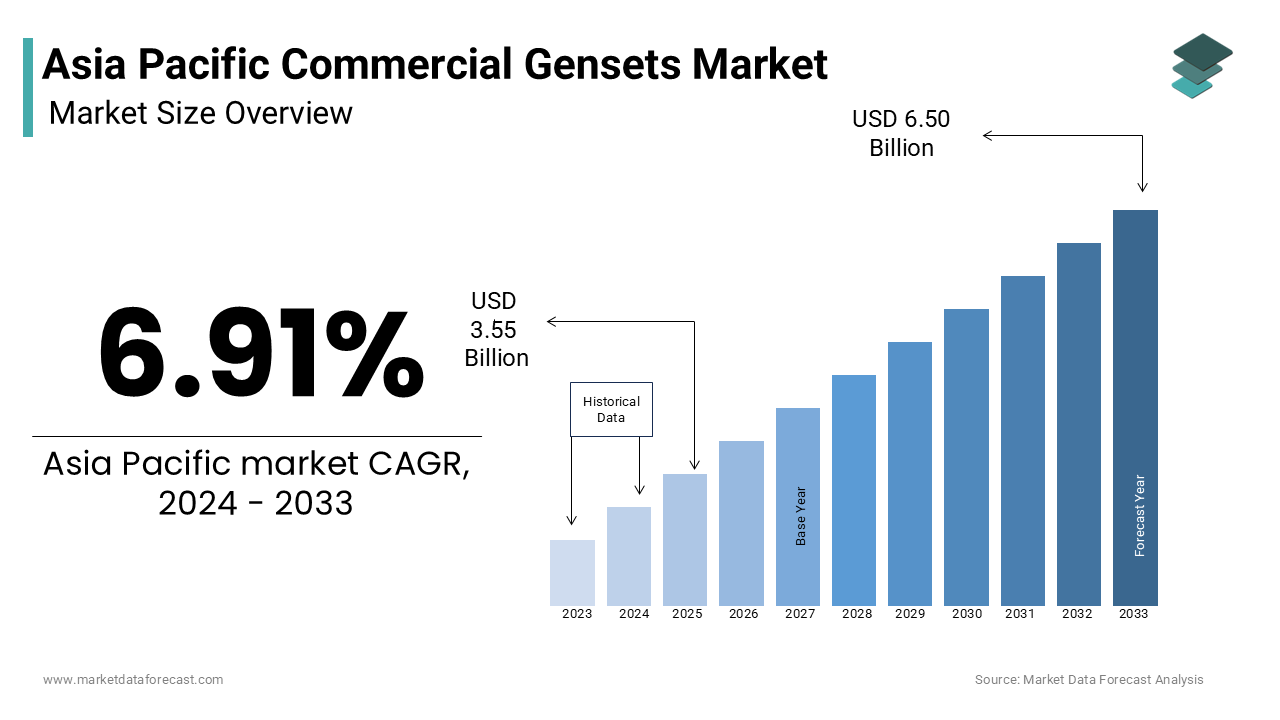
Commercial gensets are part of power generation equipment designed for non-residential applications such as hospitality, retail, healthcare, data centers, and office complexes. These gensets, typically powered by diesel, natural gas, or dual-fuel systems, serve as backup or primary electricity sources where grid reliability is inconsistent. Unlike industrial gensets used in heavy manufacturing or construction, commercial gensets are tailored for continuous operation in environments where power stability is crucial for business continuity and customer safety.
Asia Pacific has emerged as a focal point for commercial genset deployment due to rapid urbanization and the expansion of service-oriented economies. According to the Asian Development Bank, the region accounted for over 50% of global urban population growth between 2010 and 2020. This urban transformation has spurred infrastructure development, particularly in Tier 2 and Tier 3 cities across India, Indonesia, and the Philippines, where power outages remain a frequent challenge. As per the World Bank, countries like Vietnam and Bangladesh still experience more than 10 hours of annual power outages per consumer, reinforcing the reliance on alternative power solutions.
Moreover, the growth of commercial real estate, including malls, hotels, and healthcare facilities, has further driven demand. These trends underscore the critical role of commercial gensets in ensuring uninterrupted operations across the Asia Pacific region.
MARKET DRIVERS
Surge in Data Center Investments Across Asia Pacific
The exponential growth in data center investments, particularly in countries like Singapore, India, and Australia, is one of the key drivers of the Asia Pacific commercial gensets market. As digital transformation accelerates, businesses and governments are investing heavily in cloud computing, artificial intelligence, and big data analytics.
Data centers require continuous, uninterrupted power to prevent service disruptions and data loss. Gensets serve as critical backup power systems, ensuring seamless operation during grid failures.
Besides, countries like India are witnessing a boom in data center construction due to favorable government policies such as the Production-Linked Incentive (PLI) scheme for IT hardware. This trend directly translates into heightened demand for commercial gensets, reinforcing their role in supporting digital infrastructure across the Asia Pacific region.
Expansion of the Healthcare Infrastructure in Emerging Economies
The rapid expansion of healthcare infrastructure in emerging economies such as Indonesia, the Philippines, and Vietnam is another significant driver of the Asia Pacific commercial gensets market. Governments across these countries are investing heavily in upgrading and expanding hospital networks, especially in rural and semi-urban areas where grid stability remains a challenge.
Hospitals and clinics require an uninterrupted power supply to operate life-support systems, diagnostic equipment, and emergency lighting. The integration of commercial gensets in these facilities is not just a regulatory requirement but a necessity for patient safety and operational continuity, directly boosting market demand.
MARKET RESTRAINTS
Stringent Emission Regulations Affecting Diesel Genset Adoption
The tightening of emission norms, particularly for diesel-powered units is one of the major restraints in the Asia Pacific commercial gensets market. Governments across the region are increasingly adopting environmental regulations to curb carbon emissions and air pollution. In China, for example, the Ministry of Ecology and Environment implemented the China VI emission standards in 2023, significantly limiting the allowable levels of nitrogen oxides and particulate matter from diesel engines. These regulations have increased the cost of compliance for genset manufacturers and discouraged the use of traditional diesel models in urban areas.
Similarly, in India, the Central Pollution Control Board (CPCB) has implemented stricter emission norms aligned with Bharat Stage VI (BS-VI) standards, which came into full effect in 2023. This has made alternative fuel-based gensets, such as those running on natural gas or hybrid systems, more attractive, though they still face infrastructural limitations. This regulatory pressure is slowing the adoption of conventional diesel gensets and pushing manufacturers to invest in cleaner technologies, which may delay market growth in the short term.
High Maintenance and Operational Costs of Standby Gensets
The high maintenance and operational costs associated with standby power systems is a significant restraint in the Asia Pacific commercial gensets market. While gensets are essential for ensuring uninterrupted power supply, their long-term operation involves substantial expenses related to fuel, servicing, and parts replacement.
In countries like the Philippines and Indonesia, where gensets are frequently used due to unreliable grid infrastructure, operational costs have become a major concern for businesses. This financial burden is particularly challenging for small and medium enterprises (SMEs) that lack the budget for high-end power solutions.
Moreover, the need for regular servicing and skilled technicians to operate gensets increases dependency on trained personnel, which is not always available in remote areas. These high operational and maintenance costs discourage potential buyers, especially in cost-sensitive markets, and pose a significant challenge to the widespread adoption of commercial gensets across the Asia Pacific region.
MARKET OPPORTUNITIES
Growth of Off-Grid Commercial Facilities in Remote Asia Pacific Regions
The expansion of off-grid commercial facilities in remote and underdeveloped regions is one of the key opportunities in the Asia Pacific commercial gensets market. As governments and private entities invest in economic development zones, eco-tourism resorts, and mining-related infrastructure, the demand for independent power solutions is rising.
In countries like Papua New Guinea and Laos, where electrification rates remain below 50%, commercial establishments such as hotels, resorts, and logistics hubs are adopting gensets to ensure continuous operations. Like, in Indonesia’s eastern provinces, where grid connectivity is limited, commercial enterprises are deploying gensets to support operations in agriculture, fisheries, and retail.
Moreover, the rise of decentralized commercial hubs in India’s northeastern states and Myanmar’s border regions is further driving genset adoption. This trend presents a significant growth avenue for genset manufacturers targeting remote and off-grid commercial sectors across the Asia Pacific.
Increasing Adoption of Hybrid and Smart Genset Technologies
The increasing adoption of hybrid and smart genset technologies that integrate renewable energy sources and digital monitoring systems is a growing opportunity in the Asia Pacific commercial gensets market. As businesses seek more sustainable and efficient power solutions, manufacturers are developing gensets that combine diesel or gas engines with solar inverters, battery storage, and IoT-enabled control systems.
In Australia and Japan, commercial buildings are increasingly deploying smart gensets equipped with AI-based load management systems that optimize fuel consumption and reduce emissions. Similarly, in Singapore, the Smart Nation initiative has encouraged the deployment of intelligent genset systems in hospitals and data centers that can be remotely monitored and controlled via cloud platforms. These technological advancements are enabling commercial users to reduce operational costs, comply with environmental regulations, and enhance power reliability, thereby opening new growth avenues for the genset market in the Asia Pacific region.
MARKET CHALLENGES
Supply Chain Disruptions Affecting Genset Component Availability
The ongoing supply chain disruptions affecting the availability of critical components such as engines, alternators, and control panels is a major challenge in the Asia Pacific commercial gensets market. The global semiconductor shortage, which began in 2021, has had a prolonged impact on the production of electronic control modules used in modern gensets. Like, lead times for key genset components sourced from China, South Korea, and Japan increased compared to pre-pandemic levels. This has resulted in production backlogs and increased costs for manufacturers, who have had to seek alternative suppliers or redesign systems to accommodate available components.
Additionally, geopolitical tensions and trade restrictions have further complicated the supply chain landscape. In 2023, export controls imposed by the United States on certain high-tech components affected the availability of advanced genset control systems in China. As a result, many companies have had to delay product launches or pass on the increased costs to end-users, impacting market growth and customer adoption in the Asia Pacific region.
Rising Fuel Prices Impacting Operational Economics of Gensets
The rising cost of fuel, particularly diesel, which remains the dominant energy source for commercial gensets, is one of the most pressing challenges in the Asia Pacific commercial gensets market.
In countries like the Philippines and Indonesia, where diesel gensets are widely used due to inconsistent grid supply, businesses have been hit hard by rising fuel costs. Like, in India, as per the Petroleum Planning and Analysis Cell (PPAC), diesel prices in major cities like Mumbai and Kolkata reached record highs, increasing genset operating expenses for hospitals, data centers, and retail chains.
This financial burden is particularly acute for small and medium enterprises (SMEs) that rely on gensets for daily operations. Some businesses have started exploring alternative fuels such as liquefied natural gas (LNG) and biodiesel, but the transition requires significant investment in infrastructure and equipment upgrades.
REPORT COVERAGE
| REPORT METRIC | DETAILS |
| Market Size Available | 2025 to 2034 |
| Base Year | 2025 |
| Forecast Period | 2026 to 2034 |
| CAGR | 6.23% |
| Segments Covered | By Fuel, Power Rating, Application, End-User and Country |
| Various Analyses Covered | Regional & Country Level Analysis, Segment-Level Analysis, DROC, PESTLE Analysis, Porter’s Five Forces Analysis, Competitive Landscape, Analyst Overview on Investment Opportunities |
| Countries Covered | India, China, Japan, South Korea, Australia, New Zealand, Thailand, Malaysia, Vietnam, the Philippines, Indonesia, Singapore, and the Rest of APAC. |
| Market Leaders Profiled | Cummins Inc., Caterpillar Inc., Kohler Co., Mitsubishi Heavy Industries Ltd., Yanmar Holdings Co. Ltd., FG Wilson, Honda Motor Co. Ltd., Kirloskar Oil Engines Limited, Perkins Engines Company Limited, and Atlas Copco AB |
SEGMENTAL ANALYSIS
By Fuel Type Insights
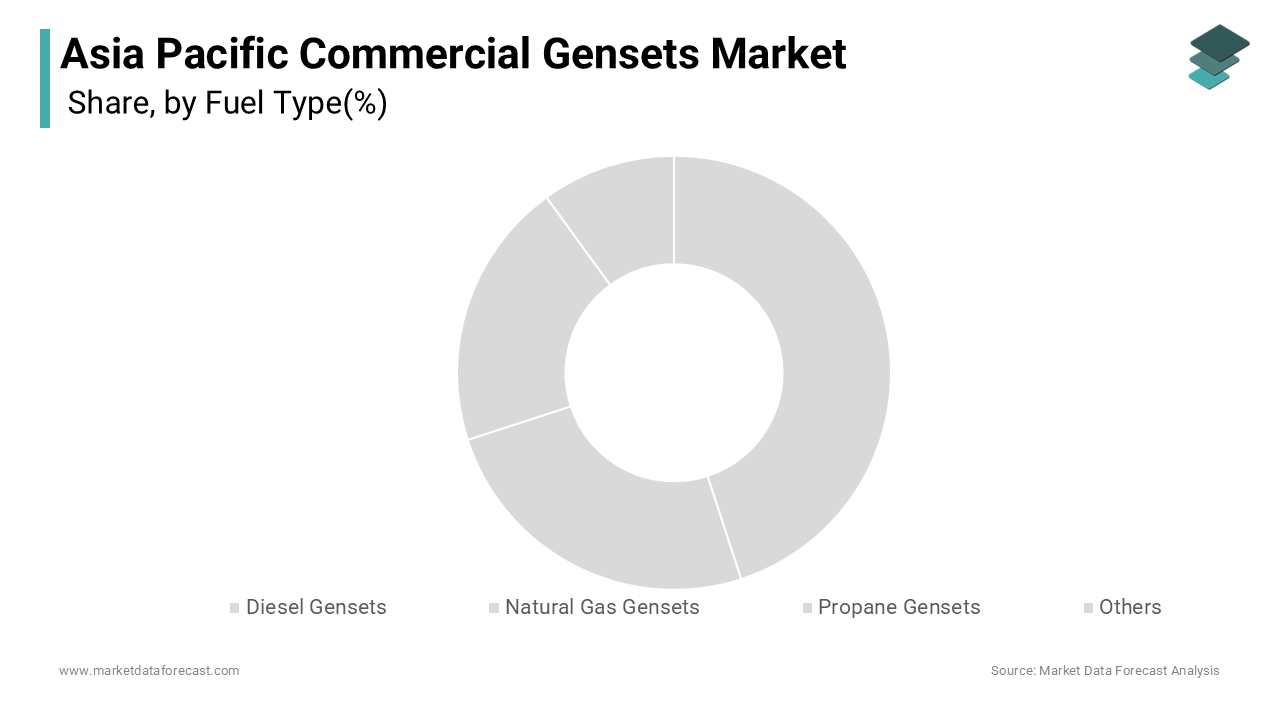
The diesel gensets segment dominated the Asia Pacific commercial gensets market by holding an estimated 57.4% share in 2024. The dominance of this segment is primarily attributed to their reliability, high energy density, and widespread availability across the region. According to the International Energy Agency (IEA), diesel remains the most widely used fuel for backup power systems in commercial applications due to its ability to provide immediate and stable power during outages.
The persistent issue of grid instability in emerging economies such as India, Indonesia, and the Philippines is also one of the key driving factors. Additionally, diesel gensets are known for their durability and ability to handle high loads, which is particularly beneficial for commercial buildings and data centers that require consistent power backup. A further major factor is the existing fuel infrastructure, which supports easy access to diesel in both urban and rural areas. Like, India alone consumed a significant liters of diesel for non-transport purposes, a significant portion of which was used for gensets in commercial settings. These factors reinforce the dominance of diesel gensets in the Asia Pacific commercial market.
The natural gas gensets segment is projected to be the fastest-growing segment in the Asia Pacific commercial gensets market, with a CAGR of 9.3% between 2025 and 2033. The growth of this segment is driven by increasing environmental regulations and a shift toward cleaner energy sources across the region.
The surging availability of natural gas infrastructure, particularly in countries like China, Japan, and South Korea is also one of the key drivers. The government’s push for low-emission technologies has encouraged businesses to adopt natural gas gensets, which emit less carbon dioxide than diesel alternatives. Additionally, the expansion of liquefied natural gas (LNG) terminals across Southeast Asia has improved fuel accessibility. The ASEAN Centre for Energy pointed out that in 2023, LNG import terminals in Indonesia, Thailand, and Vietnam expanded their capacities, enabling more commercial facilities to transition from diesel to gas-based power solutions. These trends are accelerating the adoption of natural gas gensets across the Asia Pacific region.
By Power Rating Insights
The 75–375 kVA power rating segment held the largest share of the Asia Pacific commercial gensets market of 42.4% in 2024. Its dominance is due to the increasing number of mid-sized commercial infrastructure projects across emerging economies. The segment primarily serves medium-sized commercial establishments such as hospitals, office complexes, retail malls, and small to mid-sized data centers that require reliable yet scalable power solutions.
These buildings often operate on limited budgets and prefer gensets that offer cost-effective power backup without the need for excessive infrastructure investment. A different contributing factor is the growing deployment of distributed energy systems in healthcare and telecom sectors. These applications reinforce the dominance of this power rating segment in the Asia Pacific commercial genset market.
The >750 kVA power rating segment is the fastest-growing in the Asia Pacific commercial gensets market and is registering a CAGR of approximately 8.7% from 2025 to 2033. The growth of this segment is primarily driven by the rising demand for large-scale power backup solutions in hyperscale data centers, industrial parks, and mega commercial complexes.
Among the key growth drivers is the rapid expansion of data centers across the region, especially in Singapore, India, and Japan. For instance, in Singapore, where land is scarce and data centers are built vertically, operators are deploying >750 kVA gensets to meet the high power density requirements of these facilities. A further major factor is the surge in investments in smart city and industrial park developments across China and Vietnam. These trends are fueling the rapid adoption of high-power gensets in the Asia Pacific region.
By Application Insights
The commercial buildings segment commanded the Asia Pacific commercial gensets market by capturing 31.3% of total demand in 2024. A major factor driving this segment is the rapid expansion of commercial real estate across the region. This includes office complexes, shopping malls, hotels, and other non-residential structures where uninterrupted power supply is critical for daily operations. These buildings often require reliable backup power to support elevators, HVAC systems, lighting, and security infrastructure, especially in areas with unreliable grid supply. A dfferent contributing factor is the increasing regulatory mandates for emergency power systems in commercial structures. These regulatory and infrastructural developments are reinforcing the dominance of commercial buildings as the largest application segment in the Asia Pacific commercial gensets market.
The data centers segment is the fastest-growing application in the Asia Pacific commercial gensets market and is recording a CAGR of 10.2% from 2025 to 2033. The rapid growth of this segment is fueled by the digital transformation across the region, with increased investments in cloud computing, artificial intelligence, and edge data centers. Among the primary drivers is the surge in data consumption and the expansion of hyperscale data centers. Countries like Singapore, India, and Australia are witnessing a boom in data center construction, all of which require high-capacity gensets for Tier III and Tier IV power redundancy.
A further key factor is the increasing deployment of edge computing infrastructure to support 5G networks and IoT applications. In Japan, for example, telecom operators are setting up micro data centers in urban areas, each equipped with redundant genset systems to ensure uninterrupted service. These developments are propelling the demand for commercial gensets in the data center application segment across the Asia Pacific region.
By End-User Insights
The hospitals segment led the Asia Pacific commercial gensets market by holding a 27.3% of the total demand in 2024. The critical need for uninterrupted power in healthcare facilities, particularly in life-support systems, surgical units, and emergency lighting, drives this dominance. A crucial drivers is the rapid expansion of hospital infrastructure in emerging economies such as India, Indonesia, and the Philippines. An additional contributing factor is the regulatory requirement for hospitals to maintain backup power systems. Similarly, in Indonesia, the Ministry of Health requires new healthcare facilities to install gensets with automatic transfer switches to ensure seamless power transition. These regulatory and infrastructural developments are reinforcing the dominance of hospitals as the largest end-user segment in the Asia Pacific commercial gensets market.
The retail stores segment is the fastest-growing end-user in the Asia Pacific commercial gensets market and is registering a CAGR of 9.5% between 2025 and 2033. The growth of this segment is primarily driven by the rapid expansion of organized retail and the need for continuous operations in hypermarkets, supermarkets, and shopping malls.
Among the key factors is the increasing number of large-format retail establishments in emerging economies such as India, Vietnam, and Thailand. These retail centers require reliable backup power to maintain refrigeration, point-of-sale systems, security, and lighting. A further major driver is the rise of e-commerce fulfillment centers and 24/7 convenience stores, which depend on uninterrupted power for logistics and customer service. These trends are accelerating the adoption of commercial gensets in the retail sector across the Asia Pacific region.
REGIONAL ANALYSIS
China Commercial Gensets Market Insights
China led the Asia Pacific commercial gensets market by accounting for 22.4% in 2024. The country's position as a manufacturing and technological hub drives substantial demand for backup power solutions across commercial infrastructure, data centers, and industrial facilities. One of the key drivers is the rapid expansion of data centers to support cloud computing and digital transformation. Additionally, the Chinese government’s push for smart city development under the 14th Five-Year Plan has led to increased deployment of commercial gensets in municipal buildings, transport hubs, and healthcare facilities. Another major factor is the growth of the commercial real estate sector. These facilities increasingly rely on gensets to maintain uninterrupted operations, particularly in regions with fluctuating power supply. These developments solidify China’s leadership in the Asia Pacific commercial gensets market.
India Commercial Gensets Market Insights
India is rapidly expanding in the Asia Pacific commercial gensets market. The country’s growing commercial infrastructure, expanding healthcare sector, and frequent power outages drive the demand for reliable backup power solutions. One of the primary growth drivers is the rapid expansion of commercial real estate, particularly in Tier 2 and Tier 3 cities. These buildings require gensets for continuous operations, particularly in retail, hospitality, and office sectors. Another key factor is the government’s focus on improving healthcare infrastructure. Additionally, the telecom sector, which relies heavily on diesel gensets for base stations, continues to be a major consumer. These factors collectively drive India’s strong presence in the regional commercial gensets market.
Japan Commercial Gensets Market Insights
Japan holds a strong position in the Asia Pacific commercial gensets market in 2023, driven by its advanced infrastructure and focus on energy resilience. The country’s market is characterized by high adoption of gas-based and hybrid gensets, reflecting its commitment to reducing carbon emissions. One of the key drivers is the increasing deployment of gensets in the healthcare and data center sectors. Another major factor is the country’s emphasis on disaster preparedness. Following past natural disasters, the Japanese government has mandated that critical infrastructure, including commercial buildings and transportation hubs, maintain robust backup power systems. These regulatory and infrastructural developments support Japan’s steady growth in the commercial gensets market.
Australia Commercial Gensets Market Insights
Australia accounts for a notable share of the Asia Pacific commercial gensets market. The country’s market is driven by its focus on energy security, particularly in remote and regional areas where grid reliability is limited. One of the main growth drivers is the expansion of mining and resource-based commercial operations in Western Australia and Queensland. Additionally, the growth of off-grid commercial facilities such as resorts and research stations in remote regions has increased genset adoption. Another key factor is the integration of hybrid power systems in commercial buildings. These technological advancements, along with regulatory incentives for energy resilience, are contributing to Australia’s stable growth in the commercial gensets market.
Indonesia Commercial Gensets Market Insights
Indonesia holds a smaller share of the Asia Pacific commercial gensets market, driven by rapid urbanization and the expansion of commercial infrastructure in both urban and rural areas. One of the primary growth drivers is the expansion of the tourism and hospitality sector. Many of these establishments, particularly in Bali, Lombok, and eastern Indonesia, rely on gensets due to inconsistent grid supply. Another major factor is the government’s push for infrastructure development under the National Medium-Term Development Plan (RPJMN). Additionally, the telecommunications sector continues to be a significant consumer. These factors collectively support Indonesia’s growing presence in the Asia Pacific commercial gensets market.
COMPETITIVE LANDSCAPE
The Asia Pacific commercial gensets market is characterized by a mix of global giants and regionally strong players, creating a highly competitive environment. Companies are continuously striving to enhance their product portfolios, improve service offerings, and expand their regional footprint to capture a larger market share. The market is fragmented, with several manufacturers competing on technology, pricing, and customization capabilities. While international players bring in advanced engineering and global standards, local manufacturers offer cost-effective solutions tailored to specific regional needs. The competition is further intensified by the growing demand for eco-friendly and energy-efficient gensets, prompting companies to innovate and adopt sustainable practices. Customer service and after-sales support play a crucial role in maintaining brand loyalty, especially in markets with frequent power disruptions where genset reliability is critical. As the commercial sector continues to evolve with digitalization and smart infrastructure, players are focusing on integrating digital monitoring systems and hybrid power solutions to differentiate themselves and strengthen their market position.
KEY MARKET PLAYERS
Some of the companies that are playing a dominating role in the Asia Pacific Commercial Gensets Market include
- Cummins Inc.
- Caterpillar Inc.
- Kohler Co.
- Mitsubishi Heavy Industries Ltd.
- Yanmar Holdings Co. Ltd.
- FG Wilson
- Honda Motor Co. Ltd.
- Kirloskar Oil Engines Limited
- Perkins Engines Company Limited
- Atlas Copco AB
Top Players in the Asia Pacific Commercial Gensets Market
Caterpillar Inc.
Caterpillar is a global leader in the design, manufacture, and distribution of power generation equipment, including commercial gensets. In the Asia Pacific market, Caterpillar is known for its reliable and high-performance diesel and gas gensets tailored for diverse commercial applications. The company's strong distribution network, customer-centric service model, and continuous investment in R&D have solidified its position as a market leader. Caterpillar's focus on sustainability and digital integration has also allowed it to adapt to evolving environmental standards and customer needs across the region.
Cummins Inc.
Cummins is a key player in the Asia Pacific commercial gensets market, offering a broad portfolio of power solutions ranging from standby to prime power applications. The company has built a strong regional presence through strategic partnerships, localized manufacturing, and after-sales service excellence. Cummins is recognized for its innovative product designs, fuel-efficient engines, and commitment to reducing emissions. Its ability to cater to both traditional and emerging power demands, such as hybrid and smart genset technologies, has helped it maintain a competitive edge in the commercial segment.
Kirloskar Electric Company
As a leading Indian manufacturer, Kirloskar Electric plays a dominant role in the Asia Pacific commercial gensets market, particularly in South Asia and Southeast Asia. The company offers a wide range of diesel and gas gensets suited for hospitals, data centers, retail, and commercial buildings. Known for its cost-effective solutions and robust engineering, Kirloskar Electric has built a strong brand reputation through decades of local market understanding and customer trust. Its focus on energy-efficient systems and expansion into green technologies has further strengthened its market position.
Top Strategies Used by Key Market Participants
Localization of Manufacturing and Distribution
Leading players are increasingly setting up localized manufacturing units and distribution networks across the Asia Pacific region. This strategy helps reduce production costs, ensures faster delivery, and allows companies to cater to regional regulatory requirements and customer preferences more effectively.
Product Innovation and Technological Advancements
To stay competitive, key players are investing heavily in R&D to develop advanced genset technologies that offer higher efficiency, lower emissions, and smart connectivity features. This includes hybrid gensets, IoT-enabled monitoring systems, and integration with renewable energy sources to meet evolving market demands.
Strategic Partnerships and Collaborations
Major companies are forming strategic alliances with local distributors, technology providers, and government bodies to enhance market penetration and improve after-sales service. These collaborations help in expanding customer reach and ensuring long-term service support, which is crucial for commercial genset users.
RECENT MARKET DEVELOPMENTS
- In May 2024, Caterpillar Inc. launched a new line of low-emission natural gas gensets tailored for commercial buildings across Southeast Asia. The product line is designed to meet stricter environmental norms and supports the company’s broader sustainability goals.
- In March 2024, Cummins Inc. expanded its service network in India by setting up five new regional service hubs across Tier 2 cities. This move aims to enhance after-sales support and improve customer satisfaction in the commercial genset segment.
- In February 2024, Kirloskar Electric Company announced a strategic partnership with a leading Indian renewable energy firm to develop hybrid genset systems that integrate solar and battery storage for commercial applications.
- In July 2024, Mitsubishi Heavy Industries launched a smart genset monitoring platform in Japan, enabling remote diagnostics and predictive maintenance for commercial users, thereby improving operational efficiency and reducing downtime.
- In September 2024, Kohler Co. introduced a new range of compact commercial gensets designed for small to mid-sized businesses in Australia, focusing on ease of installation, fuel efficiency, and noise reduction.
MARKET SEGMENTATION
This research report on the Asia Pacific Commercial Gensets Market is segmented and sub-segmented into the following categories.
By Fuel Type
- Diesel Gensets
- Natural Gas Gensets
- Propane Gensets
- Others
By Power Rating
- <75 kVA
- 75-375 kVA
- 375-750 kVA
- >750kVA
By Application
- Healthcare
- Data Centers
- Telecom
- Commercial Buildings
- Manufacturing
- Construction
- Others
By End-User
- Hospitals
- Offices
- Factories
- Retail Stores
- Infrastructure
- Others
By Country
- India
- China
- Japan
- South Korea
- Australia
- New Zealand
- Thailand
- Malaysia
- Vietnam
- Philippines
- Indonesia
- Singapore
- Rest of APAC