- Product Description Description
- Table of Contents TOC
- List of Table & Figure LOT
- Get Free Sample PDF Sample PDF
Market Size, 2025
$1.46 BnMarket Estimate, 2026
$1.53 BnMarket Forecast, 2034
$2.27 BnCAGR, 2026–2034
5.07%Asia Pacific Commercial Water Heater Market Size
The Asia Pacific Commercial Water Heater Market size was valued at USD 1.46 billion in 2025 and is anticipated to reach USD 1.53 billion in 2026 from USD 2.27 billion by 2034, growing at a CAGR of 5.07% during the forecast period from 2026 to 2034.
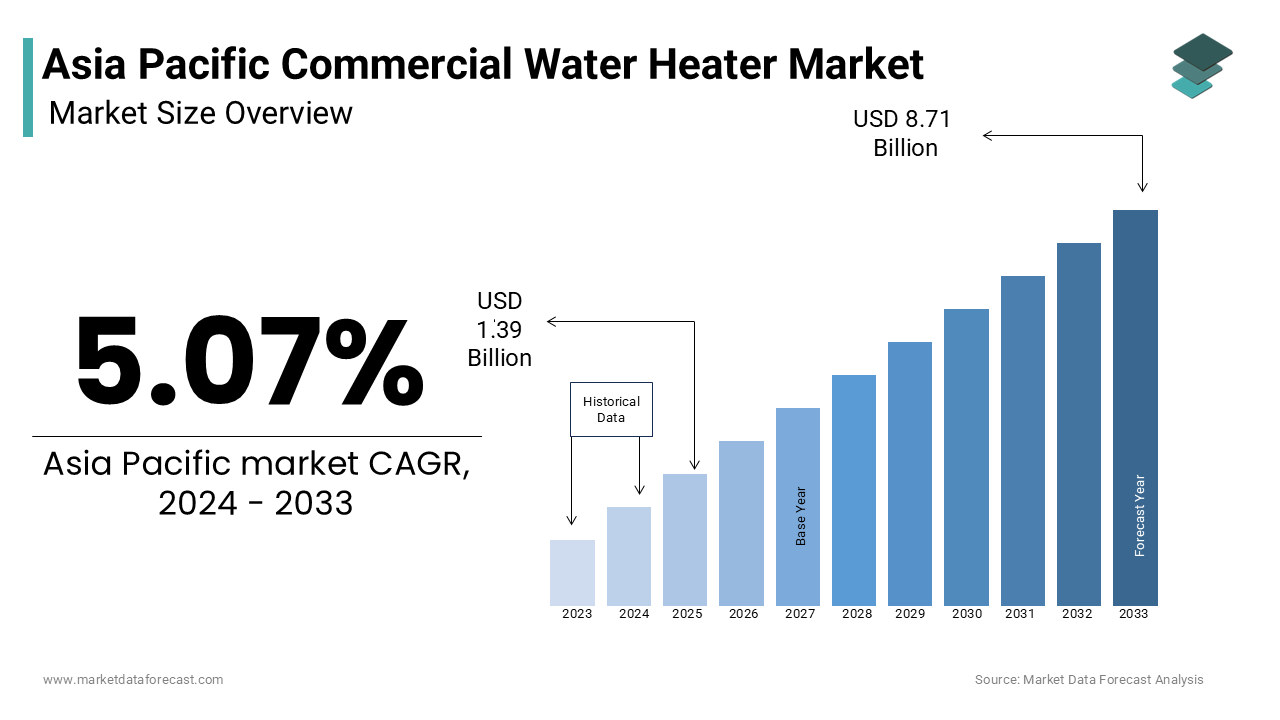
Commercial water heater serves non-residential applications, including hotels, hospitals, educational institutions, office buildings, food service establishments, and industrial facilities. This market encompasses a range of products such as gas-fired, electric, and hybrid water heating systems designed to meet high-volume and continuous hot water demands. As urbanization accelerates and commercial infrastructure expands across the region, the demand for efficient and reliable water heating solutions has grown significantly.
Additionally, governments across the region have also emphasized energy efficiency and sustainability, prompting the adoption of high-efficiency and low-emission water heating technologies in commercial settings.
In developed markets such as Australia, Japan, and South Korea, commercial water heaters are increasingly integrated with smart technologies to optimize energy use and reduce operational costs. Meanwhile, in emerging economies like India and Indonesia, the rapid growth of hospitality and healthcare infrastructure is driving market expansion. These dynamics collectively define the evolving landscape of the Asia Pacific commercial water heater market.
MARKET DRIVERS
Expansion of the Hospitality and Healthcare Sectors
The rapid expansion of the hospitality and healthcare sectors, which require continuous and high-volume hot water supply, is one of the key drivers of the Asia Pacific commercial water heater market. This growth has directly increased the demand for commercial water heating systems capable of supporting large-scale operations.
In the healthcare sector, increasing investments in hospital infrastructure and medical facilities have further fueled market growth. These facilities require high-capacity water heating systems for sanitation, patient care, and sterilization processes.
Moreover, regulatory standards mandating hot water availability in commercial establishments have reinforced the need for efficient and reliable water heating solutions. In Australia, for instance, the National Construction Code requires all new commercial buildings to be equipped with energy-efficient water heating systems. Similarly, in Japan, the Ministry of Health, Labour and Welfare has set stringent hygiene standards for healthcare facilities, necessitating the use of high-performance commercial water heaters. These factors drive the expansion of the commercial water heater market across the Asia Pacific region.
Rising Demand for Energy-Efficient and Smart Water Heating Solutions
The growing demand for energy-efficient and smart water heating solutions, driven by rising energy costs and environmental concerns, is a significant driver of the Asia Pacific commercial water heater market.
In adition, manufacturers are increasingly introducing high-efficiency gas and hybrid water heaters equipped with smart controls, real-time monitoring, and automated temperature regulation. In South Korea, the Ministry of Trade, Industry and Energy has mandated the use of energy-efficient appliances in new commercial buildings, encouraging the adoption of advanced water heating systems.
Additionally, in China, the National Development and Reform Commission has set energy efficiency targets for commercial infrastructure, leading to increased adoption of condensing and tankless commercial water heaters. These trends reflect a broader shift toward sustainable and intelligent water heating solutions, further propelling market growth across the Asia Pacific region.
MARKET RESTRAINTS
High Initial Investment and Installation Costs
The high initial investment and installation costs associated with advanced water heating systems is one of the primary restraints affecting the Asia Pacific commercial water heater market. Unlike residential models, commercial water heaters require larger capacities, specialized plumbing, and integration with existing building infrastructure, significantly increasing upfront expenses.
In emerging markets such as India and Indonesia, where budget constraints are a key purchasing determinant, these high costs act as a barrier to widespread adoption.
Moreover, in countries like the Philippines and Vietnam, where commercial infrastructure development is still in its early stages, many businesses prefer low-cost electric water heaters over gas or hybrid models. These financial considerations limit the adoption of more efficient and sustainable commercial water heating solutions across the Asia Pacific region.
Regulatory and Compliance Challenges
The complexity of regulatory and compliance requirements governing the installation and operation of commercial water heating systems is another significant restraint on the Asia Pacific commercial water heater market. Governments across the region have introduced stringent safety, energy efficiency, and emissions standards, which manufacturers and end-users must adhere to. Like, compliance with Japan’s Gas Appliance Quality Assurance Act requires extensive product testing and certification before market entry.
These regulatory barriers can be particularly challenging for smaller manufacturers and new entrants, limiting their ability to compete effectively in the market.
Additionally, in emerging markets like India and Indonesia, regulatory frameworks are still evolving, leading to inconsistencies in certification processes across states and regions. These regulatory complexities not only increase operational costs but also delay product launches, posing a significant challenge to market growth in the Asia Pacific region.
MARKET OPPORTUNITIES
Growth of Green Building Certifications and Sustainable Infrastructure Initiatives
The increasing adoption of green building certifications and sustainable infrastructure initiatives is a major opportunity in the Asia Pacific commercial water heater market. Governments and industry bodies across the region are promoting energy-efficient buildings through certification programs such as Green Mark in Singapore, LEED in India, and Green Star in Australia.
These certifications encourage the use of high-efficiency water heating systems that reduce energy consumption and carbon emissions.
Additionally, in China, the Ministry of Housing and Urban-Rural Development has integrated energy efficiency requirements into its building codes, promoting the use of high-performance commercial water heating systems. These sustainability-driven initiatives provide a strong growth opportunity for the commercial water heater market across the Asia Pacific region.
Expansion of Industrial and Manufacturing Facilities
The expansion of industrial and manufacturing facilities, which require high-capacity water heating systems for sanitation, cleaning, and process applications, is another significant opportunity in the Asia Pacific commercial water heater market.
In the food and beverage industry, increasing hygiene regulations and sanitation requirements have led to a higher demand for industrial water heating systems.
Moreover, in China, the Ministry of Industry and Information Technology has been promoting smart manufacturing and automation, leading to increased integration of high-efficiency water heating systems in industrial facilities. These developments indicate that the industrial expansion across the Asia Pacific presents a substantial growth opportunity for commercial water heater manufacturers.
MARKET CHALLENGES
Rapid Technological Obsolescence and Innovation Pressure
The rapid pace of technological obsolescence and the increasing pressure on manufacturers to continuously innovate is a major challenge facing the Asia Pacific commercial water heater market. As consumer expectations and regulatory standards evolve, companies must invest heavily in research and development to stay competitive.
In Japan, where technological innovation is a key market driver, manufacturers such as Rinnai and Noritz are constantly upgrading their product lines to incorporate smart connectivity and AI-based optimization features.
Additionally, in South Korea, as per the Korea Energy Economics Institute, commercial building developers are increasingly demanding customizable and IoT-enabled water heating solutions, pushing manufacturers to accelerate product development cycles. This rapid technological evolution not only increases R&D costs but also shortens product lifespans, making it difficult for smaller players to keep up with market demands. As a result, the commercial water heater industry in the Asia Pacific faces significant innovation-driven challenges.
Competition from Alternative Water Heating Technologies
The Asia Pacific commercial water heater market faces increasing competition from alternative water heating technologies, particularly solar thermal and heat pump systems, which are being aggressively promoted by governments and energy agencies as part of broader sustainability initiatives. This growing shift toward alternative technologies poses a formidable challenge to the commercial gas water
REPORT COVERAGE
| REPORT METRIC | DETAILS |
| Market Size Available | 2025 to 2034 |
| Base Year | 2025 |
| Forecast Period | 2026 to 2034 |
| CAGR | 6.23% |
| Segments Covered | By Type , Rated Capacity, Liter and Country |
| Various Analyses Covered | Regional & Country Level Analysis, Segment-Level Analysis, DROC, PESTLE Analysis, Porter’s Five Forces Analysis, Competitive Landscape, Analyst Overview on Investment Opportunities |
| Countries Covered | India, China, Japan, South Korea, Australia, New Zealand, Thailand, Malaysia, Vietnam, the Philippines, Indonesia, Singapore, and the Rest of APAC. |
| Market Leaders Profiled | A. O. Smith Corporation, Rheem Manufacturing Company, Rinnai Corporation, Ariston Holding N.V., Haier Electronics Group Co., Ltd., Bradford White Corporation, Noritz Corporation, Ferroli S.p.A., Havells India Ltd., and Stiebel Eltron GmbH & Co. KG. |
SEGMENTAL ANALYSIS
By Type Insights
The electric water heater segment dominated the Asia Pacific commercial water heater market by accounting for a 34.2% of total volume in 2024. The dominance of this segment is primarily attributed to the widespread availability of electricity and the relatively lower installation costs associated with electric systems compared to gas or hybrid alternatives.
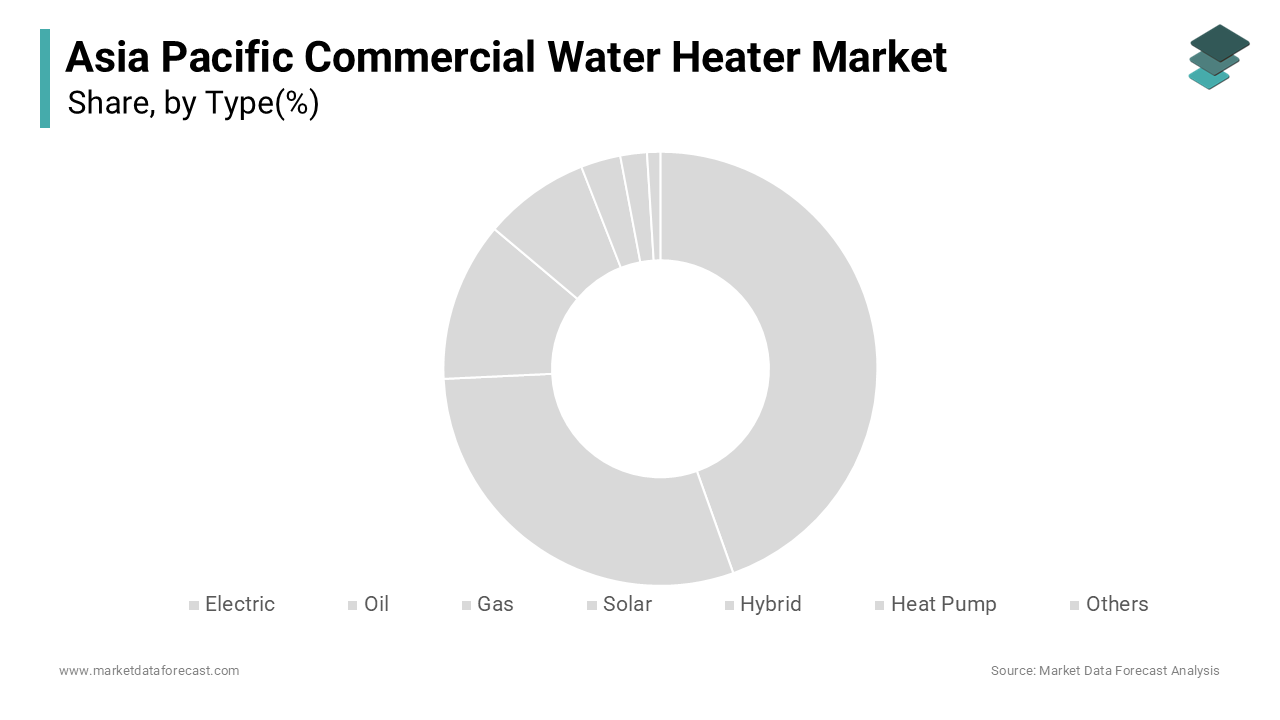
In countries such as India and Indonesia, where gas infrastructure is limited outside major urban centers, electric water heaters are the preferred choice for commercial establishments. Moreover, electric water heaters are favored in multi-tenant commercial buildings where gas venting can be complex and costly. These factors collectively contribute to the continued dominance of the electric water heater segment in the Asia Pacific commercial market.
The heat pump water heater segment is the fastest-growing within the Asia Pacific commercial water heater market and is projected to expand at a CAGR of 12.4% from 2026 to 2034. The rapid growth of this segment is driven by the increasing demand for energy-efficient and low-emission water heating solutions, particularly in government and corporate sustainability initiatives. As governments across the region continue to incentivize clean energy technologies, the heat pump segment is poised for sustained growth in the Asia Pacific market.
By Liter Capacity Insights
The 1,000–3,000 liters capacity segment held the largest share of the Asia Pacific commercial water heater market of 42.5% of total sales in 2025. The dominance of this segment is primarily attributed to its suitability for mid-sized commercial establishments such as hotels, hospitals, and office complexes that require a consistent and moderate volume of hot water. The combination of infrastructure development and energy efficiency considerations has cemented the dominance of the 1,000–3,000-liter capacity segment in the Asia Pacific market.
The 3,000–4,000-liter capacity segment is the fastest-growing within the Asia Pacific commercial water heater market and is projected to expand at a CAGR of 11.7% from 2025 to 2033. The rapid growth of this segment is largely driven by the increasing demand for large-scale hot water supply in high-occupancy commercial facilities such as luxury hotels, large hospitals, and industrial complexes. Also, 3,000–4,000-liter water heaters were the preferred choice for these establishments due to their ability to support a continuous hot water supply across multiple floors.
Additionally, in South Korea, large commercial buildings, including integrated shopping complexes and multi-functional office towers, increasingly adopted this capacity range to meet high-volume demands. These factors collectively contribute to the accelerated growth of this segment in the Asia Pacific commercial water heater market.
By Rated Capacity Insights
The 10–50 kW rated capacity segment led the Asia Pacific commercial water heater market by accounting for a 45.4% of total volume in 2025. The dominance of this segment is primarily due to its suitability for a wide range of commercial applications, including medium-sized hotels, hospitals, office buildings, and educational institutions that require a steady but not excessively high hot water supply.
These units are particularly well-suited for business hotels, clinics, and small to mid-sized office buildings, which form a significant portion of the country’s commercial real estate. Moreover, the versatility and adaptability of 10–50 kW water heaters make them the most widely adopted category in the Asia Pacific commercial market.
The 50–150 kW rated capacity segment is the fastest-growing within the Asia Pacific commercial water heater market and is projected to expand at a CAGR of 11.2% from 2026 to 2034. This growth is primarily driven by the increasing construction of large-scale commercial and industrial facilities that require high-capacity hot water systems for continuous operation. As industrial and commercial expansion continues across the region, the 50–150 kW segment is expected to maintain its rapid growth trajectory.
REGIONAL ANALYSIS
China Commercial Water Heater Market Insights
China led the Asia Pacific commercial water heater market by accounting for 25.2% of total regional demand in 2025. As the region’s largest economy and a key hub for commercial infrastructure development, China has witnessed a steady increase in demand for high-capacity water heating systems across hospitality, healthcare, and industrial sectors. A key driver of market growth is the government’s push for energy-efficient and low-emission commercial infrastructure. Under the Green Building Evaluation Standard, newly constructed commercial buildings are required to meet energy efficiency benchmarks, encouraging the adoption of high-efficiency gas and heat pump water heaters. Moreover, the expansion of industrial and hospitality sectors has further fueled demand. With continued investment in commercial infrastructure and sustainability initiatives, China remains the dominant force in the Asia Pacific commercial water heater market.
India Commercial Water Heater Market Insights
India is swiftly expanding in the Asia Pacific commercial water heater market. The country’s market is experiencing rapid expansion due to increasing investments in commercial infrastructure, particularly in the hospitality, healthcare, and industrial sectors. A key driver of market growth is the government’s push for energy-efficient infrastructure through initiatives such as the Energy Conservation Building Code (ECBC). Furthermore, the rise of organized food service chains and industrial processing units has contributed to market expansion. As India continues to invest in commercial infrastructure and promote sustainable energy solutions, the commercial water heater market is expected to grow at a robust pace.
Japan Commercial Water Heater Market Insights
Japan is another major player in the Asia Pacific commercial water heater market. The country has a well-developed commercial infrastructure and one of the highest per capita penetrations of high-efficiency water heating systems in the region. One of the primary drivers of market growth is the widespread adoption of high-efficiency and smart-enabled water heating systems in commercial buildings. Additionally, Japan’s aging population and rising healthcare demand have led to increased construction of hospitals and elderly care facilities, all of which require high-capacity water heating systems. With continued emphasis on technological advancement and sustainability, Japan remains a key player in the Asia Pacific commercial water heater market.
Australia Commercial Water Heater Market Insights
Australia holds a significant share of the Asia Pacific commercial water heater market. The country benefits from a well-established natural gas distribution network and a strong regulatory framework that encourages the adoption of energy-efficient heating solutions. A key driver of market growth is the country’s preference for high-efficiency and low-emission water heating systems. Moreover, the hospitality sector remains a major consumer of commercial water heaters. With continued policy support and a growing focus on reducing carbon emissions, Australia remains a significant contributor to the Asia Pacific commercial water heater market.
South Korea Commercial Water Heater Market Insights
South Korea is known for its advanced home and commercial appliance industry, with a strong emphasis on smart and energy-efficient technologies. A key growth driver is the integration of smart features into commercial water heaters, including mobile connectivity, automated temperature control, and real-time energy monitoring. Moreover, the country’s dense urban population and high-rise commercial infrastructure favor the installation of compact, high-performance water heating systems. As South Korea continues to emphasize technological innovation and sustainability, the commercial water heater market is expected to maintain steady growth.
COMPETITIVE LANDSCAPE
The competition in the Asia Pacific commercial water heater market is marked by a blend of global industry leaders and dynamic regional players, all striving to capture market share through innovation, service excellence, and strategic positioning. The market is moderately concentrated, with a few dominant companies maintaining strong footholds due to their brand recognition, extensive product portfolios, and well-established distribution networks. However, the increasing demand for energy-efficient and smart-enabled commercial water heating systems is pushing both large and mid-sized players to invest heavily in research and development. Companies are also focusing on sustainability, after-sales service, and digital integration to differentiate themselves in a competitive landscape. As commercial infrastructure development accelerates across the region, the competition is expected to intensify further, with new entrants and local manufacturers challenging the dominance of global players by offering cost-effective and region-specific solutions. This evolving dynamic is shaping a more diverse and competitive market environment.
KEY MARKET PLAYERS
Key players operating in the Asia Pacific Commercial Water Heater Market include
- A. O. Smith Corporation
- Rheem Manufacturing Company
- Rinnai Corporation
- Ariston Holding N.V.
- Haier Electronics Group Co., Ltd.
- Bradford White Corporation
- Noritz Corporation
- Ferroli S.p.A.
- Havells India Ltd.
Top Players in the Asia Pacific Commercial Water Heater Market
Rinnai Corporation
Rinnai is a leading global manufacturer of gas appliances and holds a dominant presence in the Asia Pacific commercial water heater market. Known for its innovation and reliability, the company has been instrumental in shaping the demand for high-efficiency, eco-friendly commercial water heating systems. Rinnai’s focus on product development, particularly in condensing and tankless technologies, has allowed it to maintain a competitive edge in both hospitality and industrial applications across the region.
A. O. Smith Corporation
A. O. Smith is a global leader in water heating technology with a strong foothold in the Asia Pacific commercial market. The company has expanded its influence through strategic partnerships and localized manufacturing facilities. A. O. Smith is recognized for its advanced heat pump and hybrid water heating technologies, which cater to the growing demand for energy-efficient and sustainable solutions in large-scale commercial settings.
Noritz Corporation
Noritz specializes in high-performance gas water heaters, particularly tankless models, and has built a strong reputation in the commercial sector. The company has successfully expanded its reach in the Asia Pacific market by aligning with regional distribution networks and emphasizing technological innovation. Noritz is known for its compact, durable, and highly efficient commercial units that meet the needs of modern buildings and facilities.
Top Strategies Used by Key Market Participants
One of the primary strategies employed by key players in the Asia Pacific commercial water heater market is product innovation and technological advancement. Companies are continuously developing energy-efficient, smart-enabled, and high-capacity models to meet evolving consumer preferences and regulatory requirements. These innovations help manufacturers differentiate their offerings and capture a larger market share.
Another critical strategy is strategic partnerships and collaborations. By aligning with local distributors, utility providers, and government agencies, companies can enhance their market penetration and streamline supply chain operations. These collaborations also support after-sales service networks, which are crucial for customer satisfaction and brand loyalty.
Lastly, expansion into emerging markets and localization of production play a vital role in strengthening market presence. Manufacturers are setting up regional manufacturing units and adapting product designs to suit local climatic conditions and commercial infrastructure needs, ensuring cost efficiency and faster delivery across the Asia Pacific region.
RECENT MARKET DEVELOPMENTS
- In February 2023, Rinnai launched a new line of smart gas commercial water heaters equipped with mobile connectivity and real-time energy monitoring features, targeting large-scale hospitality and healthcare facilities in Japan and South Korea.
- In July 2023, A. O. Smith expanded its manufacturing facility in China to increase production capacity and better serve the growing demand for high-efficiency commercial gas and hybrid water heating systems in the region.
- In November 2023, Noritz partnered with a leading utility provider in Australia to integrate its tankless commercial gas water heaters into new hotel and hospital developments, enhancing market penetration and customer trust.
- In March 2024, Rheem Manufacturing introduced a new series of high-capacity commercial heat pump water heaters designed for large-scale applications, catering to the rising demand for sustainable and energy-efficient solutions across Southeast Asia.
- In August 2024, Bradford White Corporation entered into a strategic distribution agreement with a regional supplier in India to expand its presence in the fast-growing commercial water heating market, focusing on hospitals, hotels, and industrial facilities.
MARKET SEGMENTATION
This research report on the Asia Pacific commercial water heater market is segmented and sub-segmented into the following categories.
By Type
- Electric
- Oil
- Gas
- Solar
- Hybrid
- Heat Pump
- Others (Bio-fuel & Solid Fuel-fired commercial water heaters)
By Rated Capacity
- Up to 10kW
- 10–50kW
- 50–150kW
- 150–300kW
- Above 300kW
By Liter
- Below 500 Liters
- 500–1,000 Liters
- 1,000–3,000 Liters
- 3,000–4,000 Liters
- Above 4,000 Liters
By Country
- India
- China
- Japan
- South Korea
- Australia
- New Zealand
- Thailand
- Malaysia
- Vietnam
- Philippines
- Indonesia
- Singapore
- Rest of APAC