- Product Description Description
- Table of Contents TOC
- List of Table & Figure LOT
- Get Free Sample PDF Sample PDF
Market Size, 2025
$6.23 BnMarket Estimate, 2026
$6.80 BnMarket Forecast, 2034
$13.63 BnCAGR, 2026–2034
9.08%Asia Pacific Corn Starch Market Size
Asia Pacific Corn Starch Market size was calculated to be USD 6.23 billion in 2025 and is anticipated to be worth USD 13.63 billion by 2034, up from USD 6.80 billion in 2026, growing at a CAGR of 9.08% during the forecast period.
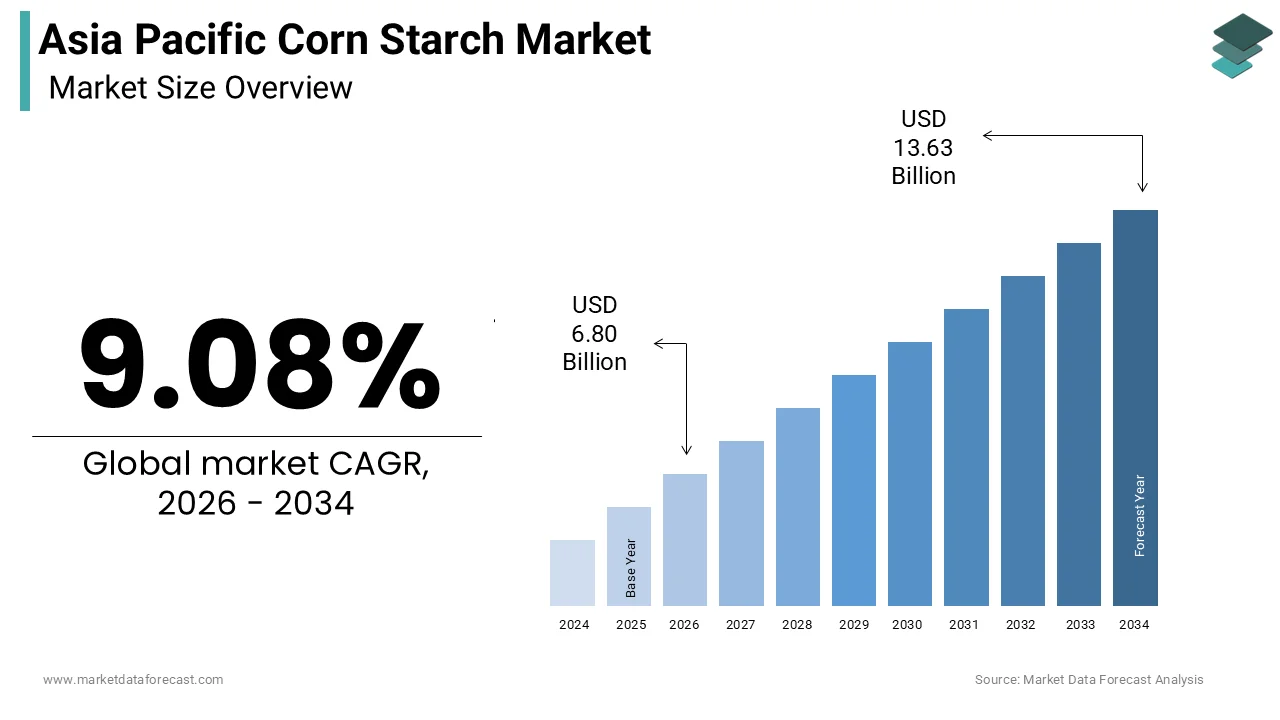
The corn starch is an industrial and nutritional ecosystem, where maize processing intersects with regional food security, pharmaceutical manufacturing, and biodegradable material innovation. Unlike Western markets driven primarily by high fructose corn syrup, this region utilizes native and modified starches predominantly for texture modification in traditional foods, paper sizing, and as a fermentation substrate for amino acid production. According to the study, the region accounts for over 60% of global maize consumption, yet significant disparities exist between industrial processing capacity in East Asia and agrarian supply chains in Southeast Asia. As per the United Nations Economic and Social Commission for Asia and the Pacific, rapid urbanization has shifted dietary patterns toward processed convenience foods, increasing per capita starch intake by 18% since 2015 across developing member states. The Asian Development Bank notes that bio-based industrial policies in China, Thailand, and Indonesia now mandate minimum bioplastic content in packaging, directly linking agricultural output to manufacturing sustainability targets. Consequently, this market is defined not merely by commodity trading but by its strategic role in national value addition strategies, where raw grain is converted into functional ingredients essential for diverse downstream industries ranging from textiles to biologics.
MARKET DRIVERS
Expansion of Processed Food Manufacturing in Emerging Economies
The accelerating transition from subsistence diets to processed food consumption across Southeast Asia and South Asia is a primary factor boosting the growth of the Asia Pacific corn starch market. According to the World Bank Urban Development Series 2024, the urban population in Vietnam, Indonesia, and the Philippines grew by an average of 3.2% annually between 2020 and 2024, correlating directly with a 27% increase in sales of packaged noodles, sauces, and bakery products that rely heavily on starch for viscosity and shelf stability. Nestle’s regional supply chain data indicates that procurement volumes for modified starches in ASEAN manufacturing hubs increased in 2024 alone to support new instant noodle and seasoning powder production lines. As per the Survey, 68% of consumers in emerging Asian cities now purchase ready-to-eat meals at least three times weekly, necessitating industrial-scale thickening and stabilizing agents that only corn starch can provide cost-effectively. This demographic transformation creates non-discretionary demand because traditional wet milling processes cannot be substituted without altering product texture or significantly increasing formulation costs, thereby embedding corn starch deeply within the region’s modernizing food infrastructure.
Industrial Biotechnology and Fermentation Substrate Requirements
Government mandates promoting bio-based chemicals and pharmaceutical intermediates have transformed corn starch from a food ingredient into a strategic industrial feedstock across Northeast Asia. The industrial biotechnology and fermentation substrate requirements are additionally fuelling the growth of the Asia-Pacific corn starch market. According to China’s Ministry of Industry and Information Technology Bioeconomy Development Plan 2025, domestic production of lysine, monosodium glutamate, and citric acid requires approximately 28 million metric tons of corn starch annually as a carbon source for microbial fermentation. As per the study, pharmaceutical excipient demand for high-purity corn starch grew by 11% in 2024 due to expanded domestic vaccine and generic drug manufacturing capacity under national health security initiatives. These industrial applications are insulated from food price volatility because they are tied to long term policy targets and capital-intensive biorefinery investments that require consistent feedstock throughput to maintain economic viability by creating a stable demand floor independent of consumer sentiment.
MARKET RESTRAINTS
Volatility in Domestic Maize Supply and Import Dependency
The structural mismatch between processing capacity and domestic grain availability in key manufacturing nations is hindering the growth of the Asia Pacific corn starch market. Indonesia’s Ministry of Agriculture documented that domestic corn production covered only 72% of wet milling demand in 2024, forcing starch manufacturers to import 2.8 million metric tons at prices 22% above regional benchmarks due to freight premiums and tariff structures. As per the research, erratic monsoon patterns caused maize yield fluctuations of up to 18% between 2023 and 2024, triggering export bans that stranded starch exporters and forced temporary plant shutdowns. This supply insecurity prevents manufacturers from optimizing capacity utilization and forces them to maintain expensive buffer inventories, eroding margins and making long term contracting with downstream customers difficult when raw material costs can swing dramatically within single fiscal quarters.
Competition from Alternative Starch Sources and Substitutes
Abundant regional production of cassava and sago starch creates persistent substitution pressure that caps corn starch pricing power in price-sensitive applications. This factor is another factor hindering the growth of the Asia Pacific corn starch market. According to the study, Thailand exported 3.8 million metric tons of tapioca starch in 2024 at average prices 18% below equivalent corn starch grades, capturing a significant share in textile sizing and adhesive formulations across Southeast Asia. Vietnam’s Ministry of Industry and Trade reports that cassava cultivation area expanded in 2024, specifically to supply starch factories competing directly with corn processors in noodle and snack food segments. As per the study, palm kernel expeller-based fillers have displaced corn starch in 12% of low-grade biscuit and cracker formulations since 2023 due to cost advantages exceeding 30% in local currency terms. This competitive landscape forces corn starch producers to continuously invest in modification technologies to justify premiums, as native starch applications remain perpetually vulnerable to cheaper alternatives during periods of maize price inflation or currency depreciation affecting import-dependent processors.
MARKET OPPORTUNITIES
Biodegradable Packaging Material Innovation
Legislative restrictions on conventional plastics for thermoplastic starch and polylactic acid derived from corn are a major factor in creating new opportunities for the expansion of the Asia Pacific corn starch market. According to the United Nations Environment Programme Regional Assessment 2025, 18 Asia Pacific nations have implemented partial or full bans on single-use plastic bags and food containers since 2022, generating estimated annual demand for 2.4 million metric tons of bio-based packaging substitutes. Thailand’s Board of Investment approved tax incentives in 2024 for bioplastic resin plants using domestic corn and cassava, resulting in three new facilities with a combined capacity of 180000 metric tons commencing construction. As per the study, certified compostable carry bag manufacturers increased corn starch procurement by 41% in 2024, following enforcement of Plastic Waste Management Amendment Rules. The biodegradable shopping bag production consumed 890000 metric tons of modified corn starch in 2024, representing 28% growth year on year. This regulatory-driven demand creates a premium segment where starch functionality commands higher margins than food applications, while simultaneously providing an outlet for lower-grade industrial corn that might otherwise face disposal costs or discount pricing.
Pharmaceutical and Nutraceutical Excipient Localization
The post pandemic emphasis on domestic pharmaceutical manufacturing capacity, previously imported from Western suppliers, is additionally bolstering the growth of the Asia Pacific corn starch market. According to the World Health Organization, regional API and finished dosage manufacturing investment exceeded 8.5 billion dollars in 2024, with associated excipient demand projected to grow 14% annually through 2028. India’s Department of Pharmaceuticals Production Linked Incentive Scheme resulted in 12 new excipient manufacturing units becoming operational in 2024, collectively requiring 45000 metric tons of high-purity corn starch meeting IP and USP standards. As per Australia’s Therapeutic Goods Administration, domestic medicine manufacturing grants allocated 320 million AUD in 2024, including specific funding for local excipient supply chain development to reduce import dependency. Statistics from the Japan Pharmaceutical Manufacturers Association indicate that domestic corn starch excipient consumption grew 9% in 2024 as companies reshored tablet binding and disintegrant sourcing amid geopolitical supply concerns. This localization trend creates opportunities for starch processors willing to invest in GMP-compliant refining and drying infrastructure, accessing margins 3 to 4 times higher than commodity food starch, while building defensible positions in regulated supply chains.
MARKET CHALLENGES
Water Scarcity and Effluent Treatment Compliance Costs
Corn wet milling is inherently water-intensive, requiring 3 to 5 cubic meters of fresh water per metric ton of starch produced, creating acute vulnerability in regions facing aquifer depletion and tightening discharge standards. Water scarcity and effluent treatment compliance costs are a huge challenge for the growth of the Asia Pacific corn starch market. According to the study, 68% of China’s corn processing capacity is located in northern provinces experiencing severe groundwater overdraft, forcing facilities to invest 15 to 20% of capital expenditure in zero liquid discharge systems. As per the study, 23 corn starch facilities received violation notices in 2024 for exceeding biological oxygen discharge limits during dry season operations when dilution capacity diminishes. Asia Pacific corn processing sites face high or extremely high baseline water stress, making expansion permits increasingly difficult to obtain. These environmental constraints transform water from operational input into strategic liability by forcing consolidation among smaller players unable to finance required upgrades, while compressing margins for all participants regardless of efficiency levels.
Technical Workforce Deficits in Advanced Modification Technologies
The transition from native starch to specialized modified variants requires chemical engineering expertise and application development capabilities that remain scarce across much of the region outside established hubs. The technical workforce deficit in advanced modification technologies also hinders the growth of the Asia Pacific corn starch market. According to the study, Southeast Asia faces a shortage of 28000 qualified food technologists and chemical engineers specializing in carbohydrate chemistry, limiting domestic capacity to develop custom modified starches for multinational clients. Vietnam’s Ministry of Education and Training reports that only 4 universities offer specialized starch technology curricula, graduating fewer than 200 students annually against industry demand exceeding 1500 positions. As per the research, 67% of local starch processors rely on foreign technical consultants for product development, adding 6 to 9 months to commercialization timelines versus integrated multinational competitors. This human capital deficit traps many regional processors in low-margin commodity segments despite available raw materials and growing premium demand, as they lack internal capability to formulate and validate functional solutions required by sophisticated food and industrial customers.
REPORT COVERAGE
| REPORT METRIC | DETAILS |
| Market Size Available | 2025 to 2034 |
| Base Year | 2025 |
| Forecast Period | 2026 to 2034 |
| CAGR | 9.08% |
| Segments Covered | By Product, Application, and Region |
| Various Analyses Covered | Global, Regional & Country Level Analysis; Segment-Level Analysis, DROC, PESTLE Analysis, Porter’s Five Forces Analysis, Competitive Landscape, Analyst Overview of Investment Opportunities |
| Regions Covered | India, China, Japan, South Korea, Australia, New Zealand, Thailand, Malaysia, Vietnam, Philippines, Indonesia, Singapore and Rest of APAC |
| Market Leaders Profiled | Cargill Incorporated, HL Agro, Oji Cornstarch, Global Bio- chem Technology Group, Grain Processing Corporation, Croda International, Akzo Nobel NV, Bayer AG, Ajinomoto Company Incorporated, Henkel KGaA |
SEGMENTAL ANALYSIS
By Product Insights
The native starch segment held a dominant share of the Asia Pacific corn starch market in 2025, as the foundational thickening and binding agent for traditional food manufacturing across price-sensitive developing economies. According to the Food and Agriculture Organization Regional Office for Asia and the Pacific, native corn starch accounted for 58% of total regional consumption in 2024 due to its widespread use in noodle production, sauce formulation, and snack coating applications where functional modification is unnecessary. According to the study, domestic instant noodle manufacturers consumed 1.8 million metric tons of native corn starch in 2024, representing 34% of national starch demand because alternative modified variants would increase unit costs by 22% without delivering perceptible quality improvements for mass market products. The rural and semi-urban food processing units procure native starch exclusively due to limited technical capacity to handle modified variants requiring precise hydration and temperature control during processing. This economic reality ensures native starch retains volume leadership despite premiumization trends in developed countries, as the vast base of traditional food manufacturing across South and Southeast Asia remains structurally anchored to unmodified commodity grades.
The modified starch segment is likely to witness the fastest CAGR of 9.3% from 2026 to 2034, with urbanization driving demand for processed foods requiring enhanced stability, texture, and shelf life that native starch cannot provide. The modified starch imports for convenience food manufacturing increased 18% in 2024, as domestic processors reformulated products to meet clean label expectations, while maintaining functional performance. This functional necessity creates structural growth decoupled from overall starch volume trends, as value addition concentrates in specialized ingredients commanding premium pricing and technicallock-inn with sophisticated manufacturers. Expansion of regional pharmaceutical manufacturing and specialty chemical production creates high-margin demand for pharmacopeial and technically modified starches unavailable from commodity suppliers. This technical grade expansion creates growth corridors where margins exceed commodity starch by a factor of four to six, attracting investment in specialized processing capabilities that further accelerate segment growth through capability building and import substitution dynamics.
By Application Insights
The food and beverages segment was the largest, holding 44.5% of the Asia-Pacific corn starch market, with the adoption of traditional cooking methods and staple food preparation across diverse Asian cuisines. According to the United Nations Economic and Social Commission for Asia and the Pacific Dietary Transition Report 2025, household and foodservice corn starch consumption for thickening sauces, coating fried foods, and preparing desserts reached 18.4 million metric tons in 2024. According to China’s National Bureau of Statistics Household Survey, 89% of urban households purchase corn starch monthly for home cooking, with an average per capita annual consumption of 2.3 kilograms embedded in recipes for stir-fries, dumplings, and confectionery. This cultural embedding creates demand stability independent of economic cycles or technological disruption, as starch functionality cannot be replicated by alternative ingredients without altering sensory profiles consumers expect across generations. Large-scale food processing operations across Asia Pacific generate concentrated procurement volumes that sustain food and beverage segment leadership through supply chain integration and long-term contracting.
The pharmaceuticals and chemicals segment is likely to register the fastest CAGR of 12.3% from 2026 to 2034, as government policies promoting bio-based materials and domestic pharmaceutical security drive specialized starch adoption. According to the study, seven Asia Pacific nations implemented minimum bio content requirements for packaging, textiles, and construction materials in 2024 by creating regulatory pull for thermoplastic starch and polylactic acid precursors derived from corn. As per China’s Ministry of Industry and Information Technology, the Bioeconomy Plan targets 3.5 million metric tons of bio-based chemical production by 2027, requiring approximately 8 million metric tons of industrial corn starch as fermentation substrate. This policy-driven demand creates a growth trajectory decoupled from traditional food and industrial cycles, as government mandates and incentive schemes de-risk investment in starch-intensive bio-manufacturing regardless of short-term commodity price fluctuations or consumer sentiment.
REGIONAL ANALYSIS
China Corn Starch Market Analysis
China was the top performer in the Asia Pacific corn starch market by holding a 48.3% share in 2025 due to its status as the world’s second-largest maize producer and most extensive wet milling infrastructure. According to China’s National Grain and Oil Information Center, domestic corn starch production reached 38.5 million metric tons in 2024, supported by integrated processing clusters in Shandong, Hebei, and Jilin provinces that convert 65% of national maize output into starch and derivatives. The country’s bioeconomy development strategy mandates minimum bioplastic content in packaging and textile applications, driving industrial starch consumption. As per the Ministry of Industry and Information Technology, amino acid and organic acid fermentation consumed 28 million metric tons of corn starch in 2024, making China both the largest producer and consumer of industrial-grade starch globally. Market leadership stems from unmatched scale, vertical integration, and policy alignment that transforms corn starch from an agricultural commodity into a strategic industrial input central to national manufacturing competitiveness.
India Corn Starch Market Analysis
India corn starch market held the second position, holding a 34.2% share in 2025, with the rapidly expanding food processing sector and emerging pharmaceutical excipient localization driven by government incentive schemes. According to the report, organized sector corn starch consumption grew 13% in 2024 as instant noodle, snack food, and beverage manufacturing capacity expanded under Production Linked Incentive programs targeting 25 billion dollars in additional output by 2027. As per the study, PLI scheme-approved bulk drug projects will require 65000 metric tons annually of pharmacopeial-grade starch upon commissioning, creating a premium segment currently served primarily by imports. Monsoon-dependent agriculture introduces supply volatility; the 2024 kharif season yield fluctuated 18% across key growing states, triggering temporary export restrictions that disrupted regional trade flows.
Thailand Corn Starch Market Analysis
Thailand corn starch market is significantly to have prominent growth opportunities throughout the forecast period, with modified starch and tapioca corn blend formulations serving multinational clients. According to the study, domestic corn starch production reached 2.1 million metric tons in 2024, with 58% exported to Japan, South Korea, and ASEAN neighbors seeking cost-competitive modified variants meeting Japanese Agricultural Standards and Korean Food Code specifications. The country’s Board of Investment approved tax incentives for bioplastic resin plants in 2024, resulting in three new facilities with a combined capacity of 180000 metric tons commencing construction and securing long term starch feedstock commitments. As per the study, modified starch exports grew 19% in 2024, while native starch shipments declined 8%, indicating a successful value-addition strategy.
Indonesia Corn Starch Market Analysis
Indonesia corn starch market growth is likely to grow with the massive domestic food consumption base and growing import dependency due to structural maize supply deficits. According to the research, household and foodservice corn starch consumption reached 2.4 million metric tons in 2024, driven by traditional snack production, tempeh coating, and instant noodle manufacturing that embed starch in daily dietary patterns across the archipelago. As per the study, instant noodle factories consumed 1.8 million metric tons of native starch in 2024, representing 34% of national demand and creating a non-discretionary volume anchor resistant to economic downturns. Bioplastic policy implementation lags behind Thailand and China, where only two commercial-scale PLA facilities operated in 2024 versus 12 in Thailand.
Japan Corn Starch Market Analysis
Japan corn starch market growth is likely to grow with the premium quality standards, pharmaceutical grade specifications, and technology transfer partnerships shaping regional supply chains. According to Japan’s Ministry of Agriculture, Forestry and Fisheries Food Balance Sheet 2025, domestic corn starch consumption reached 1.9 million metric tons in 2024, with 89% imported as grain or finished starch due to limited domestic maize cultivation and high processing costs relative to ASEAN competitors. The country’s stringent food safety and labeling regulations set benchmark standards adopted voluntarily by exporters in Thailand, Vietnam, and China seeking access to premium Japanese retail and foodservice channels.
COMPETITION OVERVIEW
The Asia Pacific corn starch market exhibits a tiered competition structure, with multinational ingredient companies dominating premium modified and pharmaceutical segments while domestic processors control commodity native starch volumes in respective home markets. Multinationals leverage global R&D platforms, regulatory expertise, and application development capabilities to serve sophisticated food and pharmaceutical customers requiring customized functionality and compliance documentation that local suppliers cannot provide. Domestic players compete through cost advantages from integrated grain sourcing, lower overhead structures, government subsidies, and deeper relationships with traditional food manufacturers and small enterprisescomprising thee bulk demand base. Geographic fragmentation prevents pan-regional consolidation, as transportation costs, tariff barriers, and divergent regulatory standards create natural market boundaries favoring locally present manufacturers with established supply chains. Emerging threats include Chinese state-owned enterprises expanding overseas processing capacity in Southeast Asia under Belt and Road initiatives, bringing subsidized capital and integrated grain logistics challenging private sector incumbents. Differentiation increasingly depends on sustainability credentials, water stewardship, and circular economy integration as multinational customers tie procurement to environmental performance metrics alongside technical specifications. Currency volatility and infrastructure deficits raise barriers to entry, protecting incumbents but also constraining expansion investment and margin stability.
Key Players in the Market
A few major corn starch market participants include
- Cargill Incorporated
- HL Agro
- Oji Cornstarch
- Global Bio- chem Technology Group
- Grain Processing Corporation
- Croda international
- Akzo Nobel NV
- Bayer AG
- Ajinomoto Company Incorporated
- Henkel KGaA
Top Strategies Used by Key Market Participants
Key players employ vertical integration strategies, securing maize supply through contract farming and grain origination networks to mitigate feedstock volatility affecting processing economics across monsoon-dependent agricultural systems. Companies establish geographically distributed manufacturing footprints across multiple countries to hedge against single-jurisdiction policy risks, currency fluctuations, and trade barriers while serving regional customers with localized supply chains. Strategic partnerships with downstream food and pharmaceutical manufacturers enable co-development of application-specific starch solutions addressing unique functional requirements and regulatory standards, creating technical lock-in beyond price competition. Firms invest heavily in water treatment, renewable energy, and effluent recycling infrastructure to maintain social license to operate amid tightening environmental regulations and stakeholder expectations across water-stressed regions. Portfolio diversification balances commodity native starch volumes with premium modified and pharmaceutical grades to smooth revenue streams across agricultural cycles and capture value addition opportunities in growing specialty segments. Regulatory engagement teams work proactively with national food and drug authorities to shape novel ingredient approval pathways and labeling standards favorable to starch-based solutions versus synthetic alternatives.
Leading Players in the Asia Pacific Corn Starch Market
- Cargill Incorporated maintains extensive involvement in the Asia Pacific corn starch market through integrated wet milling facilities across China, India, Indonesia, and Thailand serving food, feed, and industrial customers. The company strengthened its regional position by commissioning a new modified starch production line at its Nakhon Sawan, Thailand facility in March 2025 to supply clean label ingredients for ASEAN convenience food manufacturers. Cargill partnered with Japanese pharmaceutical companies to validate pharmacopeial-grade starches meeting PMDA requirements, reducing import dependency for critical excipients. They invested in water recycling infrastructure at Indian plants to address environmental compliance pressures and secure operational continuity amid tightening discharge regulations. These initiatives demonstrate commitment to localized technical solutions addressing diverse regulatory, environmental, and application-specific needs across heterogeneous Asia Pacific countries rather than standardized global offerings, reinforcing supply chain resilience and customer loyalty through embedded problem-solving capabilities.
- Ingredion Incorporated contributes significantly to the Asia Pacific corn starch market as a leading supplier of specialty modified starches and plant-based texturizers with manufacturing bases in China, Thailand, Singapore, and Australia. The company expanded its Singapore R&D center in November 2024, adding application laboratories focused on plant-based meat analogues and biodegradable packaging formulations tailored to regional texture preferences and regulatory frameworks. Ingredion launched a clean-label functional native starch range specifically validated for Southeast Asian noodle and sauce applications in 2024 by capturing premium segments previously served by chemically modified alternatives. They established strategic distribution partnerships in Vietnam and the Philippines to improve market access without capital-intensive greenfield investments.
- Roquette Frères plays a pivotal role in the Asia Pacific corn starch market through specialized pharmaceutical and nutrition grade starch production with facilities in China, India, and Singapore serving high-value regulated segments. The company inaugurated expanded pharma-grade starch capacity at its Lianyungang, China, plant in June 2025 to serve domestic generic drug manufacturers reshoring excipient sourcing under national health security policies. Roquette collaborated with Australian infant formula producers to develop allergen-controlled starch variants meeting TGA and export market requirements, securing long term supply contracts tied to nutritional product growth. They invested in renewable energy integration at Indian facilities to meet multinational customer sustainability mandates increasingly tied to supplier selection criteria. These activities reflect a focus on premium niches where technical specifications and regulatory compliance create defensible positions insulated from commodity volatility by leveraging European quality heritage adapted to Asia Pacific localization requirements through targeted capacity and capability investments.
DETAILED SEGMENTATION OF THE ASIA PACIFIC CORN STARCH MARKET INCLUDED IN THIS REPORT
This research report on the Asia Pacific corn starch market has been segmented and sub-segmented based on product, application, and region.
By Product
- Native starch
- Modified starch
- Sweeteners
By Application
- Food and Beverages
- Animal feed
- Pharmaceuticals and chemicals
- Textile
- Paper and Corrugated
- Others
By Region
- India
- China
- Japan
- South Korea
- Australia
- New Zealand
- Thailand
- Malaysia
- Vietnam
- Philippines
- Indonesia
- Singapore
- Rest of APAC