- Product Description Description
- Table of Contents TOC
- List of Table & Figure LOT
- Get Free Sample PDF Sample PDF
Market Size, 2025
$2.74 BnMarket Estimate, 2026
$2.92 BnMarket Forecast, 2034
$4.81 BnCAGR, 2026–2034
6.45%Asia Pacific Cryogenic Tanks Market Report Summary
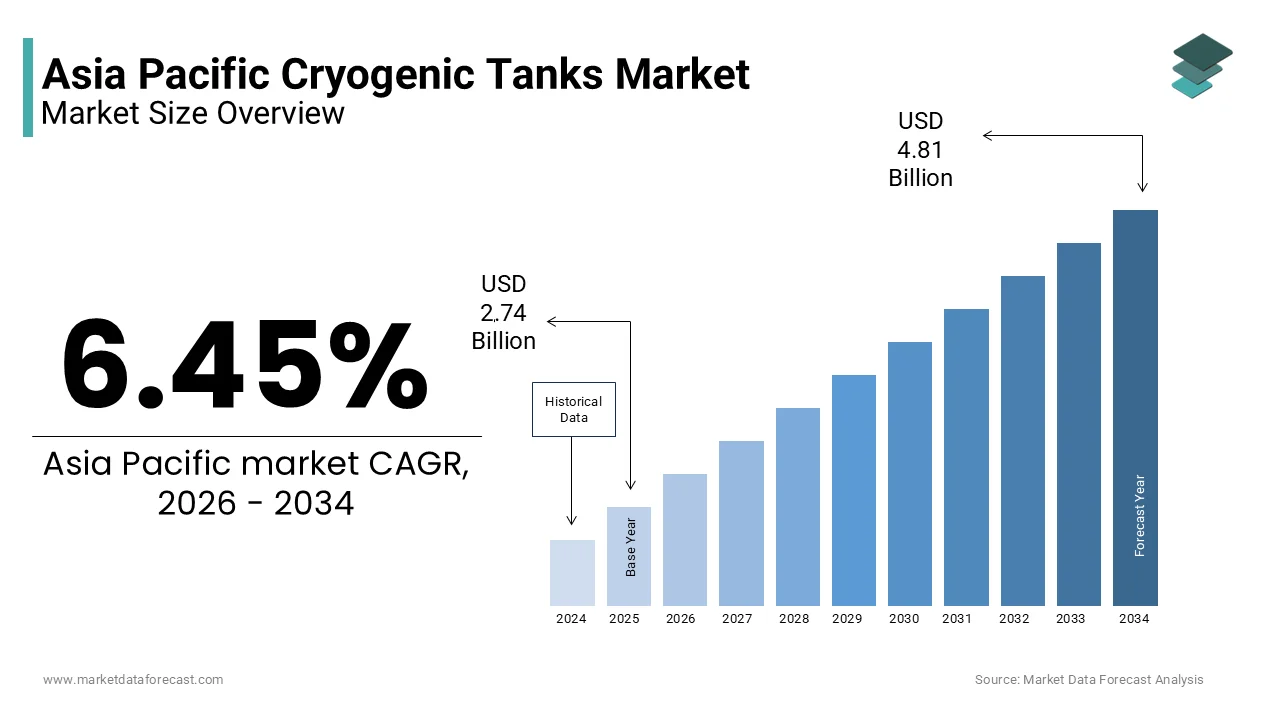
The Asia Pacific cryogenic tanks market was valued at USD 2.74 billion in 2025, is estimated to reach USD 2.92 billion in 2026, and is projected to reach USD 4.81 billion by 2034, growing at a CAGR of 6.45% during the forecast period from 2026 to 2034. The growth of the Asia Pacific cryogenic tanks market is driven by increasing demand for liquefied natural gas (LNG), expanding industrial gas applications, and rising investments in healthcare, energy, and manufacturing sectors. The growing adoption of cryogenic storage solutions for LNG, liquid oxygen, liquid nitrogen, and liquid hydrogen, coupled with the expansion of clean energy infrastructure and industrial gas distribution networks, is further supporting market growth. Additionally, rapid industrialization and government investments in energy security are fueling market expansion across the region.
Key Market Trends
-
Rising investments in LNG infrastructure and clean energy projects are driving demand for cryogenic storage tanks across Asia Pacific.
-
Increasing consumption of industrial gases in healthcare, manufacturing, and electronics industries is supporting market growth.
-
Growing adoption of cryogenic hydrogen storage solutions is creating new opportunities in the emerging hydrogen economy.
-
Technological advancements in vacuum-insulated storage systems are improving safety, efficiency, and thermal performance.
-
Expansion of industrial gas distribution networks and cross-border energy infrastructure is accelerating market development.
Segmental Insights
-
Based on cryogenic liquid, the liquefied natural gas (LNG) segment dominated the Asia Pacific cryogenic tanks market by accounting for 45.3% of the market share in 2025. The segment's leadership is attributed to the increasing use of LNG as a cleaner fuel, expanding LNG import and export infrastructure, and rising demand from power generation and industrial applications.
-
Based on application, the storage segment held the largest share of 60.2% of the Asia Pacific cryogenic tanks market in 2025. The segment's dominance is driven by the growing need for safe, long-term storage of cryogenic liquids across industrial, healthcare, and energy sectors.
-
Based on end use, the manufacturing sector accounted for the largest share of the Asia Pacific cryogenic tanks market in 2025. The segment's growth is supported by increasing consumption of industrial gases in metal fabrication, chemical processing, electronics manufacturing, and food processing industries.
Regional Insights
-
The Asia Pacific cryogenic tanks market is witnessing strong growth due to expanding industrialization, rising LNG consumption, and increasing investments in energy and healthcare infrastructure.
-
China dominated the Asia Pacific cryogenic tanks market by accounting for 30.5% of the regional market share in 2025. The country's leadership is supported by rapid industrial expansion, large-scale LNG infrastructure development, growing industrial gas demand, and increasing investments in clean energy projects.
-
India remains a significant market due to expanding LNG terminals, rising industrial gas consumption, and growing investments in manufacturing and healthcare infrastructure.
Competitive Landscape
The Asia Pacific cryogenic tanks market is highly competitive, with manufacturers focusing on advanced storage technologies, product innovation, and expansion of production capabilities to strengthen their market positions. Companies are investing in research and development, strategic collaborations, and energy-efficient cryogenic solutions to meet the increasing demand across LNG, industrial gas, healthcare, and hydrogen applications. Key players operating in the Asia Pacific cryogenic tanks market include Chart Industries Inc., INOX India Pvt. Ltd., Linde PLC, Air Products & Chemicals Inc., Cryolor, Air Water Inc., Wessington Cryogenics, Cryofab, Super Cryogenic Systems, FIBA Technologies, Inc., Suretank Group, and Eden Cryogenics.
Asia Pacific Cryogenic Tanks Market Size
The Asia Pacific cryogenic tanks market size was valued at USD 2.74 billion in 2025, and is expected to reach USD 4.81 billion by 2034 from USD 2.92 billion in 2026. The market's promising CAGR for the predicted period is 6.45%.
Cryogenic tanks are specialized storage systems designed to hold gases in their liquid state at extremely low temperatures, typically below -150°C. These tanks are indispensable for industries such as energy, healthcare, and manufacturing, where preserving the integrity of substances like liquefied natural gas (LNG), nitrogen, oxygen, and hydrogen is critical.
The region’s strategic focus on hydrogen as a sustainable energy source further amplifies the importance of cryogenic tanks. Cryogenic tanks are essential for storing and transporting hydrogen in its liquid form, requiring temperatures below -253°C.
MARKET DRIVERS
Rising Demand for LNG Infrastructure
The Asia Pacific region is witnessing an unprecedented surge in liquefied natural gas (LNG) consumption, driven by its role as a cleaner alternative to coal and oil. According to the International Energy Agency, LNG imports in the region grew in 2022, with countries like Japan, South Korea, and China leading the charge. This increased reliance on LNG has created a pressing need for cryogenic tanks, which are essential for the storage and transportation of this fuel at temperatures below -160°C. For instance, Japan’s Ministry of Economy, Trade, and Industry has allocated substantial funds to expand its LNG terminal infrastructure, ensuring energy security amid geopolitical uncertainties. Cryogenic tanks are critical components of these facilities, enabling safe and efficient handling of LNG. Moreover, the transition to renewable energy sources has heightened the demand for hydrogen, another cryogenically stored substance.
Expansion of Healthcare and Biotechnology Sectors
The rapid growth of the healthcare and biotechnology sectors in the Asia Pacific is another key driver of the cryogenic tanks market. Similarly, the rise of precision medicine has increased the demand for cryopreservation systems used to store stem cells, tissues, and other biological materials. Cryogenic tanks play a vital role in maintaining the viability of these samples, ensuring their usability in cutting-edge therapies. Furthermore, the ongoing COVID-19 pandemic has highlighted the importance of resilient healthcare infrastructure, prompting governments to invest in cryogenic solutions for future preparedness.
MARKET RESTRAINTS
High Initial Investment Costs
One of the most significant barriers to the widespread adoption of cryogenic tanks in the Asia Pacific is the substantial initial investment required for deployment. Cryogenic tanks involve complex engineering, including vacuum-insulated vessels, advanced cooling mechanisms, and precise temperature control, all of which contribute to elevated costs. Like, developing nations in the region allocate less than 2% of their GDP to industrial modernization, limiting their capacity to invest in high-cost technologies like cryogenic tanks. For instance, small-scale LNG operators in Southeast Asia often face financial constraints when attempting to establish cryogenic storage facilities, despite the region’s growing energy demands. Also, the maintenance of cryogenic tanks requires specialized expertise and regular inspections, further increasing operational expenses. As per the International Energy Agency, the lifecycle costs of cryogenic tanks significantly higher than conventional storage solutions, deterring potential adopters with limited budgets.
Limited Technical Expertise and Skilled Workforce
Another critical restraint impacting the adoption of cryogenic tanks in the Asia Pacific is the shortage of technical expertise and skilled personnel capable of operating and maintaining these systems. According to the World Economic Forum, the region faces a skills gap in advanced manufacturing and engineering, with an estimated shortfall of 47 million workers by 2030. Cryogenic tanks require precise handling and calibration to ensure optimal performance, yet training programs for such specialized skills are scarce. For example, in rural areas of India and Indonesia, the lack of trained technicians has delayed the implementation of cryogenic cold chain solutions for agricultural products. This gap in technical knowledge not only hampers the effective deployment of cryogenic tanks but also raises concerns about safety and operational efficiency. 
MARKET OPPORTUNITIES
Growing Adoption of Hydrogen Fuel Technologies
The Asia Pacific region is at the forefront of the global transition to hydrogen as a sustainable energy source, presenting a lucrative opportunity for the cryogenic tanks market. For instance, Japan’s Green Growth Strategy aims to achieve carbon neutrality by 2050, with hydrogen playing a central role in decarbonizing industries such as transportation and manufacturing. Cryogenic tanks are indispensable for storing and transporting hydrogen in its liquid form, requiring temperatures below -253°C.
Advancements in Space Exploration and Aerospace Applications
The burgeoning space exploration initiatives in the Asia Pacific present another significant opportunity for the cryogenic tanks market. Countries like India and China are investing heavily in space programs, leveraging cryogenic propulsion systems to enhance rocket performance. For example, India’s Geosynchronous Satellite Launch Vehicle (GSLV) utilizes cryogenic engines developed by the Indian Space Research Organisation, enabling the launch of heavier payloads into orbit. According to the United Nations Office for Outer Space Affairs, the number of satellite launches in the region increased in 2022, reflecting the growing demand for cryogenic technologies in aerospace applications. Furthermore, as per the Aerospace Industries Association, advancements in reusable rockets and deep-space missions are driving the need for more efficient cryogenic systems capable of withstanding extreme conditions.
MARKET CHALLENGES
Stringent Regulatory Frameworks and Safety Standards
The deployment of cryogenic tanks in the Asia Pacific is often hindered by stringent regulatory frameworks and safety standards, which vary significantly across countries. For instance, in densely populated urban areas of Japan and South Korea, obtaining clearance for cryogenic storage facilities requires multiple approvals from local authorities, environmental agencies, and industry regulators. These regulations are designed to mitigate risks associated with cryogenic operations, such as leaks or explosions, but they also increase compliance costs and create operational bottlenecks.
Vulnerability to Supply Chain Disruptions
Another pressing challenge for the Asia Pacific cryogenic tanks market is its vulnerability to supply chain disruptions, exacerbated by geopolitical tensions and logistical complexities. According to the World Trade Organization, the region’s reliance on imported raw materials and components for cryogenic tanks has made it susceptible to fluctuations in global trade dynamics. For example, the ongoing semiconductor shortage has impacted the production of advanced sensors and control systems used in cryogenic tanks, as noted by the Semiconductor Industry Association. Also, geopolitical conflicts, such as those in the South China Sea, have disrupted shipping routes critical for transporting cryogenic materials and equipment. As per the United Nations Conference on Trade and Development, maritime trade in the Asia Pacific accounts for over 40% of global shipments, making supply chains highly vulnerable to external shocks.
REPORT COVERAGE
| REPORT METRIC | DETAILS |
| Market Size Available | 2025 to 2034 |
| Base Year | 2025 |
| Forecast Period | 2026 to 2034 |
| CAGR | 6.45% |
| Segments Covered | By Cryogenic Liquid, Application, End-Use, and Region |
|
Various Analyses Covered | Regional & Country Level Analysis, Segment-Level Analysis, DROC, PESTLE Analysis, Porter’s Five Forces Analysis, Competitive Landscape, Analyst Overview on Investment Opportunities |
| Regions Covered | India, China, Japan, South Korea, Australia, New Zealand, Thailand, Malaysia, Vietnam, Philippines, Indonesia, Singapore, and the Rest of Asia-Pacific |
| Market Leaders Profiled | Chart Industries Inc, INOX India Pvt Ltd, Linde PLC, Air Products & Chemicals Inc, Cryolor, Air Water Inc, Wessington Cryogenics, Cryofab, Super Cryogenic Systems, FIBA Technologies, Inc., Suretank Group, Eden Cryogenics, and others |
SEGMENTAL ANALYSIS
By Cryogenic Liquid Insights
The liquefied natural gas (LNG) segment dominated the Asia Pacific cryogenic tanks market by commanding a share of 45.3% as of 2025. This dominance is driven by the region’s escalating energy demands and the transition toward cleaner fuels. According to the International Energy Agency, LNG consumption in the Asia Pacific grew in 2022, with countries like Japan, China, and South Korea leading consumption trends. Cryogenic tanks are essential for LNG storage and transportation, ensuring the safe handling of this fuel at temperatures below -160°C. For instance, Japan’s Ministry of Economy, Trade, and Industry has invested heavily in expanding its LNG terminal infrastructure, where cryogenic tanks are indispensable for maintaining the integrity of stored gases. Another factor contributing to LNG’s prominence is its role in decarbonizing energy systems. As per the United Nations Environment Programme, the Asia Pacific aims to reduce carbon emissions by 45% by 2030, driving investments in LNG infrastructure. Apart from these, advancements in small-scale LNG systems have expanded access to remote areas, as noted by the International Renewable Energy Agency.
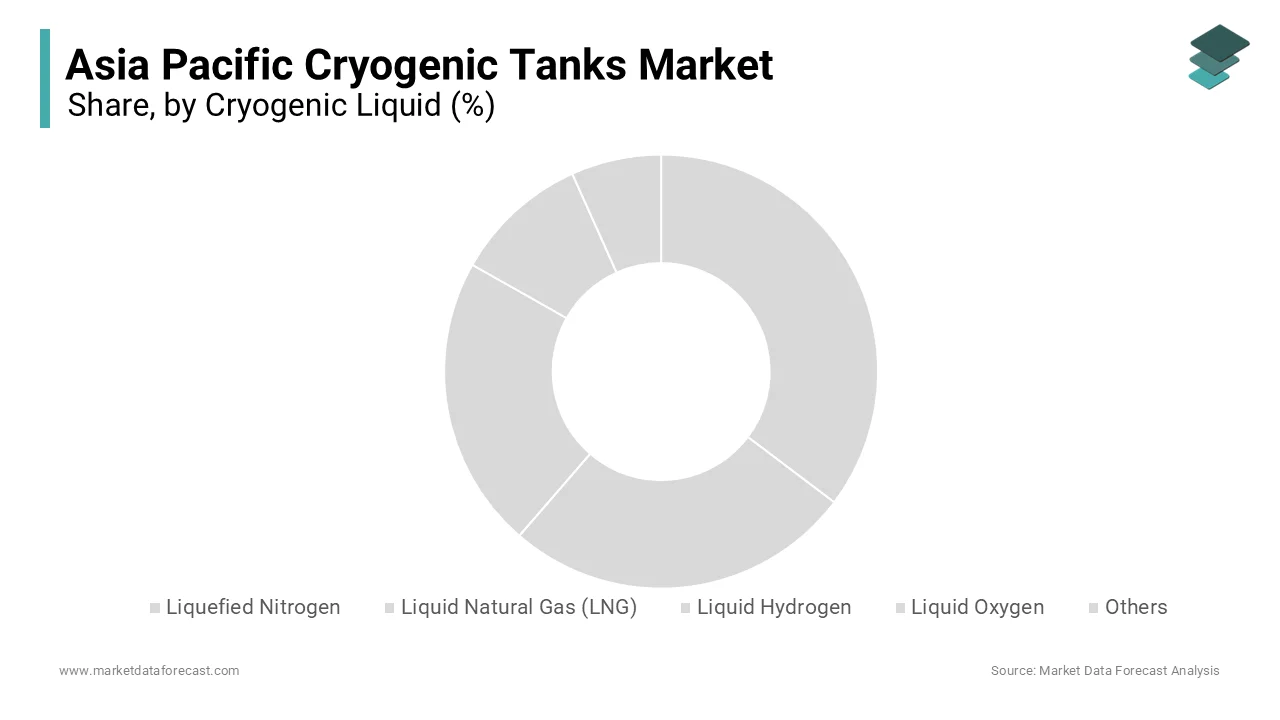
The liquid hydrogen segment is projected to grow at the fastest CAGR of 12.5% during the forecast period which is driven by its potential as a sustainable energy source. According to the Hydrogen Council, the Asia Pacific is expected to account for 40% of global hydrogen production by 2030, with countries like Japan and South Korea spearheading green hydrogen initiatives. For example, Japan’s Green Growth Strategy emphasizes hydrogen as a cornerstone of its carbon neutrality goals, necessitating advanced cryogenic tanks for storage and transportation. Another main driver of liquid hydrogen’s rapid growth is its versatility across industries. As per the International Energy Agency, hydrogen’s applications in transportation, manufacturing, and power generation are expanding, creating new opportunities for cryogenic solutions. Furthermore, government incentives, such as subsidies for hydrogen fuel cell vehicles, have accelerated adoption. According to the Federation of Indian Chambers of Commerce & Industry, investments in renewable hydrogen projects are expected to exceed USD 100 billion by 2030, further propelling the segment’s growth.
By Application Insights
The storage application segment held the largest market share of 60.2% in 2025. This control over the market is fueled by the critical role of cryogenic tanks in preserving temperature-sensitive materials such as LNG, nitrogen, and oxygen. For instance, Australia has emerged as a global LNG exporter, leveraging cryogenic tanks to meet international demand. Another aspect driving the prominence of storage applications is their versatility across industries. Tanks are integral to healthcare, energy, and chemical sectors, ensuring the safe preservation of sensitive substances. Apart from these, advancements in vacuum-insulated technology have enhanced the durability and efficiency of these tanks, reducing heat ingress and improving operational longevity.
The transportation segment is predicted to advance at the swiftest CAGR of 10.7% during the forecast period and is propelled by the increasing need to transport cryogenic liquids across long distances. According to the Hydrogen Council, the Asia Pacific is projected to account for 40% of global hydrogen production by 2030, necessitating efficient transportation solutions for liquid hydrogen. For example, South Korea’s green hydrogen initiatives rely on advanced cryogenic tanks to ensure seamless integration into power generation and transportation networks. Another key driver of the transportation segment’s rapid growth is its adoption in marine and aerospace applications. As per the International Maritime Organization, maritime trade in the Asia Pacific accounts for over 40% of global shipments, creating opportunities for cryogenic tanks in LNG-powered vessels. Apart from these, advancements in space exploration have spurred demand for cryogenic tanks capable of withstanding extreme conditions.
By End Use Insights
The manufacturing sector commanded the biggest market share in 2025. This influence is supported by the region’s industrialization and reliance on cryogenic liquids such as nitrogen, oxygen, and argon for processes like metal fabrication, welding, and electronics manufacturing. For instance, India’s steel industry relies heavily on liquid oxygen for cutting and welding applications, underscoring the importance of cryogenic tanks. Another factor contributing to the manufacturing sector’s prominence is its focus on sustainability. As per the United Nations Environment Programme, the Asia Pacific aims to reduce carbon emissions by 45% by 2030, prompting industries to adopt cleaner technologies. Cryogenic tanks play a vital role in storing gases used in eco-friendly manufacturing processes, aligning with regional environmental goals.
The healthcare segment is estimated to rise at the fastest CAGR of 11.8% during the coming years. This is due to the rise of precision medicine and biotechnology. Cryogenic tanks are essential for preserving biological samples, vaccines, and tissues, ensuring their usability in cutting-edge therapies. Another key driver of healthcare’s rapid growth is the ongoing pandemic recovery. Also, advancements in stem cell research and regenerative medicine have increased the demand for cryopreservation systems, further propelling the segment’s expansion.
REGIONAL ANALYSIS
China was the largest contributor to the Asia Pacific cryogenic tanks market by holding a market share of 30.5%. The country’s rapid industrialization and focus on clean energy have driven significant investments in LNG infrastructure and hydrogen technologies. Also, China’s LNG imports increased in 2022, necessitating advanced cryogenic systems for storage and transportation. In addition, the Chinese government’s commitment to achieving carbon neutrality by 2060 has spurred demand for cryogenic tanks in power generation and transportation sectors.
Japan accounted for a major share of the regional market which is driven by its prowess in hydrogen fuel technologies and LNG consumption. According to the Hydrogen Council, Japan’s Green Growth Strategy emphasizes hydrogen as a key enabler of carbon neutrality, creating lucrative opportunities for cryogenic tank manufacturers. Apart from these, Japan’s reliance on LNG for energy security has bolstered investments in cryogenic storage facilities.
India is an emerging market, with a strong focus on LNG infrastructure and healthcare applications. Like, India’s LNG imports grew in 2022, driven by rising energy demands. Besides, the country’s Serum Institute relies on cryogenic tanks for vaccine storage, showing the importance of cryogenic equipment in healthcare logistics.
South Korea is a key player in the market, with a strategic emphasis on green hydrogen and LNG. According to the Hydrogen Council, South Korea’s hydrogen economy roadmap aims to produce 27.5 million tons of hydrogen annually by 2050, necessitating advanced cryogenic systems. Also, the country’s LNG imports have surged, further driving cryogenic tank adoption.
Australia accounts for smaller share of the market, with a focus on LNG exports and hydrogen production. Apart from these, the country’s investments in renewable hydrogen projects have created new opportunities for cryogenic tank manufacturers.
COMPETITIVE LANDSCAPE
The Asia Pacific cryogenic tanks market is characterized by intense competition, driven by the presence of established global players and emerging regional firms. Leading companies such as Chart Industries, Air Products and Chemicals, and Linde plc dominate the market through their advanced technologies and extensive experience in energy and industrial applications. However, smaller players are gaining traction by offering cost-effective and customizable solutions tailored to local demands. The competitive landscape is further shaped by increasing government investments in clean energy, healthcare, and industrial modernization, which create lucrative opportunities for all participants. To differentiate themselves, companies are focusing on innovation, strategic collaborations, and expanding their service offerings. Additionally, the growing emphasis on sustainability and technological advancements has intensified competition, as firms strive to develop versatile systems capable of addressing both industrial and environmental challenges.
KEY MARKET PLAYERS
Some of the key players in the Asia Pacific cryogenic tanks market are
- Chart Industries Inc.
- INOX India Pvt. Ltd.
- Linde PLC
- Air Products & Chemicals Inc.
- Cryolor
- Air Water Inc.
- Wessington Cryogenics
- Cryofab
- Super Cryogenic Systems
- FIBA Technologies, Inc.
- Suretank Group
- Eden Cryogenics
TOP PLAYERS IN THE MARKET
- Chart Industries is a global leader in cryogenic tanks, renowned for its innovative solutions in LNG storage, hydrogen fuel systems, and industrial gas applications. The company’s commitment to sustainability aligns with the Asia Pacific’s growing demand for clean energy technologies, making it a key player in the region. Chart Industries has contributed significantly to the global market by developing advanced cryogenic tanks that cater to diverse industries, including oil & gas and healthcare.
- Air Products and Chemicals specializes in the production and distribution of industrial gases, with a strong presence in the Asia Pacific cryogenic tanks market. The company provides end-to-end solutions for energy and industrial applications, emphasizing hydrogen and LNG technologies. Air Products’ emphasis on sustainability and innovation has driven its global expansion, particularly in regions transitioning to renewable energy.
- Linde plc is a leading provider of cryogenic tanks and industrial gases, with a significant footprint in the Asia Pacific. The company’s expertise spans healthcare, metallurgy, and chemical processing, where its cryogenic solutions ensure safe and efficient operations. Linde’s commitment to technological advancements and customer-centric innovations has strengthened its global market position.
TOP STRATEGIES USED BY KEY PLAYERS
Strategic Acquisitions and Partnerships
Key players in the Asia Pacific cryogenic tanks market have prioritized acquisitions and partnerships to expand their product portfolios and geographic reach. Collaborating with local governments and private entities allows companies to tailor solutions to regional needs while leveraging existing networks. For instance, partnerships with energy firms enable seamless integration of cryogenic tanks into LNG terminals and hydrogen fuel stations, ensuring long-term adoption and scalability.
Investment in Sustainable Technologies
Sustainability remains a core focus for market leaders aiming to align with global environmental goals. By investing in green hydrogen and LNG technologies, companies are addressing the region’s energy transition challenges while enhancing their competitive edge.
Expansion of Service Offerings
To strengthen their market presence, companies are diversifying their offerings beyond hardware sales. Providing comprehensive services, including installation, maintenance, and training, ensures customer satisfaction and fosters trust.
RECENT HAPPENINGS IN THE MARKET
- In March 2023, Chart Industries partnered with India’s Oil and Natural Gas Corporation to supply cryogenic tanks for LNG terminals. This collaboration aimed to enhance India’s energy infrastructure while expanding Chart Industries’ regional footprint.
- In June 2023, Air Products and Chemicals launched a green hydrogen project in South Korea, integrating advanced cryogenic tanks for storage and transportation. This initiative aligned with South Korea’s hydrogen economy roadmap, reinforcing Air Products’ leadership in sustainable energy solutions.
- In September 2023, Linde plc signed a Memorandum of Understanding with Australia’s Department of Industry to support LNG exports using cryogenic tanks. This agreement marked a significant step in strengthening Linde’s presence in the Asia Pacific energy sector.
- In November 2023, Cryostar SAS opened a new manufacturing facility in Thailand to produce cryogenic pumps and vaporizers. This move was aimed at catering to the growing demand for industrial gas applications in Southeast Asia.
- In February 2025, VRV Asia Pacific introduced a next-generation cryogenic bayonet connection system in Japan, designed for use in space exploration missions. This innovation positioned VRV as a leader in aerospace cryogenic solutions, aligning with Japan’s ambitious space programs.
MARKET SEGMENTATION
This research report on the Asia Pacific cryogenic tanks market has been segmented and sub-segmented based on the following categories.
By Cryogenic Liquid
- Liquefied Nitrogen
- Liquid Natural Gas (LNG)
- Liquid Hydrogen
- Liquid Oxygen
- Others
By Application
- Storage
- Transportation
By End-Use
- Manufacturing
- Healthcare
- Food & Beverages
- Others
By Country
- India
- China
- Japan
- South Korea
- Australia
- New Zealand
- Thailand
- Malaysia
- Vietnam
- Philippines
- Indonesia
- Singapore
- Rest of Asia-Pacific