Asia Pacific FPGA Market Size, Share, Growth, Trends, And Forecast Research Report, Segmented By Configuration, Technology, Node-Size, And Country (India, China, Japan, South Korea, Australia, New Zealand, Thailand, Malaysia, Vietnam, Philippines, Indonesia, Singapore and Rest of APAC), Industry Analysis From (2026 to 2034)
Market Size, 2025
$3.51 BnMarket Estimate, 2026
$4.12 BnMarket Forecast, 2034
$14.75 BnCAGR, 2026–2034
17.29%Asia Pacific FPGA Market Size
The Asia Pacific FPGA market size was valued at USD 3.51 billion in 2025 and is anticipated to reach a valued at USD 4.12 billion in 2026 and USD 14.75 billion by 2034, growing at a CAGR of 17.29%, from 2026 to 2034.
FPGAs (Field-Programmable Gate Arrays) are programmable semiconductor devices that offer flexible, reconfigurable logic capabilities for a wide range of applications, including telecommunications, industrial automation, automotive electronics, aerospace, and consumer electronics. Unlike application-specific integrated circuits (ASICs), FPGAs can be reprogrammed post-manufacture, making them ideal for rapidly evolving technological environments where adaptability is crucial.
Asia Pacific has emerged as a key growth region for FPGA adoption due to its strong presence in global electronics manufacturing, rising investments in 5G infrastructure, and increasing reliance on high-performance computing systems. According to the International Telecommunication Union (ITU), several countries in the region have accelerated their rollout of next-generation communication networks, necessitating hardware solutions that support real-time processing and protocol flexibility—areas where FPGAs excel.
In addition, governments across the region are prioritizing digital transformation through initiatives such as "Digital India," "Made in China 2025," and Japan’s Society 5.0 strategy. These national programs are fostering innovation in smart cities, autonomous systems, and advanced manufacturing, all of which drive demand for FPGA-based solutions. Moreover, the rise of artificial intelligence and edge computing applications has further intensified the need for adaptive hardware platforms capable of handling complex algorithms with low latency.
MARKET DRIVERS
Expansion of 5G and High-Speed Communication Infrastructure
The rapid expansion of 5G and high-speed communication infrastructure across the region is one of the primary drivers of the Asia Pacific FPGA market. FPGAs are widely used in base stations, radio access networks (RAN), and network edge computing units due to their ability to handle dynamic modulation schemes, real-time signal processing, and protocol adaptability—features essential for next-generation telecom equipment.
Also, many of the world’s 5G network deployments between 2020 and 2023 occurred in the Asia Pacific region, with China leading the way in infrastructure investment. According to the Ministry of Industry and Information Technology (MIIT) of China, by the end of 2023, the country had deployed more than 3 million 5G base stations, each requiring programmable logic components like FPGAs for flexible and efficient signal processing. So, with continued advancements in wireless connectivity and the emergence of 6G research initiatives in Japan and Australia, the demand for FPGA-based solutions in the telecom sector is expected to remain a strong growth catalyst in the Asia Pacific region.
Growth of Industrial Automation and Smart Manufacturing
The expanding adoption of industrial automation and smart manufacturing technologies is another significant driver of the Asia Pacific FPGA market. FPGAs play a critical role in factory automation, robotics, machine vision, and real-time control systems due to their parallel processing capabilities and ultra-low latency response, es advantages over traditional microprocessors.
According to the United Nations Industrial Development Organization (UNIDO), the Asia Pacific region accounted for nearly 60% of global industrial output in 2023, driven by countries such as China, Japan, and South Korea investing heavily in Industry 4.0 technologies. In China, as per the Ministry of Industry and Information Technology (MIIT), over 15,000 smart factories were under development or operation in 2023, many of which incorporated FPGA-enabled programmable logic controllers (PLCs) and sensor fusion modules.
Japan has also been at the forefront of adopting FPGA-based automation systems, particularly in precision manufacturing and robotics. With the ongoing push toward digitalization, predictive maintenance, and AI-integrated manufacturing, the industrial automation sector continues to serve as a major growth engine for the FPGA market in the Asia Pacific.
MARKET RESTRAINTS
Complexity and High Cost of FPGA Design and Development
The complexity and high cost associated with FPGA design, programming, and system integration a major restraints affecting the Asia Pacific FPGA market. Unlike off-the-shelf microcontrollers or ASICs, FPGAs require specialized expertise in hardware description languages (HDLs) such as Verilog and VHDL, as well as domain-specific knowledge in digital signal processing and embedded systems.
In India, according to the National Association of Software and Services Companies (NASSCOM), there is a shortage of skilled FPGA engineers and limited widespread adoption in local design ecosystems.
Moreover, the learning curve associated with FPGA development tools from vendors like Xilinx and Intel discourages rapid deployment, especially in price-sensitive markets such as Southeast Asia.
Apart from these, the lack of standardized development platforms and compatibility issues between different FPGA vendors further complicate integration into existing industrial and telecom systems. These challenges contribute to slower adoption rates, particularly in emerging economies where cost efficiency and time-to-market are critical decision-making factors.
Supply Chain Disruptions and Semiconductor Shortages
The ongoing impact of supply chain disruptions and semiconductor shortages, which have delayed product availability and increased procurement costs for FPGA common, is another key constraint on the Asia Pacific FPGA market. As a region that hosts a large portion of global electronics manufacturing, the Asia Pacific is particularly vulnerable to geopolitical tensions, logistics bottlenecks, and raw material shortages.
In China, the Ministry of Industry and Information Technology (MIIT) acknowledged that domestic FPGA suppliers faced sourcing difficulties for advanced packaging materials and silicon wafers, affecting production timelines.
Similarly, in Japan and South Korea, companies reported inventory constraints due to reduced wafer fabrication capacity in foundries based in Taiwan and the United States.
India also experienced setbacks in FPGA-based defense and aerospace applications due to export controls and dependency on foreign chipmakers.
MARKET OPPORTUNITY
Integration of FPGAs in Edge Computing and AI Acceleration
The growing integration of FPGAs into edge computing and AI acceleration applications presents a significant opportunity within the Asia Pacific FPGA market. As industries shift toward decentralized data processing and real-time analytics, the need for hardware that offers both performance and flexibility has surged.
In China, the Ministry of Science and Technology supported the development of FPGA-accelerated edge servers tailored for smart surveillance and autonomous vehicle applications.
Japanese tech firms have actively explored FPGA-powered AI co-processors for real-time image recognition in healthcare and manufacturing.
In India, startups and academic institutions have begun leveraging FPGAs for AI inferencing in agriculture, defense, and medical diagnostics.
Rising Demand for FPGAs in Automotive and Autonomous Driving Systems
The rising demand for FPGAs in automotive and autonomous driving systems is another transformative opportunity for the Asia Pacific FPGA market. As vehicles become more intelligent and connected, the need for real-time sensor fusion, image processing, and onboard AI computation has surged—areas where FPGAs provide distinct advantages over conventional processors.
In Japan, automotive giants such as Toyota and Honda have collaborated with Renesas and Xilinx to integrate FPGAs into advanced driver-assistance systems (ADAS) and autonomous test fleets. South Korea’s automotive industry, led by Hyundai and Kia, has also embraced FPGA technology for real-time object detection and vehicle-to-everything (V2X) communication systems.
MARKET CHALLENGES
Intense Competition from ASICs and GPUs in High-Performance Applications
The intense competition from Application-Specific Integrated Circuits (ASICs) and Graphics Processing Units (GPUs) in high-performance computing applications is a major challenge facing the Asia Pacific FPGA market. While FPGAs offer unparalleled flexibility, ASICs and GPUs often provide superior performance-per-watt ratios and lower unit costs at scale, making them attractive alternatives in sectors such as AI training, cloud computing, and high-volume industrial systems.
In China, as per the Ministry of Science and Technology, government-backed AI chip startups were focusing on ASIC-based neural processing units (NPUs), directly competing with FPGA-based acceleration cards in data centers and edge AI boxes.
Similarly, GPU vendors such as NVIDIA have gained dominance in deep learning applications due to their highly parallel architecture and mature software ecosystems. In South Korea, major AI research institutes have favored GPU clusters over FPGA-based accelerators for natural language processing and computer vision tasks.
Limited Domestic FPGA Manufacturing Capabilities in Emerging Markets
The limited domestic manufacturing capabilities in emerging markets, resulting in heavy dependence on foreign suppliers for high-end programmable logic devices, is another significant challenge for the Asia Pacific FPGA market. This reliance creates vulnerabilities in terms of cost, delivery timelines, and access to cutting-edge technologies, particularly amid escalating trade restrictions and export controls.
In India, the Ministry of Electronics and Information Technology (MeitY) acknowledged that most FPGA-based systems still rely on imported chips, limiting scalability and long-term sustainability.
China, despite having domestic FPGA companies such as Analogic and Inspur, still imports a majority of high-density FPGAs from U.S.-based vendors like Intel and AMD. As per the Chinese Academy of Sciences, export restrictions imposed by Western nations have hindered access to sub-10nm node FPGAs, impacting advanced research and industrial applications.
Furthermore, in countries like Thailand and Vietnam, the absence of dedicated FPGA design centers hampers local innovation.
REPORT COVERAGE
| REPORT METRIC | DETAILS |
| Market Size Available | 2025 to 2033 |
| Base Year | 2025 |
| Forecast Period | 2026 to 2034 |
| CAGR | 14.77% |
| Segments Covered | By Configuration, Technology, Node Size, and Region. |
| Various Analyses Covered | Global Regional, Country-Level Analysis, Segment-Level Analysis, DROC, PESTLE Analysis, Porter’s Five Forces Analysis, Competitive Landscape, Analyst Overview of Investment Opportunities |
| Regions Covered | India, China, Japan, South Korea, Australia, New Zealand, Thailand, Malaysia, Vietnam, Philippines, Indonesia, Singapore, and the Rest of APAC |
| Market Leaders Profiled | Advanced Micro Devices, Inc. (Formerly Xilinx, Inc.) (US), Intel Corporation (US), Microchip Technology Inc., (US), Lattice Semiconductor Corporation (US), Achronix Semiconductor Corporation (US), QuickLogic Corporation (US), Efinix, Inc. (US), FlexLogix (US), GOWIN Semiconductor Corporation (China), and S2C (China). |
SEGMENTAL ANALYSIS
By Configuration Insights
Low-End FPGA
The low-end FPGA segment dominated the Asia Pacific FPGA market by accounting for 42.5% of total revenue in 2025. This dominance is primarily attributed to Their widespread adoption across cost-sensitive applications such as consumer electronics, industrial automation, and entry-level communication systems is primarily attributed to the dominance of the low-end FPGA segment.
Also, the proliferation of smart home devices, IoT-enabled appliances, and programmable logic controllers in small-scale manufacturing units has driven significant demand for affordable and power-efficient FPGAs.
In China, where domestic semiconductor manufacturers are focusing on localized design ecosystems, companies like Anlogic have introduced cost-effective FPGA solutions tailored for edge devices and embedded applications. As per the China Semiconductor Industry Association, there has been an increase in domestic FPGA design wins in the industrial and automotive sectors during this period.
Moreover, in Southeast Asia, countries like Thailand and Vietnam are leveraging low-end FPGAs for factory automation upgrades and test equipment development.
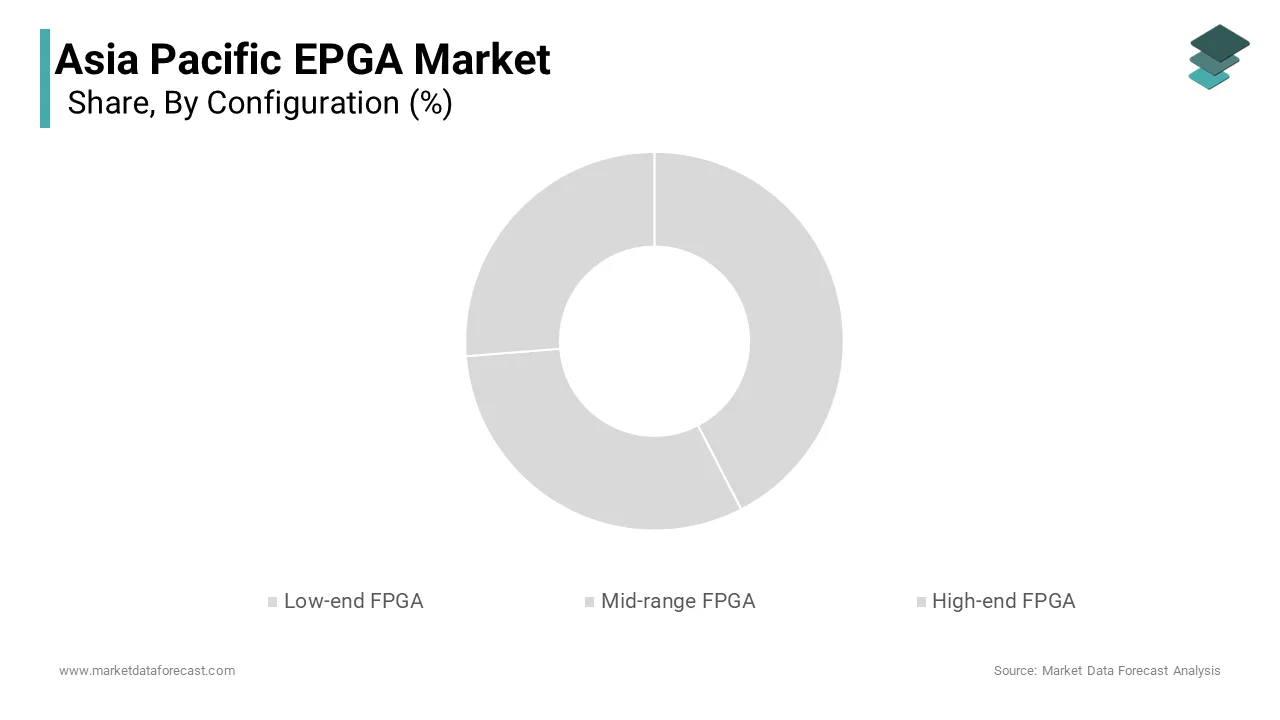
High-End FPGA
The high-end FPGA segment is projected to grow at the fastest rate and is recording a CAGR of 12.6% from 2025 to 2033. Increasing deployment in high-performance computing, AI acceleration, and advanced defense systems is mainly propelling the surge of the high-end FPGA segment. These FPGAs offer superior processing capabilities, large gate counts, and high-speed transceivers, making them ideal for complex applications requiring real-time data processing.
Like the use of high-end FPGAs in AI-driven vision systems, autonomous vehicles, and 5G baseband processing has surged across Asia. In Japan, major technology firms, including NEC and Fujitsu, have integrated high-density FPGAs into AI inference accelerators for medical imaging and robotics.
In South Korea, the Korea Institute of Science and Technology (KIST) reported that FPGA usage in autonomous driving research increased in 2023 compared to the previous year, with Hyundai and Samsung R&D Center adopting these chips for sensor fusion and decision-making algorithms.
China remains a key growth driver, with the Ministry of Science and Technology supporting the indigenous development of high-end FPGAs for defense and aerospace applications.
By Technology Insights
SRAM-Based FPGA
The SRAM-based FPGA segment commanded the Asia Pacific FPGA market by capturing 58.1% of total demand in 2025. The technology’s programmability, scalability, and compatibility with high-speed applications in telecommunications, data centers, and industrial control systems are assisting the SRAM-based FPGA segment to maintain the lead position.
According to the Semiconductor Industry Association (SIA), SRAM-based FPGAs are widely adopted in 5G infrastructure and cloud computing due to their ability to be reconfigured multiple times, enabling dynamic adaptation to evolving protocols and workloads.
In India, the Centre for Development of Advanced Computing (C-DAC) emphasized the importance of SRAM-based FPGAs in national defense projects, particularly in radar and secure communication systems. Similarly, in South Korea, leading telecom operators such as SK Telecom and KT have integrated SRAM FPGAs into their 5G Open RAN architectures to enhance network flexibility and efficiency.
Besides, Japanese companies like Sony and Panasonic continue to leverage SRAM-based FPGAs for real-time image processing in industrial and consumer applications.
Flash-Based FPGA
The flash-based FPGA segment is expected to grow at the highest pace and is recording a CAGR of 11.9% in the future. The increasing demand for non-volatile, instant-on programmable logic solutions in automotive, aerospace, and industrial automation applications is driving the rapid expansion of the flash-based FPGA segment.
In addition, flash-based FPGAs offer advantages such as lower power consumption, higher security, and immunity to radiation-induced configuration error, making them suitable for mission-critical systems. In Japan, automotive giants like Toyota and Honda have adopted flash-based FPGAs for ADAS and vehicle-to-everything (V2X) communication systems, enhancing safety and reliability.
Moreover, flash-based FPGAs are being increasingly used in drone navigation and satellite communication systems due to their inherent resistance to single-event upsets.
In India, startups and academic institutions are exploring flash-based FPGAs for edge AI and smart surveillance applications.
By Node Size Insights
20–90 nm Node Size
The 20–90 nm node size segment led the Asia Pacific FPGA market by contributing 45.3% of total revenue in 2025. This segment includes mid-generation FPGAs that balance performance, power efficiency, and cost-effectiveness, making them ideal for a broad range of industrial, communications, and defense applications.
Besides, the 20–90 nm process nodes provide an optimal trade-off between complexity and manufacturability, which is why they are still widely used despite the availability of more advanced sub-16 nm chips. In China, many local FPGA manufacturers focused on the 28 nm and 40 nm processes to meet the needs of the smart grid, factory automation, and defense electronics sectors.
Also, India supported several university-led FPGA projects using 40 nm architecture for applications ranging from agricultural drones to remote sensing.
=16 nm Node Size
The =16 nm node size segment is projected to grow at the fastest rate by registering a CAGR of 13.4% from 2025 to 2033. The rising demand for ultra-high-performance FPGAs in next-generation applications such as artificial intelligence, autonomous driving, and high-speed networking is fuelling the development of =16 nm node size segment.
Also, sub-16 nm FPGAs offer significantly improved computational density and energy efficiency, making them essential for AI inferencing and real-time data processing at the edge.
Japanese tech firms such as Toshiba and Renesas have begun integrating 16 nm and below FPGAs into autonomous vehicle prototypes, leveraging their parallel processing capabilities for sensor fusion and object detection.
COUNTRY ANALYSIS
China FPGA Market Analysis
China spearheaded the Asia Pacific FPGA market by contributing 38.3% of regional revenue in 2025. This dominant position is attributed to the country’s aggressive push toward digital transformation, AI integration, and 5G infrastructure expansion.
According to the Ministry of Industry and Information Technology (MIIT), China had deployed over 3 million 5G base stations by the end of 2023, each requiring FPGA-based digital signal processors for beamforming and protocol adaptability. Further, the Ministry of Science and Technology pointed out that state-backed semiconductor firms like Anlogic and Inspur are accelerating domestic FPGA development to reduce reliance on foreign suppliers. Furthermore, China’s industrial automation drive under the Made in China 2025 initiative has spurred FPGA adoption in smart factories, robotics, and edge computing.
Japan Market Analysis
Japan is a major contributor to the Asia Pacific FPGA market and is maintaining a strong presence due to its advanced electronics sector, robust defense spending, and early adoption of AI-driven technologies. The country’s FPGA market benefits from a mature industrial base and strategic investments in robotics, automotive innovation, and aerospace engineering.
Also, Japanese companies have been among the earliest adopters of FPGA-based AI co-processors for real-time image recognition and machine learning applications. Apart from these, the Japan Aerospace Exploration Agency (JAXA) has been utilizing radiation-tolerant FPGAs in satellite communication and onboard data processing systems. Domestic players like Sony, NEC, and Fujitsu continue to integrate FPGAs into high-end applications, strengthening Japan’s pivotal role in shaping the regional FPGA landscape.
India Market Analysis
India is emerging as a key growth hub due to rising investments in digital infrastructure, defense modernization programs, and expanding startup-led innovation in AI and embedded systems.
The Indian Institute of Technology (IITs) and the Centre for Development of Advanced Computing (C-DAC) played a crucial role in advancing indigenous FPGA applications.
Besides, private-sector telecom providers like Jio and BSNL have leveraged FPGAs for 5G Open RAN deployments. With a growing emphasis on self-reliance in critical technologies, India is strengthening its FPGA ecosystem through policy incentives, academic-industry collaborations, and indigenous chip design initiatives, positioning itself as a rapidly emerging player in the Asia Pacific FPGA market.
South Korea Market Analysis
South Korea is distinguished by its leadership in AI, robotics, and next-generation telecommunications. The country’s FPGA adoption is largely driven by its focus on semiconductor innovation and integration of programmable logic in high-tech applications.
Also, South Korean universities and research labs have been actively developing FPGA-based AI accelerators for healthcare diagnostics, autonomous systems, and real-time language processing. In the automotive sector, companies like Hyundai and Kia have partnered with global FPGA vendors to deploy reconfigurable logic in advanced driver-assistance systems (ADAS). With ongoing investments in AI, 6G research, and smart manufacturing, South Korea continues to expand its FPGA footprint, strengthening its influence in the broader Asia Pacific market.
Australia Market Analysis
Australia is characterized by its strong defense and space research programs, as well as growing interest in FPGA-based AI and edge computing solutions. The country’s FPGA adoption is primarily driven by government-funded R&D initiatives and partnerships with global chipmakers.
In addition, Australian researchers have been exploring FPGA-based AI inference engines for environmental monitoring, mining automation, and precision agriculture. Also, Australian universities like the University of Melbourne and Monash University have collaborated with international FPGA vendors to develop custom acceleration platforms for genomics and climate modeling. With growing investment in space exploration through the Australian Space Agency, FPGAs are increasingly being used in satellite payloads and ground station processing units.
COMPETITIVE LANDSCAPE
The competition in the Asia Pacific FPGA market is shaped by a mix of global technology leaders and rapidly emerging domestic players striving to capture the growing demand for programmable logic solutions. While multinational corporations such as Intel, AMD-Xilinx, and Lattice Semiconductor bring established expertise and standardized architectures, regional firms are making strides in cost-effective, niche-market FPGA development. This dynamic fosters a highly competitive environment centered around performance optimization, ease of use, and sector-specific customization. Governments across the region are increasingly prioritizing self-reliance in semiconductor design, further intensifying the race for indigenous FPGA capabilities. The expansion of 5G, AI, and defense electronics has heightened the need for flexible and reprogrammable hardware, prompting companies to invest in localized R&D centers and supply chain resilience. Moreover, the growing adoption of edge AI and autonomous systems is redefining FPGA usage patterns, compelling firms to continuously recalibrate their offerings. As technological barriers lower and new entrants emerge, the battle for market share is expected to become even more pronounced, with companies exploring acquisitions, joint ventures, and open-platform strategies to gain a stronger foothold in this high-growth region.
KEY MARKET PLAYERS
These are the market players that are dominating the Asia Pacific FPGA market:
- Advanced Micro Devices, Inc. (Formerly Xilinx, Inc.) (US)
- Intel Corporation (US)
- Microchip Technology Inc. (US)
- Lattice Semiconductor Corporation (US)
- Achronix Semiconductor Corporation (US)
- QuickLogic Corporation (US)
- Efinix, Inc. (US)
- FlexLogix (US)
- GOWIN Semiconductor Corporation (China)
- S2C (China).
Top Players In The Market
- One of the leading players in the Asia Pacific FPGA market is Intel Corporation, a global semiconductor giant known for its Agilex and Stratix series of FPGAs. Intel plays a crucial role in enabling high-performance computing, AI acceleration, and next-generation telecommunications infrastructure across the region. Its strong R&D capabilities and strategic partnerships with local telecom and defense firms have made it a dominant force.
- Another major player is Xilinx Inc., now part of AMD, which has a robust presence in the region due to its Versal adaptive SoC platform and leadership in data center acceleration and 5G applications. Xilinx’s focus on edge computing and programmable logic solutions has positioned it as a preferred choice among Asian tech companies developing smart systems and autonomous technologies.
- Renesas Electronics is also a key participant, particularly in Japan and South Korea. Renesas specializes in compact, low-power FPGAs tailored for industrial automation, automotive electronics, and IoT applications. With a strong regional footprint and deep integration into automotive and manufacturing ecosystems, Renesas continues to expand its influence in the Asia Pacific FPGA landscape.
Top Strategies Used By Key Market Participants
Key players in the Asia Pacific FPGA market employ several strategic approaches to strengthen their competitive edge. One major strategy is technology innovation and product differentiation, where companies invest heavily in advanced node development, AI integration, and adaptive computing platforms to meet evolving industry demands.
Another critical approach is expanding regional presence through localized partnerships and manufacturing support, allowing firms to better serve diverse application areas and comply with local regulatory standards across emerging markets like India, China, and Southeast Asia.
Lastly, strengthening ecosystem collaboration through software tool development and open-source frameworks plays a pivotal role in enhancing user accessibility and accelerating FPGA adoption in non-traditional sectors such as healthcare, finance, and defense.
RECENT MARKET NEWS
- In February 2023, Intel Corporation launched its Agilex-based FPGA accelerator cards specifically designed for AI inference and 5G edge computing in Chinese data centers. This move aimed to enhance real-time processing capabilities and strengthen Intel’s position in the country’s expanding cloud and telecom infrastructure.
- In June 2023, Xilinx (now part of AMD) entered into a strategic partnership with LG Electronics to develop FPGA-powered AI accelerators for autonomous driving and smart city applications. This initiative was intended to boost Xilinx’s relevance in the South Korean automotive and urban technology sectors.
- In October 2023, Renesas Electronics introduced a new line of ultra-low-power FPGAs tailored for industrial IoT and robotics applications in Japan and Southeast Asia. These devices were developed to meet the rising demand for adaptive logic in factory automation and smart equipment deployment.
- In March 2025, Analogic Semiconductor, a leading Chinese FPGA company, signed a licensing agreement with Achronix Semiconductor to access high-speed interconnect IP for its upcoming 14 nm FPGA roadmap. This step was aimed at improving performance for data center and defense applications.
- In May 2025, Samsung Electronics acquired a Singapore-based FPGA startup specializing in AI inference optimization. This acquisition is anticipated to allow Samsung to integrate FPGA-based acceleration into its next-generation AI SoCs and data center products, strengthening its market presence in the Asia Pacific region.
MARKET SEGMENTATION
This research report on the Asia Pacific FPGA market is segmented and sub-segmented into the following categories.
By Configuration
- Low-end FPGA
- Mid-range FPGA
- High-end FPGA
By Node-Size
- ≤16 nm
- 20-90 nm
- 90 nm
By Technology
- SRAM
- Flash
- Antifuse
By Size
- FPGAFPGAA
By Vertical
- Telecommunications
- Consumer Electronics
- Data Center & Computing
- Military & Aerospace
- Industrial
- Automotive
- Healthcare
- Multimedia
- Broadcasting
By Country
- India
- China
- Japan
- South Korea
- Australia
- New Zealand
- Thailand
- Malaysia
- Vietnam
- Philippines
- Indonesia
- Singapore
- Rest of APAC
Frequently Asked Questions
What is the Asia Pacific FPGA market?
The Asia Pacific FPGA market focuses on field-programmable gate arrays used in electronics, telecom, industrial automation, automotive, and data processing applications.
What drives growth in the Asia Pacific FPGA market?
Rising 5G deployments, expanding automotive electronics, fast adoption of AI/ML hardware, and growth in consumer electronics manufacturing.
Why are FPGAs important in the Asia Pacific FPGA market?
They offer flexibility, low latency, and high performance for tasks like signal processing, edge computing, and real-time data analysis.
Which countries lead the Asia Pacific FPGA market?
China, Japan, South Korea, Taiwan, and India dominate due to strong semiconductor ecosystems and major electronics production hubs.
Which industries use the Asia Pacific FPGA market the most?
Telecommunications, automotive, industrial automation, medical devices, aerospace, and consumer electronics manufacturers.
What trends are shaping the Asia Pacific FPGA market?
Growth in AI accelerators, increased demand for reconfigurable hardware, rising EV electronics, and the push toward smarter factory automation.
What challenges affect the Asia Pacific FPGA market?
High design complexity, shortage of skilled chip engineers, dependency on imports for advanced nodes, and rising geopolitical pressures in the semiconductor supply chain.
How is 5G expansion influencing the Asia Pacific FPGA market?
FPGAs are used in base stations, network acceleration, and edge computing—supporting low-latency communications as 5G coverage increases.
Why are automakers shaping the Asia Pacific FPGA market?
Modern vehicles require advanced driver-assistance systems, sensor fusion, and real-time processing, all of which benefit from FPGA flexibility.
What is the future outlook for the Asia Pacific FPGA market?
Strong growth is expected as AI workloads increase, telecom networks densify, and industries adopt customizable, high-performance computing solutions.
Related Reports
Access the study in MULTIPLE FORMATS
Purchase options starting from
$ 2000
Didn’t find what you’re looking for?
TALK TO OUR ANALYST TEAM
Need something within your budget?
NO WORRIES! WE GOT YOU COVERED!
Call us on: +1 888 702 9696 (U.S Toll Free)
Write to us: sales@marketdataforecast.com