- Product Description Description
- Table of Contents TOC
- List of Table & Figure LOT
- Get Free Sample PDF Sample PDF
Asia Pacific EV Charging Infrastructure Market Size
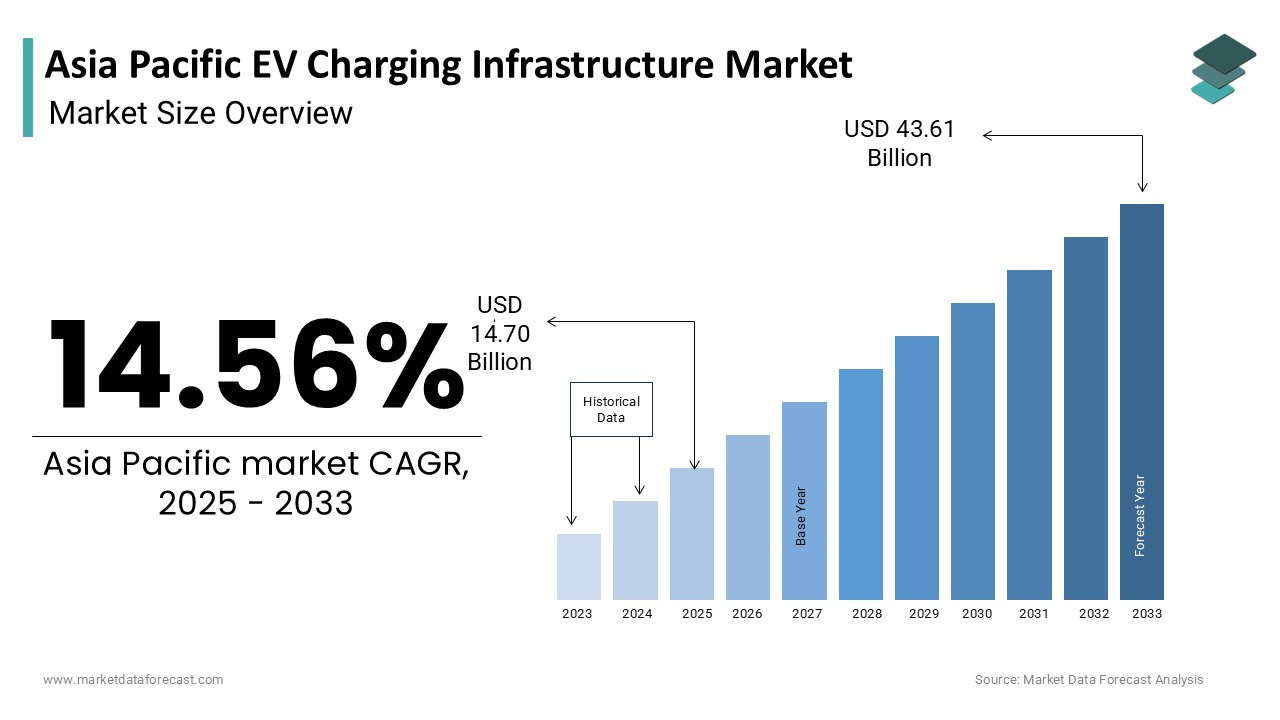
The Asia Pacific EV Charging Infrastructure Market was worth USD 12.83 billion in 2024. The Asia Pacific market is expected to reach USD 43.61 billion by 2033 from USD 14.70 billion in 2025, rising at a CAGR of 14.56% from 2025 to 2033.
The Asia Pacific EV charging infrastructure market refers to the network of electric vehicle (EV) charging stations, including public, private, and semi-public installations, along with the associated hardware, software platforms, and grid integration systems. This market is a critical enabler for the widespread adoption of electric vehicles in the region, which includes major automotive markets such as China, Japan, South Korea, India, Australia, and Southeast Asian nations. Governments across these countries are prioritizing decarbonization efforts, promoting clean mobility solutions, and investing heavily in electrification infrastructure. As per the China Electricity Council, the country surpassed eight million installed public and private EV charging points by the end of 2023, significantly influencing regional growth. Moreover, increasing urbanization, rising disposable incomes, and growing environmental awareness are shaping consumer behavior toward sustainable transport options. In tandem with this shift, public-private partnerships have accelerated investments in fast-charging corridors, smart grid technologies, and payment-enabled digital platforms.
MARKET DRIVERS
Government Policies and Subsidies Promoting Electric Mobility
One of the strongest drivers of the Asia Pacific EV charging infrastructure market is the implementation of aggressive government policies aimed at reducing carbon emissions and accelerating the adoption of electric vehicles. Countries like China, India, South Korea, and Thailand have introduced financial incentives, tax exemptions, and subsidies not only for EV buyers but also for companies investing in charging station development. These measures have enabled the rapid deployment of DC fast-charging stations along highways and in metropolitan areas. Similarly, in India, the Faster Adoption and Manufacturing of Electric Vehicles (FAME II) scheme has spurred investment in charging stations, particularly in Tier-1 and Tier-2 cities.
Expansion of Urban Electromobility Programs and Ride-Hailing Fleets
The proliferation of city-led electromobility initiatives and the electrification of ride-hailing fleets are playing a crucial role in driving demand for extensive and accessible EV charging infrastructure in the Asia Pacific region. Metropolitan authorities in key economies are adopting zero-emission transportation strategies, mandating the transition of taxis, buses, and commercial delivery vehicles to electric alternatives, thereby necessitating a parallel expansion of charging facilities. In South Korea, Seoul's Green Transport Plan aims to replace all municipal buses and taxis with electric models by 2030, requiring a significant increase in charging points across the capital. Also, ride-hailing giants such as Grab in Southeast Asia and Ola Electric in India have committed to full electrification of their fleets in multiple cities.
MARKET RESTRAINTS
High Capital Expenditure and Return-on-Investment Uncertainty
A major restraint facing the Asia Pacific EV charging infrastructure market is the substantial initial investment required for setting up charging stations, especially high-speed DC fast chargers and ultra-fast units. Unlike traditional fueling stations, EV charging infrastructure involves significant costs related to equipment procurement, installation, grid connectivity upgrades, and ongoing maintenance. In emerging markets such as Indonesia and the Philippines, where electricity distribution networks are less developed, additional investments in grid reinforcement further escalate project expenses. Furthermore, as outlined in a 2023 study conducted by the Institute of Electrical and Electronics Engineers, inconsistent utilization rates and fluctuating pricing mechanisms contribute to uncertainty in revenue generation. Many operators charge usage-based fees or subscription models, yet without a critical mass of EV users, profitability remains elusive.
Fragmented Regulatory Frameworks and Interoperability Issues
Another significant barrier to the growth of the Asia Pacific EV charging infrastructure market is the lack of standardized regulations and interoperability protocols across different countries. The absence of uniform technical standards for plug types, communication protocols, and billing systems complicates cross-border compatibility and discourages multinational investments. According to a white paper published by the Asia-Pacific Economic Cooperation (APEC), there are currently three dominant charging connector standards in use across the region—GB/T (China), CHAdeMO (Japan), and CCS (South Korea and some ASEAN countries). This fragmentation forces automakers and charging operators to develop multi-standard equipment, increasing complexity and costs. Moreover, differences in licensing requirements, grid access rules, and pricing structures across national borders create regulatory hurdles for companies aiming to establish integrated charging networks.
MARKET OPPORTUNITIES
Integration of Renewable Energy and Smart Grid Technologies
One of the most promising opportunities for the Asia Pacific EV charging infrastructure market lies in the convergence of renewable energy sources and intelligent grid management systems. As countries in the region strive to reduce reliance on fossil fuels and enhance energy security, the integration of solar, wind, and battery storage into EV charging ecosystems presents a strategic pathway for sustainable mobility. This rapid expansion enables the development of green charging stations powered entirely by renewables, particularly in decentralized and off-grid locations. For instance, in Australia, ChargeFox has deployed solar-powered highway charging stations equipped with battery storage, offering a fully sustainable model for long-range travel. Also, as outlined by the Asia Smart Grid Forum, utilities and tech firms are exploring vehicle-to-grid (V2G) technologies that allow EVs to act as mobile energy storage units, feeding excess power back into the grid during peak demand.
Public-Private Partnerships Driving Nationwide Charging Networks
Public-private partnerships (PPPs) have emerged as a pivotal opportunity for accelerating the rollout of EV charging infrastructure across the Asia Pacific. Governments seeking to meet climate commitments and urban mobility targets are increasingly collaborating with private enterprises to fund, deploy, and manage large-scale charging networks. According to the World Bank, several APAC nations have adopted PPP models to overcome funding gaps and operational inefficiencies in infrastructure development. These partnerships leverage government planning expertise and private sector agility to deliver scalable solutions more efficiently.
MARKET CHALLENGES
Grid Capacity Limitations and Power Supply Constraints
A critical challenge confronting the Asia Pacific EV charging infrastructure market is the existing limitations of electrical grid capacity, particularly in rapidly urbanizing and developing economies. As the number of electric vehicles grows exponentially, the strain on power distribution networks intensifies, raising concerns about reliability, load balancing, and peak-time demand surges. According to the International Energy Agency, several regions in India, Indonesia, and the Philippines still experience intermittent power supply issues, making it difficult to sustain a widely distributed and reliable EV charging network. As per the Central Electricity Authority of India, certain states reported grid instability during peak hours when multiple high-power EV charging stations operated simultaneously in urban centers.
Consumer Perception and Range Anxiety
Despite growing awareness of electric vehicles, consumer perception and range anxiety remain persistent challenges affecting the uptake of EV charging infrastructure across the Asia Pacific. Many potential buyers remain hesitant due to concerns about insufficient charging availability, long waiting times, and inconsistent service quality. In Southeast Asia, where charging networks are still nascent, this concern is even more pronounced. Moreover, anecdotal reports from users highlight issues such as malfunctioning stations, non-uniform payment methods, and poor signage, contributing to dissatisfaction.
SEGMENTAL ANALYSIS
By Vehicle Type Insights
The passenger cars dominate the Asia Pacific EV charging infrastructure market by accounting for a substantial share of total revenue in 2024. This dominance is primarily driven by the rapid electrification of personal mobility, supported by government policies, consumer awareness, and a growing fleet of electric passenger vehicles on the road. In China alone, the Ministry of Industry and Information Technology recorded more than 6 million new battery electric vehicle (BEV) registrations in 2023, necessitating an extensive expansion of supporting charging networks. Also, ride-hailing platforms such as Ola Electric in India, Grab in Southeast Asia, and Didi Chuxing in China have contributed significantly to the demand, introducing large-scale electric fleets that require accessible and fast-charging solutions.
The commercial vehicles are projected to be the fastest-growing segment in the Asia Pacific EV charging infrastructure market, expanding at a CAGR of 33.4%. The increasing adoption of electric buses, delivery vans, logistics trucks, and construction equipment is fueling the need for dedicated and high-capacity charging infrastructure tailored for commercial operations. Similarly, in India, companies like Mahindra Electric and Ashok Leyland are collaborating with state transport corporations to deploy electric buses equipped with standardized charging interfaces. Furthermore, as outlined by McKinsey & Company, e-commerce giants such as Alibaba, Flipkart, and Amazon India are transitioning their last-mile delivery fleets to electric models, prompting investments in dedicated charging depots.
By Charger Type Insights
Alternating Current (AC) charging stations represented the largest segment in the Asia Pacific EV charging infrastructure market by holding approximately 58% of the total revenue share in 2024. This segment primarily includes Level 1 and Level 2 chargers used for overnight or extended parking scenarios, particularly in residential and workplace settings. These slower but cost-effective units are preferred for regular daily use due to lower installation costs and grid compatibility. Similarly, in Japan, utility providers such as Tokyo Electric Power have incentivized homeowners through subsidies to install AC wall boxes, enhancing domestic adoption.
Direct Current (DC) fast charging stations are emerging as the swiftest growing segment in the Asia Pacific EV charging infrastructure market, registering a CAGR of 38.2% from 2025 to 2033. The rising demand for quick-charge solutions among long-distance travelers, fleet operators, and commercial vehicle users is driving significant investment into high-speed and ultra-fast DC charging infrastructure. The Chinese National Development and Reform Commission mandated the installation of DC chargers at every 50 km along all expressways, ensuring seamless intercity travel.
By Application Type Insights
The public charging stations constitute the largest application segment of the Asia Pacific EV charging infrastructure market by capturing a 54.4% of total revenue share in 2024. The expansion of publicly accessible charging networks has been critical in addressing range anxiety and encouraging EV adoption among consumers who lack access to private charging facilities. These initiatives reflect a strategic push toward nationwide accessibility, making public charging infrastructure a cornerstone of the EV transition across the Asia Pacific.
The private charging stations are emerging as the fastest-growing segment in the Asia Pacific EV charging infrastructure market by expanding at a CAGR of 31.8% between 2025 and 2033. Driven by increasing ownership of electric vehicles among urban dwellers, rising home charger installations, and employer-sponsored charging programs, private EVSE (Electric Vehicle Supply Equipment) is gaining substantial traction. According to McKinsey & Company, in China's Tier-1 cities, over 80% of EV owners prefer installing home-based AC chargers due to convenience and reliability. In South Korea, the Korea Electric Power Corporation (KEPCO) introduced time-of-use pricing schemes favoring off-peak home charging, further boosting private station adoption. In addition, in India, corporate campuses and IT parks in Bengaluru and Hyderabad began integrating EV charging facilities for employees, aligning with sustainability goals.
REGIONAL ANALYSIS
China dominated the Asia Pacific EV charging infrastructure market by commanding 46.8% of the regional revenue in 2024. As the world’s largest automotive market and a global leader in EV adoption, China has made significant strides in developing a comprehensive and scalable charging ecosystem. According to the China Electricity Council, the country surpassed 8 million installed public and private charging points by the end of 2023, with a strong emphasis on fast-charging infrastructure along expressways and within metropolitan areas. Major tech and energy firms such as BYD, State Grid, and Tencent-backed Tgood have played pivotal roles in building interconnected charging networks. Moreover, the central government continues to provide direct subsidies under its 14th Five-Year Plan, aiming to ensure seamless long-range travel and support mass-market EV penetration.
India is a rapidly expanding market. The country is undergoing a transformative phase in electromobility, driven by federal and state-level initiatives aimed at cutting emissions and promoting sustainable transportation. Under the Faster Adoption and Manufacturing of Electric Vehicles (FAME II) scheme, the Indian government allocated funds for setting up 2,700 public charging stations across 68 cities. Private sector participation has also surged, with companies like Tata Power, Bharat Petroleum Corporation Limited (BPCL), and Adani Energy investing heavily in charging networks.
South Korea is a technological leader and is positioning itself as a key innovator and early adopter in smart and ultra-fast charging technologies. The country benefits from a well-developed power grid, advanced manufacturing capabilities, and strong government support for green mobility initiatives. The Ministry of Environment has implemented generous subsidies for household EV charger installations, contributing to a notable increase in private charging adoption over the past two years. Besides, major automakers such as Hyundai and Kia are working closely with energy firms to integrate vehicle-to-grid (V2G) technology, enabling bidirectional energy flow between EVs and the grid.
Japan is seeing steady growth with a focus on smart integration and is maintaining steady growth driven by technological advancements and a strong emphasis on smart mobility integration. While not experiencing the same explosive growth as China or India, Japan is steadily enhancing its network of fast and ultra-fast charging stations, particularly in urban centers and along major transportation routes. Major automakers like Nissan and Honda, in collaboration with utility providers, have championed the development of interoperable charging solutions to enhance user experience. The Japanese government has also introduced financial incentives for households and businesses adopting EV charging infrastructure.
Australia is establishing itself as an emerging player with a strategic focus on regional connectivity and renewable-powered charging solutions. Despite relatively low EV adoption rates compared to other developed economies, the country has intensified efforts to expand its charging infrastructure in alignment with climate commitments. The National Electric Vehicle Strategy aims to install 10,000 public charging points by 2030, with priority given to highway corridors and regional towns. State governments in Victoria, New South Wales, and Queensland have actively partnered with private firms like ChargeFox, Evie Networks, and Ionity to roll out ultra-fast charging stations.
Top Players in the Asia Pacific EV Charging Infrastructure Market
State Grid Corporation of China
State Grid Corporation of China is a dominant force in the Asia Pacific EV charging infrastructure market, playing a central role in developing and managing large-scale public and private charging networks across China. The company has been instrumental in integrating EV charging with national smart grid initiatives, ensuring seamless energy distribution and load balancing. Its extensive reach, government backing, and strategic investments have enabled rapid nationwide deployment of high-speed charging stations. As a key player in China’s electrification push, State Grid's influence extends beyond its domestic market through technology exports, policy advisory roles, and participation in regional EV infrastructure forums.
ChargeFox (Australia)
ChargeFox is a leading EV charging network operator in Australia and one of the fastest-growing players in the Asia Pacific region. Known for its user-friendly mobile application, interoperability with multiple EV models, and rapid expansion of ultra-fast charging stations, ChargeFox has played a pivotal role in improving long-distance travel accessibility for electric vehicle owners. The company collaborates with governments, private investors, and international partners to establish corridor-based charging infrastructure powered by renewable energy sources. Through innovation and strategic deployment, ChargeFox is shaping the future of sustainable mobility in Australia and influencing broader APAC market trends.
Tata Power (India)
Tata Power is a frontrunner in India’s EV charging infrastructure development, driving both public and private sector adoption of electric mobility solutions. The company has established an expansive charging network across major Indian cities while also engaging in partnerships to develop indigenous fast-charging technologies. With a strong commitment to sustainability and energy transition, Tata Power is contributing to the integration of EV charging with solar and battery storage systems. Its leadership in India positions it as a model for emerging economies seeking scalable and clean transport electrification strategies within the Asia Pacific region.
Top Strategies Used by Key Market Participants
One of the most impactful strategies employed by key players in the Asia Pacific EV charging infrastructure market is expanding the intercity and highway charging corridor. Recognizing that long-distance travel remains a concern for EV users, companies are investing heavily in ultra-fast charging stations along major transportation routes. This approach not only enhances consumer confidence but also supports commercial fleet electrification, such as electric buses and delivery trucks.
Another crucial strategy involves forming public-private partnerships (PPPs) to accelerate deployment. By collaborating with municipal authorities, utility providers, and transport agencies, companies can streamline permitting processes, secure land access, and benefit from government subsidies. These alliances ensure faster rollout timelines and better alignment with national decarbonization goals, making them a preferred route for scaling operations.
Lastly, many industry leaders are focusing on integrating digital platforms and smart payment systems into their charging networks. Seamless user experiences, real-time monitoring, and plug-and-play billing interfaces are becoming standard features.
KEY MARKET PLAYERS AND COMPETITIVE LANDSCAPE
ABB Ltd., Siemens AG, Schneider Electric SE, Delta Electronics Inc., BYD Company Ltd., Tesla Inc., Tata Power, Star Charge, China State Grid Corporation, and Charge+ are some of the key market players.
The competition in the Asia Pacific EV charging infrastructure market is marked by a blend of state-backed enterprises, global technology firms, and agile startups striving to capture market share in a rapidly evolving ecosystem. Unlike traditional industries, this market is shaped by regulatory policies, technological compatibility, and strategic site placements, making differentiation more complex yet essential for long-term success. Established utilities and automotive manufacturers are leveraging their existing infrastructural and brand advantages, while newer entrants are innovating through digital platforms, modular designs, and renewable-powered solutions.
A key battleground lies in the race to deploy ultra-fast and interoperable charging stations that cater to diverse EV models. Companies are increasingly adopting multi-standard equipment and open-access software to avoid fragmentation and improve user experience. At the same time, government-led initiatives are dictating the pace of growth, with countries like China and India witnessing aggressive expansion due to favorable policy frameworks. Meanwhile, in developed markets such as Japan and Australia, customer-centric offerings and service reliability are emerging as differentiators. As the demand for electric mobility accelerates, the competition is shifting from mere hardware installation to comprehensive ecosystem building—combining smart grids, renewable energy, and integrated mobility services.
RECENT MARKET DEVELOPMENTS
- In February 2024, State Grid Corporation of China announced a partnership with Huawei to integrate AI-driven energy management systems into EV charging stations across major provinces. This initiative aims to optimize grid stability, reduce peak-load stress, and enhance overall efficiency in high-demand urban centers.
- In May 2024, ChargeFox expanded its ultra-fast charging network into New Zealand in collaboration with ChargeNet NZ, establishing a cross-border connectivity solution for travelers across both countries. This move strengthens ChargeFox’s position as a regional leader in EV mobility infrastructure.
- In July 2024, Tata Power launched its first solar-powered EV charging station in Bengaluru, marking a significant step toward integrating renewable energy with electric mobility. This pilot project sets the foundation for sustainable charging infrastructure across Indian cities.
- In September 2024, Hyundai Motor Group partnered with Korea Electric Power Corporation (KEPCO) to install 50 ultra-fast 350 kW chargers at highway rest stops, supporting the growing number of hydrogen-electric and battery-electric vehicles entering the market.
- In November 2024, JXTG Energy, Japan’s largest oil refiner, entered into a joint venture with Panasonic to repurpose conventional gas stations into dual-function EV charging hubs, combining convenience retail with high-speed charging to meet the evolving needs of urban and rural areas.
MARKET SEGMENTATION
This research report on the Asia Pacific EV charging infrastructure market is segmented and sub-segmented into the following categories.
By Vehicle Type
- Passenger Cars
- Commercial Vehicles
By Charger Type
- AC Charging Stations
- DC Charging Stations
By Application Type
- Public Charging Stations
- Private Charging Stations
By Country
- India
- China
- Japan
- South Korea
- Australia
- New Zealand
- Thailand
- Malaysia
- Vietnam
- Philippines
- Indonesia
- Singapore
- Rest of APAC