- Product Description Description
- Table of Contents TOC
- List of Table & Figure LOT
- Get Free Sample PDF Sample PDF
Asia Pacific Fish Processing Market Size
The size of the Asia Pacific fish processing market was calculated to be USD 51.72 billion in 2025 and is anticipated to be worth USD 77.19 billion by 2034, from USD 54.07 billion in 2026, growing at a CAGR of 4.55% during the forecast period.
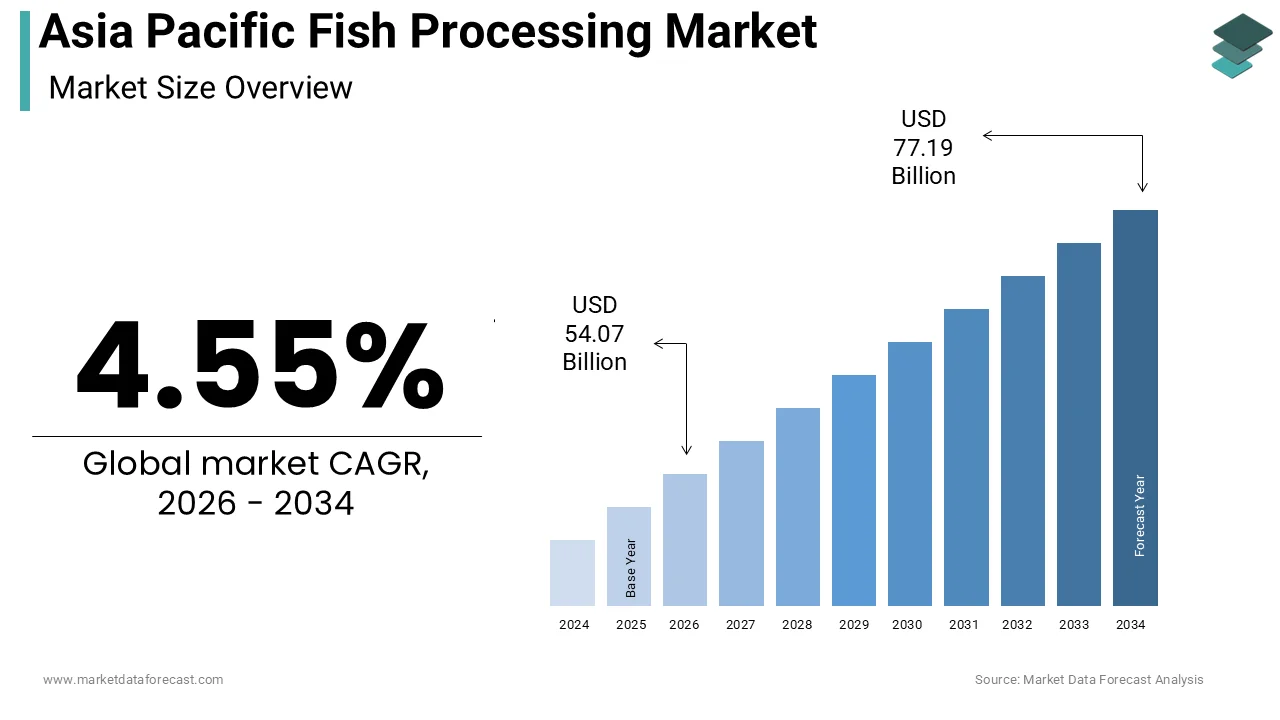
The market is expected to show substantial growth in the mentioned forecasting period. The market continues to gain momentum with the increased fish consumption lately. Fish Processing is the process which starts with the catching of fishes and ends at final shipping to customers. It includes entire species of aquatic organisms, irrespective of the place they are obtained from. Fish is a very perishable food and hence needs to be stored and preserved properly for protection against decaying. Some of the popular fish processes used for fish preservation are surimi, curing, salting, drying, and smoking.
The major driving factors for the market of Asia-Pacific Fish Processing are plenty of facilities like boats, advanced equipment and others which are expected to fuel the market growth in future. Also, the presence of a long coastal line gives rise to huge demand for different types of seafood and is thus responsible for the growth of market in this region. However, the gradually increasing acceptance of vegetarian and vegan diets is the major constraint for the growth of this market.
This research report on the Asia Pacific fish processing market is segmented and sub-segmented into the following categories.
Asia Pacific Fish Processing Market By Category
- Preserved
- Frozen
- Others
Asia Pacific Fish Processing Market By Application
- Food
- Non-Food Products
The food segment leads the market under the segmentation on the basis of application due to increased inclusion of fish in people’s diets.
Asia Pacific Fish Processing Market By sources
- Inland
- Marine
The fish harvested from marine sources lead the market due to the development of new techniques for fishing.
Asia Pacific Fish Processing Market By species
- Molluscs
- Crustaceans
- Fish
Asia Pacific Fish Processing Market By Equipment
- Slaughtering
- Gutting
- Scaling
- Filleting
- Smoking
- Deboning
- Skinning
Asia Pacific Fish Processing Market By Region
- India
- Japan
- China
- Australia
- Singapore
- Malaysia
- South Korea
- New Zealand
- Southeast Asia
China has the highest demand for fish in the Asia-Pacific Fish Processing Market. Many countries in the Asia-Pacific region like Thailand, Vietnam and South Korea depend on fishery for a living and highly contribute to the GDP of the countries.
KEY MARKET PLAYERS
Key players in the Asia Pacific fish processing market are Charoen Pokphand Foods PCL (Thailand), Maruha Nichiro Corporation (Japan), Nippon Suisan Kaisha, Ltd. (Japan), and Thai Union Frozen Products PLC (Thailand)