- Product Description Description
- Table of Contents TOC
- List of Table & Figure LOT
- Get Free Sample PDF Sample PDF
Market Size, 2025
$11.30 BnMarket Estimate, 2026
$12.14 BnMarket Forecast, 2034
$21.48 BnCAGR, 2026–2034
7.4%Asia Pacific Floating Production Storage and Offloading (FPSO) Market Summary
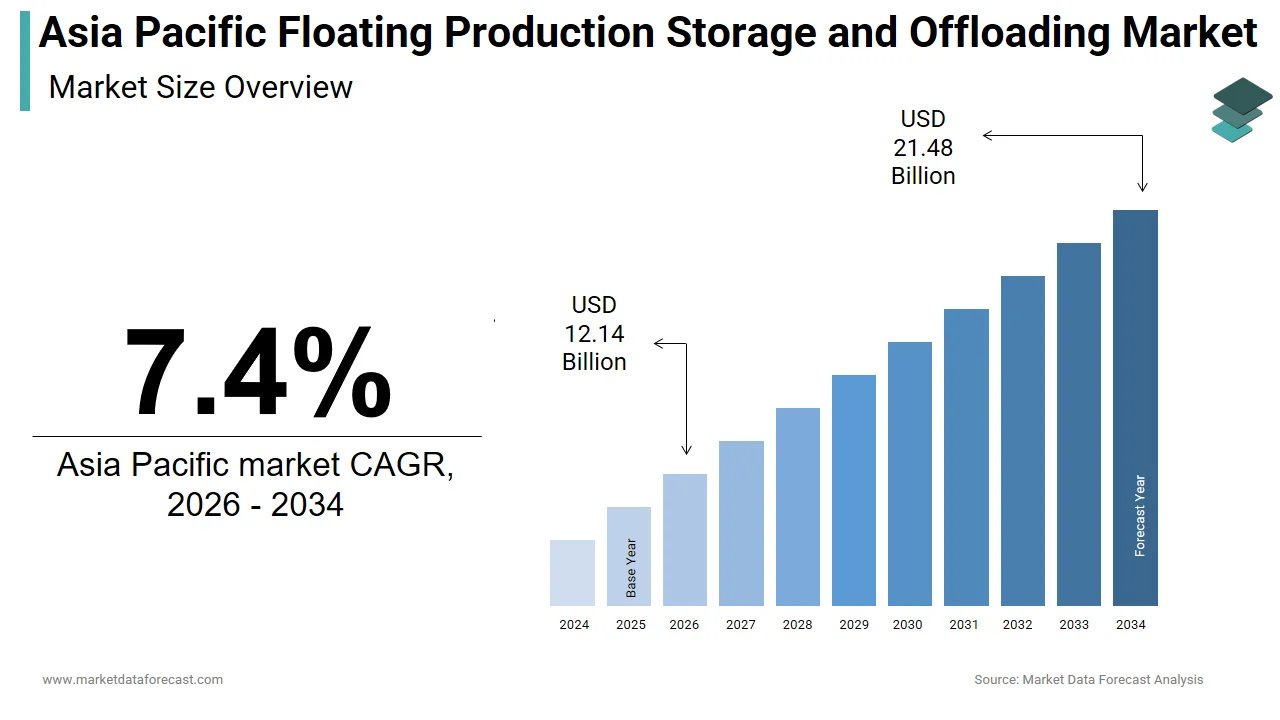
The Asia Pacific floating production storage and offloading (FPSO) market was valued at USD 11.30 billion in 2025, is estimated to reach USD 12.14 billion in 2026, and is projected to reach USD 21.48 billion by 2034, growing at a CAGR of 7.4% from 2026 to 2034. Rising offshore field monetization, subsea tie-back projects, and demand for deepwater developments are key growth factors.
Key Market Trends & Insights
- Indonesia emerged as the largest market in 2025.
- Malaysia held a significant share of the regional FPSO market in 2025.
- South Korea served as the primary construction hub for FPSOs.
- Based on type, the FPSO vessel segment dominated the market in 2025.
- Based on water depth, the deepwater segment accounted for the largest share in 2025.
Market Size & Forecast
- 2025 Market Size: USD 11.30 Billion
- 2026 Estimated Size: USD 12.14 Billion
- 2034 Projected Market Size: USD 21.48 Billion
- CAGR (2026–2034): 7.4%
- Indonesia: Largest market in 2025
- South Korea: Leading construction hub
Asia Pacific Floating Production Storage and Offloading (FPSO) Market Size
The Asia Pacific floating production storage and offloading (FPSO) market was valued at USD 11.30 billion in 2025, is estimated to reach USD 12.14 billion in 2026, and is projected to reach USD 21.48 billion by 2034, growing at a CAGR of 7.4% from 2026 to 2034.
Floating Production Storage and Offloading (FPSO) system represents a critical enabler of offshore hydrocarbon exploitation, particularly in geographically complex and deepwater maritime zones where conventional pipeline infrastructure is impractical. Unlike fixed platforms, FPSOs are moored vessels capable of processing crude oil, storing it onboard, and transferring it to shuttle tankers, offering unmatched operational flexibility in remote or seismically active waters. These units are central to the offshore strategies of nations seeking to monetize marginal fields, extend the life of aging reservoirs, and respond dynamically to shifting energy demand. The Asia Pacific region, encompassing some of the world’s most active maritime economic zones from the South China Sea to the Bay of Bengal is witnessing a reconfiguration of offshore development models, driven by energy security imperatives and technological maturation. As of 2023, over 40 FPSOs were in active operation across the region, with South Korea serving as the primary construction hub, having delivered 60% of all newbuilds in the past five years, as stated by Clarksons Research. Indonesia and Malaysia collectively manage more than half of these units, reflecting their strategic reliance on floating infrastructure. Moreover, the average service life of an FPSO in the region exceeds 15 years, with 70% of existing units undergoing life extension or mid-field redevelopment, according to DNV. This underscores a shift from Greenfield dominance to brownfield optimization, where FPSOs are repurposed or redeployed to maintain production continuity amid declining reservoir pressures and tightening fiscal regimes.
MARKET DRIVERS
Accelerated Offshore Field Monetization in Geopolitically Sensitive Zones
The urgent need to rapidly monetize offshore hydrocarbon reserves in contested maritime regions, where political sensitivities and security risks discourage long-term, fixed infrastructure investments, is a pivotal driver of FPSO adoption across the Asia Pacific. China has commissioned at least six FPSOs in the region since 2020, including the Nanhai Kaibai in the Liuhua field, to assert energy presence without provoking permanent militarization, as confirmed by the China National Offshore Oil Corporation (CNOOC). These vessels can be disconnected and relocated within weeks, minimizing exposure during diplomatic escalations. In 2023 alone, Malaysia deployed the Kikeh-2 FPSO in Block SK318, a field near the maritime boundary with Vietnam, underscoring the tactical advantage of mobility. Additionally, FPSOs require less seabed footprint and fewer permanent installations, reducing environmental scrutiny and regulatory hurdles. This confluence of geopolitical agility and environmental pragmatism is fundamentally reshaping offshore investment patterns.
Rising Subsea Tie-Back Projects in Mature Basins
The proliferation of subsea tie-back developments in aging offshore fields is significantly amplifying demand for FPSOs across the Asia Pacific. As primary reservoirs in mature basins like Indonesia’s Natuna Sea and India’s Mumbai High experience pressure depletion, operators are increasingly turning to satellite fields located several kilometers away from existing infrastructure. Rather than constructing new platforms, these satellite discoveries are economically linked via subsea pipelines to existing or newly deployed FPSOs, which serve as central processing hubs. According to Wood Mackenzie, subsea tie-backs accounted for 68% of all new offshore developments in the region in 2023, up from 45% in 2018. In Indonesia, Pertamina’s Jangkrik FPSO processes output from three subsea fields located up to 25 kilometers away, achieving a recovery rate of 62%, well above the regional average of 48%, as reported in the 2023 SKK Migas Operational Review. Similarly, India’s ONGC connected the Satellite Cluster in the KG-DWN-98/2 block to the GSP Saturn FPSO using a 36-kilometer subsea manifold system, enabling production from seven marginal fields that would otherwise be uneconomical. The cost efficiency is compelling. Moreover, technological advances in flexible risers and remotely operated vehicles (ROVs) have extended tie-back feasibility to distances exceeding 50 kilometers. Hence, the synergy between subsea systems and FPSOs is becoming the default development model.
MARKET RESTRAINTS
Stringent Environmental Regulations in Coastal Ecological Hotspots
The expansion of FPSO operations in the Asia Pacific is increasingly constrained by tightening environmental regulations, particularly in ecologically sensitive coastal zones where offshore developments risk impacting marine biodiversity and fisheries. Countries like Indonesia, the Philippines, and Australia have strengthened regulatory oversight following high-profile incidents such as the 2020 MV Wakashio oil spill and the 2022 Montara wellhead leak, which heightened public scrutiny of floating production systems. Indonesia’s Ministry of Environment and Forestry now mandates Environmental Impact Assessments (AMDAL) for all FPSO deployments, requiring operators to demonstrate zero-discharge operations and emergency response readiness, a process that can delay project timelines by 12 to 18 months, as stated in the 2023 National Environmental Management Regulation. Similarly, Australia’s National Offshore Petroleum Safety and Environmental Management Authority (NOPSEMA) has rejected two FPSO proposals since 2021 due to inadequate spill containment plans. The Great Barrier Reef Marine Park Authority prohibits any offshore production within 100 kilometers of the reef, effectively blocking deepwater development in parts of the Coral Sea. According to the United Nations Environment Programme, the Asia Pacific accounts for 45% of the world’s coral reef systems, with over 350 million people dependent on reef-associated fisheries. This ecological sensitivity translates into operational limitations: FPSOs must now incorporate closed-loop processing systems, zero-flaring technologies, and real-time emissions monitoring. Additionally, the International Maritime Organization’s 2023 sulfur cap regulations require all support vessels servicing FPSOs to use low-sulfur fuels, raising logistics expenses. These regulatory burdens, while necessary for sustainability, are slowing project approvals and increasing capital intensity.
Limited Domestic Shipyard Capacity for FPSO Conversion and Maintenance
The Asia Pacific FPSO market faces a critical bottleneck in the form of insufficient specialized shipyard capacity for FPSO conversion, mid-life upgrades, and dry-docking maintenance. While South Korea dominates global FPSO construction, regional yards in Indonesia, India, and Vietnam lack the dry docks, skilled workforce, and certification standards required for complex conversions. Indonesia’s PT PAL, the country’s largest shipbuilder, has only one dry dock capable of accommodating FPSO-sized vessels, limiting its throughput to one major conversion every 18 months. This dependency on foreign facilities leads to extended downtime. India’s Cochin Shipyard, though constructing its first indigenous FPSO, still relies on Norwegian and Singaporean engineering firms for process module integration. The lack of certified welders and non-destructive testing (NDT) personnel further delays projects. Hence, the capacity gap poses a systemic risk to production continuity. Without significant investment in port infrastructure and technical training, local operators will remain reliant on external hubs, undermining energy sovereignty.
MARKET OPPORTUNITIES
Integration of Digital Twins and Predictive Analytics in FPSO Operations
The integration of digital twin technology and predictive analytics into FPSO operations, enabling real-time performance optimization, risk mitigation, and extended asset life, is a transformative opportunity. Digital twins, virtual replicas of physical FPSOs, allow operators to simulate operational scenarios, monitor equipment health, and forecast maintenance needs with unprecedented precision. The technology relies on thousands of onboard sensors transmitting data to onshore control centers, where machine learning algorithms detect anomalies before failures occur. DNV estimates that digital twin adoption can extend an FPSO’s operational life by 3 to 5 years by preventing premature degradation. The foundation for digital transformation is in place. The region is also seeing collaboration between oil companies and tech firms: CNOOC partnered with Huawei in 2022 to develop a 5G-enabled digital twin platform for its South China Sea assets. As cybersecurity frameworks mature and edge computing becomes more accessible, this digital shift promises to redefine operational efficiency across the offshore sector.
Repurposing FPSOs for Carbon Capture and Offshore Sequestration
The repurposing of aging FPSOs for offshore carbon capture, utilization, and storage (CCUS), aligning with regional decarbonization goals while extending asset utility, is an emerging frontier. As nations like Australia, Japan, and South Korea commit to net-zero targets, there is growing interest in using decommissioned FPSOs as floating CO₂ processing and injection hubs. The existing infrastructure, processing modules, power systems, and mooring setups can be retrofitted to handle CO₂ compression and subsea injection into depleted reservoirs. The Gorgon project in Australia, operated by Chevron, already injects 3.4 million tons of CO₂ annually into a saline aquifer beneath the Barrow Island field, utilizing modified offshore platforms, as reported by Geoscience Australia. This transition not only reduces emissions but also preserves jobs and industrial capacity. Hence, their conversion into green energy assets represents a strategic opportunity to bridge fossil fuel dependence with climate resilience.
MARKET CHALLENGES
Vulnerability to Extreme Weather and Typhoon-Prone Operating Zones
Their exposure to extreme weather events, particularly typhoons, cyclones, and monsoon-driven waves that threaten structural integrity and production continuity is a persistent operational challenge for FPSOs in the Asia Pacific. The western Pacific basin experiences an average of 26 typhoons annually, with 8 to 10 making landfall or passing through offshore production zones, as documented by the Japan Meteorological Agency. Unlike fixed platforms, FPSOs are designed to weathervane, rotate around their mooring point, but extreme wave heights exceeding 15 meters can strain mooring lines and disconnect risers. To mitigate risks, operators are investing in advanced forecasting and dynamic positioning systems, but these add 10–15% to operational costs. Climate change is exacerbating the challenge. As operators push into deeper, more remote waters, weather resilience will remain a defining challenge.
Skilled Workforce Shortage in Offshore Engineering and Operations
The acute shortage of skilled engineers, naval architects, and offshore technicians capable of managing complex floating production systems is a critical structural challenge facing the Asia Pacific FPSO market. Despite the region’s large population, there is a significant mismatch between labor supply and technical demand. Training pipelines are underdeveloped. Additionally, aging workforce demographics compound the issue. The complexity of modern FPSOs, which integrate digital systems, subsea controls, and high-pressure processing, demands multidisciplinary expertise that local universities are not yet producing at scale. Collaborative programs like the Australia-Indonesia Centre’s Offshore Energy Initiative are attempting to bridge the gap, but progress remains slow. Without systemic investment in technical education and certification, the region risks operational inefficiencies, safety incidents, and project delays.
REPORT COVERAGE
| REPORT METRIC | DETAILS |
| Market Size Available | 2025 to 2034 |
| Base Year | 2025 |
| Forecast Period | 2026 to 2034 |
| Segments Covered | By Type, Water Depth, and Region. |
| Various Analyses Covered | Global, Regional and Country-Level Analysis, Segment-Level Analysis, Drivers, Restraints, Opportunities, Challenges; PESTLE Analysis; Porter’s Five Forces Analysis, Competitive Landscape, Analyst Overview of Investment Opportunities |
| Countries Covered | India, China, Japan, South Korea, Australia, New Zealand, Thailand, Malaysia, Vietnam, Philippines, Indonesia, Singapore, Rest of APAC |
| Market Leaders Profiled | Bumi Armada Berhad, Hyundai Heavy Industries Co. Ltd, Keppel Offshore & Marine Ltd, SBM Offshore, Samsung Heavy Industries Co. Ltd, and Others. |
SEGMENTAL ANALYSIS
By Type Insights
The Floating Production Storage and Offloading (FPSO) vessel segment dominated the Asia Pacific offshore oil and gas infrastructure landscape by accounting for a substantial share of the regional market in 2025. This overwhelming share stems from the region’s reliance on flexible, mobile, and economically viable production units suited to its diverse offshore geographies. Unlike fixed platforms, FPSOs can be redeployed, making them ideal for countries with scattered or marginal fields. Brazil and West Africa often dominate global FPSO discourse, but in the Asia Pacific, nations like Indonesia, Malaysia, and Vietnam are increasingly turning to FPSOs to monetize offshore discoveries without long-term capital lock-in.

Their adaptability to deepwater and ultra-deepwater reserves, where traditional infrastructure is cost-prohibitive, is a primary driver of FPSO dominance. Also, their ability to process, store, and offload crude on-site reduces dependency on pipelines, which are expensive and logistically complex in seismically active or remote regions. For example, Malaysia’s Kikeh field, operating at 1,270 meters depth, relies on the world’s first deepwater spread-moored FPSO, demonstrating technical feasibility. A further pivotal factor is government-backed energy security initiatives. Countries like Indonesia and India are prioritizing domestic hydrocarbon production to reduce import dependence. The country has awarded multiple FPSO contracts, including for the Jangkrik and Gendalo fields. The flexibility of FPSOs to operate in environmentally sensitive zones, such as near coral reefs or shipping lanes, without permanent seabed alteration further enhances regulatory acceptance. This combination of technical agility, faster deployment, and alignment with national energy strategies solidifies the FPSO’s dominance across the region.
The Tension Leg Platform (TLP) segment is emerging as the fastest-growing in the Asia Pacific offshore market and is projected to expand at a CAGR of 9.3% from 2026 to 2034. This surge is primarily fueled by the region’s shift toward ultra-deepwater exploration, where TLPs offer superior stability and production efficiency compared to conventional floating units. Unlike FPSOs, which drift with currents, TLPs are vertically moored with taut tendons, minimizing vertical movement and enabling direct vertical access to wells critical for high-pressure, high-temperature (HPHT) reservoirs found below 1,500 meters.
Technological advancements in tendon and riser systems, which have significantly improved reliability and reduced maintenance costs, are one of the key drivers. In 2022, Shell’s Bonga Southwest project offshore Nigeria demonstrated a 25% reduction in riser fatigue through new composite tendon materials, a technology now being adapted in the Asia Pacific. Moreover, TLPs support higher production rates, making them ideal for large-scale developments. An additional critical factor is strategic collaboration between national oil companies (NOCs) and international majors to de-risk deepwater ventures. These partnerships bring in advanced engineering expertise and capital, essential for high-cost TLP installations. Additionally, the decommissioning of aging shallow-water assets is pushing operators toward deeper, untapped reserves. With China National Offshore Oil Corporation (CNOOC) also exploring TLP applications in the South China Sea’s deep basins, the segment is poised for accelerated adoption.
By Water Depth Insights
The deepwater operations segment represented the largest part of the Asia Pacific FPSO market at 65.6% share in 2024. This dominance is rooted in the region’s geological shift from mature shallow-water basins to more prolific deepwater reservoirs, which offer larger hydrocarbon volumes and longer field life. Countries like Malaysia, Indonesia, and Australia are increasingly focusing on deepwater blocks to offset declining onshore production and meet rising energy demand. A major factor driving Deepwater’s lead is the discovery of large, commercially viable reserves in frontier basins. The Abadi LNG project, located in the Masela block at 1,500 meters depth, holds 10.5 trillion cubic feet of gas and will utilize a floating LNG (FLNG) unit, a variant of FPSO technology. These discoveries justify the higher capital expenditure associated with deepwater development. Another critical enabler is advancements in subsea processing and remote monitoring technologies, which have reduced operational risks and improved recovery rates. In Australia’s Greater Gorgon project, subsea compression has extended field life by 8–10 years. The availability of deepwater-capable vessels further strengthens supply chain readiness. Thus, the segment’s dominance remains structurally entrenched.
The ultra-deepwater operations segment is the fastest-growing segment in the Asia Pacific FPSO market and is projected to grow at a CAGR of 10.7% from 2026 to 2034. This rapid expansion is driven by the exhaustion of shallow and deepwater reserves and the increasing feasibility of tapping into previously inaccessible hydrocarbon deposits in the South China Sea, offshore Indonesia, and the Bay of Bengal. A primary catalyst is rising exploration activity in high-potential frontier zones. These successes are prompting a surge in ultra-deepwater licensing rounds. A further key driver is improvements in dynamic positioning and mooring systems that enable stable operations in extreme depths. Modern FPSOs like the Liza Destiny in Guyana operated with technology being replicated in Asia use advanced azimuth thrusters and satellite-based positioning to maintain station within 50 meters of the target, even in 2,000-meter depths, as documented by OneSubsea in its 2023 technical report. Additionally, the development of ultra-deepwater risers capable of withstanding pressures exceeding 15,000 psi has reduced failure risks. Thus, the trajectory for ultra-deepwater growth is firmly upward.
COUNTRY-LEVEL ANALYSIS
Malaysia Floating Production Storage and Offloading (FPSO) Market Insights
Malaysia stood as a cornerstone of the Asia Pacific FPSO market by holding a 23.6% share in 2024. As a mature hydrocarbon producer, Malaysia has transitioned from shallow-water platforms to deepwater FPSO-led developments to sustain production amid declining onshore output. The country’s offshore Sarawak and Sabah basins host a significant share of its proven reserves, most of which lie in waters deeper than 1,000 meters. Malaysia’s regulatory framework also supports foreign investment, with production-sharing contracts (PSCs) attracting majors like Shell and ExxonMobil. Moreover, Malaysia is emerging as a regional hub for FPSO conversion and maintenance. Thus, Malaysia’s FPSO market is set for sustained expansion.
Indonesia Floating Production Storage and Offloading (FPSO) Market Insights
Indonesia commands the largest share of the Asia Pacific FPSO market. As Southeast Asia’s top oil producer and a major gas exporter, Indonesia relies heavily on offshore infrastructure to exploit its vast maritime territory. The country operates several FPSOs, the highest in the region, including units at the Jangkrik, Gendalo, and Bangka fields. Indonesia’s push to increase oil production hinges on FPSO deployment in deepwater eastern regions like Maluku and Papua. The government has streamlined licensing through the new upstream regulator, MKS, reducing approval times from several months. Additionally, Pertamina has partnered with TechnipFMC and Hyundai Heavy Industries to develop indigenous FPSO capabilities, reducing reliance on foreign contractors. With over 80 underdeveloped offshore fields identified, Indonesia’s FPSO market remains the most dynamic in the region.
Australia Floating Production Storage and Offloading (FPSO) Market Insights
Australia ranks third in the Asia Pacific FPSO market with a 16% share in 2023, valued at USD 2.5 billion, according to Rystad Energy. While the country has traditionally favored onshore LNG and fixed platforms, recent deepwater discoveries have shifted focus toward floating production systems. Australia is the world’s largest LNG exporter, shipping 88 million tons in 2023, a 5% increase from 2022, as per the Australian Bureau of Statistics. Much of this comes from offshore fields like Prelude, which uses the world’s largest FLNG unit, technically an FPSO variant, operating in 250 meters of water but capable of processing 3.6 million tons of LNG annually. However, the real growth lies in ultra-deepwater prospects: the Scarborough field, located 500 kilometers offshore Western Australia at 900 meters depth, will require a new FPSO to process gas for export, with first production expected in 2026, according to Woodside Energy. The country’s offshore rig count increased from 12 in 2020 to 19 in 2023, per NOPSEMA, reflecting renewed exploration. Additionally, Australia’s commitment to carbon capture and storage (CCS) is opening new FPSO applications. The $2.2 billion Gorgon CCS project, integrated with the Gorgon FPSO, has injected over 7 million tons of CO2 since 2020, as confirmed by Chevron. With 15 deepwater exploration wells planned by 2025, Australia’s FPSO market is evolving beyond traditional roles into integrated energy hubs.
India Floating Production Storage and Offloading (FPSO) Market Insights
India holds a significant share of the Asia Pacific FPSO market. As the world’s third-largest energy consumer, India is aggressively pursuing offshore production to reduce its crude import dependency. The country’s offshore production accounts for a portion of total oil output, with the Krishna-Godavari (KG) and Mumbai High basins being key contributors. ONGC, India’s largest oil producer, operates five FPSOs, including the GSP Saturn in the KG-DWN-98/2 block, which targets 20 million metric tons of gas annually. The Dhirubhai-1 discovery in 2022, holding 15 TCF of gas at 2,300 meters depth, is one of the largest in Asia and will require multiple FPSOs for phased development, as stated by the Ministry of Petroleum and Natural Gas. India’s FPSO market is further boosted by domestic shipbuilding initiatives: the Cochin Shipyard is constructing India’s first indigenous FPSO for ONGC, scheduled for deployment by 2026, reducing reliance on South Korean yards. According to the Indian Bureau of Energy Efficiency, offshore gas could meet 25% of India’s power demand by 2030, up from 12% in 2023. Hence, India’s FPSO sector is on a steep growth curve.
China Floating Production Storage and Offloading (FPSO) System Market Insights
China captures a notable share of the Asia Pacific FPSO market. While its offshore production is still dominated by shallow-water platforms, China is rapidly advancing into deep and ultra-deepwater domains to secure energy independence. CNOOC, the national offshore operator, has launched a strategic push to develop the South China Sea, which holds a substantial quantity of oil and gas, according to the China Geological Survey. The Liuhua 16-2 field, operating at 410 meters depth, uses the Lufeng 14-4 FPSO, capable of processing 42,000 barrels per day. China’s shipbuilding prowess is a key enabler. Thus, China’s FPSO market is transitioning from consumer to global supplier.
COMPETITIVE LANDSCAPE
The competition in the Asia Pacific FPSO market is characterized by a dynamic interplay between global engineering firms, regional shipbuilders, and national oil companies, each vying for dominance in a technically demanding and capital-intensive sector. South Korea’s shipyards, particularly Samsung Heavy Industries and HD Hyundai, maintain a strong lead in newbuild construction due to their advanced infrastructure and proven track record. European engineering giants like Technip Energies and Saipem dominate front-end design and project management, often partnering with Asian fabricators to execute complex developments. Regional players such as PT PAL in Indonesia and Cochin Shipyard in India are striving to increase local participation, supported by government mandates for domestic content. The market is also witnessing rising competition from Chinese firms like CNOOC and COSCO, which are investing heavily in indigenous FPSO capabilities to reduce foreign dependency. Differentiation is increasingly based on technological innovation, including digitalization, emissions reduction, and modular construction. Strategic alliances between operators and service providers are common, especially in high-risk deepwater projects. With project timelines extending beyond five years and capital outlays exceeding USD 3 billion per unit, financial strength and technical credibility are critical competitive factors. As energy transition pressures grow, companies that integrate sustainability into FPSO design and operations are gaining strategic advantage, reshaping the competitive hierarchy.
KEY MARKET PLAYERS
Some of the noteworthy companies in the Asia Pacific floating production storage and offloading (FPSO) market profiled in this report are
- Bumi Armada Berhad
- Hyundai Heavy Industries Co. Ltd
- Keppel Offshore & Marine Ltd
- SBM Offshore
- Samsung Heavy Industries Co. Ltd
TOP LEADING PLAYERS IN THE MARKET
- Technip Energies has established itself as a pivotal player in the Asia Pacific FPSO market through its engineering excellence and integrated front-end design capabilities. The company plays a central role in developing complex floating systems, particularly in deepwater projects across Indonesia and Malaysia. In 2023, it completed the engineering, procurement, and construction management (EPCM) for the Abadi FLNG project in Indonesia’s Masela block, showcasing its capacity to deliver large-scale floating solutions in challenging environments. The firm has strengthened its regional footprint by forming joint ventures with local contractors and investing in digital engineering hubs in Kuala Lumpur and Jakarta. Technip Energies is also advancing modular construction techniques to reduce project timelines and enhance cost efficiency. Its collaboration with Hyundai Heavy Industries on the Liza Unity FPSO deployment demonstrated seamless integration of subsea and floating systems. By prioritizing energy transition-ready infrastructure, including carbon capture integration, Technip Energies is positioning itself at the forefront of next-generation offshore developments in the region.
- Samsung Heavy Industries remains a dominant force in the Asia Pacific FPSO market, leveraging its world-class shipbuilding infrastructure and technological innovation to deliver high-capacity floating units. Based in Geoje, South Korea, SHI has constructed over 30 FPSOs since 2000, many of which are deployed across Southeast Asia and Australia. In 2022, the company delivered the Prelude FLNG, one of the largest floating facilities ever built, which supports Australia’s offshore gas production. SHI has recently invested in smart ship technologies, integrating AI-based monitoring systems and automated welding processes to improve build quality and reduce delivery time. It also partnered with KSOE to develop eco-friendly FPSO designs featuring LNG-fueled power modules and low-emission processing systems. In 2023, SHI secured a major contract to build a deepwater FPSO for a Vietnamese offshore field, reinforcing its strategic outreach beyond traditional markets. With continuous advancements in hull design and mooring systems, SHI is setting new benchmarks in safety, efficiency, and scalability, making it a preferred partner for national oil companies and international operators alike.
- Petrofac has carved a niche in the Asia Pacific FPSO market by focusing on brownfield upgrades, life extension projects, and operations & maintenance (O&M) services for aging floating units. The company supports key operators such as PETRONAS and ONGC with integrated asset management solutions, ensuring sustained production from mature fields in Malaysia, India, and Indonesia. In 2023, Petrofac completed the mid-life enhancement of the Kikeh FPSO, upgrading its processing capacity and safety systems to extend operations beyond 2030. It has also expanded its regional engineering centers in Kuala Lumpur and Chennai, enhancing local content compliance and reducing project lead times. Petrofac’s recent emphasis on digital O&M platforms using predictive analytics and remote monitoring has improved uptime and reduced intervention costs. The company is actively pursuing opportunities in decommissioning and FPSO repurposing, aligning with sustainability trends. By combining technical expertise with operational agility, Petrofac is reinforcing its role as a long-term service partner in the region’s evolving offshore landscape.
TOP STRATEGIES USED BY KEY MARKET PARTICIPANTS
Key players in the Asia Pacific FPSO market are deploying strategic initiatives to consolidate their competitive advantage. Major strategies include forming joint ventures with regional contractors to enhance localization and reduce costs, investing in digital twin and predictive maintenance technologies to improve operational efficiency, and expanding engineering and fabrication capacities in South Korea and Southeast Asia. Companies are increasingly focusing on brownfield life extension projects to capitalize on aging infrastructure, while others are pursuing Greenfield developments in deepwater and ultra-deepwater zones. Strategic partnerships with national oil companies ensure long-term project visibility and regulatory alignment. Additionally, firms are integrating energy transition technologies such as carbon capture readiness and low-emission processing modules into new FPSO designs. There is also a growing emphasis on modular construction and offshore integration to shorten project timelines. Leading shipyards are adopting smart manufacturing techniques, including AI-driven quality control and automated welding, to enhance build precision. Some operators are exploring FPSO repurposing for floating energy hubs, including hydrogen or ammonia production. These strategies collectively reflect a shift toward sustainability, operational resilience, and technological differentiation in a highly competitive offshore environment.
RECENT MARKET DEVELOPMENTS
- In January 2022, Samsung Heavy Industries partnered with KSOE to develop an eco-friendly FPSO design featuring LNG-fueled power generation and carbon capture readiness, enhancing its competitiveness in sustainable offshore projects across the Asia Pacific region.
- In March 2023, Technip Energies launched a digital engineering hub in Jakarta to accelerate front-end design and project delivery for deepwater FPSO developments in Indonesia and Malaysia, strengthening its regional technical footprint.
- In August 2023, Petrofac completed the life extension upgrade of the Kikeh FPSO in Malaysia, increasing processing capacity and safety systems to extend operations beyond 2030, reinforcing its position in brownfield asset management.
- In November 2023, CNOOC deployed the Liuhua 16-2 FPSO in the South China Sea, marking China’s first fully indigenous deepwater floating production unit, showcasing its growing self-reliance in offshore technology.
- In April 2024, HD Hyundai signed a strategic agreement with PETRONAS to jointly develop modular FPSO solutions for Malaysia’s deepwater fields, aiming to reduce construction time and improve cost efficiency through localized fabrication.
MARKET SEGMENTATION
This Asia Pacific floating production storage and offloading (FPSO) market research report is segmented and sub-segmented into the following categories.
By Type
- FPSO
- Tension Leg Platform
- SPAR
- Barge
By Water Depth
- Shallow Water
- Deepwater and Ultra-Deepwater
By Country
- India
- China
- Japan
- South Korea
- Rest Of Asia Pacific