- Product Description Description
- Table of Contents TOC
- List of Table & Figure LOT
- Get Free Sample PDF Sample PDF
Asia Pacific Food Minerals Market Size
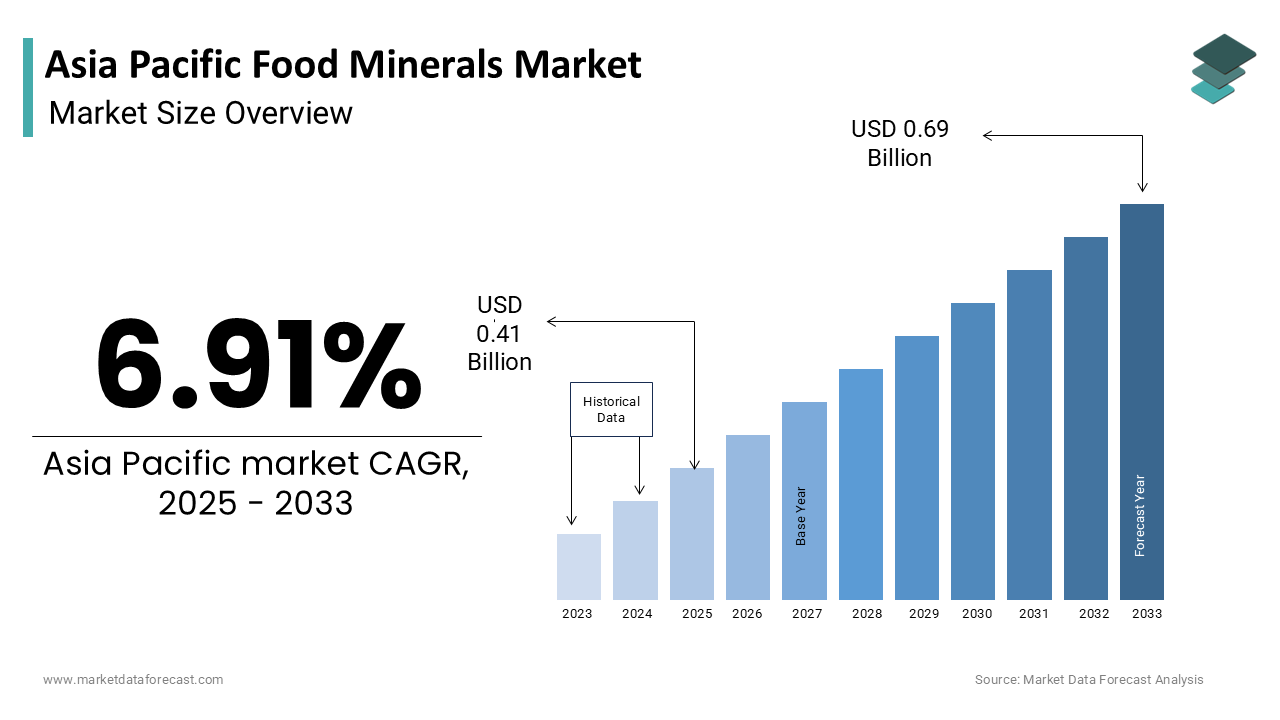
The Asia Pacific Food Minerals Market was worth USD 0.38 billion in 2024. The Asia Pacific market is expected to reach USD 0.69 billion by 2033 from USD 0.41 billion in 2025, rising at a CAGR of 6.91% from 2025 to 2033.
The Asia Pacific food minerals market is focusing on the integration of essential mineral nutrients into processed foods to address nutritional deficiencies and enhance dietary value. Food minerals include macro-minerals such as calcium, potassium, magnesium, and sodium, as well as trace minerals like iron, zinc, selenium, and iodine. These elements play vital roles in maintaining physiological functions, bone health, immune response, and metabolic processes. The growing awareness regarding fortified diets and the rising prevalence of micronutrient deficiencies across several developing economies have accelerated the demand for mineral-enriched food formulations.
Asia Pacific remains one of the most dynamic regions for food fortification initiatives due to its large and diverse population, rapid urbanization, and government-led nutrition programs. According to the World Health Organization (WHO), approximately 2 billion people globally suffer from micronutrient deficiencies, with a substantial portion residing in South and Southeast Asia. Also, the increased presence of multinational food companies and local manufacturers incorporating mineral supplements into daily consumption products is further supporting market growth. Consumer preference for functional foods and ready-to-eat meals fortified with essential minerals also contributes to the evolving landscape of the Asia Pacific food minerals market.
MARKET DRIVERS
Rising Incidence of Micronutrient Deficiencies Across Populations
One of the primary drivers fueling the Asia Pacific food minerals market is the widespread prevalence of micronutrient deficiencies, particularly among children and women in developing countries. According to the United Nations Children's Fund (UNICEF), a large share of preschool-age children in South Asia suffer from anemia, largely due to iron deficiency. Similarly, iodine deficiency disorders affect millions in parts of China, India, and Southeast Asia, prompting governments and health organizations to implement large-scale fortification programs. As a result, food and beverage manufacturers are increasingly integrating essential minerals such as iron, zinc, and iodine into staple foods like salt, wheat flour, and edible oils to combat these deficiencies effectively. The Indian government's National Family Health Survey (NFHS-5) indicates that over 57% of women and 67% of children under five years old suffer from anemia, reinforcing the urgency for mineral-enriched food solutions. In response, private and public stakeholders have collaborated on mandatory fortification policies. For example, the Food Safety and Standards Authority of India (FSSAI) has mandated the fortification of rice, wheat flour, edible oil, and milk with key vitamins and minerals. This regulatory push, coupled with rising consumer awareness about the health benefits of fortified foods, has significantly amplified the demand for food minerals in the region.
Expansion of the Functional Food Industry and Consumer Demand for Nutritional Enhancement
Another significant driver of the Asia Pacific food minerals market is the expanding functional food industry, where minerals are increasingly incorporated into everyday food items to provide additional health benefits beyond basic nutrition. Consumers in countries such as Japan, Australia, South Korea, and China are showing a strong preference for nutrient-dense foods, including dairy products, cereals, snacks, and beverages fortified with calcium, magnesium, and potassium.
In Japan, for instance, the Ministry of Health, Labour and Welfare reports that functional foods labeled under the FOSHU (Foods for Specified Health Use) category have seen consistent double-digit growth over the past decade. A major share of these products includes mineral-fortified beverages aimed at improving bone density, cardiovascular health, and muscle function. This trend extends to emerging markets like Thailand and Malaysia, where FMCG giants are launching fortified biscuits, noodles, and breakfast cereals tailored to regional tastes while delivering essential minerals.
MARKET RESTRAINTS
Regulatory Complexities and Inconsistent Compliance Across the Region
A key challenge impeding the seamless growth of the Asia Pacific food minerals market is the lack of harmonized regulatory frameworks governing food fortification and labeling standards. For example, in countries like Myanmar and Papua New Guinea, the absence of standardized norms for mineral fortification limits the commercial viability of enriched food products. Even in more developed nations like Indonesia and the Philippines, inconsistent enforcement hampers market expansion. The ASEAN Economic Community has made efforts to standardize food regulations, but progress remains slow due to differing national priorities and infrastructural limitations. Besides, small and medium-sized enterprises (SMEs) often struggle with compliance costs associated with quality control, testing, and certification, thereby restricting their ability to compete with larger multinational corporations.
High Cost of Fortification Technologies and Limited Awareness Among Rural Populations
Another significant restraint affecting the Asia Pacific food minerals market is the high capital investment required for advanced fortification technologies, which poses a barrier to smaller food processors and rural-based producers. This financial burden limits accessibility, especially for businesses operating in low-income regions where profit margins are narrow and infrastructure is underdeveloped. Moreover, despite government-led campaigns promoting fortified foods, awareness levels remain low in remote areas of countries such as Cambodia, Nepal, and Bangladesh. A study conducted by the Global Alliance for Improved Nutrition (GAIN) found that less than 30% of rural consumers in these countries were familiar with the concept of mineral-fortified foods. Limited access to education, inadequate distribution networks, and skepticism towards industrially processed foods contribute to this knowledge gap.
MARKET OPPORTUNITIES
Government-Led Public Health Initiatives Encouraging Widespread Fortification
A prominent opportunity emerging in the Asia Pacific food minerals market stems from intensifying government-backed health initiatives aimed at curbing malnutrition through mass fortification programs. Several national governments in the region have strengthened their commitment to addressing micronutrient deficiencies through policy reforms and public-private partnerships. For instance, the Indian government’s ‘Anemia Mukt Bharat’ initiative targets a 3-percent annual reduction in anemia prevalence by promoting the consumption of iron-fortified foods. According to the Ministry of Health and Family Welfare, India, over 30 million metric tons of wheat flour and rice have been fortified since the program’s inception. In the Philippines, Republic Act No. 8976 mandates the fortification of certain staple foods with essential micronutrients, creating a legal framework that encourages manufacturers to incorporate minerals in their product lines. China has also introduced mandatory fortification requirements for infant formula and staple foods, aligning with the World Bank’s estimate that improved nutrition can boost GDP growth in developing nations.
Surge in Demand for Clean-label and Organic Mineral Supplements
The growing consumer inclination toward clean-label, organic, and plant-based food products has created a lucrative opportunity for natural and bioavailable mineral sources in the Asia Pacific food minerals market. Consumers are increasingly seeking transparency in ingredient sourcing and prefer food products fortified with naturally derived minerals rather than synthetic additives. This shift has prompted manufacturers to explore alternatives such as algae-based calcium, sea minerals, and plant-derived iron extracted from spinach or spirulina. For instance, Japanese firm Taiyo Kagaku has introduced seaweed-derived mineral blends that are being adopted in fortified beverages and baby foods. Similarly, Australia’s Ocean Minerals has gained traction by supplying sustainably harvested oceanic minerals for use in organic cereal bars and functional snacks. In India, startups like Sustenir Agriculture are leveraging vertical farming techniques to extract bioactive minerals from hydroponically grown greens.’
MARKET CHALLENGES
Quality Control Issues and Adulteration in Fortified Products
A pressing challenge confronting the Asia Pacific food minerals market is the inconsistency in product quality and the prevalence of adulteration in fortified food items, which undermines consumer trust and regulatory effectiveness. According to a 2023 report by the Centre for Science and Environment (CSE), nearly 25% of fortified food samples tested in Indian markets failed to meet prescribed mineral content standards, with discrepancies ranging from insufficient iron levels in atta (wheat flour) to inconsistent iodine concentrations in salt. Such inconsistencies raise concerns about the reliability of fortified foods in delivering promised nutritional benefits, discouraging repeat purchases and weakening consumer confidence. In addition, weak enforcement mechanisms in several regional markets allow substandard products to enter supply chains unchecked. This issue is compounded by limited access to sophisticated testing infrastructure in rural areas, where the need for fortified foods is highest. Furthermore, counterfeit labeling practices mislead consumers about mineral composition and efficacy, posing a threat to legitimate brands and hindering industry growth.
Supply Chain Disruptions and Raw Material Price Volatility
Supply chain complexities and fluctuating raw material prices pose a formidable challenge to the stability and scalability of the Asia Pacific food minerals market. Many essential food minerals, including zinc, calcium carbonate, and ferrous sulfate, depend on mining and chemical synthesis processes that are vulnerable to geopolitical instability, trade restrictions, and environmental regulations. According to the US Geological Survey (USGS), global zinc prices saw a year-over-year increase notably in 2023 due to supply constraints originating from mine closures in Australia and Indonesia, directly impacting the cost of mineral premixes used in food fortification. Also, logistics disruptions caused by extreme weather events and shifting trade policies have delayed the delivery of mineral ingredients to manufacturing hubs across the region. For example, the Maritime Executive reported that container freight rates from China to Southeast Asia surged by more than 30% during the first half of 2024 due to port congestion and vessel shortages. These fluctuations make it difficult for food manufacturers to maintain stable pricing and ensure continuous supply to both domestic and export markets. Small-scale producers, in particular, struggle to hedge against currency exchange risks and input cost variations.
SEGMENTAL ANALYSIS
By Type Insights
The zinc oxide segment held the largest market share by accounting for 42.6% of the total zinc-based food minerals segment in 2024. This dominance is primarily attributed to its widespread use in staple food fortification programs due to its cost-effectiveness, high stability, and ease of incorporation into flour, rice, and edible oils. One key driver behind the popularity of zinc oxide is its role in addressing zinc deficiency, a major public health concern in several developing countries in the region. According to the World Health Organization (WHO), a significant share of children under five years in South Asia suffer from stunted growth linked to zinc deficiency, making it a priority nutrient in national nutrition strategies. Countries like India and Indonesia have integrated zinc oxide into government-mandated fortification initiatives, with India’s FSSAI estimating that over 15 million metric tons of wheat flour fortified with zinc were distributed nationwide in 2023 alone. Besides, zinc oxide's compatibility with existing food processing infrastructure allows manufacturers to scale production without significant capital investment.

The zinc sulfate is emerging as the fastest-growing form within the zinc-based food minerals category, projected to register a CAGR of 8.7% between 2025 and 2033. Unlike zinc oxide, which is widely used in staple foods, zinc sulfate is gaining traction in specialized nutritional products such as infant formula, sports nutrition bars, and dietary supplements due to its higher bioavailability and solubility. The growing demand for fortified infant and maternal nutrition products is a critical growth catalyst. According to UNICEF, in Southeast Asia, a major share of pregnant women are zinc deficient, increasing the risk of preterm birth and low birth weight. In response, governments in countries like the Philippines and Vietnam have introduced policies promoting the inclusion of zinc sulfate in prenatal supplements and baby foods, contributing to its rising consumption. Furthermore, the functional beverage sector is increasingly adopting zinc sulfate to enhance immunity-boosting claims. Apart from these, clinical research published by the International Journal for Vitamin and Nutrition Research highlights that zinc sulfate has notably higher absorption rates compared to zinc oxide, making it a preferred choice in premium health formulations.
The magnesium oxide segment accounted for 38.5% of the Asia Pacific magnesium-based food minerals market in 2024, which is making it the dominant form in this category. Its prevalence stems from its widespread use in staple food enrichment, particularly in calcium-magnesium co-fortified dairy products, breakfast cereals, and bakery items. One of the primary drivers of magnesium oxide’s dominance is its cost-efficiency and long shelf life, which make it ideal for large-scale fortification projects. According to the Indian Council of Medical Research (ICMR), nearly 45% of the urban population in India suffers from magnesium deficiency, largely due to changing dietary habits and processed food consumption. To address this, India’s Ministry of Consumer Affairs, Food and Public Distribution has included magnesium-enriched staples in the mid-day meal program, reaching over 120 million schoolchildren daily. Moreover, magnesium oxide is extensively used in the pharmaceutical industry for manufacturing antacids and laxatives, further boosting its demand.
Magnesium citrate is witnessing the highest growth rate in the Asia Pacific food minerals market, with an anticipated CAGR of 9.4%. This surge is supported by its superior bioavailability and growing integration into organic and plant-based food products, especially in Australia, Japan, and South Korea. A major aspect fueling this trend is the rising incidence of metabolic syndrome and cardiovascular disorders across urban populations. According to the Australian Institute of Health and Welfare (AIHW), more than 3.5 million Australians suffer from hypertension, often linked to magnesium deficiency. Consequently, magnesium citrate is being incorporated into heart-health-focused beverages and nutraceuticals, with local brands expanding their magnesium citrate supplement lines. In addition, the rise of clean-label consumerism has led to increased preference for naturally chelated mineral forms.
The calcium carbonate segment was the biggest single mineral type in the Asia Pacific food minerals market by holding a market share of 34.9% in 2024. This influence is associated with its extensive application across food fortification, including dairy products, baked goods, and nutritional beverages, owing to its affordability and high elemental calcium content. A primary driver of calcium carbonate’s leading position is the rising prevalence of osteoporosis and vitamin D deficiency-related bone disorders, particularly in aging populations across China, Japan, and South Korea. According to the International Osteoporosis Foundation (IOF), a significant number of people in China suffer from osteoporosis, prompting both governmental and private sectors to promote calcium-fortified milk, tofu, and biscuits. The Chinese Center for Disease Control and Prevention reports that calcium-fortified dairy product sales increased considerably in 2023, bringing attention to consumer responsiveness. Besides, calcium carbonate plays a crucial role in the functional confectionery and snack segments, where it is used to enhance texture and nutritional value.
The iron stands out as the swiftest advancing mineral type in the Asia Pacific food minerals market and is expected to grow at a CAGR of 10.2% between 2025 and 2033. This rapid expansion is primarily fueled by the high prevalence of iron-deficiency anemia, particularly among women and children in South and Southeast Asia. Beyond government programs, the commercial food sector is also embracing iron fortification. Furthermore, the pharmaceutical industry continues to expand its iron supplement portfolio, with companies like Ferrosan and Himalaya Wellness launching new formulations tailored to regional dietary needs.
By Application Insights
The food and beverages segment spearheaded the Asia Pacific food minerals market by representing 58% of total revenue in 2024. This is largely credited to the widespread incorporation of essential minerals into everyday consumables, including dairy products, cereals, beverages, and snacks, aimed at combating micronutrient deficiencies. One of the primary growth drivers is the expansion of government-led fortification programs across the region, particularly in staple foods. For example, India’s Food Safety and Standards Authority mandates the fortification of rice, wheat flour, edible oil, and milk with iron, folic acid, and vitamin A. According to the Ministry of Consumer Affairs, Food and Public Distribution, a large number of metric tons of fortified rice were distributed in 2023, significantly boosting mineral usage in food applications. Simultaneously, the rise of functional and fortified beverages has contributed to market expansion. In addition, multinational FMCG firms such as Nestlé and Danone have expanded their fortified dairy and plant-based beverage portfolios in emerging markets like Indonesia and the Philippines, further strengthening the food and beverages segment as the largest contributor to the Asia Pacific food minerals market.
Nutraceuticals are emerging as the fastest-growing application segment in the Asia Pacific food minerals market, projected to grow at a CAGR of 12.4%. This quick ascent is driven by rising consumer awareness about preventive healthcare and the integration of mineral-based ingredients in dietary supplements, functional foods, and herbal formulations. A key growth catalyst is the increasing prevalence of lifestyle-related diseases such as diabetes, hypertension, and osteoporosis, particularly in urban centers. According to the International Diabetes Federation (IDF), China alone accounts for over 141 million cases of diabetes, prompting consumers to seek mineral-rich supplements for metabolic support. Additionally, the rise of e-commerce platforms and direct-to-consumer marketing has facilitated wider access to mineral-based nutraceuticals.
REGIONAL ANALYSIS
India had the largest share of the Asia Pacific food minerals market by accounting for 24.7% of total regional revenue in 2024. The country’s advancement is underpinned by robust government-backed fortification initiatives, a vast population suffering from micronutrient deficiencies, and a rapidly expanding food processing sector. One of the key growth drivers is the National Nutritional Anaemia Prophylaxis Programme (NNAPP), which distributes iron and folic acid supplements to millions of women and children annually. According to the Ministry of Health and Family Welfare, over 1.2 billion tablets were distributed in 2023, reinforcing the demand for food-grade iron and folate. Besides, the mandatory fortification of rice, wheat flour, edible oil, and milk by the Food Safety and Standards Authority of India (FSSAI) has created a structured demand base for mineral suppliers. Private sector participation is also on the rise, with companies like Tata Chemicals and Hindustan Unilever incorporating food minerals into packaged food and beverage lines.
China contributes majorly and is positioning itself as the second-largest economy in the region. The country’s growth is driven by a combination of government regulations, an aging population, and a booming functional food industry. The National Health Commission of China mandates the fortification of infant formula and certain staple foods, aligning with the World Health Organization’s recommendations to combat early-life nutrient gaps. Besides, the aging demographic is fueling demand for calcium and magnesium supplements. As per the National Bureau of Statistics of China, the elderly population (above 60 years) reached 280 million in 2023, increasing the need for bone and cardiovascular health products. Meanwhile, the functional beverage sector is expanding rapidly, with Coca-Cola China and Master Kong introducing fortified drinks enriched with potassium and magnesium.
Japan is a premium market with high per capita consumption. Despite its smaller population compared to India and China, Japan distinguishes itself through high per capita spending on fortified foods and nutraceuticals, supported by an aging population and advanced regulatory frameworks. A major growth factor is the Ministry of Health, Labour and Welfare’s FOSHU (Foods for Specified Health Use) program, which has no notable number of certified over 2,000 functional food products since its inception. Moreover, Japan’s emphasis on preventive healthcare has spurred demand for bioavailable mineral forms such as magnesium citrate and microencapsulated calcium, particularly in the senior care and sports nutrition segments.
Australia and New Zealand together have a strong regulatory backing and consumer awareness. The region’s strength lies in stringent food fortification standards, high health literacy, and a thriving organic and clean-label movement. The Australian Government’s mandatory iodine fortification program, implemented in 2009, has significantly boosted the use of iodized salt in bread and dairy products. Additionally, the clean-label trend is driving demand for natural mineral sources, with companies like Sanitarium and Fonterra launching fortified plant-based milks and yogurts using algae-derived calcium and sea minerals.
Indonesia is emerging as a key growth market in the Asia Pacific food minerals sector. The country’s potential is being unlocked through government-backed nutrition programs, increasing urbanization, and a young, health-conscious population. A significant driver is the Indonesian Ministry of Health’s national iron deficiency anemia control program, which promotes the use of iron-fortified fish sauce and wheat flour in rural areas. Moreover, multinational food companies such as Nestlé and Indofood are integrating minerals into popular instant noodle and biscuit ranges, targeting mass-market consumers.
KEY MARKET PLAYERS AND COMPETITIVE LANDSCAPE
Archer Daniels Midland Company, BASF SE, Nestlé S.A., Glanbia plc, Koninklijke DSM N.V., Lonza Group, Minerals Technologies Inc., Albion Minerals, Trouw Nutrition, and Balchem Corporation are some of the key market players.s
The competition in the Asia Pacific food minerals market is marked by a mix of global ingredient suppliers and regional manufacturers striving to gain market share through differentiation and localized strategies. While multinational corporations leverage their established brand reputation, advanced technologies, and global distribution networks, regional players are increasingly focusing on cost-effective solutions and proximity to fast-growing markets. The market sees a strong emphasis on innovation, with companies developing more bioavailable and clean-label mineral formats to cater to evolving consumer preferences. Government procurement programs and public-private partnerships serve as critical battlegrounds where companies compete for large-volume supply contracts. Additionally, regulatory compliance and quality assurance have become key differentiators, especially in countries with stringent food safety standards. As demand for fortified foods rises across urban and rural populations, players are expanding production capacities, enhancing technical support, and building strategic alliances to strengthen their foothold.
Top Players in the Asia Pacific Food Minerals Market
Archer Daniels Midland Company (ADM)
Archer Daniels Midland plays a crucial role in the Asia Pacific food minerals market by offering a diverse portfolio of mineral-based ingredients tailored for food fortification and nutritional enhancement. The company has strengthened its presence through strategic collaborations with regional manufacturers and investment in R&D centers across Southeast Asia. ADM's focus on sustainable sourcing, clean-label formulations, and customized mineral blends has positioned it as a preferred supplier among leading FMCG brands in the region.
BASF SE
BASF is a global leader in specialty nutrients and a key contributor to the Asia Pacific food minerals market. The company provides essential vitamins, minerals, and premix solutions for use in fortified foods, dietary supplements, and functional beverages. In the Asia Pacific region, BASF has expanded its distribution network and technical support services, particularly in India and China. With innovation at the core of its strategy, BASF continues to develop bioavailable mineral forms that align with evolving consumer health trends in the region.
Glencore Plc
Glencore is a major supplier of food-grade mineral raw materials such as zinc, copper, and iron compounds used in food fortification processes across the Asia Pacific region. As one of the world’s largest producers and marketers of metals and minerals, the company supplies essential micronutrients to food ingredient processors and manufacturers. Its strong upstream integration ensures consistent quality and supply reliability, making it a vital player in the mineral value chain. Glencore supports various public health initiatives by supplying affordable and high-purity minerals for mass-scale nutrition programs.
Top Strategies Used by Key Market Participants
Strategic Collaborations with Governments and NGOs
Many key players actively engage with government agencies and non-governmental organizations to support large-scale food fortification programs. These partnerships help companies align with public health goals while securing long-term contracts and ensuring widespread adoption of their mineral ingredients in staple food items.
Product Innovation and Customized Formulations
To meet the evolving preferences of consumers, companies are investing heavily in research and development to create bioavailable, clean-label, and plant-based mineral variants. Launching tailored premixes that cater to specific demographic needs, such as maternal or infant nutrition, enhances their market relevance and brand loyalty.
Expansion of Local Production and Distribution Networks
Major players are strengthening their regional presence by setting up production facilities, warehouses, and technical service centers across key markets like India, China, and Southeast Asia. This not only reduces lead times but also ensures compliance with local regulations and improves responsiveness to customer demands.
RECENT MARKET DEVELOPMENTS
- In August 2024, Archer Daniels Midland (ADM) announced the launch of a new regional innovation center in Singapore focused on developing customized mineral premixes tailored for Asian diets. This move was aimed at enhancing product localization and supporting rapid formulation development for regional clients.
- In March 2024, BASF SE formed a strategic partnership with an Indian nutraceutical manufacturer to co-develop mineral-enriched dietary supplements designed specifically for women and children. The collaboration was intended to expand BASF’s footprint in the South Asian fortified foods sector.
- In June 2024, Glencore Plc expanded its mineral processing facility in Queensland, Australia, with a dedicated line for producing food-grade zinc and iron compounds. This expansion supported increased export volumes to Southeast Asian markets experiencing growing demand for fortification-grade minerals.
- In January 2024, Cargill Incorporated launched a fortified rice program in Indonesia in collaboration with the Ministry of Health. The initiative involved supplying mineral-fortified rice to public school feeding programs, reinforcing Cargill’s commitment to improving public nutrition in emerging markets.
- In October 2024, DSM-Firmenich introduced a new line of plant-based calcium and magnesium blends specifically designed for the booming vegan and dairy-free beverage market in Japan. This product launch aligned with the company’s broader strategy to capitalize on the region’s clean-label and wellness trends.
MARKET SEGMENTATION
This research report on the Asia Pacific food minerals market is segmented and sub-segmented into the following categories.
By Type
- Zinc
- Zinc Oxide
- Zinc Sulfate
- Others
- Magnesium
- Magnesium Oxide
- Magnesium Citrate
- Others
- Calcium
- Calcium Carbonate
- Iron
- Others
By Application
- Food & Beverages
- Nutraceuticals
By Country
- India
- China
- Japan
- South Korea
- Australia
- New Zealand
- Thailand
- Malaysia
- Vietnam
- Philippines
- Indonesia
- Singapore
- Rest of APAC