- Product Description Description
- Table of Contents TOC
- List of Table & Figure LOT
- Get Free Sample PDF Sample PDF
Market Size, 2025
$5.25 BnMarket Estimate, 2026
$5.53 BnMarket Forecast, 2034
$8.44 BnCAGR, 2026–2034
5.42%Asia-Pacific Fragrance Ingredients Market Size, Growth, Trends & Forecast (2026–2034)
The Asia-Pacific fragrance ingredients market size was valued at USD 5.25 billion in 2025, is anticipated to reach USD 5.53 billion in 2026, and is projected to scale up to USD 8.44 billion by 2034, registering a compound annual growth rate (CAGR) of 5.42% during the forecast period from 2026 to 2034. Driven by rapid urbanization, rising disposable incomes, expanding personal care and cosmetics sectors, and an increasing shift toward natural and sustainable botanical ingredients, the regional market continues its robust growth trajectory.
Key Executive Metrics (At-a-Glance)
- 2025 Base Valuation: USD 5.25 Billion
- 2026 Current Valuation: USD 5.53 Billion
- 2034 Forecast Valuation: USD 8.44 Billion
- Compound Annual Growth Rate (CAGR): 5.42% (2026–2034)
- Dominant Type Segment: Aroma Chemicals & Essential Oils (holding primary market share through versatile industrial use and rich regional botanical diversity)
- Fastest-Growing Type Segment: Bio-based & Natural Essential Oils (surging via rising demand for clean-label, eco-friendly, and therapeutic plant extracts)
- Dominant Application Segment: Cosmetics & Toiletries (leading through massive regional production and daily personal care consumption)
- Fastest-Growing Application Segment: Fine Fragrances (expanding rapidly as urban middle classes seek luxury, status-symbol, and custom scents)
- Dominant Regional Markets: China and India (commanding major volume backed by massive populations, urban expansion, and rising per-capita cosmetic expenditures)
Core Market Drivers
- Urbanization & Disposable Incomes: Mass migration to urban hubs in emerging economies elevating personal grooming budgets and premium cosmetic consumption.
- Cosmetics Industry Expansion: The rapid rise of local and international beauty brands (e.g., K-beauty, J-beauty) integrating custom scent identities.
Primary Market Restraints & Challenges
- Regulatory Complexities & Price Volatility: Straining compliance hurdles for synthetic ingredients alongside climate-induced supply shocks and price swings for natural agricultural crops.
Asia-Pacific Fragrance Ingredients Market Segmentation Breakdown
| Segment Category | Largest (Dominant) Sub-Segment | Fastest-Growing Sub-Segment |
|---|---|---|
| By Type | Aroma Chemicals | Essential Oils / Bio-based Ingredients |
| By Application | Cosmetics & Toiletries | Fine Fragrances |
| By Region / Country | China & India | Southeast Asia (Vietnam, Indonesia, Thailand) |
Major Industry Players Profiled
Key corporations driving the Asia-Pacific market include Givaudan SA, Firmenich International SA, Symrise AG, International Flavors & Fragrances Inc. (IFF), BASF SE, Takasago International Corp., Robertet SA, Mane SA, T. Hasegawa Co., Ltd., and Frutarom Industries Ltd.
Asia-Pacific Fragrance Ingredients Market Size
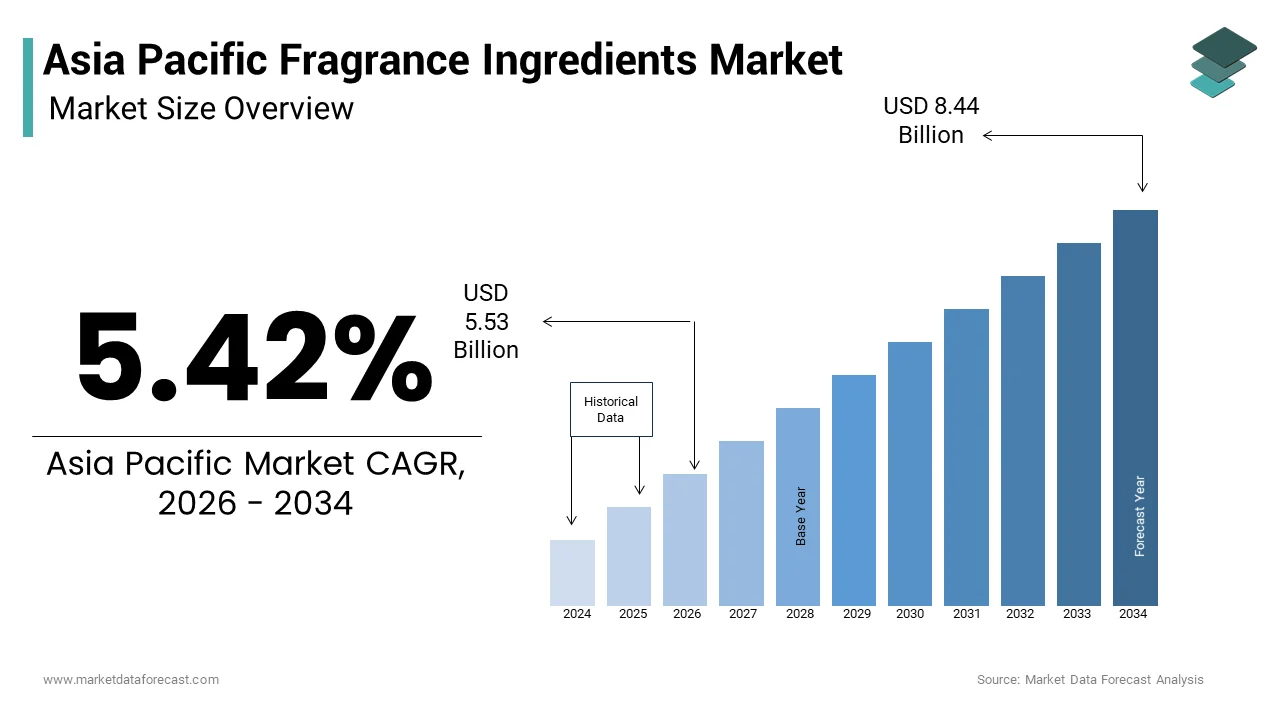
The Asia Pacific fragrance ingredients market size was valued at USD 5.25 billion in 2025 and is anticipated to reach USD 5.53 billion in 2026 from USD 8.44 billion by 2034, growing at a CAGR of 5.42% from 2026 to 2034.
MARKET OVERVIEW
The fragrance ingredients are derived from both natural sources and synthetic processes by serving as the foundational elements for perfumes, personal care products, and household cleaners. The region’s unique cultural heritage, particularly in countries like India, China, and Japan, influences the demand for specific scent profiles such as sandalwood, jasmine, and cherry blossom. According to the United Nations Department of Economic and Social Affairs, the Asia-Pacific region is home to approximately 60% of the global population, creating a vast consumer base for personal care and hygiene products that utilize fragrance ingredients. As per the World Health Organization, rising health awareness and hygiene standards post-pandemic have led to a sustained increase in the consumption of soaps, sanitizers, and detergents, all of which require significant volumes of fragrance compounds. The growing middle class in emerging economies is also driving demand for premium personal care items, further stimulating the market. Furthermore, the region is a major supplier of raw materials, with countries like Indonesia and Vietnam exporting essential oils and extracts globally.
MARKET DRIVERS
Rapid Urbanization And Rising Disposable Income In Emerging Economies
The rapid urbanization and rising disposable income in emerging economies is driving the growth of the Asia-Pacific Fragrance Ingredients Market. As millions of people move from rural areas to urban centers, their lifestyle changes lead to increased consumption of personal care and cosmetic products, which are key end users of fragrance ingredients. The demographic shift drives demand for premium grooming products, perfumes, and scented household items, as consumers seek to enhance their personal image and living environments. In countries like India and China, the per capita expenditure on personal care has increased by double digits in recent years by reflecting a growing appetite for branded and high quality products. As per the National Bureau of Statistics of China, urban residents spend significantly more on cosmetics and toiletries compared to their rural counterparts, indicating a strong correlation between urbanization and fragrance consumption. Furthermore, the influence of social media and global beauty trends has heightened awareness of fragrance as a status symbol and essential part of daily routine. Younger consumers are experimenting with diverse scent profiles, driving innovation in ingredient formulations. The availability of a wide range of affordable, yet high quality personal care products in urban retail channels further facilitates this growth.
Expansion Of The Personal Care And Cosmetics Industry In The Region
The expansion of the personal care and cosmetics industry is additionally elevating the growth of the Asia Pacific fragrance ingredients market. This sector includes skincare, haircare, oral care, and makeup products, all of which increasingly incorporate fragrances to enhance user experience and brand identity. The rise of local brands that cater to specific regional preferences has intensified competition by leading to greater innovation in product formulations and scent profiles. As per the Korea Cosmetic Industry Association, the export of Korean beauty products has grown steadily, with fragrance playing a crucial role in differentiating products in international markets. Additionally, the trend towards natural and organic personal care products has increased the demand for natural fragrance ingredients such as essential oils and plant extracts. Consumers are becoming more ingredient conscious, seeking products free from synthetic chemicals, which boosts the market for botanically derived fragrances. The proliferation of e commerce platforms has also made it easier for consumers to access a wide variety of personal care products, further driving sales. Manufacturers are responding by developing customized fragrance solutions that align with brand identities and consumer preferences.
MARKET RESTRAINTS
Stringent Regulatory Frameworks And Compliance Costs For Synthetic Ingredients
The stringent regulatory frameworks and high compliance costs for synthetic fragrance ingredients is hindering the growth of the Asia-Pacific fragrance ingredients market. The increasing adopting stricter safety standards for cosmetic and personal care products, influenced by global regulations, such as those in the European Union. The member states are harmonizing their cosmetic directives to ensure product safety, which requires manufacturers to conduct extensive testing and documentation for each ingredient. This process is time consuming and expensive, particularly for small and medium sized enterprises that lack the resources for comprehensive regulatory compliance. The new regulations require detailed safety assessments for all new cosmetic ingredients by creating barriers to entry for innovative but unproven synthetic compounds. Furthermore, certain synthetic fragrance ingredients that were previously widely used are now restricted or banned due to concerns about allergenicity and environmental impact. For instance, the use of certain musks and phthalates is being phased out in several countries, forcing manufacturers to reformulate their products. These regulatory changes require significant investment in research and development to find safer alternatives, increasing production costs. The complexity of navigating different regulatory landscapes across multiple countries in the region also adds to the operational burden.
Volatility In Raw Material Prices And Supply Chain Disruptions
The volatility in raw material prices and supply chain disruptions constitute is additionally hampering the growth of the Asia-Pacific Fragrance Ingredients Market. Many natural fragrance ingredients, such as essential oils and absolutes, are derived from agricultural crops that are susceptible to weather conditions, pests, and diseases. According to the Food and Agriculture Organization of the United Nations, climate change has led to increased frequency of extreme weather events in the region, affecting the yield and quality of aromatic plants like jasmine, rose, and sandalwood. This unpredictability causes fluctuations in supply and prices by making it difficult for manufacturers to maintain consistent production costs and profit margins. The global supply chain disruptions caused by geopolitical tensions and logistical bottlenecks have further exacerbated the situation by leading to delays in the import and export of raw materials. For synthetic ingredients, the price of petroleum based feedstocks is subject to global oil market fluctuations, adding another layer of uncertainty. Manufacturers often struggle to pass these increased costs on to consumers due to competitive market conditions, squeezing their profitability. Additionally, the reliance on single sources for certain rare ingredients creates vulnerability to supply shocks. The lack of standardized pricing mechanisms and long term contracts in the natural ingredients sector further contributes to market instability.
MARKET OPPORTUNITIES
Growing Demand For Natural And Organic Fragrance Ingredients
The growing demand for natural and organic fragrance ingredients is likely to set up new opportunity for the growth of the Asia-Pacific Fragrance Ingredients Market. Consumers are increasingly prioritizing health and wellness, leading to a preference for products with clean and transparent ingredient lists. The sales of natural and organic personal care products in the Asia-Pacific region have grown at a double digit rate in recent years by outpacing the conventional segment. As per the Soil Association, certification bodies are seeing a rise in applications for organic cosmetic standards in countries like Australia, Japan, and South Korea, indicating a formal shift towards regulated natural products. The rich biodiversity of the Asia-Pacific region offers a vast array of botanical resources that can be sourced for natural fragrances, such as lemongrass, ginger, ylang ylang, and tea tree. Local manufacturers are leveraging this advantage to develop unique scent profiles that appeal to both domestic and international markets. Brands are also marketing the story behind their natural ingredients, connecting with consumers who value authenticity and ethical sourcing. This shift towards naturality opens up new avenues for innovation and differentiation by allowing companies to capture a premium segment of the market and drive sustainable growth.
Innovation In Biotechnology And Sustainable Production Methods
The innovation in biotechnology and sustainable production methods is also to escalate the growth of the Asia-Pacific Fragrance Ingredients Market. Biotechnology enables the production of fragrance ingredients through fermentation and enzymatic processes by offering a sustainable alternative to traditional agricultural extraction and petrochemical synthesis. According to the Journal of Industrial Microbiology and Biotechnology, bio-based fragrance production can reduce carbon footprint and land use while ensuring consistent quality and supply. Companies in the region are investing in research and development to create bio identical molecules that mimic the scent of rare or endangered natural ingredients, such as oud and sandalwood, without depleting natural resources. This technological advancement aligns with the global sustainability agenda and appeals to environmentally conscious consumers and brands. Furthermore, biotechnology allows for the creation of novel scent molecules that are not found in nature, expanding the creative possibilities for perfumers. The ability to produce ingredients in a controlled laboratory environment also mitigates the risks associated with climate variability and supply chain disruptions. Government support for green chemistry and sustainable manufacturing practices further encourages the adoption of these technologies.
MARKET CHALLENGES
Counterfeiting And Intellectual Property Theft In The Supply Chain
The counterfeiting and intellectual property theft, undermining brand integrity and consumer safety, which is a major challenge for the growth of the Asia Pacific fragrance ingredient market. The region is known for its complex supply chains and varying levels of regulatory enforcement, which create opportunities for illicit trade in counterfeit fragrance ingredients and finished products. Asia is the primary source of counterfeit goods globally by including cosmetics and perfumes. Fake ingredients often contain harmful substances that can cause allergic reactions or other health issues, damaging the reputation of legitimate brands and eroding consumer trust. The lack of robust intellectual property protection laws in some countries makes it difficult for companies to prosecute infringers and protect their proprietary formulations. This issue is particularly prevalent in the online marketplace, where counterfeit products are sold at lower prices, attracting price sensitive consumers. Legitimate manufacturers face increased costs for anti counterfeiting measures, such as holographic labels and blockchain tracking, which can be burdensome for smaller players. Furthermore, the presence of counterfeit goods distorts market data and makes it difficult to assess true demand and trends. The inability to guarantee the authenticity and purity of ingredients also poses challenges for premium brands that rely on quality and exclusivity.
Environmental Concerns And Sustainability Pressures On Sourcing Practices
Environmental concerns and sustainability pressures on sourcing practices is also to limit the growth of the Asia-Pacific Fragrance Ingredients Market. The extraction of natural fragrance ingredients often involves intensive agricultural practices that can lead to deforestation, soil degradation, and water scarcity. The cultivation of certain aromatic crops has contributed to habitat loss in biodiverse regions of Southeast Asia and South Asia. Consumers and regulatory bodies are increasingly demanding proof of sustainable and ethical sourcing by putting pressure on manufacturers to adopt responsible practices. The certification schemes for sustainable agriculture are becoming more common, but compliance can be costly and complex for smallholder farmers who supply many of these raw materials. The transition to sustainable sourcing requires significant investment in training, infrastructure, and monitoring systems, which may not be feasible for all suppliers. Additionally, the carbon footprint associated with the transportation of ingredients from remote rural areas to processing facilities adds to the environmental impact. Companies face the challenge of balancing cost efficiency with sustainability goals, as eco-friendly practices often come with higher upfront costs. The lack of standardized metrics for measuring sustainability in the fragrance industry further complicates efforts to demonstrate compliance. Failure to address these environmental concerns can lead to reputational damage and loss of market share to competitors who prioritize sustainability. Navigating this complex landscape requires strategic partnerships and long term commitments to sustainable development.
REPORT COVERAGE
| REPORT METRIC | DETAILS |
| Market Size Available | 2025 to 2034 |
| Base Year | 2025 |
| Forecast Period | 2026 to 2034 |
| CAGR | 5.42% |
| Segments Covered | By Type, Application, and Region. |
| Various Analyses Covered | Global, Regional, & Country Level Analysis, Segment-Level Analysis, DROC, PESTLE Analysis, Porter’s Five Forces Analysis, Competitive Landscape, Analyst Overview on Investment Opportunities |
| Regions Covered | India, China, Japan, South Korea, Australia, New Zealand, Thailand, Malaysia, Vietnam, Philippines, Indonesia, Singapore, and the Rest of APAC |
| Market Leaders Profiled | BASF SE, Frutarom Industries Ltd., Firmenich International SA, Givaudan SA, Mane SA, International Flavors and Fragrances Inc., Robertet SA, T. Hasegawa Co. Ltd., Symrise AG, Takasago International Corp. |
COMPETITIVE LANDSCAPE
The competition in the Asia Pacific Fragrance Ingredients Market is characterized by the presence of global giants and emerging local players who strive to capture market share through innovation and regional customization. Leading international companies differentiate themselves by offering comprehensive portfolios that include both synthetic and natural ingredients along with advanced technical support. They leverage their global scale to invest heavily in research and development creating unique scent profiles that appeal to diverse cultural preferences across the region. Local players compete by offering cost effective solutions and leveraging their deep understanding of traditional botanical resources and local consumer tastes. Price competition is also significant particularly in the mass market segment where cost efficiency is crucial. Strategic acquisitions and partnerships are common as companies seek to expand their geographic reach and enhance their supply chain resilience.
KEY MARKET PLAYERS
Some of the major companies leading the Asia Pacific fragrance ingredients market share include
- BASF SE
- Frutarom Industries Ltd.
- Firmenich International SA
- Givaudan SA
- Mane SA
- International Flavors and Fragrances Inc.
- Robertet SA
- T. Hasegawa, Co., Ltd
- Symrise AG
- Takasago International Corp.
Top Players In The Market
- Givaudan maintains a robust presence in the Asia Pacific fragrance ingredients market by leveraging its extensive network of research and development centers located in key countries such as China India and Singapore. The company focuses on creating innovative scent solutions that cater to local consumer preferences while adhering to global sustainability standards. Recently Givaudan has strengthened its market position by expanding its production capabilities in the region and investing in digital tools for fragrance creation. These initiatives allow the company to respond quickly to changing market trends and customer demands. Their commitment to innovation and regional customization reinforces their leadership in the diverse and dynamic Asia Pacific market.
- Firmenich contributes significantly to the Asia Pacific fragrance ingredients market through its strong focus on sustainability and natural ingredient sourcing. The company has established strategic partnerships with local farmers in countries like Indonesia and Vietnam to secure ethical supplies of essential oils and botanical extracts. Recently Firmenich has enhanced its market position by launching new bio based fragrance ingredients that align with the growing demand for clean and eco friendly products. The company also invests in advanced technologies to improve the efficiency and consistency of its production processes. Their proactive approach to sustainability and innovation ensures they remain a preferred partner for personal care and home care manufacturers in the Asia Pacific region.
- Symrise plays a vital role in the Asia Pacific fragrance ingredients market by offering a diverse portfolio of synthetic and natural aroma chemicals. The company emphasizes close collaboration with customers to develop customized fragrance solutions that meet specific regional tastes and regulatory requirements. Recently Symrise has strengthened its position by expanding its manufacturing facilities in China and enhancing its logistics network to ensure timely delivery of products. The company also focuses on research and development to create novel scent molecules that offer unique olfactory experiences. Their dedication to quality innovation and customer centricity enables Symrise to maintain a competitive edge and drive growth in the rapidly evolving Asia Pacific fragrance industry.
Top Strategies Used By Key Market Participants
Key players in the Asia Pacific Fragrance Ingredients Market primarily employ strategies focused on sustainable sourcing and technological innovation to strengthen their competitive position. Companies are increasingly investing in ethical supply chains to secure natural raw materials while minimizing environmental impact. This approach appeals to environmentally conscious consumers and brands seeking transparency. Additionally, manufacturers are leveraging advanced biotechnology to create bio based fragrance alternatives that reduce reliance on petrochemicals. Strategic partnerships with local suppliers and research institutions facilitate access to unique regional ingredients and expertise. Digitalization is another major strategy with firms using artificial intelligence and data analytics to predict trends and accelerate product development. Expansion of production facilities in key markets like China and India ensures closer proximity to customers and faster response times. These combined efforts enable key participants to address the diverse needs of the Asia Pacific market while driving sustainable growth and innovation in the fragrance industry.
MARKET SEGMENTATION
This research report on the Asia-Pacific Fragrance Ingredients Market is segmented and sub-segmented into the following categories.
By Type
- Aroma chemicals
- Terpenes
- Benzenoids
- Musk Chemicals
- Essentials oils
- Orange
- Mentha Arvensis
- Eucalyptus
- Cedarwood
- Citronella
By Application
- Fine Fragrances
- Cosmetics & toiletries
- Soaps & Detergents
By Country
- India
- China
- Japan
- South Korea
- Australia
- New Zealand
- Thailand
- Malaysia
- Vietnam
- Philippines
- Indonesia
- Singapore
- Rest of APAC