- Product Description Description
- Table of Contents TOC
- List of Table & Figure LOT
- Get Free Sample PDF Sample PDF
Asia Pacific Frozen Fruits and Vegetables Market Size
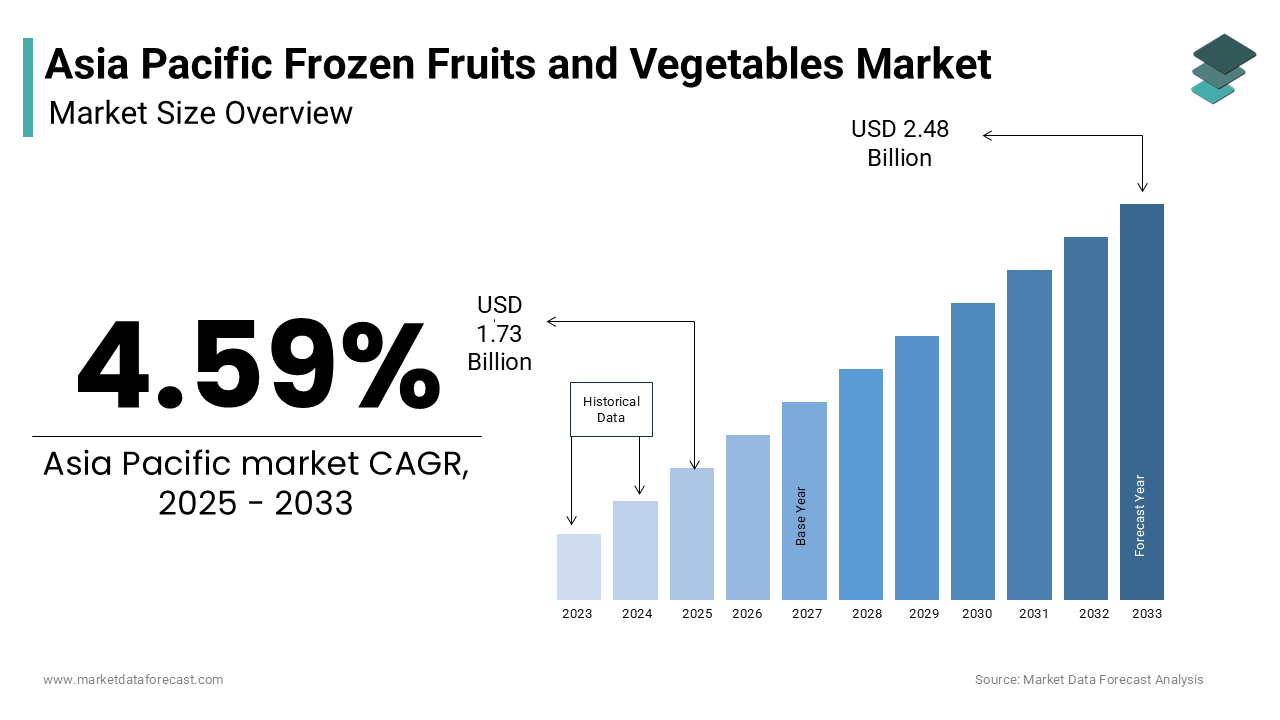
The Asia Pacific Frozen Fruits and Vegetables Market was worth USD 1.65 billion in 2024. The Asia Pacific market is expected to reach USD 2.48 billion by 2033 from USD 1.73 billion in 2025, rising at a CAGR of 4.59% from 2025 to 2033.
The frozen fruits and vegetables plays a crucial role in bridging seasonal supply gaps, thereby reducing food waste, and catering to the rising demand for convenience foods across urban and semi-urban populations. In recent years, changing dietary habits, rapid urbanization, and increased cold chain infrastructure have significantly contributed to market expansion. According to the Food and Agriculture Organization (FAO), Asia accounts for over 40% of global vegetable production, with countries like China and India leading in both cultivation and export volumes. Advances in quick-freezing technologies such as Individual Quick Freezing (IQF) have enhanced product quality and consumer acceptance. Additionally, growing health consciousness among consumers has led to increased inclusion of frozen fruits in smoothies, yogurts, and ready-to-eat meals, especially in metropolitan centers across Australia, Japan, and South Korea. As per data from the United Nations Environment Programme (UNEP), nearly one-third of all food produced globally is wasted, and frozen foods provide a sustainable alternative by preserving surplus harvests and minimizing post-harvest losses.
MARKET DRIVERS
The expansion of organized retail and e-commerce platforms , which have transformed the way consumers purchase groceries is prompting the growth of the Asia Pacific fruits and vegetables market. The proliferation of hypermarkets, supermarkets, and online delivery services has made frozen produce more accessible to a broader consumer base. In countries like China, India, and Singapore, major players such as Alibaba, Reliance Retail, and Woolworths have invested heavily in refrigerated logistics and digital ordering systems, enabling seamless delivery of frozen food products directly to consumers' homes. According to McKinsey & Company, e-commerce penetration in grocery retail across Asia is expected to double by 2030, driven largely by younger demographics who prioritize convenience and variety. Moreover, modern retail formats ensure consistent stock availability, better temperature control during storage, and improved packaging that preserves product integrity. These factors collectively enhance consumer confidence in frozen produce, encouraging greater adoption across diverse income groups and geographic regions. The integration of mobile payment systems and AI-driven recommendations further streamlines the purchasing process by reinforcing the long-term growth trajectory of the frozen fruits and vegetables segment.
Another significant driver of the Asia Pacific frozen fruits and vegetables market is the growing awareness of nutrition and healthy eating habits among the urban working population and fitness-conscious individuals. Consumers are actively seeking healthier food options that align with their wellness goals with rising disposable incomes and increasing prevalence of lifestyle-related diseases such as obesity and diabetes. Frozen fruits and vegetables are perceived as viable alternatives to fresh produce due to their ability to retain nutrients for longer periods without the need for preservatives. As per the World Health Organization (WHO), non-communicable diseases account for over 60% of total deaths in the Asia Pacific region, which is prompting governments to launch public health campaigns promoting fruit and vegetable consumption. Schools, hospitals, and corporate cafeterias are integrating frozen produce into daily meal plans to ensure year-round availability of essential vitamins and minerals. Notably, frozen berries and green leafy vegetables have gained popularity in smoothie bowls, plant-based diets, and gluten-free recipes, especially in Japan and Australia. Additionally, improvements in freezing techniques have minimized nutrient loss, enhancing consumer trust in frozen food quality and contributing to sustained market expansion.
MARKET RESTRAINTS
One of the primary restraints hindering the Asia Pacific frozen fruits and vegetables market is the persistent perception that frozen produce is inferior to fresh counterparts in terms of taste and nutritional value. Despite technological advancements in freezing methods such as blast freezing and IQF (Individual Quick Freezing), many consumers in rural and semi-urban areas continue to associate frozen foods with artificial additives and diminished sensory attributes. Traditional cooking cultures in countries like Indonesia and Vietnam emphasize the use of freshly harvested ingredients, making it challenging to shift consumer behavior toward frozen alternatives. According to the International Food Policy Research Institute (IFPRI), nearly half of Asian consumers still prefer sourcing fruits and vegetables from local wet markets due to freshness concerns and lower price points. Moreover, limited awareness about the benefits of frozen foods—such as reduced pesticide exposure, minimal spoilage, and nutrient retention—has slowed adoption in key demographic segments. Educational campaigns and in-store sampling initiatives have been relatively slow compared to other regions like North America and Europe, where frozen food consumption is more normalized. Without targeted efforts to change consumer perceptions and highlight the advantages of frozen produce, growth may remain constrained in certain parts of the Asia Pacific region.
Another critical restraint affecting the Asia Pacific frozen fruits and vegetables market is the high cost of cold chain infrastructure and logistical complexities in developing economies. Maintaining optimal temperature conditions throughout the supply chain from harvesting and processing to transportation and retail display is essential for preserving product quality and safety. However, in many parts of Southeast Asia and South Asia, inadequate refrigeration facilities, unreliable power supply, and underdeveloped transport networks pose significant challenges to efficient distribution. According to the Asian Development Bank (ADB), nearly 30% of perishable agricultural produce in the region is lost due to inefficient cold storage systems. These inefficiencies not only increase operational costs for manufacturers but also limit market access in remote and rural areas. Additionally, the capital investment required to establish and maintain cold storage, freezers, and refrigerated transport remains prohibitively high for small and medium-sized enterprises (SMEs). In countries like the Philippines and Bangladesh, where last-mile delivery is fragmented, maintaining product consistency and minimizing thawing episodes becomes even more difficult. Until there is substantial government and private sector investment in upgrading cold chain infrastructure, the growth of the frozen fruits and vegetables market will continue to face structural limitations across the APAC region.
MARKET OPPORTUNITIES
One of the major opportunities driving the Asia Pacific frozen fruits and vegetables market is the rising demand for plant-based and vegan diets, which has created new avenues for frozen produce applications. Consumers across the region are increasingly shifting toward plant-forward eating habits driven by health considerations, environmental sustainability, and ethical concerns regarding animal welfare. Frozen fruits and vegetables play a central role in this movement by serving as foundational ingredients in plant-based meals, meat substitutes, and dairy alternatives. According to the Good Food Institute, the Asia Pacific region accounted for almost 40% of global plant-based food investments in 2023, with startups in Singapore, India, and Australia introducing innovative frozen plant-based products tailored to local tastes. In particular, frozen legumes, mushrooms, jackfruit, and berries are being extensively used in vegan burgers, protein bowls, and frozen entrees. Supermarkets and specialty stores are expanding their frozen aisles to accommodate these offerings, while foodservice chains are incorporating frozen plant-based ingredients into their menus to cater to evolving consumer preferences. Governments in several APAC countries are also supporting the shift toward sustainable food systems through policy incentives and research funding that is accelerating the integration of frozen fruits and vegetables into mainstream diets.
Another significant opportunity emerging in the Asia Pacific frozen fruits and vegetables market is the growing utilization of frozen produce in the foodservice and hospitality industry in quick-service restaurants (QSRs), cloud kitchens, and institutional catering. According to Euromonitor International, QSR chains in Thailand, Malaysia, and South Korea have reported a notable uptick in menu items featuring frozen fruits and vegetables, which range from smoothies and pancakes to vegetable stir-fries and soups. Cloud kitchens, which operate without dine-in facilities and focus solely on delivery, benefit from the convenience and space-saving aspects of frozen inventory management. Additionally, hotels and airlines are adopting standardized frozen produce to ensure uniformity across regional outlets and reduce dependency on seasonal availability. This trend is further supported by innovations in flash freezing technologies that preserve the integrity of delicate fruits and vegetables, making them suitable for gourmet applications.
MARKET CHALLENGES
One of the major challenges facing the Asia Pacific frozen fruits and vegetables market is the volatility in raw material supply and agricultural output, influenced by climatic fluctuations, pest infestations, and regulatory policies. Extreme weather events such as typhoons, monsoons, and droughts have disrupted farming cycles in key producing regions like China, India, and Vietnam, leading to inconsistent yields and fluctuating prices. According to the Intergovernmental Panel on Climate Change (IPCC), climate variability has intensified over the past decade, impacting crop productivity and threatening the stability of frozen food supply chains. Additionally, geopolitical tensions and trade restrictions on agricultural exports further complicate procurement strategies for manufacturers reliant on specific fruits or vegetables. For instance, sudden export bans on tropical fruits from Thailand or chili peppers from India can disrupt processing schedules and delay product launches. Furthermore, the reliance on seasonal crops means that frozen food producers must manage inventory carefully to avoid shortages during off-seasons. Unless robust contingency planning and vertical integration measures are adopted, the frozen fruits and vegetables sector may face recurrent supply-side pressures that hinder its growth potential across the Asia Pacific region.
Another pressing challenge confronting the Asia Pacific frozen fruits and vegetables market is the stringent and often inconsistent food safety regulations across different countries which create compliance hurdles for manufacturers and importers. Each country in the region maintains its own set of food safety standards, labeling requirements, and permissible additive limits, necessitating customized formulations and packaging solutions for each market. According to the ASEAN Economic Community’s Food Safety and Standards Working Group, harmonizing food regulations across member states has proven difficult due to differing national priorities and enforcement capacities. For example, Australia and New Zealand follow closely aligned regulations under FSANZ, whereas India and Indonesia have distinct approval processes for food additives and preservatives. These discrepancies increase time-to-market and operational complexity, especially for multinational companies that are aiming to scale their frozen food offerings across multiple APAC countries. Additionally, traceability requirements and mandatory inspections at borders add to the logistical burden, increasing costs and delaying product availability.
REGIONAL ANALYSIS
China accounted for holding 31.2% of the Asia Pacific frozen fruits and vegetables market, driven by its vast agricultural output, strong domestic demand, and export-oriented processing sector. The country is one of the world's top producers of vegetables and tropical fruits, many of which are converted into frozen forms for both local consumption and international markets.
According to the Ministry of Agriculture and Rural Affairs, China exported over 1.2 million metric tons of frozen vegetables in 2023, with the U.S., Japan, and ASEAN countries being major buyers. Domestic demand is equally robust, particularly in urban areas where home cooking trends and restrictive dining regulations post-pandemic have increased reliance on frozen alternatives. The government's emphasis on smart agriculture and food security has led to greater investments in freezing technologies and cold logistics development, supporting market expansion.
India was next with 19.2% of the Asia Pacific frozen fruits and vegetables market share, with the rising health consciousness, changing food habits, and a growing export demand for value-added agri-products. The country ranks among the top five producers of fruits and vegetables globally but historically faced significant post-harvest losses due to inadequate storage infrastructure.
As reported by the Indian Council of Agricultural Research, nearly 16% of horticultural produce in India goes to waste annually due to poor handling and preservation methods. To address this, the Ministry of Food Processing Industries launched several incentive schemes under the Pradhan Mantri Kisan Sampada Yojana by encouraging private investment in cold storage and freezing units. This policy push has enabled processors to scale operations and meet both domestic and international standards. Simultaneously, the rise of dual-income households and busy lifestyles has spurred demand for ready-to-use frozen vegetables among urban consumers. Companies like Jain Irrigation Systems and Godrej Agrovet have expanded their frozen produce portfolios to cater to this demographic shift.
Japan frozen fruits and vegetables market growth is driven by its high-quality food processing standards, aging population, and extensive integration of frozen ingredients in daily meals. Japanese consumers place a strong emphasis on food safety, consistency, and convenience, which attributes that frozen produce effectively delivers.
According to the Japan Frozen Food Association, domestic frozen food consumption reached over JPY 1.2 trillion (~USD 8 billion) in 2023, with frozen vegetables accounting for nearly half of total sales. Traditional dishes like oden and sukiyaki increasingly utilize pre-cut frozen vegetables, while frozen fruits are commonly used in bakery and confectionery applications. The country’s advanced cold chain logistics and supermarket culture further support seamless product distribution.
Additionally, Japan imports significant volumes of exotic fruits and berries from North and South America, refreezing and repackaging them for local sale and re-export to neighboring Asian markets. The presence of major players like Nichirei Corporation and Maruha Nichiro enhances domestic production capacity and innovation.
Australia and New Zealand are growing lucratively in the Asia Pacific frozen fruits and vegetables market, characterized by steady consumer demand for premium frozen produce and a highly regulated food safety environment. Both countries emphasize clean-label products and traceability, making frozen fruits and vegetables a preferred choice among health-conscious consumers.
South Korea frozen fruits and vegetables market growth is likely to be driven by evolving dietary patterns, expanding convenience food culture, and a thriving foodservice sector. Korean consumers exhibit a strong preference for imported frozen fruits and locally processed vegetables, particularly in ready-to-cook and meal-in-a-box formats. Government-led initiatives promoting food technology startups and frozen food standardization have encouraged domestic manufacturers to innovate and scale production. Moreover, the rise of OTG (oven-to-go) meals and microwaveable dishes has intensified the need for high-quality frozen ingredients. Supported by rising disposable incomes and expanding online retail channels, South Korea continues to play a pivotal role in shaping the frozen food dynamics of the APAC region.
KEY MARKET PLAYERS AND COMPETITIVE LANDSCAPE
Dole Food Company, Ardo NV, General Mills Inc., Nestlé S.A., Conagra Brands Inc., Del Monte Pacific Ltd., Bonduelle Group, Pinnacle Foods Inc., Greenyard NV, and Simplot Australia Pty Ltd. are some of the key market players in the Asia Pacific frozen fruits and vegetables market.
The Asia Pacific frozen fruits and vegetables market is characterized by intense competition driven by the convergence of global giants, regional leaders, and agile startups vying for market share. While multinational corporations leverage established supply chains and brand recognition, local enterprises capitalize on indigenous knowledge, cost advantages, and proximity to raw materials. This dynamic environment fosters continuous innovation in product development, packaging formats, and distribution mechanisms to match evolving consumer expectations.
A key battleground lies in differentiating offerings based on quality, nutritional retention, and environmental impact. Consumers are increasingly selective about ingredient transparency and sustainability, prompting brands to adopt eco-friendly practices such as renewable energy-powered freezing, biodegradable packaging, and carbon-neutral transport. Moreover, the rise of health-conscious eating habits has intensified the race to introduce functional frozen products enriched with vitamins, probiotics, or plant-based proteins.
Competition is further shaped by government policies, trade agreements, and investment in cold chain infrastructure, which influence market access and operational efficiency. Companies that can swiftly adapt to regulatory changes, technological advancements, and shifting dietary patterns will be better positioned to thrive in this rapidly evolving landscape.
Top Players in the Asia Pacific Frozen Fruits and Vegetables Market
Nichirei Corporation
Nichirei Corporation is a leading Japanese player in the frozen food industry with a strong presence across the Asia Pacific region. The company is known for its premium-quality frozen fruits, vegetables, seafood, and ready-to-eat meals. Nichirei’s commitment to product innovation, traceability, and cold chain efficiency has positioned it as a trusted supplier in both retail and foodservice sectors. Its focus on sustainable sourcing and advanced freezing technologies ensures minimal nutrient loss while preserving texture and flavor.
Olam International
Olam International, headquartered in Singapore, plays a vital role in the frozen fruits and vegetables supply chain across Asia. As a global agri-business, Olam leverages its extensive sourcing network to provide high-quality frozen produce tailored to regional tastes and dietary preferences. The company emphasizes vertical integration, ensuring control from farm to freezer, and supports customers through flexible packaging solutions and value-added processing. Its strategic partnerships enhance market reach and responsiveness to evolving consumer demands.
Cargill Incorporated
Cargill operates extensively in the Asia Pacific frozen foods sector by supplying ingredients, processed produce, and customized formulations to manufacturers and foodservice providers. With a focus on food safety, sustainability, and operational excellence, Cargill strengthens its position by integrating technology into freezing and storage systems. The company collaborates with local growers and processors to ensure consistent supply and quality, which are catering to both domestic and export markets across emerging economies in Southeast Asia and Oceania.
Top Strategies Used by Key Market Participants
Key players in the Asia Pacific frozen fruits and vegetables market are employing several strategic initiatives to reinforce their competitive standing. One of the primary approaches involves product diversification and customization, where companies develop region-specific frozen blends that align with local culinary traditions and health trends. This includes introducing organic, non-GMO, and allergen-free options to meet the rising demand for clean-label products.
Another critical strategy is expanding manufacturing and cold storage capacities, particularly in emerging markets where infrastructure development is accelerating. Additionally, strengthening digital engagement and e-commerce presence has become imperative for reaching urban consumers who prefer online grocery shopping. Companies are optimizing digital platforms, offering home delivery solutions, and leveraging data analytics to understand purchasing behaviors and tailor promotional efforts effectively.
RECENT MARKET DEVELOPMENTS
- In February 2024, Nichirei Corporation launched a new line of individually quick-frozen (IQF) tropical fruit blends targeting the Australian and Southeast Asian markets. This initiative was aimed at expanding its footprint in the premium frozen fruit category and meeting the rising demand for smoothie-ready products among health-conscious consumers.
- In May 2023, Olam International partnered with an Indonesian farmer cooperative to establish a dedicated freezing facility near major agricultural zones. This collaboration was designed to improve post-harvest management and provide farmers with direct access to international frozen food markets, strengthening supply chain resilience and product quality.
- In November 2024, Cargill Incorporated announced the expansion of its cold storage infrastructure in India by setting up two temperature-controlled warehouses in Gujarat and Tamil Nadu. This move enabled the company to serve large-scale food processors and exporters more efficiently while reducing losses due to spoilage.
- In September 2023, Thai Union Group entered the frozen vegetable segment by acquiring a majority stake in a Vietnamese processor specializing in organic frozen greens. This acquisition allowed Thai Union to diversify beyond seafood and enter the fast-growing plant-based frozen food space in Southeast Asia.
- In January 2024, Woolworths Australia collaborated with a local frozen produce supplier to launch a private-label range of locally sourced and sustainably packaged frozen vegetables. This initiative supported Woolworths’ broader commitment to promoting convenience and nutrition through accessible frozen alternatives.
MARKET SEGMENTATION
This research report on the Asia Pacific cloud analytics market is segmented and sub-segmented into the following categories.
By Product Types
- Frozen Fruits
- Frozen Vegetables
By Distribution Channel
- Supermarkets and Hypermarkets
- Independent Retailers
- Convenience Stores
- Online
- Others
By Country
- India
- China
- Japan
- South Korea
- Australia
- New Zealand
- Thailand
- Malaysia
- Vietnam
- Philippines
- Indonesia
- Singapore
- Rest of APAC