- Product Description Description
- Table of Contents TOC
- List of Table & Figure LOT
- Get Free Sample PDF Sample PDF
Asia Pacific Fruit Powders Market Size
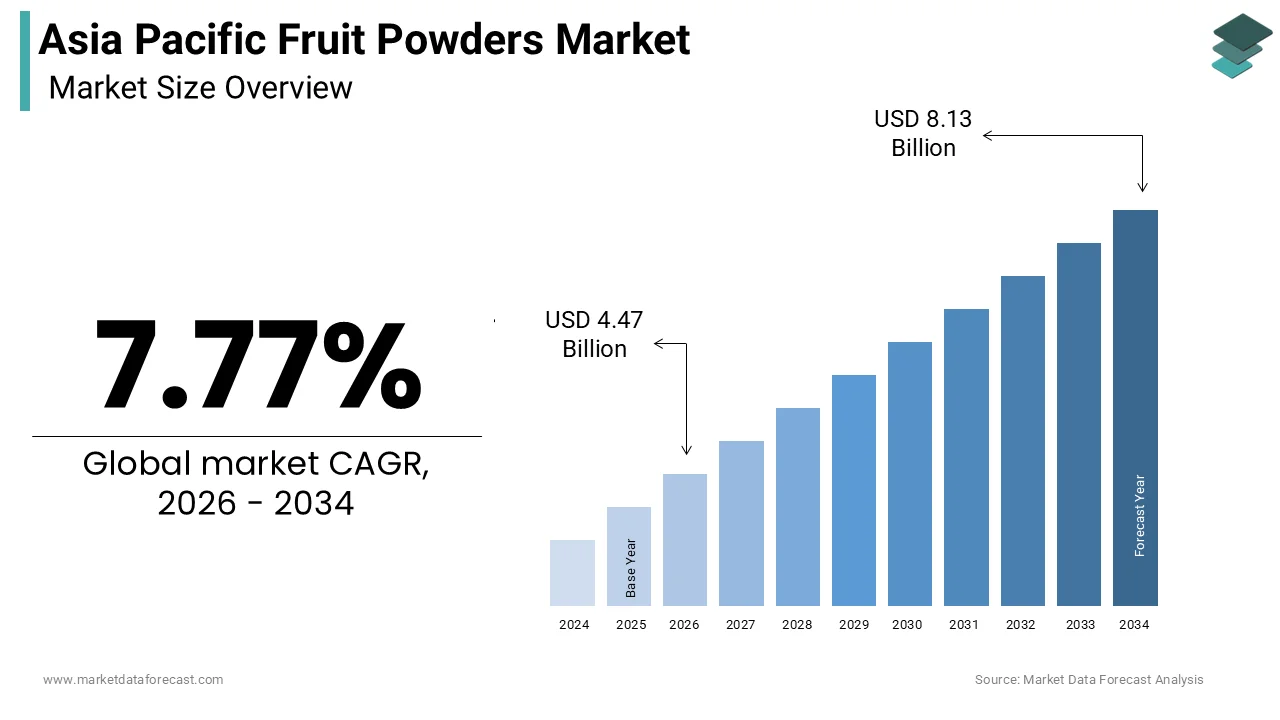
The Asia Pacific Fruit Powders Market size was calculated to be USD 4.15 billion in 2025 and is anticipated to be worth USD 8.13 billion by 2034, from USD 4.47 billion in 2026, growing at a CAGR of 7.77% during the forecast period.
Fruit powders are made by freeze drying and vacuum processing method. They are available at organic markets and health food stores. Fruits have more water content, henceforth it is concentrated and excess water has to be removed, demineralized which is then spray-dried to produce free flowing powder. Fruit powders are used as ingredients for cooking or as flavouring agents. At ambient temperature they have long shelf lives because of the low water activity along with low logistic expenditure because of low weight and volume. They are produced from either freeze drying or spray drying process. They consist of sun-dried or freeze-dried which is ground into powder, lacking supplementary additives which contain similar calories as raw fruit. They contain no preservatives or artificial colours however low-fat and sodium amounts are present. They are mostly used in beverages and vitamin enhanced formulas and supplements. They are convenient to incorporate in pharmaceutical formulations such as tablets, capsules or soft gels.
Market Drivers
Primary drivers of this market are increasing demand for variety of fruit powders health drinks which contains high amount of vitamins and minerals along with antioxidants. The fruit powders market is projected to have growth potential in emerging and developed economies because of consumer preference towards health drinks coupled with variety of fruit flavours in the drinks. Fruit powders are suitable and economical substitute to fresh fruits in numerous applications. The usage of fruit powders in infant formulas is growing robustly because of consumer preference towards fruit flavoured infant formula that also provides essential vitamins and minerals for infants. Apart from growing usage of fruit powders in various industries and economic potential by increased fruit production in the market, the Asia Pacific fruit powders market is likely to observe steady growth over the aforementioned forecast period.
Market Restraints
Adulteration in making these powders in order to reduce the cost along with addition of artificial colour are the primary restraints of this market.
Segmental Analysis
Asia Pacific Fruit Powders Market By Application
- Infant formula
- Smoothies
- Instant food products
- Beverage premixes
- Supplemental liquids
- Desserts
In beverages such as fruit drinks, energy drinks and carbonated drinks, confectionery such as chocolates, and biscuits, bakery products such as cakes, bread and bread products and candy in pharmaceuticals such as tablets, soft gels and capsules, and dairy products such as yogurt, flavoured milk, cheese and butter. Hence, the Asia Pacific fruit powders market is estimated to significantly increase the revenue contribution over the aforementioned forecast period.
Asia Pacific Fruit Powders Market By Fruit Type
- Apple
- Orange
- Lemon
- Pineapple
- Grapes
- Banana
- Peas
- specialty fruits
- Blueberry
- Cranberry
- Others ( mango, pomegranate, and watermelon)
Regional Analysis
On the basis of geography, the Asia Pacific fruit powders industry can be segmented into India, China, Korea, Japan and others. Asia Pacific has developed as the leading region in fruit powders market. Growing utilization of fruit powders in meat industry along with growing demand for natural colorants, has strengthened the growth of Asia Pacific fruit powders market and thus is estimated to significantly increase the revenue contribution of the market over the aforementioned forecast period.
Key Players in the Market
Some of the major players identified across the value chain of the Asia Pacific fruit powders market include La Herbal (India), Kanegrade Limited, Saipro Biotech Pvt. Ltd, Kamdhenu Foods, NutraDry, Batory Foods, Farmvilla, Aum Agri Freeze Foods, SVagrofood, NutriBotanica, AARKAY FOOD PRODUCTS LTD and The Green Labs LLC.